Evaluating Unsupervised Part-of-Speech Tagging for Grammar Induction
William P. Headden III, David McClosky, Eugene Charniak Brown Laboratory for Linguistic Information Processing (BLLIP)
Brown University Providence, RI 02912
{headdenw,dmcc,ec}@cs.brown.edu
Abstract
This paper explores the relationship be-tween various measures of unsupervised part-of-speech tag induction and the per-formance of both supervised and unsuper-vised parsing models trained on induced tags. We find that no standard tagging metrics correlate well with unsupervised parsing performance, and several metrics grounded in information theory have no strong relationship with even supervised parsing performance.
1 Introduction
There has been a great deal of recent interest in the unsupervised discovery of syntactic structure from text, both parts-of-speech (Johnson, 2007; Goldwater and Griffiths, 2007; Biemann, 2006; Dasgupta and Ng, 2007) and deeper grammatical structure like constituency and dependency trees (Klein and Manning, 2004; Smith, 2006; Bod, 2006; Seginer, 2007; Van Zaanen, 2001). While some grammar induction systems operate on raw text, many of the most successful ones presume prior part-of-speech tagging. Meanwhile, most re-cent work in part-of-speech induction focuses on increasing the degree to which their tags match hand-annotated ones such as those in the Penn Treebank.
In this work our goal is to evaluate how im-provements in part-of-speech tag induction affects grammar induction. Using several different unsu-pervised taggers, we induce tags and train three grammar induction systems on the results.
c
2008. Licensed under the Creative Commons
Attribution-Noncommercial-Share Alike 3.0 Unported
li-cense (http://creativecommons.org/licenses/by-nc-sa/3.0/). Some rights reserved.
We then explore the relationship between the performance on common unsupervised tagging metrics and the performance of resulting grammar induction systems. Disconcertingly we find that they bear little to no relationship.
This paper is organized as follows. In Section 2 we discuss unsupervised part-of-speech induction systems and common methods of evaluation. In Section 3, we describe grammar induction in gen-eral and discuss the systems with which we evalu-ate taggings. We present our experiments in Sec-tion 4, and finally conclude in SecSec-tion 5.
2 Part-of-speech Tag Induction
Part-of-speech tag induction can be thought of as a clustering problem where, given a corpus of words, we aim to group word tokens into syntactic classes. Two tasks are commonly labeled unsupervised part-of-speech induction. In the first, tag induction systems are allowed the use of a tagging dictionary, which specifies for each word a set of possible parts-of-speech (Merialdo, 1994; Smith and Eis-ner, 2005; Goldwater and Griffiths, 2007). In the second, only the word tokens and sentence bound-aries are given. In this work we focus on this latter task to explore grammar induction in a maximally unsupervised context.
Tag induction systems typically focus on two sorts of features: distributional and morphologi-cal. Distributional refers to what sorts of words appear in close proximity to the word in question, while morphological refers to modeling the inter-nal structure of a word. All the systems below make use of distributional information, whereas only two use morphological features.
We primarily focus on the metrics used to evalu-ate induced taggings. The catalogue of recent part-of-speech systems is large, and we can only test
the tagging metrics using a few systems. Recent work that we do not explore explicitly includes (Biemann, 2006; Dasgupta and Ng, 2007; Freitag, 2004; Smith and Eisner, 2005). We have selected a few systems, described below, that represent a broad range of features and techniques to make our evaluation of the metrics as broad as possible.
2.1 Clustering using SVD and K-means
Sch¨utze (1995) presents a series of part-of-speech inducers based on distributional clustering. We implement the baseline system, which Klein and Manning (2002) use for their grammar induction experiments with induced part-of-speech tags. For each word typewin the vocabularyV, the system forms a feature row vector consisting of the num-ber of times each of theF most frequent words oc-cur to the left ofwand to the right ofw. It normal-izes these row vectors and assembles them into a |V|×2F matrix. It then performs a Singular Value Decomposition on the matrix and rank reduces it to decrease its dimensionality to dprinciple compo-nents (d < 2F). This results in a representation of each word as a point in addimensional space. We follow Klein and Manning (2002) in using K-means to cluster the ddimensional word vectors into parts-of-speech. We use the F = 500 most frequent words as left and right context features, and reduce to a dimensionality ofd= 50. We re-fer to this system as SVD in our experiments.
The other systems described in Sch¨utze (1995) make use of more complicated feature models. We chose the baseline system primarily to match pre-vious evaluations of grammar induction using in-duced tags (Klein and Manning, 2002).
2.2 Hidden Markov Models
One simple family of models for part-of-speech in-duction are the Hidden Markov Models (HMMs), in which there is a sequence of hidden state vari-ablest1...tn(for us, the part-of-speech tags). Each stateti is conditioned on the previousn−1states
ti−1...ti−n+1, and everytiemits an observed word
wi conditioned onti. There is a single start state
that emits nothing, as well as a single stop state, which emits an end-of-sentence marker with prob-ability 1 and does not transition further. In our ex-periments we use the bitag HMM, in which each statetidepends only on stateti−1.
The classic method of training HMMs for part-of-speech induction is the Baum-Welch (Baum, 1972) variant of the Expectation-Maximization
(EM) algorithm, which searches for a local max-imum in the likelihood of the observed words.
Other methods approach the problem from a Bayesian perspective. These methods place Dirichlet priors over the parameters of each transi-tion and emission multinomial. For an HMM with a set of statesT and a set of output symbolsV:
∀t∈T θt ∼ Dir(α1, ...α|T|) (1)
∀t∈T ηt ∼ Dir(β1, ...β|V|) (2)
ti|ti−1, θti−1 ∼ Multi(θti−1) (3) wi|ti, ηti ∼ Multi(ηti) (4)
One advantage of the Bayesian approach is that the prior allows us to bias learning toward sparser structures, by setting the Dirichlet hyperparame-ters α, β to a value less than one (Johnson, 2007; Goldwater and Griffiths, 2007). This increases the probability of multinomial distributions which put most of their mass on a few events, instead of dis-tributing them broadly across many events. There is evidence that this leads to better performance on some part-of-speech induction metrics (John-son, 2007; Goldwater and Griffiths, 2007).
There are both MCMC and variational ap-proaches to estimating HMMs with sparse Dirich-let priors; we chose the latter (Variational Bayes or VB) due to its simple implementation as a minor modification to Baum-Welch. Johnson (2007) evaluates both estimation techniques on the Bayesian bitag model; Goldwater and Griffiths (2007) emphasize the advantage in the MCMC ap-proach of integrating out the HMM parameters in a tritag model, yielding a tagging supported by many different parameter settings.
Following the setup in Johnson (2007), we ini-tialize the transition and emission distributions to be uniform with a small amount of noise, and run EM and VB for 1000 iterations. We label these systems as HMM-EM and HMM-VB respectively in our experiments. In our VB experiments we set
αi =βj = 0.1,∀i∈ {1, ...,|T|}, j ∈ {1, ...,|V|}, which yielded the best performance on most re-ported metrics in Johnson (2007). We use max-imum marginal decoding, which Johnson (2007) reports performs better than Viterbi decoding.
2.3 Systems with Morphology
implementation found on his website.1
2.3.1 Ney-Essen with Morphology
The simplest model is based on work by (Ney et al., 1994). It uses a bitag HMM, with the restric-tion that each word type in the vocabulary can only be generated by a single part-of-speech. Thus the tag induction task here reduces to finding a multi-way partition of the vocabulary. The learning al-gorithm greedily reassigns each word type to the part-of-speech that results in the greatest increase in likelihood.
In order to incorporate morphology, Clark (2003) associates with each part-of-speech a HMM with letter emissions. The vocabulary is gener-ated by generating a series of word types from the letter HMM of each part-of-speech. These can model very basic concatenative morphology. The parameters of the HMMs are estimated by running a single iteration of Forward-Backward after each round of reassigning words to tags. In our exper-iments we evaluate both the model without mor-phology (NE in our experiments), and the morpho-logical model, trying both 5 and 10 states in the let-ter HMM (NEMorph5, NEMorph10 respectively).
2.3.2 Two-Level HMM
The final part-of-speech inducer we try from Clark (2003) is a two-level HMM. This is similar to the previous model, except it lifts the restriction that a word appear under only one part-of-speech. Alternatively, one could think of this model as a standard HMM, whose emission distributions in-corporate a mixture of a letter HMM and a stan-dard multinomial. Training uses a simple variation of Forward-Backward. In the experiments in this paper, we initialize the mixture parameters to .5, and try 5 states in the letter HMM. We refer to this model as 2HMM.
2.4 Tag Evaluation
Objective evaluation in any clustering task is al-ways difficult, since there are many al-ways to de-fine good clusters. Typically it involves a mix-ture of subjective evaluation and a comparison of the clusters to those found by human annotators. In the realm of part-of-speech induction, there are several common ways of doing the latter. These split into two groups: accuracy and information-theoretic criteria.
1
http://www.cs.rhul.ac.uk/home/alexc/pos.tar.gz
Accuracy, given some mapping between the set of induced classes and the gold standard labels, is the number of words in the corpus that have been marked with the correct gold label divided by the total number of word tokens. The main challenge facing these metrics is deciding how to to map each induced part-of-speech class to a gold tag. One option is what Johnson (2007) calls “many-to-one” (M-to-1) accuracy, in which each induced tag is labeled with its most frequent gold tag. Although this results in a situation where multiple induced tags may share a single gold tag, it does not punish a system for providing tags of a finer granularity than the gold standard.
In contrast, “one-to-one” (1-to-1) accuracy re-stricts each gold tag to having a single induced tag. The mapping typically is made to try to give the most favorable mapping in terms of accuracy, typically using a greedy assignment (Haghighi and Klein, 2006). In cases where the number of gold tags is different than the number of induced tags, some must necessarily remain unassigned (John-son, 2007).
In addition to accuracy, there are several infor-mation theoretic criteria presented in the literature. These escape the problem of trying to find an ap-propriate mapping between induced and gold tags, at the expense of perhaps being less intuitive.
Let TI be the tag assignments to the words in the corpus created by an unsupervised tag-ger, and let TG be the gold standard tag as-signments. Clark (2003) uses Shannon’s condi-tional entropy of the gold tagging given the in-duced tagging H(TG|TI). Lower entropy indi-cates less uncertainty in the gold tagging if we al-ready know the induced tagging. Freitag (2004) uses the similar “cluster-conditional tag perplex-ity” which is merely exp(H(TG|TI))2. Since cluster-conditional tag perplexity is a monotonic function ofH(TG|TI), we only report the latter.
Goldwater and Griffiths (2007) propose using the Variation of Information of Meilˇa (2003):
V I(TG;TI) =H(TG|TI) +H(TI|TG)
VI represents the change in information when go-ing from one clustergo-ing to another. It holds the nice properties of being nonnegative, symmetric, as well as fulfilling the triangle inequality.
2Freitag (2004) measures entropy in nats, while we use
3 Grammar Induction
In addition to parts-of-speech, we also want to dis-cover deeper syntactic relationships. Grammar in-duction is the problem of determining these re-lationships in an unsupervised fashion. This can be thought of more concretely as an unsupervised parsing task. As there are many languages and do-mains with few treebank resources, systems that can learn syntactic structure from unlabeled data would be valuable. Most work on this problem has focused on either dependency induction, which we discuss in Section 3.2, or on constituent induction, which we examine in the next section.
The Grammar Induction systems we use to eval-uate the above taggers are the Constituent-Context Model (CCM), the Dependency Model with Va-lence (DMV), and a model which combines the two (CCM+DMV) outlined in (Klein and Man-ning, 2002; Klein and ManMan-ning, 2004).
3.1 Constituent Grammar Induction
Klein and Manning (2002) present a generative model for inducing constituent boundaries from part-of-speech tagged text. The model first gener-ates a bracketingB ={Bij}1≤i≤j≤n, which spec-ifies whether each span (i, j) in the sentence is a constituent or a distituent. Next, given the con-stituency or dicon-stituency of the spanBij, the model generates the part-of-speech yield of the span
ti...tj, and the one-tag context window of the span
ti−1, tj+1. P(ti...tj|Bij) and P(ti−1, tj+1|Bij)
are multinomial distributions. The model is trained using EM.
We evaluate induced constituency trees against those of the Penn Treebank using the versions of unlabeled precision, recall, and F-score used by Klein and Manning (2002). These ignore triv-ial brackets and multiple constituents spanning the same bracket. They evaluate their CCM system on the Penn Treebank WSJ sentences of length 10 or less, using part-of-speech tags induced by the baseline system of Sch¨utze (1995). They report that switching to induced tags decreases the overall bracketing F-score from 71.1 to 63.2, although the recall of VP and S constituents actually improves. Additionally, they find that NP and PP recall de-creases substantially with induced tags. They at-tribute this to the fact that nouns end up in many induced tags.
There has been quite a bit of other work on constituency induction. Smith and Eisner (2004)
present an alternative estimation technique for CCM which uses annealing to try to escape local maxima. Bod (2006) describes an unsupervised system within the Data-Oriented-Parsing frame-work. Several approaches try to learn structure directly from raw text. Seginer (2007) has an in-cremental parsing approach using a novel repre-sentation called common-cover-links, which can be converted to constituent brackets. Van Zaanen (2001)’s ABL attempts to align sentences to deter-mine what sequences of words are substitutable.
The work closest in spirit to this paper is Cramer (2007), who evaluates several grammar induction systems on the Eindhoven corpus (Dutch). One of his experiments compares the grammar induc-tion performance of these systems starting with tags induced using the system described by Bie-mann (2006), to the performance of the systems on manually-marked tags. However he does not evaluate to what degree better tagging performance leads to improvement in these systems.
3.2 Dependency Grammar Induction
A dependency tree is a directed graph whose nodes are words in the sentence. A directed edge exists between two words if the target word (argument) is a dependent of the source word (head). Each word token may be the argument of only one head, but a head may have several arguments. One word is the head of the sentence, and is often thought of as the argument of a virtual “Root” node.
Klein and Manning (2004) present their Depen-dency Model with Valence (DMV) for the un-supervised induction of dependencies. Like the constituency model, DMV works from parts-of-speech. Under this model, for a given head, h, they first generate the parts-of-speech of the argu-ments to the right ofh, and then those to the left. Generating the arguments in a particular direction breaks down into two parts: deciding whether to stop generating in this direction, and if not, what part-of-speech to generate as the argument. The ar-gument decision conditions onhand the direction. The stopping decision conditions on this and also on whetherhhas already generated an argument in this direction, thereby capturing the limited notion of valence from which the model takes its name. It is worth noting that this model can only repre-sent projective dependency trees, i.e. those without crossing edges.
di-Tagging Metrics Grammar Induction Metrics
Tagger No. Tags CCM CCM+DMV DMV
1-to-1 H(TG|TI) M-to-1 VI UF1 DA UA UF1 DA UA
Gold 1.00 0.00 1.00 0.00 71.50 52.90 67.60 56.50 45.40 63.80
HMM-EM 10 0.39 2.67 0.41 4.39 58.89 40.12 59.26 59.43 36.77 57.37
HMM-EM 20 0.43 2.28 0.48 4.54 57.31 51.16 64.66 61.33 38.65 58.57
HMM-EM 50 0.36 1.83 0.58 4.92 56.56 48.03 63.84 58.02 39.30 58.84
HMM-VB 10 0.40 2.75 0.41 4.42 39.05 27.72 52.84 58.64 23.94 51.64
HMM-VB 20 0.40 2.63 0.43 4.65 37.60 33.77 55.97 40.30 30.36 51.53
HMM-VB 50 0.38 2.70 0.42 5.01 34.68 37.29 57.72 39.82 29.03 50.50
NE 10 0.34 2.74 0.40 4.32 28.80 20.70 50.60 32.70 26.20 48.90
NE 20 0.48 2.02 0.55 3.76 32.50 36.00 59.30 40.60 32.80 54.00
NEMorph10 10 0.44 2.46 0.47 3.74 29.03 25.99 53.80 34.58 26.98 48.72
NEMorph10 20 0.48 1.94 0.56 3.65 31.95 35.85 57.93 38.22 30.45 50.72
NEMorph10 50 0.47 1.24 0.72 3.60 31.07 36.29 57.76 39.28 31.50 52.83
NEMorph5 10 0.45 2.50 0.47 3.76 29.04 22.72 51.58 32.67 23.62 47.89
NEMorph5 20 0.44 2.02 0.56 3.80 31.94 24.17 52.43 32.90 22.41 47.17
NEMorph5 50 0.47 1.27 0.72 3.64 31.39 38.63 59.44 40.23 34.26 54.63
2HMM 10 0.38 2.78 0.41 4.55 31.63 36.35 58.87 44.97 28.43 49.32
2HMM 20 0.41 2.35 0.48 4.71 42.39 43.91 60.74 50.85 29.32 50.69
2HMM 50 0.37 1.92 0.58 5.11 41.18 49.94 64.87 57.84 39.24 59.14
SVD 10 0.31 3.07 0.34 4.99 37.77 27.64 49.56 36.46 20.74 45.52
SVD 20 0.33 2.73 0.40 4.99 37.17 30.14 51.66 37.66 22.24 46.25
SVD 50 0.34 2.37 0.47 5.18 36.87 37.66 56.49 52.83 22.50 46.52
SVD 100 0.34 2.03 0.53 5.37 45.46 41.68 58.83 64.20 20.81 44.36
[image:5.595.72.527.71.346.2]SVD 200 0.32 1.72 0.59 5.59 61.90 34.79 52.25 59.93 22.66 42.30
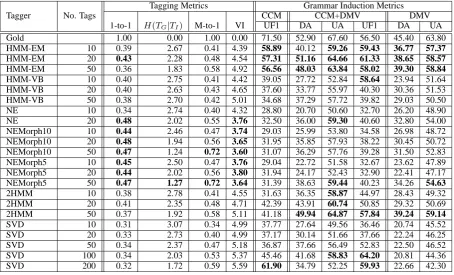
Table 1: The performance of the taggers regarding both tag and grammar induction metrics on WSJ sections 0-10, averaged over 10 runs. Bold indicates the result was within 10 percent of the best-scoring induced system for a given metric.
rected and undirected accuracy. These are the to-tal number of proposed edges that appear in the gold tree divided by the total number of edges (the number of words in the sentence). Directed accu-racy gives credit to a proposed edge if it is in the gold tree and is in the correct direction, while undi-rected accuracy ignores the direction.
Klein and Manning (2004) also present a model which combines CCM and DMV into a single model, which we show as CCM+DMV. In their experiments, this model performed better on both the constituency and dependency induction tasks. As with CCM, Klein and Manning (2004) simi-larly evaluate the combined CCM+DMV system using tags induced with the same method. Again they find that overall bracketing F-score decreases from 77.6 to 72.9 and directed dependency accu-racy measures decreases from 47.5 to 42.3 when switching to induced tags from gold. However for each metric, the systems still do quite well with induced tags.
As in the constituency case, Smith (2006) presents several alternative estimation procedures for DMV, which try to minimize the local maxi-mum problems inherent in EM. It is thus possible these methods might yield better performance for
the models when run off of induced tags.
4 Experiments
We induce tags with each system on the Penn Tree-bank Wall Street Journal (Marcus et al., 1994), sec-tions 0-10, which contain 20,260 sentences. We vary the number of tags (10, 20, 50) and run each system 10 times for a given setting. The result of each run is used as the input to the CCM, DMV, and CCM+DMV systems. While the tags are in-duced from all sentences in the section, following the practice in (Klein and Manning, 2002; Klein and Manning, 2004), we remove punctuation, and consider only sentences of length not greater than 10 in our grammar induction experiments. Tag-gings are evaluated after punctuation is removed, but before filtering for length.
To explore the relationship between tagging metrics and the resulting performance of grammar induction systems, we examine each pair of tag-ging and grammar induction metrics. Consider the following two examples: DMV directed accuracy vs. H(TG|TI) (Figure 1), and CCM f-score vs. variation of information (Figure 2). These were se-lected because they have relatively high magnitude
may be a slight correspondence, the relationships are weak at best.
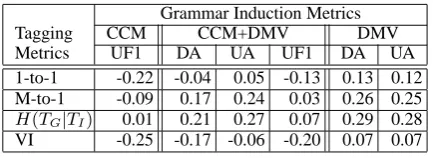
Each tagging and grammar induction metric gives us a ranking over the set of taggings of the data generated over the course of our experiments. These are ordered from best to worst according to the metric, so for instance H(TG|TI) would give highest rank to its lowest value. We can com-pare the two rankings using Kendall’sτ (see Lap-ata (2006) for an overview), a nonparametric mea-sure of correspondence for rankings. τ measures the difference between the number of concordant pairs (items the two rankings place in the same or-der) and discordant pairs (those the rankings place in opposite order), divided by the total number of pairs. A value of 1 indicates the rankings have per-fect correspondence, -1 indicates they are in the opposite order, and 0 indicates they are indepen-dent. The τ values are shown in Table 2. The scatter-plot in Figure 1 shows theτ with the great-est magnitude. However, we can see that even these rankings have barely any relationship.
An objection one might raise is that the lack of correspondence reflects poorly not on these met-rics, but upon the grammar induction systems we use to evaluate them. There might be something about these models in particular which yields these low correlations. For instance these grammar in-ducers all estimate their models using EM, which can get caught easily in a local maximum.
To this possibility, we respond by pointing to performance on gold tags, which is consistently high for all grammar induction metrics. There is clearly some property of the gold tags which is ex-ploited by the grammar induction systems even in the absence of better estimation procedures. This property is not reflected in the tagging metrics.
The scores for each system for tagging and grammar induction, averaged over the 10 runs, are shown in Table 1. Additionally, we included runs of the SVD-tagger for 100 and 200 tags, since run-ning this system is still practical with these num-bers of tags. The Ney-Essen with Morphology gers perform at or near the top on the various tag-ging metrics, but not well on the grammar induc-tion tasks on average. HMM-EM seems to perform on average quite well on all the grammar induction tasks, while the SVD-based systems yield the top bracketing F-scores, making use of larger numbers of tags.
Grammar Induction Metrics
Tagging CCM CCM+DMV DMV
Metrics UF1 DA UA UF1 DA UA
1-to-1 -0.22 -0.04 0.05 -0.13 0.13 0.12
M-to-1 -0.09 0.17 0.24 0.03 0.26 0.25
H(TG|TI) 0.01 0.21 0.27 0.07 0.29 0.28
[image:6.595.307.524.70.149.2]VI -0.25 -0.17 -0.06 -0.20 0.07 0.07
Table 2: Kendall’s τ, between tag and grammar induction criteria.
4.1 Supervised Experiments
One question we might ask is whether these tag-ging metrics capture information relevant to any parsing task. We explored this by experimenting with a supervised parser, training off trees where the gold parts-of-speech have been removed and replaced with induced tags. Our expectation was that the brackets, the head propagation paths, and the phrasal categories in the training trees would be sufficient to overcome any loss in information that the gold tags might provide. Additionally it was possible the induced tags would ignore rare parts-of-speech such as FW, and make better use of the available tags, perhaps using new distribu-tional clues not in the original tags.
To this end we modified the Charniak Parser (Charniak, 2000) to train off induced parts-of-speech. The Charniak parser is a lexicalized PCFG parser for which the part-of-speech of a head word is a key aspect of its model. During training, the head-paths from the gold part-of-speech tags are retained, but we replace the tags themselves.
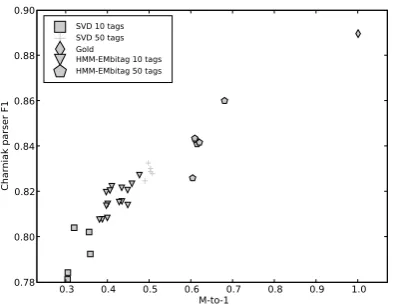
We ran experiments using the bitag HMM from Section 2.2 trained using EM, as well as with the Sch¨utze SVD tagger from Section 2.1. The parser was trained on sections 2-21 of the Penn Treebank for training and section 24 was used for evaluation.
As before we calculated τ scores between each tagging metric and supervised f-score. Unlike the unsupervised evaluation where we used the metric UF1, we use the standard EVALB calculation of unlabeled f-score. The results are shown in Table 3.
0.0 0.5 1.0 1.5 2.0 2.5 3.0 3.5 15
20 25 30 35 40 45 50 55
DMV DA
[image:7.595.350.481.69.127.2]NEMorph HMM-VB 2HMM NE SVD HMM-EM Gold
Figure 1: DMV Directed Accuracy vs.H(TG|TI)
0 1 2 3 4 5 6
VI 20
30 40 50 60 70 80
CCM UF1
[image:7.595.89.278.98.247.2]NEMorph HMM-VB 2HMM NE SVD HMM-EM Gold
Figure 2: CCM fscore vs. tagging variation of in-formation.
0.3 0.4 0.5 0.6 0.7 0.8 0.9 1.0
M-to-1 0.78
0.80 0.82 0.84 0.86 0.88 0.90
Charniak parser F1
SVD 10 tags SVD 50 tags Gold
HMM-EMbitag 10 tags HMM-EMbitag 50 tags
Figure 3: Supervised parsing f-score vs. tagging many-to-one accuracy.
Tagging Metric Supervised F1
1-to-1 0.62
M-to-1 0.83
H(TG|TI) -0.19
[image:7.595.86.281.329.480.2]VI 0.25
Table 3: Kendall’s τ, between tag induction cri-teria and supervised parsing unlabeled bracketing F-score.
Interestingly, parsing performance and speed does degrade considerably when training off in-duced tags. We are not sure what causes this. One possibility is in the lexicalized stage of the parser, where the probability of a head word is smoothed primarily by its part-of-speech tag. This requires that the tag be a good proxy for the syntactic role of the head. In any case this warrants further in-vestigation.
5 Conclusion and Future Work
In this work, we found that none of the most com-mon part-of-speech tagging metrics bear a strong relationship to good grammar induction perfor-mance. Although our experiments only involve English, the poor correspondence we find between the various tagging metrics and grammar induc-tion performance raises concerns about their re-lationship more broadly. We additionally found that while tagging accuracy measures do corre-late with better supervised parsing, common infor-mation theoretic ones do not strongly predict bet-ter performance on either task. Furthermore, the supervised experiments indicate that informative part-of-speech tags are important for good parsing. The next step is to explore better tagging met-rics that correspond more strongly to better gram-mar induction performance. A good metric should use all the information we have, including the gold trees, to evaluate. Finally, we should explore gram-mar induction schemes that do not rely on prior parts-of-speech, instead learning them from raw text at the same time as deeper structure.
Acknowledgments
[image:7.595.82.279.565.718.2]References
Baum, L.E. 1972. An inequality and associated maxi-mization techniques in statistical estimation of prob-abilistic functions of Markov processes. Inequali-ties, 3:1–8.
Biemann, Chris. 2006. Unsupervised part-of-speech tagging employing efficient graph clustering. In Proceedings of the COLING/ACL 2006 Student Re-search Workshop, pages 7–12, Sydney, Australia.
Bod, Rens. 2006. An all-subtrees approach to unsuper-vised parsing. In Proceedings of Coling/ACL 2006, pages 865–872.
Charniak, Eugene. 2000. A
maximum-entropy-inspired parser. In Proceedings of the North Ameri-can Chapter of the ACL 2000, pages 132–139.
Clark, Alexander. 2003. Combining distributional and morphological information for part of speech induc-tion. In Proceedings of EACL 2003, pages 59–66, Budapest, Hungary.
Cramer, Bart. 2007. Limitations of current grammar induction algorithms. In Proceedings of the ACL 2007 Student Research Workshop, pages 43–48.
Dasgupta, Sajib and Vincent Ng. 2007. Unsupervised part-of-speech acquisition for resource-scarce lan-guages. In Proceedings of the EMNLP/CoNLL 2007, pages 218–227.
Freitag, Dayne. 2004. Toward unsupervised whole-corpus tagging. In Proceedings of Coling 2004, pages 357–363, Aug 23–Aug 27.
Goldwater, Sharon and Tom Griffiths. 2007. A fully bayesian approach to unsupervised part-of-speech tagging. In Proceedings of the ACL 2007, pages 744–751.
Haghighi, Aria and Dan Klein. 2006. Prototype-driven learning for sequence models. In Proceedings of HLT/NAACL 2006, pages 320–327, New York, USA.
Johnson, Mark. 2007. Why doesn’t EM find
good HMM POS-taggers? In Proceedings of the EMNLP/CoNLL 2007, pages 296–305.
Klein, Dan and Christopher Manning. 2002. A gener-ative constituent-context model for improved gram-mar induction. In Proceedings of ACL 2002.
Klein, Dan and Christopher Manning. 2004. Corpus-based induction of syntactic structure: Models of de-pendency and constituency. In Proceedings of ACL 2004, pages 478–485, Barcelona, Spain, July.
Lapata, Mirella. 2006. Automatic evaluation of infor-mation ordering: Kendall’s tau. Computational Lin-guistics, 32(4):1–14.
Marcus, Mitchell, Grace Kim, Mary Ann
Marcinkiewicz, Robert MacIntyre, Ann Bies, Mark Ferguson, Karen Katz, and Britta Schasberger. 1994. The Penn Treebank: Annotating Predicate Argument Structure. In Proceedings of the 1994 ARPA Human Language Technology Workshop.
Meilˇa, Marina. 2003. Comparing clusterings. Pro-ceedings of the Conference on Computational Learn-ing Theory (COLT).
Merialdo, Bernard. 1994. Tagging english text with a probabilistic model. Computational Linguistics, 20(2):154–172.
Ney, Herman, Ute Essen, and Renhard Knesser. 1994. On structuring probabilistic dependencies in stochas-tic language modelling. Computer Speech and Lan-guage, 8:1–38.
Sch ¨utze, Hinrich. 1995. Distributional part-of-speech tagging. In Proceedings of the 7th conference of the EACL, pages 141–148.
Seginer, Yoav. 2007. Fast unsupervised incremental parsing. In Proceedings of the 45th Annual Meet-ing of the Association of Computational LMeet-inguistics, pages 384–391, Prague, Czech Republic.
Smith, Noah A. and Jason Eisner. 2004. Anneal-ing techniques for unsupervised statistical language learning. In Proceedings of ACL 2004, pages 487– 494, Barcelona, Spain.
Smith, Noah A. and Jason Eisner. 2005. Contrastive estimation: Training log-linear models on unlabeled data. In Proceedings of ACL 2005, pages 354–362, Ann Arbor, Michigan.
Smith, Noah A. 2006. Novel Estimation Methods for Unsupervised Discovery of Latent Structure in Nat-ural Language Text. Ph.D. thesis, Department of Computer Science, Johns Hopkins University, Octo-ber.