Detecting multiple facets of an event using graph-based unsupervised
methods
Pradeep Muthukrishnan Dept of EECS University of Michigan [email protected]
Joshua Gerrish School of Information University of Michigan [email protected]
Dragomir R. Radev Dept of EECS & School of Information, University of Michigan [email protected]
Abstract
We propose a new unsupervised method for topic detection that automatically iden-tifies the different facets of an event. We use pointwise Kullback-Leibler divergence along with the Jaccard coefficient to build a topic graph which represents the com-munity structure of the different facets. The problem is formulated as a weighted set cover problem with dynamically vary-ing weights. The algorithm is domain-independent and generates a representa-tive set of informarepresenta-tive and discriminarepresenta-tive phrases that cover the entire event. We evaluate this algorithm on a large collec-tion of blog postings about different news events and report promising results.
1 Introduction
Finding a list of topics that a collection of docu-ments cover is an important problem in informa-tion retrieval. Topics can be used to describe or summarize the collection, or they can be used to cluster the collection. Topics provide a short and informative description of the documents that can be used for quickly browsing and finding related documents.
Inside a given corpus, there may be multiple top-ics. Individual documents can also contain multi-ple topics.
Traditionally, information retrieval systems re-turn a ranked list of query results based on the similarity between the user’s query and the docu-ments. Unfortunately, the results returned will of-ten be redundant. Users may need to reformulate
c
°2008. Licensed under the Creative Commons Attribution-Noncommercial-Share Alike 3.0 Unported license (http://creativecommons.org/licenses/by-nc-sa/3.0/). Some rights reserved.
their search to find the specific topic they are in-terested in. This active searching process leads to inefficiencies, especially in cases where queries or information needs are ambiguous.For example, a user wants to get an overview of the Virginia tech shootings, then the first query he/she might try is “Virginia tech shooting”. Most of the results re-turned would be posts just mentioning the shoot-ings and the death toll. But the user might want a more detailed overview of the shootings. Thus this leads to continuously reformulating the search query to discover all the facets of the event.
2 Related Work
Topic detection and tracking was studied exten-sively on newswire and broadcast collections by the NIST TDT research program (Allan et al., ). The large number of people blogging on the web provides a new source of information for topic de-tection and tracking.
The TDT task defines topics as “an event or tivity, along with all directly related events and ac-tivities.” In this paper we will stay with this defini-tion of topic.
Zhai et al. proposed several methods for dealing with a related task, which they called subtopic re-trieval (Zhai et al., 2003). This is an information retrieval task where the goal is to retrieve and re-turn documents that cover the different subtopics of a given query. As they point out, the utility of each document is dependent on the other doc-uments in the ranking, which violates the indepen-dent relevance assumption traditionally used in IR. Blei et al. (Blei et al., 2003) proposed Latent Dirichlet Allocation (LDA), a generative model that allows sets of documents to be explained by unobserved groups of documents, each based on a single topic. The LDA model assumes the
of-words model and posits that each document is composed of different topics. Specifically, each word’s existence is attributed to one of the docu-ment’s topic. This algorithm outputs a set of n-grams for each topic whereas our algorithm mod-els each subtopic using a single n-gram. Due to limitations of time we were not able to compare this approach with ours. We plan to have this com-parison in our future work.
To reduce the complexity of this task, a candi-date set of subtopics needs to be generated that cover the document collection. We choose to use a keyphrase detection algorithm to generate topic labels. Several keyphrase extraction algo-rithms have been discussed in the literature, in-cluding ones based on machine learning methods (Turney, 2000), (Hulth, 2003) and tf-idf ((Frank et al., 1999)). Our method uses language models and pointwise mutual information expressed as the Kullback-Leibler divergence.
Kullback-Leibler divergence has been found to be an effective method of finding keyphrases in text collections. But identification of keyphrases is not enough to find topics in document. The keyphrases identified may describe the entire col-lection, or aspects of the collection. We wish to summarize subtopics within these collections.
The problem of subtopic detection is also related to novelty detection in (Allan et al., ). In this prob-lem, given a set of previously seen documents, the task is to determine whether a new document con-tains new or novel content. The TREC 2002 nov-elty track, the task was to discard sentences that did not contain new material. This is similar to our goal of reducing redundancy in the list of returned subtopics.
In most cases, novelty detection is implemented as an online algorithm. The system has a set of ex-isting documents they have seen up until a certain point. The task is to determine whether a new doc-ument is novel based on the previous docdoc-uments. Once a decision has been made, the status of that document is fixed. The subtopic detection task dif-fers from this because it is an offline task. The al-gorithm typically has access to the entire document set. Our method differs from this novelty detection task in that it has access to the entire document col-lection.
2.1 Existing redundancy measures
Zhang et al. examine five different redundancy measures for adaptive information filtering (Zhang
et al., ). Information filtering systems return rel-evant documents in a document stream to a user. Examples of information filtering systems include traditional information retrieval systems that return relevant documents depending on the user’s query. The redundancy measures Zhang et al. examine are based on online analysis of documents. They identify two methods of measuring redundancy:
• Givenndocuments, they are considered one by one, and suppose we have processedi doc-uments and we havekclusters. Now we need to process thei+ 1thdocument. We compute the distance of thei+ 1thdocument with the
kclusters and add the document to the clos-est cluster if the distance is above a certain threshold, else we create a new cluster with only thei+ 1thdocument.
• Measure distance between the new document and each previously seen document.
They evaluate several measures like set difference, geometric distance, Distributional similarity and mixture models. Evaluating the five systems, they found that cosine similarity was the most effective measure, followed by the new mixture model mea-sure.
3 Data
We choose several news events that occurred in 2007 and 2008 based on the popularity in the bl-ogosphere. We were looking for events that were widely discussed and commented on. The events in our collection are the top-level events that we have gathered. Table 1 lists the events that were chosen for analysis:
To help illustrate our subtopic detection method, we will use the Virginia Tech tragedy as an ex-ample throughout the rest of this paper. People throughout the blogosphere posted responses ex-pressing support and condolences for the people involved, along with their own opinions on what caused it.
Event Description Posts Dates
[image:3.595.123.478.72.124.2]iPhone iPhone release hype 48810 June 20 , 2007 - July 7, 2007 petfoodrecall Melamine tainted petfood recall 4285 March 10, 2007 - May 10, 2007 spitzer Eliot Spitzer prostitution scandal 10379 March 6, 2008 - March 23, 2008 vtech Virginia Tech shooting 12256 April 16, 2007 - April 30, 2007
Table 1: Major events summarized
identify these and other distinct discussions that occur around an event.
After the Virginia Tech murders, there’s the usual outcry for something to be done, and in particular, for more gun control. As usual, I am not persuaded. The Virginia Tech campus had gun con-trol, which meant that Cho Seung-Hui was in violation of the law even before he started shooting, and also that no law-abiding citizens were able to draw.
Figure 1: Example blog post from LiveJournal dis-cussing gun control (Rosen, 2007)
... Predictably, there have been rum-blings in the media that video games contributed to Cho Seung-Hui’s mas-sacre at Virginia Tech. Jack Thomp-son has come out screaming, referring to gamers as “knuckleheads” and calling video games “mental masturbation” all the while referring to himself as an “ed-ucator” and “pioneer” out to “right” so-ciety. ...
Figure 2: Example blog post discussing video games (hoopdog, 2007)
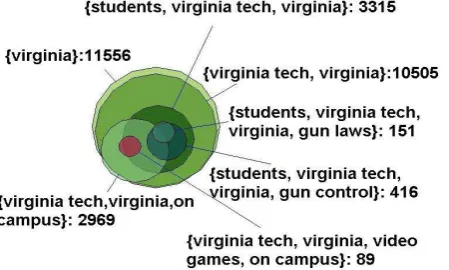
Figure 3 shows a generalized Venn diagram (Kestler et al., 2005) of the cluster overlap between different keyphrases from the Virginia Tech event.
3.1 Preprocessing
Data was collected from the Blogocenter blog-lines database. The Blogocenter group at UCLA has been retrieving RSS feeds from the Bloglines, Blogspot, Microsoft Live Spaces, and syndic8 ag-gregators for the past several years. They currently have over 192 million blog posts collected.
For each news item, relevant posts were re-trieved, based on keyword searching and date of blog post. Posts from the date of occurrence of the item to two weeks after the event occurred
Figure 3: Generalized Venn diagram of topic over-lap in the Virginia Tech collection
were gathered, regardless of the actual length of the event.
Since many RSS feeds indexed by Bloglines are from commercial news organizations or commer-cial sites, we had to clean up the retrieved data. Table 1 lists the event we analyzed along with ba-sic statistics.
4 Method
Our algorithm should find discriminative labels for the different topics that exist in a collection of doc-uments. Taken together, these labels should satisfy the following conditions:
• Describe a large portion of the collection
• The overlap between the topics should be minimal
This task is similar to Minimum Set Cover, which is NP-complete (Garey and Johnson, 1990). Therefore, trying to find the optimal solution by enumerating all possible phrases in the corpus would be impossible, instead we propose a two-step method for subtopic detection.
[image:3.595.308.533.178.313.2]4.1 Generating Candidate Phrases
We want to generate a list of phrases that have a high probability of covering the document space. There are many methods that could be used to find informative keyphrases. One such method is using the standard information retrieval TF-IDF model (Salton and McGill, 1986).
Witten et al.(Witten et al., 1999) proposed KEA, an algorithm which generates a list of can-didate keyphrases using lexical features. They keyphrases are then selected from these candidates using a supervised machine learning algorithm. This approach is not plausible for our purposes be-cause of the following two reasons.
1. The algorithm is domain-dependent and needs a training set of documents with anno-tated keyphrases. But our data sets come from various domains and it is not a very viable op-tion to create a training set for each domain.
2. The algorithm generates keyphrases for a sin-gle document, but for our purposes we need keyphrases for a corpus.
Another method is using Kullback-Leibler di-vergence to find informative keyphrases. We found that KL divergence generated good candidate top-ics.
Tomokiyo and Hurst (2003) developed a method of extracting keyphrases using statistical language models. They considered keyphrases as consisting of two features, phraseness and informativeness. Phraseness is described by them as the “degree to which a given word sequence is considered to be a phrase.” For example, collocations could be con-sidered sequences with a high phraseness. Infor-mativeness is the extent to which a phrase captures the key idea or main topic in a set of documents.
To find keyphrases, they compared two lan-guage models, the target document set and a back-ground corpus. Pointwise KL divergence was cho-sen as the method of finding the difference be-tween two language models.
The KL divergenceD(p||q)between two prob-ability mass functionsp(x)andq(x)with alphabet
χis given in equation 1.
D(p||q) =X
x∈χ
p(x)logp(x)
q(x) (1)
KL divergence is an asymmetric function.
D(p||q)may not equalD(q||p).
Pointwise KL divergence is the individual con-tribution ofxto the loss of the entire distribution. The pointwise KL divergence of a single phrasew isδw(p||q):
δw(p||q) =p(w)logpq((ww)) (2)
The phraseness of a phrase can be found by comparing the foregroundn-gram language model against the background unigram model. For ex-ample, if we were judging the phraseness of “gun control”, we would find the pointwise KL diver-gence of “gun control” between the foreground bi-gram language model and the foreground unibi-gram language model.
ϕp =δw(LMfgN||LMfg1) (3)
The informativeness of a phrase can be found by finding the pointwise KL divergence of the fore-ground model against the backfore-ground model.
ϕi =δw(LMfgN||LMbgN) (4)
A unified score can be formed by adding the phraseness and informative score:ϕ=ϕp+ϕi
4.2 Selecting Topic Labels
Once keyphrases have been extracted from the document set, they are sorted based on their combined score. We select the top n-ranked keyphrases as candidate phrases. This step will hereafter be referred to as “KL divergence mod-ule”.
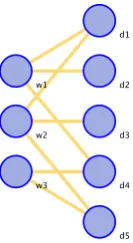
Based on our chosen task conditions regarding coverage of the documents and minimized overlap between topics, we need an undirected mapping between phrases and documents. A natural repre-sentation for this is a bipartite graph where the two sets of nodes are phrases and documents. Let the graph be: G = (W, D, E)whereW is the set of candidate phrases generated by the first step andD is the entire set of documents.Eis the set of edges betweenW andDwhere there is an edge between a phrase and a document if the document contains the phrase.
We formulate the task as a variation of Weighted Set Cover problem in theoretical computer science. In normal Set Cover we are given a collection of setsSover a universeU, and the goal is to select a minimal subset ofSsuch that the whole universe,
d1
w3 w1
d4 d2
w2
[image:5.595.148.215.75.197.2]d5 d3
Figure 4: Bipartite graph representation of topic document coverage, where the di’s are the docu-ments and thewi’s are the n-grams
settle for an approximate solution. But fortunately there exist very goodα-approximation algorithms for this problem (Cui, 2007).
The difference in Weighted Set Cover is that each set has an associated real-valued weight or cost and the goal is to find the minimal or maximal cost subset which covers the universeU.
In our problem, each phrase can be thought of as a set of the documents which contain it. The universe is the set of all documents.
4.3 Greedy Algorithm
To solve the above problem, we propose a greedy algorithm. This algorithm computes a cost for each node iteratively and selects the node with the low-est cost at every iteration. The cost of a keyphrase should be such that we do not choose a phrase with very high coverage, like “Virginia” and at the same time not choose words with very low document frequency since a very small collection of docu-ments can not be judged a topic.
Based on these two conditions we have come up with a linear combination of two cost components, similar to Maximal Marginal Relevance (MMR) (Carbonell and Goldstein, 1998).
1. Relative Document Size:
f1(wi) = |adjN(wi)| (5)
where|adj(wi)|is the document frequency of the word.
This factor takes into account that we do not want to choose words which cover the whole document collection. For example, phrases such as “Virginia” or “Virginia tech” are bad
subtopics, because they cover most of the document set.
2. Redundancy Penalty:
We want to choose elements that do not have a lot of overlap with other elements. One mea-sure of set overlap is the Jaccard similarity co-efficient:
J(A, B) = ||AA∩∪BB|| (6)
f2(wi) = 1−
P
wj∈W−wiJ(wi, wj)
|W| −1 (7)
This component is essentially 1− average Jaccard similarity.
We calculate the pairwise Jaccard coefficient between the target keyphrase and every other keyphrase. The pairwise coefficient vector provides information on how much overlap there is between a keyphrase and every other keyphrase. Phrases with a high average Jac-card coefficient are general facets that cover the entire collection. Phrases with a low Jac-card coefficient are facets that cover specific topics with little overlap.
3. Subtopic Redundancy Memory Effect
Once a keyphrase has been chosen we also want to penalize other keyphrases that cover the same content or documents. Equation 8 represents a redundancy “memory” for each keyphrase or subtopic. This memory is up-dated for every step in the greedy algorithm.
R(wi) =R(wi) +J(wi, wj) (8) wherewjis the newly selected phrase.
A general cost function can be formed from a linear combination of the three cost components. We provide two parameters,α andβ to represent the trade-off between coverage, cohesiveness and intersection. For our experiments, we found that anα value of0.7 and aβ value of0.2performed well.
cost(wi) =α×f1(wi)
+β×f2(wi)
+(1−(α+β))×R(wi)
The pseudocode for the greedy algorithm is given in Figure 5. It should be noted that the al-gorithm requires the costs to be recomputed af-ter every iaf-teration. This is because the cost of a keyphrase may change due to a change in any of the three components. This is because after select-ing a keyphrase, it might make another keyphrase redundant, that is, covering the same content. This makes the whole problem a dynamic weighted set cover problem. Hence, the performance guaran-tees associated with the greedy algorithm for the Weighted Set Cover problem do not hold true for the dynamic version.
Algorithm Greedy algorithm for weighted set-cover Input: GraphG= (W, D, E)
1. N: number of documents to cover 2.
Output: Set of discriminative phrases for the different topics
3. W ={w1, w2, . . . , wn} 4. Wchosen=∅
5. num docs covered= 0 6. whilenum docs covered < N
7. do forwi∈W
8. docost(wi) =α×f1(wi)
9. +β×f2(wi)
10. +(1−(α+β))×R(wi) 11. wselected= argmax
w cost(wi)
12. forwi∈W
13. doR(wi) =R(wi) +J(wselected, wi)
14. num docs covered = num docs covered+
|adj(wselected)|
15. Wchosen=Wchosen∪ {wselected}
16. W =W− {wselected}
17. D=D−adj(selected) 18. returnWchosen
Figure 5: A greedy set-cover algorithm for detect-ing sub-topics
5 Experiments
As a baseline measure, we extracted the top k phrases from the word distribution as the topic la-bels. As a gold standard, we manually annotated the four different collections of blog posts. Each annotator generated a list of subtopics.
6 Evaluation
In evaluating topic detection, there exist two cate-gories of methods, intrinsic and extrinsic (Liddy, 2001). Extrinsic methods evaluate the labels against a particular task whereas intrinsic methods measure the quality of the labels directly. We pro-vide intrinsic and extrinsic evaluations of our algo-rithm.
To evaluate our facet detection algorithm, we created a gold standard list of facets for each data
set. A list of the top 300 keyphrases generated by the KL divergence module was given to two eval-uators. The evaluators were the first and second author of this paper. The evaluators labeled each keyphrase as a positive example of a subtopic or a negative example of a subtopic. The positive examples taken together form the gold standard. For this evaluation process we defined a positive subtopic as a cohesive collection of documents dis-cussing the same topic.
Cohen’s Kappa coefficient (Cohen, 1960) was calculated for the gold standard. Table 6 lists theκ value for the four data sets.
iPhone petfoodrecall spitzer vtech 0.62 0.86 0.77 0.88
Table 2: Kappa scores for the gold standard
The kappa scores for the petfoodrecall and vtech datasets showed good agreement among the raters, while the spitzer data set had only fair agreement. For the iPhone data set, both evaluators had a large amount of disagreement on what they considered subtopics.
A separate group of two evaluators was given the output from our graph-based algorithm, a list of the top KL divergence keyphrases of the same length, and the gold standard for all four data sets. Evaluators were asked to rate the keyphrases on a scale from one to five, with one indicating a poor subtopic, and five indicating a good subtopic. The numberkof subtopics for the algorithm was cutoff where the f-score is maximized. The same number of phrases was chosen for KL divergence as well. Table 3 lists the cutoffs for the four data sets.
iPhone Petfood recall Spitzer Vtech
25 30 24 18
Table 3: Number of generated subtopics for each collection.
“phrase-ness” and “informative“phrase-ness” score calculated by the keyphrase detection module. This value is nor-malized by dividing by the KL divergence for the entire 300 phrase list. This provides a relevancy score for the output.
Data set Precision Recall F-score iphone
KL-Divergence 0.08 0.10 0.09 Graph-based method 0.52 0.60 0.56
petfoodrecall
KL-Divergence 0.37 0.39 0.38 Graph-based method 0.61 0.57 0.59
spitzer
KL-Divergence 0.10 0.08 0.09 Graph-based method 0.79 0.59 0.68
vtech
[image:7.595.304.457.69.339.2]KL-Divergence 0.05 0.06 0.05 Graph-based method 0.72 0.76 0.74
Table 4: Precision, recall and F-score for the base-line and graph-based algorithm.
Data set
Coverage Average Normalized Human pairwise KL rating JC divergence iphone
KL-Divergence 40168 0.08 18.19 1.92 Gold standard 12977 0.02 2.81 3.13 Graph-based 9850 0.01 1.98 2.82
petfoodrecall
KL-Divergence 4280 0.18 19.53 1.82 Gold standard 2659 0.05 4.30 3.43 Graph-based 2055 0.01 1.75 2.81
spitzer
KL-Divergence 9291 0.19 22.90 1.33 Gold standard 4036 0.03 2.29 3.31 Graph-based 2468 0.01 1.60 2.88
vtech
[image:7.595.75.290.152.289.2]KL-Divergence 12215 0.29 24.61 1.61 Gold standard 5058 0.03 2.79 3.76 Graph-based 4342 0.01 1.66 3.28
Table 5: Coverage, overlap and relevance and eval-uation scores for the gold standard, baseline and graph-based method.
7 Results
Table 6 shows some of the different subtopics cho-sen by our algorithm for the different data sets. There is no manual involvement required in the al-gorithm except for the intial preprocessing to re-move commercial news feeds and spam posts. Our graph-based method performs very well and al-most achieves the gold standard’s rating. The F-score for the iPhone data set was only0.56, but we believe part of this may be because this data set did not have clearly defined subtopics, as shown by the low agreement (0.62) among human evaluators.
Spitzer Petfood recall Ashley Alexandra Dupre Under Wal-Mart
Oberweis Xuzhou Anying Emperor’s club People who buy Governor of New Cuts and Gravy Spitzer’s resignation Cat and Dog
Dr Laura Cats and Dogs Mayflower hotel Food and Drug Sex workers Cyanuric acid former New york recent pet High priced prostitution industrial chemical
McGreevey massive pet food Geraldine Ferraro Royal canin
High priced call Iams and Eukanuba legally blind Dry food money laundering
Virginia Tech shooting iPhone Korean American Photo sent from
Gun Ownership Waiting in line Holocaust survivor About the iPhone
Mentally ill Unlimited data Shooting spree From my iPhone
Don Imus cell phones Video Games Multi-touch Gun free zone Guided tour West Ambler Johnston iPhone launch Columbine High school Walt Mossberg Self defense Apple Inc Two hours later Windows Mobile
Gun violence June 29th Seung Hui Cho Web browser Second Amendment Activation
South Korean
[image:7.595.73.295.344.544.2]Table 6: Different topics chosen by the graph-based algorithm for the different data sets
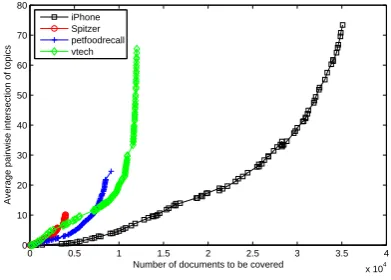
Figure 6 shows the trade off between coverage and redundancy. This graph clearly shows that the overlap between the subtopics increases very slowly as compared to the number of documents covered. The slope of the curves increases slowly when the number of documents to be covered is small and later increases rapidly. This means that initially there are a lot of small focused subtopics and once we have selected all the focused ones the algorithm is forced to pick the bigger topics and hence the average pairwise intersection increases.
0 0.5 1 1.5 2 2.5 3 3.5 4
x 104 0
10 20 30 40 50 60 70 80
Number of documents to be covered
Average pairwise intersection of topics
iPhone Spitzer petfoodrecall vtech
[image:7.595.321.517.592.732.2]8 Conclusion
We have presented a new algorithm based on weighted set cover for finding subtopics in a corpus of selected blog postings. The algo-rithm performs very well in practice compared to the baseline standard, which outputs the top keyphrases according to the Kullback-Leibler di-vergence method. While the baseline standard out-puts keyphrases which are redundant, in the sense, they cover the same documents, the graph-based method outputs keyphrases which have very little intersection. We provide a new method of ranking keyphrases that can help users find different facets of an event.
The identification of facets has many applica-tions to natural language processing. Once facets have been identified in a collection, documents can be clustered based on these facets. These clusters can be used to generate document summaries or for visualization of the event space.
The keyphrases themselves provide a succinct summary of the different subtopics. In future work, we intend to investigate summarization of documents based on subtopic clustering using this method.
9 Acknowledgments
This work was supported by NSF grants IIS 0534323 “Collaborative Research: BlogoCenter -Infrastructure for Collecting, Mining and Access-ing Blogs” awarded to The University of Michigan and ”iOPENER: A Flexible Framework to Support Rapid Learning in Unfamiliar Research Domains”, jointly awarded to U. of Michigan and U. of Mary-land as IIS 0705832.” Also we would like to thank Vahed Qazvinian and Arzucan ¨Ozg¨ur for helping with the evaluation and their valuable suggestions. Any opinions, findings, and conclusions or recom-mendations expressed in this material are those of the authors and do not necessarily reflect the views of the National Science Foundation.
References
Allan, James, Courtney Wade, and Alvaro Bolivar. Re-trieval and novelty detection at the sentence level.
SIGIR 2003, pages 314–321.
Blei, D., A. Ng, and M. Jordan. 2003. Latent dirichlet allocation. Journal of Machine Learning Research, 3:993–1022, January.
Carbonell, Jaime G. and Jade Goldstein. 1998. The use of MMR, diversity-based reranking for reordering
documents and producing summaries. SIGIR 1998, pages 335–336.
Cohen, J. 1960. A coefficient of agreement for nomi-nal scales. Educationomi-nal and Psychological
Measure-ment, 20:37.
Cui, Peng. 2007. A tighter analysis of set cover greedy algorithm for test set. In ESCAPE, pages 24–35.
Frank, Eibe, Gordon W. Paynter, Ian H. Witten, Carl
Gutwin, and Craig G. Nevill-Manning. 1999.
Domain-specific keyphrase extraction. Sixteenth
In-ternational Joint Conference on Artificial Intelli-gence, pages 668–673.
Garey, Michael R. and David S. Johnson. 1990.
Com-puters and Intractability; A Guide to the Theory of NP-Completeness. W. H. Freeman.
hoopdog. 2007. Follow-up: Blame game.
http://hoopdogg.livejournal.com/39060.html.
Hulth, Anette. 2003. Improved automatic keyword ex-traction given more linguistic knowledge. EMNLP
2003, pages 216–223.
Kestler, Hans A., Andre Muller, Thomas M. Gress, and Malte Buchholz. 2005. Generalized venn diagrams: a new method of visualizing complex genetic set re-lations. Bioinformatics, 21:1592–1595, April.
Liddy, Elizabeth. 2001. Advances in automatic text summarization. Information Retrieval, 4:82–83.
Rosen, Nicholas D. 2007. Gun control and mental health. http://ndrosen.livejournal.com/128715.html.
Salton, G. and M. J. McGill. 1986. Introduction to
Modern Information Retrieval. McGraw-Hill, Inc.
New York, NY, USA.
Tomokiyo, Takashi and Matthew Hurst. 2003. A lan-guage model approach to keyphrase extraction. ACL
2003 workshop on Multiword expressions: analysis, acquisition and treatment - Volume 18, pages 33–40.
Turney, Peter D. 2000. Learning algorithms for
keyphrase extraction. Information Retrieval, 2:303– 336.
Witten, Ian H., Gordon W. Paynter, Eibe Frank, Carl Gutwin, and Craig G. Nevill-Manning. 1999. KEA:
Practical automatic keyphrase extraction. In 1st
ACM/IEEE-CS joint conference on Digital libraries,
pages 254–255.
Zhai, Chengxiang, William W. Cohen, and John Laf-ferty. 2003. Beyond independent relevance: meth-ods and evaluation metrics for subtopic retrieval.
SI-GIR 2003, pages 10–17.