Web-based and combined language models:
a case study on noun compound identification
Carlos Ramisch†∗ Aline Villavicencio∗ Christian Boitet†
†GETALP – Laboratory of Informatics of Grenoble, University of Grenoble ∗Institute of Informatics, Federal University of Rio Grande do Sul
{ceramisch,avillavicencio}@inf.ufrgs.br [email protected]
Abstract
This paper looks at the web as a corpus
and at the effects of using web counts
to model language, particularly when we consider them as a domain-specific versus a general-purpose resource. We first com-pare three vocabularies that were ranked according to frequencies drawn from
general-purpose, specialised andweb
cor-pora. Then, we look at methods to com-bine heterogeneous corpora and evaluate the individual and combined counts in the automatic extraction of noun compounds from English general-purpose and
spe-cialised texts. Better n-gram counts can
help improve the performance of
empiri-cal NLP systems that rely onn-gram
lan-guage models.
1 Introduction
Corpora have been extensively employed in sev-eral NLP tasks as the basis for automatically learning models for language analysis and gener-ation. In theory, data-driven(empiricalor statis-tical) approaches are well suited to take intrinsic characteristics of human language into account. In practice, external factors also determine to what extent they will be popular and/or effective for a given task, so that they have shown different per-formances according to the availability of corpora, to the linguistic complexity of the task, etc.
An essential component of most empirical
sys-tems is thelanguage model (LM) and, in
partic-ular, n-gram language models. It is the LM that
tells the system how likely a word orn-gram is in
that language, based on the counts obtained from
corpora. However, corpora represent a sample of a language and will be sparse, i.e. certain words or expressions will not occur. One alternative to min-imise the negative effects of data sparseness and account for the probability of out-of-vocabulary words is to use discounting techniques, where a constant probability mass is discounted from each
n-gram and assigned to unseenn-grams. Another
strategy is to estimate the probability of an
un-seenn-gram by backing off to the probability of
the smallern-grams that compose it.
In recent years, there has also been some
ef-fort in using thewebto overcome data sparseness,
given that thewebis several orders of magnitude
larger than any available corpus. However, it is not straightforward to decide whether (a) it is
bet-ter to use the web than a standard corpus for a
given task or not, and (b) whether corpus andweb
counts should be combined and how this should be done (e.g. using interpolation or back-off tech-niques). As a consequence there is a strong need
for better understanding of the impacts ofweb
fre-quencies in NLP systems and tasks.
More reliable ways of combining word counts could improve the quality of empirical NLP
sys-tems. Thus, in this paper we discuss web-based
word frequency distributions (§ 2) and investigate
to what extent “web-as-a-corpus” approaches can
be employed in NLP tasks compared to standard corpora (§ 3). Then, we present the results of two experiments. First, we compare word counts drawn from general-purpose corpora, from
spe-cialised corpora and from theweb(§ 4). Second,
expression task: automatic noun compound iden-tification. We close this paper with some conclu-sions and future work (§ 6).
2 Thewebas a corpus
Conventional and, in particular, domain-specific corpora, are valuable resources which provide a
closed-world environment where precise n-gram
counts can be obtained. As they tend to be smaller than general purpose corpora, data sparseness can considerably hinder the results of statistical meth-ods. For instance, in the biomedical Genia cor-pus (Ohta et al., 2002), 45% of the words occur
only once (so-calledhapax legomena), and this is
a very poor basis for a statistical method to decide whether this is a significant event or just random noise.
One possible solution is to see the web as a
very large corpus containing pages written in sev-eral languages and being representative of a large fraction of human knowledge. However, there are some differences between using regular corpora
and theweb as a corpus, as discussed by
Kilgar-riff (2003). One assumption, in particular, is that page counts can approximate word counts, so that the total number of pages is used as an estimator
of then-gram count, regardless of how many
oc-currences of then-gram they contain.
This simple underlying assumption has been employed for several tasks. For example, Grefen-stette (1999), in the context of example-based
ma-chine translation, useswebcounts to decide which
of a set of possible translations is the most natural
one for a given sequence of words (e.g.groupe de
travailaswork groupvslabour collective).
Like-wise, Keller and Lapata (2003) use thewebto
esti-mate the frequencies of unseen nominal bigrams, while Nicholson and Baldwin (2006) look at the interpretation of noun compounds based on the individual counts of the nouns and on the global
count of the compound estimated from thewebas
a large corpus.
Villavicencio et al. (2007) show that the web
and the British National Corpus (BNC) could be used interchangeably to identify general-purpose and type-independent multiword expressions. La-pata and Keller (2005) perform a careful and
systematic evaluation of the web as a corpus in
other general-purpose tasks both for analysis and generation, comparing it with a standard corpus (the BNC) and using two different techniques to combine them: linear interpolation and back-off.
Their results show that, whilewebcounts are not
as effective for some tasks as standard counts, the combined counts can generate results, for most tasks, that are as good as the results produced by the best individual corpus between the BNC and
theweb. Nakov (2007) further investigates these
tasks and finds that, for many of them, effective attribute selection can produce results that are at least comparable to those from the BNC using
counts obtained from theweb.
On the one hand, the web can minimise the
problem of sparse data, helping distinguish rare from invalid cases. Moreover, a search engine al-lows access to ever increasing quantities of data, even for rare constructions and words, which counts are usually equated to the number of pages
in which they occur. On the other hand, n
-grams in the highest frequency ranges, such as
the words the, up and down, are often assigned
the estimated size of theweb, uniformly. While
this still gives an idea of their massive occur-rence, it does not provide a finer grained
distinc-tion among them (e.g. in the BNC,the,downand
up occur 6,187,267, 84,446 and 195,426 times,
respectively, while in Yahoo! they all occur in 2,147,483,647 pages).
3 Standard vswebcorpora
When we comparen-gram counts estimated from
the web with counts taken from a well-formed
standard corpus, we notice that web counts are
“estimated” or “approximated” as page counts, whereas standard corpus counts are the exact
number of occurrences of then-gram. In this way,
webcounts are dependent on the particular search
as the Google 1 trillion n-grams1. Thus, our
re-sults cannot be compared to those using this kind of data (Bergsma et al., 2009).
In data-driven techniques, some statistical mea-sures are based on contingency tables, and the counts for each of the table cells can be straight-forwardly computed from a standard corpus.
However, this is not the case for theweb, where
the occurrences of an n-gram are not precisely
calculated in relation to the occurrences of the
(n−1)-grams composing it. For instance, the
n-gram the man may appear in 200,000 pages,
while the words the and man appear in
respec-tively 1,000,000 and 200,000 pages, implying that
the wordmanoccurs with no other word thanthe2.
In addition, the distribution of words in a stan-dard corpus follows the well known Zipfian
dis-tribution (Baayen, 2001) while, in the web, it is
very difficult to distinguish frequent words or n
-grams as they are often estimated as the size of the
web. For instance, the Yahoo! frequencies plotted
in figure 1(a) are flattened in the upper part, giv-ing the same page counts for more than 700 of the most frequent words. Another issue is the size of the corpus, which is an important information, of-ten needed to compute frequencies from counts or
to estimate probabilities in n-gram models.
Un-like the size of a standard corpus, which is easily obtained, it is very difficult to estimate how many
pages exist on theweb, especially as this number
is always increasing.
But perhaps the biggest advantage of thewebis
its availability, even for resource-poor languages and domains. It is a free, expanding and easily ac-cessible resource that is representative of language use, in the sense that it contains a great variability of writing styles, text genres, language levels and knowledge domains.
4 Analysingn-gram frequencies
In this section, we describe an experiment to com-pare the probability distribution of the vocabulary of two corpora, Europarl (Koehn, 2005) and Ge-nia (Ohta et al., 2002), that represent a sample of general-purpose and specialised English. In 1This dataset is released through LDC and is not freely
available. Therefore, we do not consider it in our evaluation.
2In practice, this procedure can lead to negative counts.
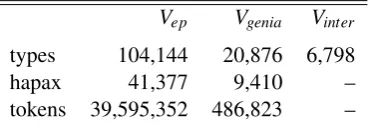
Vep Vgenia Vinter
types 104,144 20,876 6,798
hapax 41,377 9,410 –
tokens 39,595,352 486,823 –
Table 1: Some characteristics of general vs domain-specific corpora.
addition to both corpora, we also considered the
counts from the web as a corpus, using Google
and Yahoo! APIs, and these four corpora act as
n-gram count sources. To do that, we preprocessed the data (§ 4.1), extracted the vocabularies from each corpus and calculated their counts in our
fourn-gram count sources (§ 4.2), analysing their
rank plots to compare how each of these sources models general-purpose and specialised language (§ 4.3). The experiments described in this
sec-tion were implemented in themwetoolkitand
are available athttp://sf.net/projects/
mwetoolkit/.
4.1 Preprocessing
The Europarl corpus v3.0 (ep) contains
transcrip-tions of the speeches held at the European Par-liament, with more than 1.4M sentences and
39,595,352 words. The Genia corpus (genia)
con-tains abstracts of scientific articles in biomedicine, with around 1.8K sentences and 486,823 words. These standard corpora were preprocessed in the following way:
1. conversion to XML, lemmatisation and POS tagging3;
2. case homogenisation, based on the following criteria:
• all-uppercase and mixed case words
were normalised to their predominant form, if it accounts for at least 80% of the occurrences;
• uppercase words at the beginning of
sentences were lowercased;
• other words were not modified.
3Genia contains manual POS tag
annota-tion. Europarl was tagged using the TreeTagger
(www.ims.uni-stuttgart.de/projekte/
This lowercasing algorithm helps to deal with the massive use of abbreviations, acronyms, named entities, and formulae found in specialised cor-pora, such as those containing biomedical (and other specialised) scientific articles.
For calculating arbitrary-sizedn-grams in large
textual corpora efficiently, we implemented a structure based on suffix arrays (Yamamoto and Church, 2001). While suffix trees are often used
in LM tools, wheren-grams have a fixed size, they
are not fit for arbitrary lengthn-gram searches and can consume quite large amounts of memory to store all the node pointers. Suffix arrays, on the
other hand, allow for arbitrary length n-grams to
be counted in a time that is proportional to log(N),
whereNis the number of words (which is
equiva-lent to the number of suffixes) in the corpus. Suf-fix arrays use a constant amount of memory
pro-portional toN. In our implementation, where
ev-ery word and evev-ery word position in the corpus are encoded as a 4-byte integer, it corresponds pre-cisely to 4×2×Nplus the size of the vocabulary,
which is generally very small if compared toN,
given a typical token/type ratio. The construction of the suffix array takes O(Nlog2N) operations,
due to a sorting step at the end of the process.
4.2 Vocabulary creation
After preprocessing, we extracted all the unigram
surface forms (i.e. all words) fromepand from
ge-nia, generating two vocabularies,Vep andVgenia,
where the words are ranked in descending fre-quency order with respect to the corpus itself seen
as an-gram count source. Formally, we can model
avocabularyas a setV of wordsvi∈V taken from
a corpus. A wordcountis the valuec(vi) =nof a
function that goes from words to natural numbers,
c:V →N. Therefore, there is always an implicit
word order relation≤rin a vocabulary, that can be
generated fromVandcby using the order relation
≥ inN4. Thus, arank is defined as a
partially-ordered set formed by a vocabulary–word order pair relation:hV,≤ri.
Table 1 summarises some measures of the
ex-tracted vocabularies, whereVinter denotes the
in-tersection of Vep and Vgenia. Notice that Vinter
4That is,∀v1,v2∈V, supposec(v1) =n1andc(v2) =n2,
thenv1≤rv2if and only ifn1≥n2.
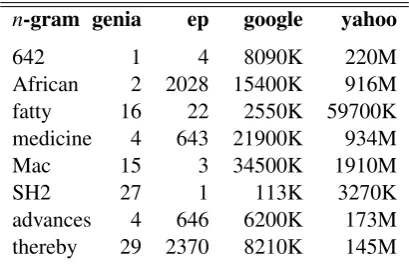
n-gram genia ep google yahoo
642 1 4 8090K 220M
African 2 2028 15400K 916M
fatty 16 22 2550K 59700K
medicine 4 643 21900K 934M
Mac 15 3 34500K 1910M
SH2 27 1 113K 3270K
advances 4 646 6200K 173M
thereby 29 2370 8210K 145M
Table 2: Distribution of some words inVinter.
contains considerably less entries than the
small-est vocabulary (Vgenia). This shows to what
ex-tent both types of text differ and how important it is to use the correct techniques when work-ing with domain-specific data in empirical ap-proaches. The table also shows the number of ha-pax legomena (i.e. words that occur only once) in each corpus, and in this aspect both corpora are similar5. It also shows how sparseness affects
lan-guage, since a vocabulary that is 400% bigger has only 5% less hapax legomena.
For each entry in each vocabulary, we
ob-tained a count estimated from four different n
-gram count sources: ep, genia, Google as a
cor-pus (google) and Yahoo! as a corpus (yahoo). The latter were configured to return only results for pages in English. Table 2 shows an example of entries extracted fromVinter. Notice that there are
no zeroes in columnsgeniaandep, since this
vo-cabulary only contains words that occur at least
once in these corpora. Also, some words likeMac
andSH2, that are probably specialised terms,
oc-cur more ingenia than in ep even if the latter is
more than 80 times larger than the former.
4.3 Rank analyses
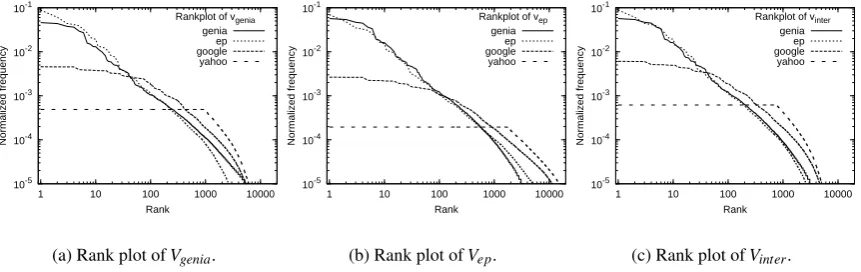
For each vocabulary, we want to estimate how similar the ranks generated by each of the four count sources are. Figure 1 shows the rank po-sition (x) against the frequency (y) of words in
Vgenia,VepandVinter, where each plotted point
rep-resents a rank position according to corpus
fre-5The percentual difference in the proportion of hapax
10-5 10-4 10-3 10-2 10-1
1 10 100 1000 10000
Normalized frequency
Rank
Rankplot of vgenia genia
1 10 100 1000 10000
Normalized frequency
Rank
Rankplot of vep genia
1 10 100 1000 10000
Normalized frequency
Rank
Rankplot of vinter genia
ep google yahoo
(c) Rank plot ofVinter.
Figure 1: Plot of normalised frequencies of vocabularies according to rank positions, log-log scale.
quencies and may correspond to several different
words.6 The four sources have similar shaped
curves for each of the three vocabularies: ep
and genia could be reasonably approximated by a linear regression curve (in the log-log domain).
google andyahoopresent Zipfian curves for low frequency ranges but have a flat line for higher frequencies, and the phenomenon seems consis-tent in all vocabularies and more intense onyahoo. This is related to the problem discussed in
sec-tion 3 which is thatweb-based frequencies are not
accurate to model common words because web
counts correspond to page counts and not to word counts, and that a common word will probably ap-pear dozens of times in a single page.
Nonethe-less, google seems more robust to this effect,
and indeedyahooreturns exactly the same value
(roughly 2 billion pages) for a large number of common words, producing the perfectly straight line in the rank plots. Moreover, the problem seems less serious inVinter, but this could be due
to its much smaller size. These results show that
google is incapable of distinguishing among the
top-100 words whileyahoois incapable of
distin-guishing among the top-1000 words, and this can
be a serious drawback forweb-based counts both
in general-purpose and specialised NLP tasks. The curves agree in a large portion of the
fre-quency range, and the only interval in which
ge-niaandepdisagree is in lower frequencies (shown
in the bottom right corner). This happens
be-6Given the Zipfian behaviour of word probability
distri-butions, a log-log scale was used to plot the curves.
cause general-purpose ep frequencies are much
less accurate to model the specialised genia
vo-cabulary, specially in low frequency ranges when sparseness becomes more marked (figure 1(a)), and vice-versa (figure 1(b)). This effect is min-imised in figure 1(c), corresponding toVinter.
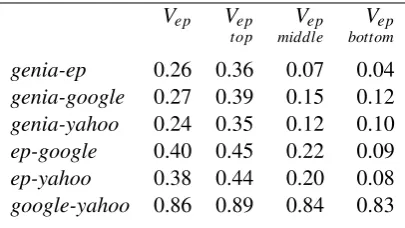
Although both vocabularies present the same word frequency distributions, it does not mean that their ranks are similar for the four count sources. Tables 3 and 4 show the correlation scores for the compared count sources and for the
two vocabularies, using Kendall’sτ. Theτ
corre-lation index estimates the probability that a word
pair in a given rank has the same respective
po-sition in another rank, in spite of the distance be-tween the words7.
In the two vocabularies, correlation is low, which indicates that the ranks tend to order words differently even if there are some similarities in terms of the shape of the frequency distribution.
When we compare genia with google and with
yahoo, we observe thatyahoois slightly less
cor-related withgeniathangoogle, probably because
of its uniform count estimates for frequent words.
However, both seem to be more similar togenia
thanep.
A comparison ofepwithgoogleand withyahoo
shows thatwebfrequencies are much more similar
to a general-purpose count source likeepthan to
a specialised source likegenia. Additionally, both
yahooandgoogle seem equally correlated toep.
7For all correlation values,p<0.001 for the alternative
Vgenia Vgenia Vgenia Vgenia top middle bottom
genia-ep 0.26 0.24 0.13 0.06
genia-google 0.28 0.24 0.18 0.09
genia-yahoo 0.27 0.22 0.17 0.09
ep-google 0.57 0.68 0.53 0.49
ep-yahoo 0.57 0.68 0.53 0.49
google-yahoo 0.90 0.90 0.89 0.89
Table 3: Kendall’sτ for count sources inVgenia.
Vep Vep Vep Vep top middle bottom
genia-ep 0.26 0.36 0.07 0.04
genia-google 0.27 0.39 0.15 0.12
genia-yahoo 0.24 0.35 0.12 0.10
ep-google 0.40 0.45 0.22 0.09
ep-yahoo 0.38 0.44 0.20 0.08
google-yahoo 0.86 0.89 0.84 0.83
Table 4: Kendall’sτ for count sources inVep.
Surprisingly, this correlation is higher for Vgenia
than forVep, as web frequencies andep
frequen-cies are more similar for a specialised vocabulary than for a general-purpose vocabulary. This could mean that the three perform similarly (poorly) at estimating frequencies for the biomedical vocab-ulary (Vgenia) whereas they differ considerably at
estimating general-purpose frequencies.
The correlation of the rank (first column) is also
decomposed into the correlation for top words
(more than 10 occurrences), middlewords (10 to
3 occurrences) andbottomwords (2 and 1
occur-rences). Except for the pairgoogle-yahoo, the cor-relation is much higher in the top portion of the vocabulary and is close to zero in the long tail. In spite of the logarithmic scale of the graphics in figure 1, that show the largest difference in the top part, the bottom part is actually the most
ir-regular. The only exception isep compared with
thewebcount sources inVgenia: these two pairs do
not present the high variability of the other
com-pared pairs, and this means that using ep counts
(general-purpose) to estimate genia counts
(spe-cialised) is similar to usingwebcounts,
indepen-dently of the position of the word in the rank.
Counts fromgoogleand fromyahooare also very
similar, specially if we also consider Spearman’s
ρ, that is very close to total correlation. Web ranks are also more similar for a specialised vocabulary than for a general-purpose one, providing further evidence for the hypothesis that the higher corre-lation is a consequence of both sources being poor frequency estimators. That is, for a given
vocabu-lary, whenwebcount sources are good estimators,
they will be more distinct (e.g. having less zero frequencies).
5 Combining corpora frequencies
In our second experiment, the goal is to propose and to evaluate techniques for the combination
of n-gram counts from heterogeneous sources.
Therefore, we will use the insights about the vo-cabulary differences presented in the previous sec-tion. In this evaluation, we measure the impact of the suggested techniques in the identification of noun–noun compounds in corpora. Noun com-pounds are very frequent in general-purpose and
specialised texts (e.g. bus stop, European Union
andgene activation). We extract them
automat-ically from ep and from genia using a standard
method based on POS patterns and association measures (Evert and Krenn, 2005; Pecina, 2008; Ramisch et al., 2010).
5.1 Experimental setup
The evaluation task consists of, given a corpus
of N words, extract all occurrences of adjacent
pairs of nouns8 and then rank them using a
stan-dard statistical measure that estimates the asso-ciation strength between the two nouns. Analo-gously to the formalism adopted in section 4.2, we assume that, for each corpus, we generate a setNNcontainingn-gramsv1...n∈NN9for which
we obtainn-gram counts from four sources. The
elements inNN are generated by comparing the
POS patternnoun–nounagainst all the bigrams in
the corpus and keeping only those pairs of adja-cent words that match the pattern. The calculation of the association measure, considering a bigram
v1v2, is based on a contingency table which cells
8We ignore other types of compounds, e.g. adjective–
noun pairs.
9We abbreviate a sequencev1. . .vnasv1
contain all possible outcomesa1a2,ai∈ {vi,¬vi}.
For web-based counts, we corrected up to 2% of
them by forcing the frequency of a unigram to be at least equal to the frequency of the bigram in which it occurs. Such inconsistencies are incom-patible with statistical approaches based on con-tingency table, as discussed in section 2.
The log-likelihood association measure (LL,
al-ternatively called expected mutual information),
estimates the difference between the observed ta-ble and the expected tata-ble under the assumption of
independent events, whereE(a1. . .an) = n
∏
i=1c(ai)
Nn−1
is calculated using maximum likelihood:
LL(v1v2) =
∑
a1a2
c(a1a2)×log2Ec((aa1a2) 1a2)
The evaluation of theNNlists is performed
au-tomatically with the help of existing noun com-pound dictionaries. The general-purpose gold
standard, used to evaluateNNep, is composed of
bigram noun compounds extracted from several resources: 6,212 entries from the Cambridge In-ternational Dictionary of English, 22,981 from Wordnet and 2,849 from the data sets of MWE
200810. Those were merged into a single
general-purpose gold standard that contains 28,622 bi-gram noun compounds. The specialised gold
stan-dard, used to evaluate NNgenia, is composed of
7,441 bigrams extracted from constituent
annota-tion of the geniacorpus with respect to concepts
in the Genia ontology (Kim et al., 2006).
True positives (TPs) are the n-grams of NN
that are contained in the respective gold standard,
whilen-grams that do not appear in the gold
stan-dard are considered false positives11. While this
is a simplification that underestimates the perfor-mance of the method, it is appropriate for the pur-pose of this evaluation because we compare only themean average precision(MAP) between two
NN ranks, in order to verify whether
improve-ments obtained by the combined frequencies are 10420 entries provided by Timothy Baldwin, 2,169
en-tries provided by Su Nam Kim and 250 enen-tries provided by Preslav Nakov, freely available athttp://multiword. sf.net/
11In fact, nothing can be said about ann-gram that is not
in a (limited-coverage) dictionary, further manual annotation would be necessary to asses its relevance.
significant. Additionaly, MWEs are complex lin-guistic phenomena, and their annotation, specially in a domain corpus, is a difficult task that reaches low agreement rates, sometimes even for expert native speakers. Therefore, not only for theo-retical reasons but also for practical reasons, we adopted an automatic evaluation procedure rath-ern than annotating the top candidates in the lists by hand.
Since the log-likelihood measure is a function
that assigns a real value to eachn-gram, there is
a rank relation ≤r that will be used to calculate
MAP as follows:
From the initial list of 176,552 lemmatised n
-grams in NNep and 14,594 in NNgenia, we
fil-tered out all hapax legomena in order to remove noise and avoid useless computations. Then, we counted the occurrences ofv1, v2andv1v2 in our
four sources, and those were used to calculate the
fourLL values ofn-grams in both lists. We also
propose three heuristics to combine a set of m
count sources c1 through cm into a single count
sourceccomb:
between 0 and 1 for each count source accord-ing to the n-gram v1...n. Three different
func-tions were used in our experiments: uniform
linear interpolation assumes a constant and uni-form weightw(v1...n) =1/mfor alln-grams;
pro-portionallinear interpolation assumes a constant weightwi(v1...n) = ((∑mj=1Nj)−Ni)/∑mj=1Njthat
is proportional to the inverse size of the corpus; and back-off uses the uniform interpolation of
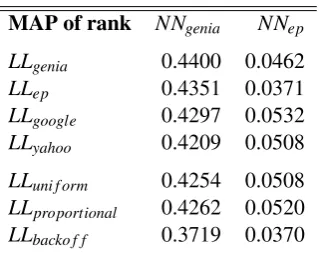
webfrequencies whenever then-gram count in the
MAP of rank NNgenia NNep
LLgenia 0.4400 0.0462
LLep 0.4351 0.0371
LLgoogle 0.4297 0.0532
LLyahoo 0.4209 0.0508
LLuni f orm 0.4254 0.0508
LLproportional 0.4262 0.0520
LLbacko f f 0.3719 0.0370
Table 5: Performance of compound extraction.
Table 5 shows that the performance of
back-off is below all other techniques for both
vocab-ularies, thus excluding it as a successful combina-tion heuristic. The large difference between MAP
scores for NNep and for NNgenia is explained by
the relative size of the gold standards: while the general-purpose reference accounts for 16% of the size of theNNep set, the specialised reference has
as many entries as 50% ofNNgenia. Moreover, the
former was created by joining heterogeneous re-sources while the latter was compiled by human annotators from the Genia corpus itself. The goal of our evaluation, however, is not to compare the difficulty of each task, but to compare the com-bination heuristics presented in each row of the table.
The best MAP for NNgenia was obtained with
genia, that significantly outperforms all other
sources except ep12. On the other hand, the use
ofweb-based or interpolated counts in extracting
specialised noun–noun compounds does not im-prove the performance of results based on sparse but reliable counts drawn from well-formed
cor-pora. Nonetheless, the performance ofep in
spe-cialised extraction is surprising and could only be explained by some overlap between the corpora. Moreover, the interpolated counts are not
signif-icantly different from googlecounts, even if this
corpus should have the weakest weight in
propor-tionalinterpolation.
General-purpose compound extraction, how-ever, benefits from the counts drawn from large
corpora asgoogle andyahoo. Indeed, the former
12Significance was assessed through a standard one-tailed
ttest for equal sample sizes and variances,α=0.005.
significantly outperforms all other count sources,
closely followed by proportional counts. In
both vocabularies,proportionalinterpolation
per-forms very similar to the best count source, but, strangely enough, it still does not outperform
google. Further data inspection would be needed to explain these results for the interpolated combi-nation and to try to shed some light on the reason
why thebackoff method performs so poorly.
6 Future perspectives
In this work, we presented a detailed
evalua-tion of the use of web frequencies as
estima-tors of corpus frequencies in general-purpose and specialised tasks, discussing some important
as-pects of corpus-based versus web-based n-gram
frequencies. The results indicate that they are not only very distinct but they are so in different ways. The importance of domain-specific data for modelling a specialised vocabulary is discussed in
terms of using ep to getVgenia counts.
Further-more, thewebcorpora were more similar togenia
than toep, which can be explained by the fact that “similar” is different from “good”, i.e. they might
be equally bad in modellinggeniawhile they are
distinctly better forep.
We also proposed heuristics to combine count sources inspired by standard interpolation and back-off techniques. Results show that we
can-not useweb-based or combined counts to identify
specialised noun compounds, since they do not help minimise data sparseness. However, general-purpose extraction is improved with the use of
webcounts instead of counts drawn from standard
corpora.
Acknowledgements
This research was partly supported by CNPq (Projects 479824/2009-6 and 309569/2009-5), FINEP and SEBRAE (COMUNICA project FINEP/SEBRAE 1194/07). Special thanks to Flávio Brun for his thorough work as volunteer proofreader.
References
Baayen, R. Harald. 2001. Word Frequency
Distri-butions, volume 18 ofText, Speech and Language
Technology. Springer.
Bergsma, Shane, Dekang Lin, and Randy Goebel. 2009. Web-scale N-gram models for lexical disam-biguation. In Boutilier, Craig, editor, Proceedings of the 21st International Joint Conference on Arti-ficial Intelligence (IJCAI 2009), pages 1507–1512, Pasadena, CA, USA, July.
Evert, Stefan and Brigitte Krenn. 2005. Using small random samples for the manual evaluation of sta-tistical association measures. Computer Speech &
Language Special issue on Multiword Expression,
19(4):450–466.
Grefenstette, Gregory. 1999. The World Wide Web as a resource for example-based machine translation tasks. InProceedings of the Twenty-First Interna-tional Conference on Translating and the Computer, London, UK, November. ASLIB.
Keller, Frank and Mirella Lapata. 2003. Using the web to obtain frequencies for unseen bigrams.
Computational Linguistics Special Issue on the Web as Corpus, 29(3):459–484.
Kilgarriff, Adam and Gregory Grefenstette. 2003. In-troduction to the special issue on the web as corpus.
Computational Linguistics Special Issue on the Web as Corpus, 29(3):333–347.
Kilgarriff, Adam. 2007. Googleology is bad science.
Computational Linguistics, 33(1):147–151.
Kim, Jin-Dong, Tomoko Ohta, Yuka Teteisi, and Jun’ichi Tsujii. 2006. GENIA ontology. Techni-cal report, Tsujii Laboratory, University of Tokyo.
Koehn, Philipp. 2005. Europarl: A parallel corpus for statistical machine translation. In Proceedings of the Tenth Machine Translation Summit(MT Summit
2005), Phuket, Thailand, September. Asian-Pacific
Association for Machine Translation.
Lapata, Mirella and Frank Keller. 2005. Web-based models for natural language processing. ACM
Transactions on Speech and Language Processing (TSLP), 2(1):1–31.
Nakov, Preslav. 2007. Using the Web as an Implicit Training Set: Application to Noun Compound
Syn-tax and Semantics. Ph.D. thesis, EECS Department,
University of California, Berkeley, CA, USA.
Nicholson, Jeremy and Timothy Baldwin. 2006. Inter-pretation of compound nominalisations using cor-pus and web statistics. In Moirón, Begoña Villada, Aline Villavicencio, Diana McCarthy, Stefan Ev-ert, and Suzanne Stevenson, editors,Proceedings of the COLING/ACL Workshop on Multiword Expres-sions: Identifying and Exploiting Underlying Prop-erties (MWE 2006), pages 54–61, Sidney, Australia, July. Association for Computational Linguistics.
Ohta, Tomoko, Yuka Tateishi, and Jin-Dong Kim. 2002. The GENIA corpus: an annotated research abstract corpus in molecular biology domain. In
Proceedings of the Second Human Language
Tech-nology Conference (HLT 2002), pages 82–86, San
Diego, CA, USA, March. Morgan Kaufmann Pub-lishers.
Pecina, Pavel. 2008. Reference data for czech collo-cation extraction. In Gregoire, Nicole, Stefan Ev-ert, and Brigitte Krenn, editors,Proceedings of the LREC Workshop Towards a Shared Task for
Multi-word Expressions (MWE 2008), pages 11–14,
Mar-rakech, Morocco, June.
Ramisch, Carlos, Aline Villavicencio, and Christian Boitet. 2010. mwetoolkit: a framework for mul-tiword expression identification. In Calzolari, Nico-letta, Khalid Choukri, Bente Maegaard, Joseph Mar-iani, Jan Odjik, Stelios Piperidis, Mike Rosner, and Daniel Tapias, editors, Proceedings of the Seventh International Conference on Language Resources
and Evaluation (LREC 2010), Valetta, Malta, May.
European Language Resources Association.
Villavicencio, Aline, Valia Kordoni, Yi Zhang, Marco Idiart, and Carlos Ramisch. 2007. Validation and evaluation of automatically acquired multi-word expressions for grammar engineering. In Eisner, Jason, editor, Proceedings of the 2007 Joint Conference on Empirical Methods in Natural Language Processing and Computational Natural
Language Learning (EMNLP-CoNLL 2007), pages
1034–1043, Prague, Czech Republic, June. Associ-ation for ComputAssoci-ational Linguistics.
Yamamoto, Mikio and Kenneth W. Church. 2001. Us-ing suffix arrays to compute term frequency and document frequency for all substrings in a corpus.