Proceedings of the 27th International Conference on Computational Linguistics: System Demonstrations, pages 161–165 Santa Fe, New Mexico, USA, August 20-26, 2018.
161
A flexible and easy-to-use semantic role labeling framework
for different languages
Quynh Ngoc Thi Do Artuur Leeuwenberg Geert Heyman Marie-Francine Moens
Department of Computer Science, KU Leuven, Belgium
{quynhngocthi.do,tuur.leeuwenberg,geert.heyman,sien.moens}@cs.kuleuven.be
Abstract
This paper presentsDAMESRL1, a flexible and open source framework for deep semantic role labeling (SRL). DAMESRL aims to facilitate easy exploration of model structures for multi-ple languages with different characteristics. It provides flexibility in its model construction in terms of word representation, sequence representation, output modeling, and inference styles and comes with clear output visualization. Additionally, it handles various input and output for-mats and comes with clear output visualization. The framework is available under the Apache 2.0 license.
1 Introduction
During the first decade of the 21st century, mapping from the syntactic analysis of a sentence to its se-mantic representation has received a central interest in the natural language processing (NLP) community. Semantic role labeling, which is a sentence-level semantic task aimed at identifying “Who did What to Whom, and How, When and Where?” (Palmer et al., 2010), has strengthened this focus. Recently, sev-eral neural mechanisms have been used to train end-to-end SRL models that do not require task-specific feature engineering as the traditional SRL models do. Zhou and Xu (2015) introduced the first deep end-to-end model for SRL using a stacked Bi-LSTM network with a conditional random field (CRF) as the top layer. He et al. (2017) simplified their architecture using a highway Bi-LSTM network. More recently, Tan et al. (2018) replaced the common recurrent architecture with a self-attention network, di-rectly capturing relationships between tokens regardless of their distance, resulting in better results and faster training. The work in deep end-to-end SRL has focused heavily on applying deep learning ad-vances without considering the multilingual aspect. However, language-specific characteristics and the available amount of training data highly influence the optimal model structure.
DAMESRL facilitates exploration and fair evaluation of new SRL models for different languages by providing flexible neural model construction on different modeling levels, the handling of various input and output formats, and clear output visualization. Beyond the existing state-of-the-art models (Zhou and Xu, 2015; He et al., 2017; Tan et al., 2018), we exploit character-level modeling, beneficial when con-sidering multiple languages. To demonstrate the merits of easy cross-lingual exploration and evaluation of model structures for SRL provided by DAMESRL, we report performance of several distinct models integrated into our framework for English, German and Arabic, as they have very different linguistic characteristics.
2 Task Definition
Formally, the goal of end-to-end SRL is to predict a sequence(l1, l2, . . . , ln) of semantic labels given a sentence(w1, w2, . . . , wn), and its predicatewp as input. Eachli, which belongs to a discrete set of PropBank BIO tags, is the semantic tag corresponding to the word wi in the semantic frame evoked
1
The source code can be found at:https://liir.cs.kuleuven.be/software_pages/damesrl.php.
bywp. Here, words outside argument spans have the tagO, and words at the beginning and inside of argument spans with roler have the tags Br andIr, respectively. For example, the sentence “the cat
chases the dog .” should be annotated as “theB−A0catI−A0chasesB−VtheB−A1dogI−A1.O”.
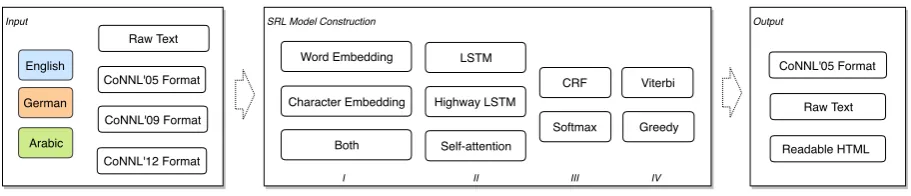
Figure 1: Schematic overview of the DAMESRL architecture from input to output.
DAMESRL’s architecture (see Fig. 1) facilitates the construction of models that prioritize certain language-dependent linguistic properties, such as the importance of word order and inflection, or that adapt to the amount of available training data. The framework, implemented in Python 3.5 using Tensor-Flow, can be used to train new models, or make predictions with the provided pre-trained models.
3.1 Input and Output
The input/output format of DAMESRL is a shortened version of the CoNLL’05 format, which only contains the Words, Targets and (possibly) Props columns2. DAMESRL also provides an HTML format that can be directly visualized in the web browser (as in Fig. 2).
3.2 Model Construction Modules
As can be seen in Fig. 1, the framework divides model construction in four phases: (I) word representa-tion, (II) sentence representarepresenta-tion, (III) output modeling, and (IV) inference.
Phase I: The word representation of a wordwi consist of three optional concatenated components: a word-embedding, a Boolean indicating ifwiis the predicate of the semantic frame (wp), and a character representation. DAMESRL provides a Bi-LSTM network to learn character-level word representations helping for languages where important SRL cues are given through inflections, such as case markings in German and Arabic. Despite the foreseen importance, character-level embeddings have not been used in previous work (Zhou and Xu, 2015; He et al., 2017; Tan et al., 2018).
Phase II: As core sequence representation component, users can choose between a self-attention en-coding (Tan et al., 2018), a regular LSTM (Hochreiter and Schmidhuber, 1997) or a highway Bi-LSTM (Zhang et al., 2016; He et al., 2017).
Phase III: To compute model probabilities, users can choose a regular softmax, or a linear chain CRF as proposed by (Zhou and Xu, 2015), which can be useful for languages where word order is an important SRL cue, such as English, or when less training data is available (shown in Section 4).
2
http://www.lsi.upc.edu/˜srlconll/conll05st-release/README
163
Phase IV: The inference phase provides two options for label inference from the computed model probabilities including greedy prediction and Viterbi decoding.
4 Experiments
4.1 Settings
To evaluate our framework, and show the benefits of choosing certain model components, we construct five models: HLstm, Char, CRFm, Att, and CharAtt, whose configurations are shown in Tab. 1. The
Table 1: Configurations of experimental models.
HLstm Char CRFm Att CharAtt
selected models are evaluated in three languages: English, German and Arabic (see Tab. 2) using the standard CoNLL’05 metrics. Information about the used SRL data is shown in Tab. 2. We initialize the weights of all sub-layers as random orthogonal matrices. The learning rate is fixed in the firstN1
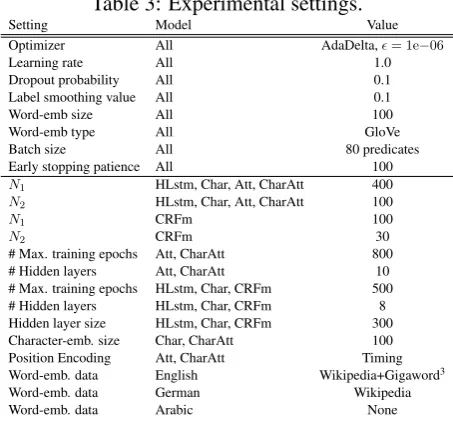
training epochs, and halved after every nextN2epochs. Detailed settings and the word embeddings used
to initialize the word representation layer used per language are found in Tab. 3.
Table 3: Experimental settings.
Setting Model Value
Optimizer All AdaDelta,ϵ= 1e−06
Learning rate All 1.0
N1 HLstm, Char, Att, CharAtt 400
N2 HLstm, Char, Att, CharAtt 100
N1 CRFm 100
N2 CRFm 30
# Max. training epochs Att, CharAtt 800
# Hidden layers Att, CharAtt 10
# Max. training epochs HLstm, Char, CRFm 500
# Hidden layers HLstm, Char, CRFm 8
Hidden layer size HLstm, Char, CRFm 300 Character-emb. size Char, CharAtt 100
Position Encoding Att, CharAtt Timing
Word-emb. data English Wikipedia+Gigaword3
Word-emb. data German Wikipedia
Word-emb. data Arabic None
Table 4: Training (Tr.) and prediction (Pr.) times (greedy) for English. Tr. time/epoch Pr. time/predicate
Table 5: Results on CoNLL’12 Arabic and CoNLL’09 German data: precision (P), recall (R), and F1.4
Arabic German
Model Development Evaluation Development Out-Of-Domain Evaluation
P R F1 P R F1 P R F1 P R F1 P R F1
HLstm 46.2 45.2 45.7 47.4 45.3 46.3 67.9 66.4 67.1 55.6 57.2 56.4 68.2 67.1 67.6 Char 51.2 50.2 50.7 47.5 46.0 46.7 69.1 66.5 67.8 54.0 55.2 54.6 68.2 67.0 67.6 CRFm 50.8 47.7 49.2 51.9 48.0 49.9 68.7 66.0 67.3 55.3 53.8 54.6 65.8 64.4 65.1 Att 50.4 48.0 49.2 50.0 46.7 48.3 71.6 70.8 71.2 54.7 56.8 55.7 71.9 71.5 71.7 CharAtt 56.9 56.0 56.5 56.0 54.5 55.2 74.8 73.8 74.3 57.2 57.3 57.3 73.4 73.6 73.5
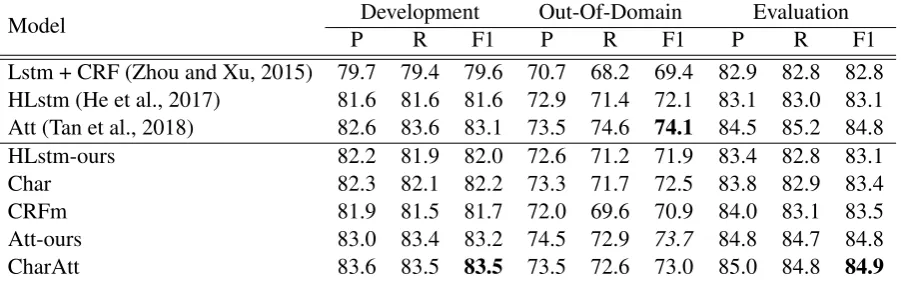
Table 6: Results on CoNLL’05 English data: precision (P), recall (R), and F1. We compare our results with other state-of-the-art deepsinglemodels.
Model Development Out-Of-Domain Evaluation
P R F1 P R F1 P R F1
Lstm + CRF (Zhou and Xu, 2015) 79.7 79.4 79.6 70.7 68.2 69.4 82.9 82.8 82.8 HLstm (He et al., 2017) 81.6 81.6 81.6 72.9 71.4 72.1 83.1 83.0 83.1 Att (Tan et al., 2018) 82.6 83.6 83.1 73.5 74.6 74.1 84.5 85.2 84.8
HLstm-ours 82.2 81.9 82.0 72.6 71.2 71.9 83.4 82.8 83.1
Char 82.3 82.1 82.2 73.3 71.7 72.5 83.8 82.9 83.4
CRFm 81.9 81.5 81.7 72.0 69.6 70.9 84.0 83.1 83.5
Att-ours 83.0 83.4 83.2 74.5 72.9 73.7 84.8 84.7 84.8
CharAtt 83.6 83.5 83.5 73.5 72.6 73.0 85.0 84.8 84.9
Table 7: F1 scores on CoNLL’05 English data, CoNLL’09 German data and CoNLL’12 Arabic data using 2000 random training sentences: Dev (Development), Eval (Evaluation), and Ood (Out of Domain).
Model English German Arabic
Dev Eval Ood Dev Eval Ood Dev Eval
HLstm-ours 62.8 54.3 64.9 42.34 45.58 40.44 35.12 34.42 Char 64.8 55.2 65.8 43.99 47.64 42.39 36.52 37.01
CRFm 65.8 57.5 67.0 43.42 44.06 40.73 38.91 38.36
Att-ours 57.4 51.7 59.6 32.48 37.13 31.45 23.38 23.32 CharAtt 58.2 52.4 60.7 33.35 38.49 31.91 35.10 34.70
4.2 Results and Discussion
In Tab. 5-6, we compare the five models on English, German and Arabic. The proposed CharAtt out-performs all other models in almost all cases except the English out-of-domain setting. As can be seen in Tab. 6, our implementation achieves competitive performance to other state-of-the-art systems for En-glish. To the best of our knowledge, we report the first SRL results (in CoNLL’05 metrics) for German and Arabic without using linguistic features.
In general, we find that using character embeddings improves the performance of HLstm and Att, al-though at a cost of increased processing time. Interestingly, using character embeddings is particularly effective for the Att model. One explanation could be that character embeddings are important for learn-ing good attention masks as they encode information about the syntax of words and the sentence, e.g., it facilitates the system in learning that the number (singular/plural) of a subject and its verb should match.
Among the three languages, the performance gain by character-level representations is larger for Ger-man and Arabic than for English. This can be explained by the much larger vocabularies for GerGer-man and Arabic combined with the smaller training datasets (#sentences, and#predicates) for these languages. Moreover, many grammatical cases, which are very strong predictors for semantic roles, are explicitly
165
marked through use of inflection in German and Arabic.
To evaluate the influence of the training size on model performance, we train the models on a random sample of 2000 sentences for each language (see Tab. 7). Intriguingly, the attention models perform worst in this setting, indicating their need of large datasets. A reason for this could be that the attention models consider the sequential dependency between hidden states to a lesser degree than recurrent models do. In contrast, CRFm achieves the best results for English and Arabic, and the second best result for German. In fact, CRFm exploits not only the input sequence – using the LSTM – but also the sequential output dependencies, to compute output probabilities. We can see that this is very beneficial when less training data is available, especially when word order is a strong cue for SRL, which applies well for a strict word order language like English. For such cases the output dependencies can be learned even from less training data, which results in the CRFm model to excel. As can be seen in Tab. 7, when comparing Char with HLstm-ours and CharAtt with Att-ours, the benefit of using character embeddings is demonstrated on small datasets as well.
5 Conclusions
We introduced an open source SRL framework, DAMESRL, which provides flexible model construction, using state-of-the-art model components, handles various input and output formats, and which comes with clear output visualization. Using our framework, we slightly improve the state-of-the-art results of single end-to-end deep systems on the English CoNLL’05, and report the first experimental end-to-end deep SRL results for German5and Arabic5. We have shown that the flexible model construction provided by the framework is crucial for exploring good model structures when considering different languages with different characteristics, especially when training data is limited. DAMESRL is made available under the Apache 2.0 license.
References
Anders Bj¨orkelund, Love Hafdell, and Pierre Nugues. 2009. Multilingual semantic role labeling. InProceedings
of CoNLL: Shared Task, CoNLL ’09. ACL.
Luheng He, Kenton Lee, Mike Lewis, and Luke Zettlemoyer. 2017. Deep semantic role labeling: What works and whats next. InProceedings of ACL, volume 1. ACL.
Sepp Hochreiter and Jrgen Schmidhuber. 1997. Long short-term memory. Neural Computation, 9(8).
Martha Palmer, Daniel Gildea, and Nianwen Xue. 2010. Semantic role labeling, volume 3. Morgan & Claypool Publishers.
Gabriel Pereyra, George Tucker, Jan Chorowski, Lukasz Kaiser, and Geoffrey E. Hinton. 2017. Regularizing neural networks by penalizing confident output distributions. InProceedings of the ICLR Workshop.
Zhixing Tan, Mingxuan Wang, Jun Xie, Yidong Chen, and Xiaodong Shi. 2018. Deep semantic role labeling with self-attention.
Yu Zhang, Guoguo Chen, Dong Yu, Kaisheng Yaco, Sanjeev Khudanpur, and James Glass. 2016. Highway long short-term memory RNNs for distant speech recognition. InProceedings of ICASSP. IEEE.
Jie Zhou and Wei Xu. 2015. End-to-end learning of semantic role labeling using recurrent neural networks. In
Proceedings of ACL-IJCNLP, volume 1. ACL.