Cross-Language Entity Linking
Paul McNamee and James Mayfield
HLTCOE & Applied Physics Laboratory Johns Hopkins University
{paul.mcnamee,james.mayfield}@jhuapl.edu
Dawn Lawrie
Loyola University Maryland [email protected]
Douglas W. Oard
iSchool & UMIACS
University of Maryland, College Park [email protected]
David Doermann
UMIACS
University of Maryland, College Park [email protected]
Abstract
There has been substantial recent interest in aligning mentions of named entities in unstructured texts to knowledge base de-scriptors, a task commonly called entity linking. This technology is crucial for applications in knowledge discovery and text data mining. This paper presents ex-periments in the new problem of cross-language entity linking, where documents and named entities are in a different lan-guage than that used for the content of the reference knowledge base. We have created a new test collection to evaluate cross-language entity linking performance in twenty-one languages. We present ex-periments that examine issues such as: the importance of transliteration; the utility of cross-language information retrieval; and, the potential benefit of multilingual named entity recognition. Our best model achieves performance which is 94% of a strong monolingual baseline.
1 Introduction
Entity Linking involves aligning a textual mention of a named entity to the entry in a knowledge base (KB) that represents the mentioned entity, if it is present. The problem has two main complicating features: entities can be referred to using multi-ple name variants (e.g., aliases or misspellings); and several entities can share the same name (e.g.,
many people are named Mar´ıa S´anchez). Ap-plications of entity linking include linking pa-tient health records from separate hospitalizations, maintaining personal credit files, preventing iden-tity crimes, and supporting law enforcement.
Starting in 2009 the NIST Text Analysis Conference (TAC) began conducting evaluations
of technologies for knowledge base population (KBP). Systems addressing the entity linking sub-task take as input a name string from a document and produce as output the knowledge base node, if any, corresponding to the mentioned entity. This capability is vital for knowledge discovery; with-out it, extracted information cannot be properly in-serted in the correct KB node. We follow the TAC-KBP problem formulation and use its reference knowledge base, which was derived from a 2008 snapshot of English Wikipedia. In the present work our focus is on person entities. We seek to develop and evaluate technologies for matching foreign language names to the appropriate knowl-edge base descriptor (orkbid) in the English KB.
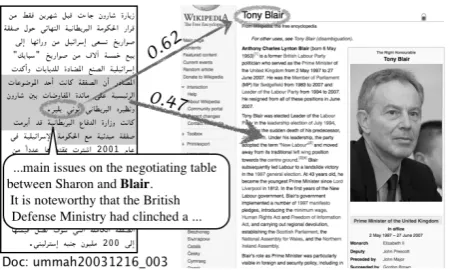
To support this research we created what we believe to be the first cross-language entity link-ing test collection. Our dataset includes twenty-one languages in addition to English, and covers five writing systems. Compared to the problem of monolingual (English) entity linking, a solution to the cross-language variant requires both a method to match foreign names to their English equiva-lents, and a way to compare contextual features from the non-English source document with con-textual information about known entities stored in the KB. Figure 1 illustrates the process.
The rest of this paper is structured as follows. In Section 2 we discuss related work in entity link-ing and cross-language name matchlink-ing. In Sec-tion 3 we present our approach to monolingual en-tity linking and describe the adaptations that are required to address the cross-language problem. Section 4 discusses the TAC-KBP evaluation and the construction of our test collection. Sections 5 and 6 present experiments exploring the effects of transliteration and cross-language content match-ing on the problem. Section 7 summarizes the main contributions of this work.
Figure 1: Linking an Arabic query referring to Tony Blair to a Wikipedia-derived KB using name matching and context matching features.
hentity wiki title=“Tony Blair” type=“PER” id=“E0481157” name=“Tony Blair”i hfacts class=“Infobox Prime Minister”i
hfact name=“honorific-prefix”iThe Right Honourableh/facti hfact name=“name”iTony Blairh/facti
hfact name=“order”iPrime Minister of the United Kingdomh/facti hfact name=“monarch”ihlink entity id=“E0699345”iElizabeth IIh/linkih/facti hfact name=“predecessor”ihlink entity id=“E0614790”iJohn Majorh/linkih/facti hfact name=“successor”ihlink entity id=“E0455080”iGordon Brownh/linkih/facti hfact name=“birth date”i6 May 1953 (1953-05-06) (age56)h/facti
hfact name=“spouse”ihlink entity id=“E0629105”iCherie Boothh/linkih/facti hfact name=“children”iEuan, Nicholas, Kathryn, Leoh/facti
hfact name=“alma mater”ihlinkiSt John’s College, Oxfordh/linkih/facti hfact name=“profession”ihlink entity id=“E0701822”iLawyerh/linkih/facti h/factsi
hwiki textih![CDATA[Tony Blair
Anthony Charles Lynton “Tony” Blair (born 6 May 1953) is a British politician who was Prime Minister of the United Kingdom from 2 May 1997 to 27 June 2007. He was Leader of the Labour Party from 1994 to 2007 and the Member of Parliament for Sedgefield from 1983 to 2007...
Figure 2: Excerpt from the KB entry for Tony Blair (E0481157). From LDC2009E58.
2 Related Work
Three types of named entity resolution are found in the literature: identity resolution, which matches structured or semi-structured entity de-scriptions, such as database records; coreference resolution, which clusters textual entity descrip-tions; andentity linking,which matches a textual description to a structured or semi-structured de-scription. All three types of resolution have signif-icant literature on monolingual processing; cross-language matching is less well studied.
Identity resolutionand its closely related cousin
record linkage grew out of the database commu-nity, which needs to determine when two database records represent the same entity. When matching records are found, identity resolution merges the two records, while record linkage simply notes the correspondence. Brizan and Tansel (2006) present a short overview of work in these fields. Typical approaches combine algorithmic matching of indi-vidual column values with hand-coded heuristics to combine the column scores and threshold the
result.
Coreference resolutionoperates over text, deter-mining when two entity mentions refer to the same entity. Approaches to within-document corefer-ence resolution typically exploit syntactic, gram-matical and discourse-level features, information that is not available when trying to resolve ref-erences across documents. Ng (2010) presents a comprehensive review of recent approaches to within-document coreference resolution. In con-trast, cross-document coreference resolution typ-ically assumes that within-document references have been resolved, and tries to place all such mention chains that refer to the same entity into a single cluster that represents that entity. Because the kinds of document-specific features that guide within-document coreference resolution are miss-ing, research in cross-document coreference reso-lution tends to be more directly applicable to entity linking (which also lacks those features). The Web People Search Evaluation Workshop (Artiles et al., 2010) has been one of the recent drivers of re-search in cross-document coreference resolution, defining a clustering task that groups Web pages for multiple people bearing the same name.
widely explored. TAC1 and NTCIR.2 have both for the first time announced plans for shared tasks for cross-language entity linking. Steinberger and Pouliquen (2007) describe a system that uses multilingual named entity recognition and cross-language name matching to automatically analyze tens of thousands of news stories daily; however, they do not conduct a formal evaluation of their name merging algorithm.
Contributing to each of these three kinds of named entity resolution are two essential un-derlying technologies: name matching and con-text matching. In name matching we ask the question, “Do two different strings represent the same name?” For example, we might like to know whether “Gadhafi” and “Khadafy” are two spellings of the same name. When used as a fea-ture for machine learning, we ask the related ques-tion, “How similar are two name strings?”
Cross-language name matching is closely re-lated to name transliteration. Indeed, transliterat-ing a name to the language of the knowledge base, then performing monolingual name matching in that language, is a reasonable approach to cross-language name matching. Name transliteration has an extensive literature; Karimi et al. (2011) present a comprehensive survey of the topic.
Name matching does not demand translitera-tion though; transliteratranslitera-tion is a generative pro-cess, and name matching requires only that a known name pair be given a score represent-ing the degree of match. Snae (2007) presents a survey of popular name matching algorithms from the record linkage perspective. Monolin-gually, Levenshtein distance (1966) and its vari-ants are used for basic string matching in many contexts. Cross-language approaches typically combine cross-language mappings of some sort with edit distance metrics. For example, Mani
et al.(2008) demonstrate a machine learning ap-proach to the problem.
The second crucial underlying technology is context matching. Monolingually, context match-ing can match on many contextual attributes, in-cluding words, entities, topics, or graph struc-tures. Context matching in the translingual set-ting is closely related to cross-language informa-tion retrieval (CLIR); both tasks attempt to esti-mate the degree of similarity between texts written
1http://nlp.cs.qc.cuny.edu/kbp/2011/ 2http://ntcir.nii.ac.jp/CrossLink/
in different languages. Kishida (2005) presents an overview of the key methods in CLIR.
3 Cross-Language Entity Linking
Our approach to entity linking breaks the problem down into two main parts: candidate identifica-tionandcandidate ranking. Candidate identifica-tion quickly identifies a small set of KB nodes that with high probability contain the correct answer, if it is present. Candidate ranking then consid-ers each candidate in greater detail, producing a ranked list. We give a description of each of these steps in this section; complete details of our En-glish entity linking approach, including descrip-tions of all of the features used and performance on the TAC-KBP datasets can be found in (Mc-Namee, 2010).
3.1 Candidate Identification
As a KB may contain a large number of entries, we prefer to avoid brute force comparisons between the query and all KB entities. To identify the en-tries that might reasonably correspond to the input named entity, we rely on a set of fast name match-ing techniques. We have found that it is possible to achieve high recall without resorting to contex-tual features. We create indexes for the names in the KB to support fast lookup of potential matches. The specific techniques that we use include:
• Exact match of query and candidate names • Known alias or nickname lookup
• Number of character 4-grams in common be-tween query and candidate
• Sum of IDF-weighted words in common
be-tween query and candidate3
In tests on the TAC-KBP 2009 test collection, this approach achieved 97.1% recall. For only 2.9% of the queries, the proper KB referent for the query was not one of the candidates. These cases were particularly challenging because they in-volved ambiguous organization names or obscure personal nicknames. Our methods are similar to methods used in the database community, some-times known asblocking(Whang et al., 2009) or
canopies(McCallum et al., 2000).
3Inverse document frequency weights enable us to
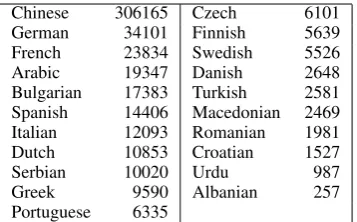
Chinese 306165 Czech 6101 German 34101 Finnish 5639 French 23834 Swedish 5526
Arabic 19347 Danish 2648
Bulgarian 17383 Turkish 2581 Spanish 14406 Macedonian 2469 Italian 12093 Romanian 1981 Dutch 10853 Croatian 1527
Serbian 10020 Urdu 987
Greek 9590 Albanian 257
Portuguese 6335
Table 1: Number of training pairs for transliterat-ing to English from each language.
To perform cross-language candidate identifica-tion, we transliterate4 the query name to English, then apply our monolingual English heuristics. We used the multilingual transliteration system and training data developed by Irvineet al.(2010) in their experiments in orthographic translitera-tion. The number of training name/transliteration pairs varied by language and is given in Ta-ble 1. The source for most of this training data is Wikipedia, which contains links between article pages in multiple languages.
3.2 Candidate Ranking
The second phase in our approach is to score each viable candidate using supervised machine learn-ing, and to select the highest scoring one as output. Each entity linking query is represented by a fea-ture vectorx, wherex∈Rk, and each candidatey
is a member ofY, the set of entities in the knowl-edge base. Individual feature functions, fi(x, y),
are based on intrinsic properties of the query x,
intrinsic properties of a specific KB candidate y,
and most commonly, on comparisons between the query and candidate. For each query our goal is to select a single KB entityyor choose NIL if the
mentioned entity is not represented in the KB. Thus, we desire that the correct knowledge base entityy0for a queryxreceives a higher score than
any other knowledge base entitiesy ∈ Y, y 6= y0.
We chose a soft maximum margin approach to learning and used the ranking Support Vector Ma-chine approach described by Joachims (2002) and implemented in the SVMrank tool. We selected a linear kernel for training speed, and set the slack parameterCto be0.01times the number of
train-ing examples.
In our system absence from the knowledge base
4We usetransliterationin a broad sense, to include
situa-tions where word translation rather than character translitera-tion is warranted.
is treated as a distinct ranked candidate, the so-called NIL candidate. NIL prediction is integrated into the process by including features that are in-dicative of no other candidate being correct. Con-sidering absence as a ranked candidate eliminates the need to select a threshold below which NIL will be returned.
The classes of feature functions we use include:
• Name matching features between the query
name (Qname) and KB candidate (KBname) • Text comparisons between the query
docu-ment (Qdoc) and the text associated with the
KB candidate
• Relation features, chiefly evidence from rela-tions in the KB being evidenced in theQdoc • Co-occurring entities, detected by running named entity recognition (NER) on theQdoc
and finding matching names in the candi-date’s KB entry
• Features pertaining to the entity type of the KB candidate
• Indications that no candidate is correct and
that NIL is therefore the appropriate response
3.2.1 Name matching
A variety of string similarity features are incorpo-rated to account for misspellings, name variants, or partially specified names when trying to match the query name and KB entry. Christen (2006) dis-cusses a variety of name matching features, sev-eral of which we adopt. One of the most useful is the Dice score over sets of character bigrams.
3.2.2 Cross-language name equivalence
In all of our cross-language experiments we added name matching features designed to directly cal-culate the likelihood that a given non-English name is equivalent to a given English name. The model is based on projections of character n-grams across languages (McNamee, 2008).
3.2.3 Contextual Similarity
We measure monolingual document similarity be-tweenQdocand the KB text (KBdoc) in two ways:
To match contexts when the query document and KB are in different languages we treat cross-language context linking as a CLIR problem in which the query is created from the words in the vicinity of mentions of the query name. We adopt Probabilistic Structured Queries (PSQ) (Darwish and Oard, 2003), the key idea of which is to treat alternate translations of a query term as synonyms and to weight the contributions of each “synonym” using a statistical translation model. We index the Wikipedia articles in our test collection using a publicly available IR tool (Indri), learn isolated word translation probabilities from a parallel text using the Berkeley aligner5 and Joshua,6 and im-plement PSQ using Indri’s#wsynoperator. Based on initial tests on training data, we use a contex-tual window size of±40 terms to the left and right of the query name mention as the source language query. In Roman alphabet languages, untranslated terms are retained in a character-normalized form.
3.2.4 Relation Features
As can be seen in Figure 2, the KB contains a set of attributes and relations associated with each en-tity (e.g.,age, employer, spouses, etc.). While one could run a relation extractor over the query docu-ment and look for relational equivalences, or con-tradictions, we chose a more straightforward ap-proach: we simply treat the words from all facts as a surrogate “document” and calculate document similarity with the query document.
3.2.5 Named Entity Features
We applied the named entity tagger by Ratinov and Roth (2009) to query documents and created features from the tagger output, including: the per-centage of NEs present inKBdoc; the percentage
of words from all NEs that are present inKBdoc;
and, the number of co-occurring NEs from Qdoc
that are present inKBdoc. Except for an
experi-ment described in Section 6.1, these features are only used in our monolingual English runs.
3.2.6 Entity Type Features
In English experiments the type of the query entity is determined from the NER output for the query document. Since the reference knowledge base provides a class (e.g., scientist) and a type (e.g.,
PER) for most entities, we can check whether the type of the KB entity is consistent with the query.
5http://code.google.com/p/berkeleyaligner/ 6http://sourceforge.net/projects/joshua/
This helps discourage selection of eponymous en-tries named after famous people (e.g., the USS Abraham Lincoln (CVN-72), a nuclear-powered aircraft carrier named after the 16th US president).
3.2.7 NIL Features
Some features can indicate whether it is likely or unlikely that there is a matching KB entry for a query. For example, if many candidates have strong name matches, it is reasonable to believe that one of them is correct. Conversely, if no can-diate has high textual similarity with the query, or overlap between KB facts and the query document text, it becomes more plausible to believe that the entity is missing from the KB.
4 Building a Test Collection for Entity Linking in Twenty-One Languages
The TAC-KBP entity linking test collections from 2009 and 2010 include the following resources: (a) a large collection of English documents; (b) approximately 7,000 queries comprising English name mentions from those documents; (c) a refer-ence knowledge base with over 818K entries; and (d) a set of annotations that identify the appro-priate KB entry for each query, or absence (Mc-Namee and Dang, 2009; Ji et al., 2010). The KB was created by processing a 2008 dump of English Wikipedia; each entry includes structured attributes obtained from Wikipedia’s infoboxes in addition to the unstructured article text. A sample KB entry is shown in Figure 2. We use the TAC KB in all of our experiments.
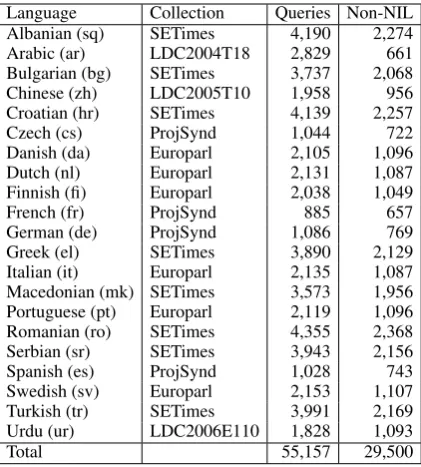
Language Collection Queries Non-NIL Albanian (sq) SETimes 4,190 2,274 Arabic (ar) LDC2004T18 2,829 661 Bulgarian (bg) SETimes 3,737 2,068 Chinese (zh) LDC2005T10 1,958 956 Croatian (hr) SETimes 4,139 2,257
Czech (cs) ProjSynd 1,044 722
Danish (da) Europarl 2,105 1,096 Dutch (nl) Europarl 2,131 1,087 Finnish (fi) Europarl 2,038 1,049
French (fr) ProjSynd 885 657
German (de) ProjSynd 1,086 769
Greek (el) SETimes 3,890 2,129
Italian (it) Europarl 2,135 1,087 Macedonian (mk) SETimes 3,573 1,956 Portuguese (pt) Europarl 2,119 1,096 Romanian (ro) SETimes 4,355 2,368 Serbian (sr) SETimes 3,943 2,156 Spanish (es) ProjSynd 1,028 743 Swedish (sv) Europarl 2,153 1,107 Turkish (tr) SETimes 3,991 2,169 Urdu (ur) LDC2006E110 1,828 1,093
Total 55,157 29,500
Table 2: Language coverage in our collection.
kbidfor each name. Finally, we use standard sta-tistical word alignment techniques implemented in the Berkeley Word Aligner (Haghighi et al., 2009) to map from English name mentions to the corre-sponding names in the non-English documents.
The six parallel collections we used came from the LDC and online sources. Together, these col-lections contain 196,717 non-English documents in five different scripts and twenty-one different languages. The final size of the query sets by lan-guage is shown in Table 2. We partitioned these queries and their associated documents into three sets per language: 60% for training, 20% for de-velopment, and 20% for test. In other work we give additional details about the creation of our test collection (Mayfield et al., 2011).
5 Experimental Results 5.1 English Baselines
Since all of our documents are from parallel cor-pora, every query is available in English and at least one other language. To serve as a point of comparison, we ran our monolingual entity linking system using the English version of the queries. We also determined performance of a baseline that predicts akbidif its entity’s name is a unique, exact match for the English query string, and NIL otherwise.
To compare approaches we calculate the per-centage of time that the top-ranked prediction from a system is correct, which we call
Precision-at-rank-one (P@1).7 For the exact match base-line (Exact), the mean P@1 accuracy across all query sets is 0.897; on the TAC-KBP 2010 person queries, this baseline achieves a score of 0.832, which is lower most likely because of the inten-tional efforts at TAC to artificially increase query name ambiguity. Results for both English base-lines are included in Table 3.
5.2 Cross-Language Name Matching
Table 3 also reports cross-language experiments in twenty languages where cross-language name matching is used to project the non-English query name into English (NameMatch), but the docu-ment remains untranslated. If the correct translit-eration is known from our translittranslit-eration training data, we perform table lookup; otherwise the 1-best transliteration produced by our model is used. Name matching alone produces serviceable per-formance. Averaged over all languages, perfor-mance on all queries is 93% of the monolingual English baseline. Losses tend to be small in the languages that use a Latin alphabet.
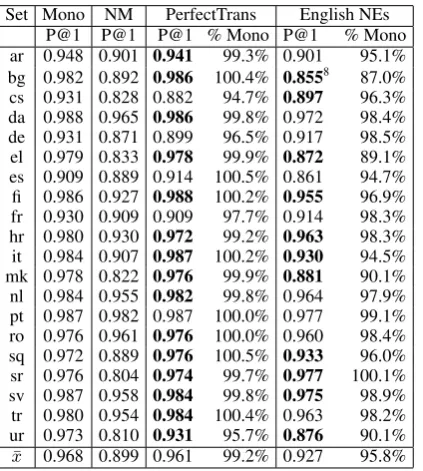
To investigate how errors in automated translit-eration affect the system, we also conducted an ex-periment where the human-produced translations of the entity name were obtained from the English side of the parallel data. In Table 4 we report how this condition (PerfectTrans) performs relative to the monolingual baseline. Perfect name transla-tion reduces the error rate dramatically, and per-formance of 99.2% of monolingual is obtained.
5.3 Name Matching and Context Matching
Table 3 also reports the use of both name match-ing and context matchmatch-ing usmatch-ing CLIR (+Context). Over all queries, performance rises from 92.9% to 93.9% of the English baseline. Bigger gains are evident on non-NIL queries. In fact, the pan-language average hides the fact that much larger gains are observed for non-NILs in Arabic, Czech, Macedonian, Serbian, and Turkish. We checked whether these gains are significant compared to NameMatch using the sign test; values indicating significant gains (p <0.05) are emboldened.
5.4 Learning Rate
Our approach depends on having a quantity of la-belled data on which to train a classifier. To in-vestigate the effect that the number of training
All Queries Non-NIL Queries
English Cross-Language English Cross-Language
Set N Mono Exact NameMatch +Context N Mono Exact NameMatch +Context ar 577 0.948 0.886 (93%) 0.901 (95%) 0.926 (98%) 136 0.838 0.552 (66%) 0.706 (84%) 0.787 (94%)
bg 770 0.982 0.918 (94%) 0.892 (91%) 0.892 (91%) 430 0.972 0.854 (88%) 0.821 (84%) 0.833 (86%) cs 203 0.931 0.764 (82%) 0.828 (89%) 0.862 (93%) 136 0.985 0.669 (68%) 0.772 (78%) 0.838 (85%)
da 428 0.988 0.963 (97%) 0.965 (98%) 0.963 (97%) 225 0.982 0.933 (95%) 0.938 (95%) 0.933 (95%) de 217 0.931 0.756 (81%) 0.871 (94%) 0.876 (94%) 154 0.987 0.675 (68%) 0.857 (87%) 0.877 (89%) el 776 0.979 0.928 (95%) 0.833 (85%) 0.851 (87%) 423 0.972 0.868 (89%) 0.714 (73%) 0.745 (77%)
es 208 0.909 0.760 (84%) 0.889 (98%) 0.894 (98%) 149 0.960 0.685 (71%) 0.873 (91%) 0.899 (94%)
fi 425 0.986 0.965 (98%) 0.927 (94%) 0.941 (95%) 220 0.982 0.936 (95%) 0.868 (88%) 0.900 (92%)
fr 186 0.930 0.742 (80%) 0.909 (98%) 0.876 (94%) 135 0.978 0.659 (67%) 0.904 (92%) 0.911 (93%) hr 846 0.980 0.924 (94%) 0.930 (95%) 0.920 (94%) 470 0.972 0.864 (89%) 0.889 (91%) 0.866 (89%) it 443 0.984 0.966 (98%) 0.907 (92%) 0.914 (93%) 227 0.978 0.938 (96%) 0.833 (85%) 0.859 (88%) mk 720 0.978 0.932 (95%) 0.822 (84%) 0.850 (87%) 391 0.967 0.875 (90%) 0.706 (73%) 0.749 (78%)
nl 441 0.984 0.964 (98%) 0.955 (97%) 0.955 (97%) 224 0.978 0.933 (95%) 0.924 (95%) 0.933 (95%) pt 443 0.987 0.964 (98%) 0.982 (100%) 0.977 (99%) 230 0.978 0.935 (96%) 0.974 (100%) 0.961 (98%) ro 878 0.976 0.924 (95%) 0.961 (98%) 0.961 (98%) 480 0.967 0.860 (89%) 0.935 (97%) 0.933 (97%) sq 849 0.972 0.927 (95%) 0.889 (92%) 0.913 (94%) 465 0.955 0.867 (91%) 0.809 (85%) 0.860 (90%)
sr 799 0.976 0.920 (94%) 0.804 (82%) 0.840 (86%) 447 0.966 0.857 (89%) 0.653 (68%) 0.743 (77%)
sv 448 0.987 0.964 (98%) 0.958 (97%) 0.960 (97%) 231 0.978 0.935 (96%) 0.935 (96%) 0.944 (96%) tr 804 0.980 0.923 (94%) 0.954 (97%) 0.968 (99%) 440 0.973 0.859 (88%) 0.925 (95%) 0.953 (98%)
ur 363 0.973 0.862 (89%) 0.810 (83%) 0.840 (86%) 215 0.967 0.772 (80%) 0.707 (73%) 0.763 (79%) ¯
x 541 0.968 0.897 (93%) 0.899 (93%) 0.909 (94%) 291 0.967 0.826 (85%) 0.837 (87%) 0.864 (89%)
Table 3: P@1 for a variety of experimental conditions. The left half of the table presents aggregate results for all queries; on the right performance is given for just non-NIL queries. Percentages are with respect to the monolingual English condition.
Set Mono NM PerfectTrans English NEs P@1 P@1 P@1 % Mono P@1 % Mono ar 0.948 0.901 0.941 99.3% 0.901 95.1% bg 0.982 0.892 0.986 100.4% 0.8558 87.0%
cs 0.931 0.828 0.882 94.7% 0.897 96.3% da 0.988 0.965 0.986 99.8% 0.972 98.4% de 0.931 0.871 0.899 96.5% 0.917 98.5% el 0.979 0.833 0.978 99.9% 0.872 89.1% es 0.909 0.889 0.914 100.5% 0.861 94.7% fi 0.986 0.927 0.988 100.2% 0.955 96.9% fr 0.930 0.909 0.909 97.7% 0.914 98.3% hr 0.980 0.930 0.972 99.2% 0.963 98.3% it 0.984 0.907 0.987 100.2% 0.930 94.5% mk 0.978 0.822 0.976 99.9% 0.881 90.1% nl 0.984 0.955 0.982 99.8% 0.964 97.9% pt 0.987 0.982 0.987 100.0% 0.977 99.1% ro 0.976 0.961 0.976 100.0% 0.960 98.4% sq 0.972 0.889 0.976 100.5% 0.933 96.0% sr 0.976 0.804 0.974 99.7% 0.977 100.1% sv 0.987 0.958 0.984 99.8% 0.975 98.9% tr 0.980 0.954 0.984 100.4% 0.963 98.2% ur 0.973 0.810 0.931 95.7% 0.876 90.1%
¯
x 0.968 0.899 0.961 99.2% 0.927 95.8%
Table 4: Cross-language effectiveness (P@1) over all queries with optimal (a) transliteration and (b) named entity recognition. Simply having access to perfect transliterations achieves 99% of mono-lingual performance, on average. Providing lists of named entities mentioned in the document, in English, also improves performance. Bold values indicate statistically significant gains compared to the NameMatch (NM) run.
0.80 0.82 0.84 0.86 0.88 0.90 0.92 0.94 0.96 0.98 1.00
0 500 1000 1500 2000 2500
Accuracy
Training Queries
tr hr ar sq de mk
Figure 3: Classifier accuracy and training set size.
emplars has on classifier accuracy we built classi-fiers using fixed numbers of training queries. Fig-ure 3 shows these results for selected languages. Each curve was produced by generating a random permutation of the training data, selecting the first
kqueries, and averaging the results over five
0.70 0.75 0.80 0.85 0.90 0.95 1.00
ar/ar ur/ar ur/ur ar/ur
0.70 0.75 0.80 0.85 0.90 0.95 1.00
bg/bg mk/bg mk/mk bg/mk
0.70 0.75 0.80 0.85 0.90 0.95 1.00
ro/ro tr/ro tr/tr ro/tr
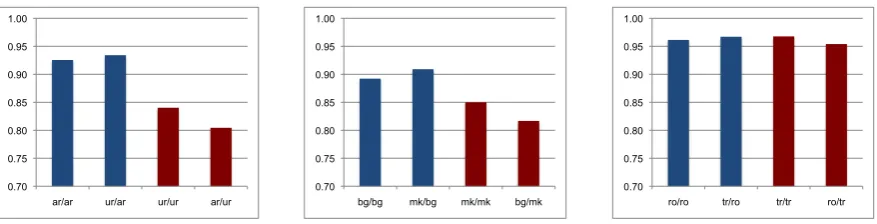
Figure 4: Training with annotations from another language using the same writing system. A label of
xx/yyindicates that feature weights were trained using labelled data from languagexxand then applied
to queries on languageyy.
6 Additional Experiments
6.1 Multilingual NER and Transliteration
We believe that the entities in a document that co-occur with a target entity are important clues for disambiguating entities. However, while we had ready access to named entity recognizers in En-glish, we did not have NER capability in all of the languages of our collection. We would like to know how useful multilingual NER could be. To simulate this using our test collection, where all documents are from parallel texts with an En-glish translation, we conducted an experiment that used the English documents only to recognize En-glish named entities that co-occur with the query string; in every other respect, the untranslated for-eign document was used by the system. The En-glish NER may make errors, but we use it to simulate the performance of excellent non-English NER coupled with perfect entity translation.
Table 4 shows that co-occurring entities are a very helpful feature. Compared to name matching alone, average P@1 rises from 89.9% to 92.7%.
6.2 Cross-Language Training
Although we have demonstrated an efficient method for building a test collection for cross-language entity linking, it may still be diffi-cult to obtain training data and tools for some less-resourced languages. Our process and fea-ture set is largely language-independent, and we would like to know how feasible it is to make predictions without any language-specific train-ing data by exploittrain-ing entity linktrain-ing annotations from a related language. We examined pairs of languages using the same script – Arabic/Urdu, Bulgarian/Macedonian, and Romanian/Turkish – and trained classifiers using labeled data for the
other language. Figure 4 shows that performance is not dramatically different when using annota-tions from a language sharing a common alphabet. This suggests that it is plausible to build a cross-language entity linking system without manually-produced annotations for a particular language.
7 Conclusions
In this paper we introduced a new problem, cross-language entity linking, and we described an ap-proach to this problem that uses statistical translit-eration and cross-language information retrieval. Using a newly-developed test collection for this task,9 we demonstrated the success of the ap-proach in twenty languages. Our best model us-ing both name and context matchus-ing achieves av-erage performance across twenty languages which is 94% of a strong monolingual English baseline, with individual languages ranging from 86% to 99%. Additionally, we characterized the number of training exemplars needed, demonstrated the feasibility of off-language training, and illustrated performance gains that are possible if combined multilingual NER/transliteration is available.
Acknowledgments
We are grateful to Chris Callison-Burch and Ann Irvine for their support with machine translation and orthographic transliteration, and to Tan Xu and Mohammad S. Raunak for their help in data curation. Support for one of authors was provided in part by NSF grant CCF 0916081.
8The English NEs run was significantly worse vs.
NameMatch in Bulgarian (bg).
9The test collection is available athttp://web.jhu.
References
Sisay Fissaha Adafre and Maarten de Rijke. 2005. Discovering missing links in Wikipedia. In LinkKDD ’05: Proceedings of the 3rd international workshop on Link discovery, pages 90–97. ACM. Javier Artiles, Andrew Borthwick, Julio Gonzalo,
Satoshi Sekine, and Enrique Amigo. 2010. Overview of the web people search clustering and at-tribute extraction tasks. InCLEF Third WEPS Eval-uation Workshop.
David Guy Brizan and Abdullah Uz Tansel. 2006. A survey of entity resolution and record link-age methodologies. Communications of the IIMA, 6(3):41–50.
Razvan C. Bunescu and Marius Pasca. 2006. Us-ing encyclopedic knowledge for named entity dis-ambiguation. InEuropean Chapter of the Assoca-tion for ComputaAssoca-tional Linguistics (EACL). Peter Christen. 2006. A comparison of personal name
matching: Techniques and practical issues. Techni-cal Report TR-CS-06-02, Australian National Uni-versity.
Silviu Cucerzan. 2007. Large-scale named entity dis-ambiguation based on Wikipedia data. InEmpirical Methods in Natural Language Processing.
Kareem Darwish and Douglas W. Oard. 2003. Prob-abilistic structured query methods. InACM SIGIR, pages 338–344. ACM.
Aria Haghighi, John Blitzer, John DeNero, and Dan Klein. 2009. Better word alignments with super-vised ITG models. InProceedings of the Joint Con-ference of the 47th Annual Meeting of the ACL and the 4th International Joint Conference on Natural Language Processing, pages 923–931. ACL. Ann Irvine, Chris Callison-Burch, and Alexandre
Kle-mentiev. 2010. Transliterating from all languages. InAMTA.
Heng Ji and Ralph Grishman. 2011. Knowledge base population: Successful approaches and challenges. InAssociation for Computational Linguistics. Heng Ji, Ralph Grishman, Hoa Trang Dang, Kira
Grif-fitt, and Joe Ellis. 2010. Overview of the TAC 2010 Knowledge Base Population track. InText Analysis Conference (TAC).
Thorsten Joachims. 2002. Optimizing search engines using clickthrough data. In Knowledge Discovery and Data Mining (KDD).
Sarvnaz Karimi, Falk Scholer, and Andrew Turpin. 2011. Machine transliteration survey. ACM Com-puting Surveys, 43(4):1–57.
Kazuaki Kishida. 2005. Technical issues of cross-language information retrieval: a review. Informa-tion Processing and Management, 41(3):433 – 455. Cross-Language Information Retrieval.
Martin Klein and Michael L. Nelson. 2008. A com-parison of techniques for estimating IDF values to generate lexical signatures for the web. In WIDM ’08, pages 39–46. ACM.
Vladimir I. Levenshtein. 1966. Binary codes capable of correcting deletions, insertions and reversals. So-viet Physics–Doklady, 10(8):707–710.
Inderjeet Mani, Alex Yeh, and Sherri Condon. 2008. Learning to match names across languages. In MMIES ’08, pages 2–9. ACL.
James Mayfield, Dawn Lawrie, Paul McNamee, and Douglas W. Oard. 2011. Building a cross-language entity linking collection in twenty-one languages. In Cross-Language Evaluation Forum (CLEF). Andrew McCallum, Kamal Nigam, and Lyle Ungar.
2000. Efficient clustering of high-dimensional data sets with application to reference matching. In Knowledge Discovery and Data Mining (KDD). Paul McNamee and Hoa Trang Dang. 2009. Overview
of the TAC 2009 Knowledge Base Population track. InText Analysis Conference (TAC).
Paul McNamee. 2008. Textual Representations for Corpus-Based Bilingual Retrieval. Ph.D. thesis, University of Maryland Baltimore County, Balti-more, MD.
Paul McNamee. 2010. HLTCOE efforts in entity link-ing at TAC KBP 2010. InText Analysis Conference (TAC), Gaithersburg, Maryland, November.
Rada Mihalcea and Andras Csomai. 2007. Wikify!: linking documents to encyclopedic knowledge. In CIKM, pages 233–242.
David N. Milne and Ian H. Witten. 2008. Learning to link with wikipedia. InCIKM, pages 509–518. Vincent Ng. 2010. Supervised noun phrase
corefer-ence research: The first fifteen years. In Proceed-ings of the 48th Annual Meeting of the Association for Computational Linguistics, pages 1396–1411. Lev Ratinov and Dan Roth. 2009. Design
chal-lenges and misconceptions in named entity recog-nition. In Proceedings of the Thirteenth Confer-ence on Computational Natural Language Learning (CoNLL-2009), pages 147–155, Boulder, Colorado, June. Association for Computational Linguistics. Chakkrit Snae. 2007. A comparison and analysis of
name matching algorithms. Proceedings of World Academy of Science, Engineering and Technology, 21:252–257, January.
Ralf Steinberger and Bruno Pouliquen. 2007. Cross-lingual named entity recognition. Linguisticae In-vestigationes, 30(1):135–162, January.