Rapid Prototyping of Robust Language Understanding Modules
for Spoken Dialogue Systems
†Yuichiro Fukubayashi,†Kazunori Komatani,‡Mikio Nakano, ‡Kotaro Funakoshi,‡Hiroshi Tsujino,†Tetsuya Ogata,†Hiroshi G. Okuno †Graduate School of Informatics, Kyoto University
Yoshida-Hommachi, Sakyo, Kyoto 606-8501, Japan
{fukubaya,komatani}@kuis.kyoto-u.ac.jp {ogata,okuno}@kuis.kyoto-u.ac.jp
‡Honda Research Institute Japan Co., Ltd. 8-1 Honcho, Wako, Saitama
351-0188, Japan
{funakoshi,tsujino}@jp.honda-ri.com
Abstract
Language understanding (LU) modules for spoken dialogue systems in the early phases of their development need to be (i) easy to construct and (ii) robust against vari-ous expressions. Conventional methods of LU are not suitable for new domains, be-cause they take a great deal of effort to make rules or transcribe and annotate a suf-ficient corpus for training. In our method, the weightings of the Weighted Finite State Transducer (WFST) are designed on two levels and simpler than those for conven-tional WFST-based methods. Therefore, our method needs much fewer training data, which enables rapid prototyping of LU mod-ules. We evaluated our method in two dif-ferent domains. The results revealed that our method outperformed baseline methods with less than one hundred utterances as training data, which can be reasonably prepared for new domains. This shows that our method is appropriate for rapid prototyping of LU modules.
1 Introduction
[image:1.612.340.511.257.420.2]The language understanding (LU) of spoken dia-logue systems in the early phases of their devel-opment should be trained with a small amount of data in their construction. This is because large amounts of annotated data are not available in the early phases. It takes a great deal of effort and time to transcribe and provide correct LU results to a
Figure 1: Relationship between our method and con-ventional methods
large amount of data. The LU should also be robust, i.e., it should be accurate even if some automatic speech recognition (ASR) errors are contained in its input. A robust LU module is also helpful when col-lecting dialogue data for the system because it sup-presses incorrect LU and unwanted behaviors. We developed a method of rapidly prototyping LU mod-ules that is easy to construct and robust against var-ious expressions. It makes LU modules in the early phases easier to develop.
con-Figure 2: Example of WFST for LU
cepts from user utterances by keyword spotting or heuristic rules has also been proposed (Seneff, 1992) where utterances can be transformed into concepts without major modifications to the rules. However, numerous complicated rules similarly need to be manually prepared. Unfortunately, neither method is robust against ASR errors.
To cope with these problems, corpus-based (Su-doh and Tsukada, 2005; He and Young, 2005) and Weighted Finite State Transducer (WFST)-based methods (Potamianos and Kuo, 2000; Wutiwi-watchai and Furui, 2004) have been proposed as LU modules for spoken dialogue systems. Since these methods extract concepts using stochastic analy-sis, they do not need numerous complicated rules. These, however, require a great deal of training data to implement the module and are not suitable for constructing new domains.
Here, we present a new WFST-based LU module that has two main features.
1. A statistical language model (SLM) for ASR and a WFST for parsing that are automatically generated from the domain grammar descrip-tion.
2. Since the weighting for the WFST is simpler than that in conventional methods, it requires fewer training data than conventional weight-ing schemes.
Our method accomplishes robust LU with less ef-fort using SLM-based ASR and WFST parsing. Fig-ure 1 outlines the relationships between our method and conventional schemes. Since rule- or grammar-based approaches do not require a large amount of data, they take less effort than stochastic techniques.
However, they are not robust against ASR errors. Stochastic approaches, on the contrary, take a great deal of effort to collect data but are robust against ASR errors. Our method is an intermediate approach that lies between these. That is, it is more robust than rule- or grammar-based approaches and takes less effort than stochastic techniques. This characteristic makes it easier to rapidly prototype LU modules for a new domain and helps development in the early phases.
2 Related Work and WFST-based Approach
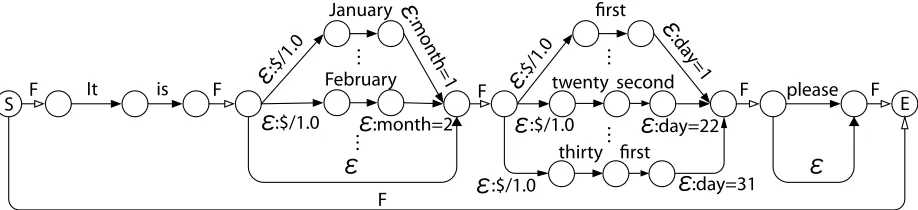
A Finite State Transducer (FST)-based LU is ex-plained here, which accepts ASR output as its in-put. Figure 2 shows an example of the FST for a video recording reservation domain. The input, ε,
means that a transition with no input is permitted at the state transition. In this example, the LU mod-ule returns the concept [month=2, day=22] for the utterance “It is February twenty second please”. Here, a FILLER transition in which any word is ac-cepted is appropriately allowed between phrases. In Figure 2, ‘F’ represents 0 or more FILLER tran-sitions. A FILLER transition from the start to the end is inserted to reject unreliable utterances. This FILLER transition enables us to ignore unnecessary words listed in the example utterances in Table 1. The FILLER transition helps to suppress the inser-tion of incorrect concepts into LU results.
[image:2.612.80.539.71.176.2]Table 2: Many LU results for input “It is February twenty second please”
LU output LU result w
It is February twenty second please month=2, day=22 2.0
It is FILLER twenty second please day=22 1.0
It is FILLER twenty second FILLER day=22 1.0
FILLER FILLER FILLER FILLER FILLER FILLER n/a 0
Table 1: Examples of utterances with FILLERs ASR output
Well,it is February twenty second please It isuhm,February twenty second please It is February,twe-, twenty second please It is February twenty second please,OK?
(LU result = [month=2, day=22])
WFST-based LU. In the example in Table 2, the concept [month=2, day=22] has been selected, be-cause its cumulative weight,w, is 2.0, which is the
highest.
The weightings of conventional WFST-based ap-proaches used an n-gram of concepts (Potamianos
and Kuo, 2000) and that of word-concept pairs (Wu-tiwiwatchai and Furui, 2004). They obtained the
n-grams from several thousands of annotated
ut-terances. However, it takes a great deal of ef-fort to transcribe and annotate a large corpus. Our method enables prototype LU modules to be rapidly constructed that are robust against various expres-sions with SLM-based ASR and WFST-based pars-ing. The SLM and WFST are generated automat-ically from a domain grammar description in our toolkit. We need fewer data to train WFST, because its weightings are simpler than those in conventional methods. Therefore, it is easy to develop an LU module for a new domain with our method.
3 Domain Grammar Description
A developer defines grammars, slots, and concepts in a domain in an XML file. This description en-ables an SLM for ASR and parsing WFST to be au-tomatically generated. Therefore, a developer can construct an LU module rapidly with our method.
Figure 3 shows an example of a descrip-tion. A definition of a slot is described in keyphrase-class tags and its keyphrases and
...
<keyphrase-class name="month"> ...
<keyphrase>
<orth>February</orth> <sem>2</sem>
</keyphrase> ...
</keyphrase-class> ...
<action type="specify-attribute">
<sentence> {It is} [*month] *day [please] </sentence>
</action>
Figure 3: Example of a grammar description
the values are inkeyphrasetags. The monthis defined as a slot in this figure.Februaryand2are defined as one of the phrases and values for the slot month. A grammar is described in a sequence of terminal and non-terminal symbols. A non-terminal symbol represents a class of keyphrases, which is defined inkeyphrase-class. It begins with an asterisk “*” in a grammar description insentence tags. Symbols that can be skipped are enclosed by brackets []. The FILLER transition described in Section 2 is inserted between the symbols un-less they are enclosed in brackets[]or braces {}. Braces are used to avoid FILLER transitions from being inserted. For example, the grammar in Figure 3 accepts “It is February twenty second please.” and “It is twenty second, OK?”, but rejects “It is Febru-ary.” and “It, uhm, is February twenty second.”.
4 Weighting for ASR Outputs on Two Levels
We define weights on two levels for a WFST. The first isa weighting for ASR outputs, which is set to select paths that are reliable at a surface word level. The second is a weighting for concepts, which is used to select paths that are reliable on a concept level. The weighting for concepts reflects correct-ness at a more abstract level than the surface word level. The weighting for ASR outputs consists of two categories: a weighting for ASR N-best outputs and one for accepted words. We will describe the definitions of these weightings in the following sub-sections.
4.1 Weighting for ASR N-Best Outputs
The N-best outputs of ASR are used for an input of a WFST. Weights are assigned to each sentence in ASR N-best outputs. Larger weights are given to more reliable sentences, whose ranks in ASR N-best are higher. We define this preference as
wis= e
β·scorei PN
j eβ·scorej ,
wherewsi is a weight for the i-th sentence in ASR
N-best outputs,βis a coefficient for smoothing, and scorei is the log-scaled score of thei-th ASR
out-put. This weighting reflects the reliability of the ASR output. We set β to 0.025 in this study after
a preliminary experiment.
4.2 Weighting for Accepted Words
Weights are assigned to word sequences that have been accepted by the WFST. Larger weights are given to more reliable sequences of ASR outputs at the surface word level. Generally, longer sequences having more words that are not fillers and more re-liable ASR outputs are preferred. We define these preferences as the weights:
1. word(const.): ww= 1.0,
2. word(#phone): ww =l(W), and
3. word(CM):ww =CM(W)−θw.
The word(const.) gives a constant weight to all accepted words. This means that sequences
with more words are simply preferred. The
word(#phone) takes the length of each accepted word into consideration. This length is measured by its number of phonemes, which are normalized by that of the longest word in the vocabulary. The nor-malized values are denoted asl(W) (0 < l(W) ≤ 1). By adopting word(#phone), the length of se-quences is represented more accurately. We also take the reliability of the accepted words into ac-count asword(CM). This uses confidence measures (Lee et al., 2004) for a word, W, in ASR outputs,
which are denoted asCM(W). Theθwis the
thresh-old for determining whether wordW is accepted or
not. Theww obtains a negative value for an
unreli-able wordW whenCM(W)is lower thanθw. This
represents a preference for longer and more reliable sequences.
4.3 Weighting for Concepts
In addition to the ASR level, weights on a concept level are also assigned. The concepts are obtained from the parsing results by the WFST, and contain several words. Weights for concepts are defined by using the measures of all words contained in a con-cept.
We prepared three kinds of weights for the con-cepts:
1. cpt(const.): wc= 1.0,
2. cpt(avg):
wc= P
W(CM(W)−θc)
#W ,and
3. cpt(#pCM(avg)):
wc= P
W(CM(W)·l(W)−θc)
#W ,
whereWis a set of accepted words,W, in the
corre-sponding concept, and#W is the number of words inW.
The cpt(const.) represents a preference for sequences with more concepts. The cpt(avg)
is defined as the weight by using the CM(W) of each word contained in the concept. The
cpt(#pCM(avg))represents a preference for longer and reliable sequences with more concepts. Theθc
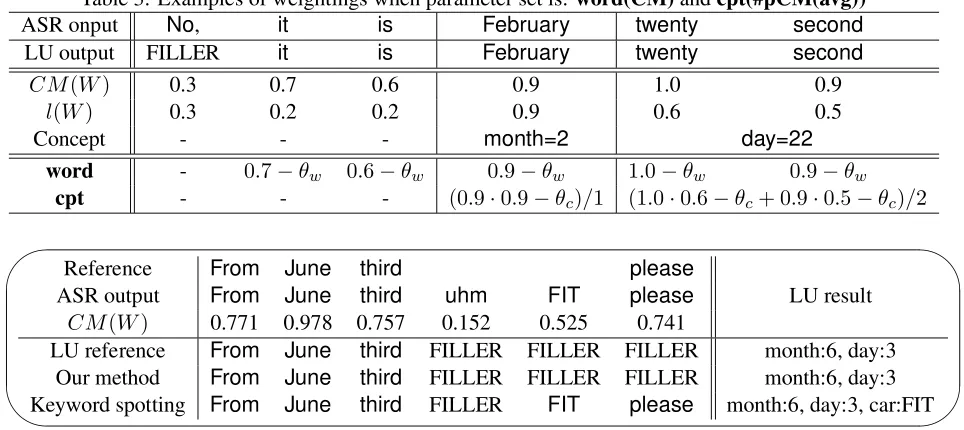
Table 3: Examples of weightings when parameter set is:word(CM)andcpt(#pCM(avg))
ASR onput No, it is February twenty second
LU output FILLER it is February twenty second
CM(W) 0.3 0.7 0.6 0.9 1.0 0.9
l(W) 0.3 0.2 0.2 0.9 0.6 0.5
Concept - - - month=2 day=22
word - 0.7−θw 0.6−θw 0.9−θw 1.0−θw 0.9−θw
cpt - - - (0.9·0.9−θc)/1 (1.0·0.6−θc+ 0.9·0.5−θc)/2
'
&
$
%
Reference From June third please
ASR output From June third uhm FIT please LU result
CM(W) 0.771 0.978 0.757 0.152 0.525 0.741
LU reference From June third FILLER FILLER FILLER month:6, day:3
Our method From June third FILLER FILLER FILLER month:6, day:3
Keyword spotting From June third FILLER FIT please month:6, day:3, car:FIT (‘FIT’ is the name of a car.) Figure 4: Example of LU with WFST
4.4 Calculating Cumulative Weight and Training
The LU results are selected based on the weighted sum of the three weights in Subsection 4.3 as
wi=wsi +αw X
ww+αc X
wc
The LU module selects an output sequence with the highest cumulative weight,wi, for1≤i≤N.
Let us explain how to calculate cumulative weight
wi by using the example specified in Table 3. Here,
word(CM)andcpt(#pCM(avg))are selected as pa-rameters. The sum of weights in this table for ac-cepted words isαw(4.1−5θw), when the input
se-quence is “No, it is February twenty second.”. The sum of weights for concepts isαc(1.335−2θc)
because the weight for “month=2” isαc(0.81−θc) and the weight for “day=22” is αc(0.525 − θc).
Therefore, cumulative weight wi for this input
se-quence iswi
s+αw(4.1−5θw) +αc(1.335−2θc).
In the training phase, various combinations of pa-rameters are tested, i.e., which weightings are used for each of ASR output and concept level, such as
N =1 or 10, coefficientαw,c=1.0 or 0, and
thresh-oldθw,c =0 to 0.9 at intervals of 0.1, on the train-ing data. The coefficient αw,c = 0 means that a
corresponding weight is not added. The optimal
pa-rameter settings are obtained after testing the various combinations of parameters. They make the concept error rate (CER) minimum for a training data set. We calculated the CER in the following equation:
CER= (S+D+I)/N, whereN is the number of
concepts in a reference, andS,D, andI correspond
to the number of substitution, deletion, and insertion errors.
Figure 4 shows an example of LU with our method, where it rejects misrecognized concept
[car:FIT], which cannot be rejected by keyword spotting.
5 Experiments and Evaluation
5.1 Experimental Conditions
We discussed our experimental investigation into the effects of weightings in Section 4. The user utter-ance in our experiment was first recognized by ASR. Then, thei-th sentence of ASR output was input to
WFST for 1 ≤ i ≤ N, and the LU result for the
highest cumulative weight,wi, was obtained.
eight different dialogues with 23 different speakers. We used Julius 1 as a speech recognizer with an
SLM. The language model was prepared by using example sentences generated from the grammars of both domains. We used 10000 example sentences in the video and 40000 in the rent-a-car domain. The number of the generated sentences was determined empirically. The vocabulary size was 209 in the video and 891 in the rent-a-car domain. The average ASR accuracy was 83.9% in the video and 65.7% in the rent-a-car domain. The grammar in the video domain included phrases for dates, times, channels, commands. That of the rent-a-car domain included phrases for dates, times, locations, car classes, op-tions, and commands. The WFST parsing mod-ule was implemented by using the MIT FST toolkit (Hetherington, 2004).
5.2 Performance of WFST-based LU
We evaluated our method in the two domains: video and rent-a-car. We compared the CER on test data, which was calculated by using the optimal settings for both domains. We evaluated the results with 4-fold cross validation. The number of utterances for training was 3139 (=4186*(3/4)) in the video and 2523 (=3364*(3/4)) in the rent-a-car domain.
The baseline method was simple keyword spot-ting because we assumed a condition where a large amount of training data was not available. This method extracts as many keyphrases as possible from ASR output without taking speech recogni-tion errors and grammatical rules into considerarecogni-tion. Both grammar-based and SLM-based ASR outputs are used for input in keyword spotting (denoted as “Grammar & spotting” and “SLM & spotting” in Table 4). The grammar for grammar-based ASR was automatically generated by the domain descrip-tion file. The accuracy of grammar-based ASR was 66.3% in the video and 43.2% in the rent-a-car do-main.
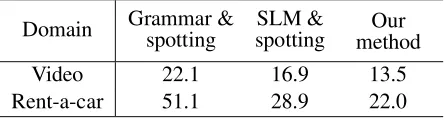
Table 4 lists the CERs for both methods. In key-word spotting with SLM-based ASR, the CERs were improved by 5.2 points in the video and by 22.2 points in the rent-a-car domain compared with those with grammar-based ASR. This is because SLM-based ASR is more robust against fillers and
[image:6.612.316.538.93.153.2]un-1http://julius.sourceforge.jp/
Table 4: Concept error rates (CERs) in each domain Domain Grammar &spotting spottingSLM & methodOur
Video 22.1 16.9 13.5
Rent-a-car 51.1 28.9 22.0
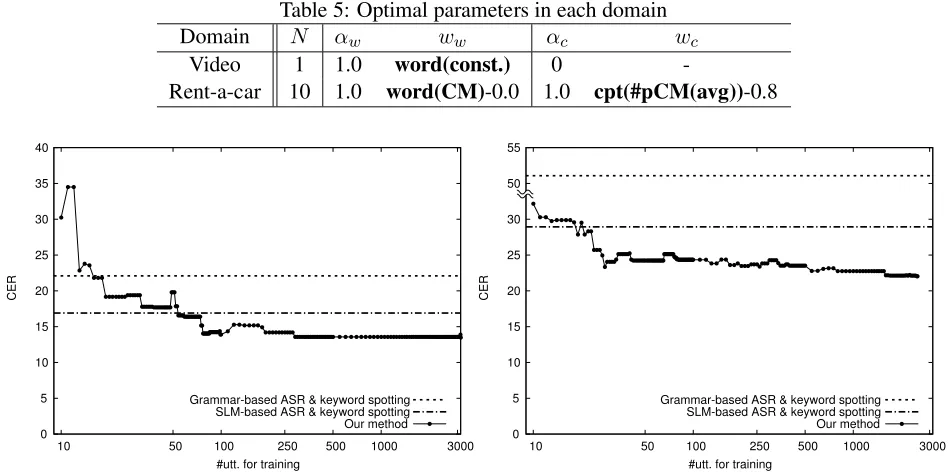
known words than grammar-based ASR. The CER was improved by 3.4 and 6.9 points by optimal weightings for WFST. Table 5 lists the optimal pa-rameters in both domains. Theαc = 0in the video
domain means that weights for concepts were not used. This result shows that optimal parameters de-pend on the domain for the system, and these need to be adapted for each domain.
5.3 Performance According to Training Data
We also investigated the relationship between the size of the training data for our method and the CER. In this experiment, we calculated the CER in the test data by increasing the number of utterances for training. We also evaluated the results by 4-fold cross validation.
Figures 5 and 6 show that our method outper-formed the baseline methods by about 80 utterances in the video domain and about 30 utterances in the rent-a-car domain. These results mean that our method can effectively be used to rapidly prototype LU modules. This is because it can achieve robust LU with fewer training data compared with conven-tional WFST-based methods, which need over sev-eral thousand sentences for training.
6 Conclusion
re-Table 5: Optimal parameters in each domain
Domain N αw ww αc wc
Video 1 1.0 word(const.) 0
-Rent-a-car 10 1.0 word(CM)-0.0 1.0 cpt(#pCM(avg))-0.8
0 5 10 15 20 25 30 35 40
3000 1000
500 250 100 50 10
CER
#utt. for training
Grammar-based ASR & keyword spotting SLM-based ASR & keyword spotting Our method
Figure 5: CER in video domain
0 5 10 15 20 25 30 50 55
3000 1000
500 250 100 50 10
CER
#utt. for training
Grammar-based ASR & keyword spotting SLM-based ASR & keyword spotting Our method
Figure 6: CER in rent-a-car domain
vealed that the CER could be improved compared to the baseline by training optimal parameters with a small amount of training data, which could be rea-sonably prepared for new domains. This means that our method is appropriate for rapidly prototyping LU modules. Our method should help developers of spoken dialogue systems in the early phases of development. We intend to evaluate our method on other domains, such as database searches and ques-tion answering in future work.
Acknowledgments
We are grateful to Dr. Toshihiko Ito and Ms. Yuka Nagano of Hokkaido University for constructing the rent-a-car domain system.
References
Yulan He and Steve Young. 2005. Spoken Language Understanding using the Hidden Vector State Model.
Speech Communication, 48(3-4):262–275.
Lee Hetherington. 2004. The MIT finite-state trans-ducer toolkit for speech and language processing. In
Proc. 6th International Conference on Spoken
Lan-guage Processing (INTERSPEECH-2004 ICSLP).
Akinobu Lee, Kiyohiro Shikano, and Tatsuya Kawahara.
2004. Real-time word confidence scoring using lo-cal posterior probabilities on tree trellis search. In
Proc. 2004 IEEE International Conference on
Acous-tics, Speech, and Signal Processing (ICASSP 2004),
volume 1, pages 793–796.
Alexandors Potamianos and Hong-Kwang J. Kuo. 2000. Statistical recursive finite state machine parsing for speech understanding. In Proc. 6th Interna-tional Conference on Spoken Language Processing
(INTERSPEECH-2000 ICSLP), pages 510–513.
Stephanie Seneff. 1992. TINA: A natural language sys-tem for spoken language applications. Computational Linguistics, 18(1):61–86.
Katsuhito Sudoh and Hajime Tsukada. 2005. Tightly in-tegrated spoken language understanding using word-to-concept translation. In Proc. 9th European Con-ference on Speech Communication and Technology
(INTERSPEECH-2005 Eurospeech), pages 429–432.
Chai Wutiwiwatchai and Sadaoki Furui. 2004. Hybrid statistical and structural semantic modeling for Thai multi-stage spoken language understanding. InProc. HLT-NAACL Workshop on Spoken Language Under-standing for Conversational Systems and Higher Level
Linguistic Information for Speech Processing, pages
[image:7.612.69.544.81.317.2]