Cross-domain Feature Selection for Language Identification
Marco Lui and Timothy Baldwin
NICTA VRL
Department of Computer Science and Software Engineering University of Melbourne, VIC 3010, Australia
[email protected], [email protected]
Abstract
We show that transductive (cross-domain) learning is an important consideration in building a general-purpose language iden-tification system, and develop a feature selection method that generalizes across domains. Our results demonstrate that our method provides improvements in transductive transfer learning for language identification. We provide an implementa-tion of the method and show that our sys-tem is faster than popular standalone lan-guage identification systems, while main-taining competitive accuracy.
1 Introduction
Language identification (LangID) is the task of determining the language(s) that a text is written in. It is considered by some researchers to be a solved task, because previous research has re-ported near-perfect accuracy (Cavnar and Trenkle, 1994). Hughes et al. (2006) elaborated a number of simplifying assumptions that have made this the case, and Baldwin and Lui (2010a) showed that when some of these assumptions are relaxed to make the task closer to the actuality of open-web LangID, it becomes considerably harder. In this paper, we demonstrate that the style of evaluation used by Baldwin and Lui (2010a) performs well in-domain but badly cross-domain, and develop a novel method for preserving high in-domain ac-curacy, while significantly boosting cross-domain accuracy. Similarly to Baldwin and Lui (2010a), we make the simplifying assumption that all doc-uments are monolingual, despite recent work on multilingual LangID (Baldwin and Lui, 2010b).
LangID is usually formulated as a supervised machine learning problem and evaluated in an of-fline setting (Cavnar and Trenkle, 1994; Baldwin and Lui, 2010a). However, its primary use is
online without any additional configuration, op-timized for maximal cross-domain accuracy. A number of such standalone LangID systems are available, notable among which isTextCat(van Noord, 1997). TextCat has been the LangID solution of choice in research, and is the basis of language identification/filtering in the ClueWeb09 Dataset (Callan and Hoy, 2009) and Corpus-Builder (Ghani et al., 2004). Elsewhere, Google provides LangID as a web service via its Google Language Detect API (GoogleAPI). While it has much higher accuracy thanTextCat(as we show in Section 6.1), research applications contravene the service’s terms of use, and moreover the ser-vice is rate-limited.
Our ideal system should offer the same ad-vantages as TextCatin terms of licensing and run-time speed, while matching the open-domain accuracy and ease-of-use of an API such as
GoogleAPI. To this end, we release the op-timized final LangID system described in this paper, and benchmark it against TextCat and
GoogleAPI. Our major contributions are: (1) we show that negative transfer occurs when training a classifier over a combined set of LangID datasets; (2) we show that language models learned in a par-ticular domain do not always generalize to other domains; (3) we develop a method for extracting features for LangID that are not tied to a particular domain, and show that our method mitigates neg-ative transfer and provides improvements in cross-domain LangID; (4) we show that our method can incorporate additional languages without a penalty in performance on existing languages; and (5) we provide an implementation of our method that is faster than state-of-the-art LangID systems while maintaining competitive accuracy.
2 Background
LangID as a computational task is usually at-tributed to Gold (1967), who sought to investigate
language learnability from a language theory per-spective. However, its current form is much more recognizable in the work of Cavnar and Trenkle (1994), where the authors classified documents ac-cording to rank order statistics over byten-grams
between a document and a global language pro-file. Since the 1990s, LangID has been formu-lated as a supervised machine learning task, and has been greatly influenced by text categorization in general. Monolingual LangID of a test docu-mentDitakes the form of a mapping onto a unique language from a closed set of languages C, i.e. I :Di →ci ∈C.
Statistical approaches applied to LangID in-clude the use of Markov models overn-gram
fre-quencies (Dunning, 1994) and dot products of word frequency vectors (Darnashek, 1995). Ker-nel methods have also been applied to the task of LangID (Kruengkrai et al., 2005). Linguistically motivated models for LangID have also been pro-posed, such as stop word list overlap (Johnson, 1993), where a document is classified according to its overlap with lists for different languages. There has also been work on word and part of speech cor-relation (Grefenstette, 1995), cross-language to-kenisation (Giguet, 1995) and grammatical-class models (Dueire Lins and Gonc¸alves, 2004).
LangID has been applied in a variety of do-mains, including USENET messages (Cavnar and Trenkle, 1994), web pages (Kikui, 1996; Mar-tins and Silva, 2005; Liu and Liang, 2008), and web search queries (Hammarstrom, 2007; Ceylan and Kim, 2009). It has been shown to improve performance of other tasks such as parsing (Alex et al., 2007) and multilingual text retrieval (Mc-Namee and Mayfield, 2004). It has also been used for gathering data for linguistic corpus creation (Ghani et al., 2004; Baldwin et al., 2006; Xia et al., 2009; Xia and Lewis, 2009), and is an im-portant area of research for supporting low-density languages (Hughes et al., 2006; Abney and Bird, 2010).
Transfer learningrefers to the use of data from external domains to improve task performance on a target domain. Pan and Yang (2010) provide a survey, in which they definetransductivetransfer learning, where labels are available in source do-main(s) but not in the target domain. This corre-sponds exactly to our task, where we wish to train a classifier using language-labelled data from a va-riety of sources, and apply this classifier to target
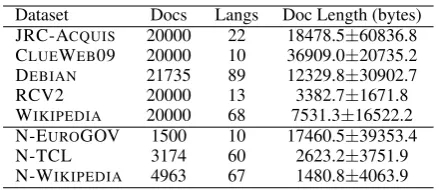
Dataset Docs Langs Doc Length (bytes) JRC-ACQUIS 20000 22 18478.5±60836.8 CLUEWEB09 20000 10 36909.0±20735.2 DEBIAN 21735 89 12329.8±30902.7
RCV2 20000 13 3382.7±1671.8
WIKIPEDIA 20000 68 7531.3±16522.2 N-EUROGOV 1500 10 17460.5±39353.4
N-TCL 3174 60 2623.2±3751.9
N-WIKIPEDIA 4963 67 1480.8±4063.9
Table 1: Summary of the LangID datasets
data without making any assumptions about its do-main. Pan and Yang (2010) also discuss the phe-nomenon ofnegative transfer, whereby including data from the source domain(s) results in reduced performance in the target domain.
Other work has used the term domain adapta-tion to refer toinductive transfer learning, where labels are available in both the source and target domains, and the goal is to improve the perfor-mance in the target domain (Daum´e III and Marcu, 2006; Daum´e III, 2007). Daum´e III and Marcu (2006) tackle this problem by using a mixture model, where data in a specific domain is mod-elled as coming from a mixture of domain-specific and general components, and the linkage between domains is achieved by sharing a single general component. In our task, we have no labels in the target domain, and thus know nothing about the domain-specific component. Thus, our challenge is to build a suitable model of the general com-ponent, which we do by eliminating features that make minimal contribution to the general com-ponent. This approach makes the conversion of documents to a standardized representation much simpler than a model that decomposes individual features into general and domain-specific compo-nents.
3 Data Sources
For this work, we collected language-labelled de-velopment data from five sources of diverse ori-gin, and use these as the basis of our examination of in-domain, inductive (all-domain) and transduc-tive (cross-domain) learning. We additionally use three independent test data sets to validate the ef-fectiveness of the final methodology. Statistics of all datasets are provided in Table 1.
3.1 Development data sets
lan-guages. From the corpus, we randomly selected 20000 documents without replacement, maintaing the relative skew of languages. For each docu-ment, only the text enclosed in the<body>tags was retained.
CLUEWEB09: The ClueWeb09 dataset (Callan and Hoy, 2009) consists of about 1 billion web pages in 10 languages.1 The language of
each document was automatically detected using
TextCat, an implementation of the algorithm of Cavnar and Trenkle (1994). We sampled 20000 instances from the dataset by selecting the first in-stance in each of 20000 files selected without re-placement. Because the language labels are auto-matically assigned, they do not constitute a true gold-standard, and we thus use CLUEWEB09
ex-clusively as a training dataset in Section 6.
WIKIPEDIA: Wikimedia provides dumps of the complete contents of all Wikipedia wikis.2
Indi-vidual languages have their own wiki, usually un-der the corresponding ISO 639-1 code. We ob-tained XML dumps of the wikis with valid ISO 639-1 codes. From these dumps, we selected 20000 pages in a skew-preserving fashion. In order to ensure that each language contained at least 20 documents, we limited selection to the 68 largest wikis by page count. The data we used was obtained from July–August 2010.
RCV2: Reuters RCV23consists of over 487000
Reuters News stories in 13 languages. We ran-domly selected 20000 documents in a skew-preserving fashion.
DEBIAN: The Debian Project maintains manual translations of the content strings of a large number of software packages.4 We obtained
all translations with codes corresponding to valid ISO 639-1 codes. This resulted in 21735 language-package pairs in 89 languages.
For each dataset, we randomly divided the doc-uments into two equal-sized partitions. One parti-tion was used for selecting language features and for training, and the other was used for testing.
1http://boston.lti.cs.cmu.edu/
clueweb09/
2
http://dumps.wikimedia.org/backup-index.html
3http://trec.nist.gov/data/reuters/
reuters.html
4http://i18n.debian.net/material/po/
unstable/main/
To distinguish between them, we label the parti-tions A and B, respectively. For example, DE -BIANAis the partition of the DEBIANdataset used
to compute feature weights and language models, and DEBIANBis the partition used for testing. We
also make frequent use of the union of the A par-titions across all datasets, and will refer to this as UNIONA.
3.2 Test data sets
In order to evaluate accuracy in the transductive learning setting, we make use of N-EUROGOV,
N-TCL and N-WIKIPEDIA, the three datasets
de-scribed in detail by Baldwin and Lui (2010a). N-EUROGOV was sourced from the EuroGOV
col-lection used in the 2005 Web-CLEF task, N-TCL was manually sourced by the Thai Computational Linguistics Laboratory (TCL) in 2005 from online news sources, and N-WIKIPEDIAis drawn from a
2008 dump of Wikipedia, with normalization.
4 Learning Algorithms
In this work, we use a multinomial naive Bayes learner. For brevity, we only give a short sketch of the technique; it is described in much more de-tail by McCallum and Nigam (1998). The crux of the method is to compute the probability that an instance belongs to a classCifrom a given closed setC, and hence assign the most probable class to
a documentD, consisting of a vector ofnfeatures
x1...xn:
c=argmaxCi∈CP(Ci|D)
Bayes’ theorem allows us to re-express this as:
c=argmaxCi∈C
P(D|Ci)P(Ci)
P(D)
where P(D) is a normalizing constant indepen-dent ofCi. Thus for classification, we only need to estimate P(D|Ci) and P(Ci). C is modelled as a categorical distribution over classes, and so
P(Ci)is obtained via a maximum likelihood esti-mate. In order to estimateP(D|Ci), we make the naive assumption that each term is conditionally independent, hence:
P(D|Cj) = n
∏
i=1
P(ti|Cj)ND,ti
ND,ti!
0.05 0.10 0.15 0.20 0.25 0.30 0.35 IG Language
0.1 0.2 0.3 0.4 0.5 0.6
IG Domain
0.0 0.8 1.6 2.4 3.2 4.0 4.8 5.6
log10(N)
Figure 1: Scatter plot of IG for language vs. IG for domain (byte trigrams)
The reason we select multinomial naive Bayes is that it is relatively lightweight and has been shown to be highly accurate when combined with feature selection (McCallum and Nigam, 1998; Manning et al., 2008). To establish the general-izability of our results, we also experimented with a nearest prototype classifier based on skew diver-gence (Lee, 2001), based on the findings of Bald-win and Lui (2010a). However, when combined with feature selection, we found it was consis-tently outperformed by the naive Bayes classifier, and thus omit results from this paper. We also ex-perimented with a linear-kernel SVM learner, but once again omit results as we found it to be compa-rable in accuracy to naive Bayes when combined with feature selection, but much slower to retrain.
5 Feature Selection
The document representation that we use is a mix-ture of byten-grams (Cavnar and Trenkle, 1994;
Baldwin and Lui, 2010a), as it is language-neutral in that it does not make any assumptions about the language or language type of each document. In particular, we make no assumptions about word delimitation (e.g. via white space) in each lan-guage. Results from Baldwin and Lui (2010a) ad-ditionally suggest that explicit encoding detection is not necessary in LangID, and that the simple byte tokenization strategy also used in this work is superior to encoding-aware codepoint-based to-kenization. Where we have data in more than one encoding, we do not transcode it; instead we sim-ply extract byte features across all the encodings. In practice this is not an issue as the data that we
5000 10000 15000 20000 25000 30000 35000 40000 Document Frequency
0.4 0.3 0.2 0.1 0.0 0.1 0.2 0.3
LangDomain score
0.0 0.8 1.6 2.4 3.2 4.0 4.8 5.6
log10(N)
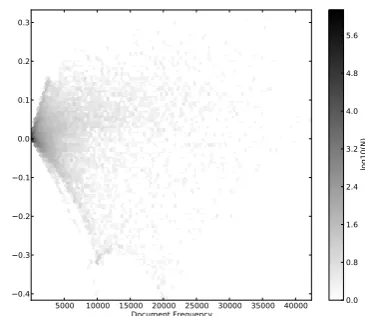
Figure 2: Scatter plot of DF vs. LD (byte
tri-grams)
use is mostly UTF8-encoded, with small quanti-ties of other encodings (esp. in N-TCL). We make no further mention of encoding as it is not the fo-cus of this work.
Cavnar and Trenkle (1994) perform feature se-lection over such a mixture ofn-grams, where1≤ n≤5. Their feature selection method is based on
the frequency of terms, where theN most frequent
terms for each language are retained in the global feature set. Related to term frequency is document frequency, where rather than counting individual terms in a class, we count the number of docu-ments that a particular term appears in. Feature selection based on document frequency has been shown to be inferior to other methods. Generally it has been found that Information Gain (IG: Quin-lan (1986)) is particularly suited to feature selec-tion in multiclass problem settings such as LangID (Yang and Pedersen, 1997; Forman, 2003).
The novel aspect of our research is that we con-siderIG of particularn-gram features along
mul-tiple dimensions: (1) with respect to the set of all languages; (2) with respect to a given language; and (3) with respect to the domain the data was ob-tained from. We are interested in identifying fea-tures that have highIG with respect to language but lowIGwith respect to domain.
that there are two distinct groups of features: one where the IG for language is strongly correlated with that for domain, and one where the IG for
language is largely independent of that for domain. We are interested in identifying features in the sec-ond group, and so for each feature we compute a
LD(Language-Domain) score, defined as:
LDall(t) =IGalllang(t)− IGdomain(t) The number of features to consider grows ex-ponentially with n-gram order. This makes
cal-culating the IG for higher token n-gram orders
computationally infeasible. Yang and Pedersen (1997) found that document frequency (DF) and
IGwere strongly correlated. Thus, we studied the
relationship betweenLDandDFin our data, and found that lowDF is a good predictor of lowLD
score, but not vice versa, as seen in Figure 2. As
DFis much cheaper to compute thanIG, we first identify the 15000 features with highestDF for a givenn-gram order, and assign aLDscore of 0 to
all features outside this set.
We also consider an alternative formulation of
LD. Due to skews between the quantities of data
for each language, the highest-ranked features by
LD tend to be biased towards the more common languages. In order to mitigate this, we also con-sider a formulation whereby we compute aLDbin
score for each feature conditioned on each lan-guagel:
LDbin(t|l) =IGbinlanguage(t|l)− IGdomain(t) In order to give better representaiton to less-frequent languages, we then select the top-scoring features from each language, and define theLDbin
feature set as the union of these features.
The number of features N is a parameter in
both methods that we will investigate empirically in Section 6.
6 Experimental Setup and Results
The results presented in Baldwin and Lui (2010a) are based on cross-validation within datasets, without considering the applicabiliy of a model learned in one domain to LangID in another do-main. Baldwin and Lui (2010a) also presented preliminary results with regards to feature selec-tion, based on the Cavnar and Trenkle (1994) method. We first compare results with and without feature selection using ourLDbin andLDall met-rics, as well as IGalllang—where we select the top
features according to their information gain with the set of all languages—and finally IGbin
lang— where we select a fixed number of features per lan-guage, according to their information gain with the language.
Baldwin and Lui (2010a) found that byte bi-grams performed well as a feature set for LangID, so we use them for this initial experiment. Tok-enizing across all of our datasets results in 57160 unique bigrams. For IGalllang andLDall, we con-sider the top 2000 to 10000 features, in increments of 1000. For the per-language metrics, we exper-iment with selecting 100 to 800 features per lan-gauge, in increments of 100.
We perform this experiment in two settings: (1) the supervised learning setting, where we use training and test data from the same domain; and (2) the inductive transfer learning setting, where we train a single classifier on UNIONA—the union
of the A partitions across the five domains—and use this to classify partition B from each of the five domains in turn. We found that forIGall
lang, 10000 features produced the best results; for IGbinlang, it was 100 features per class, corresponding to 4078 features; forLDall, it was 3000 features; and for LDbin it was 200 features per class, correspond-ing to 3086 features. We report the results for the best parametrization of each feature selection met-ric in Tables 2 and 3. In each case, we present the classification accuracy for the full feature set (“Full”), followed by the classification accuracy for feature selection over the same combination of training and test dataset, as the ∆over Full. In
all our experiments, the language skew present in each domain is preserved in both the training and the test partitions.
In the supervised case, the accuracy attained is similar when using the full feature set as for the respective reduced feature sets. This shows that utilizing the reduced feature sets does not harm in-domain classification accuracy, implying that we are able to preserve the key features required for classifying the data.
In the case of inductive transfer learning, we observe negative transfer: the greater amount of training data causes the accuracy to drop. This is particularly evident over RCV2, where adding in data from the other four domains results in a drop in accuracy from 0.973 to 0.576. We find that the
pro-Train Eval Full IGall
lang IGbinlang LDall LDbin
JRC-ACQUISA JRC-ACQUISB 0.985 +0.000 +0.007 +0.007 +0.005 DEBIANA DEBIANB 0.963 +0.003 +0.002 −0.001 −0.016
RCV2A RCV2B 0.973 −0.017 −0.016 −0.003 +0.026
WIKIPEDIAA WIKIPEDIAB 0.935 +0.017 +0.020 +0.030 +0.001
Table 2: In-domain supervised learning accuracy, relative to all features (“Full”)
Train Eval Full IGall
lang IGbinlang LDall LDbin
UNIONA
JRC-ACQUIS 0.931 −0.001 +0.039 +0.060 +0.062
DEBIAN 0.817 −0.031 +0.049 +0.122 +0.127
RCV2 0.576 −0.048 +0.129 +0.347 +0.410 WIKIPEDIA 0.739 −0.150 −0.070 +0.179 +0.179
Table 3: Inductive Transfer Learning (all-domain) accuracy, relative to all features (“Full”)
vide the best accuracy over each dataset in the in-ductive transfer learning setting, increasing accu-racy over RCV2 to 0.986, exceeding the accuaccu-racy of the in-domain classification on the full feature set. We find thatLDbin features can also improve
accuracy for in-domain classification, increasing accuracy on RCV2 to a near-perfect 0.999. These results validate the choice of LDbin as a suitable
metric for selecting general features for LangID. Since our aim is to build a classifier in a trans-ductive transfer learning setting, we examined the behaviour of theLDbin features in such a setting over our 5 datasets. For each dataset, we trained a classifier on the A partitions, and evaluated the classifier on the B partition of each of the other datasets. Since each dataset covers a different set of languages, there may be languages in the eval-uation dataset that are not present in the training dataset. It makes no sense to attempt to clas-sify documents in these languages since we will by definition misclassify them, so the results re-sported in Table 4 are only over languages in the evaluation set that are also present in the train-ing set. As a result, caution must be exercised in naively comparing accuracy figures across differ-ent combinations of training and test datasets.
In Table 4, we see several examples of language models not generalizing to other domains. For ex-ample, we see that when using all features, the lan-guage models learned from RCV2 classify data from the RCV2 domain with accuracy 0.973, but this drops to 0.838, 0.889 and 0.796 in other do-mains. We also find that language models from other domains have reduced accuracy when classi-fying RCV2 data. We find that in all these cases, using theLDbin features mitigates this loss in
ac-curacy. On RCV2 in particular, use of theLDbin
features results in over 0.95 accuracy when train-ing with any of the 5 domains.
There is a number of domains where the use of the LDbin features results in a loss in accu-racy relative to the full feature set. This contrasts with our results in the inductive learning setting. We hypothesize that this is due to theLDbin
fea-tures having been selected from the union of all 5 datasets. While this feature set represents a gen-eral model across these 5 domains, for a specific pair of domains there will be some additional fea-tures that are strong predictors of language.
Preliminary work by Baldwin and Lui (2010a) suggested that feature selection over a mixture of
n-grams yielded promising results. This is also
supported by Cavnar and Trenkle (1994), who use a mixture of 1- to 5-grams. We thus investigated the interaction between the range ofn-gram orders
used for feature selection, the number of features selected per language and classification accuracy. Based on the results in Tables 2, 3 and 4, we used theLDbin metric exclusively.
We conducted a parameter search for maximum token order M (e.g.M = 3would mean all 1-,
2- and 3-grams) and number of features per lan-guage N. We considered 1 ≤ M ≤ 9 and 100 ≤ N ≤ 800 in increments of 100 features.
We tested all combinations exhaustively in a su-pervised learning task across the union of all 5 datasets. We found that the best results are ob-tained forM ≥4andN ≥300. In order to
max-imize classification rate we need to minmax-imize the number of features used, so we choseM = 4and N = 300, producing a feature set consisting of
7480 features.
Training JRC-ACQUIS DEBIAN Test Dataset RCV2 WIKIPEDIA
Full LDbin Full
LDbin Full
LDbin Full
LDbin
JRC-ACQUIS 0.985 +0.005 0.979 −0.055 0.812 +0.174 0.977 −0.026 CLUEWEB09 0.981 −0.005 0.989 −0.010 0.925 +0.069 0.927 −0.039 DEBIAN 0.983 −0.003 0.963 −0.016 0.689 +0.261 0.937 −0.058
RCV2 0.838 +0.148 0.889 −0.003 0.973 +0.026 0.796 +0.154
WIKIPEDIA 0.837 +0.141 0.863 +0.011 0.561 +0.407 0.935 +0.001
Table 4: Transductive transfer learning (cross-domain) accuracy relative to all features (“Full”)
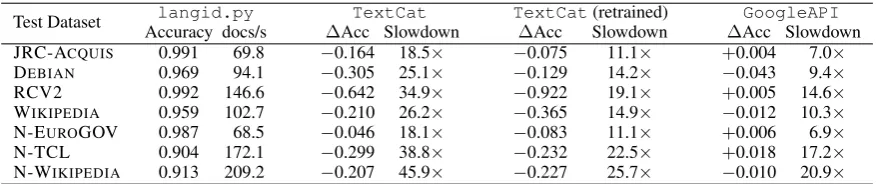
Test Dataset Accuracy docs/slangid.py ∆Acc SlowdownTextCat TextCat∆Acc Slowdown(retrained) ∆Acc SlowdownGoogleAPI
JRC-ACQUIS 0.991 69.8 −0.164 18.5× −0.075 11.1× +0.004 7.0×
DEBIAN 0.969 94.1 −0.305 25.1× −0.129 14.2× −0.043 9.4×
RCV2 0.992 146.6 −0.642 34.9× −0.922 19.1× +0.005 14.6×
WIKIPEDIA 0.959 102.7 −0.210 26.2× −0.365 14.9× −0.012 10.3×
N-EUROGOV 0.987 68.5 −0.046 18.1× −0.083 11.1× +0.006 6.9×
N-TCL 0.904 172.1 −0.299 38.8× −0.232 22.5× +0.018 17.2×
N-WIKIPEDIA 0.913 209.2 −0.207 45.9× −0.227 25.7× −0.010 20.9×
Table 5: Comparison of standalone classification tools, in terms of accuracy and speed (docu-ments/second), relative tolangid.py
present in the training set, and a domain-specific classifier trained only on languages in the test set. The reference classifier is trained on 1–4-grams, selecting 300 features per language on the full 97 languages, whereas each domain-specific clas-sifier is trained only on the subset of languages present in the target domain.
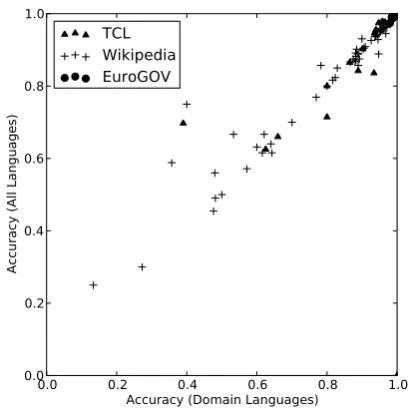
Figure 3 shows a scatter plot of the per-language accuracy over the different datasets. Rather than harming performance, we find that adding lan-guges extraneous to the target domain generally has no impact on accuracy over the languages in the dataset. In fact, it occasionally positively im-pacts on accuracy (points to the left of the diago-nal), and for the rare instances where it hurts accu-racy (points to the right of the diagonal), the dif-ference is relatively modest.
6.1 Comparison to existing tools
Our ultimate interest is in building a standalone classifier that is fast and accurate. For comparison to existing tools, we implemented our method as a Python module (langid.py), in the form of a single Python file with pre-trained models for 97 languages. It can act as a standalone LangID sys-tem, an embedded Python module, or a web ser-vice with an AJAX API.5
We compared the speed and accuracy of our system to TextCat, as well as GoogleAPI.
GoogleAPIis constrained to: (1) limit the
classi-5The code is available for public download from
http://www.csse.unimelb.edu.au/research/ lt/resources/langid/
fication rate to 10 documents/second, and (2) base the classification only on the first 500 bytes of the document. These constraints are imposed by the service’s terms of use. For TextCat, we test it: (1) off-the-shelf using the pre-trained language models, and (2) after retraining it over the same training data aslangid.py.
Table 5 shows the accuracy of each system across 7 test datasets, as well as the speed in documents per second. We present absolute ac-curacy and speed for langid.py, and relative accuracy and slowdown for the other classifiers. The machine used to perform this experiment was a commodity desktop-class machine, with an In-tel Q9400 4-Core CPU, 4GB of RAM and a 7200RPM SATA II hard drive. The slowdown for
GoogleAPIis reported based on a classification rate of 10 documents per second.
We find that in general, langid.py is faster and more accurate than TextCat(both off-the-shelf and re-trained). The difference is small-est over a “traditional” LangID dataset like N-EUROGOV which contains only 10 languages,
and is much more pronounced over a dataset like N-TCL which has a much larger vari-ety of languages. Comparing langid.py and
GoogleAPI, the two systems are evenly matched in accuracy, but again, langid.py is signifi-cantly faster. All differences in accuracy are sta-tistically significant (McNemar’s test,p <0.01).
doc-0.0 0.2 0.4 0.6 0.8 1.0 Accuracy (Domain Languages)
0.0 0.2 0.4 0.6 0.8 1.0
Accuracy (All Languages)
TCL
Wikipedia
EuroGOV
Figure 3: Per-language accuracy of a classifier trained only on languages present in the evaluation domain (x-axis) vs. all languages (y-axis)
Test dataset Feature selection
TextCat CT LDbin
N-EUROGOV 0.904 +0.067 +0.083
N-TCL 0.672 +0.016 +0.227
N-WIKIPEDIA 0.686 +0.084 +0.223
Table 6: Comparison ofTextCatto aNB classi-fier usingCTandLDbin for feature selection, us-ing UNIONAas the training data
uments (57%). To quantify the effect of this, we transcoded all the documents in N-TCL to UTF8 and repeated the experiment. We found that af-ter transcoding, the accuracy of langid.py in-creased from 0.904 to 0.947. This indicates that unsupported encodings have a small impact on ac-curacy, though it is relatively minor considering that the majority of the data is not UTF8-encoded. The are two key conceptual differences between
TextCat and langid.py: feature selection and learning algorithm. TextCat (CT) selects
features per language by term frequency, whereas
langid.pyusesLDbin (the focus of this work).
On the other hand, the learning algorithm used by TextCat is a nearest-prototype method us-ing the token rank difference metric of Cavnar and Trenkle (1994), whereas langid.py uses multinomial naive Bayes. In order to consider these differences independently, we combine the
CTfeature selection with the multinomial naive
Bayes learner, selecting the union of the top-300 features per language by document frequency over 1- to 5-grams, yielding 10846 features. For
com-parison, we also selected the top 300 features by
LDbin over 1- to 5-grams, yielding 8166 fea-tures. We then trained a naive Bayes classifier over UNIONA using the respective feature sets,
and used it to classify each of N-EUROGOV,
N-TCL and N-WIKIPEDIA. In Table 6, we
com-pare the accuracy of these two classifiers to (re-trained) TextCat. Across all datasets, LDbin
is superior to CT. Additionally, NB with CTis
superior to TextCat(which uses the same fea-ture selection strategy, with the nearest prototype learner), although the difference here is much smaller. This suggests that the bulk of the im-provement oflangid.pyoverTextCatis due to the use ofLDbin, as developed in this research.
7 Conclusion
We demonstrated the problem of negative trans-fer in training a LangID system using language-labelled data from a variety of domains. We de-veloped a method for identifying features that are strongly predictive of language across multiple do-mains by examining the difference in information gain of each feature with language and with the source domain. We used this method to compile a feature set from 50,000 documents in 97 lan-guages across 5 datasets, and implemented this as a standalone LangID system using a naive Bayes classifier. We empirically compared our system to state-of-the-art LangID systems, and found our system to be faster whilst maintaining competitive accuracy.
Acknowledgments
The authors wish to thank Google for providing increased ac-cess to the Google AJAX Language Identification API for the purposes of this research. The first author was additionally a recipient of travel support from Google Australia.
NICTA is funded by the Australian Government as rep-resented by the Department of Broadband, Communications and the Digital Economy and the Australian Research Coun-cil through the ICT Centre of Excellence program.
References
Steven Abney and Steven Bird. 2010. The human language project: building a Universal Corpus of the world’s lan-guages. InProceedings of the 48th Annual Meeting of the Association for Computational Linguistics, pages 88–97, Uppsala, Sweden.
Timothy Baldwin and Marco Lui. 2010a. Language identifi-cation: The long and the short of the matter. In Proceed-ings of Human Language Technologies: The 11th Annual Conference of the North American Chapter of the Associ-ation for ComputAssoci-ational Linguistics (NAACL HLT 2010), pages 229–237, Los Angeles, USA.
Timothy Baldwin and Marco Lui. 2010b. Multilingual lan-guage identification: ALTW 2010 shared task dataset. In Proceedings of the Australasian Language Technol-ogy Workshop 2010 (ALTW 2010), pages 5–7, Melbourne, Australia.
Timothy Baldwin, Steven Bird, and Baden Hughes. 2006. Collecting low-density language materials on the web. InProceedings of the 12th Australasian Web Conference (AusWeb06). http://www.ausweb.scu.edu.au/
ausweb06/edited/hughes/.
Jamie Callan and Mark Hoy, 2009. ClueWeb09 Dataset. Available at http://boston.lti.cs.cmu.edu/
Data/clueweb09/.
William B. Cavnar and John M. Trenkle. 1994. N-gram-based text categorization. In Proceedings of the Third Symposium on Document Analysis and Information Re-trieval, Las Vegas, USA.
Hakan Ceylan and Yookyung Kim. 2009. Language iden-tification of search engine queries. InProceedings of the Joint Conference of the 47th Annual Meeting of the ACL and the 4th International Joint Conference on Natural Language Processing of the AFNLP, pages 1066–1074, Singapore.
Marc Darnashek. 1995. Gauging similarity withn-grams: Language-independent categorization of text. Science, 267:843–848.
Hal Daum´e III and Daniel Marcu. 2006. Domain adaptation for statistical classifiers. Journal of Artificial Intelligence Research, 26(1):101–126.
Hal Daum´e III. 2007. Frustratingly easy domain adaptation. InProceedings of the 45th Annual Meeting of the Asso-ciation for Computational Linguistics (ACL 2007), pages 256–263, Prague, Czech Republic.
Rafael Dueire Lins and Paulo Gonc¸alves. 2004. Automatic language identification of written texts. InProceedings of the 2004 ACM Symposium on Applied Computing (SAC 2004), pages 1128–1133, Nicosia, Cyprus.
Ted Dunning. 1994. Statistical identification of language. Technical Report MCCS 940-273, Computing Research Laboratory, New Mexico State University.
George Forman. 2003. An Extensive Empirical Study of Feature Selection Metrics for Text Classification. Journal of Machine Learning Research, 3(7-8):1289–1305. Rayid Ghani, Rosie Jones, and Dunja Mladenic. 2004.
Building Minority Language Corpora by Learning to Gen-erate Web Search Queries. Knowledge and Information Systems, 7(1):56–83.
Emmanuel Giguet. 1995. Categorization according to lan-guage: A step toward combining linguistic knowledge and statistic learning. InProceedings of the 4th International Workshop on Parsing Technologies (IWPT-1995), Prague, Czech Republic.
E. Mark Gold. 1967. Language identification in the limit.
Information and Control, 5:447–474.
Gregory Grefenstette. 1995. Comparing two language iden-tification schemes. InProceedings of Analisi Statistica dei Dati Testuali (JADT), pages 263–268.
Harald Hammarstrom. 2007. A Fine-Grained Model for Language Identication. InProceedings of Improving Non English Web Searching (iNEWS07), pages 14–20. Baden Hughes, Timothy Baldwin, Steven Bird, Jeremy
Nicholson, and Andrew MacKinlay. 2006. Reconsider-ing language identification for written language resources.
In Proceedings of the 5th International Conference on Language Resources and Evaluation (LREC 2006), pages 485–488, Genoa, Italy.
Stephen Johnson. 1993. Solving the problem of language recognition. Technical report, School of Computer Stud-ies, University of Leeds.
Genitiro Kikui. 1996. Identifying the coding system and language of on-line documents on the internet. In Pro-ceedings of the 16th International Conference on Compu-tational Linguistics (COLING ’96), pages 652–657, Ky-oto, Japan.
Canasai Kruengkrai, Prapass Srichaivattana, Virach Sornlert-lamvanich, and Hitoshi Isahara. 2005. Language identifi-cation based on string kernels. InProceedings of the 5th International Symposium on Communications and Infor-mation Technologies (ISCIT-2005), pages 896–899, Bei-jing, China.
Lillian Lee. 2001. On the effectiveness of the skew diver-gence for statistical language analysis. InProceedings of Artificial Intelligence and Statistics 2001 (AISTATS 2001), pages 65–72, Key West, USA.
Jicheng Liu and Chunyan Liang. 2008. Text Categorization of Multilingual Web Pages in Specific Domain. In Pro-ceedings of the 12th Pacific-Asia Conference on Advances in Knowledge Discovery and Data Mining, PAKDD’08, pages 938–944, Osaka, Japan.
Christopher D. Manning, Prabhakar Raghavan, and Hinrich Sch¨utze. 2008. Introduction to Information Retrieval. Cambridge University Press, Cambridge, UK.
Bruno Martins and M´ario J. Silva. 2005. Language identi-fication in web pages. InProceedings of the 2005 ACM Symposium on Applied Computing (SAC ’05), page 764. Andrew McCallum and Kamal Nigam. 1998. A
compari-son of event models for Naive Bayes text classification. InProceedings of the AAAI-98 Workshop on Learning for Text Categorization, Madison, USA.
Paul McNamee and James Mayfield. 2004. CharacterN -gram Tokenization for European Language Text Retrieval.
Information Retrieval, 7(1–2):73–97.
Sinno Jialin Pan and Qiang Yang. 2010. A Survey on Trans-fer Learning.IEEE Transactions on Knowledge and Data Engineering, 22(10):1345–1359, October.
J.R. Quinlan. 1986. Induction of Decision Trees. Machine Learning, 1(1):81–106, October.
Ralf Steinberger, Bruno Pouliquen, Anna Widiger, Camelia Ignat, Tomaˇz Erjavec, Dan Tufis, and D´aniel Varga. 2006. The JRC-Acquis: A multilingual aligned parallel corpus with 20+ languages. InProceedings of the 5th Interna-tional Conference on Language Resources and Evaluation (LREC’2006), Geona, Italy.
Gertjan van Noord, 1997. TextCat. Software avail-able at http://odur.let.rug.nl/˜vannoord/
TextCat/.
Fei Xia and William Lewis. 2009. Applying NLP technolo-gies to the collection and enrichment of language data on the web to aid linguistic research. InProceedings of the EACL 2009 Workshop on Language Technology and Re-sources for Cultural Heritage, Social Sciences, Humani-ties, and Education (LaTeCH – SHELT&R 2009), pages 51–59, Athens, Greece.
Fei Xia, William Lewis, and Hoifung Poon. 2009. Language ID in the context of harvesting language data off the web. InProceedings of the 12th Conference of the EACL (EACL 2009), pages 870–878, Athens, Greece.