Paraphrasing and Aggregating Argumentative
Text
Using Text Structure
Xiaorong Huang A r m i n Fiedler Fachbereich Informatik, Universit/it des Saarlandes Postfach 15 11 50, D-66041 Saarbriicken, G e r m a n y
{huang I a f i e d l e r } O c s , u n i - s b , de
A b s t r a c t
We argue in this paper that sophisticated mi- croplanning techniques are required even for mathematical proofs, in contrast to the belief that mathematical texts are only schematic and mechanical. We demonstrate why para- phrasing and aggregation significantly en- hance the flexibility and the coherence of the text produced. To this end, we adopted the Text Structure of Meteer as our basic representation. The type checking mecha- nism of Text Structure allows us to achieve paraphrasing by building comparable combi- nations of linguistic resources. Specified in terms of concepts in an uniform ontological structure called the Upper Model, our se- mantic aggregation rules are more compact than similar rules reported in the literature.
1
I n t r o d u c t i o n
Many of the first NLG systems link their information structure to the corresponding linguistic resources either through predefined templates or via careful engineering for a spe- cific application. Therefore their expressive power is restricted (see [12] for an extensive discussion). An increasing interest in more sophisticated microplanning techniques can be clearly observed [12, 14], however. In this paper, we first motivate the needs for paraphrasing and aggregation for the gener- ation of argumentative texts, in particular of mathematical proofs, and then describe how our microplanning operations can be formu- lated in terms of Meteer's
Text Structure.
The work reported here is part of a fully implemented system called
PRO VERB,
which produces natural language proofs from proofs found by' automated reasoning sys- tems [7]. First experiments withPRO VERB
resulted in very mechanical texts due to the lack of microplanning techniques. According to our analysis, there are at least two lin- guistic phenomena that call for appropriate microplanning techniques.First, naturally occurring proofs contain paraphrases with respect to both rhetorical relations, as well as to logical functions or predicates. For instance, the derivation of B from A can be verbalized as:
"Since A, B." or as "A leads to B."
The logic predicate
para(C1, C2),
also, can be verbalized as:"Line C1 parallels line C2." or as "The parallelism of the lines C1 and C2."
Second, without microplanning
PROVERB
generates text structured ex- actly mirroring the information structure of the proof and the formulae. This means that every step of derivation is translated into a separate sentence, and formulae are recur- sively verbalized. As an instance of the lat- ter, the formulaSet(F) A Subset(F, G)
(1)" F is a set. F is a subset of G."
although t h e following is much more natural:
"The set F is a subset of G."
Therefore, we came to the conclusion that an intermediate level of representation is nec- essary that allows flexible combinations of linguistic resources. It is worth pointing out that these techniques are required although the input information chunks are of clause size. Another requirement is that this in- termediate representation is easy to control, since a m a t h e m a t i c a l text must conform to the syntactic rules of its sublanguage. In the next section, we first give a brief overview of
P R O V E R B . T h e n we describe the architec-
ture of our microplanner, and illustrate how Meteer's Text Structure can be adopted as our central representation. In Sec. 5 and 6 we describe the handling of paraphrases and aggregation rules, two of the major tasks of our microplanner.
2
T h e
M a c r o p l a n n e r
of
P R 0 VERB
The macroplanner of P R O V E R B combines
hierarchical planning [13] with local organi-
zation [15] in a uniform planning framework
[6]. The hierarchical planning is realized by so-called top-down presentation operators that split the task of presenting a particular proof into subtasks of presenting subproofs. While the overall planning mechanism is sim- ilar to the R S T - b a s e d planning approach, the plan operators resemble the schemata in
schema-based planning. The o u t p u t of the
macroplanner is an ordered sequence of proof
communicative acts (PCAs).
P C A s are the primitive actions planned during macroplanning to achieve commu- nicative goals. Like speech acts, P C A s can be defined in terms of the communicative goals they fulfill as well as in terms of their possible verbalizations. Based on an analysis of proofs in m a t h e m a t i c a l textbooks, there are mainly two types of goals:
Conveying derivation step: In terms of
rhetorical relations, P C A s in this category
represent a variation of the rhetorical rela- tion derive [8]. Below we examine the simple P C A called D e r i v e as an example.
( D e r i v e R e a s o n s : ( a 6 F , F C G ) Method : d e f - s u b s e t
Conclusion: a 6G)
Depending on the reference choices, the following is a possible verbalization:
"Since a is an element of F and F is a subset of G, a is an element of G by the definition of subset."
Updating the global attentional structure:
These P C A s either convey a partial plan for the forthcoming discourse or signal the end of a subproof. P C A s of this sort are also called meta-comments [16].
The P C A
( B e g i n - C a s e s G o a l : Formula
Assumptions: (A B))
produces the verbalization:
"To prove Formula, let us consider the two cases by assuming A and B."
3
T e x t
S t r u c t u r e
in
P R 0 VERB
3 . 1 I n t r o d u c t i o n a n d G e n e r a l S t r u c t u r e
Text Structure is first proposed by Meteer [11, 12] in order to bridge the generation gap between the representation in the application program and the linguistic resources pro- vided by the language. By abstracting over concrete linguistic resources, Text Structure should supply the planner with basic vocab- ularies, with which it chooses linguistic re- sources. Meteer's text structure is organized as a tree, in which each node represents a constituent of the text. In this form it con- tains three types of linguistic information:
constituency, structural relations among con-
stituents, and in particular, the semantic cat-
egories the constituents express.
restrictions for nodes. T h e y define how sep- arate Text Structures can be combined, and ensure t h a t the planner only builds express- ible Text Structures. For instance if tree A should be expanded at node n by tree B, the resulting type of B must be compatible to the type restriction attached to n. Panaget [14] argues, however, that Meteer's semantic categories mix the ideational and the textual dimension as argued in the systemic linguis- tic theory [5]. Here is one of his examples:
"The ship sank" is an ideational event, and it is textually presented from an EVENT- PERSPECTIVE. "The sinking of the ship" is still an ideational event, but now presented from an OBJECT-PERSPECTIVE.
On account of this, Panaget split the type restrictions into two orthogonal dimensions: the ideational dimension in terms of the Up-
per Model [1], and the hierarchy of textual
semantic categories based on an analysis of
French and of English. In our work, we ba- sically follow the approach of Panaget.
Technically speaking, the Text Structure
in P R O V E R B is a tree recursively composed
of kernel subtrees or composite subtrees: An atomic kernel subtree has a head at the root and arguments as children, representing basically a p r e d i c a t e / a r g u m e n t structure.
Composite subtrees can be divided into two
subtypes: the first has a special matrix child and zero or more adjunct children and rep- resents linguistic hypotaxis, the second has two or more coordinated children and stands for parataxis.
3 . 2 T y p e R e s t r i c t i o n s
Each node is typed b o t h in terms of the Upper Model and the hierarchy of textual semantic categories. T h e Upper Model is a domain-independent property inheritance network of concepts that are hierarchically organized according to how they can be lin- guistically expressed. Figure 1 shows a frag- ment of the Upper Model in PRO VERB. For every domain of application, domain-specific concepts must be identified and placed as an extension of the Upper Model.
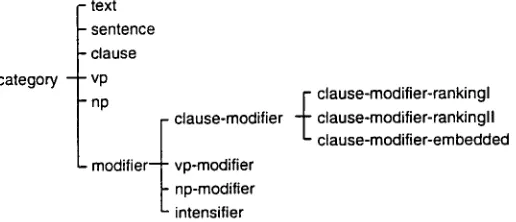
The hierarchy of textual semantic cate- gories is also a d o m a i n - i n d e p e n d e n t p r o p e r t y inheritance network. T h e concepts axe or- ganized in a hierarchy based on their tex- tual realization. For example, the concept
clause-modifier-rankingl t is realized as an ad- verb, clause-modifier-rankingll as a preposi- tional phrase, and clause-modifier-embedded as an adverbial clause. Fig. 2 shows a frag- ment of the hierarchy of textual semantic categories.
3 . 3 M a p p i n g A P O s t o U M O s
The mapping from the content to the linguis- tic resources now happens in a two-staged way. While Meteer associates the applica- tion program objects (APOs) directly with so-called resources trees, we map APOs into Upper Model objects, which in t u r n are ex- p a n d e d to the Text Structures. It is worth noting t h a t there is a practical advantage of this two-staged process. Instead of having to construct resource trees for APOs, the user of our system only needs to define a map- ping from the A P O s to Upper Model objects
(UMOs).
W h e n mapping A P O s to UMOs, the mi- croplanner must choose among available al- ternatives. For example, the application program object p a r a that stands for the log- ical predicate denoting the parallelism rela- tion between lines m a y map in five different Upper Model concepts. In the 0-place case, p a r a can be m a p p e d into object leading to the noun "parallelism," or quality, leading to the adjective "parallel." In the binary case, the choices are property-ascription that may be verbalized as "x and y are parallel,"
quality-relation t h a t allows the verbalization
as "x is parallel to y", or process-relation,
that is the formula "x II Y."
The mapping of Upper Model objects into the Text S t r u c t u r e is defined by so-called
resource trees, i.e. reified instances of text
structure subtrees. T h e resource trees of an Upper Model concept are assembled in its
realization class.
~Concepts of the hierarchy of textual semantic
c o n c e p t
" m o d i f i e d - c o n c e p t
f - c o n s c i o u s - b e i n g - o b j e c t ---q . .
t - n o n - c o n c i o u s - U u n g [ - r e l a t i o n a l - p r o c e s s e s - - p r o c e s s
t. m e n t a l - p r o c e s s e s ._~- m o d a l - q u a l i o ' q u a l i t y t . m a t e r i a l - w o r d - q u a l i t y
r " l o g i c a l - a r b i t r a t y - p l a c e - r e l a t i o n - ~
, - s e q u e n c e
- g e n e r a l i z e d - p o s s e s s i o n - q u a n t i f i c a t i o n s . , .
d i s c r e t e - p l a c e - r e l a t i o n ~ . . r " t a e n t t t y r " p r o p e r t y - a s c r i p t i o n t n t e n s t v e - - - ' 1 . .
t - a s c r i p t i o n -1_
c i r c u m s t a n t i a l c l a s s - a s c r i p t i o n
Figure 1: A Fragment of Upper Model in P R O V E R B
- t e x t - s e n t e n c e - c l a u s e c a t e g o r y - v p
- n p
m o d i f i e r -
c l a u s e - m o d i f i e r
v p - m o d i f i e r n p - m o d i f i e r intensifier
_•
c l a u s e - m o d i f i e r - r a n k i n g l c l a u s e - m o d i f i e r - r a n k i n g l l c l a u s e - m o d i f i e r - e m b e d d e dFigure 2: A Fragment of the Hierarchy of Textual Semantic Categories in P R O V E R B
4
A r c h i t e c t u r e a n d C o n t r o l
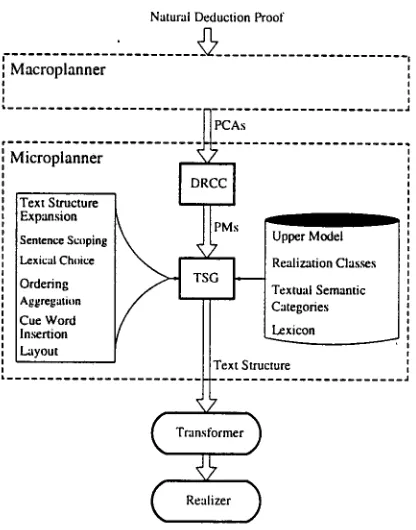
T h e main tasks of our microplanner in- clude aggregation to remove redundancies, insertion of cue words to increase coher- ence, and reference choices, as well as lexical choices. A p a r t from that, the microplanner also handles sentence scoping and layout. An overview of the microplanner's architecture is provided in Figure 3.
Our microplanner takes as input an or- dered sequence of PCAs, structured in an attentional hierarchy. The first module,
the derivation reference choice component
( D R C C ) , suggests which parts of a P C A are to be verbalized. This is done based on the hierarchical discourse structure as well as on the textual distance. P C A s a n n o t a t e d with these decisions a n n o t a t e d are called preverbal
messages (PMs).
Starting from a list of P M s as the initial
Text Structure, the microplanner progres- sively maps application program concepts in P M s into text s t r u c t u r e objects of some tex- tual semantic t y p e by referring to U p p e r Model objects as an intermediate level. The Text Structure evolves by the expansion of leaves top-down and left to right. This pro- cess is controlled by the main module of our microplanner, the Text Structure Generator
(TSG), which carries out the following algo- rithm:
• W h e n the current node is an A P O with more than one son, apply ordering and ag- gregation, in order to p r o d u c e more con- cise and more coherent text. The appli- cation of an aggregating rule before the expansion of a leaf node may trigger the insertion of cue words.
[image:4.596.104.521.85.391.2] [image:4.596.236.494.273.384.2]Natural Deduction Proof
Macroplanner
. . . R) k: . . .
gregation rules.
5
Paraphrasing in
PROVERB
W i t h the help of a concrete example we M~c'r~p]~e[ . . . ~ . . . illustrate in this section how the Text Struc-
Text Structure Expansion Sentence Striping Lexical Choice Ordering Aggregation Cue Word Insertion Layout
F
~ [ Realizatioa Closes ] Textual Semantic I Categories
Text Structure
Transformer
)
6
(
)
Figure 3: Architecture of the Microplanner
• A fully expanded Text Structure will be traversed again:
-- to choose the appropriate lexical items. -- to make sentence scoping decisions by
singling out one candidate textual se- mantic category for each constituent. This in turn may trigger the execution of a cue word rule. For instance, the choice of the category sentence for a constituent may lead to the insertion of the cue word "furthermore" in the next sentence.
- - t o determine the layout parameters, which will be realized later as ~TEX- c o m m a n d s in the final o u t p u t text.
A Text Structure constructed in this way is the o u t p u t of our microplanner, and will be transformed into the input formalism of T A G - G E N [10], our linguistic realizer.
In the next two sections, we concentrate on two m a j o r tasks of the Text Structure generator: to choose compatible paraphrases of application program concepts, and to im- prove the textual structure by applying ag-
ture generator chooses among paraphrases and avoids building inexpressible text struc- tures via type checking.
E x a m p l e We examine a simple logic for- mula derive(para(C1,C2),B). Note that B stands for a conclusion which will not be ex- amined here. We will also not follow the pro- cedure in detail.
In the current implementation, the rhetor- ical relation derive is only connected to one Upper Model concept derive, a s u b c o n c e p t
of cause.relation. The realization class as-
sociated to the concept, however, contains several alternative resource trees leading to different p a t t e r n s of verbalization. We only list two variations below:
• B, since A. • Because of A, B.
The resource tree of the first alternative is given in Fig. 4.
The logic predicate p a r a ( C 1 , C2) can be m a p p e d to one of the following U p p e r Model concepts, where we always include one pos- sible verbalization:
• quality-relation(para, C1, C2)
(line C1 is parallel to C2)
• process-relation(para, C1, C2)
(C1[[C2)
• property-ascription(para, Cl A C2)
(lines C1 and C2 are parallel)
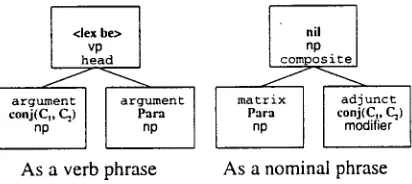
Textually, the property-ascription version can be realized in two forms, represented by the two resource trees in Fig. 5.
T y p e checking during the construction of the Text S t r u c t u r e must ensure, that the realization be compatible along b o t h the ideational and the textual dimension. In this example, the combination of the tree in Fig. 4 and the first tree in Fig. 5 is compatible and will lead to the verbalization:
[image:5.596.88.296.82.347.2](realization-class (derive :reason R :conclusion C) (resource-tree (composite-tree :content nil
:tsc (sentence clause) :matrix (leaf :content C
: t s c (clause))
:adjunct (composite-tree :content since
:tsc (clause)
:matrix (leaf :content R : t s c ( c l a u s e ) ) ) ) )
(.further resource trees . . . ))
Figure 4: The Realization Class for derive
<lex be> vp head
a r g u r a e n t a r g u l n e n t conj(C,, C~) P a r a
no no
As a verb phrase
• nil
comproPsite [
matrix adjunct P a r a conj(C,, CC~) no modifier
As a nominal phrase
Figure 5: Textual Variations in form of Re- source Trees
The second tree in Fig. 5, however, can only be combined with another realization of
derive, resulting in:
"Because of the parallelism of line C1 and line C2, B."
In our current system we concentrat on the mechanism and are therefore still exper- imenting with heuristics which control the choice of paraphrases. One interesting rule is to distinguish between general rhetorical relations and domain specific mathematical concepts. While the former should be para- phrased to increase the flexibility, continuity of the latter helps the user to identify tech- nical concepts.
6
S e m a n t i c
Aggregation
Rules
Although the handling of paraphrase gen- eration already increases the flexibility in the text, the default verbalization strategy will still expand the Text Structure by re- cursively descending the proof and formula structure, and thereby forced to keep these
structures. To achieve the second verbal- ization of equation (1) in the introduction, however, we have to combine Set(F) and
Subset(F, G) to form an e m b e d d e d structure
Subset(Set(F), G). Clearly, although still in
the same format, this is no more an Up- per Model object, since S e t ( F ) is an U p p e r Model process, not an object. Actually, this documents a textual decision that no mat- ter how Subset and Set should be instanti- ated, the argument F in Subset(F, G) will be replaced by Set(F). This textual operation eliminates one of the duplicates of F . This section is devoted to various textual reorgan- isations which eliminate such redundancies. Following the tradition, we call t h e m aggre-
gation rules.
As it will become clear when handling con- crete aggregation rules, such rules may nar- row the realization choices of A P O s by im- posing additional type restrictions. Further- more, some realization choices block desir- able textual reorganisation. On account of this we carry out aggregations before con- crete resources for the A P O s like object and
class-ascription are chosen.
APOs, before they are m a p p e d to UMOs, can be viewed as variables for U M O s (for convenience, we continue to refer to t h e m as APOs). In this sense, our rules work with such variables at the semantic level of the Upper Model, and therefore differ from those more syntactic rules reported in the litera- ture. For a comparison see Sec. 6.4.
[image:6.596.100.306.225.317.2]Grouping (5)
Logical Predicates (1)
Aggregation(l 1)
Embedding (2)
PMs (2) Logical Connectives (2)
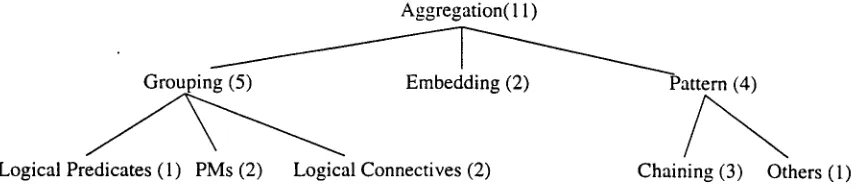
Figure 6: Aggregation Rules in
PROVERB
Pattern (4)
Chaining (3) Others (1)
6.1 S e m a n t i c G r o u p i n g
We use semantic grouping to characterize the merge of two parallel Text Structure objects with the same top-concept by grouping their arguments. Two A P O s are parallel in the sense that they have the same parent node. T h e general form of this type of rules can be characterized by the p a t t e r n as given below:
R u l e P a t t e r n A
P[a]
+P[b]
P[aCb]
T h e syntax of our rules means that a text structure of the form above the bar will be transformed into one of the form below the bar. Viewing Text Structure as a tree,
P[a]
and
P[b]
are both sons of +, they are mergedtogether by grouping the arguments a and b under a n o t h e r operator ~ . In the first rule below, + and ~ are identical.
R u l e A . 1 ( P r e d i c a t e G r o u p i n g )
P[a] + P[b]
P[a + b]
where + can be either a logical A or a logical V, and P stands for a logical predicate. The following example illustrates the effect of this rule.
Set(F) A Set(G)
" F is a set. G is a set."
are aggregated to:
Set(F A G)
" F and G are sets."
T h e rule covers the predicate grouping rule r e p o r t e d in [3]. This is also the best place to explain why we apply aggregation before
choosing concrete linguistic resources. If the two occurrences of
Set
are instantiated dif- ferently, this rule will be blocked.Now let us examine another semantic grouping rule, where + and ~ are no longer identical.
R u l e A . 2 ( I m p l i c a t i o n w i t h i d e n t i c a l
c o n c l u s i o n )
c) A (P2
c)
(& v P2) c
Here +, ~ , and P are instantiated to A, V, and ~ , respectively. By instantiating +, E[~ and P in p a t t e r n A to different logical connectives and derivation relations, we have alltogether five rules in this category. The correctness of the rules in this category with respect to the information conveyed is guar- anteed by the semantics of the Upper Model concerned. In the case of rule A.2 for in- stance, (PiVP2) ~ C is a logical consequence of (P1 ~ C) A (P2 ~ C).
6.2 S e m a n t i c E m b e d d i n g
The next category of aggregation rules han- dles parallel structures which are not identi- cal. In this case, some of t h e m may be con- verted to e m b e d d e d structures, as is done by the following rule.
R u l e B.1 ( O b j e c t E m b e d d i n g )
P[T] A Q[T]
Q[P[T]]
where
[image:7.596.90.519.79.173.2]• f is the innermost application program concept.governing T in
Q[T],
• concepts(f, T)
denotes the Upper Model concepts the argument T of f may take,• concepts(P)
denotes the Upper Model concept P may result in.We require also that
PIT]
is realized as an object T with modifiers. It is this intuitive explanation which guarantees the correctness of this rule with respect to meaning.The following example illustrates this rule, in particular, how the decision made here narrows the choices of linguistic resources for b o t h P and T as an argument of Q. We begin with the two A P O s in a conjunction below, containing a common A P O F.
Set(F) A Subset(F, G)
" F is a set. F is a subset of G."
Since F is directly governed by
Subset,
f and Q in our rule above coincide here.concepts(Subset, F)
=
{object),
whileconcepts(Set) = (class-ascription, object).
Therefore, their intersection i s{object).
This not only guarantees the expressibility of the new A P O , b u t also restricts the choice of linguistic resources forSet,
now restricted toobject.
The result as well as its verbaliza- tion is given below:Subset(Set(F), G)
"The set F is a subset of G."
Actually, for m a t h e m a t i c a l texts we have only used two e m b e d d i n g rules, with the other being the dual of rule B.1 where P and Q change their places.
6 . 3 P a t t e r n - b a s e d r u l e s
O p t i m i z a t i o n
Rules in the third category involve more complex changes of the textual structure in a way which is neither a grouping nor an em- bedding. T h e y could be u n d e r s t o o d as some domain-specific communicative conventions, and must be explored in every domain of ap- plication. In
PRO VERB,
currently four such rules are integrated. Three of them build asequence of some transitive relations into a chain.
Rule C. 1 below addresses the p r o b l e m that every step of derivation is m a p p e d to a sepa- rate sentence in the default verbalization. It reflects the familiar p h e n o m e n o n that when several derivation steps form a chain, they are verbalized in a more connected way. To a c c o m m o d a t e the p h e n o m e n o n of a chain, we have also a d d e d a slot called
next
in the do- main model conceptderive-chain.
Now sup- pose that we have two consecutive deriva- tions withR1,M1,C1
and R2, M2, C2 as its premises (called reasons), the rule of infer- ence (called method), and the conclusion. T h e y form part of a chain if the conclusion C1 is used as a premise in the second step, namely C1 E R2. In this case, the following rule combines t h e m into a chain by putting the second derivation into the next slot of the chain. At the same time, C1 is removed fromR2 since it is redundant.
R u l e C . 1 D e r i v a t i o n C h a i n 2
derive(R1, M1, C1), derive(R2, IVI2, C2)
derive-chain(R1, M1, C1, derive( R2 \ C1, M2, C2, ))
The following example illustrates how this rule works. We will only give the verbaliza- tion and omit the Text Structure. Given a sequence of two derivation steps which can be verbalized as:
"0 C_ o'*, by the definition of transitive closure." and
"Since (x, y) E a and o C o*, (x, y) E c* by the definition of subset."
Rule C.1 will p r o d u c e a chain which will be verbalized as
"a C 0" by the definition of transitive closure, thus establishing (x, y) E 0" by the definition of subset, since (x,y) E
0 . "
Note that the rule above is only a simpli- fication of a recursive definition, since chain- ing is not restricted to two derivation steps.
Readers are referred to [4]. Although this rule inserts the second derive into another Text Structure, the resulting structure is now a chain, no longer a plain derive. Therefore it distinguishes clearly f;om the rules in Sec- tion 6.2.
There are two more chaining rules for the logical connectors implication and equiv-
alence. A further rule removes redundancies
in some case analyses (see [4]).
6.4 D i s c u s s i o n
While many systems have some. aggregation rules implemented [9, 2], there are compar- atively few detailed discussions in the liter- ature. The most s t r u c t u r e d categorization we found is the work of Dalianis and Hovy [3], where they define aggregation as a way of avoiding redundancy. Some of their rules, nevertheless, make decisions which we would call reference choice. Since this is treated in another module, we define our aggregation at the semantic level. The following are several significant features of our aggregation rules.
The first difference is that our aggregation rules are defined in terms of manipulations of the U p p e r Model. T h e y remove redun- dancies by combining the linguistic resources of two adjacent APOs, which contain redun- dant content. T h e y cover the more syntactic rules reported in the literature at a more ab- stract level.
Second, Text Structure provides us stronger means to specify textual operations. While rules reported in the literature typ- ically aggregate clauses, our rules operate b o t h above and b e n e a t h the level of clause constituents.
Third, while most investigations have con- centrated on general purpose microplanning operations, we came to the conclusion that microplanning needs domain-specific rules and patterns as well.
7
A R u n n i n g E x a m p l e
The following example illustrates the mecha- nism of aggregation and its effect on resulting
text. We start with the following sequence of PMs:
assume(Set(F))
assume(Set(G))
assume(Subset(F, G) ) assume(element(a, F) ) assume(element(b, F) )
derive( (element(a, F) A Subset(F, G) ), e, element(a, G) )
derive( (element(b, F) A Subset(F, G)),
e, element(b, G) )
W i t h o u t aggregation, the system produces:
"Let F be a set. Let G be a set. Let F C G. Let a E F. Let b E F. Since a E F and F C G, a E G. Since b E F and F C G, b E G."
Aggregation of the assume-PMs results in:
assume(Set(F) A Set(G) A Subset(F, G) i element(a, F) i element(b, F))
whereas the application of the grouping rule for independent derive-PMs provides:
derive( ( element( a, F) A element(b, F) A Subset(F, G)), e,
(element(a, G) A element(b, G) ) )
After that, the predicate grouping rule A.1 is applied to the arguments of assume, which are grouped to:
( Set( F A G) A Subset(F, G) A element(a A B, F A F)))
Note that F A F is later reduced to F. Predicate grouping applies to the arguments
of derive in a similar way. Finally, the system
produces the following output:
"Let F and G be sets, F C G, and a, b E F. Then a, b E G."
8
C o n c l u s i o n
carry out appropriate textual rearrangement we need a representation formalism which al- lows flexible but principled manipulation of linguistic resources. To this end, we basi- cally adopted the Text Structure of Meteer, but split her semantic categories into two di- mensions following Panaget. The type check- ing mechanism of Text Structure allows us to achieve paraphrasing by building comparable combinations of linguistic resources. Speci- fied in terms of Upper Model concepts, our semantic aggregation rules are more abstract than similar rules reported in the literature. One important feature of our work is the integration of microplanning knowledge spe- cific to our domain of application. This body of knowledge must be refined to further improve the quality of the text produced. More experience is also required to formulate strategies to choose among alternatives.
References
[1]
John Bateman, Bob Kasper, Johanna Moore, and Richard Whitney. The pen- man upper model. Technical Report ISI research report, USC/Information Sci- ence institute, 1990.[2]
Robert Dale. Generating Referring Ex-pressions. ACL-MIT PressSeries in Nat-
ural Language Processing. MIT Press, 1992.
[3]
[4]
Hercules Dalianis and Eduard Hovy. Aggregation in natural language gener- ation. In Proc. 4th European Workshop
on Natural Language Generation, 1993.
Armin Fiedler. Mikroplanungstechniken zur PrEsentation mathematischer Be- weise. Master's thesis, Fachbereich In- formatik, Universit£t des Saartandes, 1996.
[5]
[6]
M.A.K. Halliday. Introduction to func-
tional grammar. Edward Arnold, 1985.
Xiaorong Huang. Planning argumenta- tive texts. In Proc. of 15th International
Conference on Computational Linguis-
tics, 1994.
[7] Xiaorong Huang. PROVERB: A sys- tem explaining machine-found proofs.
In Proc. of 16th Annual Conference of
the Cognitive Science Society, 1994.
[8] Xiaorong Huang. Human Oriented Proof Presentation: A Reconstructive
Approach. Infix, 1996.
[9] Gerard Kempen. Conjunction reduc- tion and gapping in clause-level coordi- nation: an inheritance-based approach.
Computational Intelligence, 7(4):357-
360, 1991.
[10] Anne Kilger and Wolfgang Finkler. In- cremental generation for real-time ap- plications. Research Report RR-95-11, DFKI, Saarbriicken, 1995.
[11] Marie W. Meteer. Bridging the genera- tion gap between text planning linguis- tic realization. Computational Intelli-
gence, 7(4), 1991.
[12] Marie W. Meteer. Expressibility and the
Problem of Efficient Text Planning. Pin-
ter Publishes, London, 1992.
[13] Johanna Doris Moore and CEcile L. Paris. Planning text for advisory dia- logues. In Proc. 27th Annual Meeting of the Association for Computational Lin-
guistics, 1989.
[14] FFranck Panaget. Using a textual repre- sentational level component in the con- text of discourse or dialogue generation.
In Proc. of 7th International Workshop
on Natural Language Generation, 1994.
[15] Penelope Sibun. The local organiza- tion of text. In Proe. of the fifth in- ternational natural language generation
workshop, 1990.
[16] Ingrid Zukerman. Using meta-com- ments to generate fluent text in a techni- cal domain. Computational Intelligence,