Toward An Epic Epigraph Graph
Francis Bond, Graham John Matthews
Linguistics and Multilingual Studies, EnglishSchool of Humanities Nanyang Technological University www3.ntu.edu.sg/home/fcbond/
www.soh.ntu.edu.sg/Programmes/english/FacultyandStaff/Pages/Graham-Matthews.aspx [email protected], [email protected]
Abstract
We present a database of epigraphs collected with the goal of revealing literary influence as a set of connections between authors over time. We have collected epigraphs from over 12,000 literary works and are in the process of identifying their provenance. The database is released under an open license.
Keywords:epigraph, influence, digital humanities
The best ideas are common property.
Seneca the Younger,
“On Old Age”, Moral Letters to Lucilius
1.
Introduction
An epigraph is a quotation at the beginning of some piece of writing. Genette (1987, Ch. 7, pp156–160) identifies four major uses: (i) commenting on and justifying the title of the work; (ii) commenting on the text of the work (the most canonical usage); (iii) claiming a relationship to the cited author (name dropping); (iv) signaling the genre of the work (romantic and gothic authors use more epigraphs, classical and realistic fewer). As a results authors use them both to set the theme and to link their work to the existing body of literature.
We have built a database of epigraphs, as a preliminary step to creating a network which maps epigraphs and their provenance (author, work, date, and country of origin) and consequently reveals literary influence as a set of connec-tions between authors over time.
Epigraphs are indicative of the intended audience: for ex-ample, Evelyn Waugh uses epigraphs written in Ancient Greek, which suggest that the reader is expected to have some familiarity with the Classics, while Ali Smith utilises epigraphs from around the world, suggesting a more cos-mopolitan readership. Most importantly however, they function as a clear marker of influence. From their choice of epigraph, we know that writers such as Jeanette Winterson and Margaret Atwood were influenced by Greek tragedy, Ian McEwan was influenced by Jane Austen, and that Roberto Bola˜no’s influences range from Malcolm Lowry to Petronius. Reading literature as a communal network of ideas, philosophies, and artistic practices rather than a set of discreet objects signals the ways in which societies, in-stitutions and structures of power represent themselves in art and language and are shaped in turn by representations. Rather than focusing attention on the idiosyncratic group of writers that comprise the canon, this project examines the larger patterns that shape entire literary forms and periods. For instance, it is commonly understood that the writers of
the English Renaissance were heavily influenced by the re-cently re-discovered Greek classics yet preliminary studies of the choice of epigraphs suggest that the Ancient Greeks were just as much, if not more, of an influence on British writers from the 1950s and 1960s, a notion that is born out by closer inspection of the novels’ themes.
Epigraphs are often discussed within wider literary crit-icism as a way authors explicitly show their influences (Poplawski, 2017). However, to date there has been no large scale quantitative study of who cites whom. There is a tumblr (a microblog) of epigraphs:epigraphic1, but the data cannot be downloaded and there is no explicit license. Our large collection of epigraphs makes it possible to ex-plore questions such as the following:
• To examine the literary field as a whole through vastly larger sampling than the tiny number of novels that comprise the canon traditionally studied by literary scholars. Although epigraphs are a small part of the ecology of the novel, treated as a network they reveal fresh connections and perspectives on literature
• To study the hitherto untold history of the literary epi-graph and its evolution in purpose and form. In partic-ular, the project seeks to discover the origin of the first epigraph, to determine whether the use of epigraphs increases in frequency over time, and to contextualise its evolution in relation to a changing socio-historical context.
• To establish the groundwork for an encyclopaedia of literary epigraphs with entries written by leading ex-perts in the field. This book is projected to be an indis-pensable resource for academics and students working at all levels.
The epigraph database has the potential to not only provide a new means of describing and analysing the development of the epigraph but to reshape our understanding of the dis-semination and international reception of the novel more generally.
Epigraphs also appear in more technical works, for example
The TEXbook (Knuth, 1984) cites epigraphs both from the
poet Byron and the Proceedings of the United Typothetæ of America. Although our database focuses on literary works, we also include a few technical works, and hope to add more in the future
2.
The Epigraph Database
The database contains the following records:• the epigraph
– text of the epigraph
– image of the page it appears on or link to online text
– title of original text
– author of original text
– country of origin
or more detailed region if available
– year of origin
– language of the epigraph
– original language of the epigraph
if different from the language it is cited int
– medium (novel, play song, . . . )
– ISBN of the original text (if it exists)
• the work
– title
– author(s)
– country of first publication or more detailed region if available
– year of first publication
– language of work (all currently English)
– original language of work
– genre
– ISBN (if it exists)
• Remarks (for other information such as whether the cited work is fictional)
For example for this paper, the data would be:
• Epigraph
– The best ideas are common property.
– [image of page 1]
– “On Old Age”, Moral Letters to Lucilius
– Seneca the Younger
– 65 AD∗
– Rome∗
– English
– Latin∗
– Letters
– ISBN=9780674990845 (Loeb Classical Library)
• Work
– Toward An Epic Epigraph Graph
– Francis Bond, Graham Matthews
– Miyazaki, Japan
– 2017
– English
– Academic
– ISSN=???
∗ shows data that was deduced, rather than explicit in the
original. For works such asMoral Letters to Lucilius, for which many editions exist, we select one – the goal is to link to a controlled vocabulary to allow further look up of metadata.
The database can be thought of as a very unconnected graph. However, by backing off to the meta-data (e.g. group authors from a location or time or genre as one node) the graph can be made more connected.
2.1.
Selection Criteria
2.2.
The State of the Database
There are currently 10,921 records in the database, al-though not all fields are complete. Many epigraphs do not identify the source at all, or only the author’s name, it is rare to give the work and date. In addition misquotation (or paraphrasing) is common.
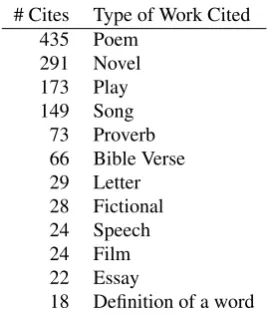
The most common works cited in epigraphs are shown in Table 1, the most common authors in Table 2, the most common types of works in Table 3 and finally the most common quotations used in epigraphs are shown in Table 4. The most cited author (if we exclude the bible) is Shake-speare, by an extremely wide margin. Gothic and fantastic authors are common, reflecting the fact that these genres use epigraphs more. Finally, it is interesting to see that po-etry is the most common source of epigraphs, with plays, songs, and proverbs all also popular.
# Cites Work Cited 129 Bible
35 The Tempest 32 Hamlet 23 Paradise Lost 23 Macbeth
22 Romeo and Juliet 20 As You Like It
19 The Book of Counted Sorrows 18 King Lear
15 Alice’s Adventures in Wonderland
Table 1: The most common works quoted in epigraphs
# Cites Author Cited
323 Shakespeare, William 74 Dickinson, Emily 62 Poe, Edgar Allan 45 Wilde, Oscar 44 Whitman, Walt 43 Blake, William 37 Nietzsche, Friedrich 36 Carroll, Lewis 35 Thoreau, Henry David 35 Milton, John
34 Emerson, Ralph Waldo 33 Einstein, Albert 32 Twain, Mark 32 Frost, Robert
Table 2: The most common authors quoted in epigraphs
The most commonly cited quotations are all from famous literary works, and show a wide spread from Ancient Greece and China (Aristotle and Sun Zu) to modern nov-els (such as Faulkner). The most common works are domi-nated by the Bible and Shakespeare, and include one origi-nally non-existent workThe Book of Counted Sorrows. This comes from a young adult series where the author cites poems from a fictional book at the start of each book.6
6In a letter dated August 10, 1992, Koontz stated:
“Ac-tually, there is no such book. I made it up. The way you
# Cites Type of Work Cited
435 Poem
18 Definition of a word
Table 3: The most types of works quoted in epigraphs
Later, the author wrote the book (Koontz, 2001). Another book cited by the same author,The Book of Counted Joys, remains non-existent.
2.2.1. Access
The epigraph database is released under the Creative Com-mons Attribution 4.0 International (CC BY 4.0) license7, which allows you to share and adapt in any medium or format for any purpose, so long as you give appro-priate credit, provide a link to the license, and indi-cate if changes were made. A snapshot is currently available at http://compling.hss.ntu.edu.sg/ projects/epigraph/, and future releases and analy-sis will be made available there.
3.
Future Work
In future work, we intend to both increase the size and rich-ness of the database, further analyze it and add support for visualizing patterns.
First we intend to add another 10,000 or so epigraphs, and fill in as much missing information as possible. This work will be completed within a year. The revised network will be published as an open-access online resource available to other scholars and researchers as well as members of the general public.
We wish to take advantage of linked open data to link lo-cations to the geonames database8and the works, through ISBN, to further metadata, with the help of NTU’s librar-ians. This helps both with normalization and checking of the data. Having an ISBN number allows us to link to the library catalogue’s controlled vocabulary.
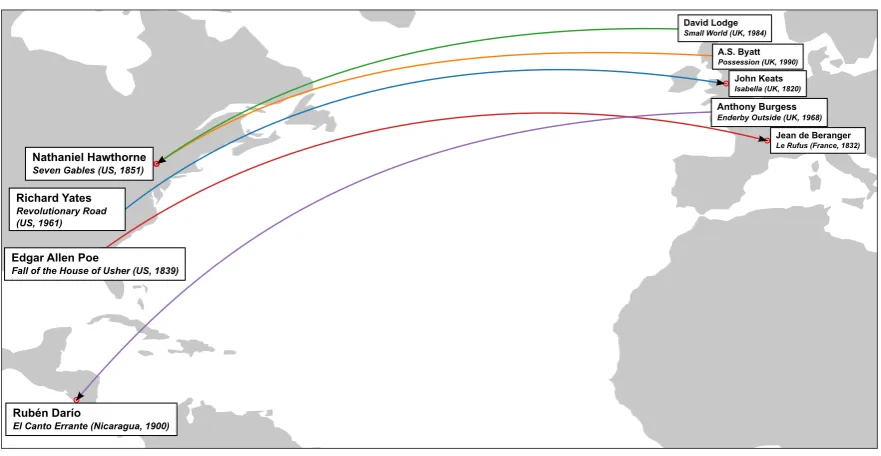
We also aim to display computer-generated visualisations of the map of literary influence in a manner accessible to a lay audience at venues such as the British Library and the Art-Science Museum in Singapore: we give sample visual-izations in Figures 1 and 2. This will involve both clustering and visualization.
made up footnote sources for fabricated facts in high-school
English reports.” http://flavorwire.com/135568/
5-real-books-inspired-by-fake-books
7https://creativecommons.org/licenses/by/ 4.0/
# Cites Epigraph Text Author
6 The past is never dead. It’s not even past. Faulkner, William
5 If an injury has to be done to a man it should be so severe that his vengeance need not be feared.
Machiavelli, Niccolo
5 We shall not cease from exploration And the end of all our exploring Will be to arrive where we started And know the place for the first time.
Eliot, T.S
4 Truth is beautiful, without doubt; but so are lies. Emerson, Ralph Waldo
4 Hell is empty and all the devils are here. Shakespeare, William
3 What is a friend? A single soul dwelling in two bodies. Aristotle
3 All war is deception. Sun Tzu
3 If a man will begin with certainties, he shall end in doubts; but if he will be content to begin with doubts, he shall end in certainties.
Bacon, Francis
3 Time present and time past Are both perhaps present in time future, And time future contained in time past.
Eliot, T.S
Table 4: The most common epigraphs
Edgar Allen Poe
Fall of the House of Usher (US, 1839)
Richard Yates
Revolutionary Road (US, 1961)
Nathaniel Hawthorne
Seven Gables (US, 1851)
Rubén Darío
El Canto Errante (Nicaragua, 1900)
Jean de Beranger Le Rufus (France, 1832) John Keats
Isabella (UK, 1820) David Lodge Small World (UK, 1984)
Anthony Burgess
Enderby Outside (UK, 1968) A.S. Byatt Possession (UK, 1990)
Figure 1: Epigraphs showing trans-atlantic influence
Arrows point from the work with the Epigraph to the cited work.
Further, we will use the network of literary epigraphs to test connections and densities. For instance, we can map the in-fluence of key literary authors such as Charles Dickens or Jane Austen by seeing how much of the network they cap-ture. We can similarly track the influence of women writ-ers or writwrit-ers of a particular nationality or movement. For example, this project would allow us to determine the ex-tent of the influence of the key Russian realist writers, Tur-genev, Tolstoy, and Dostoyevsky on European literature of the late-nineteenth century. When are the Ancient Greek and Roman writers in their ascendancy? Is eighteenth-century satire an influence on postmodern writers of the late-twentieth century? Are lines of literary influence in-tercontinental or do they cluster around Europe? Singapore has a burgeoning literary movement and this project can determine where in the world Singapore writers take their inspiration from: is it predominantly the English literary canon, the Chinese classics, Indian literature, Malay writ-ers, self-contained, or derived from more eclectic sources?
We can also determine the influence of Singaporean litera-ture on world literalitera-ture.
A figure like William Shakespeare is widely acknowledged as important by literary critics because his works are mean-ingful and there is a great deal to be said about them. How-ever, if we remove Shakespeare from the network, we can then explore the extent to which the network is altered: is Shakespeare such a focal point that it breaks apart or do the connections occur with a high enough frequency that its shape is unaffected? Conducting a series of case stud-ies such as these presents us with fresh insight into literary and cultural influence, the dissemination of ideas, and the circulation of people.
James Joyce Portrait of Artist (1915)
Ovid
Metamorphoses (Italy, 8AD) Aristotle
Politics (Greece, 427BC) A.S. Byatt
Biographer's Tale (2000)
David Lodge Therapy (1995)
Søren Kierkegaard (Denmark, 1836)
Goethe
Wahlverwandtschaften (Germany 1809)
Molière
Le Misanthrope (France, 1666) Samuel Butler
Erewhon (1872)
L.P Hartley The Hireling (1957)
Figure 2: Epigraphs showing the diverse range of European works that have influenced twentieth-century British literature.
Arrows point from the work with the Epigraph to the cited work.
from Faulkner (1951), we have several variants, shown in Table 5. We would like to investigate whether the change
fromnevertonot, which happens twice, reveals a
connec-tion between the two citing works. We add a link in the database between a variants of the same text.
4.
Conclusions
We have created a database of 10,000 epigraphs, which we released under an open license. It allows us to study how works influence each other, as well as the use of the epi-graph itself.
Acknowledgments
This research was supported by the Singapore MOE Tier 1 Grant: Digital Mapping the Literary Epigraph: Quantita-tive Analysis of Literary Influence Using Network Theory
and Thousands of Epigraphs(RG158/16) and the NTU
CO-HASS Cluster on Digital Humanities. We would like to thank the reviewers for their insightful comments.
5.
Bibliographical References
Faulkner, W. (1951). Requiem for a Nun. Random House. Genette, G. (1987). Paratexts: Thresholds of
Interpreta-tion. Cambridge University Press. (trans Jane E. Lewin). Knuth, D. (1984). The TEXbook. Addison-Wesley.
Koh, T. A. (2008). Singapore Literature in English: an
Annotated Bibliography. National Library Board
Singa-pore and Centre for Liberal Arts and Social Sciences, Nanyang Technological University. (now online and up-dated:https://eps.ntu.edu.sg/client/en_ US/SingaporeLiterature/).
Koontz, D. (2001). The Book of Counted Sorrows. Charnel House.
Paul Poplawski, editor. (2017). English Literature in Con-text. Cambridge University Press, second edition. Simkin, M. and Roychowdhury, V. (2003). Read before
Variant Cited in
The past is never dead. It’s not even past. cited by 6 authors
The past is never dead, it’s not even past. Langley Lee (2010)
The past is not dead. It is not even past. Carey, Peter (2012)
The past is never dead. It isn’t even past. Wolff, Isabel (2014)
The past is not dead; it’s not even past. Ohanesian, Aline 2015)
The past isn’t over. It isn’t even the past. Poulson, Christine (2016)
Table 5: Variants ofThe past is never dead. . . .