Generative Content Models for Structural Analysis of Medical Abstracts
Jimmy Lin1,2, Damianos Karakos3, Dina Demner-Fushman2, and Sanjeev Khudanpur3
1College of Information Studies 3Center for Language and
2Institute for Advanced Computer Studies Speech Processing
University of Maryland Johns Hopkins University
College Park, MD 20742, USA Baltimore, MD 21218, USA
[email protected], [email protected] (damianos, khudanpur)@jhu.edu
Abstract
The ability to accurately model the con-tent structure of text is important for many natural language processing appli-cations. This paper describes experi-ments with generative models for analyz-ing the discourse structure of medical ab-stracts, which generally follow the pattern of “introduction”, “methods”, “results”, and “conclusions”. We demonstrate that Hidden Markov Models are capable of ac-curately capturing the structure of such texts, and can achieve classification ac-curacy comparable to that of discrimina-tive techniques. In addition, generative approaches provide advantages that may make them preferable to discriminative techniques such as Support Vector Ma-chines under certain conditions. Our work makes two contributions: at the applica-tion level, we report good performance on an interesting task in an important do-main; more generally, our results con-tribute to an ongoing discussion regarding the tradeoffs between generative and dis-criminative techniques.
1 Introduction
Certain types of text follow a predictable structure, the knowledge of which would be useful in many natural language processing applications. As an example, scientific abstracts across many different
fields generally follow the pattern of “introduction”, “methods”, “results”, and “conclusions” (Salanger-Meyer, 1990; Swales, 1990; Or˘asan, 2001). The ability to explicitly identify these sections in un-structured text could play an important role in ap-plications such as document summarization (Teufel and Moens, 2000), information retrieval (Tbahriti et al., 2005), information extraction (Mizuta et al., 2005), and question answering. Although there is a trend towards analysis of full article texts, we believe that abstracts still provide a tremendous amount of information, and much value can still be extracted from them. For example, Gay et al. (2005) experimented with abstracts and full article texts in the task of automatically generating index term rec-ommendations and discovered that using full article texts yields at most a 7.4% improvement in F-score. Demner-Fushman et al. (2005) found a correlation between the quality and strength of clinical conclu-sions in the full article texts and abstracts.
This paper presents experiments with generative content models for analyzing the discourse struc-ture of medical abstracts, which has been con-firmed to follow the four-section pattern discussed above (Salanger-Meyer, 1990). For a variety of rea-sons, medicine is an interesting domain of research. The need for information systems to support physi-cians at the point of care has been well studied (Cov-ell et al., 1985; Gorman et al., 1994; Ely et al., 2005). Retrieval techniques can have a large im-pact on how physicians access and leverage clini-cal evidence. Information that satisfies physicians’ needs can be found in the MEDLINE database main-tained by the U.S. National Library of Medicine
(NLM), which also serves as a readily available corpus of abstracts for our experiments. Further-more, the availability of rich ontological resources, in the form of the Unified Medical Language Sys-tem (UMLS) (Lindberg et al., 1993), and the avail-ability of software that leverages this knowledge— MetaMap (Aronson, 2001) for concept identification and SemRep (Rindflesch and Fiszman, 2003) for re-lation extraction—provide a foundation for studying the role of semantics in various tasks.
McKnight and Srinivasan (2003) have previously examined the task of categorizing sentences in med-ical abstracts using supervised discriminative ma-chine learning techniques. Building on the work of Ruch et al. (2003) in the same domain, we present a generative approach that attempts to directly model the discourse structure of MEDLINE abstracts us-ing Hidden Markov Models (HMMs); cf. (Barzilay and Lee, 2004). Although our results were not ob-tained from the same exact collection as those used by authors of these two previous studies, comparable experiments suggest that our techniques are compet-itive in terms of performance, and may offer addi-tional advantages as well.
Discriminative approaches (especially SVMs) have been shown to be very effective for many supervised classification tasks; see, for exam-ple, (Joachims, 1998; Ng and Jordan, 2001). How-ever, their high computational complexity (quadratic in the number of training samples) renders them pro-hibitive for massive data processing. Under certain conditions, generative approaches with linear com-plexity are preferable, even if their performance is lower than that which can be achieved through dis-criminative training. Since HMMs are very well-suited to modeling sequences, our discourse model-ing task lends itself naturally to this particular gener-ative approach. In fact, we demonstrate that HMMs are competitive with SVMs, with the added advan-tage of lower computational complexity. In addition, generative models can be directly applied to tackle certain classes of problems, such as sentence order-ing, in ways that discriminative approaches cannot readily. In the context of machine learning, we see our work as contributing to the ongoing debate be-tween generative and discriminative approaches— we provide a case study in an interesting domain that begins to explore some of these tradeoffs.
2 Methods
2.1 Corpus and Data Preparation
Our experiments involved MEDLINE, the biblio-graphical database of biomedical articles maintained by the U.S. National Library of Medicine (NLM). We used the subset of MEDLINE that was extracted for the TREC 2004 Genomics Track, consisting of citations from 1994 to 2003. In total, 4,591,008 records (abstract text and associated metadata) were extracted using the Date Completed (DCOM) field for all references in the range of 19940101 to 20031231.
Viewing structural modeling of medical abstracts as a sentence classification task, we leveraged the existence of so-called structured abstracts (see Fig-ure 1 for an example) in order to obtain the appro-priate section label for each sentence. The use of section headings is a device recommended by the Ad Hoc Working Group for Critical Appraisal of the Medical Literature (1987) to help humans assess the reliability and content of a publication and to facil-itate the indexing and retrieval processes. Although structured abstracts loosely adhere to the introduc-tion, methods, results, and conclusions format, the exact choice of section headings varies from ab-stract to abab-stract and from journal to journal. In our test collection, we observed a total of 2688 unique section headings in structured abstracts—these were manually mapped to the four broad classes of “intro-duction”, “methods”, “results”, and “conclusions”. All sentences falling under a section heading were assigned the label of its appropriately-mapped head-ing (naturally, the actual section headhead-ings were re-moved in our test collection). As a concrete exam-ple, in the abstract shown in Figure 1, the “OBJEC-TIVE” section would be mapped to “introduction”, the “RESEARCH DESIGN AND METHODS” sec-tion to “methods”. The “RESULTS” and “CON-CLUSIONS” sections map directly to our own la-bels. In total, 308,055 structured abstracts were ex-tracted and prepared in this manner, serving as the complete dataset. In addition, we created a reduced collection of 27,075 abstracts consisting of only Randomized Controlled Trials (RCTs), which rep-resent definitive sources of evidence highly-valued in the clinical decision-making process.
unstruc-Integrating medical management with diabetes self-management training: a randomized control trial of the Diabetes Outpatient Intensive Treatment program.
OBJECTIVE– This study evaluated the Diabetes Outpatient Intensive Treatment (DOIT) program, a multiday group educa-tion and skills training experience combined with daily medical management, followed by case management over 6 months. Using a randomized control design, the study explored how DOIT affected glycemic control and self-care behaviors over a short term. The impact of two additional factors on clinical outcomes were also examined (frequency of case management contacts and whether or not insulin was started during the program). RESEARCH DESIGN AND METHODS– Patients with type 1 and type 2 diabetes in poor glycemic control (A1c ¿8.5%) were randomly assigned to DOIT or a second con-dition, entitled EDUPOST, which was standard diabetes care with the addition of quarterly educational mailings. A total of 167 patients (78 EDUPOST, 89 DOIT) completed all baseline measures, including A1c and a questionnaire assessing diabetes-related self-care behaviors. At 6 months, 117 patients (52 EDUPOST, 65 DOIT) returned to complete a follow-up A1c and the identical self-care questionnaire. RESULTS– At follow-up, DOIT evidenced a significantly greater drop in A1c than EDUPOST. DOIT patients also reported significantly more frequent blood glucose monitoring and greater attention to carbohydrate and fat contents (ACFC) of food compared with EDUPOST patients. An increase in ACFC over the 6-month period was associated with improved glycemic control among DOIT patients. Also, the frequency of nurse case manager follow-up contacts was positively linked to better A1c outcomes. The addition of insulin did not appear to be a significant contributor to glycemic change. CONCLUSIONS– DOIT appears to be effective in promoting better diabetes care and posi-tively influencing glycemia and diabetes-related self-care behaviors. However, it demands significant time, commitment, and careful coordination with many health care professionals. The role of the nurse case manager in providing ongoing follow-up contact seems important.
Figure 1: Sample structured abstract from MEDLINE.
tured abstracts of randomized controlled trials re-trieved to answer a question about the manage-ment of elevated low-density lipoprotein cholesterol (LDL-C). We submitted a PubMed query (“elevated LDL-C”) and restricted results to English abstracts of RCTs, gathering 49 unstructured abstracts from 26 journals. Each sentence was annotated with its section label by the third author, who is a medical doctor—this collection served as our blind held-out testset. Note that the annotation process preceded our experiments, which helped to guard against annotator-introduced bias. Of 49 abstracts, 35 con-tained all four sections (which we refer to as “com-plete”), while 14 abstracts were missing one or more sections (which we refer to as “partial”).
Two different types of experiments were con-ducted: the first consisted of cross-validation on the structured abstracts; the second consisted of train-ing on the structured abstracts and testtrain-ing on the unstructured abstracts. We hypothesized that struc-tured and unstrucstruc-tured abstracts share the same un-derlying discourse patterns, and that content models trained with one can be applied to the other.
2.2 Generative Models of Content
Following Ruch et al. (2003) and Barzilay and Lee (2004), we employed Hidden Markov Models to model the discourse structure of MEDLINE ab-stracts. The four states in our HMMs correspond
to the information that characterizes each section (“introduction”, “methods”, “results”, and “conclu-sions”) and state transitions capture the discourse flow from section to section.
Using the SRI language modeling toolkit, we first computed bigram language models for each of the four sections using Kneser-Ney discounting and Katz backoff. All words in the training set were downcased, all numbers were converted into a generic symbol, and all singleton unigrams and bi-grams were removed. Using these results, each sen-tence was converted into a four dimensional vector, where each component represents the log probabil-ity, divided by the number of words, of the sentence under each of the four language models.
In an attempt to further boost performance, we employed Linear Discriminant Analysis (LDA) to find a linear projection of the four-dimensional vec-tors that maximizes the separation of the Gaussians (corresponding to the HMM states). Venables and Ripley (1994) describe an efficient algorithm (of lin-ear complexity in the number of training sentences) for computing the LDA transform matrix, which en-tails computing the within- and between-covariance matrices of the classes, and using Singular Value De-composition (SVD) to compute the eigenvectors of the new space. Each sentence/vector is then mul-tiplied by this matrix, and new HMM models are re-computed from the projected data.
An important aspect of our work is modeling con-tent structure using generative techniques. To as-sess the impact of taking discourse transitions into account, we compare our fully trained model to one that does not take advantage of the Markov assumption—i.e., it assumes that the labels are in-dependently and identically distributed.
To facilitate comparison with previous work, we also experimented with binary classifiers specifi-cally tuned to each section. This was done by creat-ing a two-state HMM: one state corresponds to the label we want to detect, and the other state corre-sponds to all the other labels. We built four such classifiers, one for each section, and trained them in the same manner as above.
3 Results
We report results on three distinct sets of experi-ments: (1) ten-fold cross-validation (90/10 split) on all structured abstracts from the TREC 2004 MED-LINE corpus, (2) ten-fold cross-validation (90/10 split) on the RCT subset of structured abstracts from the TREC 2004 MEDLINE corpus, (3) training on the RCT subset of the TREC 2004 MEDLINE cor-pus and testing on the 49 hand-annotated held-out testset.
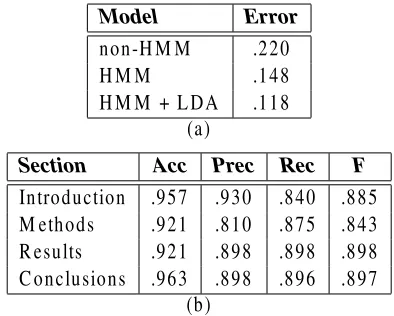
The results of our first set of experiments are shown in Tables 1(a) and 1(b). Table 1(a) reports the classification error in assigning a unique label to every sentence, drawn from the set{“introduction”, “methods”, “results”, “conclusions”}. For this task, we compare the performance of three separate mod-els: one that does not make the Markov assumption,
Model Error
non-HMM .220
HMM .148
HMM + LDA .118
(a)
Section Acc Prec Rec F
Introduction .957 .930 .840 .885
Methods .921 .810 .875 .843
Results .921 .898 .898 .898
Conclusions .963 .898 .896 .897 (b)
Table 1: Ten-fold cross-validation results on all structured abstracts from the TREC 2004 MED-LINE corpus: multi-way classification on complete abstract structure (a) and by-section binary classifi-cation (b).
the basic state HMM, and the improved four-state HMM with LDA. As expected, explicitly mod-eling the discourse transitions significantly reduces the error rate. Applying LDA further enhances clas-sification performance. Table 1(b) reports accuracy, precision, recall, and F-measure for four separate bi-nary classifiers specifically trained for each of the sections (one per row in the table). We only dis-play results with our best model, namely HMM with LDA.
The results of our second set of experiments (with RCTs only) are shown in Tables 2(a) and 2(b). Table 2(a) reports the multi-way classification er-ror rate; once again, applying the Markov assump-tion to model discourse transiassump-tions improves perfor-mance, and using LDA further reduces error rate. Table 2(b) reports accuracy, precision, recall, and F-measure for four separate binary classifiers (HMM with LDA) specifically trained for each of the sec-tions (one per row in the table). The table also presents the closest comparable experimental re-sults reported by McKnight and Srinivasan (2003).1 McKnight and Srinivasan (henceforth, M&S) cre-ated a test collection consisting of 37,151 RCTs from approximately 12 million MEDLINE abstracts dated between 1976 and 2001. This collection has
1
[image:4.612.327.524.56.214.2]Model Error
non-HMM .238
HMM .212
HMM + LDA .209
(a)
Present study McKnight and Srinivasan Section Acc Prec Rec F Acc Prec Rec F
Introduction .931 .898 .715 .807 .967 .920 .970 .945
Methods .904 .812 .847 .830 .895 .810 .830 .820
Results .902 .902 .831 .867 .860 .810 .830 .820
Conclusions .929 .772 .790 .781 .970 .880 .910 .820
[image:5.612.141.471.97.266.2](b)
Table 2: Ten-fold cross-validation results on the structured RCT subset of the TREC 2004 MEDLINE corpus: multi-way classification (a) and binary classification (b). Table (b) also reproduces the results from McKnight and Srinivasan (2003) for a comparable task on a different RCT-subset of structured abstracts.
Model Complete Partial
non-HMM .247 .371
HMM .226 .314
HMM + LDA .217 .279
(a)
Complete Partial McKnight and Srinivasan Section Acc Prec Rec F Acc Prec Rec F Acc Prec Rec F
Introduction .923 .739 .723 .731 .867 .368 .636 .502 .896 .630 .450 .524
Methods .905 .841 .793 .817 .859 .958 .589 .774 .897 .880 .730 .799
Results .899 .913 .857 .885 .892 .942 .830 .886 .872 .840 .880 .861
Conclusions .911 .639 .847 .743 .884 .361 .995 .678 .941 .830 .750 .785
(b)
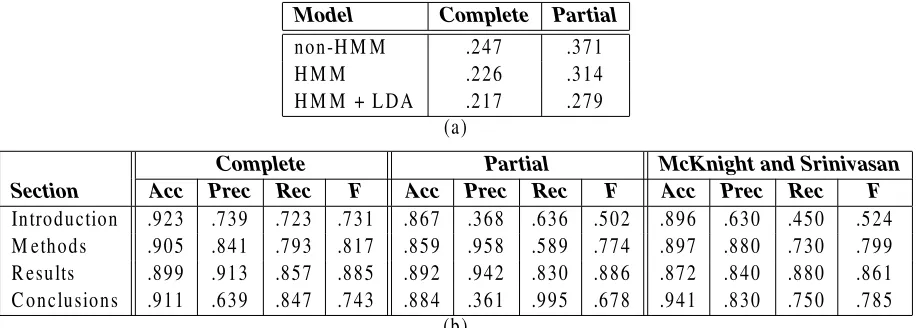
[image:5.612.78.538.415.579.2]significantly more training examples than our corpus of 27,075 abstracts, which could be a source of per-formance differences. Furthermore, details regard-ing their procedure for mappregard-ing structured abstract headings to one of the four general labels was not discussed in their paper. Nevertheless, our HMM-based approach is at least competitive with SVMs, perhaps better in some cases.
The results of our third set of experiments (train-ing on RCTs and test(train-ing on a held-out testset of hand-annotated abstracts) is shown in Tables 3(a) and 3(b). Mirroring the presentation format above, Table 3(a) shows the classification error for the four-way label assignment problem. We noticed that some unstructured abstracts are qualitatively differ-ent from structured abstracts in that some sections are missing. For example, some unstructured ab-stracts lack an introduction, and instead dive straight into methods; other unstructured abstracts lack a conclusion. As a result, classification error is higher in this experiment than in the cross-validation ex-periments. We report performance figures for 35 ab-stracts that contained all four sections (“complete”) and for 14 abstracts that had one or more miss-ing sections (“partial”). Table 3(b) reports accu-racy, precision, recall, and F-measure for four sep-arate binary classifiers (HMM with LDA) specifi-cally trained for each section (one per row in the table). The table also presents the closest compa-rable experimental results reported by M&S—over 206 hand-annotated unstructured abstracts. Interest-ingly, M&S did not specifically note missing sec-tions in their testset.
4 Discussion
An interesting aspect of our generative approach is that we model HMM outputs as Gaussian vec-tors (log probabilities of observing entire sentences based on our language models), as opposed to se-quences of terms, as done in (Barzilay and Lee, 2004). This technique provides two important ad-vantages. First, Gaussian modeling adds an ex-tra degree of freedom during ex-training, by capturing second-order statistics. This is not possible when modeling word sequences, where only the probabil-ity of a sentence is actually used in the HMM train-ing. Second, using continuous distributions allows
us to leverage a variety of tools (e.g., LDA) that have been shown to be successful in other fields, such as speech recognition (Evermann et al., 2004).
Table 2(b) represents the closest head-to-head comparison between our generative approach (HMM with LDA) and state-of-the-art results reported by M&S using SVMs. In some ways, the results reported by M&S have an advantage because they use significantly more training examples. Yet, we can see that generative techniques for the model-ing of content structure are at least competitive—we even outperform SVMs on detecting “methods” and “results”. Moreover, the fact that the training and testing of HMMs have linear complexity (as opposed to the quadratic complexity of SVMs) makes our approach a very attractive alternative, given the amount of training data that is available for such experiments.
Although exploration of the tradeoffs between generative and discriminative machine learning techniques is one of the aims of this work, our ul-timate goal, however, is to build clinical systems that provide timely access to information essential to the patient treatment process. In truth, our cross-validation experiments do not correspond to any meaningful naturally-occurring task—structured ab-stracts are, after all, already appropriately labeled. The true utility of content models is to struc-ture abstracts that have no strucstruc-ture to begin with. Thus, our exploratory experiments in applying con-tent models trained with structured RCTs on un-structured RCTs is a closer approximation of an extrinsically-valid measure of performance. Such a component would serve as the first stage of a clin-ical question answering system (Demner-Fushman and Lin, 2005) or summarization system (McKe-own et al., 2003). We chose to focus on randomized controlled trials because they represent the standard benchmark by which all other clinical studies are measured.
5 Related Work
Although not the first to employ a generative ap-proach to directly model content, the seminal work of Barzilay and Lee (2004) is a noteworthy point of reference and comparison. However, our study differs in several important respects. Barzilay and Lee employed an unsupervised approach to building topic sequence models for the newswire text genre using clustering techniques. In contrast, because the discourse structure of medical abstracts is well-defined and training data is relatively easy to ob-tain, we were able to apply a supervised approach. Whereas Barzilay and Lee evaluated their work in the context of document summarization, the four-part structure of medical abstracts allows us to con-duct meaningful intrinsic evaluations and focus on the sentence classification task. Nevertheless, their work bolsters our claims regarding the usefulness of generative models in extrinsic tasks, which we do not describe here.
Although this study falls under the general topic of discourse modeling, our work differs from previ-ous attempts to characterize text in terms of domain-independent rhetorical elements (McKeown, 1985; Marcu and Echihabi, 2002). Our task is closer to the work of Teufel and Moens (2000), who looked at the problem of intellectual attribution in scientific texts.
6 Conclusion
We believe that there are two contributions as a re-sult of our work. From the perspective of machine learning, the assignment of sequentially-occurring labels represents an underexplored problem with re-spect to the generative vs. discriminative debate— previous work has mostly focused on stateless clas-sification tasks. This paper demonstrates that Hid-den Markov Models are capable of capturing dis-course transitions from section to section, and are at least competitive with Support Vector Machines from a purely performance point of view.
The other contribution of our work is that it con-tributes to building advanced clinical information systems. From an application point of view, the abil-ity to assign structure to otherwise unstructured text represents a key capability that may assist in ques-tion answering, document summarizaques-tion, and other natural language processing applications.
Much research in computational linguistics has focused on corpora comprised of newswire articles. We would like to point out that clinical texts provide another attractive genre in which to conduct experi-ments. Such texts are easy to acquire, and the avail-ability of domain ontologies provides new opportu-nities for knowledge-rich approaches to shine. Al-though we have only experimented with lexical fea-tures in this study, the door is wide open for follow-on studies based follow-on semantic features.
7 Acknowledgments
The first author would like to thank Esther and Kiri for their loving support.
References
Ad Hoc Working Group for Critical Appraisal of the Medical Literature. 1987. A proposal for more infor-mative abstracts of clinical articles. Annals of Internal Medicine, 106:595–604.
Alan R. Aronson. 2001. Effective mapping of biomed-ical text to the UMLS Metathesaurus: The MetaMap
program. InProceeding of the 2001 Annual
Sympo-sium of the American Medical Informatics Association (AMIA 2001), pages 17–21.
Regina Barzilay and Lillian Lee. 2004. Catching the drift: Probabilistic content models, with applications
to generation and summarization. In Proceedings
of the 2004 Human Language Technology Confer-ence and the North American Chapter of the Associ-ation for ComputAssoci-ational Linguistics Annual Meeting (HLT/NAACL 2004).
David G. Covell, Gwen C. Uman, and Phil R. Manning. 1985. Information needs in office practice: Are they
being met? Annals of Internal Medicine, 103(4):596–
599, October.
Dina Demner-Fushman and Jimmy Lin. 2005. Knowl-edge extraction for clinical question answering: Pre-liminary results. InProceedings of the AAAI-05 Work-shop on Question Answering in Restricted Domains.
Dina Demner-Fushman, Susan E. Hauser, and George R. Thoma. 2005. The role of title, metadata and ab-stract in identifying clinically relevant journal
arti-cles. InProceeding of the 2005 Annual Symposium of
the American Medical Informatics Association (AMIA 2005), pages 191–195.
potential solutions. Journal of the American Medical Informatics Association, 12(2):217–224, March-April.
Gunnar Evermann, H. Y. Chan, Mark J. F. Gales, Thomas Hain, Xunying Liu, David Mrva, Lan Wang, and Phil Woodland. 2004. Development of the 2003 CU-HTK Conversational Telephone Speech Transcription
Sys-tem. In Proceedings of the 2004 International
Con-ference on Acoustics, Speech and Signal Processing (ICASSP04).
Clifford W. Gay, Mehmet Kayaalp, and Alan R. Aronson. 2005. Semi-automatic indexing of full text biomedi-cal articles. InProceeding of the 2005 Annual Sympo-sium of the American Medical Informatics Association (AMIA 2005), pages 271–275.
Paul N. Gorman, Joan S. Ash, and Leslie W. Wykoff. 1994. Can primary care physicians’ questions be an-swered using the medical journal literature? Bulletin of the Medical Library Association, 82(2):140–146, April.
Thorsten Joachims. 1998. Text categorization with Sup-port Vector Machines: Learning with many relevant
features. InProceedings of the European Conference
on Machine Learning (ECML 1998).
Donald A. Lindberg, Betsy L. Humphreys, and Alexa T. McCray. 1993. The Unified Medical Language Sys-tem. Methods of Information in Medicine, 32(4):281– 291, August.
Daniel Marcu and Abdessamad Echihabi. 2002. An
unsupervised approach to recognizing discourse
rela-tions. InProceedings of the 40th Annual Meeting of
the Association for Computational Linguistics (ACL 2002).
Kathleen McKeown, Noemie Elhadad, and Vasileios Hatzivassiloglou. 2003. Leveraging a common rep-resentation for personalized search and summarization
in a medical digital library. In Proceedings of the
3rd ACM/IEEE Joint Conference on Digital Libraries (JCDL 2003).
Kathleen R. McKeown. 1985. Text Generation: Using
Discourse Strategies and Focus Constraints to Gen-erate Natural Language Text. Cambridge University Press, Cambridge, England.
Larry McKnight and Padmini Srinivasan. 2003. Catego-rization of sentence types in medical abstracts. In Pro-ceeding of the 2003 Annual Symposium of the Ameri-can Medical Informatics Association (AMIA 2003).
Yoko Mizuta, Anna Korhonen, Tony Mullen, and Nigel Collier. 2005. Zone analysis in biology articles as a basis for information extraction. International Journal of Medical Informatics, in press.
Andrew Y. Ng and Michael Jordan. 2001. On discrim-inative vs. generative classifiers: A comparison of lo-gistic regression and naive Bayes. InAdvances in Neu-ral Information Processing Systems 14.
Constantin Or˘asan. 2001. Patterns in scientific abstracts. InProceedings of the 2001 Corpus Linguistics Confer-ence.
Thomas C. Rindflesch and Marcelo Fiszman. 2003. The interaction of domain knowledge and linguistic struc-ture in natural language processing: Interpreting
hy-pernymic propositions in biomedical text. Journal of
Biomedical Informatics, 36(6):462–477, December.
Patrick Ruch, Christine Chichester, Gilles Cohen, Gio-vanni Coray, Fr´ed´eric Ehrler, Hatem Ghorbel, Hen-ning M¨uller, and Vincenzo Pallotta. 2003. Report on the TREC 2003 experiment: Genomic track. In
Proceedings of the Twelfth Text REtrieval Conference (TREC 2003).
Franc¸oise Salanger-Meyer. 1990. Discoursal movements in medical English abstracts and their linguistic
expo-nents: A genre analysis study. INTERFACE: Journal
of Applied Linguistics, 4(2):107–124.
John M. Swales. 1990. Genre Analysis: English in
Aca-demic and Research Settings. Cambridge University Press, Cambridge, England.
Imad Tbahriti, Christine Chichester, Fr´ed´erique Lisacek, and Patrick Ruch. 2005. Using argumentation to re-trieve articles with similar citations: An inquiry into improving related articles search in the MEDLINE digital library. International Journal of Medical In-formatics, in press.
Simone Teufel and Marc Moens. 2000. What’s yours and what’s mine: Determining intellectual
attribu-tion in scientific text. In Proceedings of the Joint
SIGDAT Conference on Empirical Methods in Nat-ural Language Processing and Very Large Corpora (EMNLP/VLC-2000).
William N. Venables and Brian D. Ripley. 1994. Modern
Applied Statistics with S-Plus. Springer-Verlag.
Steve Young, Gunnar Evermann, Thomas Hain, Dan Ker-shaw, Gareth Moore, Julian Odell, Dave Ollason, Dan Povey, Valtcho Valtchev, and Phil Woodland. 2002.