Using Scenario Knowledge in Automatic Question Answering
Sanda Harabagiu and Andrew Hickl
Language Computer Corporation 1701 North Collins Boulevard Richardson, Texas 75080 USA
Abstract
This paper describes a novel framework for using scenario knowledge in open-domain Question Answering (Q/A) appli-cations that uses a state-of-the-art textual entailment system (Hickl et al., 2006b) in order to discover textual information rele-vant to the set of topics associated with a scenario description. An intrinsic and an extrinsic evaluation of this method is pre-sented in the context of an automatic Q/A system and results from several user sce-narios are discussed.
1 Introduction
Users of today’s automatic question-answering (Q/A) systems generally have complex informa-tion needs that cannot be satisfied by asking single questions in isolation. When users interact with Q/A systems, they often formulate sets of queries that they believe will help them gather the infor-mation that needed to perform one or more spe-cific tasks. While human users are generally able to identify their information needs independently, the information needs of organizations are often presented in the form of short prose descriptions
– known as scenarios – which outline the range
of knowledge sought by a customer in order to achieve a specific outcome or to accomplish a par-ticular task. (An example of one scenario is pre-sented in Figure 1.)
Recent work in Q/A has sought to use in-formation derived from these kinds of scenar-ios in order to retrieve sets of answers that are more relevant – and responsive – to a customer’s
information needs. While (Harabagiu et al.,
2005) usedtopic signatures(Lin and Hovy, 2000;
Scenario Description
The customer has commissioned a research project looking at the impact of the outsourcing of American jobs on the United States’ relationship with India. After conducting research on U.S. companies currently doing business in India, the customer wants to know why American corporations have sought to outsource jobs to India, the types of economic advantages that American companies could gain from relocating to India, and the kinds of economic or political inducements that India has offered to American companies looking to outsource jobs there. The customer is not interested in demographic information on Indian employees of American firms.
Table 1: Example of a User Scenario.
Harabagiu, 2004) computed automatically from collections of documents relevant to a scenario in order to approximate the semantic content of a scenario, (Narayanan and Harabagiu, 2004) em-ployed formal models of the interrelated events, actions, states, and relations implicit to a sce-nario in order to produce fine-grained, context-sensitive inferences that could be used to answer questions. Scenario knowledge was also included in the form of axiomatic logic transformation de-veloped in (Moldovan et al., 2003). Under this approach, information extracted from the scenario narrative is converted to logical axioms that can used in conjunction with a logic prover in order justify answers returned for questions.
In this paper, we propose that scenario-relevant passages in natural language texts can be identified by recognizing a semantic relation, known as con-textual entailment(CE), that exists between a text passage and one of a set of subquestions that are conventionally implied by a scenario. Under this model, we expect that a scenarioScan be
consid-ered to contextually entail a passaget, when there
exists at least one subquestion q derived from S
that textually entails the passaget. We show that
by using a state-of-the-art textual entailment tem (Hickl et al., 2006b), we can provide Q/A sys-tems with another mechanism for approximating the inference between questions and relevant an-swers. We show how each of these cases of
textual entailment can be computed and how it can be used in the intrinsic and extrinsic evaluation of a Q/A system.
The remainder of the paper is organized in the following way. Section 2 introduces our notion of contextual entailment and provides a framework for recognizing instances of CE between scenar-ios and both questions and answers. Section 3 de-scribes the textual entailment system used at the core of our CE system. Sections 4 and 5 describe separate frameworks for intrinsically and extrinsi-cally evaluating the impact of CE on current Q/A systems. Section 6 presents results from our evalu-ations, and Section 7 summarizes our conclusions 2 Recognizing Contextual Entailment
We define contextual entailment (CE) as a
direc-tional relation that exists between a text passaget
and one of a set of implicit subquestionsqthat can
be derived from a user’s interpretation of a sce-nario. Informally, we consider that a scenario S
contextually entails a passagetwhen there exists
at least one subquestionqimplied bySthat can be
considered to entailt.
We expect that the meaning of an information-seeking scenario S can be represented as a
ques-tion under discussion (QUD)QS, which denotes a partially-ordered set of subquestions (q∈QS) that represent the entire set of questions that could po-tentially be asked in order to gather information
relevant to S. Taken together, we expect these
subquestions to represent the widest possible con-strual of a user’s information need givenS.
Entailment?Contextual Entailment?Contextual
CASE 1 CASE 2 CASE 3
Answer
Question Question
User Scenario
Entailment?
Answer
Question User Scenario
Entailment?
Answer User Scenario
Entailment?
[image:2.595.307.525.368.595.2]Contextual Entailment? Contextual Entailment?
Figure 1: Three types of Contextual Entailment
We believe the set of subquestions implied by
QS can be used to test whether a text passage is
relevant to S. Since the formal answerhood
re-lation between a question and its answer(s) can be cast in terms of (logical) entailment (Groe-nendijk, 1999; Lewis, 1988), we believe that sys-tems for recognizing textual entailment(Dagan et al., 2005) could be used in order to identify those text passages that should be considered when
gath-ering information related to a scenario. Based on these assumptions, we expect that the set of text passages that are textually entailed by subques-tions derived from a scenario represent informa-tion that is more likely to be relevant to the overall topic of the scenario as a whole.
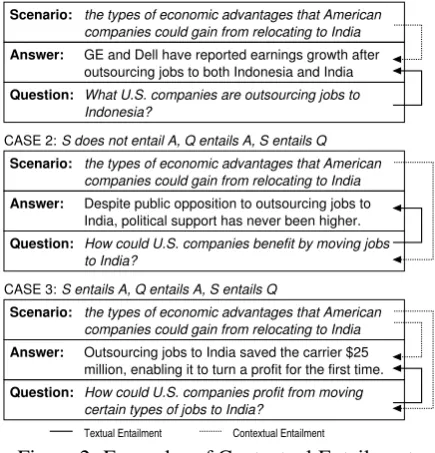
We expect that there are three types of contex-tual entailment relationships that could prove use-ful for automatic Q/A systems. First, as illustrated in Case 1 in 1, CE could exist between a scenario and one of the set of answers returned by a Q/A system in response to a user’s question. Second, as in Case 2, CE could be established directly be-tween a scenario and the question asked by the user. Finally, as in Case 3, CE could be established both between a scenario and a user’s question as well as between a scenario and one of the answers returned by the Q/A system for that question.
Figure 2 provides examples of each of these three types of contextual entailment using the sce-nario presented in Figure 1.
CASE 1:
Scenario:
companies could gain from relocating to India the types of economic advantages that American
Answer:
Question:
GE and Dell have reported earnings growth after outsourcing jobs to both Indonesia and India What U.S. companies are outsourcing jobs to Indonesia?
Textual Entailment Contextual Entailment
Scenario:
companies could gain from relocating to India the types of economic advantages that American
Answer:
Question:
Scenario:
companies could gain from relocating to India the types of economic advantages that American
Answer:
Question:
certain types of jobs to India?
How could U.S. companies profit from moving How could U.S. companies benefit by moving jobs to India?
Outsourcing jobs to India saved the carrier $25 million, enabling it to turn a profit for the first time. Despite public opposition to outsourcing jobs to India, political support has never been higher.
CASE 3:
CASE 2: S does not entail A, Q entails A, S entails Q S entails A, Q entails A, S does not entail Q
[image:2.595.74.290.527.615.2]S entails A, Q entails A, S entails Q
Figure 2: Examples of Contextual Entailment.
In Case 1, the scenario textually entails the
meaning of the answer passage, as earnings
growth from outsourcing necessarily represents
one of the types ofeconomic advantages that can
scenario-relevant information that is encountered – even when the user asks questions that are not entailed by the scenario itself. We expect that this type of contextual entailment would allow systems to identify scenario-relevant knowledge through-out a user’s interaction with a system, regardless of topic of a user’s last query.
In Case 2, the user’s question is entailed by the scenario, but no corresponding entailment re-lationship can be established between the scenario and the answer passage identified by the Q/A sys-tem as an answer to the question. While political supportmay be interpretable as one of the benefits realized by companies that outsource, it cannot be
understood as one of theeconomic advantagesof
outsourcing. Here, recognizing that contextual en-tailment could not be established between the sce-nario and the answer – but could be established between the scenario and the question – could be used to signal the Q/A system to consider addi-tional answers before moving on to the user’s next question. By identifying contextual entailment relationships between answers and elements in a scenario, systems could perform valuable forms of answer validation that could be used to select only the most relevant answers for a user’s considera-tion.
Finally, in Case 3, entailment relationships exist between the scenario and both the user’s question and the returned answer, assaving$25 millioncan
be considered to be both aneconomic advantage
and one of the ways that companies profit from
outsourcing. In this case, the establishment of con-textual entailment could be used to inform topic models that could be used to identify and extract other similarly relevant passages for the user.
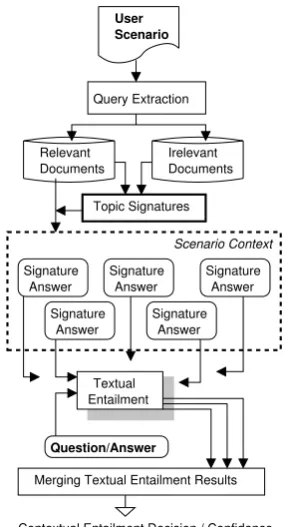
In order to capture these three types of CE re-lationships, we developed the architecture for rec-ognizing contextual entailment illustrated in Fig-ure 3.
This architecture includes three basic types of
modules: (1) aContext Discoverymodule, which
identifies passages relevant to the concepts men-tioned in a scenario, (2) aTextual Entailment mod-ule, which recognizes implicational relationships
between passages, and (3) a Entailment
Merg-ing module, which ranks relevant passages
ac-cording to their relevance to the scenario itself. In Context Discovery, document retrieval queries are first extracted from each sentence found in a scenario. Once a set of documents has been
as-User Scenario
Query Extraction
Documents Relevant
Documents Irelevant
Topic Signatures
Signature
Answer Signature Answer Signature
Answer Signature
Answer Signature Answer
EntailmentTextual
Question/Answer
Scenario Context
Merging Textual Entailment Results
[image:3.595.342.485.60.324.2]Contextual Entailment Decision / Confidence
Figure 3: Contextual Entailment Architecture.
sembled, topic signatures (Lin and Hovy, 2000;
Harabagiu 2004) are computed which identify the set of topic-relevant concepts – and relations be-tween concepts – that are found in the relevant set of documents. Weights associated with each set of topic signatures are then used to extract a set of relevant sentences – referred to astopic answers– from each relevant document. Once a set of topic answers have been identified, each topic answer is paired with a question submitted by a user and sent to theTextual Entailmentsystem described in Sec-tion 2. Topic answers that are deemed to be pos-itive entailments of the user question are assigned a confidence value by the TE system and are then
sent to aEntailment Mergingmodule, which uses
logistic regression in order to rank passages ac-cording to their expected relevance to the user sce-nario. Here, logistic regression is used to find a set of coefficientsbj (where 0≤j≤p) in order to fit a variablexto a logistic transformation of a
prob-abilityq.
logit(q) = log q
1−q =b0+
p X
j=1
bjxj +e
Coreference
Coreference NE Aliasing
Concept Textual
Input 1 TextualInput 2
Lexical Alignment
Paraphrase Acquisition
Alignment Module
WWW Training Corpora
Classifier YES
NO Features
Alignment
Dependency Features Paraphrase
Features Semantic/ Pragmatic Features
Feature Extraction
Classification Module
Lexico−Semantic PoS/ NER Synonyms/ Antonyms
Normalization Syntactic Semantic Temporal Parsing
Modality Detection Speech Act Recognition Pragmatics
Factivity Detection Belief Recognition
[image:4.595.109.252.63.372.2]Preprocessing
Figure 4: Textual Entailment Architecture.
3 Recognizing Textual Entailment
Recent work in computational
seman-tics (Haghighi et al., 2005; Hickl et al., 2006b; MacCartney et al., 2006) has demonstrated the viability of supervised machine learning-based approaches to the recognition of textual en-tailment (TE). While these approaches have not incorporated the forms of structured world knowledge featured in many logic-based TE sys-tems, classification-based approaches have been consistently among the top-performing systems in both the 2005 and 2006 PASCAL Recognizing Textual Entailment (RTE) Challenges (Dagan et al., 2005), with the best systems (such as (Hickl et al., 2006b)) correctly identifying instances of textual entailment more than 75% of the time.
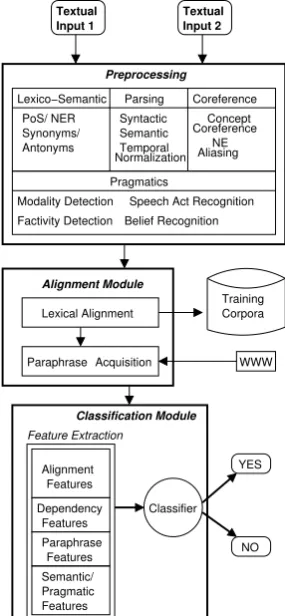
The architecture of our TE system is presented in Figure 4.1 Pairs of texts are initially sent to a
Preprocessing Module, which performs syntactic and semantic parsing of each sentence, resolves coreference, and annotates entities and predicates with a wide range of lexico-semantic and
prag-1For more information on the TE system described in this
section, please see (Hickl et al., 2006b) and (Harabagiu and Hickl, 2006).
matic information, including named entity infor-mation, synonymy and antonymy inforinfor-mation, and polarity and modality information.
Once preprocessing is complete, texts are then
sent to an Alignment Module, which uses
lexi-cal alignmentmodule in conjunction with a para-phrase acquisition module in order to determine the likelihood that pairs of elements selected from each sentence contain corresponding information that could be used in recognizing textual
entail-ment. Lexical Alignment is performed using a
Maximum Entropy-based classifier which com-putes an alignment probability p(a) equal to the likelihood that a term selected from one text cor-responds to an element selected from another text. Once these pairs of corresponding elements are identified, alignment information is then used in order to extract portions of texts that could be related via one or more phrase-level alternations or “paraphrases”. In order to acquire these al-ternations, the most likely pairs of aligned
ele-ments were then sent to aParaphrase Acquisition
module, which extracts sentences that contain in-stances of both aligned elements from the World Wide Web.
Output from these two modules are then com-bined in a finalClassification Module, which uses features derived from (1) lexico-semantic prop-erties, (2) semantic dependencies, (3) predicate-based features (including polarity and modality), (4) lexical alignment, and (5) paraphrase acquisi-tion in order learn a decision tree classifier capable of determining whether an entailment relationship exists for a pair of texts.
4 Intrinsic Evaluation of Contextual Entailment
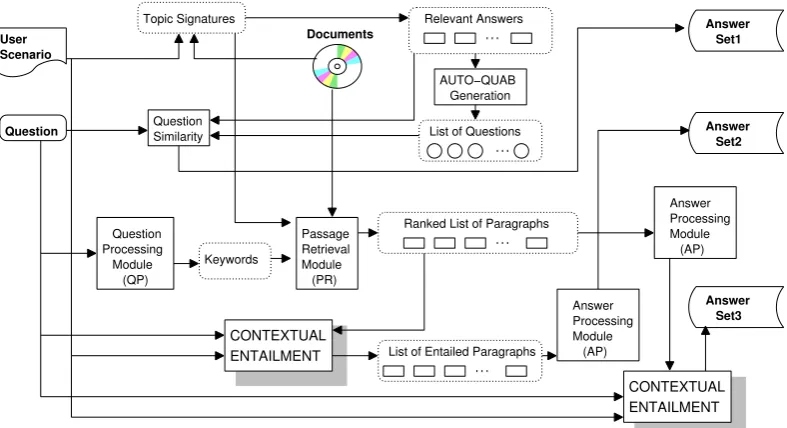
Since we believe CE is intrinsic to the Q/A task, we have evaluated the impact of contextual en-tailment on our Q/A system in two ways. First, we compared the quality of the answers produced, with and without contextual entailment. Second, we evaluated the quality of the ranked list of para-graphs against the list of entailed parapara-graphs iden-tified by the CE system and the set of relevant an-swers identified by the Q/A system. This compar-ison was performed for each of the three cases of entailment presented in Figure 2.
Topic Signatures Relevant Answers
Generation AUTO−QUAB
List of Questions Question
Similarity
ENTAILMENT CONTEXTUAL
ENTAILMENT CONTEXTUAL ProcessingQuestion
Module (QP)
Keywords
Passage Retrieval Module
(PR)
Ranked List of Paragraphs
List of Entailed Paragraphs Module Answer Processing
(AP)
Question User Scenario
Answer Set1
Answer Set2
Module Answer Processing
(AP)
[image:5.595.104.498.62.276.2]Answer Set3 Documents
Figure 5: Framework for Intrinsic Evaluation of Contextual Entailment in Q/A.
results of such knowledge integration in a Q/A system against the usage of scenario knowledge reported in (Harabagiu et al., 2005).
Topic signatures, derived from the user scenario and from documents are used to establish text pas-sages that are relevant to the scenario, and thus constitute relevant answers. For each such an-swer, one or multiple questions were built auto-matically with the method reported in (Harabagiu et al., 2005). When a new question was asked, its similarity to any of the questions generated based on the knowledge of the scenario is computed, and its corresponding answer is provided as an answer for the current question as well. Since the tions are ranked by similarity to the current ques-tion, the answers are also ranked and produce the Answer Set1illustrated in Figure 5.
When a Q/A system is used for answering the question, the scenario knowledge can be used in two ways. First, the keywords extracted by the Question Processing module can be enhanced with concepts from the topic signatures to produce a ranked list of paragraphs, resulting from the Pas-sage Retrieval Module. These pasPas-sages together with the question and the user scenario are used in one of the contextual entailment configurations to derive a list of entailed paragraphs from which the Answer Processing module can extract the an-swer set 2 illustrated in Figure 5. In another way, the ranked list of paragraphs is passed to the An-swer Processing module, which provides a set of ranked answers to the contextual entailment con-figurations to derive a list of entailed answers,
rep-resented as answer set 3 in Figure 5. We evalu-ate the quality of each set of answers, and for the answer set 2 and 3, we produce separate evalua-tion for each configuraevalua-tion for the contextual en-tailment.
5 Extrinsic Evaluation of Contextual Entailment
Questions asked in response to a user scenario tend to be complex. Following work in (Hickl et al., 2004), we believe complex questions can be answered in one of two ways: either by (1) using techniques (similar to the ones pro-posed in (Harabagiu et al., 2006)) for automati-cally decomposing complex questions into sets of informationally-simpler questions, or by (2) us-ing a multi-document summarization (MDS) sys-tem (such as the one described in (Lacatusu et al., 2006)) in order to assemble a ranked list of pas-sages which contain information that is potentially relevant to the user’s question.
en-User Scenario
Question
Keyword Extraction
System Question Answering Entailment
Contextual
Question Decomposition Documents
Entailment Contextual Multi−Document
Summarization System
Candidate
Sub−Questions Query
Relevant Documents
Candidate Answers Summary
[image:6.595.105.495.65.159.2]Answers Ranked
Figure 6: Framework for Extrinsic Evaluation of Contextual Entailment in Q/A.
tailment can be used to select the most relevant sentences from the summary.
The architecture of this proposed system is il-lustrated in Figure 6.
When using contextual entailment for selecting question decompositions, we rely on the method reported in (Harabagiu et al., 2006) which gener-ates questions by using a random walk on a bipar-tite graph of salient relations and answers. In this case, the recognition of entailment between ques-tions operates as a filter, forcing quesques-tions that are not entailed by any of the signature answers de-rived from the scenario context (see Figure 3) to be dropped from consideration.
When entailment information is used for re-ranking candidate answers, the summary is added to the scenario context, each summary sentence being treated akin to a signature answer. We be-lieve that the summary contains the most informa-tive information from both the question and the scenario, since the queries that produced it orig-inated both in the question and in the scenario. By adding summary sentences to the scenario context, we have introduced a new dimension to the pro-cessing of the scenario. The contextual entailment is based on the textual entailments between any of the texts from the scenario context and any of the candidate answers.
6 Experimental Results
In this section, we present preliminary results from four sets of experiments which show how forms of textual – and contextual – entailment can enhance the quality of answers returned by an automatic Q/A system.
Questions used in these experiments were gath-ered from human interactions with the interactive Q/A system described in (Hickl et al., 2006a). A total of 6 users were asked to spend approximately 90 minutes gathering information related to three different information-gathering scenarios similar
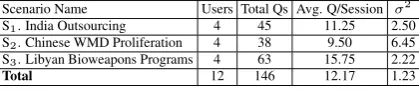
to the one in Table 1. Each user researched two different scenarios, resulting in a total of 12 to-tal research sessions. Once all research sessions were completed, linguistically well-formed ques-tions were extracted from the system logs for each session for use in our experiments; ungrammatical questions or keyword-style queries were not used in our experiments. Table 2 presents a breakdown of the total number of questions collected for each of the 6 scenarios.
Scenario Name Users Total Qs Avg. Q/Session σ2
S1. India Outsourcing 4 45 11.25 2.50 S2. Chinese WMD Proliferation 4 38 9.50 6.45 S3. Libyan Bioweapons Programs 4 63 15.75 2.22
Total 12 146 12.17 1.23
Table 2: Questions Collected from User Experi-ments.
In order to evaluate the performance of our Q/A system under each of the experimental conditions described below, questions were re-submitted to the Q/A system and the top 10 answers were re-trieved. Two annotators were then tasked with judging the correctness – or “relevance” – of each returned answer to the original question. If the an-swer could be considered to provide either a com-plete or partial answer to the original question, it was marked ascorrect; if the answer contained in-formation that could not be construed as an answer to the original question, it was marked as incor-rect.
6.1 Textual Entailment
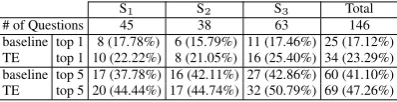
Following (Harabagiu and Hickl, 2006), we used TE information in order to filter answers identified by the Q/A system that were not entailed by the user’s original question. After filtering, the top-ranked entailed answer (as determined by the Q/A system) was returned as the system’s answer to the question. Results from both a baseline version and a TE-enhanced version of our Q/A system are pre-sented in Table 4.
[image:6.595.311.521.340.385.2]S1 S2 S3 Total # of Questions 45 38 63 146 baseline top 1 8 (17.78%) 6 (15.79%) 11 (17.46%) 25 (17.12%) TE top 1 10 (22.22%) 8 (21.05%) 16 (25.40%) 34 (23.29%) baseline top 5 17 (37.78%) 16 (42.11%) 27 (42.86%) 60 (41.10%) TE top 5 20 (44.44%) 17 (44.74%) 32 (50.79%) 69 (47.26%)
Table 3: Impact of Textual Entailment on Q/A.
system increased by more than 6% over the base-line system for each of the three scenarios. These results suggest that TE can be used effectively in order to boost the percentage of relevant answers found in the top answers returned by a system: by focusing only on answers that are entailed by a user’s question, we feel that systems can better identify passages that might contain information relevant to a user’s information need.
6.2 Contextual Entailment
In order to evaluate the performance of our con-textual entailment system directly, two annota-tors were tasked with identifying instances of CE amongst the passages and answers returned by our Q/A system. Annotators were instructed to
mark a passage as being contextually entailed by
a scenario only when the passage could be rea-sonably expected to be associated with one of the subtopics they believed to be entailed by the com-plex scenario. If the passage could not be associ-ated with the extension of any subtopic they be-lieved to be entailed by the scenario, annotators were instructed to mark the passage as not being contextually entailed by the scenario. For evalua-tion purposes, only examples that were marked by both annotators were considered as valid examples of CE.
Annotators were tasked with evaluating three types of output from our Q/A system: (1) the ranked list of passages retrieved by our system’s Passage Retrievalmodule, (2) the list of passages identified as being CE by the scenario, and (3) the set of answers marked as being CE by the scenario (AnsSet3). Results from the annotation of these passages are presented in Table 4.
S1 S2 S3 Total # %Rel # %Rel # %Rel # %Rel Ranked Paragraphs 450 40.4% 380 31.3% 630 42.5% 1460 39.3% Entailed Paragraphs 112 46.5% 87 44.8% 149 52.4% 348 48.6% Answer Set 3 304 44.4% 188 39.9% 322 49.1% 814 45.2%
Table 4: Distribution of CE.
Annotators marked 39.3% of retrieved passages as being CE by one of the three scenarios. This number increased substantially when only pas-sages identified by the CE system were consid-ered, as annotators judged 48.6% of CE passages
and 45.2% of CE-filtered answers to be valid in-stances of contextual entailment.
6.3 Intrinsic Evaluation
In order to evaluate the impact of CE on a Q/A sys-tem, we compared the quality of answers produced
(1) when no CE information was used (AnsSet1),
(2) when CE information was used to select a list of entailed paragraphs that were submitted to anAnswer Processing module (AnsSet2), and (3) when CE information was used directly to select answers (AnsSet3). Results from these three ex-periments are presented in Table 5.
[image:7.595.308.522.238.307.2]S1 S2 S3 Total # of Questions 45 38 63 146 AnsSet1 top 1 12 (26.67%) 9 (23.68%) 19 (30.16%) 40 (27.39%) AnsSet2 top 1 16 (35.56%) 11 (28.95%) 26 (41.27%) 53 (36.30%) AnsSet3 top 1 14 (31.11%) 15 (39.47%) 31 (49.21%) 60 (41.09%) AnsSet1 top 5 21 (46.67%) 17 (44.74%) 30 (47.62%) 68 (46.58%) AnsSet2 top 5 24 (53.33%) 18 (47.37%) 35 (55.55%) 77 (52.74%) AnsSet3 top 5 29 (64.44%) 20 (52.63%) 39 (61.90%) 88 (60.27%)
Table 5: Intrinsic Evaluation of CE on Q/A Per-formance.
As with the TE-based experiments described in Section 7.1, we found that the Q/A system was more likely to return at least one relevant an-swer among the top-ranked anan-swers when con-textual entailment information was used to either rank or select answers. When CE was used to
rank passages for Answer Processing (AnsSet2),
accuracy increased by nearly 9% over the base-line (AnsSet1), while accuracy increased by al-most 14% overall when CE was used to select an-swers directly (AnsSet3).
6.4 Extrinsic Evaluation
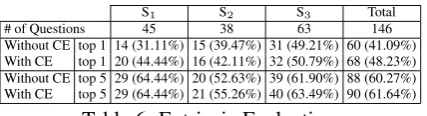
In order to evaluate the performance of the frame-work illustrated in Figure 6, we compared the per-formance of a question-focused MDS system (first described in (Lacatusu et al., 2006)) that did not use CE with a similar system that used CE to rank passages for a summary answer.
When CE was not used, sentences identified by the system’s Q/A and MDS system for each ques-tion were combined and ranked based on number of question keywords found in each sentence. In the CE-enabled system (analogous to the system depicted in Figure 6), only the sentences that were contextually entailed by the scenario were consid-ered; sentences were then ranked using the
real-valuedentailment confidencecomputed by the CE
system for each sentence. Results from this sys-tem are presented in Table 6.
[image:7.595.76.286.637.694.2]S1 S2 S3 Total # of Questions 45 38 63 146 Without CE top 1 14 (31.11%) 15 (39.47%) 31 (49.21%) 60 (41.09%) With CE top 1 20 (44.44%) 16 (42.11%) 32 (50.79%) 68 (48.23%) Without CE top 5 29 (64.44%) 20 (52.63%) 39 (61.90%) 88 (60.27%) With CE top 5 29 (64.44%) 21 (55.26%) 40 (63.49%) 90 (61.64%)
Table 6: Extrinsic Evaluation.
position (48.23%) than the system that did not use CE (41.09%), differences between the systems were much less apparent when the top 5 answers returned by each system were compared.
7 Conclusions
This paper introduced a new form of textual entail-ment, known as contextual entailentail-ment, which can be used to recognize scenario-relevant information in both the questions users ask and in the answers that automatic Q/A systems return. In addition to outlining a framework for recognizing contex-tual entailment in texts, we showed that contexcontex-tual entailment information can significantly enhance the quality of answers returned by a Q/A system in response to users’ questions about a particular scenario. In our evaluations, we found that using contextual entailment allowed Q/A systems to im-prove their accuracy by more than 10% overall. 8 Acknowledgments
This material is based upon work funded in whole or in part by the U.S. Government and any opin-ions, findings, conclusopin-ions, or recommendations expressed in this material are those of the authors and do not necessarily reflect the views of the U.S. Government.
References
Ido Dagan, Oren Glickman, and Bernardo Magnini. 2005. The PASCAL Recognizing Textual Entailment Challenge. InProceedings of the PASCAL Challenges Workshop.
Jeroen Groenendijk. 1999. The logic of interrogation: Clas-sical version. InProceedings of the Ninth Semantics and Linguistics Theory Conference (SALT IX), Ithaca, NY.
Aria Haghighi, Andrew Ng, and Christopher Manning. 2005. Robust textual inference via graph matching. In Pro-ceedings of Human Language Technology Conference and Conference on Empirical Methods in Natural Language Processing, Vancouver, British Columbia, Canada, Octo-ber.
Sanda Harabagiu and Andrew Hickl. 2006. Methods for using textual entailment in open-domain question-answering. In Proceedings of the Joint International Conference on Computational Linguistics and Annual Meeting of the Association for Computational Linguistics (COLING-ACL 2006), Sydney, Australia.
Sanda Harabagiu, Andrew Hickl, John Lehmann, and Dan Moldovan. 2005. Experiments with Interactive Question-Answering. InProceedings of the 43rd Annual Meeting of the Association for Computational Linguistics (ACL’05). Sanda Harabagiu, Finley Lacatusu, and Andrew Hickl. 2006.
Answering complex questions with random walk models. In2006 ACM SIGIR Conference on Research and Devel-opment in Information Retrieval (SIGIR), Seattle, WA. Sanda Harabagiu. 2004. Incremental Topic Representations.
InProceedings of the 20th COLING Conference, Geneva, Switzerland.
Andrew Hickl, John Lehmann, John Williams, and Sanda Harabagiu. 2004. Experiments with Interactive Question-Answering in Complex Scenarios. InProceedings of the Workshop on the Pragmatics of Question Answering at HLT-NAACL 2004, Boston, MA.
Andrew Hickl, Patrick Wang, John Lehmann, and Sanda Harabagiu. 2006a. FERRET: Interactive Question-Answering for Real-World Environments. In Proceed-ings of the Joint International Conference on Computa-tional Linguistics and Annual Meeting of the Association for Computational Linguistics (COLING-ACL 2006) In-teractive Presentations Program, Sydney, Australia. Andrew Hickl, John Williams, Jeremy Bensley, Kirk Roberts,
Bryan Rink, and Ying Shi. 2006b. Recognizing Textual Entailment with LCC’s Groundhog System. In Proceed-ings of the Second PASCAL Challenges Workshop, Syd-ney, Australia.
Finley Lacatusu, Andrew Hickl, Kirk Roberts, Ying Shi, Jeremy Bensley, Bryan Rink, Patrick Wang, and Lara Tay-lor. 2006. LCC’s GISTexter at DUC 2006: Multi-Strategy Multi-Document Summarization. InProceedings of the 2006 Document Understanding Conference (DUC 2006), New York, New York.
David Lewis. 1988. Relevant Implication. Theoria, 54(3):161–174.
Chin-Yew Lin and Eduard Hovy. 2000. The auto-mated acquisition of topic signatures for text summariza-tion. InProceedings of the 18th COLING Conference, Saarbr¨ucken, Germany.
Bill MacCartney, Trond Grenager, Marie-Catherine de Marn-effe, Daniel Cer, and Christopher D. Manning. 2006. Learning to recognize features of valid textual entail-ments. In Proceedings of the Joint Human Language Technology Conference and Annual Meeting of the North American Chapter of the Association for Computational Linguistics (HLT-NAACL 2006), New York, New York. Dan Moldovan, Christine Clark, Sanda Harabagiu, and Steve
Maiorano. 2003. COGEX: A Logic Prover for Question Answering. InProceedings of HLT/NAACL-2003. Srini Narayanan and Sanda Harabagiu. 2004. Question