1526
Are We Ready for Robots?
Dr. Nidhi Arora1, CRIM Poonam Arora2
Advicon Tech Pvt. Ltd., Ahmedabad1,St. Kabir Institute of Professional Studies2 Email: [email protected]1,poonam.a@skips .in2
Abstract-Intelligent machines and robots have been existing since last decade as a result of years of efforts by scientists and engineers in the interest of humanity. Robotics at one extreme can be innovatively useful while on the other extreme it can disruptively leads humans to unemployment. People have always fantasized a futuristic world filled with robots working like humans and enhancing their life. A study has been done to record and analyze responses of people about the acceptance of robots in their routine life. The respondents belonging to various professions in Gujarat were selected to form the sample data for understanding their perceptions about robots. A number of intelligent machines are already in service of people with the intent of making their mechanical work automatic. A careful assessment of needs of people and capabilities of robots to assist them in their daily life is done on the basis of factors like reliability, usefulness of robots, employment status and impact on life of people. Acceptance of robots is dependent on improvement in work efficiency and reduction in errors, while the acceptance varies with the buying capacity of people and supervision it requires.
Till the time robots are bringing comfort in life of human beings life going well side-by-side, the robots are found to have substantial acceptance, but the threat of robots replacing human beings completely at work place brings down their acceptance level unfavorably.
Index Terms-Robotics; artificial intelligence; work efficiency; reliability; usefulness; acceptance
1. INTRODUCTION
Robotics and Artificial intelligence are picking up very fast now-a-days because of their widespread awareness among people. These technologies can provide a level of ease in routine activities.
Life of human beings with social responsibilities and loads of work at office has become strenuous. Robotics has emerged as a ray of hope for people to provide ease in their work. In past few years, interest of people in robotics has increased astonishingly. Robots have already been seen to assist human beings in many sectors. The reason behind this fact is obviously the enormous benefits offered by robots; efficiency, time, flexibility, stability, usability, adaptability and so on. More importantly, robots don’t bite. Even after doing repetitive tasks for months, robots never complain. Once trained, robots can perform any task with more precision than human beings without asking for anything in reward; not even salary.
Technically speaking, a robot is a mechanical device capable of doing the allotted work with utmost efficiency irrespective of the environment it is put in. It can carry out all the activities it is designed and instructed to do without asking any questions, with no complaints at all and with the expected accuracy. Robots were initially designed to replicate a rational human behavior like honesty, punctuality and precision. With the passage of time, they have occupied a significant place in business and household due to their qualities. There are variety of robots around from lawn mower to vacuum cleaner, to dish
washer and window washer. The appearance and behavior of robots matching human beings can be considered as one of the factors to improve upon the acceptance of robots.
Robotics is one of the fastest emerging domains which is expected to change the way we think and the way we live our life. Robots can not only replicate human actions, but also are candidate of substitution for human beings at home and workplace. Robots have vast applications in industry and household including manufacturing, medical, agriculture, automobile etc. They can be used even in the most dangerous environments like bomb detection and diffusion. Robots manufacturing companies give different appearance to the robots; some are even made to resemble human beings in appearance. The idea behind matching the appearance may be to increase the acceptance of robots to mimic human behavior. These robots can replicate walking, lifting, speech, cognition and almost everything a human can do even to the extent of reasoning.
1527
2. EXISTING WORK
The continued development in artificial intelligence, robotics and automation has proved to be favorable for people. The intention behind robots is to get the most boring and onerous tasks done by them. The reason is quite obvious; human beings get bored and tired doing monotonous job for longer periods. On the contrary, robots can do the same task for any length of time with the same efficiency reducing the errors and precision in work with no question of boredom.
Robotics is an area of Artificial Intelligence which has grabbed the interest of students also. Even in technical events of schools and colleges, robotic events have become most preferred events especially in India. Household robots like iRobot Roomba (Indian Express, 2018) and Milagrow Black Cat (Digit, 2016) have been in India to do the cleaning job. GRoboMac (Economic Times, 2017) and agribot (IEEE, 2011) farm robots are capable of increasing overall productivity of farming. BRABO (Livemint, 2017) is one of the industrial robots developed to be used by small and medium enterprises in India. This robot can do voluminous and repetitive task of human workers like handling of raw materials and packaging of finished goods.
Earlier, robots were seen more in the form of toys for kids or in movies, but during the last decade they have slowly entered into reality. Robots can be seen in household and business domain affecting human beings’ life directly or indirectly. Many researchers have different views about the impact on the trust and empathy of robots on their appearance (Zlotowski, 2016). Chatila put forward the ethical issues of inclusion of humanoid robots in human society. Rosen identified problem areas in industry where machine vision can be successfully applied. This is done in view of impact of robots on productivity, product quality, and mass-production process. Johnson emphasized in getting more clarity about facilities robotics offers in education sector before being caught up in fancy of it. On related lines, Leenes and Lucivero believe that robots can’t so easily enter our lives. In doing so, they have to follow the social and legal norms we follow. Hence, they worked on ways of regulating robotic behavior. Dautenhahn focused on the dimensions of Human Robotics Interface, discussing requirements on social skills for robots.
Robots can sophisticatedly carry out human-like repetitive tasks to mark the growth of intelligent robots. The third generation robots are capable of adapting to changes in the dynamic environment with sensor feedback (Gbose, 2016). With availability of complex sensors and high-performance computational platforms it has become possible to see the dream of autonomous robots to carry out sophisticated tasks in most unpredictable environments. This also makes it
possible for robots to interact with human beings (Hager, 2000). Although this may be achieved in future, researchers continue to add to the capabilities of artificial Intelligence (Xie, 2009).
3. RESEARCH METHODOLOGY
Introduction of artificial intelligence and robotics has given indication that coming years will be years of massive automation. To know and register the opinions of people about their acceptance of robotics, a well-structured questionnaire is prepared and a survey is conducted over respondents of Gujarat. The research conducted is primary in nature following the descriptive methodology. Using the proportion formula, the sample size representative of population of Gujarat came out to be 136. The data collection followed non-probability convenience sampling and could register 145 responses from people working in different arenas and having different occupation. The study attempts to understand the acceptance levels of people for robotics and the factors affecting their opinions. The study uses four independent variables i.e. reliability on robotics, impact of robotics on life, effect on employment and usefulness of robotics. The dependent variable in this study is acceptance of robotics.
Four hypotheses are formed on the basis of the study survey.
The first hypothesis is:
H01: Acceptance of robotics is independent of
improvement in work efficiency.
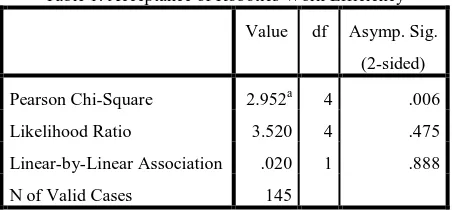
Table 1: Acceptance of Robotics Work Efficiency
Value df Asymp. Sig.
(2-sided)
Pearson Chi-Square 2.952a 4 .006
Likelihood Ratio 3.520 4 .475
Linear-by-Linear Association .020 1 .888
N of Valid Cases 145
1528 The second hypothesis is:
H02: Acceptance of robotics is independent of
reduction in degree in errors.
Table 2: Acceptance of Robotics Reduction in
Degree of Errors
Value df Asymp.
Sig.
(2-sided)
Pearson Chi-Square 5.818a 4 .013
Likelihood Ratio 5.740 4 .219
Linear-by-Linear
Association 3.353 1 .067
N of Valid Cases 145
The test value in the table 2 is smaller than the level of significance, i.e. 0.05. Hence the alternate hypothesis is accepted which means acceptance depends on the reduction in errors. The cross tabulated data identifies around 82 people out of the total size in highest favor of accepting robotics. One of the expected benefits of machines doing the manly chores is error free quantum of work which forms an important factor in acceptance of robotics by people.
The next hypothesis is:
H03: Acceptance of robotics is independent of price
affordability
Table 3: Acceptance of Robotics Price Affordability
Value df Asymp. Sig. (2-sided) Pearson Chi-Square 10.439a 4 .034
Likelihood Ratio 8.832 4 .065
Linear-by-Linear
Association 1.288 1 .256
N of Valid Cases 145
Chi square value from table 3 is 0.034 which is less than the level of significance, i.e. 0.05 which means the hypothesis is not accepted and adoption of robotics depends on the buying capacity of people. Though major incentives of its acceptance are efficient and effective work but capacity to own one can’t be ignored. Majority of respondents said that price affordability is a dominant factor in accepting machines for easing out their work.
H04: Acceptance of robotics is independent of
increased supervision.
Table 4: Acceptance of Robotics Increased Supervision
Value df Asymp. Sig. (2-sided) Pearson Chi-Square 20.333a 4 .000
Likelihood Ratio 18.749 4 .001
Linear-by-Linear
Association 7.942 1 .005
N of Valid Cases 145
The test value from table 4 is 0.000 which is less than the level of significance, i.e. 0.05. This means that alternate hypothesis has to be accepted and adoption of robotics depends on increased supervision. Around 82 respondents are of the opinion that there will be an increased need of supervision of robots in doing the human work. So, the acceptance crucially depends on the quantum period of human supervision by humans.
Fig. 1: Effect of Existence of Robots on Human’s Life
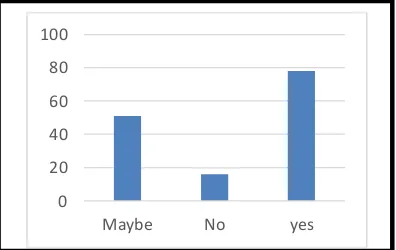
Figure 1 shows that out of total sample size, around 83 respondents believed that use of robotics in people’s life will definitely bring lot of changes. As seen in figure 2, around 80 people believed that initiation of robots in daily life will highly be useful and around 60% believed that this change will bring a positive effect in their lives.
Fig. 2: Usefulness of Robots
16
46
83
0 20 40 60 80 100
Negative Neither Positive Nor Negative
Positive
0 20 40 60 80 100
1529 The difference between opinion of housewives and
professionals is tested as they are the people who would be mostly affected by the introduction,
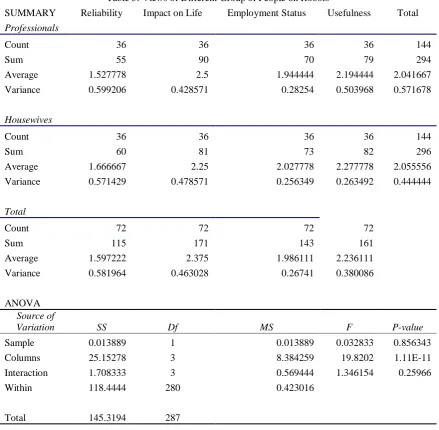
acceptance and use of robotics in future. Table 5 shows the results of test conducted.
Table 5: Views of Different Group of People on Robots
SUMMARY Reliability Impact on Life Employment Status Usefulness Total
Professionals
Count 36 36 36 36 144
Sum 55 90 70 79 294
Average 1.527778 2.5 1.944444 2.194444 2.041667
Variance 0.599206 0.428571 0.28254 0.503968 0.571678
Housewives
Count 36 36 36 36 144
Sum 60 81 73 82 296
Average 1.666667 2.25 2.027778 2.277778 2.055556
Variance 0.571429 0.478571 0.256349 0.263492 0.444444
Total
Count 72 72 72 72
Sum 115 171 143 161
Average 1.597222 2.375 1.986111 2.236111
Variance 0.581964 0.463028 0.26741 0.380086
ANOVA Source of
Variation SS Df MS F P-value
Sample 0.013889 1 0.013889 0.032833 0.856343
Columns 25.15278 3 8.384259 19.8202 1.11E-11
Interaction 1.708333 3 0.569444 1.346154 0.25966
Within 118.4444 280 0.423016
Total 145.3194 287
The analysis is done considering four variables i.e. reliability, impact on life, view about employment and usefulness of robotics. According to professionals, among all the four variables, robotics will impact the life hugely. Other two variables, usefulness and employment status scored equal on the average scale. This implies that robotics will be useful and accepted by people to a large extent which may create problems of unemployment in future. This will certainly impact life of people. Housewives believe that acceptance of robotics will be very useful in their lives as it will help them in completing the house work much efficiently in no time. The other variable with high average is
impact on life. As robots will do almost every work, it will help housewives save lot of time which they will be able to utilize in some other work and hence will impact their life positively.
Part 2 of table 5 helps in testing following three hypotheses:
H05: There is no significant difference between the
variance of housewives and professionals over acceptance of robotics
H06: There is no significant difference between the
1530 status and usefulness of robotics over acceptance of
robotics
H07: There is no significant difference between the
variance of housewives and professionals over reliability, impact on life, employment status and usefulness of robotics
The p value for ‘sample’ in part 2 of table 5 is 0.856343 which is greater than 0.5 which interprets that there is no significant difference between the variance of housewives and professionals over acceptance of robotics. Both the professions are willing over the acceptance of robotics. Second p value for ‘columns’ in the table is 0.000, which says that there is a significant difference between the given four factors leading to the acceptance. Not all factors are equally responsible in acceptance. Different factors are preferred and are sought by different people in accepting robotics. The third p value for ‘interaction’ is 0.259 which is greater than 0.05 which says that there is significant difference between the viewpoint of professionals and housewives over the four variables relating to robotics.
4. CONCLUSION
Robotics is expected to soon change the way we live and work. Although this is also true that robots have not matured to have enough common sense to deal with a dynamic environment, but they are suitable perfectly to do monotonous and laborious tasks. On one hand, where scientists and philosophers keep doing their debates on race between robots and human beings, the fact cannot be denied that robots continue to impact our lives in various ways.
The results indicate that reliability, usefulness of robots, employment status and impact on life of people are factors contributing to acceptance of robots by people. Acceptance of robots is dependent on the positive effects on improvement in work efficiency and reduction in errors, while the acceptance of people varies with their buying capacity and supervision needed to get things done in systematic way, as required. The perceptions of people towards robots and the results of this study may serve as a direction in further development of robots.
We never know what future has held for us as far as robots are concerned. Robots are welcomed today with great enthusiasm, but looking at the advanced generations of robots it is difficult to predict whether they will stay slave to human beings or win over the superiority game. No matter what tomorrow will bring, robots have secured their place in our world.
REFERENCES
[1] Borpuzari, P. (2017): Robot harvester: This precision farm machine can shape the future of India's agriculture, December 01,
https://economictimes.indiatimes.com/small- biz/startups/features/robot-harvester-this- precision-farm-machine-can-shape-the-future-of-indias-agriculture/articleshow/61763826.cms. [2] BRABO: How India got its first Made in India
industrial robot, livemint, Apr 18 2017, https://www.livemint.com/Industry/pcYwlItCLm7 MZE88Pn1feO/BRABO-How-India-got-its-first-Made-in-India-industrial-robo.html.
[3] Chatila, R. (2016): Inclusion of Humanoid Robots in Human Society: Ethical Issues, Humanoid Robotics: A Reference, Springer Netherlands, pp. 1-10.
[4] Dautenhahn, Kerstin. (2007): Socially Intelligent Robots: Dimensions of Human-Robot Interaction. Philosophical Transactions: Biological Sciences, JSTOR, 362(1480), pp. 679–704.
[5] Gbose T. (2014): Intelligent Robots Will Overtake Humans by 2100, Live Science, http://www.livescience.com/29379-intelligent-robots-will-overtake-humans.html.
[6] Gollakota A., Srinivas M. B. 2011. Agribot — A multipurpose agricultural robot, Annual IEEE India Conference, Hyderabad, pp. 1-4.
[7] Hager G. (2000). Sensor Based Intelligent Robots: International Workshop, Dagstuhl Castle, Germany, Selected Revised Papers. Springer, pp. 15-20.
[8] iRobot Roomba 606 robotic vacuum cleaner launched in India: Price, features, March 19 2018, http://indianexpress.com/article/technology/gadge ts/irobot-roomba-606-robotic-vacuum-cleaner-price-in-india-specifications-features-5103307/. [9] Johnson, J. (2003): Artif Life Robotic, 7(16),
https://doi.org/10.1007/BF02480880.
[10]Leenes, R.E. and Lucivero, F. (2014): Laws on Robots, Laws by Robots, Laws in Robots: Regulating Robot Behaviour by Design. Law, Innovation and Technology, 6(2) pp. 194–222. [11]Milagrow AguaBot 5.0 robotic vacuum cleaner
launched at Rs. 31,990, July 10 2016, https://www.digit.in/general/milagrow-aguabot- 50-robotic-vacuum-cleaner-launched-at-rs-31990-30973.html.
[12]Rosen C.A. (1979): Machine Vision and Robotics: Industrial Requirements. In: Dodd G.G., Rossol L. (eds) Computer Vision and Sensor-Based Robots. Springer, Boston, MA. [13]Xie M. (2009): Intelligent Robotics and
Applications, Second International Conference, ICIRA 2009, Singapore, Proceedings. Springer Science & Business Media.