23
Process Allocation and Migration in Virtual Machines
using Greedy Method in Cloud Computing
Preethi.M
1, Lokeshwari.P
2M.Sc. Information Technology1, 2, M.O.P.Vaishnav College for Women1, 2 Email: [email protected]1,[email protected]2
Abstract: Cloud computing is a technology which uses web and central remote servers to maintain data and applications. It permits any user from any place to use its services. Virtualization technology has been broadly applied in cloud computing due to its inherent benefits such as elasticity, scalability, flexibility, and on-demand resource provision. It shows a simulated behaviour of a software system. Virtual Machine (VM) is a simulation of a computer structure. In order to balance the work load across VMs, process migration is a very useful mechanism. Migration of process helps to satisfy performance objectives, increase resource utilization, decrease energy consumption, and facilitate system maintenance activities. Devising an efficient migration scheme is a challenging problem because the technique must manage the resources in such a way that it does not result in wastage or underutilization of resources. It may result in poor service distribution in the data centers. This paper implements greedy method for allocating processes to VM. It also maintains a state that no resources are underutilised by migrating processes to another best fit VM when requested resource is not available as a whole.
Index Terms-Resource utilisation, allocation, process migration, memory size, greedy method
1. INTRODUCTION
Cloud Computing is a network based facility that offers common resources which are shared on demand. It is a composition of three service models, four deployment models and five essential characteristics. One of its main benefits is fast storage and retrieval of data. It is a computing technology that maintains computational resources on huge data centers which can be accessed through internet, rather than on local computers. As a result there is no necessity for customers to have their individual dedicated resources. They are provided on the internet by the cloud providers. Thus customers expends only for the required services without spending for infrastructure. On the other hand, the rising energy consumption of cloud data centers has become a prominent problem. In cloud computing, virtualisation is used for storage, application, server and network devices. To manage energy consumption, techniques such as migration, load balancing and maintenance of servers are used.
Virtualization is one of the pre-eminent technologies for consuming energy efficiently in data centers. Some of its advantages are resource utilization, portability, and application isolation, reliability of system, higher performance, improved management ability and fault tolerance. Resource usage optimization is one of the ways used for reducing energy consumption which also helps administrators to control the budgets of data centers.
Cloud contains a set of virtual machines which comprises both computational and storage capacity. Virtual Machine is a complete hardware system which is virtual software and runs in an isolated environment. Large servers can run several different VMs providing different services. Better server utilization is achieved with virtualization. It allows storing many operating systems and applications on distinct and shared computer which can be used over the network with the help of a browser and an internet connection. The processes can be migrated across VMs and also physical nodes to provide quality of service. It also helps in achieving various goals. Modern day data centers consist of hundreds of virtual servers. Migration of processes provides the capability of load balancing, system maintenance, etc. Virtualization technology gives power to cloud computing.
2. REVIEW OF LITERATURE
[2] presents a system that uses
24
allocation method in virtual machines. Different methods are used for allocation of processes across virtual machines. [12] gives a study on different scheduling algorithms. [9][10][11] focuses on scheduling jobs using greedy method each with different parameters like energy consumption, completion time etc. [18]focus on a different algorithm for implementing process migration in order to balance the load.
3. VIRTUALIZATION
Virtualization offers an efficient solution to the objectives of the cloud computing paradigm by enabling creation of Virtual Machines (VMs) over the basic physical servers, leading to improved resource utilization and abstraction. Virtualization refers to creating a virtual form of a resource where the mechanism divides the resource into one or
more execution environments. Applications,
devices and end-users interact with the virtual resource as if it were a real single logical resource.
The purpose of Virtualization is to utilize the resource distribution, sharing and utilization to their maximum potential, reduce infrastructure costs in terms of physical resources, hardware, new network setups, system setups, and infrastructure
maintenance. Virtualization hides the
characteristics of the physical system from the user and as an alternative provides with another abstract computing platform.
To efficiently share system resources, virtualization abstracts the underlying hardware resource by placing a software layer between OS and the hardware. It also guarantees that the failure of one VM does not impact the proper functioning of the entire physical machine. However, co-hosting multiple VMs onto a single physical server is very challenging due to resource contention
among co-hosted applications and system
performance degeneration attributed to server overutilization.
4. RESOURCE ALLOCATION
In cloud computing, Resource allocation is the process of assigning available resources to the cloud applications. Cloud resources can be provisioned on demand to the business customers based on their needs. In cloud the resource allocation depends on the infrastructure as a service. In cloud platforms, resource allocation takes place at two stages:
When an application is uploaded to the
cloud, in order to balance the
computational load of multiple
applications across physical computers, the load balancer assigns the requested instances to physical computers.
When an application receives multiple
incoming requests, to balance the
computational load across a set of instances of the same application, these requests should be assigned to a precise application instance.
Resource allocation techniques should
satisfy the following criteria:
Resource fragmentation arises when the
resources are allocated, freed and
ultimately reallocated. There would be enough resources but cannot be allocated it to the required application due to fragmentation
Scarcity of resources arises when the
demand is greater than the available resources.
The technique should satisfy that request of multiple applications.
The resource allocation algorithms take the resource requirements of a process into consideration and change the allocated resources, thus making it an on demand elastic cloud. Process placement and migration have become a major part of resource allocation in cloud data centers. Changes in the resource requirements of VMs are considered to be significant information for process placement and migration. Some of the resource allocation algorithms are first fit, worst fit and best fit algorithm out of which the best fit algorithm is the finest technique for utilising the resources in a beneficial way. It chooses the best fit VM for allocating the process.
5. PROCESS MIGRATION
Process migration is the transfer of a process from one VM to another VM within the same physical machine. It is a very useful mechanism for load balancing. Load balancing can be done by transferring a process from one VM to another. There are two types of process migration, Pre-emptive Process Migration and Non-pre-emptive Process migration. Pre-Non-pre-emptive process transfers involve the transfer of a process that is
partially executed. Non-pre-emptive process
involves the transfer of processes that have not begun execution and hence do not require the transfer of the state of the process. The information about the environment in which the process will execute must be transferred to the receiving node.
Total-copy algorithm is the basic
algorithm for process migration. The mechanism of this algorithm is to suspend the process, transfer all state information, and then resume the process. The algorithm consists of following steps:
Suspend process on source virtual
25
Source VM sends migration approval
request message to destination virtual machine.
Destination VM responds by accepting the
request message.
Then the source node will:
Transfer process state with all the details and data up to which the execution is completed.
Tell destination VM to restart process. The major advantage of this algorithm is that it eliminates residual dependencies. A residual dependency means process information remains at the source VM after migration. A system is said to be fault tolerant only if there are no residual dependencies.
6. GREEDY METHOD
Greedy method is one of the approaches used to solve the job allocation problem. In this method, choice is made based on a criterion which gives the best solution i.e., it makes choice which seems to be the best at that moment. For a set of processes and virtual machines, allocation is done using Greedy- Based Algorithm which depends on the best fit allocation method. In this proposed system, greedy method is not only used for best fit allocation of processes but also for migration of the processes to the best fit VM. This algorithm is used for reducing the underutilisation of resources, resulting in an overall improvement of efficient allocation and execution of processes.
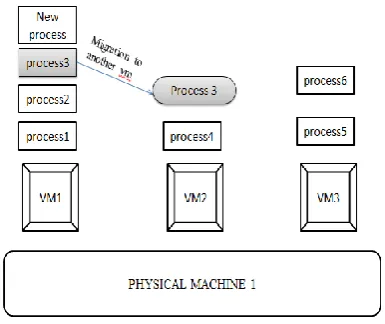
Fig. 1: Process allocation and migration across virtual machines
7. ALGORITHM
When a new process is requested, it is allocated to the best fit virtual machine using greedy algorithm. If no virtual machine has enough space for the new incoming process, then an existing process is migrated to another virtual machine which is found as a best fit for that process. Then the new process is allocated in the
freed virtual machine. Only a particular set of VMs can be held by a physical machine.
Table 1: Keywords of algorithms Keywor
d
Description
VM list Collection of Virtual Machine in the
physical machine say VM1,Vm2,…VMN
VM Virtual Machine
RMS Remaining memory size
TM Total Memory
P1 New process which is to be allocated
IPMS Incoming Process Memory Size
Limit Limit of how many number of VMs a
physical machine can have
Step 1: Calculate RMS in the VM list
Step 2: Calculate the total of values found in Step 1 i.e., TM=Sum of RMS in VM list Step 3: If IPMS>TM and number of VMs <limit then
Low memory state; create new VM with
memory size of the VM which has maximum memory size; Add it to VM list
Assign P1 to new VM
Recalculate RMS in VM list
Exit;
Step 4: If IPMS<TM then
If IPMS<=RMS of any individual VM in VM list then
Find the best fit VM and assign P1
Recalculate RMS in VM list
Exit;
Else go to Step 5 Step 5: Calculate the best fit VM
Find which process can be migrated to get
enough memory
Migrate the process to found VM
Recalculate RMS in VM list
Assign P1 to the freed VM
Recalculate RMS in VM list
Exit;
8. EXPERIMENTAL EVALUATION OF ALGORITHM
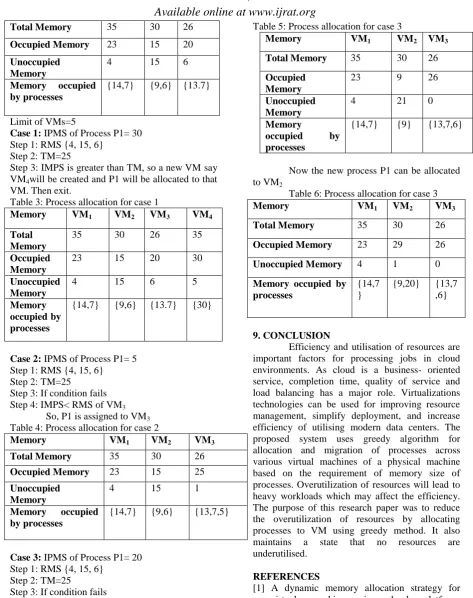
Three virtual machines (VM1, VM2 and
VM3) are considered in which processes can be
allocated or migrated based on the memory size requirement. Greedy algorithm is used for the allocation and migration of process across the data centers.
Table 2: Virtual Machine initial allocations details Master Table
[image:3.595.79.272.470.632.2]26
Total Memory 35 30 26
Occupied Memory 23 15 20
Unoccupied Memory
4 15 6
Memory occupied by processes
{14,7} {9,6} {13.7}
Limit of VMs=5
Case 1: IPMS of Process P1= 30 Step 1: RMS {4, 15, 6}
Step 2: TM=25
Step 3: IMPS is greater than TM, so a new VM say VM4will be created and P1 will be allocated to that
VM. Then exit.
Table 3: Process allocation for case 1
Memory VM1 VM2 VM3 VM4
Total Memory
35 30 26 35
Occupied Memory
23 15 20 30
Unoccupied Memory
4 15 6 5
Memory occupied by processes
{14,7} {9,6} {13.7} {30}
Case 2: IPMS of Process P1= 5 Step 1: RMS {4, 15, 6}
Step 2: TM=25
Step 3: If condition fails Step 4: IMPS< RMS of VM3
So, P1 is assigned to VM3
Table 4: Process allocation for case 2
Memory VM1 VM2 VM3
Total Memory 35 30 26
Occupied Memory 23 15 25
Unoccupied Memory
4 15 1
Memory occupied by processes
{14,7} {9,6} {13,7,5}
Case 3: IPMS of Process P1= 20 Step 1: RMS {4, 15, 6}
Step 2: TM=25
Step 3: If condition fails
Step 4: IMPS< TM but second if condition fails Step 5: Best fit VM is VM2 but it requires
minimum 5 units to be free
The smallest process in VM2is second
process (6 units of memory) which can be migrated to VM3 which has 6 units of
memory unoccupied
So, it is migrated from VM2 to VM3
Table 5: Process allocation for case 3
Memory VM1 VM2 VM3
Total Memory 35 30 26
Occupied Memory
23 9 26
Unoccupied Memory
4 21 0
Memory
occupied by processes
{14,7} {9} {13,7,6}
[image:4.595.62.536.73.672.2]Now the new process P1 can be allocated to VM2
Table 6: Process allocation for case 3
Memory VM1 VM2 VM3
Total Memory 35 30 26
Occupied Memory 23 29 26
Unoccupied Memory 4 1 0
Memory occupied by processes
{14,7 }
{9,20} {13,7
,6}
9. CONCLUSION
Efficiency and utilisation of resources are important factors for processing jobs in cloud environments. As cloud is a business- oriented service, completion time, quality of service and load balancing has a major role. Virtualizations technologies can be used for improving resource management, simplify deployment, and increase efficiency of utilising modern data centers. The proposed system uses greedy algorithm for allocation and migration of processes across various virtual machines of a physical machine based on the requirement of memory size of processes. Overutilization of resources will lead to heavy workloads which may affect the efficiency. The purpose of this research paper was to reduce the overutilization of resources by allocating processes to VM using greedy method. It also
maintains a state that no resources are
underutilised.
REFERENCES
[1] A dynamic memory allocation strategy for
virtual machines in cloud platform,
international journal of pure and applied mathematics, volume 119, no:15 ISSN: 1314-3395
27
[3] A Novel Hybrid-Copy Algorithm for Live Migration of Virtual Machine-Zhou Lei, Exiong Sun ID , Shengbo Chen, Jiang Wu ID and Wenfeng Shen
[4] A Survey of Virtual Machine Migration Techniques in Cloud Computing -Sandeep Kaur, Prof. Vaibhav Pandey, Computer
Engineering and Intelligent Systems ISSN 2222-1719 (Paper) ISSN 2222-2863
(Online) Vol.6, No.7, 2015
[5] Allocation of Resource Dynamically in Cloud
Computing Environment Using Virtual
Machines Ligade Sunil Subhash and Dr. K.P. Thooyamani,
International Journal of Advancements in
Technology, DOI:
10.4172/0976-4860.1000193
[6] An approach for VM Migration Lavneet Kaur, Er. Kanchan Lalit, Lavneet Kaur et al, / (IJCSIT) International Journal of Computer Science and Information Technologies, Vol. 5 (5) , 2014, 6547-6550, ISSN 0975-9646 [7] An Efficient Dynamic Scheduling based on
Greedy Algorithm for Heterogeneity Clouds -Dr.P.Mathiyalagan , M.Rajshree, S.Shobika ,
M.Sowmiya , International Journal of
Advanced Research in Computer and
Communication Engineering ISO 3297:2007 Certified Vol. 6, Issue 3, March 2017
[8] An Efficient Virtual Machine Migration Algorithm based on Minimization of Migration in Cloud Computing ,Nguyen Khac Chien, Vo Sy Giang Dong, Nguyen Hong Son, Ho Dac
Loc, :
https://www.researchgate.net/publication/2959 07699
[9] An Greedy-Based Job Scheduling Algorithm in Cloud ComputingJi Lia,b, Longhua Fenga,b,
Shenglong Fangc, JOURNAL OF
SOFTWARE, VOL. 9, NO. 4, APRIL 2014 [10] Best fit based vm allocation for cloud
resource allocation , international journal of computer applications, volume 158-No 9 [11] Different Process Migration Techniques for
Load Balancing in Distributed Operating System, International Journal of Innovative and Emerging Research in Engineering Volume 2, Issue 2, 2015, e-ISSN: 2394 – 3343, e-ISSN: 2394 - 5494
[12] Green Cloud Computing: Greedy Algorithms
for Virtual Machines Migration and
Consolidation to Optimize Energy
Consumption in a Data Center-Rasoul Beik, IJDACR ISSN: 2319-4863
[13] Optimum research allocation in cloud computing Fatma A. Omara, Sherif, Radhya- Egyptian informatics journal
[14] Public vs Private vs Hybrid vs Community - Cloud Computing: A Critical Review ,Sumit Goyal, I.J. Computer Network and Information Security, 2014, 3, 20-29 Published Online February 2014 in MECS (http://www.mecs-press.org/) DOI: 10.5815/ijcnis.2014.03.0 [15] Study on Different Scheduling Algorithm for
Cloud Computing Shameer A.P, Volume 6, Issue 5, May 2016 , ISSN: 2277 128X International Journal of Advanced Research in Computer Science and Software Engineering [16] Survey on Dynamic Resource Allocation
Strategy in Cloud Computing Environment, International Journal of Computer Applications Technology and Research Volume 2– Issue 6, 731 - 737, 2013
[17] Survey Study of Virtual Machine Migration Techniques in Cloud Computing, International Journal of Computer Applications (0975 – 8887) Volume 177 – No.2, November 2017 [18] Virtual Machines Migration based on Greedy
Algorithm in Cloud Computing-International Journal of Computer Applications (0975 – 8887) Volume 96– No.12, June 2014
[19] Virtual Machine Migration in Cloud Data
Centers for Resource management
Chandramouli Reddy, Suchithra R,
International Journal Of Engineering And Computer Science ISSN:2319-7242 Volume 5 Issue 09 September 2016 Page No.18029-18034
[20] Virtual machine migration in cloud data centers: a review, taxonomy, and open research issues,Raja Wasim Ahmad · Abdullah Gani · Siti Hafizah Ab. Hamid · Muhammad Shiraz · Feng Xia · Sajjad A. Madani J Supercomput (2015) 71:2473–2515 DOI 10.1007/s11227-015-1400-5
[21] Virtual Machine Migration Strategy in Cloud
Computing, 2015 14th International