Navigating the
institutional maze
This case study illustrates the messiness of approvals processes
for councils and private sector providers when water recycling
regulations and approvals are unclear. With NSW metropolitan
councils currently sitting between regulations (covered neither by the
Local Government Act nor the Water Industry Competition Act), getting
approval for a recycling scheme can be confusing, time-consuming
and costly. One of the key questions for councils is how to develop an
appropriate approach to risk management, which translates national
standards into locally applicable processes. This remains a space to
watch, with regulatory reform likely following the Metropolitan Water
Directorate’s review of water recycling arrangements, and Sydney
Water transforming their internal business processes to smooth case
management of new external recycling schemes.
Na
viga
ti
N
g the i
N
s
titutio
N
al maze
about the authors
The Institute for Sustainable Futures (ISF) is a flagship research institute at the University of Technology, Sydney. ISF’s mission is to create change toward sustainable futures through independent, project-based research with government, industry and community. For further information visit www.isf.uts.edu.au
Research team: Professor Cynthia Mitchell, Joanne Chong, Andrea Turner, Monique Retamal, Naomi Carrard, and Janina Murta, assisted by Dr Pierre Mukheibir and Candice Moy.
Contact details: [email protected], +61 (0)2 9514 4950
CitatioN
Please cite this document as: Institute for Sustainable Futures (2013), Navigating the institutional maze; Building Industry Capability to Make Recycled Water Investment Decisions. Prepared by the Institute for Sustainable Futures, University of Technology, Sydney for the Australian Water Recycling Centre of Excellence.
© Australian Water Recycling Centre of Excellence 2013
Apart from any use as permitted under the Copyright Act 1968, no part may be reproduced by any process without prior written permission. Requests and enquiries concerning reproduction and rights should be addressed to the Centre’s Knowledge Adoption Manager (www.australianwaterrecycling.com.au ).
DisClaimer
The views expressed in this report are independent findings which are the responsibility of the authors alone, and do not necessarily reflect the views or opinions of our research partner organisations, the Australian Water Recycling Centre of Excellence, or the Commonwealth Government. The authors have used all due care and skill to ensure the material is accurate as at the date of publication. Responsibility for any loss that may arise by anyone relying upon its contents is disclaimed.
about the ProjeCt
This national collaborative research project entitled “Building industry capability to make recycled water investment decisions” sought to fill significant gaps in the Australian water sector’s knowledge by investigating and reporting on actual costs, benefits and risks of water recycling
as they are experienced in practice.
This project was undertaken with the support of the Australian Water Recycling Centre of Excellence by the Institute for Sustainable Futures (ISF) at the University of Technology Sydney (UTS), in collaboration with 12 partner organisations representing diverse interests, roles and responsibilities in water recycling. ISF is grateful for the generous cash and in-kind support from these partners: UTS, Sydney Water Corporation, Yarra Valley Water, Ku-ring-gai Council, NSW Office of Water, Lend Lease, Independent Pricing and Regulatory Tribunal (IPART), QLD Department Environment & Resource Management, Siemens, WJP Solutions, Sydney Coastal Councils Group, and Water Services Association of Australia (WSAA).
ISF also wishes to acknowledge the generous contributions of the project’s research participants – approximately 80 key informants from our 12 project partners and 30 other participating organisations.
Eight diverse water recycling schemes from across Australia were selected for detailed investigation via a participatory process with project partners. The depth of the case studies is complemented by six papers exploring cross-cutting themes that emerged from the detailed case studies, complemented by insights from outside the water sector.
For each case study and theme, data collection included semi-structured interviews with representatives of all key parties (e.g., regulators, owners/investors, operators, customers, etc) and document review. These inputs were analysed and documented in a case study narrative. In accordance with UTS ethics processes, research participants agreed to participate, and provided feedback on drafts and permission to release outputs. The specific details of the case studies and themes were then integrated into two synthesis documents targeting two distinct groups: policy makers and investors/planners.
The outcomes of the project include this paper and are documented in a suite of practical, accessible resources:
• 8 Case Studies
• 6 Cross-cutting Themes
• Policy Paper, and • Investment Guide.
For more information about the project, and to access the other resources visit www.waterrecyclinginvestment.com
navigating the institutional maze
Policy paper water investment decisionsMaking better recycled
saving water and spending energy?
Demand forecasting: a risky business
Matching treatment to risk
Public-private matters: how who is involved influences outcomes
looking to the future
Y
atala Rose
ville
W
illunga
b
asin W
at
er
A
ur
or
a
Darling Quart
er
W
ide
b
ay W
at
er
R
osehill Wagga W
viga
ti
N
g the i
N
s
titutio
N
al maze
Introduction
Whilst utilities may have been able to smooth out approvals and regulatory processes for their own recycling schemes, for councils and private sector suppliers of recycled water services, the situation remains less clear, and is still subject to changing interpretations and challenging negotiations. This issue has recently been formally recognised by one key player in metropolitan NSW: as at late 2013, Sydney Water is undertaking development work internally to create a new business process to address this. Sydney Water is proposing an end-to-end case-management approach to deliver clear and consistent management and guidance for councils and private sector recycled water proponents.
Whilst recognising that the landscape is changing, this cross-cutting case study explores the messy process of establishing council schemes, drawing on Ku-ring-gai Council’s experience and reflecting on the roles of the state agencies, utilities and private sector organisations involved. Our experience across this project and across the sector more broadly gives us confidence that the Ku-ring-gai story is not unusual. Local government agencies have played a leading role innovating, testing and progressing water recycling schemes in NSW. This has uncovered a regulatory grey area for councils operating in metropolitan areas in that no formal state government approvals are currently required for council schemes. The ongoing joint review of the Water Industry
Competition Act and water recycling provisions
of the Local Government Act has flagged this gap, and it is likely that regulations will be amended in the near future. As such, a ‘how to’ guide is neither possible nor practicable. Instead, this case study seeks to document the difficulties that are hopefully soon to be historic.
Key findings
For NSW metropolitan councils, developing a successful recycling scheme requires navigating a
complex and time-consuming landscape. The
complexity relates to three interrelated challenges: 1) As a result of restructures and natural
turnover, it is highly likely that key contacts in government departments will change as a scheme is negotiated;
2) The rules and regulations themselves will shift as government seeks to improve and clarify current arrangements in this relatively new area of governance;1 and
3) With personnel and regulatory changes,
interpretation of requirements is likely to be
contested and changeable.
What approvals are
relevant for NSW
metropolitan
council schemes?
While confusion relating to approvals processes persists, it is clear that council proponents will need to take a leading role in risk management, ensuring a due diligence approach underpinned by the Australian Guidelines for Water Recycling (AGWR). Seeking to align a proposed scheme with the Guidelines from the outset of a process will likely ensure compliance with any emerging regulatory changes.
This case study explores approvals processes for NSW metropolitan councils seeking to establish and operate recycling schemes in NSW. While the NSW regulatory environment for water recycling has seen significant developments in recent years with the introduction of the Water
Industry Competition Act 2006 (the WIC Act), the
potential roles for local government within this
Changes in key contact as the scheme is negotiated
A ‘new’ and shfiting regulatory
landscape
Many different intrepretations of the rules
Na
viga
ti
N
g the i
N
s
titutio
N
al maze
“ Financially investing in a sound
irrigation system that would have
a regular and permanent supply of
water in order to actually maintain
a good quality playing surface and
good conditions was a driver.”
“ We did a number of community
surveys on environmental issues and
whether they were of importance to
people. Water recycling and water
management at the time was seen as
quite significant to the community.
So there was community acceptance
and support behind those projects.”
wider framework have remained outside thejurisdiction of reforms and continue to be an area of confusion and speculation.
For non-metropolitan councils in NSW, approval requirements are clear. Councils seeking to develop recycled water schemes need Ministerial approval (delegated to the NSW Office of Water) under section 60 of the Local Government Act 1993 (the LG Act).
For metropolitan councils – those councils within the operating areas of Sydney and Hunter Water Corporations – the situation is less straightforward. Metropolitan councils are exempted from requiring section 60 approvals by section 56 of the LG Act. This means that
no formal state government approvals are currently required by metropolitan councils
seeking to establish recycling schemes. When the Act was created, it was not foreseen that councils would play a role in water services management and delivery. Consequently the Act does not provide clarity around the regulation and management of metropolitan councils seeking to establish recycled water schemes.
However, to get a scheme up and running, councils need to put in place a series of
contractual agreements with the relevant
metropolitan water utility if they are accessing the utility’s facilities for wastewater or stormwater. They also need to demonstrate due diligence in managing their own risks, and risks related to public health and safety.
These processes can be considered part of the ‘approvals’ landscape and are explored in this case study. Findings and implications are based on interviews with key informants and a review of relevant documentation. They are illustrated here using the example of one of the pioneer metropolitan council recycling projects: Ku-ring-gai Municipal Council’s sewer mining scheme at Gordon Golf Course. The scheme was proposed in 2006 and irrigation of the golf course began in 2012.
The Gordon Golf Course
story in brief
The story began in 2005 in the context of drought, water restrictions and fears that golf courses would not in the future be allowed to use potable water for irrigation. Government funding was available for councils to develop ‘green initiatives’, and Ku-ring-gai Council was positioning itself as a pioneer in local government sustainability.
The strategy department at Ku-ring-gai developed a proposal for funding to the NSW Government to establish and operate a sewer mining scheme, accessing wastewater from Sydney Water’s sewer, at the council-owned Gordon Golf Course. In addition to contributing to sustainability and water conservation broadly, the
scheme was also seen by council as a means by which to retain and improve a profitable asset.
Another driver was responding to community expectations, with surveys at the time indicating support for water conservation schemes including recycling.
Coordinating one of the early council-proposed recycling schemes was a learning process for the Ku-ring-gai team, with few examples to follow and much uncertainty about institutional roles, responsibilities and approvals.
The scheme evolved along the way. Initial plans to include Killara Golf Course and a local primary school did not come to fruition, with changes in key personnel at these sites leading to a loss of support for the collaboration.
A water treatment and reuse contractor (Henry & Hymas) was engaged under a design-construct-operate arrangement, after the initial contractor went out of business. Council took a risk partnering with the initial contractor – a small water business offering a proprietary recycling technology – and its departure resulted in delays and increased costs. However the change was ultimately viewed as a positive for the scheme, with Henry & Hymas offering a solid base of experience and established technologies. Council also commissioned
consultants to provide guidance on an appropriate approach to risk management, after seeking advice from various state government agencies and finding that no formal approval process existed.
viga
ti
N
g the i
N
s
titutio
N
al maze
Agency responsibilities:
a few formal roles
and many informal
or advisory roles
There are many actors who play a role in establishing recycling schemes, and decision-making can seem like a crowded process
requiring complex communication. Agencies and organisations with an interest in metropolitan council schemes span public and private
sectors, across local and state jurisdictions. A
few formal contractual relationships are required, including between council and the relevant metropolitan water utility (providing access to the utility’s facilities), and between council and private service providers (e.g. under a build-own-operate arrangement). State agencies including NSW Health and the Metropolitan Water Directorate (a division of the Department of Finance and Services) have no formal role, but often provide advice and guidance as requested by councils.
Because many of the relationships are
informal and advisory, it can be unclear who
councils need to talk to, and whether or not the advice received must be taken on board. Furthermore, because council interest in
recycling schemes is still new, individuals within
agencies have different ideas about the best
approach to getting a scheme up and running, and what the requirements should be (e.g. contractual terms around length of agreement etc).
In the Gordon Golf Course case, the Ku-ring-gai Council team spent significant time seeking advice from various state agencies on how to go about developing the scheme. In the absence of a clear approval authority, they approached all agencies likely to have an interest, requesting guidance on the regulatory landscape and advice on appropriate processes to follow.
Working out who to talk to, and who needed to be in the loop took time and energy. This was a significant component of the process, and costs (particularly time costs) related to this were underestimated by Ku-ring-gai Council.
Despite this, reflecting on the process, council staff would adopt the same approach again. They felt it was important to ‘cover all bases’ given the uncertainty about Council’s roles
“ In those early days there were a
number of what I call informal approval
processes… we actually had to navigate
a little bit of that minefield as well
to get some clarity and sense as to
where that was going.”
“ Every time we feel as though
we’ve got over the last hurdle,
there’s another one.”
and responsibilities. Although consulting with various actors and agencies took time there were benefits, including relationship building and gaining familiarity with the functions and capabilities of various groups.
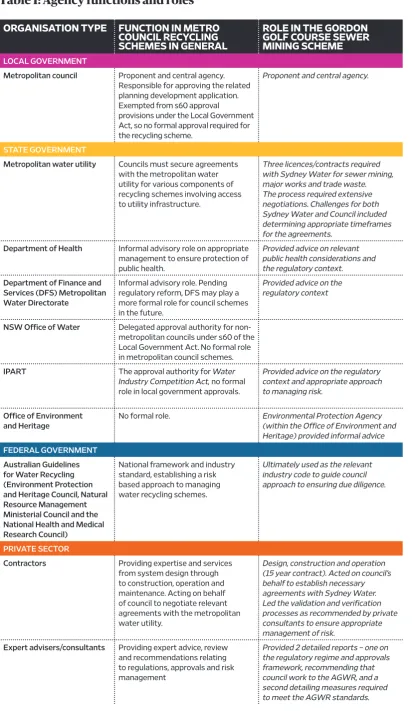
Relationships between agencies are illustrated below in Figure 1 (page 5), showing the agencies approached by Council and actions flowing from this. Table 1 (page 6) summarises the main functions of various agencies in metropolitan council recycling schemes and describes their specific role in the Gordon Golf Course scheme.
Negotiating the required
metropolitan water utility
agreements can be tricky
for utility and council staff,
and terms agreed are one
determinant of costs, risks
and benefits
For the utility and for Council staff involved in the project, navigating water recycling proposals has challenges. With only a few case examples to draw on, many of the considerations are new and organisational protocols are in early stages of development. For a water utility with a long history of managing all types of infrastructure, uncertainty about the implications of third party access can make efficient processing difficult. For councils, delays and variations can be frustrating.
To get a sewer mining scheme up and running in NSW, councils need to negotiate contractual agreements with the metropolitan water utility. Those in Sydney Water’s area of operations need to secure three agreements:
• A major works agreement for construction of infrastructure on the Sydney Water sewer line • A sewer mining agreement covering the nature of
the connection to sewer, operation and maintenance of the connection, and liabilities and risks
• A trade waste agreement governing discharge to the Sydney Water sewerage system
In negotiating these agreements, as per their
“ …it’s early days in what’s been a
150 year [Sydney Water] monopoly.
So it’s not going to change overnight.”
“ …we are maturing in how we look
Na
viga
ti
N
g the i
N
s
titutio
N
al maze
Figure 1: Institutions and relationships in a metro council recycling scheme
AuSTrAlIAn
GuIdElInES
For WATEr
rECyClInG (AGWr)
dEPArTmEnT
oF FInAnCE
And SErvICES
mETroPolITAn
WATEr
dIrECTorATE
mETroPolITAn
WATEr uTIlITy
nSW oFFICE
oF WATEr
oFFICE oF
EnvIronmEnT
And hErITAGE
dEPArTmEnT
oF hEAlTh
WATEr
ConTrACTorS
ConSulTAnTS
AdvISErS/
mETro CounCIl
ProPonEnT
End uSErS
(TyPICAlly ThE
CounCIl)
BEnEFICIArIES
(GolF CourSE
uSErS, loCAl
CommunITy)
Refers to AGWR to frame advice
Refers to AGWR to frame guidance
Seeks advice from and negotiates agreements with
Negotiates agreements with (on behalf of council)
Contracts to design, construct, operate
Approve works (planning approval)
Supplies recycled water to
Seeks advice from
Seeks advice from
Seeks advice from
Hires to provide advice on risk etc.
Consults and manages relationship with
KEY
COMMOnWEAlTh GOv’T sTATE GOv’T
PRIvATE sECTOR lOCAl GOv’T COMMunITY
Recycled wateR
assessment specialist
Formal roles
users
viga
ti
N
g the i
N
s
titutio
N
al maze
orgaNisatioN tyPe
FuNCtioN iN metro
CouNCil reCyCliNg
sChemes iN geNeral
role iN the gorDoN
golF Course sewer
miNiNg sCheme
loCAl GovErnmEnTmetropolitan council Proponent and central agency.
Responsible for approving the related planning development application. Exempted from s60 approval
provisions under the local Government Act, so no formal approval required for the recycling scheme.
Proponent and central agency.
STATE GovErnmEnT
metropolitan water utility Councils must secure agreements
with the metropolitan water utility for various components of recycling schemes involving access to utility infrastructure.
Three licences/contracts required with Sydney Water for sewer mining, major works and trade waste. The process required extensive negotiations. Challenges for both Sydney Water and Council included determining appropriate timeframes for the agreements.
department of health Informal advisory role on appropriate
management to ensure protection of public health.
Provided advice on relevant public health considerations and the regulatory context.
department of Finance and Services (dFS) metropolitan Water directorate
Informal advisory role. Pending regulatory reform, DFs may play a more formal role for council schemes in the future.
Provided advice on the regulatory context
nSW office of Water Delegated approval authority for
non-metropolitan councils under s60 of the local Government Act. no formal role in metropolitan council schemes.
IPArT The approval authority for Water
Industry Competition Act, no formal role in local government approvals.
Provided advice on the regulatory context and appropriate approach to managing risk.
office of Environment and heritage
no formal role. Environmental Protection Agency (within the Office of Environment and Heritage) provided informal advice
FEdErAl GovErnmEnT
Australian Guidelines for Water recycling (Environment Protection and heritage Council, natural resource management ministerial Council and the national health and medical research Council)
national framework and industry standard, establishing a risk based approach to managing water recycling schemes.
Ultimately used as the relevant industry code to guide council approach to ensuring due diligence.
PrIvATE SECTor
Contractors Providing expertise and services
from system design through to construction, operation and maintenance. Acting on behalf of council to negotiate relevant agreements with the metropolitan water utility.
Design, construction and operation (15 year contract). Acted on council’s behalf to establish necessary agreements with Sydney Water. Led the validation and verification processes as recommended by private consultants to ensure appropriate management of risk.
Expert advisers/consultants Providing expert advice, review
and recommendations relating to regulations, approvals and risk management
Provided 2 detailed reports – one on the regulatory regime and approvals framework, recommending that council work to the AGWR, and a second detailing measures required to meet the AGWR standards.
Na
viga
ti
N
g the i
N
s
titutio
N
al maze
sewer mining policy, Sydney Water seeks no financial gain while also aiming to avoid any loss.
For both parties, negotiating required contracts can be an uncertain and time
consuming endeavour. Contract terms – for
example the length of an agreement – can affect the viability of a proposed scheme in terms of the potential value of investment and security of operation. This entails costs and risks for the scheme in question, and contract terms shape perceptions (for all stakeholders) around the value of councils investing in recycling schemes.
Both Ku-ring-gai Council and Sydney Water found negotiating agreements challenging. The perception from the council and managing contractor side was that requirements were bureaucratic and constantly changing. While team members accepted that there would inevitably be some confusion relating to the fact that this kind of process was relatively new, they struggled with personnel changes and ‘shifting goal posts’.
From the Sydney Water perspective, staff changes were inevitable given the six-year timeframe from project conceptualisation to completion. In the early days of the project, the uncertainties about the institutional approach caused project delays on both sides, and this inevitably led to inconsistency in personnel and in the approaches adopted.
Changes in the terms Sydney Water were willing to agree to presented financial risks for Council and private contractors. The sewer mining agreement was initially negotiated for a 30-year timeframe. The timeframe became a point of contention, with Council seeking the security of a longer agreement and Sydney Water hesitant to commit to supplying set volumes of sewage so far into the future. From the perspective of the managing contractor and council, any uncertainty in the terms of agreement represents a business risk, with a potential mismatch between the level of investment and certainty of access duration, and significant implications for potential investment returns.
However from the utility perspective, making firm commitments can be tricky. Staff need to be able to manage and respond to potential changes in their operating environment and related licence provisions. Sydney Water functions on a five-year planning cycle, with their operating licence and other regulatory licences reviewed and subject to change. Given this, they are understandably hesitant to enter longer term agreements for third party access.
This creates a tension in that investors are typically seeking security of access to establish a viable operation, whereas the utility’s
responsibility is to ensure continuity of service for its customers in accordance with the provisions of its operating licence.
Further to this, from the Sydney Water perspective, the utility role in this context is to allow access to their system and to negotiate conditions around this, encouraging and fostering water recycling but seeking no financial gain. The utility is not playing a regulatory role or providing a commercial service. There can be a mismatch in perceptions if councils view themselves as customers receiving a service and therefore have expectations around how the utility will approach negotiations.
In the early days when Sydney Water was considering Ku-ring-gai’s application, staff were learning about the impacts of third party extractions on their system and considering how to facilitate third party access without compromising the operation of the sewerage system. Their knowledge and experience matured along with the number of applications, as did their concerns about operational and systemic risks. This resulted in adjustments to the terms they were comfortable agreeing to, which from Council’s perception seemed like shifting the goalposts.
For both council and utility staff, there have been many uncertainties involved in negotiations to date, and this has resulted in increased business risks for council schemes. It is likely that these will diminish over time as the process becomes more established and refined. In the meantime, both parties need to work together to share their risks and concerns and find mutually agreeable solutions on a case by case basis.
“ I think it’s fair to say there was a fair
degree of frustration…the assessment
person within Sydney Water probably
changed about three, if not four, times
over the course of the project. So we
basically had to go almost from the
start [again] and each person had a
different view on how things should
be operating... Almost by the time you
had approval, the person next had
moved on. Then you had to start it all
again with another engineer with a
different view of the world.”
viga
ti
N
g the i
N
s
titutio
N
al maze
“ We wanted to make sure… we were
managing this risk properly, and to
that end we employed an outside
consultant to help validate and verify
the system… you want to be seen as
having someone independent.”
“ Council were very aware of the
necessity to have an independent
review at the end, I think that’s
worked quite well in this case.”
Councils need to
take the lead in risk
management, developing
and demonstrating a due
diligence approach
In the absence of a formal approval process governed by a regulatory authority,
metropolitan councils need to take responsibility for managing public health risks associated with recycling schemes,
and for developing and demonstrating a ‘due diligence’ approach. A due diligence approach is important for protecting public health and ensuring councils are not at risk from potential common law complaints (e.g. negligence). The industry standard for this is clearly established in the Australian Guidelines for Water Recycling (AGWR), which provide process-based guidelines (rather than prescriptive standards) to support specific risk analysis and decision-making procedures. However application of the AGWR varies from scheme to scheme, and councils must determine the best approach for their particular recycling scheme.
In the Gordon Golf Course scheme, Ku-ring-gai Council used the AGWR to guide their due diligence approach, however it took time to settle on this approach as the most appropriate course of action.
The council team consulted with various agencies and then sought the services of consultants to provide expert advice. Two reports were prepared by the consulting team. One detailed the regulatory environment and advised Council on how to manage risk (recommending alignment with the AGWR). The second ‘gap analysis’ between Ku-ring-gai Council practices and procedures described in the AGWR. While the process of working with consultants was an additional cost for the project, commissioning independent expert advice gave Council confidence in their approach, which was particularly valued given this scheme was the first for Ku-ring-gai and likely to shape public perceptions around recycling.
Council also felt that independent advice was invaluable for ensuring transparency and managing perceptions of transparency given the absence of independent regulation. Council wanted to avoid any perception of inappropriate conduct: “[Council]
didn’t want people to think ‘okay you’re doing your own approval so you’ll do what you want’”.
For future schemes, as the regulatory
environment evolves, metropolitan councils must continue to take the lead in ensuring due diligence. The AGWR provides guidance for this, and will continue to be the industry standard Australia-wide. However industry stakeholders have noted that strict adherence to the AGWR may be overly onerous and costly for small recycling schemes such as those typically managed by councils. This has been noted by the Metropolitan Water Directorate in their November 2012 discussion paper informing the joint review of the Water Industry Competition Act 2006 and regulatory arrangements for water recycling under the Local Government Act 1993. AGWR costs have not yet been comprehensively mapped and regulators are still determining how best to match risk with response for schemes at different scales and with different functions. So this remains a
space to watch.
Na
viga
ti
N
g the i
N
s
titutio
N
al maze
Approvals processes
and regulatory
arrangements determine
the costs, benefits and
risks of a scheme
There is a tendency for those establishing recycling schemes to focus primarily on the technical components of the system – thinking through how it will work and what it will do. Yet this case study illustrates the complexity of negotiating approvals processes, and the risks and subsequent additional costs associated with overlooking or underestimating the investment required during this phase.
For each of the actors involved, regulatory arrangements are an important determinant of the costs, benefits and risks associated with recycling schemes. Some of these are predictable, while others can be hard to anticipate and quantify, such as many described in this case study relating to negotiations and relationship management over time – yet these processes underpin the success of a scheme.
Reflecting on the Gordon Golf Course story, stakeholders emphasised the significant time and energy required to navigate through the process, and that this was significantly underestimated at every stage by both Council and contractors. There was a large gap between the expected effort involved and the actual effort required. This resulted in frustration on all sides.
Getting the level of due diligence right – that is, balancing costs and risks – is difficult and nuanced. Regulatory uncertainty was perceived as either neutral or negative by different actors. Some felt more certainty would mean less risk, others felt risk was something that would always be there and that councils need to become comfortable with this. In the context of uncertainty, Ku-ring-gai Council sought compliance with the AGWR, although this approach has been criticised as being a potential barrier to local government investment in recycling.
For contractors, uncertainty was identified as an increased financial risk, as shifts in some elements of the approvals landscape will
significantly affect the viability of business models. Beyond the specific Gordon case, members of the Ku-ring-gai team reflected that the role of local government should be to lead innovation and demonstration, taking risks that businesses are unable or unwilling to. From this perspective, the ‘messy approvals’ processes was viewed as an inevitable and acceptable aspect of projects that break new ground.
“ [The AGWr is] just not that well suited
to the smaller schemes that don’t have
as high a risk as the larger schemes
for the moment. It becomes hugely
expensive for something that probably
shouldn’t be that hard and expensive.”
“ [local] government should take some
leadership to establish a sense of
momentum…This was a new idea, and
with anything new it’s going to cost
time and money and effort to work
through it step by step, to decide that
the outcome at the end was worth it.”
viga
ti
N
g the i
N
s
titutio
N
al maze
Notes
1. A review of the Water Industry Competition Act 2006 and regulatory arrangements for water recycling under the Local Government Act 1993 is currently being undertaken. A discussion paper informing the review was released in November 2012 by the Metropolitan Water Directorate.
Further resources
Sydney Water Corporation information about recycling • www.sydneywater.com.au/Water4Life/
RecyclingandReuse and sewer mining • www.sydneywater.com.au/Water4Life/
RecyclingandReuse/RecyclingAndReuseInAction/ SewerMining.cfm
NSW Metropolitan Water Directorate within the Department of Finance and Services waterforlife.nsw.gov.au/
NSW Office of Water within the Department of Primary Industries www.water.nsw.gov.au
NSW Health information on water recycling
www.health.nsw.gov.au/publichealth/environment/water/ wastewater.asp
NSW Independent Pricing and Regulatory Tribunal www.ipart.nsw.gov.au/Home/Industries/Water Information about the Ku-ring-gai Council Gordon Golf Course scheme
www.kmc.nsw.gov.au/www/html/2471-gordon-golf-course-water-recycling-scheme.asp
Water Services Association of Australia Fact Sheets on Privately Owned Recycled Water Systems www.wsaa. asn.au/WSAAPublications/FactSheets/Privately%20 Owned%20Recycled%20Water%20Systems.pdf
What does this
mean for me?
For councils seeking to get a recycling scheme up and running:
• You have to set aside significant resources including both time and money to get a scheme off the ground. Making it work requires
persistence and patience, and well-developed negotiation skills.
• As part of this, and due to uncertainties around institutional arrangements and regulations, you should expect delays and allow for them in planning.
For metropolitan water utilities:
• Recognise that the area is new and likely to change. Provide continuity of personnel (or smooth transitions between personnel) and consistency in interpretation.
• Be cognisant of the impact of policy changes on proponents, and take this into account when negotiating outcomes that are workable for both parties. With this in mind, balance the need for clear policy with context-specific analysis for each case.
For contractors and consultants:
• Factor in time for negotiation around contracts, approvals and risk management.
• Ideally, make negotiation a part of the service you offer and factor this into planning and budgeting. A business model that includes negotiation will be of significant value to local government proponents of recycling schemes.