In substance, then, the initial benefits of sage-
brush spraying on ranges grazed by livestock in the should be given to plans for future spraying on low-altitude, semiarid sagebrush ranges such as Beaver Rim area began to decrease within 5 years those at Beaver Rim.
after spraying, and within 14 years they were nulli-
fied. Seventeen years after being sprayed, sagebrush LITERATURE CITED stands were denser than before spraying.
Increased production of herbage was nullified ALLEY, H. P., D. W. BOHMONT, AND L. W. WELDON. 1956. within 6 years after spraying. Chemical sagebrush control, summary of four years’ data.
The change in composition of the grass and sedge BOHMONT, Wyo. Agr. Exp. Sta. Circ. DALE w. 67. 7 p.
herbage on the Beaver Rim area points toward 1954. Chemical sagebrush control- bunchgrasses as the “climax” forage species.
good and bad. Wyo. Agr. Exp. Sta. Circ. 54. 7 p. HULL, A. C., JR., AND W. T. VAUGHN. 1951. Controlling It should be pointed out that the original design big sagebrush with 2,4-D and other chemicals. J. Range of the treatment plots could have contributed to Manage. 4: 158-164.
the results obtained in this evaluation. The narrow HULL, A. C., JR., N. A. KISSINGER, JR., AND W. T. VAUGHN. plots with unsprayed sagebrush on each side could 1952. Chemical control of big sagebrush in Wyoming. have contributed to more rapid reinvasion than if J. Range Manage. 5:398-402.
the spraying were done in large blocks. There are JOHNSON, W. M. 1958. Reinvasion of big sagebrush follow- always some plants or portions of plants left alive to ing chemical control. J. Range Manage. 11:169-172. produce seed. It is also possible that grazing use KEARL, W. GORDON. 1965. A survey of sagebrush control was heavier on the sprayed than on the unsprayed in Wyoming 1952-1964. Wyo. Agr. Exp. Sta. M. C. 217. strips. This preference for sprayed areas has been 42 p.
observed on other areas, and narrow-strip sprayings KISSINGER, N. A., JR., A. C. HULL, JR., AND W. T. VAUGIIN. would be more susceptible to this pressure than 1952. Chemical control of big sagebrush in central large-block sprayings. Nevertheless, the results Wyoming. U.S.D.A. Forest Service., Rocky Mountain from this evaluation indicate that careful thought Forest and Range Exp. Sta., Fort Collins, Colo. Sta. Pap. 9. 15 p.
Comparison of Supplementation
Methods for Cow Herds Grazing
Pine-Bluestem Range’
VINSON L. DUVALL
Assistant Director in charge of research for Watershed Management, Recreation, Range Management, and
Wildlife Habitat, Southern Forest Experiment Station, U.S.D.A., Forest Seruice,
New Orleans, Louisiana.
Highlight
Range cows furnished cottonseed cake on alternate days in winter weighed more and had higher calving percentages than cows fed daily. Calf weights at weaning were similar. Cost of distributing cake every other day was almost 40% less than for the daily schedule. Cows self-fed cottonseed meal adulterated with salt weighed as much as those fed cake daily, but both calf crop and weaning weight aver- aged less than for daily or alternate-day feeding. Although expense of distributing supplement was least with self- feeding, cost-return relationship was unfavorable compared to other methods.
From late fall until spring, herbage on southern pine-bluestem range furnishes far less protein than breeding cattle need (Duncan and Epps, 1958).
lReceived Ju y 1 29, 1968; accepted for publication October 28, 1968.
This deficit seriously impairs production, unless supplemental protein is supplied in large quantity (Cassady and Whitaker, 1957; Duvall and Whit- aker, 1963).
Several cottonseed cake rations compared in Louisiana remedied the protein deficiency (Duvall and Hansard, 1967), and the minimal feeding level consistent with satisfactory performance proved generally conducive to profitable production (Halls and Duvall, 1961). Cost of distributing the supple ment appeared unnecessarily high, however, as cattle had been hand-fed daily during winter. Dis- pensing cake by easier means might have sufficed and reduced expense considerably, but this possi- bility was not explored until quantity and feeding- period requirements were defined. Otherwise, ex- perimental designs would have been unduly com- plex.
A study was subsequently initiated to evaluate two feeding methods designed to minimize distri- bution costs. In one method, cows were fed on alternate days during winter; in the second, con- sumption of supplement was controlled by adultera- tion with salt. Cows fed daily during winter com- prised the control. This paper describes responses of cattle to treatments. Quantity furnished and
feeding period were the same for all herds. Procedure
central Louisiana. The study area consisted of three fenced range units-two of 570 acres each and one of 480 acres.
Overstory varied from sparse second-growth longleaf pine to fully stocked stands of splash pine from 1 to 3 years old. Understory vegetation was similar for all units. Herbage average about 1600 lb/acre (air-dry); bluestems (Andropogon
spp.) and panicums (Panicurn spp.) were the main grasses (Duvall and Linnartz, 1967).
Before the study started, part of each range unit had been burned each year in either a 3- or 4-year rotation (Duvall and Whitaker, 1964). Burning was suspended during the first 2 years, when young pines were susceptible to damage. By early 1966, the oldest slash pines were large enough to tolerate prescribed fire, and burning was re- sumed in a 4-year rotation.
All units were grazed moderately. The utilization ob- jective was 40 to 45% of current herbage; 23 acres were allowed per adult animal-year. Thus, the 570-acre units were stocked with 24 cows each and the 480-acre unit with 20 cows. Each unit also provided 131 days of grazing per year for a bull.
Cows were typical “native” stock. About 70% showed evidence of Brahman breeding. The remainder were mainly mixtures of British beef breeds and Jersey. In August 1963 cows were assigned to range units as equitably as possible according to age, size, and breeding. Each year, they were mated to either purebred Angus or Shorthorn bulls between February 20 and July 1. Calves, dropped from about December 1 to April 10, were marketed directly off the cows in mid-August.
In November 1964 and annually thereafter, non-pregnant cows that had not calved the previous year were culled. Cows with serious physical defects were removed as detected. Two cows died during the study. Replacements of breeding age were introduced as needed.
In each unit, steamed bonemeal and loose salt were supplied continuousl,y in separate compartments of a covered feeder. The bonemeal was furnished for its phos- phorus content (100/o), as forage analyses had revealed a deficiency of this nutrient at all seasons (Campbell et al., 1954; Duncan and Epps, 1958). Supplies of salt and bone- meal, weighed oven-dry, were dispensed weekly. Each time, remainders were collected, oven-dried, and weighed. To calculate consumption, quantities recovered were subtracted from those dispensed.
In all units, each cow was allotted 418 lb of either cotton- seed cake or cottonseed meal (41% crude protein) annually, fed between November 1 and May 31. Average daily intake of cake or meal was as follows:
Cottonseed meal or take
Period per cow-day (lb)
November I-30 1.0
December 1-3 1 2.5
January l-March 10 3.0
March 1 l-3 1 2.0
April l-May 31 1.0
Previous study on the Palustris had shown that cattle fed cottonseed cake daily grazed little during cold, wet periods. In the current trial, therefore, supplemental forage aug- mented the range diet during late winter. About 6 lb of grass hay were furnished each cow on alternate days from mid-January to late March. Annual allowance totaled about 200 lb/head.
Treatments consisted of methods and frequencies of dis-
pensing cottonseed cake or meal. The control was desig- nated as daily feeding because cows were hand-fed cotton- seed cake each day during the critical winter period, from December 1 through March 31. They were fed on alternate days during November, April, and May. The schedule, out- lined below, was similar to that for the medium treatment described by Duvall and Hansard (1967), but with feeding during October omitted.
Feeding Cottonsned cake frenucncy per cow per Period (days) lceding (lb)
November l-30 2 2.0
December 1-3 1 1 2.5
January l-March 10 1 3.0
March 11-3 1 1 2.0
April I-May 31 2 2.0
In the alternate-day feeding treatment, cottonseed cake was distributed every other day from December 1 through March 10 and every third day during November and from March 11 through May 31. Intervals between feedings were 1 day longer than for the control during all periods except March 11 through 31, when 2 days were added. Frequency was decreased on March 11; by that date in prior studies green herbage had usually been available in limited quantity. The alternate-day schedule was as follows:
Feeding Cottonseed cake frequency per cow per Period (days) feeding (lb)
November l-30 3 3
December l-3 1 2 5
January I-March 10 2 6
March 1 l-3 1 3 6
April l-May 31 3 3
In a preliminary test, cows rapidly ate 6 lb of cottonseed cake per head. Protecting the feed from rain was there- fore unnecessary. Consequently, both daily and alternate- day feeding were in open troughs; space was sufficient for all cows to eat simultaneously.
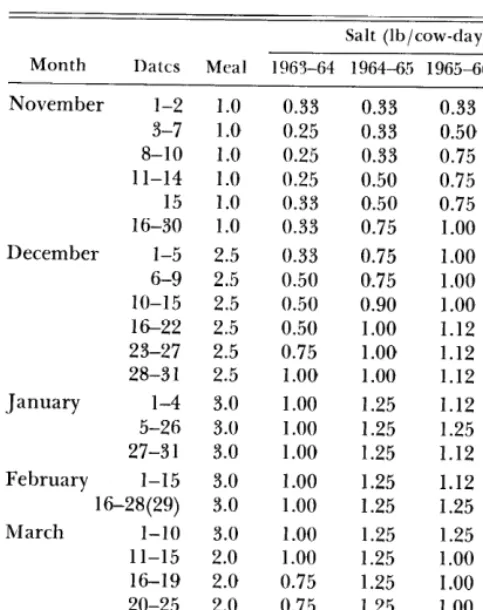
For salt-meal self-feeding a mixture of cottonseed meal and finely ground salt was provided continuously. Daily consumption of meal was maintained at approximately the prescribed level by manipulating proportions of ingredients (Table 1).
Riggs et al. (1953) found that cows ate less and less mixed feed as salt content was increased gradually from 9 to 14%; at 150/o, intake decreased sharply. In the Southwest, this principle has been employed successfully to govern intake of concentrates self-fed to cattle, thereby minimizing labor and transportation for distributing feed (Nelson et al.,
1954; Pistor et al., 1950; Savage and McIlvain, 1954). Self- feeding of salt-concentrate mixtures has also been adopted to some extent for breeding herds on southern forest range; results, according to stockmen, vary from excellent to un- satisfactory.
Table 1. Salt-meal ratios at prescribed levels.
required to maintain meal intake
Month I~atcs Meal 1963-64 1964-65 1965-66 1966-67
November 1-2 1.0 0.33 0.33 0.33 0.33 3-7 1.0 0.25 0.33 0.50 0.50 8-10 1.0 0.25 0.33 0.75 0.50 11-14 1.0 0.25 0.50 0.75 0.50 15 1.0 0.33 0.50 0.75 0.50 16-30 1.0 0.33 0.75 1.00 0.50 December 1-5 2.5 0.33 0.75 1.00 0.75 6-9 2.5 0.50 0.75 1.00 0.75 10-15 2.5 0.50 0.90 1.00 0.75 16-22 2.5 0.50 1.00 1.12 0.75 23-27 2.5 0.75 1.00 1.12 0.75 28-3 1 2.5 1.00 1.00 1.12 0.75 January l-4 3.0 1 .oo 1.25 1.12 1.00 5-26 3.0 1.00 1.25 1.25 1 .oo 27-3 1 3.0 1.00 1.25 1.12 1.00 February 1-15 3.0 1.00 1.25 1.12 1 .oo 1628(29) 3.0 1.00 1.25 1.25 1.00 March I-10 3.0 1.00 1.25 1.25 0.75 11-15 2.0 1.00 1.25 1.00 0.50 16-19 2.0 0.75 1.25 1.00 0.50 20-25 2.0 0.75 1.25 1.00 0.25 26-3 1 2.0 0.50 1.25 1 .oo 0.25 April l-30 1.0 0.50 0.75 0.50 0.25
May l-4 1.0 0.50 0.75 0.50 0.25
5-3 1 1.0 0.50 0.75 0.25 0.25
to attain prescribed intake. Cattle fed a high-salt diet drink considerably more than those eating salt voluntarily (Savage and McIlvain, 1954); therefore, bunks were located no more than ?& mile from water so the cattle would not have far to travel.
Each year, only cows in the herds from November through August were considered as experimental animals. Replacements were occasionally introduced during these periods: thus, size of treatment groups varied by years, but grazing intensity remained about constant.
Herds were checked daily from late fall until spring to ascertain calving dates. Each year, calves were weighed about 30 days after calving and immediately before market- ing. Annual calf drop for each treatment was the percent of experimental cows that weaned calves.
In 1963-64, cows were weighed directly off the range in November, April, and August. Annually thereafter, weigh- ing began in November and was repeated approximately every 3 months. The salt-meal mixture was withheld for 5 days before each weighin g during the feeding period, and prescribed quantities of meal were provided daily in open troughs. Self-feeding was interrupted to make water intake normal and thereby avoid exaggeration of body weights.
Results and Discussion Consumption of Supplements
Protein supplements were evidently eaten almost exclusively by adult animals. Competition among cows largely denied calves access to cake. The salt- meal was apparently unpalatable to calves; by late
Table 2. Average consumption of salt (lb/cow) from salt- meal mixture.
Month 1963-64 1964-65 1965-66 1966-67 Average
November 8.9 17.0 24.2 14.7 16.2 December 17.9 28.2 32.9 23.2 25.6 .January 31.0 38.8 37.6 31.0 34.6 February 29.0 35.0 33.0 28.0 31.2
March 25.5 38.8 33.5 15.0 28.2
April 15.0 22.5 15.0 7.5 15.0
May 15.5 23.2 8.8 7.8 13.8
Total 142.8 203.6 185.0 127.2 164.6
winter many were large enough to reach the supply, but none were observed eating.
Throughout the study, average daily intake of cake per cow was as prescribed. Consumption of meal periodically deviated from schedule until the mixture was adjusted, but quantity consumed per cow-year averaged the same as for cake-418 lb. Salt-meal ratios necessary to maintain intake at approximately the prescribed levels are shown in Table 1.
Salt consumed from the self-fed ration averaged almost 165 lb/cow annually but varied from about
127
lb in 1966-67 to 204 lb in 1964-65 (Table 2). Intake fluctuated most in fall and spring, least in midwinter. Availability of green herbage was ap- parently the main factor influencing quantity con- sumed after early March. In 1967, for example, the last frost was on February 23, and shortly after- ward grass began growing rapidly. Salt content necessary to regulate intake of meal was conse- quently less than in previous years, when growth had started considerably later and cattle ate less salt. In 1965, temperature consistently exceeded 40 F only after May 1. With growth of grasses de- layed, a high proportion of salt was necessary until feeding ended; hence, intake from March through May totaled more than in other years. Salt con- sumption for November averaged considerably less the first year than afterward, probably because cows were unaccustomed to a high-salt ration.Calves were observed eating salt and bonemeal supplied ad lib., mainly from early summer until weaning. Quantity consumed, though indetermin- able, was probably small compared to that eaten by cows. Therefore, intake of these supplements was attributed entirely to adult animals.
Consumption of salt supplied ad lib. averaged 15 lb/cow-year for the salt-meal treatment, as com- pared to 26 lb for hand-feeding. From both this source and the salt-meal mixture, therefore, self- fed cows each ingested about 180 lb/year. The total would have possibly been greater if meal hand-feeding had not replaced salt-meal self-feed- ing for 10 to 15 days annually.
I,OOOl
I I
I
I
I II
I I I I I I l I lFALL WIN SPR. SUM. FALL WIN. SPR. SUMFALL WIN SPR. SUMFALL WIN SPR SU
1963-1964 1964-1965 1965-1966 1966-1967
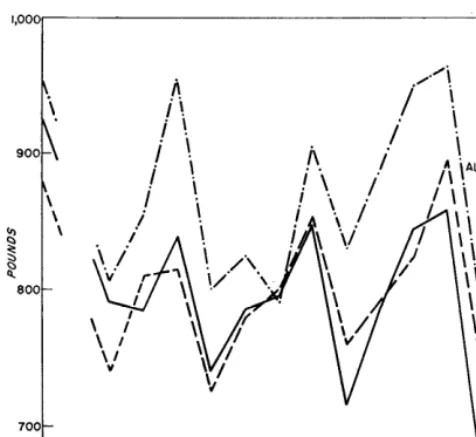
FIG. 1. Average weights of cows, by treatments, years, and seasons.
animal-year for salt-meal and alternate-day treat- ments. Cattle fed daily ate quantities similar to those for other treatments during the first 2 years but less thereafter; consequently, consumption averaged only 22 lb annually.
Weight and Condition of Cows
Initially, cows assigned the salt-meal ration were slightly heavier than others. Before feeding began, however, cows designated for alternate-day feeding gained the most; those for daily feeding, the least. In November, weights averaged 953, 924, and 879 lb/cow for the alternate-day, salt-meal, and daily- fed groups, respectively (Fig. 1).
After treatments were applied, cows fed on alter- nate days averaged heavier than others at all periods except summer 1965. For the entire study, weights were 870, 803, and 798 lb for alternate-day, daily, and salt-meal feeding, respectively. Weight ad- vantage in winter and spring for cows fed on alter- nate days was possibly attributable to greater intake of forage; they spent far less time than others on feedgrounds and presumably grazed more. Similar findings were reported in Texas (Melton and Riggs,
1964).
Winter weights of cows fed salt-meal declined steadily after 1964-65; whether method of feeding was responsible is problematical, since treatment was discontinued annually from June to November. No digestive disturbance was noted among cattle fed on alternate days, although cake consumption averaged 6 lb/cow per feeding from January 1 through March 31. In a Texas study (Melton and Riggs, 1964), cows ate 7 lb/feeding without harm- ful effects.
Scours were common during the feeding season among cows receiving the salt-meal mixture. Most
of the animals scoured for 3 or 4 days at least once per season, but no serious cases were observed. Riggs et al. (1953) concluded that self-feeding salt- meal may cause scouring and eventual death when salt intake is 1 to 1.5 lb/cow daily and forage quality is relatively low. However, Nelson et al. (1954) observed no detrimental effect of salt on health or weight of cows that ate 1.14 lb/day while grazing bluestem range in Oklahoma.
As compared to cows in other treatments, those fed salt-meal became noticeably paunchy during the feeding period, particularly from January until mid-March. Also, these cows generally had longer, rougher hair than others during winter. Both con- ditions were possibly responses to abnormally high intake of water, which was usually quite cold. Loss of hair from one or more areas measuring about 4 to 6 inches in diameter on the upper body was common during winter among cows showing strong evidence of British beef breeding; Brahman crosses, with shorter coats, were not noticeably affected. Riggs et al. (1953) mentioned, but did not describe, differences in condition of hair be- tween cows fed high and low levels of salt.
Two cows died in the self-fed herd as compared to none in the other herds. Both died during winter, but whether salt toxicity was responsible is problematical. No autopsies were performed, be- cause deaths had apparently preceded discovery of carcasses by 12 hours or more.
Calf Production
Calf crops averaged highest for cows fed on alternate days and lowest for those self-fed the salt- meal (Table 3). Thus, as compared to daily feed- ing, distributing supplement at Z- to 3-day intervals did not impair reproduction. It possibly improved nutrition sufficiently during winter to increase calving percentage. The alternate-day schedule ap- parently stimulated grazing and improved oppor- tunity for timid cows to obtain cake. Effects of feeding interval on calving were similar to those reported from western Texas, where calf crops averaged slightly greater for cows fed 3 times weekly than for those fed daily (Melton and Riggs,
1964).
Table 3. Calf crops and weights and ages of calves, by treatments and years.
Treatment Year
Calf crop weaned
%
Weight Age lb days
Weight per day
of age lb
Weight Age lb days
Weight Daily gain, per day spring to of age weaning
lb
Daily 1964-65 73 271 145 1.9 409 230 1.8 1.6
1965-66 63 289 135 2.1 437 228 1.9 1.6
1966-67 75 230 110 2.1 411 218 1.9 1.7
Average 70 263 130 2.0 419 225 1.9 1.6
Alternate day 1964-65 96 283 139 2.0 409 228 1.8 1.4
1965-66 43 251 108 2.3 405 201 2.0 1.7
1966-67 95 262 116 2.3 452 224 2.0 1.8
Average 78 265 121 2.2 422 218 1.9 1.6
Salt-meal 1964-65 70 140 128 1.1 384 213 1.8 2.9
1965-66 45 221 127 1.7 363 220 1.6 1.5
1966-67 63 261 131 2.0 427 238 1.8 1.5
Average 59 207 129 1.6 391 224 1.7 1.9
born alive and evidently healthy, disappeared within 2 days and carcasses were not found. If all pregnancies among cows fed salt-meal had resulted in weaned calves, calf crops would have averaged 76%.
All cows diagnosed as pregnant among those fed on alternate days weaned calves. In 1964-65, a calf in the herd fed daily died either before birth or soon afterward.
The reason for the high incidence of calf mor- tality associated with salt-meal feeding is uncertain. In Arizona trials (Pistor et al., 1950; Cardon et al.,
1951), cows that ingested 1 lb of salt daily during the final 2 to 3 months of gestation calved normally and both cows and calves appeared healthy. On an Oklahoma range (Nelson et al., 1954), calf crops were similar for cows self-fed salt-meal and those hand-fed cottonseed meal pellets on alternate days. Riggs et al. (1953) reported that two cows fed high levels of salt during gestation calved normally, but one calf developed severe diarrhea and died when 5 days old. Postmortem examination revealed no symptoms of salt toxicity. In a companion trial, normal parturition and healthy calves were re- ported for cows on a high-salt ration during 191 days; salt intake ranged from 1.6 to 2.0 lb/head daily for 79 days. In view of these findings, prob- ability appears low that calf mortality in the present experiment was attributable solely to the large quantity of salt ingested by cows. However, high- salt supplement may have interacted with another dietary factor-possibly low nutritive value of range forage-to impair production.
All breeding animals were brucellosis-free when the study ended. Cull cows, tested when removed, also reacted negatively.
Calf crops varied considerably by years, pri- marily because percentages were low for all treat-
ments in 1965-66. No reason for this difference was apparent.
Weaning weights for daily and alternate-day treatments were similar, averaging 419 and 422 lb/calf (Table 3). C ows self-fed salt-meal weaned calves weighing about 28 lb less than those of hand- fed cows. Average age at weaning varied only 6 days among treatments; therefore, calf weight per day of age at weaning was lowest for self-feeding.
Calf weight per day of age in the spring, when the youngest calves were about 30 days old, was con- sistently lowest for salt-meal feeding. Thus, calves in this herd either weighed less than others at birth or gained less while their dams were eating the salt-meal. Gain from spring weighing until weaning was greatest for the salt-meal treatments, but only because calves dropped during 1964-65 averaged merely 1 .l lb per day of age in the spring and gained 2.9 lb daily afterward. In subsequent years, gains from spring until weaning were less for calves in the self-fed herd than for those in other treatments.
Feed Distribution Costs
Days per year on which cottonseed cake or meal was distributed totaled 165 for daily feeding, 92 for alternate-day feeding, and 47 for self-feeding. The latter included 4 days to determine intake rate and adjust the mixture.
Transportation and labor requirements per dis- tribution were only slightly greater for alternate- day than for daily feeding. Thus, cost for alter- nate-day distribution was estimated at 57 to 60yo of that for daily. Although self-feeding required only 51% as many distribution days as alternate- day, the overall cost advantage was materially less
than those hand-fed. This not only increased cost of the ration but added about 27%, by weight, of materials requiring storage and handling. Mixing the salt and meal was also chargeable to self-feeding but cost could vary considerably, depending on fa- cilities available and quantities prepared. Covered bunks for salt-meal cost more than open troughs for cake, but this difference could normally be pro- rated over several years and would add relatively little to annual expense.
Conclusions
As compared to daily feeding, the alternate-day program saved 40y0 or slightly more in distribution costs, without detriment to cows or calves. In fact, this schedule may have favorably affected both calf crop and condition of the cows. Although cost was least for salt-meal feeding, the saving was in- sufficient to compensate for the low production of cows fed by this method. Thus where range con- ditions, kind and quantity of supplement fed, and feeding period are similar to those of the experi- ment, alternate-day distribution provides an effec- tive means of augmenting the range diet during winter. Adulterating cottonseed meal with salt to regulate intake during winter is inadvisable until the cause of low reproductive success that attended this procedure is identified and corrected.
LITERATURE CITED
CAMPBELL, R. S., E. A. EPPS, JR., C. C. MORELAND, J. L. FARR, AND FRANCES BONNER. 1954. Nutritive values of native plants on forest range in central Louisiana. La. Agr. Exp. Sta. Bull. 488. 18 p.
CARDON, B. P., E. B. STANLEY, W. J. PISTOR, AND J. C. N’es- BI’I-I-. 1951. The use of salt as a regulator of supplc-
mental feed intake and its effect on the health of range livestock. Ariz. Agr. Exp. Sta. Bull. 239. 15 p.
CASSADY, J. T., AND L. B. WHITAKER. 1957. Supplemental feeding and management of beef cattle on forest range in Louisiana. Sot. Amer. Foresters Proc. 1956:52-54.
DUNCAN, D. A., AND E. A. EPPS, JR. 1958. Minor mineral elements and other nutrients on forest ranges in central Louisiana. La. Agr. Exp. Sta. Bull. 516. 19 p.
DUVALL, V. L., AND S. L. HANSARD. 1967. Responses of southern range cattle to protein supplementation. J. Range Manage. 20: 153-157.
DUVALL, V. L., AND N. E. LINNARTZ. 1967. Influences of grazing and fire on vegetation and soil of longleaf pine- bluestem range. J. Range Manage. 20: 241-247.
DUVALL, V. L., AND L. B. WHITAKER. 1963. Supplemental feeding increases beef production on bluestem-longleaf pine ranges. La. Agr. Exp. Sta. Bull. 564. 18 p.
DUVALL, V. L., AND L. B. WHITAKER. 1964. Rotation burning: a forage management system for longleaf pine- bluestem ranges. J. Range Manage. 17:322-326.
HALLS, L. K., AND V. L. DUVALL. 1961. Profits and cost of forest grazing. Forest Farmer 20(7): 151-152.
MELTON, A. A., AND J. K. RIGGS. 1964. Frequency of feed- ing protein supplement to range cattle. Tex. Agr. Exp. Sta. Bull. B-1025. 8 p.
NELSON, A. B., L. S. POPE, ROBERT MACVICAR, A. E. DAR- LOW, AND D. F. STEPHENS. 1954. Self-feeding salt and cottonseed meal to beef cattle; a summary of experiments on self-feeding winter supplements. Okla. Agr. Exp. Sta. Bull. B-440. 14 p.
PISTOR, W. J., J. C. NESBITT, AND B. P. CARDON. 1950. The influence of high salt intake on the physiology of ruminants. Proc. Amer. Vet. Med. Assn. 1950:154-159. RIGGS, J. K., R. W. COLBY, AND L. V. SELLS. 1953. The
effect of self-feeding salt-cottonseed meal mixtures to beef cows. J. Anim. Sci. 12:379-393.
SAVAGE, D. A., AND E. H. MCILVAIN. 1954. Salt as a regulator of meal consumption for beef cattle. U.S. Dep. Agr. South. Great Plains Field Sta. Unnumbered mimeo. rep.
Short Duration or
Non-Selective Grazing
Stock raiser E. M. Rushmore of Bulawayo, Rhodesia, has been chiding ASRM and the Journal for not pub- lishing new deveolpments on “short duration grazing.” A manuscript by Dr. C. A. R. Savory, Ecological Con- sultant in Bulawayo, credits A. Voisin’s book on Grass Productivity (1961) with advancing a system of short-term graz- ing interspersed with long rests on intensively managed pastures. He further credits Howell and Acocks with development of a similar system on short grass ranges in South Africa- known as Non-Selective Grazing.In Rhodesia, Dr. Savory reports that over 150 ranches and farms are using “short duration grazing,” with planned variations, but with a central theme of short graze, long rest, no burning, no initial bush clearing, and increased stocking combined where necessary with wildlife management. The sys- tem also involves rotation to avoid overgrazing any one paddock.
Dr. Gene Payne, now at Egerton Col- lege in Kenya, writes: “. . . when graz- ing is intensified within a short period, more species of plants are used and the less palatable species are more heavily used . . . . This means a greater conver- sion per acre of energy into animal products.” Writing in the Kenya
T/VeekZy Nexus, Payne and Sid Goodloe warn that misuse of the system could lead to range deterioration. Larry White, now at Embu, Kenya states that he thinks the method warrants research under different kinds of environment. In brief, Gene Payne thinks we in America have been lax in studying the many possibilities in grazing systems, mostly because of the cost and long time involved in this kind of research. He adds: “Nor are we as aware of what is developing in range management outside the USA as we should be.”