A preliminary version of this paper appears in CRYPTO 2014. This is the full version.
Cryptography from Compression Functions:
The UCE Bridge to the ROM
Mihir Bellare1 Viet Tung Hoang2 Sriram Keelveedhi3
July 2, 2014
Abstract
This paper suggests and explores the use of UCE security for the task of turning VIL-ROM schemes into FIL-ROM ones. The benefits we offer over indifferentiability, the current leading method for this task, are the ability to handle multi-stage games and greater efficiency. The paradigm consists of (1) Showing that a VIL UCE function can instantiate the VIL RO in the scheme, and (2) Constructing the VIL UCE function given a FIL random oracle. The main technical contributions of the paper are domain extension transforms that implement the second step. Leveraging known results for the first step we automatically obtain FIL-ROM constructions for several primitives whose security notions are underlain by multi-stage games. Our first domain extender exploits indifferentiability, showing that although the latter does not work directly for multi-stage games it can be used indirectly, through UCE, as a tool for this end. Our second domain extender targets performance. It is parallelizable and shown through implementation to provide significant performance gains over indifferentiable domain extenders.
1
Department of Computer Science & Engineering, University of California San Diego, 9500 Gilman Drive, La Jolla, California 92093, USA. Email: [email protected]. URL:http://cseweb.ucsd.edu/~mihir/. Supported in part by NSF grants CNS-1116800 and CNS-1228890.
2 Department of Computer Science & Engineering, University of California San Diego, 9500 Gilman Drive, La Jolla,
California 92093, USA. Email: [email protected]. URL: http://csiflabs.cs.ucdavis.edu/~tvhoang/. Supported in part by NSF grant CNS-1116800.
3
Contents
1 Introduction 3
2 Preliminaries 6
3 UCE framework 7
4 UCE from indifferentiability 8
5 UCE from universal hashing 11
6 Fast, parallelizable AU hash from reduced-round AES 13
7 An example application 15
8 Implementation 17
A Proofs of Theorem 4.1 19
B Proof of Theorem 5.1 21
C Constructing FIL UCE-secure hash in the FIL-ROM 24
D Proof of Proposition 6.1 28
E Proof of Proposition 6.2 28
1
Introduction
Two forms of the random oracle model (ROM) of BR [9] have emerged, namely the VIL-ROM and FIL-ROM. In the VIL-ROM, the random oracle, denoted RO, is variable input length (VIL), meaning takes inputs of arbitrary length. In the FIL-ROM, the random oracle, denoted ro, is fixed input length (FIL), meaning only takes inputs of one, particular length. The VIL-ROM is preferable for the design and analysis of ROM schemes and reflects the original view of BR [9] that random oracles would be instantiated by cryptographic hash functions that, like SHA-256, take variable length inputs. However hash functions are built in a very structured way from their underlying compression functions. This lead researchers beginning with Coron, Dodis, Malinaud and Puniya [15] to suggest that it should be the compression function, rather than the hash function, that is treated as “ideal,” leading to the FIL-ROM. Indeed, SHA-256 is built from its compression function sha-256 in a way that renders SHA-256 subject to the extension attack, which can lead to attacks when SHA-256 is used to instantiate a VIL random oracle. Treating the compression function (rather than the full hash function) as the ideal object is more reflective of the design goals and intuition of practitioners and leads to better security.
The consensus then is that we should design schemes in the FIL-ROM. The question is how best to do this. One option is to directly design and analyze schemes in this model, but this is difficult and ad hoc. A better option is to provide a construction Ero of a VIL function that can substitute a VIL RO, meaning we would design schemes secure in the VIL-ROM as usual and then automatically replace RO with Ero to obtain security in the FIL-ROM. We refer to such an Eas a domain extension construction or domain extender.
For this to work in some broad and useful way, we need a definition of some property, call itX, that, if satisfied by Ero, allows the latter to securely replace RO in the VIL-ROM and thus provide security in the FIL-ROM, for some useful and hopefully large set of schemes that are proven secure in the VIL-ROM. The leading proposal forXis “indifferentiability from a random oracle” as defined by Maurer, Renner and Holenstein (MRH) [21] and advocated by [15].
This paper suggests, and explores, an alternativeX. We suggest thatXbe the notion of UCE (Universal Computational Extractor) security defined by BHK [6]. Our results will show both theoretical and practical benefits of X=UCE overX=indifferentiability in this role. On the theoretical side, UCE allows us to move from the VIL-ROM to the FIL-ROM for primitives whose security is defined via multi-stage games, a setting where indifferentiability fails [25]. On the practical side, we exhibit UCE domain extenders E that are significantly more efficient than known indifferentiability ones, in particular parallelizable to take advantage of modern multi-core machines, our efficiency claims being not just asymptotic but supported by implementations and experiments. Conceived as a way to remove random oracles, UCE now becomes a bridge to better security in the ROM.
Limitations of indifferentiability. While indifferentiability works well in some settings [21], it has two major limitations. The first is that indifferentiable-from-random functions do not suffice to securely replace a VIL random oracle for primitives whose security definition is underlain by multi-stage games [25]. This gap is more than academic, for we are seeing the emergence of numerous primitives and security notions of practical importance whose definitions are inherently multi-stage. Examples, all but the last listed by RSS [25], include Deterministic PKE (D-PKE) [4], Hedged PKE [5], encryption secure against key-dependent messages [12], primitives secure against related-key attack [8], proofs of storage [25] and Message-Locked Encryption (MLE) [7]. In each case there are natural, efficient and canonical solutions in the VIL-ROM that we would like to implement in the FIL-ROM, but indifferentiability offers no way to do this. The second limitation of indifferentiability is performance. Typical indifferentiable domain extenders iterate the compression function sequentially. This means that instantiations are left unable to take advantage of modern multi-core processors to provide performance gains. This reduces the potential for high volume usage and deployment of cryptography based on compression functions.
Method Notions Performance Applications
Keyed-Indiff UCE[S
srs] Aboutm/(m−n) times
All schemes in [6] UCE[Scrs] the speed of M
AU-then-Hash UCE[Ssup] Parallelizable MLE, key derivation,
∼0.4 cycles per byte storage auditing
Figure 1: Our UCE domain extension constructions and their properties. The second column gives the UCE notion that is achieved. M is the indifferentiable domain extender used in the first con-struction. The numbersnandm are the key length of the hash function and the input length of the ideal compression function, respectively. Typically,n= 128 andm= 512.
computes a VIL, X-secure function— for a “good” choice of X, meaning one that allows Ero to securely replaceROin the VIL-ROM for some significant set of applications. The composition theorem of [21] shows thatX=indifferentiability is able to do this for single-stage games, which is certainly important. However, as discussed above, indifferentiability also has important limitations. We ask if there are alternative definitionsX that can overcome these limitations and complement indifferentiability in its role.
The core limitation of indifferentiability is the inability to handle multi-stage games. We suggest that a natural route around this is thatX-security itself be multi-stage. The particular candidateXwe suggest is the UCE notion of [6], which is indeed multi-stage. Our suggested UCE-based paradigm to move schemes from the VIL-ROM to the FIL-ROM has two steps: (1) Show that instantiating the VIL random oracle in the scheme with a VIL UCE function preserves security, and (2) Implement the VIL UCE function as Ero to obtain a FIL-ROM scheme. Prior work has already given us the first step for many constructions: UCE-secure hash functions are shown in [6] to be able to securely instantiate VIL random oracles for diverse multi-stage applications including the important practical ones noted above and all examples of multi-stage schemes listed in [25]. The missing element is UCE domain extendersEfor the second step. If we had those, we could immediately harvest the existing results to get FIL-ROM constructions for many multi-stage primitives. The concrete quest that emerges, then, is for UCE domain extenders.
Our results. Our core contribution is two domain extenders for UCE that together allow us to reach the above goals of security and speed. These are constructions E that take a FIL random oracle ro and return a VIL, keyed function Ero that meets UCE security notions of BHK in the FIL-ROM.1 See Fig. 1 for a summary of the two domain extenders and their properties.
Our first construction is generic, turning any indifferentiable domain extender into a UCE domain extender. Given an indifferentiable domain extender M, we show (Theorem 4.2) that the hash familyH defined for keyhk and inputxbyHhk(x) =Mro(hkk ·)(x), is UCE secure. The forms of UCE achieved byH are what BHK callUCE[Scrs]-security andUCE[Ssrs]-security, namely UCE security for computationally or statistically reset-secure sources. This is enough to get FIL-ROM instantiations for all applications obtained in [6] and discussed above, including the storage-auditing scheme used in [25] as a counterexample for the failure of the indifferentiability framework in multi-stage settings, encryption secure for key-dependent messages, encryption secure against related-key attack, MLE, D-PKE and more.
This construction illustrates what we believe is an interesting relation between UCE and indifferentia-bility. Indifferentiability cannotdirectly yield the applications we have obtained for multi-stage primitives. However, it can be used, in a blackbox way, to create a domain extender that meets aparticular multi-stage notion of security, namely UCE. Then, exploiting known UCE results, we can obtain FIL-ROM security for many multi-stage primitives. Thus our construction shows how to use UCE to leverage indifferentiability to solve a problem that indifferentiability could not solve directly.
While our first construction delivers, we believe, important advances on the theoretical front, its per-1
formance is that of the underlying indifferentiable construction. Our second construction targets speed. It follows the Carter-Wegman paradigm [14]. We show (Theorem 5.2) that ifF is almost-universal, then the hash familyHdefined for key (hk, K) and inputxbyHhk(x) =ro(KkFfk(x)), is UCE secure. Here the form of UCE achieved is what BHK callUCE[Ssup]-security. We can instantiate this to obtain highly efficiently, fully parallelizable hash functions. The most important application here is a FIL-ROM instantiation of the CE MLE scheme of [18, 7], leading to efficient systems for secure deduplicated storage.
General domain extension. Above we presented the domain extension problem for notion Xas being to design E such that Ero is a VIL X-secure function in the FIL-ROM. More generally, the problem is to design E such that if H is a FIL X-secure function then EH is a VIL X-secure function. Here H can be a FIL-ROM function, and thus the prior formulation is a special case. Our domain extenders discussed above generalize to solve this problem. In the first case, we show (Theorem 4.1) that if His UCE secure then so is the family Hdefined for key hk and input x by Hhk(x) = MH(hkk ·)(x), where M, as before, is an indifferentiable domain extender, the UCE classes for which this is true beingUCE[Scrs] and UCE[Ssrs] as before. SettingHhk(·) =ro(hkk·) recovers the result stated above as a special case. The generalization however yields something new, namely astandard model domain extender for UCE. This follows by letting H be a standard model FIL UCE function. This is interesting because it shows that indifferentiability, which so far has been a ROM notion and tool, can be leveraged to get results purely in the standard model, and allows us to relax UCE assumptions in the standard model, from being on VIL functions to being on FIL functions. Our second result likewise generalizes to show (Theorem 5.1) that if F is almost-universal andHis UCE secure then the hash familyHdefined for key (hk, K) and inputxbyHhk(x) =H(KkFfk(x)) is also UCE secure, the UCE class for which this is true being UCE[Ssup] as before.
Instantiation and experimental results. We give a very fast instantiation of F for our second construction discussed above, based on reduced-round AES and polynomial evaluation. Our construction makes use of the fact that four-round AES, with the four subkeys chosen uniformly and independently, is an almost-xor-universal hash function [20]. We stress that our universal hashing construction is unconditional, making no assumption on AES. This leads to a highly efficient, parallelizable UCE-secure hashFastHash. Our experiments show that even in the sequential setting, FastHash is about 5.3 times faster than SHA-256. When parallelism is employed,FastHash achieves a much better speedup, about 24 times faster than SHA-256. Finally, we demonstrate the utility ofFastHash by giving an extremely fast MLE scheme based on it.
Related work and discussion. Mittelbach [23] defines restrictions on a multi-stage game so that the indifferentiability composition theorem of MRH still holds for a subclass of indifferentiable domain exten-ders called iterative domain extenexten-ders, and is thereby able to show that the latter suffice for applications like D-PKE and MLE. He also shows that ifMis an iterative domain extender thenMrois UCE-secure. In comparison, our first construction is more general: It is able to use any indifferentiable domain extender, and as a result our applications are able to use a broader class of domain extenders; it turns any FIL UCE function into a VIL one; and it works both in the standard model and the ROM. On the other hand, Mittelbach’s construction is aboutm/(m−n) times faster than our first construction, wheremis the input length of the compression function, andn is the key length.
Dodis, Ristenpart, and Shrimpton [17] define preimage-awareness (PrA) as a strengthening of collision resistance and show that the plain Merkle-Damg˚ard is a PrA extender. PrA can also be used in multi-stage games: Ristenpart, Shacham, and Shrimpton [25] show how to compose a PrA-secure hash with a FIL RO to achieve D-PKE.
Demay, Gazi, Hirt and Maurer [16] introduce a more fine-grained indifferentiability framework in which simulator resources are parameterized, and explain the failure of indifferentiability for multi-stage games, discovered by [25], in terms of simulator memory. They also present some more general negative results for indifferentiable domain extension.
makes no assumptions and our FIL-ROM D-PKE scheme assumes only a standard IND-CPA PKE scheme. In particular, while the UCE notion is used to obtain these results, it does not show up in the end product as an assumption. One may go a step further and ask about instantiating the FIL random oracle in these schemes to obtain standard-model schemes. Our results imply that UCE security of the instantiating functions suffices. This is another benefit over the use of indifferentiability, where there is no well-defined property of a function that allows it to securely instantiate the random oracle in the final FIL-ROM scheme. One has to be careful here that some forms of UCE are not achievable in the standard model if indistinguishability obfuscation for all circuits exists [13], but most of the applications use other forms of UCE, and, even for the few that do not, the results of [13] do not rule out the possibility of some (non-UCE) secure instantiation of the FIL random oracle.
We clarify that UCE complements, rather than replaces, indifferentiability. Indifferentiability, unlike UCE, can handle all single stage games [21]. UCE can handle some (but not all) of these, and when it can may be preferable due to the performance gain. On the other hand UCE can handle a swathe of popular multi-stage games, which indifferentiability cannot. Overall the task of moving VIL-ROM schemes to FIL-ROM ones requires and benefits from the availability of multiple tools, currently available ones including indifferentiability [21], restricted indifferentiability [23] and, now, UCE.
2
Preliminaries
Concrete security bounds are important for applications. However, notions in the current domain, involving simulators and multiple conditions and adversaries, are complex. The result is that when theorems are stated purely concretely, it is hard to understand the (much more simple) conceptual import. We will try to achieve the “best of both worlds.” We formulate definitions asymptotically. The first cut theorem statements are asymptotic so that one can quickly see the core implication and result. This is followed by a concrete statement with bounds.
Notation. Byλ∈Nwe denote the security parameter. Ifn∈Nthen 1ndenotes its unary representation.
We denote the size of a finite setX by |X|, the number of coordinates of a vectorxby|x|, and the length of a string x ∈ {0,1}∗ by |x|. We let ε denote the empty string. If x is a string then x[i] is its i-th bit and x[1, `] =x[1]. . . x[`]. By xky we denote the concatenation of strings x, y. If X is a finite set, we let
x←$X denote picking an element of X uniformly at random and assigning it to x. Algorithms may be randomized unless otherwise indicated. Running time is worst case. “PT” stands for “polynomial-time,” whether for randomized algorithms or deterministic ones. If A is an algorithm, we let y ← A(x1, . . .;r) denote runningAwith random coinsron inputsx1, . . .and assigning the output toy. We lety←$A(x1, . . .) be the resulting of pickingr at random and letting y←A(x1, . . .;r). We let [A(x1, . . .)] denote the set of all possible outputs ofAwhen invoked with inputsx1, . . .. We say that f :N→Ris negligible if for every
positive polynomialp, there existsnp ∈N such thatf(n)<1/p(n) for alln > np.
Games. We use the code based game playing framework of [10]. (See Fig. 3 for an example.) By GA1,A2,...(λ)⇒ywe denote the event that the execution of game G with adversariesA
1, A2, . . .and security parameterλresults in outputy. We abbreviate GA1,A2,...(λ)⇒trueby GA1,A2,...(λ), the occurrence of this event meaning thatA1, A2, . . . win the game.
For concrete security assessments, let the number of queries of A to an oracle Proc be the function
QProcA that on inputλreturns the maximum number of queries thatA makes toProcwhen executed with security parameter λ, the maximum over all coins and all possible replies to queries to all oracles of A. Time assessments are simplified by the convention that running time is that of the game rather than merely the adversary, and we letT(GA1,A2,...) denote the function of λthat returns the maximum execution time of game G with adversariesA1, A2, . . .and security parameterλ, the maximum over all coins, and the time being all inclusive, meaning the time taken by game procedures to compute replies is included.
RO(x)
IfH[x]6=⊥thenH[x]←${0,1}n; Return H[x]
We say thatROis variable-input length (VIL) ifU ={0,1}∗ and fixed-input length (FIL) if there ism∈ N
such thatU ={0,1}m. Formally, any random oracle referred to in a game should appear explicitly in the game as a procedure defined as above, but for the same of brevity of game descriptions, we omit writing it explicitly, instead only indicating the domain and range of each random oracle. By convention, RO indicates a VIL random oracle, and roa FIL random oracle.
3
UCE framework
The Universal Computational Extractor (UCE) framework of BHK [6] is intended to define security notions for families of hash functions in the standard model, but BHK also lift this to the ROM to show its achievability there. We use the latter with the random oracle being FIL. We note that the standard-model definition is the special case where parties and algorithms make no queries to the random oracle.
BHK first give a single-key version of the definition and then extend it to a multi-key one. We will work directly with the multi-key version, calling it UCE rather than mUCE as in [6].
Function families. Our syntax for function families follows [6], in particular allowing variable output lengths. A family of functionsHspecifies the following. On input the unary representation 1λof the security parameter λ ∈N, key generation algorithm H.Kg returns a key hk ∈ {0,1}H.kl(λ), where H.kl:
N → N is
the keylength function associated to H. The deterministic, PT evaluation algorithm H.Ev takes 1λ, a key
hk ∈ [H.Kg(1λ)], an input x ∈ {0,1}∗ with |x| ∈ H.IL(λ), and a unary encoding 1` of an output length
`∈H.OL(λ) to return H.Ev(1λ,hk, x,1`)∈ {0,1}`. Here H.IL is the input-length function associated toH, so that H.IL(λ) ⊆N is the set of allowed input lengths, and similarly H.OL is the output-length function associated to H, so that H.OL(λ) ⊆N is the set of allowed output lengths. The latter allows us to cover functions of variable output length. IfHhas fixed input length then letH.ildenote the function such that H.IL(λ) = {H.il(λ)} for everyλ ∈N. If H has fixed output length, defineH.ol likewise. In the ROM, we allow H.Ev access to a FIL random oracle denoted ro. We write H.Evro to indicate explicitly that H.Ev needs access to a FIL random oraclero.
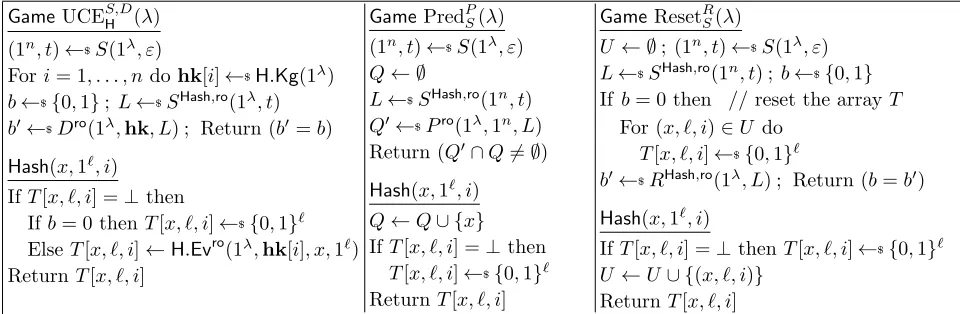
Framework. LetHbe a family of functions. LetS be an adversary called thesource andDan adversary called the distinguisher. We associate to them and H the game UCES,DH (λ) in the left panel of Fig. 2. Initially, the source specifies a unary-encoded integer n ≥ 1 to indicate the number of hash keys that it wants to use. The game then chooses a secret vector hk ofn uniformly random hash keys and grants the source access to an oracleHash. We require that any query (x,1`, i) made to this oracle satisfy|x| ∈H.IL(λ),
` ∈ H.OL(λ) and i ∈ {1, . . . , n}. When the challenge bit b is 1 (the “real” case) the oracle responds via H.Ev underhk[i]. Whenb= 0 (the “random” case) it responds via the ith random-oracle procedure. The source then leaks a stringL to its accomplice distinguisher. The latter does get the keyshk as input and must now return its guess b0 ∈ {0,1} for b. The game returns true iff b0 = b, and the uce-advantage of (S, D) is defined forλ∈Nvia
AdvuceH,S,D(λ) = 2 Pr[UCES,DH (λ)]−1 .
If S is a class (set) of sources, we say that H is UCE[S]-secure if AdvuceH,S,D(·) is negligible for all sources
S ∈ S and all PT distinguishers D. Trivial attacks from [6] show that UCE[S]-security is not achievable if S is the class of all PT sources. To obtain meaningful notions of security, BHK [6] impose restrictions on the source. There are many ways to do this; below we’ll focus on what they call unpredictable and reset-secure sources. To discuss the concrete security of constructions it will be useful to say that S is a
N-key source if we always haven≤N(λ) when (1n, t)←$S(1λ, ε).
GameUCES,DH (λ)
(1n, t)←$S(1λ, ε)
Fori= 1, . . . , ndohk[i]←$H.Kg(1λ) b←${0,1}; L←$SHash,ro(1λ, t) b0←$Dro(1λ,hk, L) ; Return (b0 =b)
Hash(x,1`, i)
IfT[x, `, i] =⊥then
Ifb= 0 thenT[x, `, i]←${0,1}` ElseT[x, `, i]←H.Evro(1λ,hk[i], x,1`)
ReturnT[x, `, i]
GamePredPS(λ)
(1n, t)←$S(1λ, ε)
Q← ∅
L←$SHash,ro(1n, t) Q0←$Pro(1λ,1n, L) Return (Q0∩Q6=∅)
Hash(x,1`, i)
Q←Q∪ {x}
IfT[x, `, i] =⊥then T[x, `, i]←${0,1}` ReturnT[x, `, i]
GameResetRS(λ)
U ← ∅; (1n, t)←$S(1λ, ε)
L←$SHash,ro(1n, t) ; b←${0,1} If b= 0 then // reset the array T
For (x, `, i)∈U do T[x, `, i]←${0,1}`
b0←$RHash,ro(1λ, L) ; Return (b=b0)
Hash(x,1`, i)
IfT[x, `, i] =⊥thenT[x, `, i]←${0,1}` U ←U∪ {(x, `, i)}
ReturnT[x, `, i]
Figure 2: Games UCE (left), Pred (middle), and Reset (right) to define UCE security. Here ro:{0,1}ro.il(λ)→ {0,1}ro.ol(λ) is a random oracle.
leakage, the predictor outputs a set Q0. The predictor wins if Q0 contains a Hash-query of the source. For
λ∈Nwe let
AdvpredS,P(λ) = Pr[PredPS(λ)] .
We require that the size of Q0, as well as the number of queries that P makes to ro, be bounded by a polynomial (allowed to depend on P) in λ. We say that S is computationally (respectively, statistically) unpredictable if AdvpredS,P(·) is negligible for all PT (respectively, all, even computationally unbounded) predictors P. We let Scup be the class of computationally unpredictable PT sources, and Ssup the class of statistically unpredictable PT sources. The corresponding security notions for H are UCE[Scup] and UCE[Ssup].
Reset-secure sources. We recall the second restriction on sources from [6], called reset security. LetS be a source andRan adversary called a reset adversary. The source again is executed with its Hashbeing a random oracle. The reset adversary is either given access to the same random oracle or to anindependent one. The requirement is that it should not be able to tell which. Formally, consider game ResetRS(λ) at the right panel of Fig. 2 associated toS, R. Forλ∈Nwe let
AdvresetS,R(λ) = 2 Pr[ResetRS(λ)]−1.
We require that the number of queries thatP makes toHashand robe bounded by a polynomial (allowed to depend on R) in λ. We say S is computationally (respectively, statistically) reset-secure if AdvresetS,R(·) is negligible for all PT (respectively, all, even computationally unbounded) reset adversaries R. We let
Scrs be the class of all PT computationally reset-secure sources, andSsrs the class of all PT statistically reset-secure sources. The corresponding security notions for HareUCE[Scrs] andUCE[Ssrs].
Relations and achievability. Reset security is a relaxation of unpredictability. In particular BHK [6] show that UCE[Scrs]-security of H implies UCE[Scup]-security of H and UCE[Ssrs]-security of H implies UCE[Ssup]-security ofH. The converses are not necessarily true. BFM [13] show that if indistinguishability obfuscation for all circuits is possible thenUCE[Scrs]-security is not achievable in the standard model. In the ROM however BHK [6] show that bothUCE[Scrs]-security and UCE[Ssrs]-security are achievable.
4
UCE from indifferentiability
We first review necessary definitions of the indifferentiability framework [21].
GameIndiffAM,M(λ)
b←${0,1}; st←ε b0←$APrim,Func(1λ) Return (b=b0)
Func(x)
Ifb= 1 then returnMro(1λ, x)
Else returnRO(x)
Prim(x)
Ifb= 1 then returnro(x) (y,st)←$M
RO
(1λ,st, x) Returny
Figure 3: Game Indiff defining indifferentiability. Here RO : {0,1}∗ → {0,1}M.fol(λ) and ro :
{0,1}M.pil(λ)→ {0,1}M.pol(λ) are random oracles.
to M, an algorithm M called a simulator, and an adversary A. In the first world (b = 1), oracle Prim implements the FIL random oracle ro while oracle Func implements the construction, namely Mro, that aims to approximate a VIL random oracle. In the second world (b= 0), oracleFuncimplements a true VIL random oracle ROwhile replies to Prim queries are determined by the simulator that itself has access to RO. The simulator is stateful, its state st being maintained by the game. The inputx toM has arbitrary length, the oracle provided toM maps M.pil(λ)-bit inputs toM.pol(λ)-bit outputs, andM returns outputs of length M.fol(λ), where M.pil,M.pol,M.fol:N→Nare functions associated to Mcalled the input-length
of M’s primitive, output-length of M’s primitive, and output-length of M’s functionality, respectively. For
λ∈Nwe let
AdvindiffM,M,A(λ) = 2 Pr[IndiffAM,M(λ)]−1.
We require that the number of queries that A makes to its oracles be bounded by a polynomial (allowed to depend onA) in λ. Then we say thatM is apseudorandom oracle (PRO) if there is a PT simulator M such thatAdvindiffM,M,A(·) is negligible for every (even computationally unbounded) adversaryA.
For concrete security assessments we letQM,q be the function that on inputλreturns the maximum, over all x1, . . . , xq ∈ {0,1}M.pil(λ), of the total number of oracle queries that M makes when run sequentially on inputs x1, . . . , xq, starting from state ε. Also let TM,q be the function that on input λ returns the maximum, over all x1, . . . , xq ∈ {0,1}M.pil(λ), of the total running time of M when run sequentially on inputsx1, . . . , xq, starting from state ε, the time for an oracle query being taken as linear in the length of the query and reply.
The Keyed-Indiff extender. Let H be a FIL function family that is UCE[Sxxx]-secure for some xxx. We want to build a VIL family of functions Hthat is also UCE[Sxxx]-secure. Our construction uses as a tool any PRO M with M.pil = H.il and M.pol = H.ol. We associate to M and H the family of functions H=Keyed-Indiff[M,H] defined as follows. We let H.IL=N, meaning H is VIL. The output length of His
H.ol=M.fol. We letH.Kg=H.Kg, meaning keys for Hare the same as forH. Finally for anyλ∈N, any hk∈[H.Kg(1λ)] and anyx∈ {0,1}∗ we let
H.Evro(1λ,hk, x,1H.ol(λ)) =MH.Ev ro
(1λ,hk,·,1H.ol(λ))
(1λ, x). (1)
This needs some explanation. Begin by ignoringro, so that we are looking at a standard-model construction. Recall thatMtakes an oracle mapping{0,1}M.pil(λ)to{0,1}M.pol(λ). In the indifferentiability setting, this is a random oracle. Our construction however does something different. It implementsM’s oracle via the given UCE[Sxxx]-secure family H. The key hk is held fixed. Our claim will be that His itself UCE[Sxxx]-secure for xxx∈ {crs,srs}. Something we consider interesting is that this result is entirely standard model, yet uses ROM theory, in the form of a PRO, for the construction and proof. Finally theroin the construction simply reflects that the result lifts to the ROM. In case H was a ROM family of functions, Hwill be as well. This extension, together with known applications ofUCE[Sxxx]-security, allow us to implement in the FIL-ROM many constructions given in the VIL-ROM.
Result. We viewKeyed-Indiff[M,·] as a domain extension transform taking a FIL familyHand returning a VIL familyH=Keyed-Indiff[M,H]. The following says that this transform preserves UCE[Sxxx]-security for xxx∈ {crs,srs}. The proof is in Appendix A.
LetH=Keyed-Indiff[M,H]. Let xxx∈ {crs,srs}.
Asymptotic result: IfHis UCE[Sxxx]-secure then so isH.
Concrete result: Let M be a simulator for M. Let S be an N-key source, D a distinguisher and R a reset adversary. Then we construct an N-key source S, indifferentiability adversaries A, B and a reset adversaryR such that
AdvuceH,S,D(λ)≤AdvuceH,S,D(λ) +N(λ)·AdvindiffM,M,A(λ) (2) AdvresetS,R(λ)≤AdvresetS,R(λ) + 3N(λ)·AdvindiffM,M,B(λ) (3) for all λ∈N. Furthermore:
QPrimA = 0;QFuncA ,QFuncB ≤QHashS ;QPrimB ≤QHashR QroR =Qro
R;Q Hash
R ≤QM,q whereq=Q Hash R ;Q
ro S =Q
ro S
QHash
S is bounded by the number of oracle queries of M in the execution of UCE S,D H
T(IndiffAM,M)≤T(UCES,DH ); T(UCES,D
H )≤T(UCE S,D H )
T(ResetRS)≤T(ResetSR) +TM,q whereq =QHash R
T(IndiffBM,M)≤T(ResetRS) +T(ResetRS)
We emphasize thatKeyed-Indiff works in both the standard and the random oracle models. In particular if FIL familyHisUCE[Sxxx]-secure in the standard model, then so isKeyed-Indiff[M,H], for xxx∈ {crs,srs}. This resolves an open problem from [6] to construct UCE domain extenders in the standard model.
Some applications in [6] use only a single hash key. In other words, they only need UCE[Scrs∩ Sone] and UCE[Ssrs∩ Sone] security, where Sone is the class of 1-key sources. Keyed-Indiff[M,·] is also a domain extender for UCE[Scrs∩ Sone] andUCE[Ssrs∩ Sone] because the value of N is preserved.
Instantiation. To obtain a concrete result that can be used in applications, we now instantiateHabove in a simple way, namely (1) H.Kg(1λ) returns hk←${0,1}λ, and (2) H.Evro(1λ,hk, x,1H.ol(λ)) returns ro(hkkx). This is shown by BHK [6] to be UCE secure in the FIL-ROM for all forms of UCE they define. For illustration, Fig. 4 describes the PRO ChopMD (truncated Merkle-Damg˚ard [15]) and shows how one would implement Keyed-Indiff[ChopMD,H] from an iterative hash like SHA-256. From Theorem 4.1 we obtain the following.
Theorem 4.2 Let Hbe constructed as above. LetM be a PRO such that M.pil=H.iland M.pol=H.ol. LetH=Keyed-Indiff[M,H].
Asymptotic result: His UCE[Scrs]-secure.
Concrete result: Let M be a simulator for M. Let S be an N-key source and D a distinguisher. We can construct a reset adversaryR and an indifferentiability adversaryA such that
AdvuceH,S,D(λ)≤AdvresetS,R(λ) + 4N(λ)·AdvindiffM,M,A(λ) +2N(λ)·q(λ) +N 2(λ) 2λ
for everyλ∈N. Furthermore,
QPrimA ≤QHashS ;QFuncA ,QroR ≤QroD; and QHashR ≤QM,q, where q=QroD T(IndiffAM,M),T(ResetRS)≤T(UCES,DH ) +TM,q, whereq =QroD
/s
xϬ xϭ
͙
/s
zϬ zϭ
͙
hk hk
h h h h
w
y y
w
y y
Figure 4: An instantiation of Keyed-Indiff domain extender: The PRO ChopMD (truncated Merkle-Damg˚ard [15]) on the left, and Keyed-Indiff[ChopMD,H] on the right, where h is a compression function and H=h(hkk ·).
H.Kg(1λ)
fk←$F.Kg(1λ) ; hk←$H.Kg(λ)
hk←(hk,fk) ; Returnhk
H.Evro(1λ,hk, x,1`)
(hk,fk)←hk; u←F.Ev(1λ,fk, x,1F.ol(λ))
y←H.Evro(1λ,hk, u,1`) ; Returny
Figure 5: The H = AU-then-Hash[F,H] construction, built from a AU hash F and a FIL UCE-secure hash H.
5
UCE from universal hashing
In this section, we show how almost universal hash functions can be used to build a domain extender for UCE.
AU hash families. For any function familyF let
Coll1F(λ, m) = max |y|=F.ol(λ),|x|≤m
n
Pr
fk←$F.Kg(1λ)[y=F.Ev(1
λ,fk, x,1F.ol(λ))]o, and defineColl2F(λ, m0, m1) as
max
n
Pr
fk←$F.Kg(1λ)[F.Ev(1 λ,fk, x
0,1F.ol(λ)) =F.Ev(1λ,fk, x1,1F.ol(λ))]
o
; the maximum is taken over distinct strings x0, x1 such that each |xi| ≤mi. Let
CollF(λ, m0, m1) = max
Coll2F(λ, m0, m1),Coll1F(λ,min{m0, m1}) .
A hash family F is almost universal (AU) if f(λ) = CollF(λ, m0, m1) is negligible for all polynomials
m0, m1. This generalizes the Carter-Wegman notion of universal hashing [14].
A similar definition is given in [11], which is very useful when one needs to work with arbitrarily large input and short hash keys. In Section 6, we’ll show how to concretely instantiate a very fast AU hash for
λ= 128, from reduced-round AES and a classic polynomial-based universal hash. Define AdvcollF (λ, p, σ) = max
`≤p,`0≤p,m1+···+m
`≤σ,m01+···+m0`0≤σ
nX`
i=1 `0
X
j=1
CollF(λ, mi, m0j)
o .
If F is AU then AdvcollF (λ, p, σ) is negligible for all polynomials p and σ: since Coll(λ,·,·) is increasing in both arguments, it follows thatAdvcollF (λ, p, σ)≤p2CollF(λ, σ, σ).
UCE extender from an AU hash. We now describe a UCE extender from AU hash. Intuitively, one first uses the AU hash to condense the input, and then applies the resulting string to the (keyed) compression function. Formally, letHbe a hash function family of fixed input length, andFbe a universal hash function family with F.ol=H.il and F.IL=N. Consider the hash function family H=AU-then-Hash[F,H] as given
in Fig. 5, with H.OL =H.OL and H.IL =N. The construction essentially follows the widely used
Theorem 5.1 LetHbe a function family of fixed input length, andFbe an AU hash function family with F.ol=H.iland F.IL=N. LetH=AU-then-Hash[F,H].
Asymptotic result: IfHis UCE[Ssup]-secure then so isH.
Concrete result: Let S be a N-key source, D a distinguisher, and P a predictor. We can construct a sourceS, a distinguisherD, and a predictor P such that
AdvuceH,S,D(λ)≤AdvuceH,S,D(λ) +AdvcollF (λ, p, σ) (4) Advpred
S,P(λ)≤
q
2qAdvcollF (λ, p, σ) +
q
qAdvpredS,P(λ) (5)
where p = QHashS , q is the maximum of the size of P’s output in the execution of PredPS, and σ is the maximum of the total length of Hash queries thatS makes in UCES,DH . Furthermore,
QroS =QroS;QHashS =QHashS ;QroD =QroD T(UCES,D
H )≤T(UCE S,D
H ), andP outputs a set of size at mostQ Hash S
We emphasize thatAU-then-Hashworks in both the standard and the random-oracle models. In particular If FIL family H is UCE[Ssup]-secure in the standard model then so is AU-then-Hash[F,H]. The intended applications for the AU-then-Hash[F,·] transform, as listed in Fig. 1, use only a single hash key, that is, they only needUCE[Ssup∩ Sone] security, whereSoneis the class of 1-key sources. AU-then-Hash[F,·] is also a domain extender for UCE[Ssup∩ Sone] security because the value of N is preserved.
Instantiation. So far we have assumed the existence of a fixed-input-length UCE-secure hashH. For the MLE application in [6], one needs to hash a short session key to produce a big one-time pad. We aim to make this process as fast as AES-CTR. It’s possible to build a ROM-basedH without any other cryptographic primitive, but this won’t give us the desired speed, if one instantiatesrofrom, say the compression function of SHA-256. Our construction therefore makes use of a PRP E, which will be instantiated by AES.
Recall that a PRP is a function familyEsuch thatE.il=E.ol, andE.Ev(1λ, K,·,1E.ol(λ)) is in Perm(E.ol(λ)) for everyλ∈NandAdvprpE,A(λ) = 2 Pr[PRPAE(λ)]−1 is negligible for every PT adversaryA, where Perm(`) is the set of permutation on{0,1}` and game PRPA
E is defined as follows.
GamePRPAE(λ)
b←${0,1}; K←${0,1}E.kl(λ) π←$Perm(E.ol(λ)) ; b0←$ARR(1λ) Return (b=b0)
RR(x)
Ifb= 1 theny←E.Ev(1λ, K, x,1E.ol(λ)) Elsey←π(x)
Returny
We now describe our ROM-based UCE construction. Assume that ro.il(λ) ≥2λ, and ro.ol(λ) = E.kl(λ), and E.ol(λ) = λ for every λ ∈ N. The construction Hrom is given as follows, where Hrom.OL(λ) =
{1,2,3, . . . ,2dλ/2e} andH
rom.il(λ) =ro.il(λ)−λfor every λ∈N. Hrom.Kg(1λ)
hk←${0,1}λ; Returnhk
Hrom.Evro(1λ,hk, x,1`)
K←ro(hkkxk`) ; m← d`/λe
Fori= 1 tomdoyi←E.Ev(1λ, K, `ki,1λ)
y←y1k · · · kym; y←y[1, `] ; Returny
Here when we call ro(hkkxk`) andE.Ev(1λ, K, `ki,1λ), the string`is encoded as a dλ/2e-bit string, and
Theorem 5.2 Let F be an AU hash function family with F.ol = Hrom.il and F.IL = N. Let H =
AU-then-Hash[F,Hrom].
Asymptotic result: His UCE[Ssup]-secure.
Concrete result: Let S be an N-key source and D a distinguisher. We can construct a predictor P and a PRP adversaryA such that
AdvuceH,S,D(λ)≤2
q
q(λ)AdvcollF (λ, p(λ), σ(λ))+
q
q(λ)AdvpredS,P(λ)+2p(λ)·AdvprpE,A(λ)+2s
2(λ) +N2(λ) +q2(λ) 2λ
for everyλ∈N, wherep=QHashS ;q=QroS +QroD;σ andsare the maximum of the total length of the first components and the total number of λ-bit blocks in the second components, respectively, ofHash queries in the execution of UCES,DH . Furthermore
QLR
A is maximum of the number of λ-bit blocks in the second component of a Hash query in UCE S,D H
T(PRPAE)≤T(UCES,DH ), andP outputs a set of size at mostQHashS .
6
Fast, parallelizable AU hash from reduced-round AES
We now show how to construct a fast parallelizable AU hash, which we call Faes4. In this section, let
n= 128, C= 215, and letr be a small integer, say r= 5. All function families in this section are concrete; the security parameter λ is hidden in the formulas, but implicitly, it is λ = 128. For any integer m, let
kmkn denotebm/nc+ 1. We’ll first describe two building blocks: Fpoly, a polynomial-based AU hash that operates on {0,1}∗, and F
tree, a highly efficient AU hash based on reduced-round AES that operates on
{x ∈({0,1}n)+ :|x| ≤2rn}. We then show how to combine them to produce a highly efficient AU hash Faes4 whose domain is {0,1}∗.
The Fpoly construction. We now describe a variant of a classic polynomial-based universal hash [14], which we callFpoly. LetFpoly.ol=n. As described in the pseudocode below, the keyfkis picked as a random element of GF(2n). To hash, we parse the input stringx∈ {0,1}∗to a unique sequence (w0, . . . , wm), where each wi ∈GF(2n) andwm is not the zero element. This is performed by (i) parsev0k · · · kvm←xk10s1, where s∈N is the smallest number such that s+|x| ≡ −2 (mod n) and each |wi|=n, and (ii) let each
wi be the encoding of vi in GF(2n). Then, the hash is computed as Pmi=0wi·fki.
Fpoly.Kg()
fk←$GF(2n) Returnfk
Fpoly.Ev(fk, x,1n)
(w0, . . . , wm)←x; y←w0 Fori= 1 tomdoy←y+wi·fki
Returny
The proof of Proposition 6.1 below is in Appendix D.
Proposition 6.1 (a) For any m∈N, we have Coll1Fpoly(m)≤ kmkn/2
n, and (b) for anym
0, m1 ∈N, we
have Coll2Fpoly(m0, m1)≤max{km0kn,km1kn}/2 n.
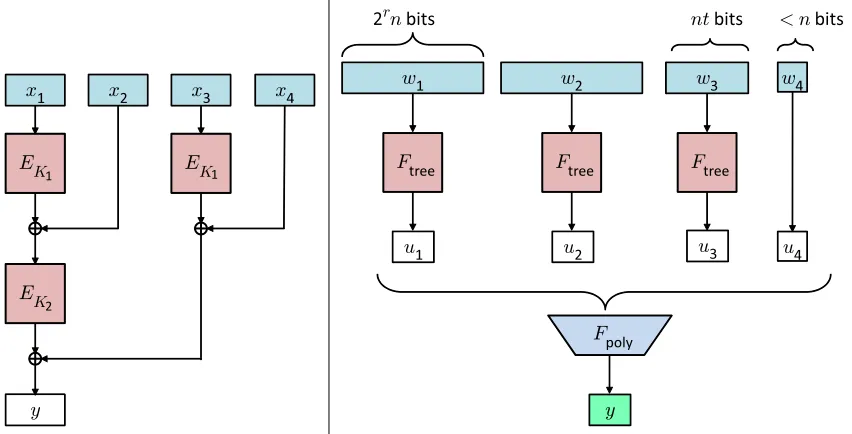
The Ftree construction. Let E : {0,1}4n× {0,1}n → {0,1}n denote a function based on 4-round AES which works as follows. Parse the key K as the concatenation of n-bit substrings S0, S1, S2, S3, and let S4 = 0n. The input is initially xored with S0, and each Si is used as the subkey of the i-th AES round, for i ∈ {1,2,3,4}. One can build from E a hash of domain {n,2n,3n, . . . ,2rn} as illustrated in Fig. 6. Formally, let Halve denote the following operation. On input (K, x) ∈ {0,1}4n×({0,1}n)∗,
we partition x into n-bit blocks x1· · ·xm. For every two consecutive blocks x2i−1 and x2i, we compute
yi ← EK(x2i−1)⊕x2i. If m is odd then let ydm/2e ← xm. Finally output y1k · · · kydm/2e. Consider the
xϭ xϮ xϯ xϰ
E
Kϭ EKϭ
y E
KϮ
uϰ
wϭ wϮ wϯ
Ϯr
nďŝƚƐ ntďŝƚƐ < nďŝƚƐ
FƚƌĞĞ FƚƌĞĞ FƚƌĞĞ
uϭ
wϰ
uϮ uϯ
F ƉŽůLJ
y
Figure 6: Left: Illustration of Ftree forr= 2. Right: Illustration of Ffast.
Ftree.Kg()
Fori= 1 tordoKi←${0,1}4n
hk ←(K1, . . . , Kr) ; Returnfk
Ftree.Ev(fk, x,1n)
z0←x; (K1, . . . , Kr)←fk
Fori= 1 tor dozi←Halve(Ki, zi−1) Returnzr
Minematsu and Tsunoo [22] show that
Coll2Ftree(m0, m1)≤
Cr
2n (6)
for anym0, m1 ≤2r. We stress that the result in [22] makes no assumption on AES. This is based on the fact that four-round AES, with the subkeys chosen uniformly and independently, is an almost-xor-universal hash [20].
Combining Ftree and Fpoly. One can “cascade” Ftree and Fpoly to produce a hash Ffast of domain {0,1}∗ as shown in Fig. 6. The formal code is shown below.
Ffast.Kg()
fk1←$Ftree.Kg()
fk2←$Fpoly.Kg() Return (fk1,fk2)
Ffast.Ev(fk, x,1n)
(fk1,fk2)←fk
y←Shrink(fk1, x)
z←Fpoly.Ev(fk2, y,1n) Returnz
Shrink(fk1, x)
w1w2· · ·wk←x; uk←wk
Fori= 1 tok−1 do ui←Ftree.Ev(fk1, wi,1n)
y←u1k · · · kuk; Returny
In the procedure Shrink above, we parse a string x as the concatenation of substrings w1, . . . , wk, where the length of each wi, withi≤k−2, is exactly 2rn, and |wk−1|>0 is a multiple ofn but does not exceed 2rn, and 0≤ |wk|< n−1. Note that on a large inputx, the hashFwill make at most (1−2−r)dx/ne calls onE, and then runFpoly on a string of length about|x|/2r. The proof of Proposition 6.2 below is in Appendix E.
Proposition 6.2 For anym0, m1 ∈N, we have CollFfast(m0, m1)≤(Cr+ max{km0kn,km1kn})/2 n.
therefore need to “double” the output length. Formally, given a hash family F, the family F=Double[F], withF.IL=F.IL and F.ol= 2F.ol, is constructed as follows.
F.Kg()
fk1,fk2←$F.Kg()
fk←(fk1,fk2) ; Returnfk
F.Ev(fk, x,1F.ol)
(fk1,fk2)←fk
Fori= 1 to 2 doyi←F.Ev(fki, x,1F.ol)
Returny1ky2
Let Faes4 denote Double[Ffast]. As shown in the term (qAdvcollFfast(p, σ))
1/2 in Theorem 5.1 is bounded by (Crp√2q+ 2(kσkn+p)
√
pq)/2n, which is good. The proof is in Appendix F.
Proposition 6.3 For anyp and σ, we have AdvFcollaes4(p, σ)≤ 2C2r2p2+422np(kσkn+p)2.
Key length. The key material ofFastHash=AU-then-Hash[Faes4,Hrom] is relatively large: 672B forr= 5. It’s slightly bigger than that of some widely used schemes such as RSA [24] (256B). This is acceptable because the key is used as a public parameter.
7
An example application
In Section 1, we introduced a two-step paradigm for using UCE to move VIL-ROM schemes to the FIL-ROM: (1) Show that instantiating the VIL random oracle in the scheme with a VIL UCE function preserves security, and (2) Implement the VIL UCE function asEro to obtain a FIL-ROM scheme, whereEis a UCE domain extender. We explained that step (1) has already been done for many primitives [6], and what remained was to build domain extendersEallowing step (2). At this point we have reached the latter goal, providing two such constructions forE, namelyKeyed-Indiffof Section 4 andAU-then-Hashof Section 5. We now illustrate how to put things together to obtain a final FIL ROM scheme for an example application, namely Message-locked Encryption (MLE) [7], by exploiting the results of [6] for the first step and our results for the second step. Other applications may be obtained in the same way.
MLE definitions. A MLE scheme can be used to provide space-efficient secure outsourced storage. Formally an MLE scheme MLE specifies the following PT algorithms. AlgorithmMLE.Pg(1λ) generates a parameter p. Next, given a parameter p and a message m, algorithm MLE.Kg(1λ, p, m) deterministically generates a keyK. To encrypt a message m under keyK, one calls c←$MLE.Enc(1λ, p, K, m). One then can decrypt a ciphertextc via m←MLE.Dec(1λ, p, K, c). The tag-generation algorithm MLE.Tag(1λ, p, c) deterministically derives a tag t from a ciphertext c. The correctness requirement demands that for all λ ∈ N, m ∈ {0,1}, p ∈ [MLE.Pg(1λ)], and K1, K2 ∈ [MLE.Kg(1λ, p, m)] we have (1) For all c1 ∈ [MLE.Enc(1λ, p, K1, m)] andc2 ∈[MLE.Enc(1λ, p, K2, m)], we haveMLE.Tag(1λ, p, c1) =MLE.Tag(1λ, p, c2), and (2)MLE.Dec(1λ, p, K
2, c) =mfor allc∈[MLE.Enc(1λ, p, K1, m)]. For privacy, the IND$-CDA security is defined via the game in the left panel of Fig. 7. A IND$-CDA adversary A is a pair of PT algorithms (A1, A2), where A1(1λ) returns a string vector m that satisfies the following: (1) There is a polynomial
v and a function len : N×N → N, depending solely on A, such that |m| = v(λ) and |m[i]| = len(λ, i),
for every λ∈ N, m∈ [A1(1λ)], and i≤ |m|, and (2) the strings m[1], . . . ,m[|m|] are distinct. Define the
guessing probability GuessA ofA as the function that on inputλ∈N returns the maximum, over alli, m,
of Pr[m[i] = m], the probability over m←$A1(1λ). We say that A has high min-entropy if GuessA(·) is negligible. We let AdvcdaMLE,A(λ) = 2 Pr[IND$-CDAAMLE(λ)]−1 and say that MLE is IND$-CDA-secure if AdvcdaMLE,A(·) is negligible for all PT Athat have high min-entropy.
A FIL-ROM MLE scheme. BHK [6] describe a variant of the Convergent Encryption (CE) scheme of [18] as shown in the right panel of Fig. 7. They then give the following result.
Proposition 7.1 [6] LetHbe a UCE[Ssup]-secure hash with H.IL=H.OL=
N.
GameIND$-CDAAMLE(λ)
p←$MLE.Pg(1λ) ; b←${0,1} m←$A1(1λ)
Fori= 1 to|m|do
K[i]←MLE.Kg(1λ, p,m[i])
c1[i]←MLE.Enc(1λ, p,K[i],m[i]) c0[i]←${0,1}|c1[i]|
b0←$A2(1λ, p,cb) Return (b0=b)
CE.Pg(1λ)
hk←$H.Kg(1λ) Returnhk
CE.Kg(1λ,hk, m)
K←H.Ev(1λ,hk, m,12λ)
ReturnK
CE.Enc(1λ,hk, K, m)
c←m⊕H.Ev(1λ,hk, K,1|m|)
Returnc
CE.Dec(1λ,hk, K, c)
m←c⊕H.Ev(1λ,hk, K,1|c|)
Returnm
CE.Tag(1λ,hk, c) Returnc
Figure 7: Left: The IND$-CDA game. Right: MLE schemeCE[H].
Concrete result: Let A = (A1, A2) be an IND$-CDA adversary. We can construct a 1-source S and a distinguisher Dsuch that for any predictorP,
AdvcdaCE[H],A(λ) ≤ AdvuceH,S,D(λ) +2v 2 22λ AdvpredS,P(λ) ≤ v`·GuessA(λ) +
2v2+v`
22λ
for every λ ∈ N, where v and ` are the maximum of the size of the vectors that A1 and P output, respectively. FurthermoreQroS =QroA
1;Q ro
D =QroA2;T(UCE S,D
H )≤T(IND$-CDA A
CE[H]), andQHashS ≤2v. By combining Theorem 5.2 and Proposition 7.1, we have the following result. This is the final end-product of our methodology, namely a FIL-ROM scheme for the application in question.
Proposition 7.2 Construct Hrom from a PRP E as in Section 5. Let F be an AU hash function family withF.ol=Hrom.iland F.IL=N. LetH=AU-then-Hash[F,Hrom].
Asymptotic result: CE[H] is IND$-CDA-secure.
Concrete result: Let A = (A1, A2) be an IND$-CDA adversary. We then can construct an adversary B attacking Esuch that
AdvcdaCE[H],A(λ)≤vp2q·GuessA(λ) + 2v·AdvprpE,B(λ) + 2
q
qAdvcollF (λ,2v, λ·(v+s)) + 2s
2+q2+ 4v 2λ
for all λ ∈ N, where q = QroA, s is the total λ-bit blocks in the string vector m that A1 outputs, and
v = |m|. Moreover, T(PRPBE) ≤ T(IND$-CDAACE[FastHash]) and QLRB is the maximum of the number of
λ-bit blocks in the components ofm.
Finally we can obtain a concrete scheme by instantiatingF and Ein Proposition 7.2. Namely, letλ= 128 and H = FastHash = AU-then-Hash[Faes4,Hrom]. Let E = AES. Then from Proposition 7.2 we have the following corollary. For any IND$-CDA adversary A= (A1, A2), one can construct another adversary B attacking AES such that
AdvcdaCE[FastHash],A≤vp2q·GuessA+ 2v·AdvprpAES,B+
2s2+q2+ (16v+ 4s)√2vq
2128 +
v√q
2107
whereq =QroA,sis the total 128-bit blocks in the string vectormthatA1 outputs, andv=|m|. Moreover,
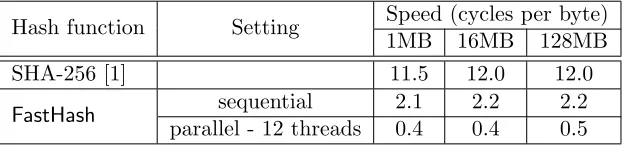
Hash function Setting Speed (cycles per byte)
1MB 16MB 128MB
SHA-256 [1] 11.5 12.0 12.0
FastHash sequential 2.1 2.2 2.2
parallel - 12 threads 0.4 0.4 0.5
Figure 8: Running time of the hash constructions. The first column lists the hash names, the second column lists the setting, namely sequential or parallel, along with the number of threads, and the last three columns list the running time on messages of sizes 1MB, 16MB, and 128MB respectively.
8
Implementation
In this section, we’ll describe how to instantiate the AU hash Faes4 in Section 6, and the FIL UCE-secure hash Hrom in Section 5. We then compare the speed of FastHash, the resulting instantiation of AU-then-Hash[Faes4,Hrom], with a standard hash function, SHA-256. We first describe our choices for com-ponents and parameters to instantiate the construction, and then provide an overview of the implemen-tation, before outlining the testing environment and test specifications. We also compare the convergent encryption (CE) MLE scheme2from FastHash and SHA-256. Our results indicate a speedup of 5.3x for our hash function over SHA-256 and 6.3x for CE in the sequential setting, and 24x and 20x speedups, respectively, once parallelism is enabled.
Instantiations. To instantiateFaes4, we use the standard irreducible polynomialp(x) =x127+x7+x2+
x+ 1 for multiplication over GF(2128). For Hrom, the FIL RO is instantiated by the compression function of SHA-256, and the PRP by AES128.
Implementation. We implemented FastHashin C with inline assembly. We used Intel’s library for mul-tiplication overGF(2128) [3], Intel’s optimized SHA256 implementation [1], and Intel’s AES-NI library [2]
for the code involving AES operations. We used the pthreads library for implementing threads for paral-lelization.
Setup. We performed experiments on an Intel Core i7-970 processor clocking at 3201 MHz with a 12288 KB L1 cache. The machine provides hardware support for SSE4 vector instructions, AES operations (AES-NI), and multiplication inGF(2128). Tests were compiled with gcc version 4.6 optimization level -O3, with
support for SSE4 via -msse4 flag, AES-NI instructions through the -maes flag,GF(2128) multiplications via
the -mpcmulqdq flag, and parallelization via the -pthread flag. We ran the tests in isolation, after turning off processor frequency scaling. We used the rdtsc instruction to count cycles.
Experiments. We measured the performance of instantiations of the hash functions (i.e. FastHash and SHA-256) as well as CE schemes based on these hash functions on messages of lengths 1MB, 16MB and 128MB. In each case, we measured the median running times of the different hash functions over 100 iterations, repeated this process 100 times and obtained the mean of the medians.
In the case of parallelizable constructions, viz. FastHashand CE[FastHash], we ran tests with multiple levels of parallelism, starting from single-threaded, serial constructions, and increasing the number of threads until we reached a point of thrashing where the performance starts to deteriorate because of other bottlenecks in the system. We report both the single-thread sequential running time, and the optimal parallel running time along with the optimal number of threads. In the latter case, the reported time does not include the time to create and destroy the threads.
In Fig. 8, we report the median running times of the hash function instantiations, in cycles per byte. We compare these times with the best times reported for SHA-256 on similar processors [1]. Our construction 2 In CE [7], one first hashes the message x to derive a key K, and then runs AES-CTR on key K to encrypt x.
To use FastHash on CE, one needs to use the CE variant of [6], in which AES-CTR on message m is replaced by FastHash(hk, K,1|x|
)⊕x. Note that this doesn’t give us any speed advantage over the standard version of CE, as the masking viaFastHashis essentially AES-CTR. The only thing we gain is the abstraction of AES as part of the hash, so that one can applyUCE[Ssup
MLE Scheme Setting Speed (cycles per byte)
1MB 16MB 128MB
CE implementation in [7] 22.1 22.3 22.6
CE[FastHash] sequential 3.5 3.6 3.7
parallel - 12 threads 1.2 1.1 1.1
Figure 9: Running time of CE instantiations. The first column lists the instantiations, the second column lists the setting, namely sequential or parallel, along with the number of threads, and the last three columns list the running time (key generation + encryption) on messages of size 1MB, 16MB, and 128MB respectively.
achieves substantially better running times. On messages of 1MB, SHA runs at 11.5 cycles per byte, but our instantiation runs more than 5.3 times faster, at a cost of 2.1 cycles per byte. With parallelism, we achieve much better speeds, below one cycle per byte.
In Fig. 9, we demonstrate the benefits of having faster hash functions by comparing the speeds of CE implemented with FastHash with the implementation of CE by SHA-256 and AES-CTR in [7]. Our experiments show that CE[FastHash], even in the sequential setting, is about 6.3x faster than the speeds reported in [7]. When parallelism enabled, we achieve about 20x speedup.
References
[1] Fast SHA-256 Implementations on Intel Architecture Processors. goo.gl/Hh81eB. 17
[2] Intel AESNI Library. goo.gl/l2czm1. 17
[3] Intel Carry-Less Multiplication Instruction and its Usage for Computing the GCM Mode. goo.gl/qJLrF1. 17
[4] M. Bellare, A. Boldyreva, and A. O’Neill. Deterministic and efficiently searchable encryption. In A. Menezes, editor, CRYPTO 2007, volume 4622 ofLNCS, pages 535–552. Springer, Aug. 2007. 3
[5] M. Bellare, Z. Brakerski, M. Naor, T. Ristenpart, G. Segev, H. Shacham, and S. Yilek. Hedged public-key encryption: How to protect against bad randomness. In M. Matsui, editor,ASIACRYPT 2009, volume 5912 of
LNCS, pages 232–249. Springer, Dec. 2009. 3
[6] M. Bellare, V. T. Hoang, and S. Keelveedhi. Instantiating random oracles via UCEs. Cryptology ePrint Archive, Report 2013/424, 2013. Preliminary version appeared at CRYPTO 2013, pages 398–415, 2013. 3, 4, 7, 8, 10, 12, 15, 17, 24
[7] M. Bellare, S. Keelveedhi, and T. Ristenpart. Message-locked encryption and secure deduplication. In T. Jo-hansson and P. Q. Nguyen, editors,Advances in Cryptology–EUROCRYPT 2013, volume 7881 of LNCS, pages 296–312. Springer, 2013. 3, 5, 15, 17, 18
[8] M. Bellare and T. Kohno. A theoretical treatment of related-key attacks: RKA-PRPs, RKA-PRFs, and appli-cations. In E. Biham, editor, EUROCRYPT 2003, volume 2656 ofLNCS, pages 491–506. Springer, May 2003. 3
[9] M. Bellare and P. Rogaway. Random oracles are practical: A paradigm for designing efficient protocols. In V. Ashby, editor, ACM CCS 93, pages 62–73. ACM Press, Nov. 1993. 3
[10] M. Bellare and P. Rogaway. The security of triple encryption and a framework for code-based game-playing proofs. In S. Vaudenay, editor,EUROCRYPT 2006, volume 4004 ofLNCS, pages 409–426. Springer, May / June 2006. 6, 22
[11] J. Black and P. Rogaway. CBC MACs for arbitrary-length messages: The three-key constructions. Journal of Cryptology, 18(2):111–131, Apr. 2005. 11
[12] J. Black, P. Rogaway, and T. Shrimpton. Encryption-scheme security in the presence of key-dependent messages. In K. Nyberg and H. M. Heys, editors, SAC 2002, volume 2595 ofLNCS, pages 62–75. Springer, Aug. 2002. 3
[14] L. Carter and M. Wegman. Universal classes of hash functions. Journal of computer and system sciences, 18(2):143–154, 1979. 5, 11, 13
[15] J.-S. Coron, Y. Dodis, C. Malinaud, and P. Puniya. Merkle-Damg˚ard revisited: How to construct a hash function. In V. Shoup, editor, CRYPTO 2005, volume 3621 ofLNCS, pages 430–448. Springer, Aug. 2005. 3, 10, 11
[16] G. Demay, P. Gazi, M. Hirt, and U. Maurer. Resource-restricted indifferentiability. In T. Johansson and P. Q. Nguyen, editors,EUROCRYPT 2013, volume 7881 ofLNCS, pages 664–683. Springer, May 2013. 5
[17] Y. Dodis, T. Ristenpart, and T. Shrimpton. Salvaging Merkle-Damg˚ard for practical applications. In A. Joux, editor, EUROCRYPT 2009, volume 5479 ofLNCS, pages 371–388. Springer, Apr. 2009. 5
[18] J. Douceur, A. Adya, W. Bolosky, P. Simon, and M. Theimer. Reclaiming space from duplicate files in a serverless distributed file system. In Distributed Computing Systems, 2002. Proceedings. 22nd International Conference on, pages 617–624. IEEE, 2002. 5, 15
[19] R. Impagliazzo and S. Rudich. Limits on the provable consequences of one-way permutations. In S. Goldwasser, editor, CRYPTO’88, volume 403 of LNCS, pages 8–26. Springer, Aug. 1988. 27
[20] L. Keliher and J. Sui. Exact maximum expected differential and linear probability for two-round advanced encryption standard. IET Information Security, 1(2):53–57, 2007. 5, 14
[21] U. M. Maurer, R. Renner, and C. Holenstein. Indifferentiability, impossibility results on reductions, and appli-cations to the random oracle methodology. In M. Naor, editor, TCC 2004, volume 2951 ofLNCS, pages 21–39. Springer, Feb. 2004. 3, 4, 6, 8
[22] K. Minematsu and Y. Tsunoo. Provably secure macs from differentially-uniform permutations and aes-based implementations. InFast Software Encryption, pages 226–241. Springer, 2006. 14
[23] A. Mittelbach. Salvaging indifferentiability in a multi-stage setting. In P. Q. Nguyen and E. Oswald, editors,
EUROCRYPT 2014, volume 8441 ofLNCS, pages 603–621. Springer, 2014. 5, 6
[24] PKCS #1: RSA cryptography standard. RSA Data Security, Inc., Sept. 1998. Version 2.0. 15
[25] T. Ristenpart, H. Shacham, and T. Shrimpton. Careful with composition: Limitations of the indifferentiability framework. In K. G. Paterson, editor, EUROCRYPT 2011, volume 6632 of LNCS, pages 487–506. Springer, May 2011. 3, 4, 5
[26] M. N. Wegman and L. Carter. New hash functions and their use in authentication and set equality. Journal of Computer and System Sciences, 22:265–279, 1981. 11
A
Proofs of Theorem 4.1
For simplicity in analyzing concrete security, we’ll assume that for any N, q1, . . . , qN ∈N, we have
N
X
i=1
TM,q
i ≤TM,q and N
X
i=1
QM,q
i ≤QM,q,
where q=q1+· · ·+qN. That is, the maximum cost of running N separate instances of M forq1, . . . , qN inputs, all starting from states st =ε, doesn’t exceed the cost of running a single instance of M starting from state st =εfor q inputs.
In this proof, we’ll use the following conventions. First, rorefers to the random oracle that everybody has access in UCE/Reset games,ROandrorefer to the VIL and FIL random oracles in the definition of in-differentiability, androSimrefers to the simulated random-oracle interface implemented by our constructed adversaries, respectively.
Sro(1λ, ε)
(1n, t)←$Sro(1λ, ε) ; Return (1n, t)
SHash,ro(1λ, t)
L←$SHashSim,ro(1λ, t) ; Return L
HashSim(x,1`, i)
y←MHash(·,1H.ol(λ),i)(1λ, x) ; Returny
Next, we’ll reduce (S, D) to an adversary A attacking the indifferentiability of M. Note that here S
may have access up to N(λ) oracles Hash, yet A has only two oracles Prim and Func. To resolve this, we’ll employ a hybrid argument. Adversary A picks r←${1, . . . , N(λ)}, and implements VIL random oracles RO1, . . . ,RON(λ) :{0,1}∗ → {0,1}M.fol(λ) and FIL random oracle ro1, . . . ,roN(λ) :{0,1}M.pil(λ) →
{0,1}M.pol(λ). For a query on theith oracle, ifi=r then it queries itsFuncoracle. Otherwise, it responds by queryingROi ifi < r, and running Mroi ifi > r. The code of A is shown below.
APrim,Func(1λ)
r←${1, . . . , N(λ)}
(1n, t)←$SroSim(1λ, ε) ; L←$SHashSim,roSim(1λ, t) Fori= 1 to ndo hk[i]←$H.Kg(1λ)
b0←$DroSim(1λ,hk, L) ; Return b0
HashSim(x,1`, i)
If i=r then (y←Func(x) ; Returny) If i < r then returnROi(x)
Else return Mroi(1λ, x)
LetMbe the corresponding PT universal simulator forM. Leta, b,andbbe the challenge bits of games IndiffA,MM , UCES,DH , and UCES,D
H respectively. Then Pr[ UCES,D
H (·)⇒true|b= 1 ] = Pr[ UCE S,D
H (·)⇒true|b= 1 ] . Moreover,
Pr[ UCES,D
H (·)⇒false|b= 0 ]−Pr[ UCE S,D
H (·)⇒false|b= 0 ]
= N· Pr[ IndiffA,MM (·)⇒true|a= 1 ]−Pr[ IndiffA,MM (·)⇒false|a= 0 ] .
Subtracting, we haveAdvuceH,S,D(·) =AdvuceH,S,D(·)−N·AdvindiffA,M,M(·), thus the UCE security ofHfollows from the UCE security of Hand the indifferentiability of M. What’s left is to prove that S is computationally reset-secure. LetR be a PT reset adversary. Consider the following reset adversary R.
RHash,ro(1λ,1n, L)
For i= 1 to ndo sti ←ε
b0←$RHashSim,ro(1λ,1n, L) ; Returnb0
HashSim(x,1`, i) (y,sti)←$MHash(
·,1H.ol(λ),i)
(1λ,sti, x) ; Return y
In the code above, R maintains N(λ) independent instances of M. We now describe how to reduce (S, R) to an adversary B attacking the indifferentiability of M. Adversary B implements VIL random oraclesRO1, . . . ,RO2N(λ):{0,1}∗ → {0,1}M.fol(λ)and FIL random oraclesro1, . . . ,ro2N(λ) :{0,1}M.pil(λ) →
{0,1}M.pol(λ). It also maintainsN(λ) independent instances of M. The code of B is shown below.
BPrim,Func(1λ)
s←${1,2,3}; r←${1, . . . , N(λ)} (1n, t)←$SroSim(1λ, ε)
Fori= 1 to n do sti ←ε
L←$SHash,roSim(1n, t)
b0←$RHashSim,roSim(1λ,1n, L) Ifs= 1 then return b0
Else return 1−b0
Hash(x,1`, i)
If s= 2 thenj←i+N(λ) else j←i
If i < rthen return ROj(x) elsifi > r then returnMroj(1λ, x) If s= 2 then returnROj(x) else return Func(x)
HashSim(x,1`, i)
If s= 3 thenj←i+N(λ) else j←i
If i < rthen (y,sti)←$MROj(1λ,sti, x) ; Return y Elsifi > r returnroj(x)
Let c, d, and dbe challenge bits of game IndiffB,MM , ResetRS, and ResetRS respectively. Let s∈ {1,2,3}
be the random coin thatB samples. Then
Pr[ ResetRS(·)⇒true|d= 1 ]−Pr[ ResetRS(·)⇒true|d= 1 ]
= N·(Pr[ IndiffB,MM (·)⇒false|(c= 0)∧(s= 1) ]−Pr[ IndiffB,MM (·)⇒true|(c= 1)∧(s= 1) ]) On the other hand,
Pr[ ResetRS(·)⇒false|d= 0 ]−Pr[ ResetRS(·)⇒false|d= 0 ]
= N·(Pr[ IndiffB,MM (·)⇒true|(c= 0)∧(s= 2) ]−Pr[ IndiffB,MM (·)⇒false|(c= 1)∧(s= 3) ]) Moreover,
Pr[ IndiffB,MM (·)⇒false|(c= 1)∧(s= 2) ] = Pr[ IndiffB,MM (·)⇒true|(c= 0)∧(s= 3) ] .
Summing up,
AdvresetS,R(·) = AdvresetS,R(·)−N
3
X
j=1
2Pr[ IndiffB,MM (·)⇒true|s=j]−1
= AdvresetS,R(·)−3NAdvindiffB,M,M(·) .
The computational reset-security ofS then follows from the computational reset-security ofSand the fact thatM is a PRO.
B
Proof of Theorem 5.1
Let S be a PT statistically unpredictable source and D be a PT distinguisher. Consider the following sourceS and distinguisherD.
Sro(1λ, ε)
(1n, t)←$Sro(1λ, ε) ; t←(1λ, t) ; Return (1n, t)
SHash,ro(1n, t)
For i= 1 to ndo fk[i]←$F.Kg(1λ)
(1λ, t)←t;L←$SHashSim,ro(1n, t) ; Return (fk, L) HashSim(x,1`, i)
u←F.Ev(1λ,fk[i], x,1F.ol(λ)) ; Return Hash(u,1`, i)
Dro(1λ,hk, L)
(fk, L)←L; hk←(fk,hk)
b0←$Dro(1λ,hk, L) ; Returnb0
Letb and bbe the challenge bits of games UCES,DH , and UCES,D
H respectively. Then Pr[ UCES,D
H (·)⇒true|b= 1 ] = Pr[ UCE S,D
H (·)⇒true|b= 1 ] .
Wlog, assume that S doesn’t repeat a prior query to Hash. Consider the following games H1 and H2, where gameH1 contains the boxed statement but game H2 does not.
Game H1S,D(λ) , H2S,D(λ) (1n, t)←$Sro(1λ)
Fori= 1 to n do
fk[i]←$F.Kg(1λ) ; hk[i]←$H.Kg(1λ) ;hk[i]←(fk[i],hk[i])
L←$SHashSim,ro(1n, t) ; b0←$Dro(1λ,hk, L) ; Return (b0 = 1)
HashSim(x,1`, i)
u←F.Ev(1λ,fk[i], x,1F.ol(λ))
y←${0,1}`
IfH[u, `, i]6=⊥ then
bad←true; y←H[u, `, i]

![Figure 5: The H = AU-then-Hash[F, H] construction, built from a AU hash F and a FIL UCE-secure hash H.](https://thumb-us.123doks.com/thumbv2/123dok_us/7912774.1313828/11.612.116.498.53.146/figure-hash-construction-built-hash-uce-secure-hash.webp)
![Figure 7: Left: The IND$-CDA game. Right: MLE scheme CE[H].](https://thumb-us.123doks.com/thumbv2/123dok_us/7912774.1313828/16.612.68.544.50.182/figure-left-ind-cda-game-right-mle-scheme.webp)