Variants of Waters’ Dual-System Primitives Using Asymmetric
Pairings
Somindu C. Ramanna1, Sanjit Chatterjee2, and Palash Sarkar1
1
Applied Statistics Unit Indian Statistical Institute
203, B.T. Road, Kolkata India 700108.
e-mail:{somindu r,palash}@isical.ac.in
2
Department of Computer Science and Automation Indian Institute of Science
Bangalore, India 560012. e-mail: [email protected]
Abstract. Waters, in 2009, introduced an important technique, called dual-system encryption, to construct identity-based encryption (IBE) and related schemes. The resulting IBE scheme was described in the setting of symmetric pairing. A key feature of the construction is the presence of random tags in the ciphertext and decryption key. Later work by Lewko and Waters has removed the tags and proceeding through composite-order pairings has led to a more efficient dual-system IBE scheme using asymmetric pairings whose security is based on non-standard but static assumptions. In this work, we have systematically simplified Waters 2009 IBE scheme in the setting of asymmetric pairing. The simplifications retain tags used in the original description. This leads to several variants, the first one of which is based on standard assumptions and in comparison to Waters original scheme reduces ciphertexts and keys by two elements each. Going through several stages of simplifications, we finally obtain a simple scheme whose security can be based on two standard assumptions and a natural and minimal extension of the decision Diffie-Hellman problem for asymmetric pairing groups. The scheme itself is also minimal in the sense that apart from the tags, both encryption and key generation use exactly one randomiser each. This final scheme is more efficient than both the previous dual-system IBE scheme in the asymmetric setting due to Lewko and Waters and the more recent dual-system IBE scheme due to Lewko. We extend the IBE scheme to hierarchical IBE (HIBE) and broadcast encryption (BE) schemes. Both primitives are secure in their respective full models and have better efficiencies compared to previously known schemes offering the same level and type of security.
Keywords: identity-based encryption, dual-system encryption, asymmetric pairing.
1 Introduction
Constructions of identity based encryption schemes constitute one of the most challenging problems of public-key cryptography. The notion of IBE was proposed in [16] and solved in [3, 7]. This lead to a great deal of research on the topic. The solution in [3], though simple and elegant, had several features which were not satisfactory from a theoretical point of view.
In this work, we will be interested in IBE schemes built from bilinear pairings. Till date, most pairing based cryptographic schemes have been based on a bilinear map e :G×G → GT, where Gis a prime-order group of elliptic curve points over a finite field andGT is a subgroup of a finite
called a symmetric pairing. Another kind of pairings, where the order of Gis composite has been
proposed [4]. Such pairings are called composite-order pairings and provide additional flexibility in designing schemes. The trade-off, however, is that computing the pairing itself becomes significantly slower and also the representation of the group elements becomes substantially longer.
Symmetric pairings (over prime order groups), are neither the most general nor the most efficient of possible pairings over elliptic curves. A general bilinear map is of the form e :G1×G2 → GT,
where G1 is a prime-order group of points of an elliptic curve over a finite field F and G2 is a
group (of the same prime-order) of points of the same curve over an extension ofF. Such maps are
called asymmetric pairings. Studies [19, 8, 5] have indicated that compared to symmetric pairings, asymmetric pairings are much faster and more compact to implement.
An important work on pairing based IBE is [20] which builds upon earlier work in [1, 2] to provide an efficient IBE scheme with several nice theoretical properties. Variants have been reported [6, 14] which result in IBE schemes which are efficient and have practical sized parameters. Though important, a drawback of the scheme in [20] is that the size of the public parameters grows linearly with the security parameter.
In a major innovation, Waters [21] introduced a new technique – called dual-system encryption – for construction of IBE schemes and related primitives. The scheme presented in [21] has the feature that the size of the public parameters is constant while retaining the other nice theoretical properties of the previous scheme also due to Waters [20]. Dual-system encryption is by itself an interesting notion and worthy of further investigation. The goal of a better understanding of dual-system encryption would be to obtain IBE schemes with improved efficiency compared to the one proposed in [21].
An immediate follow-up work [13] took the route of composite-order pairings. Such pairing groups have ‘more structure’ which can possibly help in getting a clearer understanding of the technique. (Waters remarks that his scheme [21] was first obtained for composite order groups.) The approach taken by [13] is to look at a realization of the IBE scheme of [1] in the setting of composite order groups so as to obtain adaptive-id security. They also gave a conversion of their composite-order IBE scheme to an IBE scheme using prime-order asymmetric pairing. In a very recent work [12], the framework of dual-system encryption has been thoroughly investigated and an IBE scheme using prime-order pairing has been presented. We note that the conversion from composite-order to prime-order pairings in [13] and considering prime order groups in [12] are motivated by efficiency considerations.
the DDH assumption does not hold in G. Using the SXDH assumption will potentially lead to a
simpler scheme requiring a lesser number of group elements.
Following up on the above mentioned remark by Waters, we have systematically investigated the various possibilities for using asymmetric pairings. To start the study, we performed a straight-forward conversion to the setting of asymmetric pairings. The scheme in [21] is quite complex. Several scalars are used in the public parameters, encryption and key generation. These have defi-nite and inter-connected roles in the security proof. Our first task was to pin down the relationships between these scalars and separate them out. This enabled us to work with one group of scalars with minimal changes to other groups.
With a good understanding of the roles of the scalars, we are able to apply simplifications in a stage-wise manner. The first simplification gives an IBE scheme (Scheme 1) which reduces ciphertexts and keys by two elements each and whose security can be based on DDH1 (DDH assumption inG1), DLin and the DBDH assumptions. We argue that the DDH2 assumption cannot
be directly used. So, the afore-mentioned suggestion by Waters cannot be fulfilled. On the other hand, we show that using a natural and minimal extension of the DDH2 assumption, a significantly more efficient scheme (Scheme 6) can be obtained.
Waters original scheme [21] used random tags in the ciphertext and the decryption key. Simpli-fication of this scheme by both Lewko-Waters [13] and Lewko [12] yielded IBE schemes which did not use such tags. In contrast, all our simplifications retain the tags used in the original descrip-tion [21]. Even then, we are able to obtain significant simplificadescrip-tions and efficiency improvements. This suggests that for the purpose of simplification as an IBE it is not important to do away with the tags. Removing them has other positive consequences such as obtaining a constant size ciphertext hierarchical IBE [13].
An interesting feature about Scheme 6 is the minimal use of randomisers. Apart from the tags, exactly one randomiser each is used for encryption and key generation. Since at least one randomiser each for encryption and key generation will be required for any secure IBE scheme, this feature leads us to believe that there cannot be any further simplification of Waters scheme in [21] while retaining the tags. To show that our simplification retains the flexibility of the original technique by Waters, we present an analogue of the HIBE scheme along with a security proof in Section G. This HIBE scheme inherits all the nice theoretical properties from [21], but, provides improved efficiency. From this HIBE scheme we construct an adaptively secure BE scheme which is more efficient than all the previously known BE schemes with adaptive security. The construction is given in Section 4.2 and the security proof in Section H.
A comparison of the features of various IBE schemes based on the dual-system technique is shown in Tables 1 and 2. The columns #PP, #MSK, #cpr, #key provide the number of group elements in the public parameters, the master secret key, ciphertexts and decryption keys. The pub-lic parameter and ciphertexts consist of elements ofG1 while the master secret key and decryption
keys consist of elements ofG2. Encryption efficiency counts the number of scalar multiplications in G1 while decryption efficiency counts the number of pairings that are required. Key generation (a
less frequent activity) efficiency is given by the number of scalar multiplications in G2. Currently,
scheme #PP #MSK#cpr #key enc eff dec eff key gen assump
Waters-09 [21] 13 5 9 8 14 9 12 DLin, DBDH
Lewko-11 [12] 24 30 6 6 24 6 6 DLin
Scheme 1 9 8 7 6 10 7 9 DDH1, DLin, DBDH
Table 1.Comparison of dual-system IBE schemes secure under standard assumptions. Waters-09 and Lewko-11 are originally described using symmetric pairings; the figures are for direct conversion to asymmetric pairings. .
scheme #PP#MSK#cpr #key enc eff dec eff key gen assump
LW [13] 9 6 6 6 9 6 10 LW1, LW2, DBDH
Scheme 6 6 7 4 4 7 5 6 DDH1, DDH2v, DBDH
Table 2. Comparison of dual-system IBE schemes secure under non-standard but static assumptions. Note that DDH1 is a weaker assumption than LW1 and DDH2v is a weaker assumption than LW2. .
2 Prerequisites
Definitions of IBE, HIBE and the corresponding security models is given in Section A. Here we briefly describe asymmetric pairings and related assumptions. For more details on these the reader is referred to [19, 8, 5].
2.1 Bilinear maps
Let G1, G2 and GT be cyclic groups of prime order p. G1 and G2 are written additively while GT is written multiplicatively. A cryptographic bilinear mape:G1×G2 → GT has the following
properties.
1. Bilinearity: For A1, B1 ∈ G1 and A2, B2 ∈ G2, e(A1 +B1, A2) = e(A1, A2)e(B1, A2) and
e(A1, A2+B2) =e(A1, A2)e(A1, B2).
2. Non-degeneracy: For generators P1 of G1 and P2 of G2, e(P1, P2) 6= 1T, where 1T is the identity element ofGT.
3. Efficiency:The mapeis efficiently computable.
A bilinear map is called symmetric or a Type-1 bilinear map if G1 = G2; otherwise it is
asymmetric. Asymmetric bilinear maps are further classified into Type-2 and Type-3 bilinear maps. In the Type-2 setting, there is an efficiently computable isomorphism either fromG1 toG2 or from G2 to G1 whereas in the Type-3 setting no such isomorphisms are known. Previous works [19, 8,
5] have established that the Type-3 setting is the most efficient from an implementation point of view.
We introduce some notation: Given generators P1 of G1 and P2 of G2 and elements R1 ∈G1
and R2 ∈G2, the notation R1 ∼R2 indicates that R1 has the same discrete logarithm to base P1
as that ofR2 to baseP2. For a setX, letx∈R Xdenote thatx is a uniform random element ofX.
In the following, we will assume the availability of an asymmetric bilinear mape:G1×G2 →GT
where G1 =hP1i,G2 =hP2i and both G1 and G2 are groups of the same prime order p. Being of
2.2 Hardness Assumption
We introduce a new hardness assumption for Type-3 pairings. Here we provide a discussion of this. Section B describes the other standard hardness assumptions required in this work.
LetP1 and P2 be random generators ofG1 and G2 respectively. The DDH problem inG1 is to
decide, given (P1, x1P1, x2P1, P2, Z1), whether Z1=x1x2P1 orZ1 is a random element ofG1. Here
x1, x2 ∈RZp. Similarly one can define the DDH assumption inG2. In this case, an instance has the
form (P1, P2, x1P2, x2P2, Z2) and the task is to determine whetherZ2 =x1x2P2 or whetherZ2 is a
random element ofG2. For convenience we will denote the DDH problem inG1 as DDH1 and that
in G2 as DDH2. The symmetric external Diffie-Hellman (SXDH) assumption is that both DDH1
and DDH2 problems are hard. Note that for symmetric pairing (i.e., for G1 = G2 = G = hPi),
DDH is easy to solve by comparinge(P, Z2) withe(x1P, x2P).
We will use DDH1 in our proofs. But DDH2 is not directly applicable to our proofs. An instance of DDH2 has a single element P1 of G1. For our proofs, we will require some information about
x1P1 to be carried as part of the instance. If the instance is directly augmented by x1P1, then
the problem becomes easy, since one can compute the two pairings e(x1P1, x2P2) and compare
to e(P1, Z2). Suppose that instead of x1P1 we include the elements zP1 and zx1P1 where z is
chosen randomly from Zp. This pair of elements carries some information about x1P1, but, not
the element itself. An instance will now be (P1, zP1, zx1P1, P2, x1P2, x2P2, Z2). It, however, is easy
to check whether Z2 equals x1x2P2 by checking whether e(zx1P1, x2P2) equals e(zP1, Z2). This
suggests that the information about zP1 itself needs to be blinded by another randomiser. So,
instead of having zP1 directly, the elementsdP1, dzP1 and dP2 are included where dis a random
element of Zp. The information about x1P1 is carried by the elements dP1, dzP1, zx1P1 and dP2.
Augmenting an instance of DDH2 with these elements embeds information about x1P1 but, does
not seem to provide any way to use this information to determine whether Z2 is real or random.
The entire thing can now be formulated as an assumption in the following manner.
Assumption DDH2v. LetP1,P2be random generators ofG1,G2respectively and letx1, x2, d, z∈R
Zp. The problem is to decide, given (P1, dP1, dzP1, zx1P1, P2, dP2, x1P2, x2P2, Z2), whether Z2 =
x1x2P2 orZ2 is a random element ofG2.
This corresponds to a two-level blinding ofx1P1. We have seen that providingx1P1 directly or
using a single-level blinding makes the problem easy. So, a two-level blinding is the minimum that one has to use to get to an assumption about hardness.
The assumption DDH2v (the “v” stands for variant) is no harder than DDH2. This is because an instance of DDH2v contains an embedded instance of DDH2 and an algorithm to solve DDH2 can be invoked on this embedded instance to solve the instance of DDH2v. On the other hand, there is no clear way of using an algorithm to solve DDH2v to solve DDH2. Intuitively, this is due to the fact that an instance of DDH2v contains some information aboutx1P1 whereas an instance
of DDH2 does not contain any such information.
of security of this assumption in the generic group model is provided in Section B.1. We feel that assumption DDH2v will have applications elsewhere for schemes based on asymmetric pairings.
3 Framework for Conversion
Our goal is to transform Waters-2009 IBE scheme to the asymmetric setting so that we can reduce the number of components both in the ciphertext and the key. To that end, we first perform a straightforward conversion of Waters IBE from the setting of symmetric pairing to the setting of asymmetric pairing. (See [21] for the original description of Waters 2009 scheme.)
Lete:G1×G2→GT be a Type 3 bilinear map and letP1 andP2 be generators of G1 andG2
respectively. After the conversion, either the ciphertext or the key will consist of elements ofG1; the
other will consist of elements from G2. Elements of G1 will have shorter representation compared
to those ofG2. For encryption, we want the ciphertext to be short and hence we choose its elements
to be fromG1. The public parameters will consist of elements ofG1 whereas the master secret key
will consist of elements of G2. We note that if the final goal were to construct a signature scheme,
then one would perform a conversion where the master secret key consists of elements ofG1.
A straightforward conversion will have the same structure as the one described in [21]. We use the convention in this and later schemes that the subscript 1 will denote elements ofG1 while the
subscript 2 will denote elements of G2. Further, messages are elements of GT and identities are
elements of Zp.
To generatePP, first choose α, b, a1, a2 randomly from Zp and consider the following. Let v, v′ and v′′ be random elements ofZ
p and define V2 =vP2,V2′ =v′P2 and V2′′=v′′P2. Let τ =v+a1v′
and τ′ =v+a
2v′′. Set T1 =τ P1 and T1′ =τ′P1. The PP will have elements Q1, U1, W1 ∈G1 and
correspondingly the master secret key will have elements Q2, U2, W2 ∈G2 withQ2 ∼Q1,U2∼U1
and W2 ∼W1. The structure of the PP and theMSK are as follows.
PP : (P1, bP1, a1P1, a2P1, ba1P1, ba2P1, T1, T1′, bT1, bT1′, Q1, W1, U1). MSK: (P2, αP2, αa1P2, V2, V2′, V2′′, Q2, W2, U2).
Encrypt(M,id,PP): Randomisers s1, s2, t,ctag are chosen from Zp and define s= s1 +s2. The
ciphertext is (C0, C1, . . . , C7, E1, E2,ctag) where the various elements are defined as follows.
C0 =M·e(P1, P2)ba1αs2
C1 =bsP1, C2 =ba1s1P1, C3=a1s1P1, C4 =ba2s2P1,
C5 =a2s2P1, C6 =s1T1+s2T1′, C7=s1bT1+s2bT1′ −tW1
E1=t(idQ1+ctagW1+U1), E2=tP1
KeyGen(id,MSK,PP): Randomisersr1, r2, z1, z2,ktagare chosen fromZp and definer =r1+r2.
The keySKid is (K1, . . . , K7,ktag) where the various elements are defined as follows.
K1 =αa1P2+rV2, K2 =−αP2+rV2′+z1P2, K3 =−bz1P2, K4=rV2′′+z2P2,
K5 =−bz2P2, K6=r2bP2, K7 =r1P2
The decryption algorithm requires 9 pairings and succeeds only ifctagin the ciphertext is not equal to ktag of the decryption key, an event which occurs with overwhelming probability. See [21] for the details.
Waters defines algorithms to generate semi-functional ciphertexts and keys. These cannot be computed without knowledge of the secret components and are only used in the security reduction. They are defined such that one should be able to decrypt a semi-functional ciphertext with a normal key and a normal ciphertext with a semi-functional key; but decryption of a semi-functional ciphertext with a semi-functional key should fail.
Semi-functional Ciphertext: LetC0′, . . . , C7′, E1′, E2′,ctag be ciphertext elements normally generated by theEncryptalgorithm for messageM and identityid. Chooseµ∈Zp at random. LetV′
1 =v′P1
andV′′
1 =v′′P1 so thatV1′ ∼V2′ andV1′′ ∼V2′′. The semi-functional ciphertext generation algorithm
will modify the normal ciphertext as: C0 =C0′, C1 = C1′,C2 =C2′, C3 = C3′,E1 = E1′, E2 =E2′
and
C4=C4′ +ba2µP1, C5 =C5′ +a2µP1, C6=C6′ −a2µV1′′, C7=C7′ −ba2µV1′′.
Semi-functional Key: LetK′
1, . . . , K7′, D′,ktagbe secret key components normally generated by the
KeyGen algorithm for identityid. Choose at randomγ ∈Zp. The semi-functional key generation
algorithm will modify the normal key as: K3 =K3′,K5 =K5′,K6 =K6′,K7=K7′,D=D′ and
K1 =K1′ −a1a2γP2, K2 =K2′ +a2γP2, K4=K4′ +a1γP2.
It is easy to see that one can decrypt a semi-functional ciphertext with a normal key and a normal ciphertext with a semi-functional key. However, decryption of a semi-functional ciphertext with a semi-functional key will fail because the masking factor e(P1, P2)ba1αs2 will be blinded by
the factore(P1, P2)ba1a2µγ.
Security proof. The security argument for the scheme proceeds through q+ 3 games where q is the number of key extraction queries made by the adversary. These games are
Gamereal,Game0, . . . ,Gameq,Gamef inal.
The transition between these games can be seen as three different reductions.
First reduction: The transition from Gamereal to Game0 is made by replacing the challenge
ciphertext by a semi-functional ciphertext. It is argued that detecting this change should be hard.
Third reduction: This tackles the transition from Gameq to Gamef inal. At this point, all re-sponses to key queries are semi-functional and so is the challenge ciphertext. In the last tran-sition, the challenge ciphertext is changed such that deciding whether it is the encryption of a message or whether it is statistically independent of thePP and the responses is hard.
The first and second reductions are based on the hardness of the DLin problem whereas the third reduction is based on the hardness of the DBDH problem. In the proof, the second reduction is the most complex step. The subtle point is that the simulator should not be able to generate a semi-functional ciphertext for the k-th identity. This is ensured by using algebraic techniques from [1] to create ktag using a pair-wise independent function so that the simulator is able to create a semi-functional ciphertext for idk only with ctag = ktag, in which case decryption fails unconditionally.
3.1 An Analysis
Our conversion to asymmetric pairing and subsequent simplifications are based on an analysis of the various scalars used in the scheme and their respective roles in the proof. Based on the scheme itself and a study of the three reductions used by Waters, we make the following observations.
1. PP uses the scalars a1, a2 andb, while MSK uses the scalars α and a1.
2. Key generation uses scalar randomisers r1, r2 and z1, z2. The scalarr is set tor1+r2. We will
call this the split ofr.
3. Ciphertext generation uses the scalar randomisers s1, s2 and t. The scalar s is set to s1+s2.
We will call this the split ofs.
4. The first two reductions in Waters proof are based on the DLin assumption. The first reduction uses the split ofswhereas the second reduction uses the split ofr.
For conversion to asymmetric pairing, the following points are to be noted. These have been inferred from a study of the security proof in [21].
1. The scalarα needs to be retained.
2. There are three basic possibilities for simplifications: remove the split of s; remove the split of r; remove z1, z2.
3. Getting rid of a1 and a2 and using a single a will eliminate the requirement of the split of s.
This also means that the separatez1 andz2are not required and instead a singlezcan be used.
4. Removing the split ofr does not have a direct influence on the other scalars.
5. Removing the split ofr and alsoz1, z2 means that the scalar bis no longer required.
6. In all but one of our schemes, the scalart is kept either as part of the ciphertext or as part of the key. In the final scheme, we show that the scalar t can also be removed. For this scheme, there is a single randomiser s for the ciphertext and a single randomiser r for the key. Note that further reduction in randomness is not possible. Key generation must have at least one randomiser, as otherwise the algorithm becomes deterministic; similarly, encryption must also have at least one randomiser, as otherwise the ciphertext becomes unique.
7. If the split ofsanda1,a2 are retained, then the first reduction has to be based on DLin. If it is
8. If the split ofr is retained, then the second reduction has to be based on DLin. If it is removed, we can no longer base the second reduction on DLin. However, it can neither be based on DDH2 for the following reason. An instance of DDH2 will provideP1 and some elements ofG2. Apart
fromP1 no other element of G1 is provided. The PP consists of elements ofG1 which has to be
related to the instance in some way. Just havingP1 does not provide any way to construct the PP in the second reduction. So, removing the split ofr implies that the second reduction can be based on neither DLin nor DDH2. The assumption DDH2v introduced in Section 2 provides the necessary mechanism for carrying the proof through.
9. The tags are chosen randomly and they play a crucial role in the security argument. We do not consider removing tags. If the tags are removed, then it will be necessary to introduce copies of the identity-hash (as done in [13]) to obtain the functionality of tags in the semi-functional components. This leads to an increase in the number of elements in the ciphertext and key.
Based on the above points, we explore the different natural ways in which Waters 2009 IBE scheme can be converted to asymmetric pairing. These are discussed below.
Scheme 1: Remove the split ofs. This eliminates the requirement of having separatea1, a2 and
z1, z2. Reductions of ciphertext and key are by two elements each. Removing the split ofsallows
the first reduction to be based on DDH1. Since the split ofr is retained, the second reduction is still based on DLin.
Scheme 2. Retain the split of s; this means that separate a1 and a2 are required. Remove the
split ofr and also remove z1 and z2; this means that bcan be removed. Leads to reductions of
ciphertext and key by 3 elements each. The first reduction of the proof can be based on DLin, but, the second reduction cannot be based on either DLin or DDH2.
Scheme 3: Remove the split of s; retain the split of r but, remove z. Reductions of ciphertext and key are by 3 elements each. In the proof, the first reduction can be based on DLin. The second reduction cannot be based on DDH2. Neither can it be based on DLin. This requires a more involved reasoning which we provide in Section F.
Scheme 4: Remove the splits of both r and s, but, retain z. Ciphertext and key are reduced by 3 elements each. In the proof, the first reduction can be based on DDH1, but, the second reduction cannot be based on either DLin or DDH2.
Scheme 5:Remove the splits of bothrandsand also removez. Ciphertext and keys are reduced by 4 elements each. As in the previous case, the first reduction of the proof can be based on DDH1, but, the second reduction cannot be based on either DLin or DDH2.
Scheme 6: In Schemes 1 to 5, the randomiser t is present in the ciphertext. In Scheme 6, the splits of both r and s are removed; z is removed and the role of t is played by s. This leads to a scheme where there is exactly one randomiser for encryption and exactly one randomiser for key generation. Compared to Waters’ IBE [21], reduction of the ciphertext is by 5 elements and the reduction of the key is by 4 elements. The first reduction of the proof can be based on DDH1, while the second reduction is based on assumption DDH2v.
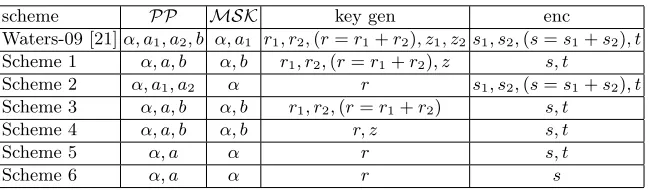
scheme PP MSK key gen enc
Waters-09 [21]α, a1, a2, b α, a1 r1, r2,(r=r1+r2), z1, z2s1, s2,(s=s1+s2), t
Scheme 1 α, a, b α, b r1, r2,(r=r1+r2), z s, t
Scheme 2 α, a1, a2 α r s1, s2,(s=s1+s2), t
Scheme 3 α, a, b α, b r1, r2,(r=r1+r2) s, t
Scheme 4 α, a, b α, b r, z s, t
Scheme 5 α, a α r s, t
Scheme 6 α, a α r s
Table 3. Usage of scalars in various schemes. Note that all the schemes usektag for key generation and ctag for encryption.
4 Constructions
In this section, we provide the description of Scheme 6. The security proof for this scheme is provided in Appendix E. In Appendix D, we provide the description and security proof for Scheme 1. For Schemes 2 to 5, only the descriptions are provided in Appendix F. These schemes primarily serve the purpose of showing the stepping stones in moving from Scheme 1 to Scheme 6.
4.1 Scheme 6
Descriptions ofPP,MSK, ciphertext generation, key generation and decryption are provided. Let a, v, v′ be random elements of Z
p. Set V2 = vP2, V2′ = v′P2 and τ = v +av′ so that
τ P2=V2+aV2′.
PP : (P1, aP1, τ P1, Q1, W1, U1, e(P1, P2)α). MSK: (P2, αP2, V2, V2′, Q2, W2, U2).
Encrypt(M,id,PP): Choose random s,ctag from Zp; C is (C0, C1, C2, C3, E,ctag) where the
ele-ments are defined as follows.
C0=M·e(P1, P2)αs,
C1=sP1, C2 =asP1, C3 =−τ sP1+sW1, E =s(idQ1+ctagW1+U1).
KeyGen(id,MSK,PP): Choose random r,ktag fromZp;SKid is (K1, K2, K3, D,ktag) where the
elements are defined as follows.
K1 =αP2+rV2, K2 =rV2′, K3 =rP2, D =r(idQ2+ktagW2+U2).
Decrypt (C,id,SKid,PP): As before, decryption succeeds only when ctag 6= ktag. Decryption is
done in two steps. First compute
A1 =
e(E, K3)
e(C1, D)
1/(ctag−ktag)
=e(W1, P2)rs
and then A2 = e(C1, K1)e(C2, K2)e(C3, K3) = e(P1, P2)αse(W1, P2)rs. Unmask the message as
Semi-functional ciphertext: Let (C0′, C1′, C2′, C3′, E′,ctag) be a normal ciphertext. Choose a random µ from Zp. The semi-functional ciphertext is (C0, C1, C2, C3, E,ctag) where C0 = C′
0, C1 = C1′,
C2=C2′ +µP1,C3=C3′ −µV1′ and E=E′.
Semi-functional key: Let (K′
1, K2′, K3′, D,ktag) be a normal key. Choose a randomγ from Zp. The semi-functional key is (K1, K2, K3, D,ktag) whereK1 =K1′ −aγP2,K2=K2′ +γP2,K3=K3′ and
D=D′.
The complete security proof for this scheme is given in Section E.
Extension to HIBE: Waters extends the IBE scheme in [21] in a natural way to a HIBE scheme. We show that our simplification of Waters scheme retains the original flexibility. In Section G, we describe a HIBE which extends Scheme 6. This HIBE scheme is secure under the DDH1, DDH2v and the DBDH assumptions and provides lesser and smaller parameters and better efficiencies of key generation, delegation, encryption and decryption compared to the HIBE in [21]. The full security proof for the HIBE is also given in Section G.2.
Conversion to Signature Scheme: There is a “dual” of Scheme 6 where the ciphertext elements are in G2 and decryption keys consist of elements of G1. Using Naor’s observation, this dual of
Scheme 6 can be converted to a secure signature scheme. The signatures will be composed of elements of G1 and will be smaller than the signatures obtained by the conversion of Waters’
2009 scheme to a signature scheme. In a similar manner, one can convert the dual of the HIBE in Section G to obtain a HIBS scheme where signatures consist elements of G1.
4.2 Broadcast Encryption
The full version of Waters paper described a broadcast encryption (BE) scheme based on the dual-system IBE in [21]. In this section, we describe a BE scheme based on Scheme 6. The security proof is given in Section H and is based on the hardness of the DDH1, DDH2v and the DBDH problems. The new BE scheme provides adaptive security and is more efficient than previously known BE schemes providing adaptive security [10, 21].
Setup(κ, n): Based on the security parameterκa group description along with a Type-3 pairinge:
G1×G2 →GT is generated. Letnbe the total number of users. GeneratorsP1 ∈RG1 andP2∈RG2
are chosen. Also choose random elementsQ1,1, . . . Q1,n, W1 ∈G1 and Q2,1, . . . , Q2,n, W2 ∈G2 such
that Q2,i ∼Q1,i for 1≤i≤n, W2 ∼ W1. Let α, a, v, v′ be random elements ofZp. Set V2 =vP2,
V′
2 =v′P2 and τ =v+av′ so that τ P2 =V2+aV2′. PK : (P1, aP1, τ P1, Q1,1, . . . , Q1,n, W1, e(P1, P2)α). MSK: (P2, αP2, V2, V2′, Q2,1, . . . , Q2,n, W2).
Encrypt(PK, S⊆ {1, . . . , n}, M): Choose randomsfrom Zp;C for the set S is (C0, C1, C2, C3, E)
where the elements are defined as follows.
C0=M·e(P1, P2)αs,
KeyGen(SK, j∈ {1, . . . , n}): Choose randomrfromZp;SKj is (K1, K2, K3, D,∀i6=jDi) where the
elements are defined as follows.
K1 =αP2+rV2, K2 =rV2′, K3 =rP2
D=r(Q2,j+W2), Di=rQ2,i fori6=j
Decrypt (C, S,SKj): Decryption works only if j∈S. It is done in two steps. First compute
A1=
e(C1, D+Pi∈S i6=jDi) e(E, K3)
=e(P1, W2)rs
and then A2 = e(C1, K1)e(C2, K2)e(C3, K3) = e(P1, P2)αse(W1, P2)rs. Unmask the message as
M = (C0·A1)/A2.
The semi-functional ciphertexts and keys for the BE are defined as follows.
Semi-functional ciphertext: LetC′
0, C1′, C2′, C3′, E be ciphertext elements normally generated by the
Encryptalgorithm for messageM and subsetS⊆ {1, . . . , n}of users. Let V′
1 be an element ofG1
such thatV1′ ∼V2′. Chooseµ∈Zp at random. The semi-functional ciphertext generation algorithm
will modify the normal ciphertext as:C0=C0′,C1 =C1′,E =E′ and
C2 =C2′ +µP1, C3 =C3′ −µV1′.
Semi-functional key: Let K1′, K2′, K3′, D′, D′i for all i6= j be secret key components normally gen-erated by the KeyGen algorithm for user j. The semi-functional key generation algorithm will choose γ ∈Zp at random and modify the normal key as K3 =K′
3, D=D′,Di =Di′ for all i6=j and
K1 =K1′ −aγP2, K2=K2′ +γP2.
5 Conclusion
We have converted Waters dual-system IBE scheme from the setting of symmetric pairings to that of asymmetric pairings. This has been done in a systematic manner going through several stages of simplifications. We have described in details two IBE schemes (Scheme 1 and Scheme 6). Security of Scheme 1 is based on standard assumptions and reduces the sizes of ciphertexts and keys by 2 elements each from the original scheme of Waters. Scheme 6 is quite simple and minimal in the sense that both encryption and key generation use one randomiser each. The security of Scheme 6 is based on two standard assumptions and a natural and minimal extension of the DDH assumption forG2.
References
2. Dan Boneh and Xavier Boyen. Secure Identity Based Encryption Without Random Oracles. In Matthew K. Franklin, editor,CRYPTO, volume 3152 ofLecture Notes in Computer Science, pages 443–459. Springer, 2004. 3. Dan Boneh and Matthew K. Franklin. Identity-Based Encryption from the Weil Pairing. SIAM J. Comput.,
32(3):586–615, 2003. Earlier version appeared in the proceedings of CRYPTO 2001.
4. Dan Boneh, Eu-Jin Goh, and Kobbi Nissim. Evaluating 2-dnf formulas on ciphertexts. In Joe Kilian, editor,
TCC, volume 3378 ofLecture Notes in Computer Science, pages 325–341. Springer, 2005.
5. Sanjit Chatterjee and Alfred Menezes. On cryptographic protocols employing asymmetric pairings – the role of
ψrevisited. Discrete Applied Mathematics, 159(13):1311–1322, 2011.
6. Sanjit Chatterjee and Palash Sarkar. Trading Time for Space: Towards an Efficient IBE Scheme with Short(er) Public Parameters in the Standard Model. In Dong Ho Won and Seungjoo Kim, editors,ICISC, volume 3935 of
Lecture Notes in Computer Science, pages 424–440. Springer, 2005.
7. Clifford Cocks. An Identity Based Encryption Scheme Based on Quadratic Residues. In Bahram Honary, editor,
IMA Int. Conf., volume 2260 ofLecture Notes in Computer Science, pages 360–363. Springer, 2001.
8. Steven D. Galbraith, Kenneth G. Paterson, and Nigel P. Smart. Pairings for cryptographers. Discrete Applied Mathematics, 156(16):3113–3121, 2008.
9. Craig Gentry and Alice Silverberg. Hierarchical ID-Based Cryptography. In Yuliang Zheng, editor,ASIACRYPT, volume 2501 ofLecture Notes in Computer Science, pages 548–566. Springer, 2002.
10. Craig Gentry and Brent Waters. Adaptive security in broadcast encryption systems (with short ciphertexts). In Antoine Joux, editor, EUROCRYPT, volume 5479 of Lecture Notes in Computer Science, pages 171–188. Springer, 2009.
11. Jeremy Horwitz and Ben Lynn. Toward Hierarchical Identity-Based Encryption. In Lars R. Knudsen, editor,
EUROCRYPT, volume 2332 ofLecture Notes in Computer Science, pages 466–481. Springer, 2002.
12. Allison Lewko. Tools for simulating features of composite order bilinear groups in the prime order setting. Cryptology ePrint Archive, Report 2011/490, 2011. http://eprint.iacr.org/.
13. Allison B. Lewko and Brent Waters. New techniques for dual system encryption and fully secure HIBE with short ciphertexts. In Daniele Micciancio, editor,TCC, volume 5978 ofLecture Notes in Computer Science, pages 455–479. Springer, 2010.
14. David Naccache. Secure and practical identity-based encryption. IET Information Security, 1(2):59–64, 2007. 15. J. T. Schwartz. Fast probabilistic algorithms for verification of polynomial identities. J. ACM, 27:701–717,
October 1980.
16. Adi Shamir. Identity-Based Cryptosystems and Signature Schemes. In G. R. Blakley and David Chaum, editors,
CRYPTO, volume 196 ofLecture Notes in Computer Science, pages 47–53. Springer, 1984.
17. Elaine Shi and Brent Waters. Delegating capabilities in predicate encryption systems. In Luca Aceto, Ivan Damg˚ard, Leslie Ann Goldberg, Magn´us M. Halld´orsson, Anna Ing´olfsd´ottir, and Igor Walukiewicz, editors,
ICALP (2), volume 5126 ofLecture Notes in Computer Science, pages 560–578. Springer, 2008.
18. Victor Shoup. Lower bounds for discrete logarithms and related problems. In EUROCRYPT, pages 256–266, 1997.
19. Nigel P. Smart and Frederik Vercauteren. On computable isomorphisms in efficient asymmetric pairing-based systems. Discrete Applied Mathematics, 155(4):538–547, 2007.
20. Brent Waters. Efficient Identity-Based Encryption Without Random Oracles. In Ronald Cramer, editor, EU-ROCRYPT, volume 3494 ofLecture Notes in Computer Science, pages 114–127. Springer, 2005.
21. Brent Waters. Dual system encryption: Realizing fully secure IBE and HIBE under simple assumptions. In Shai Halevi, editor,CRYPTO, volume 5677 ofLecture Notes in Computer Science, pages 619–636. Springer, 2009.
A Definitions and Security Models
We provide definitions and security models for identity-based encryption (IBE), hierarchical IBE (HIBE) and broadcast encryption (BE).
A.1 Identity-Based Encryption
1. Setupoutputs the public parametersPP and the master secret key MSK.PP is made public andMSK is kept secret.
2. KeyGentakes as input an identity idand MSK and returns a secret key SKidcorresponding
toid.
3. Encrypttakes as input a messageM, an identityid, the public parametersPP and produces as output a ciphertextC.
4. Decrypt takes as input a ciphertextC, an identityid, the corresponding secret keySKid, the
public parametersPP and returns either the corresponding messageM or returns⊥indicating failure.
Security of an IBE scheme is modeled using a game between an adversaryA and a challenger. There are several stages of the game which are described as follows.
Setup: The challenger takes as input a security parameterκand runs the Setupalgorithm of the IBE and provides the public parameters to A.
Phase 1: A makes a number of key extraction queries adaptively. It provides an id and the challenger computes the secret key corresponding toid and returns the key toA.
Challenge: A provides a challenge identityid∗ and two equal length messages M0 and M1 to the
challenger with the restriction that id∗ should not have been queried in Phase 1. The challenger then chooses a bit β uniformly at random from {0,1}and returns an encryption ofMβ toA. Phase 2: A issues more key extraction queries like in Phase 1 but it is not allowed to request a key for id∗.
Guess: A outputs a bitβ′.
A wins the above game if β = β′. The advantage of A in breaking the security of the IBE scheme is defined in terms of the probability of the event that β=β′ in the above game as shown
below.
AdvAIBE =
Pr[β=β′]−1
2
The IBE scheme is said to be secure if a probabilistic adversary running in time bounded by a polynomial in the security parameter κ has a negligible (in κ) advantage of winning the above game.
A.2 Hierarchical Identity-Based Encryption
A HIBE scheme is defined by five probabilistic algorithms –Setup,Encrypt,KeyGen,Delegate andDecrypt . The runtime of all these algorithms is upper bounded by a polynomial in the security parameterκ.
1. Setupoutputs the public parametersPP and the master secretMSK.PP is made public and
MSKis kept secret.
2. KeyGentakes as input an identity vector −→id and master secret MSK and outputs the secret keySK−→
id corresponding to − →
3. Encryptinputs a message M, an identity −→id, public parametersPP and returns a ciphertext
C.
4. Delegateinputs a depth ℓidentity vector−→id = (id1, . . . ,idℓ) along with a secret keySK−→id and an identityidℓ+1. It outputs a secret key for the depthd+ 1 identity vector (id1, . . . ,idℓ+1).
5. Decrypt takes as input a ciphertextC, an identity vector−→id, secret keySK−→
id,PP and returns
either the corresponding messageM or⊥ indicating failure.
The security model we follow is the one proposed by Shi and Waters [17]. The earlier security definitions for HIBE [11, 9] made no distinction as to how a key is generated (by a fresh call to the KeyGen algorithm or by delegation). These definitions were sufficient for most of the earlier schemes since the two methods produced identically distributed keys. However, for the HIBE that we describe this is not the case. We have to rely on the Shi-Waters model in order to be able to keep track of the delegation paths of keys. Note that Shi-Waters model is weaker than the standard security model for HIBE.
As usual, the security for a HIBE scheme is modeled as a game between an adversaryAand a simulator. Following are the different phases of the security game.
Setup: The challenger runs theSetupalgorithm of the HIBE and gives the public parameters to
A. It also initializes a setS=∅which denotes the set of secret keys it has created but not revealed. Phase 1: Amakes a number of queries of the following types adaptively.
– Create The adversary A provides an identity −→id for which the challenger creates a key SK−→ id
but does not give it toA. The challenger adds the secret key toS. – DelegateAspecifies a secret keySK−→
id inS and provides an identity idto the challenger. The
challenger runs the delegation algorithm of the HIBE with inputs PP,SK−→
id,id and adds the
resulting key for (−→id,id) to S.
– RevealA specifies an element SKof S. The challenger removes SKfrom S and returns it to
A.
Challenge: Aprovides a challenge identity −→id∗ and two equal length messages M0 andM1 to the
challenger with the restriction that−→id∗ should not have been queried inPhase 1. The challenger then chooses a bit β uniformly at random from {0,1} and returns an encryption of Mβ for
− →
id∗ to
A.
Phase 2:Aissues more key extraction queries as inPhase 1with the restriction that any revealed identity −→id is not a prefix of −→id∗.
Guess: A outputs a bitβ′.
A wins the above game if β = β′. The advantage of A in breaking the security of the IBE
scheme is defined in terms of the probability of the event that β=β′ in the above game as shown
below.
AdvAHIBE=
Pr[β =β′]−1
2
.
A.3 Broadcast Encryption
A broadcast encryption scheme is defined by four probabilistic algorithms whose runtimes are bounded above by a polynomial in the security parameter κ. The first three are executed by the broadcasting entity and the last one by a recipient of the broadcast message.
1. Setuptakes as input the number of usersn. It outputs a public/secret key pair (PK,SK). 2. KeyGentakes as inputSK, a user index i∈ {1, . . . , n}and returns a private keySKi for user
i.
3. Encryptinputs a subsetS ⊆ {1, . . . , n}of users to whom the message is to be broadcast, the public keyPK and the message M. It outputs a ciphertextC.
4. Decrypt takes as input a ciphertextC, a setS of users to whomC is encrypted and the user’s secret keySKi. Ifi∈S then the corresponding messageM is returned.
Adaptive CPA security of a broadcast encryption (BE) scheme is defined via the following game between an adversaryA and a challenger.
Setup:The challenger runs theSetup algorithm and gives the public keyPK toA.
Private Key Queries: A adaptively issues private key queries for a number of users from
{1, . . . , n}.
Challenge: A specifies two messages M0, M1 and a challenge set S∗ such that, for every private
key query i,i /∈S∗. The challenger chooses β∈
R{0,1}and returns to Athe encryption ofMβ for the set S∗.
Guess: The adversary outputs its guessβ′ forβ.
The adversary wins the above game ifβ =β′. The advantage of Ain breaking the security of
the BE scheme is defined in terms of the probability of the event thatβ =β′ in the above game as
shown below.
AdvABE=
Pr[β=β′]−1
2
.
A BE scheme is said to be secure if for all probabilistic adversaries running in time bounded above by a polynomial in the security parameterκ, the advantage of winning the above game is negligible.
B Hardness Assumptions
Decision Diffie-Hellman (DDH) assumption. LetP1 andP2 be random generators ofG1 and G2respectively. The DDH problem inG1(denoted DDH1) is to decide, given (P1, x1P1, x2P1, P2, Z1),
whether Z1 =x1x2P1 orZ1 is a random element ofG1. Herex1, x2∈RZp.
Let A be a probabilistic polynomial time (PPT) algorithm that outputs either 0 or 1. Define its advantage in solving the DDH1 as follows.
AdvADDH1 =|Pr[A(P1, x1P1, x2P1, P2, x1x2P1) = 1]−Pr[A(P1, x1P1, x2P1, P2, Y1) = 1]|
where Y1 ∈RG1. The DDH1 assumption is that for every PPT algorithm A,AdvADDH is negligible
Assumption DDH2v. LetP1,P2be random generators ofG1,G2respectively and letx1, x2, d, z∈R
Zp. The problem is to decide, given (P1, dP1, dzP1, zx1P1, P2, dP2, x1P2, x2P2, Z2), whether Z2 =
x1x2P2 orZ2 is a random element ofG2.
LetAbe a probabilistic polynomial time (PPT) algorithm that outputs a bit. Define its advan-tage in solving breaking DDH2v as follows.
AdvADDH2v =|Pr[A(P1, dP1, dzP1, zx1P1, P2, dP2, x1P2, x2P2, x1x2P2) = 1] −Pr[A(P1, dP1, dzP1, zx1P1, P2, dP2, x1P2, x2P2, Y2) = 1]|
where Y1 ∈RG2. The assumption is thatAdvADDH2v is negligible in the parameters that define the
size of the groups. In Section B.1, we show the hardness of the DDH2v assumption in the generic group model.
Decision Linear (DLin) assumption. LetP1, F1, H1be random generators ofG1andP2, F2, H2
be random generators ofG2. Letx1, x2 ∈RZpandY2 ∈RG2. LetAbe a PPT algorithm that outputs
either 0 or 1. Define its advantage in solving the DLin problem as follows.
AdvADLin=|Pr[A(P1, F1, H1, P2, F2, H2, x1P2, x2F2,(x1+x2)H2) = 1] −Pr[A(P1, F1, H1, P2, F2, H2, x1P2, x2F2, Y2) = 1]|
The DLin assumption is that for every PPT algorithmA,AdvADLin is negligible.
Decisional Bilinear Diffie-Hellman (DBDH) assumption. LetP1,P2 be random generators
of G1,G2 respectively and let x1, x2, x3 be random elements of Zp. Let YT be a random element of GT. For a probabilistic polynomial time (PPT) algorithm A that outputs either 0 or 1, define its
advantage in solving the DBDH problem as follows.
AdvADBDH=|Pr[A(P1, x1P1, x2P1, x3P1, P2, x1P2, x2P2, x3P2, e(P1, P2)x1x2x3) = 1] −Pr[A(P1, x1P1, x2P1, x3P1, P2, x1P2, x2P2, x3P2, YT) = 1]|
The DBDH assumption is that for every PPT algorithm A,AdvADBDH is negligible. Informally, it should be computationally hard to distinguish between e(P1, P2)x1x2x3 and a random element of GT.
B.1 Generic Security of DDH2v
Here we will provide a proof of the security of assumption DDH2v in the generic group model. The generic group model is an idealised model introduced by [18] in which lower bounds on computa-tional complexity of solving certain problems can be obtained without looking into the structure of the actual groups that are used in a protocol. Lete:G1×G2→GT be an asymmetric bilinear
group where no isomorphisms fromG1 toG2 orG2 toG1 are efficiently computable. The elements
of groups G1, G2 and GT are encoded as uniform random strings so that the adversary can only
group encodings are modeled as three injective mapsσ1 :Zp →Σ1,σ2 :Zp →Σ2 andσT :Zp →ΣT where E1,E2,ET ⊂ {0,1}∗. The following theorem provides an upper bound on the advantage of
an adversary that solves the DDH2v problem in a generic bilinear group.
Theorem 1. LetAbe an algorithm that attempts to solve theDDH2vproblem in the generic group model making at most m queries to the oracles computing the group actions in G1, G2, GT and the bilinear mape. Ifd, z, x1, x2, y ∈RZp,b∈R{0,1}withyb=x1x2 andy1−b =yandσ1, σ2, σT are
random encodings, then givenp, σ1(1), σ1(d), σ1(dz), σ1(zx1), σ2(1), σ2(d), σ2(x1), σ2(x2), σ2(y0), σ2(y1) the advantage εof Ain solving the problem is bounded above by
ε≤ 3(m+ 10) 2
2p .
Proof. Let B denote an algorithm that simulates the generic bilinear group for A. B maintains three lists
L1 ={(F1,i, σ1,i) :i= 0,1, . . . , δ1−1},
L2 ={(F2,i, σ2,i) :i= 0,1, . . . , δ2−1},
LT ={(FT,i, σT,i) :i= 0,1, . . . , δT −1}
such that at each step δ of the game the relation δ1 +δ2+δT = δ+ 10 holds. Here F⋆,⋆’s are multivariate polynomials over 6 variables d, z, x1, x2, y0, y1 and σ⋆,⋆’s are strings from {0,1}∗. At the beginning of the game i.e., δ = 0, the lists are intialized by setting δ1 = 4, δ2 = 6 and
δT = 0. The polynomials 1, d, dz, zx1 are assigned to F1,0, F1,1, F1,2, F1,3 and 1, d, x1, x2, y0, y1 to
F2,0, F2,1, F2,2, F2,3, F2,4, F2,5respectively. The encodings for these polynomials are strings uniformly
chosen from{0,1}∗ without repetition. We assume that Aqueries the oracles on strings previously
obtained from B andB can easily obtain the index of a given stringσj,i in the list Lj. The oracles are simulated as follows.
Group actions in G1,G2 and GT: Consider the group G1.A submits two strings σ1,i and σ1,j
and a selection bit indicating addition or subtraction.B first computesF1,δ1 =F1,i±F1,j. If there
exists an indexk with 0≤k < δ1 such thatF1,δ1 =F1,k then Bsetsσ1,δ1 =σ1,k. Otherwise it sets
σ1,δ1 to a uniform random string from{0,1} ∗\ {σ
1,0, . . . , σ1,δ1−1}.Bthen adds the pair (F1,δ1, σ1,δ1)
toL1, returns σ1,δ1 toA and incrementsδ1 by one.
Group actions inG2 and GT are simulated similarly with the selection bit indicating
multipli-cation or division in case ofGT.
Bilinear map: Asubmits two operandsσ1,i, σ2,j.Bfetches the corresponding polynomialsF1,i, F2,j and computesFT,δT =F1,i·F2,j. If for some kwith 0≤k < δT,FT,δT =FT,k then setσT,δT =σT,k; otherwiseσT,δT is set to a random string chosen uniformly from{0,1}
∗\ {σ
T,0, . . . , σT,δT−1}.Bthen adds the pair (FT,δT, σT,δ1) to L1, returnsσT,δT toA and incrementsδT by one.
A makes at most m oracle queries, terminates and returns a bit b′ to the simulator. Let v =
(d, z, x1, x2.y0, y1) denote the vector consisting of variables over which the polynomials are defined.
Now the simulator chooses at randomd∗, z∗, x1∗, x2∗, y∗ ∈Zp andb∈ {0,1}and setsyb∗=x1∗x2∗,
1. F1,i−F1,j = 0 for some i=6 j and F1,i6=F1,j. 2. F2,i−F2,j = 0 for some i=6 j and F2,i6=F2,j. 3. FT,i−FT,j = 0 for some i=6 j and FT,i6=FT,j.
Let F denote the event that atleast one of the above holds, indicating failure. The following result by Schwartz [15] will be used in arguing that the event failure occurs with low probability. Let p be a prime number andF(Z1, . . . , Zk) be a non-zero polynomial inZp[Z1, . . . , Zk] of degree d. Then, ifz1, . . . , zk are uniform elements ofZp , the probability thatF(z1, . . . , zk) = 0 is at most d/p.
The simulation is perfect when F does not occur and in such a case the bit b is information theoretically hidden from the adversary. To see this, observe that all variables except yb and y1−b are independent of the bit b. Since yb is x1x2 which is a polynomial of degree 2, the adversary will
win it somehow producesx1x2using combinations of polynomials fromL1 andL2. The only degree
two polynomials that can be constructed are d2, dx1, dx2, dz, zx1 or a sum of these. A could also
try to engineer a degree 3 polynomial inLT composed of x1x2. The only such polynomial iszx1x2
which can be constructed using σ1(zx1) and σ2(x2). However, to find out the bit b, A will need
σ1(z) which is not available in the instance. So Pr[b=b′|¬F] = 1/2.
We now only need to obtain a bound on the probability that F occurs. For fixed i and j, F1,i−F1,j is a polynomial of degree at most 2 and hence is zero at a randomv∗ with probability at most 2/p. Similary F2,i−F2,j vanishes at v∗ with probability at most 1/p. The list L3 consists of polynomials of degree at most 3 which implies that the third case holds with probability at most 3/p. There are totally δ1
2
, δ2 2
, δT
2
pairs of polynomials from L1,L2,LT respectively. Also since there are at mostm queries we have δ1+δ2+δT =δ+ 10≤m+ 10. It now follows that
Pr[F]≤ δ1 2 2 p + δ2 2 1 p+ δT 2 3 p
≤ 3(m+ 10) 2
p .
We have
Pr[b=b′] = Pr[b=b′|¬F] Pr[¬F] + Pr[b=b′|F] Pr[F]
≤Pr[b=b′|¬F](1−Pr[F]) + Pr[F]
≤ 1
2 + 1 2Pr[F]
and
Pr[b=b′]≥Pr[b=b′|¬F](1−Pr[F]) = 1 2 −
1 2Pr[F] together resulting in the required bound on the advantage as follows.
Pr[b=b′]−1
2
≤ Pr[F]
2 ≤
3(m+ 10)2
2p .
C Lewko’s IBE Scheme Using Asymmetric Pairing
In a recent work [12], Lewko has systematically described a method for converting a dual-system IBE scheme from the setting of composite order groups to that of prime order groups. For simplicity, the description in [12] has been given in terms of symmetric pairing. It is fairly easy to convert it to the setting of asymmetric pairing. In this section, we briefly describe this scheme.
For the convenience of presentation, some notation has been introduced in [12]. For −→v = (v1, . . . , vn)∈Znp and an elliptic curve point P, define
− →v P ∆
= (v1P, . . . , vnP).
Note that computing −→v P requiresnscalar multiplications. This notation is extended as follows.
a−→v P = (av∆ 1P, . . . , avnP);
(−→v +−→w)P = ((v∆ 1+w1)P, . . . ,(vn+wn)P);
en(−→v P1,−→w P2)=∆
n
Y
i=1
e(viP1, wiP2) =e(P1, P2) − →v·−→w
.
Here −→v · −→w denotes the dot product. The computation ofen(·,·) requiresnpairings. LetD = (−→d1, . . . ,−→d6) be a basis for Z6
p and D∗ = (
− →
d∗1, . . . ,−→d∗6) be another basis of Z6
p such that
− →
di ·
− →
d∗
j ≡0 modp fori6=j; and
− →
di ·
− →
d∗
i =ψ for all i, where ψ is a uniform random element of Z. Such a pair of bases is called “orthonormal” in [12].
An asymmetric bilinear mape:G1×G2→GT will be used. ElementsP1andP2are respectively
generators ofG1andG2. To set up the scheme in [12], first one chooses a random pair of orthonormal
bases D and D∗. Further, choose random scalars α, θ, σ from Zp. The first four vectors of D and D∗ are actually used in the scheme. The other two elements of the bases are used to define the
semi-functional spaces.
PP:e(P1, P2)αθ − →
d1· − →
d∗ 1,−→d
1P1,−→d2P1,→−d3P1,−→d4P1. MSK:θ−→d∗1P2,αθ−→d∗2P2,θd→−∗2P2,σ−→d3∗P2,σ−→d∗4P2.
Note that the PP consists of 24 elements of G1 and the MSK consists of 30 elements of G2.
The public key generator may also keep the scalars α, θ, σ and the bases D and D∗ as the secret.
This will lead to a faster key generation algorithm.
Key generation: The input is an identity id. Choose random elements r1 and r2 from Zp. The secret key for the identity id isSKid and is defined to be the following 6-tuple of elements of G2.
SKid=
(α+r1id)θ − →
d∗1−r1θ − →
d∗2+r2idσ − →
d∗3−r2σ − →
d∗4P2.
A key consists of 6 elements of G2. Generation of SKid from MSK requires 30 scalar
multiplica-tions in G2. But, generation from the scalars α, θ, σ and the bases Dand D∗ will require 6 scalar
Encrypt: The input consists of an identity id and a message M ∈GT. Choose random elements
s1 and s2 from Zp. The ciphertext is defined to be (C1, C2) where C1 and C2 are elements of G1
and are defined as follows.
C1=M×
e(P1, P2)αθ − →
d1· − →
d∗ 1
s1
;
C2=
s1−→d1 +s1id−→d2+s2id−→d3 +s2id−→d4
P1.
A ciphertext consists of 6 elements of G1. Generation of a ciphertext from the public parameters
requires 24 scalar multiplications inG1, i.e., the four 6-tupless1(−→d1P1),s1id(d−→2P1),s2id(−→d3)P1 and
s2id(−→d4P1) have to generated and added together. Generation of each of these 6-tuples will require
6 scalar multiplications in G1 for a total of 24 scalar multiplications.
Decrypt: GivenPP, an identityid, a corresponding keySKidand a ciphertext (C1, C2), decryption
can be compactly described as follows: returnC1/e6(C2,SKid). This requires 6 pairing operations.
Descriptions of the semi-functional keys and ciphertexts are given in [12] in terms of symmetric pairing. These can also be easily converted to the setting of asymmetric pairings. The security of the above scheme should also be based on DLin assumptions in G1 and G2.
Further simplications to the above scheme may be possible along the lines of the simplifications we made to Waters’ 2009 scheme. Then the hardness assumption is unlikely to be DLin or SXDH; possibly a combination of DDH1, DDH2v and DBDH may work. On the other hand, the amount of reduction in parameters and improvement in efficiency is not clear. In particular, it is unlikely that the resulting scheme would be better than Scheme 6.
D Scheme 1
In this section, we provide the description and the security argument for Scheme 1.
D.1 Description of Scheme 1
Choose generatorsP1 ∈RG1 andP2∈RG2; random elementsQ1, W1, U1 ∈G1andQ2, W2, U2 ∈G2
such thatQ2 ∼Q1,U2∼U1andW2∼W1. Letv, v′be chosen randomly fromZp and setV2=vP2,
V2′ =v′P2. Pickα, a, bat random from Zp. Setτ =v+av′ so thatτ P2=V2+aV2′.
PP : (P1, aP1, bP1, abP1, τ P1, bτ P1, Q1, W1, U1, e(P1, P2)bα). MSK: (P2, αP2, bP2, V2, V2′, Q2, U2, W2).
Encrypt(M,id,PP): Choose random s, t,ctag from Zp. C is (C0, C1, . . . , C5, E1, E2,ctag) where
the elements are computed as follows.
C0=M·e(P1, P2)bαs,
C1=bsP1, C2 =basP1, C3 =asP1, C4 =−τ sP1, C5 =−τ bsP1+tW1,
KeyGen(id,MSK,PP): Choose random r1, r2, z,ktag from Zp and let r = r1 + r2. SKid is
(K1, . . . , K5, D,ktag) where the elements are computed as follows.
K1 =αP2+rV2, K2 =rV2′−zP2, K3 =bzP2, K4=br2P2, K5=r1P2,
D=r1(idQ2+ktagW2+U2).
Decrypt (C,id,SKid,PP): Decryption succeeds only whenctag6=ktag, an event which occurs with
overwhelming probability. Decryption is done in several stages. Using the relationsr =r1+r2 and
V2+aV2′=τ P2, compute
A1=e(C1, K1)e(C2, K2)e(C3, K3)e(C4, K4)e(C5, K5)
=e(P1, P2)bαse(P1, V2)bsre(P1, V2′)absre(P1, P2)−basze(P1, P2)basz ×e(P1, P2)−τ bsr2e(P1, P2)−τ bsr1e(W1, P2)tr1
=e(P1, P2)bαse(P1, V2+aV2′−τ P2)bsre(W1, P2)tr1
=e(P1, P2)bαse(P1, W2)tr1
The last step follows from the fact that the discrete log of W1 to baseP1 is same as that of W2 to
base P2. Then if ctag6=ktag compute
A2 =
e(E1, K5)
e(E2, D)
1/(ctag−ktag)
=
e(t(idQ1+ctagW1+U1), r1P2)
e(tP1, r1(idQ2+ktagW2+U2))
1/(ctag−ktag)
=
e(W1, P2)tr1ctag
e(P1, W2)tr1ktag
1/(ctag−ktag)
=e(P1, W2)tr1
Unmask C0 to get the messageM asM = (C0·A2)/A1.
We now define semi-functional ciphertexts and keys. They are used only in the security reduction and they cannot be computed without knowledge of the secret elements.
Semi-functional ciphertext: LetC0′, C1′, C2′, C3′, C4′, C5′, E1′, E2′,ctagbe ciphertext elements normally generated by the Encrypt algorithm for message M and identity id. Let V′
1 be an element of G1
such thatV′
1 ∼V2′. Chooseµ∈Zp at random. The semi-functional ciphertext generation algorithm will modify the normal ciphertext as:C0=C0′,C1 =C1′,E1 =E1′,E2 =E2′ and
C2=C2′ +bµP1, C3 =C3′ +µP1, C4 =C4′ −µV1′, C5=C5′ −bµV1′.
Semi-functional key: LetK′
1, K2′, K3′, K4′, K5′, D′,ktagbe secret key components normally generated
by the KeyGen algorithm for identity id. Choose at random γ ∈ Zp. The semi-functional key
generation algorithm will modify the normal key as: K3 =K3′,K4 =K4′,K5 =K5′,D=D′ and
One can decrypt a semi-functional ciphertext with a normal key and a normal ciphertext with a semi-functional key. This is easily seen by verifying that
e(bµP1, K2)e(µP1, K3)e(−µV1′, K4)e(−bµV1′, K5) = 1T
and e(C1,−aγP2)e(C2, γP2) = 1T where K2, K3, K4, K5 and C1, C2 are normal key and ciphertext
components respectively. However, decryption of a semi-functional ciphertext with a semi-functional key will fail because the masking factor e(P1, P2)bαs will be blinded by an additional factor of
e(P1, P2)bµγ.
D.2 Security Proof
As is usual, the proof goes through a sequence of games. Let Gamerealdenote the real security game. Game0 is just like Gamereal except that the challenge ciphertext is a semi-functional encryption of the chosen message. Let q be the number of key extraction queries made by the adversary during the attack. Define Gamek for 1 ≤ k≤ q such that the first k keys returned to the adversary are semi-functional and the rest are normal. Let Gamef inalbe defined similar to Gameqexcept that now the challenge ciphertext is a semi-functional encryption of a random message. Let Xreal,Xk and Xf inal denote the events that the adversary wins in Gamereal, Gamek and Gamef inal for 0≤k≤q respectively.
Lemma 1. If there exists an adversaryAsuch that AdvAGamereal−AdvAGame0 =ε, then we can build an algorithm B having advantageε in solving the DDH1 problem.
Proof. The algorithm Breceives (P1, sP1, aP1, P2, Z1) as an instance of DDH1. We describe how it
will simulate each phase in the security game.
Setup: Bchooses random elementsα, b, yv, yv′, yq, yw, yufromZpand sets the parameters as follows. P1 =P1, sP1 =sP1, aP1=aP1, Q1 =yqP1, W1 =ywP1, U1 =yuP1,
P2=P2, V2 =yvP2, V2′ =y′vP2.
This implicitly setsτ =yv+ay′v. Using this, the elementτ P1can be computed asyvP1+yv′(aP1). The
simulator computes the remaining parameters usingb,α and gives the following public parameters toA.
PP ={G, P1, P2, aP1, bP1, baP1, τ P1, bτ P1, Q1, W1, U1, e(P1, P2)bα}
where G is the group description with groupsG1 and G2 given by the generatorsP1 and P2. Note
that a and s(randomiser for challenge ciphertext) come from the assumption and are not known toB.
Phase 1: A makes a number of key extract queries.B knows the master secret and using that it returns a normal key generated using theKeyGenalgorithm for every key extract query made by
A.
Challenge: B receives the target identity id∗ and two messages M0 and M1 from A. It chooses
β ∈ {0,1} at random. To encrypt Mβ, B chooses t,ctag∗ at random from Zp and computes the ciphertext elements as follows.
C1 =b(sP1), C2=bZ1, C3=Z1, C4 =−yv(sP1)−yv′Z1, C5=−byv(sP1)−by′vZ1+tW1
E1 =t(id∗Q1+ctag∗W1+U1), E2=tP1 BreturnsC∗= (C
0, C1, C2, C3, C4, C5, E1, E2,ctag∗) toA. Now eitherZ1 =asP1 orZ1= (as+c)P1
for somec∈RZp. In the first case we have
C2 =basP1, C3=asP1
C4 =−(yv+ayv′)sP1 =−τ sP1
C5 =−b(yv+ayv′)sP1+tW1=−bτ P1+tW1
making C∗ a normal ciphertext. In the second case, we have
C2 =basP1+bcP1, C3 =asP1+cP1
C4=−(yv+ay′v)sP1−y′vcP1=−τ sP1−cV1′
C5 =−b(yv+ayv′)sP1−byv′cP1+tW1=−bτ sP1+tW1−bcV1′
Then C∗ is a semi-functional encryption of Mβ with µ = c. Note that, to check whether C∗ is semi-functional or not,B itself could try to decrypt it with a semi-functional key for id∗. However sinceaP2 is not known toB, it cannot create such a key.
Phase 2: As in first phase,B returns a normal key for every query. Guess: The adversary returns its guess β′ toB.
If C∗ is normal then B simulates Game
real and if it is semi-functional, B simulates Game0.
Therefore if A is able to distinguish between Gamereal and Game0 i.e., if β = β′, then the
simu-lator can decide whether C∗ is normal or semi-functional and thus solve the DDH1 problem with advantage
AdvBDDH1=|Pr[Xreal]−Pr[X0]|=AdvAGamereal−Adv
A
Game0 =ε
⊓ ⊔
Lemma 2. If there exists an adversaryAsuch that AdvAGamek−1−AdvAGamek =ε, then we can build an algorithm B having advantageε in solving the DLin problem.
Proof. The algorithm B receives (P1, F1, H1, P2, F2, H2, x1P2, x2F2, Z2) as an instance of the DLin
problem.
Setup: B chooses random elements α, a, λ, ν, y′
v, yq, yw, yu from Zp and sets the parameters as follows.
P1=P1, bP1 =F1, P2 =P2, bP2=F2, V2 =−aH2, V2′ =H2+yv′P2
Q1 =−λF1+yqP1, U1 =−νF1+yuP1, W1=F1+ywP1
This sets τ =ay′
v which is known to the simulator. The remaining parameters required to provide
PP toAare computed usinga,α andτ and other elements of the DLin instance as shown below.