(will be inserted by the editor)
Efficient and Verifiable Algorithms for Secure
Outsourcing of Cryptographic Computations
Mehmet Sabır Kiraz · Osmanbey
Uzunkol
Received: date / Accepted: date
Abstract Reducing computational cost of cryptographic computations for resource-constrained devices is an active research area. One of the practical solutions is to securely outsource the computations to an external and more powerful cloud server. Modular exponentiations are the most expensive com-putation from the cryptographic point of view. Therefore, outsourcing modu-lar exponentiations to a single, external and potentially untrusted cloud server while ensuring the security and privacy provide an efficient solution. In this pa-per, we propose new efficient outsourcing algorithms for modular exponentia-tions using only one untrusted cloud server. These algorithms cover public-base & exponent, base & public-exponent, base & private-exponent, and more generally private-base & private-exponents simultaneous modular exponentiations. Our algorithms are the most efficient solutions uti-lizing only one single untrusted server with best checkability probabilities. Furthermore, unlike existing schemes, which have fixed checkability probabil-ity, our algorithms provide adjustable predetermined checkability parameters. Finally, we apply our algorithms to outsource Oblivious Transfer Protocols and Blind Signatures which are expensive primitives in modern cryptography.
Keywords Secure outsourcing algorithms·Modular exponentiation·Mobile computing·Secure cloud computing·Privacy
Mehmet Sabır Kiraz (Corresponding Author)
Mathematical and Computational Sciences Labs, T ¨UB˙ITAK B˙ILGEM UEKAE, National Research Institute of Electronics and Cryptology P. K. 74 41470 Gebze/Kocaeli, TURKEY Tel.: +90 262 648 1945
Fax: +90 262 648 1100
E-mail: [email protected]
Osmanbey Uzunkol
Mathematical and Computational Sciences Labs, T ¨UB˙ITAK B˙ILGEM UEKAE, National Research Institute of Electronics and Cryptology P. K. 74 41470 Gebze/Kocaeli, TURKEY Tel.: +90 262 648 1782
Fax: +90 262 648 1100
1 Introduction
Cloud Computing is getting more and more attention in the scientific commu-nity due to its multiple benefits for real-world applications (e.g., on-demand self-service, ubiquitous network access, location independent resource pooling, pay per use, rapid elasticity, and outsourcing). Depending on demands, capa-bilities and resources, it is possible to efficiently outsource costly calculations to more powerful servers using cloud computing infrastructures.
Cryptographic key sizes have been steadily increasing due to mathemati-cal and technologimathemati-cal developments. This may lead to that existing resource-constrained devices may become incapable of assuring the desired level of security. In general, these devices are required to be replaced with more pow-erful new ones. However, this leads to highly impractical and costly solutions. The main motivation of outsourcing computation is to give a usable, secure and more practical solution. For example, modular exponentiation of the form ua modulo a prime number p, where u, a, and p have minimum length of
2048 bits (in order to have a cryptographically secure algorithm) has a big computational obstacle for the computationally limited devices. To compute a single modular exponentiation for 2048-bits exponenta, more than 3000 mod-ular multiplications must be performed in average (using square and multiply method). Therefore, it is usable to outsource the expensive computations to the cloud providers. Nevertheless, the outsourced computations may contain additional sensitive information that should not be leaked to the outsiders (e.g., personal, health or financial data). In order to prevent information leak-age, the sensitive data have to be appropriately masked before outsourcing. On the one hand, the masking technique should be designed in such a way that the overall computational cost to the client is significantly reduced. Namely, reducing the cost of masking before outsourcing, and the cost of removing the mask after obtaining the result from the cloud provider are of utmost impor-tant, and the total cost should be less than performing the computation on the device itself. On the other hand, it is also essential to assure the client that the returned results are indeed correct. Namely, malicious servers or environ-mental attacks should not compromise the correctness without being detected with a non-negligible probability. Therefore, it is crucial to have an efficient outsourcing algorithm satisfying certain privacy preserving properties. This can be achieved by checking and verifying the correctness of the outcome.
How can security and privacy be guaranteed by using only a single untrusted server without revealing any information about the inputs and/or the outputs while assuring the correctness?
1.1 Related Work
Outsourcing secure computation allows parties to compute a functionality without leaking any information about their inputs and/or outputs. In general, it is expected to have no interactions between the parties, and computational cost and bandwidth of each user are expected to be independent of the func-tionality. However, general program obfuscation is impossible by utilizing only one cloud server [1]. This is one of the reasons that we mainly focus on expen-sive modular computations.
Many algorithms have been proposed for outsourcing computation [2–16]. They aim either to have a better outsourcing security model or to have more efficient constructions. However, these algorithms consider outsourcing of a public-base & private-exponent, or private-base & public-exponent, or they satisfy weaker security notions. For example, in [17], Clarkeet al.propose pro-tocols for speeding up exponentiation in a cyclic group using untrusted servers for public-base & private-exponent and private-base & public-exponent. They also extend these algorithms to compute an exponentiation modulo a compos-ite integer.
Hohenberger and Lysyanskaya [3] presented the first outsource-secure al-gorithm for modular exponentiations for outsourcing cryptographic computa-tions. This algorithm considers only the case private-base & private-exponent exponentiation modulo a prime number. With this algorithm, modular expo-nentiations can be computed by the client withO(log2(l)) multiplications with error probability 1
2, wherel denotes the number of bits of the exponent. The main drawback of this solution is to use two non-colluding untrusted servers. At ESORICS 2012, Chen et al. [2] propose a more efficient construction than Hohenberger-Lysyanskaya’s algorithm, where the probability of detecting malicious behavior is improved to 2/3. However, modular exponentiations can be computed by the client withO(log2(l)) multiplications. They also propose the first secure outsourcing algorithm for simultaneous modular exponentia-tionsua11 ·ua22 . Simultaneous modular exponentiations are also used in many cryptographic primitives such as commitments [18], zero-knowledge proofs [19] and additive variant of ElGamal encryptions [20]. Chen et al.apply their al-gorithms to outsource Cramer-Shoup encryptions and Schnorr signatures se-curely.
to the client, it can verify the correctness efficiently using the pattern. How-ever, there is a checkability issue in their algorithm, where an untrusted server can easily manipulate the result. In particular, the client invokes the server Exp(a, g) to outsource the computation ofga, and instead ofExp(a, g) the
ma-licious server can compute Exp(a, gh) for some bogus value hwithout being detected. The checks will pass successfully and subsequently the result would become incorrect without being unnoticed.
The authors in [22] proposed the only existing algorithm for modular ex-ponentiations modulo composite numbers. However, we also address an issue here that the checkability property of their scheme fails. By using their no-tation, the attack can be explained briefly as follows: A malicious server S
uses the proposed values ℓ=ℓ1=ℓ2= 5 in [22] (or any other case for which ℓ=ℓ1=ℓ2 holds), adds 1 to the valuesyj, and outputsx
yj+1
i instead ofx yj
i .
This enables the server to manipulate the result ua withua+ℓ without being
detected by the client.
Another area of outsourcing computation is the use of homomorphic en-cryption techniques. Homomorphic enen-cryption allows parties for processing computations on encrypted data without using any additional information like Yao’s garbled circuits [23]. Conventional homomorphic encryption schemes are either additive or multiplicative (e.g., RSA is multiplicative, Paillier and modified version of ElGamal encryption are additive [20, 24], or the 2DNF protocol [25] which allows multiple additions up to only one exponentiation). These schemes allow to outsource secure function evaluation to a cloud server. Recent somewhat homomorphic and fully homomorphic schemes give a com-plete solution to the outsourcing problem [26]. However, these systems are not yet efficient enough to be applied in real-life scenarios.
1.2 Our Contributions
Our contributions are as follows:
cryptographic protocols based on both the Discrete Logarithm problem (DLP) and the RSA problem can be outsourced securely to an untrusted server.
3. In [5], the authors propose the first generic algorithm for a single untrusted server considering private-base & private-exponent. Furthermore, it has fixed 1/2 checkability probability. However, their scheme is quite inefficient since it requires approximately 2000 modular multiplications. In contrast to this scheme, we would like to highlight that our base & private-exponent algorithmAlgprpr is the most efficient and verifiable solution with
respect to the existing ones (e.g., we have ≈10,17 times less MMs than the only existing algorithm [5]).
4. We emphasize further that although the existing solutions use two non-colluding malicious servers, they propose only 1/2, 2/3 or 3/4 probabili-ties for the checkability [2–4], respectively. Unlike all existing schemes, our algorithms have not only the best but also more importantly adjustable checkability. Also, any adversarial behavior can be detected by the client with the probability 1−c(c1−1), wherecis a small integer used as a security parameter for checkability (e.g., for c = 4 and c = 8 we have 11/12 and 55/56, resp.).
5. Our algorithm for the case of simultaneous modular exponentiation is more efficient than the existing algorithms [2] and [5] (there is only a general-ized result in [22], for which the checkability fails as explained above). The algorithm proposed in [2] only considers two simultaneous modular expo-nentiations. We generalize this by introducing the notion oft-simultaneous modular exponentiation, i.e., t modular exponentiations can be computed simultaneously in a single round. We also show that we gain linear com-plexity advantage intfor both the number of modular multiplications and modular inversions.
1.3 Roadmap
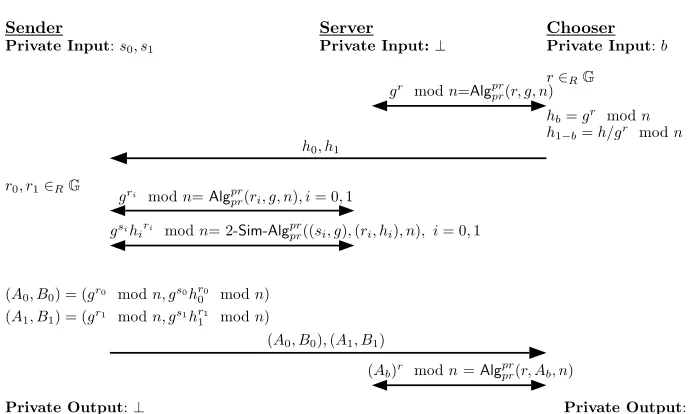
In Section 2, we give our formal security and privacy model based on the model of [3] by simplifying theirtwo untrusted server modelto a more realis-tic and secure one single untrusted server model. Section 3 starts with basic mathematical background of outsourcing algorithms of modular exponentia-tion, and describes the main algorithm for private-base & private-exponent modular exponentiations. We also provide the proofs of correctness, security and checkability of our algorithms using security/privacy model in Section 2. In Section 4, we propose algorithms for all other relevant situations, i.e. public-base & exponent, base & public-exponent, and private-base & private-exponent, and simultaneous modular exponentiations. Section 5 gives the complexity of our algorithms, and compares the efficiency of the algorithms with the prior works. In Section 6, we apply our algorithms to Oblivious Transfer protocols and to Blind Signatures. Section 7 concludes the paper with highlighting future research directions on outsourcing crypto-graphic computations.
2 Security and Privacy Model
In this work, we follow the security model proposed by Hohenberger and Lysyanskaya [3] like the recent results in [2,5]. Assume that a clientCwould like to securely outsource an expensive cryptographic computationAlgto a cloud serverS. Our aim is to split the computation into two main procedures (1)C
knows the input value toAlg, (2)CinvokesSwhich is an untrusted server that can carry out expensive computation operations. Briefly,Csecurely outsources some computation if the following conditions hold:
1. C andS implement Alg, i.e.,Alg=CS
2. Assume that C has oracle access to an adversaryS′ (instead of an honest
S) which stores its computational results during each run and behaves maliciously in order to learn extra information. S′ is not able to retrieve any valuable information about the input-output pair ofCS′
.
We are now ready to give the formal model for secure outsourced crypto-graphic algorithms, which is based on principally the model of [3].
Definition 1 [3] (Algorithm with outsource-I/O) An algorithm Alg obeys the outsource input/output specification if it takes five inputs, and pro-duces three outputs. The first three inputs are generated by an honest party, and are classified by how much the adversaryA= (E,S′) knows about them, whereE is the adversarial environment that submits maliciously chosen inputs toAlg, andS′ is the adversarial software operating in place of oracleS.
1. 1st is the honest secret input, which is unknown to bothE andS′, 2. 2nd is the honest protected input, which may be known by E, but is
3. 3rd is the honest unprotected input, which may be known by both E and
S,
4. 4th is the the adversarial protected input which is known to E, but pro-tected from S′,
5. 5th is the the adversarial unprotected input, which may be known by E
andS,
6. 1st is the secret input which is unknown to bothE andS′, 7. 2nd is the protected input which may be known to E, but notS′, 8. 3rd is the unprotected input which may be known by both parties of A.
Outsource-security means that if a maliciousS′ can obtain some informa-tion about the secret of CS by playing the role of C instead of S, then S′ can also obtain it without following this procedure. More concretely, when
CS(x) is queried, a simulatorSim
S′ is constructed in such a way that without the knowledge of the secret or protected inputs of x, the view of S′ can be simulated. In the following outsource-security definition, it is guaranteed that the malicious environmentE cannot learn any valuable information about the secret inputs and outputs of CS (even in the case that C runs the malicious softwareS′ developed byE).
Definition 2 [3] (Outsource security)Let Alg(·,·,·,·,·) be an algorithm with outsource-I/O. A pair of algorithms (C,S) is said to be an outsource-secure implementation ofAlgif:
Correctness:CS is a correct implementation ofAlg.
Security:For all probabilistic polynomial-time adversariesA= (E,S′), there exist probabilistic expected polynomial-time simulators (SimE,SimS′) such that the following pairs of random variables are computationally indistinguish-able.
– Pair One.EVIEWreal∼EVIEWideal
– The real process: EVIEWireal={(istate
i, xi
hs, xihp, xihu)←I(1k,istate i−1); (estate, ji, xiap, xiau,stopi)← E(1k,EVIEW
i−1
real, x
i
hp, xihu); (tstatei,ustatei,
yi
s, ypi, yui)← CS
′(ustatei−1)
(tstatei−1, xjhsi, xjhpi, xjhui , xi
ap, xiau) :
(estatei, yi p, yui)}
EVIEWreal=EVIEWirealifstopi =TRUE.
The real process proceeds in rounds. In round i, the honest (secret, protected, and unprotected) inputs (xi
hs, xihp, xihu) are picked using an
honest, stateful process I to which the environment E does not have access. ThenE, based on its view from the last round,
1. chooses the value of itsestatei variable as a way of remembering
what it did next time it is invoked;
2. which previously generated honest inputs (xi
hs, xihp, xihu) to give to CS′
(note thatE can specify the index ji of these inputs, but not
their values);
4. the adversarial unprotected inputxi au;
5. the Boolean variablestopi that determines whether round iis the
last round in this process.
Next, the algorithmCS′
is run on the inputs (tstatei−1, xji
hs, x ji
hp, x ji
hu,
xi
ap, xiau), where tstatei−1 is C’s previously saved state, and produces
a new state tstatei for C, as well as the secret yi
s, protected ypi and
unprotectedyi
uoutputs. The oracleS′is given its previously saved state,
ustatei−1, as input, and the current state of S′ is saved in the variable ustatei. The view of the real process in roundi consists ofestatei, and
the valuesyi
p and yui. The overall view ofE in the real process is just
its view in the last round (i.e.,ifor whichstopi =TRUE.).
– Theidealprocess: EVIEWiideal={(istate
i, xi
hs, xihp, xihu)←I(1k,istate i−1); (estate, ji, xiap, xiau,stopi)←E(1k,EVIEW
i−1
ideal, x
i hp, xihu);
(astatei, yi
s, ypi, yui)←Alg(astatei−1, x ji
hs, x ji
hp, x ji
hu, xiap, xiau);
(sstatei,ustatei, Yi
p, Yui,repi)←
SimS′(ustatei−
1
)
E (sstatei−1, x
ji
hp, x ji
hu, xiap,xiau, yip
,yi
u); (zip, zui)=repi(Ypi, Yui) + (1−repi)(ypi, yui) : (estate, zip, zui)}
EVIEWideal=EVIEWiideal ifstopi =TRUE.
The ideal process also proceeds in rounds. In the ideal process, we have a stateful simulatorSimE who, shielded from the secret input xi
hs, but
given the non-secret outputs thatAlgproduces when run all the inputs for round i, decides to either output the values (yi
p, yui) generated by
Alg, or replace them with some other values (Yi
p, Yui). Note that this is
captured by having the indicator variablerepi be a bit that determines whetheryi
p will be replaced withYpi. In doing so, it is allowed to query
oracleS′; moreover,S′ saves its state as in the real experiment.
– Pair Two.EVIEWreal∼EVIEWideal
– The view that the untrusted software S′ obtains by participating in the real process described in Pair One.UVIEWreal=ustatei if stopi =
TRUE.
– The ideal process:
UVIEWiideal ={ (istatei, xi
hs, xihp, xihu)←I(1k,istatei−1);
(estatei, ji, xi
ap, xiau,stopi)← E(1k,estatei−1, xihp, xihu,ypi−1,yiu−1;
(astatei, yi
s, ypi, yui)←Alg(astatei−1, x ji
hs, x ji
hp, x ji
hu, xiap, xiau);
(sstatei,ustatei)←SimS′(ustatei−1
)
S′ (sstatei−1, x
ji
hu, xiau) : (ustatei)}
EVIEWideal=EVIEWiideal ifstopi =TRUE.
In the ideal process, we have a stateful simulator SimS′ who, equipped with only the unprotected inputs (xi
hu, xiau), queriesS′. As before,S′ may
Definition 3 [3] (α-efficient, secure outsourcing) A pair of algorithms (C,S) is said to be anα-efficient implementation ofAlgif
1. CS is a correct implementation ofAlgand
2. ∀inputsx, the running time ofCis no more than anα-multiplicative factor of the running time of Alg.
Definition 4 [3](β-checkable, secure outsourcing)A pair of algorithms (C,S) is said to be anβ-checkable implementation ofAlgif
1. CS is a correct implementation ofAlgand
2. ∀ inputsx, if S deviates from its advertised functionality during the ex-ecution of CS′
(x), C will detect the error with probability no less than β.
Definition 5 [3] ((α, β)-outsource-security) A pair of algorithms (C,S) is said to be an (α, β)-outsource-secure implementation of Alg if it is both α-efficient andβ-checkable.
3 Main Algorithm for Modular Exponentiation (Private-Base & Private-Exponent)
3.1 Preliminaries
There are basically two different settings for which modular exponentiations are the most expensive parts of the cryptographic computation: the discrete logarithm problem (DLP) and the RSA problem. In both cases, we summarize the following conditions to obtain mathematical problem instances which are intractable enough to obtain the desired level of security for the corresponding cryptographic schemes.
3.1.1 DLP case
Let p and q be prime numbers and G ⊆ F∗p be a subgroup generated by a
primitive element g of order q. In order to have an intractable DLP on G,
we impose the usual conditions on the number of distinct cosets inF∗p/G
be-ing comparably small, i.e. we have a small cofactorc = p−1
q (since otherwise
by Chinese Remainder Theorem (Pohling-Hellman reduction) the complexity of DLP reduces to much smaller groups leading to less secure group based cryptographic systems [36]). This means that we need to hide the exponent of the exponentiation but not necessarily the base for the security of the encryp-tion algorithms. On the other hand, hiding the base element in the modular exponentiation realizes the privacy preserved applications.
We restrict ourselves to the multiplicative subgroup of prime field case
G ≤ F∗p, although it is also possible to use prime order multiplicative
that the recent quasi-polynomial attacks on DLP of certain extension fields of small characteristics suggests not to use non-prime finite fields in cryptographic setting [37]. We note that all secure outsourcing algorithms for modular ex-ponentiation (including the algorithms proposed in this paper) can easily be adapted to secure outsourcing algorithms for scalar multiplication of elliptic curve cryptography (ECC) by using a prime order subgroup ofE(Fp) instead
of the group G. Using these algorithms for scalar multiplications of elliptic
curves, one can also obtain hybrid privacy preserving outsourcing algorithms for pairing-based cryptosystems by means of outsourcing private inputs of pairing functions, bilinearity property, and private exponentiations in finite fields for the realization of ID-based cryptography [36].
3.1.2 RSA case
In this case, we have the modulus n = p·q, where p and q are distinct large prime numbers. Since RSA based systems rely on the arithmetic of
G:= (Z/nZ)∗, we have an exponent ranging 0 to (p−1)(q−1)−1. For public key encryptions, the message must be private but the public key can be dis-closed to the server (similarly, for the signatures only the private key is kept pri-vate). However, similar to the DLP case, hiding exponents or base elements in the modular exponentiations enables to obtain privacy preserving outsourced schemes. Constructing such a system makes impossible for the server to distin-guish between encryption/decryption/signature/verification processes which can be an important design criteria for privacy preserving infrastructures (e.g., attribute-based encryption schemes). To the best of our knowledge, there is only one algorithm proposed for RSA based modular exponentiation [22], for which the checkability fails as explained in Section 1.1. Hence, our algorithm unifies modular exponentiation modulo a prime or a composite number for the first time.
For real-life applications, the group ordermis typically chosen as a 2048-bit number for RSA or DLP based systems and as a 384-2048-bit number for ECC based systems.
3.2 The Main Algorithm
In this section, we propose our main algorithm for modular exponentiation modulonwith the underlying groupG, which is either the subgroup ofF∗n or
(Z/nZ)∗ of order m. Note that n can be either a prime number or an RSA
modulus covering the both cases as described above.
Client is willing to compute ua modn privately, where u ∈ G and a ∈ {0,· · ·, m−1} private inputs andn is public. More precisely, the algorithm has inputs u, a and n and outputs uamodn without explicitly giving the
values ofu,a, andua to the server.
and g−t2 these values can be computed using a Rand Algorithm as defined
in [3]. For taking the inverse of gt1 and gt2, one can either extend the Rand
algorithm or they can be computed offline. Similarly, in the case of RSA set-ting, all these values can be computed by extending the Rand algorithm or by computing them offline. Furthermore, these values are stored on the client side, and one can argue that this is dangerous for the RSA setting if the client is a lower power device because of low-power devices are not generally temper-resistant. However, these values are stored in the same protected area as all other private keys and any attack to the values can also apply to the private keys.
Note that these blinding factors are precomputed in order to speed up computations [2, 3]. The values x, y, t1 and t2 can be used several times for different exponents whereas the valuesshould be used only once.
Furthermore, we abbreviate byC the Client and byS the Server. We have also the assumption thatC can run an algorithm to queryua toS. We denote
the output of such a query byExp(a, u). Before we explain our main algorithm we propose the following subalgorithmSubAlg for outsourcinggz, whereg is
a generator of the groupGandzis a random group element. Note thatgand
z are not necessarily private for SubAlg, and it is only crucial to check the correctness of the result gz. The client C has inputs g, z and c, where c is a
checkability parameter.
During the precomputation phase, the Rand algorithm prepares (s, gs)∈ Z/mZ×G, (t1, t−1
1 ,gt1), (t2, t− 1
2 , gt2)∈R(Z/mZ)2×G, and
I−1={1−1,· · · , c−1} ⊆Z/mZ, whereI={1,· · ·, c} ⊆Z/mZ, and sends these values toC. At the first phase,Cpicks random elementsc−11,c−21∈RI−1with c1, c2∈I, c16=c2, and computesz1= (z−s)·c1−1and z2= (−z+ 2s)·c−21. Next, C runs Z1 = Exp(z1 ·t1−1, gt1) and Z2 = Exp(z2 ·t2−1, gt2). Finally, C verifies Z1c1 ·Z2c2 =? gs, and returns Z2c1
1 ·Z
c2
2 . We would like to highlight that computingt1, t−1
1 andt2, t− 1
2 does not cause a security issue in the RSA setting1 because these values are masked before they are sent toS and they are never revealed toS.
We would like to emphasize thatcis chosen to be a very small positive in-teger. For example, ifc=4 then the checkability becomes 11/12 that is already sufficient to be able to compare with the existing schemes. In particular, since c1 andc2 are very small integers, the valuesZ1c1 or Z
c2
2 can be computed by only few multiplications (forc= 4 we have at most 2 multiplications instead of approximately 3000 multiplications for 2048 bit security level.). Therefore, it does not add any considerable complexity (computational, storage and com-munication) as demonstrated in Section 5.
SubAlgorithm (SubAlg): Outsourcing an auxiliary modular
exponen-1
tiation
Input: (z, g, c) (where z ∈ Z/mZ with < g >= G ≤ F∗
n for DLP or g ∈R G= (Z/nZ)∗ for RSA with|G|=m, wheren, m∈N, and an arbitrary small
c∈N). (Note thatc= 4 is sufficient for our experiments to compare with the existing schemes.)
Output:The valuegz inG.
Precomputation:ARandalgorithm computes and stores the following values forC:
– (s, gs)∈Z/mZ×G,
– (t1, t−11,gt1), (t2, t2−1, gt2)∈R (Z/mZ)2×G,
– I={1,· · ·, c} ⊆Z/mZwithI−1={1−1,· · ·, c−1} ⊆Z/mZ.
1. C picks random elements c−11, c−21 ∈R I−1 with c1, c2 ∈ I, c1 6= c2, and computes z1←(z−s)·c−11 andz2←(−z+ 2s)·c−21.
2. C runs
(a) Z1←Exp(z1·t1−1, gt1).
(b) Z2←Exp(z2·t2−1, gt2).
3. C verifiesZ1c1·Z2c2=? gsand returnsZ2c1
1 ·Z
c2
2 .
Theorem 1 SubAlgterminates and outputs correctly with probability c(c1−1). Proof The termination simply follows from the algorithm specification. Namely,
C outsources the computations Exp(z1·t1−1, gt1) and Exp(z2·t2−1, gt2), and
obtainsZ1andZ2, respectively. IfS does not respond within specific time in-tervalC aborts and outputs fail. Otherwise,Cverifies and outputs the result. More precisely, C first computesz1 = (z−s)·c−11 andz2 = (−z+ 2s)·c−21, wherec−11,c−21∈R I−1 withc1, c2∈I, c16=c2.
S returnsZ1 =gz1 =g(z−s)·c−1
1 and Z2 = gz2 = g(−z+2s)·c− 1
2 . Finally,C
computes and verifies the following result.
Z1c1·Z2c2 = (g(z−s)·c −1
1 )c1·(g(−z+2s)·c− 1 2 )c2
=g(z−s)+(−z+2s)=gs
If the equality does not hold then algorithm outputs checkability failure. Fi-nally,C outputs
Z12c1·Z
c2
2 = (g(z−s)·c −1
1 )2c1·(g(−z+2s)·c− 1 2 )c2
=g2(z−s)+(−z+2s)=gz
To prove that a maliciousS cannot maliciously behave without being de-tected with probability 1
c(c−1) because S does not have any knowledge about z, s, c1 andz1 (andc2 and z2). More concretely, in order to validate the cor-rectnessCverifies the equalityZ1c1·Z2c2
?
U2
U1
U3 U4 U5
U6
U7
U8
R T
S
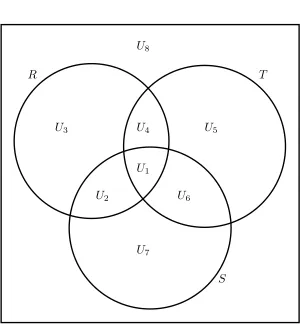
Fig. 1 The Partition of the SetU=∪8i=1Ui
toS, the only way forS to be successful is to guessc1 andc2 correctly. Note that the probability of guessing the correct value of c1 is 1/c, and once c1 is chosen we have the probability 1/(c−1) for guessing the correct value of c2. Hence, the overall probability becomes c(c1−1). ⊓⊔
We now propose our main algorithm Algorithm 1 (Algprpr) for private-base and private-exponent. For completeness, we introduce the following notation: Let a finite setM ={m1,· · · , mn}be given. We denote by Sn(M) the group
of permutations onM. Note that we can identify any permutation onSn(M)
with a permutation on Sn({1,· · · , n}). By abuse of notation, we will write
σ(mi) =σ(i) for anyσ∈Sn({1,· · ·, n}).
Before we go into the details we give a brief summary ofAlgprpr as follows.
The clientCfirst masks the baseuand the exponenta, respectively, and sends them to the server in a special form (based on the precomputed values). The server applies the algorithm specifications and returns the masked results. The client then removes the masks and verifies the correctness of the result. More precisely, for the goal of computingua we first precomputev=gx,w=ug−x,
µ=gy,Z=gax−y, wherexandyare randomly chosen. Thenua is converted
into (vw)a = gxa wa = µgzwa = µZwa such that w = uv−1, z = ax−y, wherev, w, Z looks random and is independent of uand ain the view of the attacker. Therefore, the algorithm has basically three computations in order to computeua, i.e.,µ,Z andwa.
– The first value µ=gy is already precomputed and stored.
– The second value Z = gz is computed via the subalgorithm SubAlg for
z is already masked with xandy therefore does not leak any information to S.
– Finally,wais outsourced securely which is the longest and the most
compli-cated part. This value is outsourced by first dividing the private exponent aand a random valuerintokandℓsubcomponents such thata=Pk
i=1ai andr=Pℓ
i=1ri, respectively. More precisely,
– C computesw←uv−1,z←ax−y, runs Z=SubAlg(z, g, c).
– For the sign of the values C chooses further a random α = (α1, · · ·, αℓ+k)∈R{0,1}ℓ+k.
– Using Figure 1, C first chooses random subsets Ui, i = 1,· · ·,8 (with
arbitrary length) such that
• S := U1∪U2∪U6∪U7, T := U1∪U4∪U5∪U6, Ui 6= ∅ ∀ i,
Ui∩Uj=∅ ∀i6=j,U :=A∪R:=∪8i=1Ui :={u1,· · · , uk+ℓ},
• s=P
si∈Ssi,t= P
ui∈T (−1)
αi·u
i, s+c1t=c2, wherec1, c2∈R {1,· · · , c} (the aim of this condition is to assure the checkability property ofAlgprpr),
• R :=U1∪U2∪U3∪U4 :={r1,· · ·, rℓ}, A :=U5∪U6∪U7∪U8 :={a1,· · · , ak},
• r=Pℓ
i=1ri,a=Pki=1ai. Note that the elements ofRare used to
randomize the private exponenta.
– Cchooses a random permutationσ∈RSℓ+k(U) and sets the permuted
elementsU =σ(U) := (σ1,· · ·,σk+ℓ).
– Note that we use a temporary valuetempin our main algorithm for the following reason: First observe that the following values are computed during the main algorithm:
• U∓’s are computed for the setsU =∪8
i=1Ui • R∓’s are computed for the setsR=∪4
i=1Ui • S∓’s are computed for the setsS=∪i=1,2,6,7Ui, • T∓’s are computed for the setsT =∪i=1,4,5,6Ui.
Since the sets R, S, T have common and disjoint values temp is used to minimize modular multiplications by distributing the elements into these sets. Note thattempis not used
• in the first round becauseU1=U∩R∩S∩T. After assigningU∓
toT∓ tempwill be used to compute the finalT∓.
• in the second round becauseU2 =U ∩R∩S. After assigning U∓
toS∓ tempwill be used to compute the finalS∓.
• in the third round becauseU3 =R⊂U.
– LetU :={u1,· · · , uk+ℓ}.Cchooses a random permutationσ∈RSℓ+k(U)
and sets the permuted elementsU =σ(U) := (σ1,· · ·,σk+ℓ). The
per-mutation σ basically mixes the subcomponents of a and r to ensure the privacy of the exponent a. Moreover, the invocations take place with signed values of the subcomponents usingα= (α1,· · ·,αℓ+k)∈R {0,1}ℓ+k (i.e.,S computes w(−1)ασ(i)·σ(ui)
– AfterSreturns the computed valuesCbasically computeswa+r,wr, ws
andwtand verifies the correctness of the resultwaby checkings+c1t=
c2 in the exponents.
– If the verification is successful,Coutputswaby removingwrfromwa+r. – C finally returns the expected outcomeua by computingµZwa.
We give a toy example in Section 3.2.2 for better understanding of the algorithm. The algorithm is now given as follows.
Algorithm 1 (Algprpr): Private-Base & Private-Exponent Modular
Exponentiations
Input:(a, u, k, ℓ, c) (wherea∈ Z/mZ with u∈< g >=G≤F∗
n for DLP or
u∈RG= (Z/nZ)∗ for RSA with|G|=m, wheren, m∈N, and an arbitrary
smallc∈N).
Output:The valueua inG.
Precomputation: A Rand algorithm computes (y, gy) ∈R Z/mZ×G and
(x, gx, g−x)∈Z/mZ×G2 forC withv =gxandµ=gy.
1. C computes w←uv−1,z←ax−y, runsZ =SubAlg(z, g, c).
2. For the sign of the values Cchooses further a randomα= (α1,· · ·,αℓ+k) ∈R {0,1}ℓ+k.
3. Using Figure 1,C first chooses random subsetsUi, i= 1,· · · ,8 (with
arbi-trary length) such that
– S:=U1∪U2∪U6∪U7,
– T :=U1∪U4∪U5∪U6,
– Ui6=∅ ∀i,Ui∩Uj=∅ ∀i6=j, – U :=A∪R:=∪8
i=1Ui :={u1,· · · , uk+ℓ},
– s=P
si∈Ssi,
– t=P
ui∈T (−1)
αi·u
i
– s+c1t=c2, wherec1, c2 ∈R {1,· · · , c},
– R:=U1∪U2∪U3∪U4 :={r1,· · · , rℓ},
– A:=U5∪U6∪U7∪U8:={a1,· · ·, ak},
– r=Pℓ
i=1ri,a=Pki=1ai.
4. C chooses a random permutation σ ∈R Sℓ+k(U) and sets the permuted
elements U =σ(U) := (σ1,· · ·,σk+ℓ).
5. C sets U−, U+ ← 1 and uses the partitions in Figure 1. Furthermore, C runs and computes in random order for j∈ {1,· · · , k+ℓ}
(U−, U+ are negative/positive parts of the exponents of U) (a) Ifσj ∈U1:(Computation of signed elements of U1)
i. Ifασ(j)= 1: wj ←Exp(−σj, w)
A. U−← U−·wj
ii. Ifασ(j)= 0: wj ←Exp(σj, w)
A. U+← U+·wj
(b) If σj ∈U2:(Computation of signed elements of U2)
i. Ifασ(j)= 1: wj ←Exp(−σj, w)
A. U−← U−·wj
ii. Ifασ(j)= 0: wj ←Exp(σj, w)
A. U+← U+·wj
iii. Csets S− ← U− andS+ ← U+
(c) Ifσj ∈U3:(Computation of signed elements of U3)
i. Ifασ(j)= 1: wj ←Exp(−σj, w)
A. U−← U−·wj
ii. Ifασ(j)= 0: wj ←Exp(σj, w)
A. U+← U+·wj
(d) If σj ∈ U4, C sets temp−, temp+ ← 1: (Computation of signed
elements of U4)
i. Ifασ(j)= 1: wj ←Exp(−σj, w)
A. temp−←temp−·wj
ii. Ifασ(j)= 0: wj ←Exp(σj, w)
A. temp+←temp+·wj
iii. C setsU−,R− ← U−·temp−,T− ← T−·temp−, U+,R+ ← U+· temp+ andT+ ← T+·temp+
(e) If σj ∈ U5, C sets temp−, temp+ ← 1: (Computation of signed
elements of U5)
i. Ifασ(j)= 1: wj ←Exp(−σj, w)
A. temp−←temp−·wj
ii. Ifασ(j)= 0: wj ←Exp(σj, w)
A. temp+←temp+·wj
iii. CsetsU− ← U−·temp−,T−← T−·temp−,U+← U+·temp+ and
T+ ← T+·temp+
(f) If σj ∈ U6, C sets temp−, temp+ ← 1: (Computation of signed
elements of U6)
i. Ifασ(j)= 1: wj ←Exp(−σj, w)
A. temp−←temp−·wj
ii. Ifασ(j)= 0: wj ←Exp(σj, w)
A. temp+←temp+·wj
iii. CsetsU− ← U−·temp−,T− ← T−·temp−,S− ← S−·temp−,U+
← U+·temp+,T+ ← T+·temp+ andS+ ← S+·temp+.
(g) If σj ∈ U7, C sets temp−, temp+ ← 1: (Computation of signed
elements of U7)
i. Ifασ(j)= 1: wj ←Exp(−σj, w)
A. temp−←temp−·wj
ii. Ifασ(j)= 0: wj ←Exp(σj, w)
A. temp+←temp+·wj
iii. CsetsU− ← U−·temp−,S−← S−·temp−,U+ ← U+·temp+and
S+ ← S+·temp+
(h) If σj ∈U8:(Computation of signed elements of U8)
A. U−← U−·wj
ii. Ifασ(j)= 0: wj ←Exp(σj, w)
A. U+← U+·wj
6. C verifiesS+·(T−· T+)c1 ?
=wc2· S
−
(Verification step by checking s+c1t=c2 in the exponents)
7. C returnsµ·Z ·(U−· R+)−1 ·(R−· U+) (This is the expected outcome ua)
3.2.1 Correctness and Termination.
Theorem 2 Algprpr terminates and outputs correctly.
Proof Precomputation and Step 1 ofAlgprpr imply that ua = (vw)a=gxawa=
µgzwa=µZwa, where w=uv−1 andz =ax−y.
We set Θ ={ασ(j): ασ(j)= 1, j = 1,· · ·, k+ℓ}. Let the u−i (reps. u+i )
denotes the sum of the negatively (reps. positively) signed part of the elements ofUi for alli∈ {1,· · ·,8}. In Step 7 part (a) with using the query results of S,C computes the negative partwu−
1 and the positive partwu +
1 as follows:
wu−1 = Y ασ(i)∈Θ,
σi∈U1
w−σi andwu+1 = Y ασ(i)6∈Θ,
σi∈U1 wσi.
The output will be assigned to the negative part T− and the positive part
T+ in the exponent the elements of T. Analogously, C computes in steps (b) and (c) the corresponding negative parts and the positive parts, and assigns the output to the exponent elements of the contributed sets.
Different from the steps (a), (b) and (c),Ccomputes in step (d) the negative partwu−
4 and the positive partwu + 4:
wu−4 = Y ασ(i)∈Θ,
σi∈U4
w−σi andwu+4 = Y ασ(i)6∈Θ,
σi∈U4 wσi.
The output will be multiplied in this case with the negative partsU−,T−
and the positive parts U+, T+ in the exponent elements of U and T. Anal-ogously, C computes wu−j and wu
+
j for j = 5,6,7,8 and multiply with the corresponding positive and negative parts in the exponent elements of the contributed sets. As a result, one obtains:
wr=
Y
ασ(i)∈Θ, σi∈R
w−σi
−1
· Y
ασ(i)6∈Θ, σi∈R
ws= Y
ασ(i)∈Θ, σi∈S
w−σi −1 · Y
ασ(i)6∈Θ, σi∈S
wσi =S−1 − · S+.
Using the definition of t, we obtain also
wt= Y
σi∈T
w(−1)ασ(i)σi= Y
ασ(i)∈Θ, σi∈T
w−σi· Y
ασ(i)6∈Θ, σi∈T
wσi=T −· T+,
Together with steps (a) to (g) and step (h), we obtain
wa+r==
Y
ασ(i)∈Θ, σi∈A∪R
w−σi −1 · Y
ασ(i)6∈Θ, σi∈A∪R
wσi =U−1 − · U+,
wc2 =ws+c1t=ws·(wt)c1=S−1
− · S+·(T−· T+)c1, hence,
S+·(T−· T+)c1=wc2· S−.
If the equality does not hold then the checkability fails. IfS runs the query algorithm properly then the algorithm ends with Step 7 as follows:
µ·Z·(U−· R+)−1·(R−· U+) =µ·Z· U−−1· U+· R−· R−+1 =µ·Z· U−1
− · U+·(R−−1· R+)−1 =gy·gax−y·wr+a·(wr)−1 =gy·gax−y·wr+a·w−r =gax·wa
= (gx·w)a = (v·w)a =ua.
⊓ ⊔
3.2.2 A Toy Example.
We illustrate with a toy example our main algorithmAlgprpr for better under-standing. Note that this example is just to explain our algorithm in a simple setting. For real-life applications, the group size should be at least 1024 bit for DLP or RSA and 160 bit for the elliptic curve DLP. In particular, the computational advantage of our algorithms increases with the key sizes (see Section 5). Let p = 103 be given with the primitive element g = 3. Hence,
G=<3 > with|G|=p−1 = 102. Furthermore, assume that (a, u, k, ℓ, c)=
mod 103.
Precomputation:: If we choose x = 59, y = 23 then we have (x, gx, g−x)
= (59,31,10) and (y, gy)=(23,95). Moreover, we have v = gx = 31 and
v−1=g−x= 10. Note that µ=gy = 95.
First of all,w≡u·v−1≡37·10 mod 103 = 61. We also havez≡a·x−y≡ 72·59−23≡43 mod 102. Next, runSubAlg(43,3,4) which outputs 343≡10 mod 103 (i.e., we haveZ≡gz≡10 mod 103).
Hence, we have 3772=µ·Z·6172= 95·10·6172. We now need to outsource 6172 securely. Since k = ℓ = 4 we have 8 non-empty sets that we choose randomly with the conditions of steps 2, 3, 4 and 5. U1 ={u1 = 13}, U2 =
{u2= 79},U3={u3= 19},U4={u4= 93},U5={u5= 82},U6={u6= 42}, U7={u7= 57},U8={u8= 95}. Note thatU ={u1, u2, u3, u4, u5, u6, u7, u8}. We now choose α= (10011010) as in Step 4. Then, the signed U becomes USigned={ −u1,u2,u3,−u4,−u5,u6,−u7,u8}. Let alsos=u1+u2+u6+u7=
13+79+42+57≡89 mod 102 andt≡ −u1−u4−u5+u6=−13−93−82+42≡
58 mod 102.
Now, for c1 = 2 and c2 = 1 we have 89 + 2·58 ≡1 mod 102 (because s+c1·t≡c2 modp−1).
Now, we have U = {13, 79, 19, 93, 82, 42, 57, 95 } and USigned= {−13,
79, 19, -93, -82, 42, -57, 95} ={89, 79, 19, 9, 20, 42, 45, 95}(modulo 102). Furthermore, we choose σ = 1 2 3 4 5 6 7 8
4 5 2 7 1 8 6 3
.Then, σ(USigned) = { 9, 20,
79, 45, 89, 95, 42, 19}. Now calculating each single substep of Step 7 we obtain the following:
w−u1≡6189≡66 mod 103 wu2≡6179≡100 mod 103 wu3≡6119≡13 mod 103 w−u4≡619≡79 mod 103 w−u5≡6120≡72 mod 103
wu6≡6142≡30 mod 103 w−u7≡6145≡100 mod 103
wu8≡6195≡81 mod 103
R− ≡w−u1·wu4≡66·79≡64 mod 103 R+≡wu2·wu3≡100·13≡64 mod 103
S−≡w−u1·w−u7≡66·100≡8 mod 103
S+≡w−u2·wu6≡100·30≡13 mod 103
T−≡w−u1·wu4·wu5≡66·79·72≡76 mod 103
T+≡wu6≡30 mod 103.
Now at Step 8 we check whetherS+·(T−· T+)2 ?=w· S−. In fact,S+·(T−·
T+)2≡13·(76·30)2≡76 mod 103 andw· S−≡61·8≡76 mod 103. Step 9 finally computes the outcome as follows:U−≡w−u1 ·w−u4 ·w−u5 ·w−u7 ≡66·79·72·100≡81 mod 103. Similarly,U
+ ≡wu2 · wu3 ·wu6
·wu8 ≡100 ·13·30·81≡93 mod 103.
U− · R+ ≡81 ·64 ≡34 mod 103. Next, (U− · R+)−1 ≡34−1 ≡100 mod 103. Similarly,R−· U+ ≡64·93≡81 mod 103. Hence, we haveµ·Z
·(U−· R+)−1 (U+· R−)≡95·10·100·81≡76 mod 103. The final outcome isua ≡76 mod 103.
3.2.3 Security and Checkability.
In this part, we give the security analysis ofAlgprpr and show that a malicious server cannot be able to get any valuable information aboutuanda.
The next lemma gives the probability that a malicious server obtains the exponent.
Lemma 1 A malicious server S′ learns the exponent a with probability at
most √πk
23k fork=ℓ.
Proof The output will only be disclosed ifS′obtains exactly the same position ofai’s with their signs. Hence, the probability of this event is 1/
2k
k
·2k.
Hence,S′cannot distinguish the two test queries from all of the 2kqueries that C makes, and during any execution of Algprpr the server S′ can
success-fully cheat without being detected with probability at most √πk
23k by using the Stirling’s approximation 2kk
≈ 4k √
πk [38]. Note that lettingk =ℓ = 29 the
probability becomes negligible (≈2−80). ⊓⊔
We are now ready to prove the security of Algprpr. As explained above,
outsource-security informally means that there exists a simulator which sim-ulates the view of the adversary in a real algorithm run. This means that the adversary obtains no relevant information from the real run since it could output any result from what it knows by itself.
Theorem 3 The algorithms (C,S) are an outsource-secure implementation of Algprpr, where the input(a, u) may be honest secret; or honest protected; or
Proof We note that this proof is inspired from the proof of the security analy-sis of [3]. LetA= (E,S′) be a probabilistic polynomial-time (PPT) adversary interacting with a PPT-based algorithm Cin the outsource-security model.
Firstly, we prove EVIEWreal∼EVIEWideal. (Pair One– The external
adver-saryE learns nothing.)
Let (a, u) be a private input of an honest party. Assume thatSimE is a PPT simulator which acts as follows.SimE ignores the theith round when getting input, like using Figure 1 it chooses random sets R:=U1∪U2∪U3∪U4 :=
{r1,· · ·, rℓ}andA:=U5∪U6∪U7∪U8:={a1,· · ·, ak}such thatr=Pℓ
i=1ri,
a=Pk
i=1ai. SimE first forms random subsetsUi with arbitrary length such
that U := A∪R = ∪8
i=1Ui, where Ui 6= ∅, ∀ i and Ui ∩Uj = ∅, ∀ i 6= j.
For the sign of the valuesSimE chooses further a randomα= (α1,· · ·,αℓ+k) ∈R {0,1}ℓ+k. Next, Sim
E forms random subsets S :=U1∪U2∪U6∪U7 and T :=U1∪U4∪U5∪U6 ofU such thats=P
si∈Ssiandt= P
ti∈T (−1)
αi·t
i
satisfying the condition that s+c1t = c2, where c1, c2 ∈R {1,· · · , c}. Let U :={u1,· · · , uk+ℓ}.C chooses a random permutationσ∈RSℓ+k(U) and sets
the permuted elements U =σ(U) := (σ1, · · ·, σk+ℓ). SimE sets U−, U+ ← 1 and uses the partitions in Figure 1.
If an error occurs, SimE stores its own andS′’s states and outputsYi p =
“error′′, Yi
u = ∅,repi = 1. If all checkability steps are valid, SimE outputs Yi
p = ∅, Yui = ∅, repi = 0; otherwise, SimE chooses a random group value h∈R Gand outputs Ypi =h,Yui =∅, repi = 1. Next, Sim
E stores the corre-sponding states. The distributions in the real and ideal executions of the input toS′are computationally indistinguishable. In the ideal setting, the inputs are uniformly chosen random fromZ/mZ×G. In the real setting, we follow Step 7
ofAlgprpr to assure that all parts ofExpCinvokes is randomized independently
usingσandα. Now, we consider all possible cases. IfS′behaves in an honest manner in the ith round, then EVIEWireal ∼ EVIEW
i
ideal, because in the real
execution CS′
perfectly runs Algprpr and in the ideal execution SimE does not change the output ofAlgprpr. IfS′gives a incorrect output in theith round, then
the output will be detected byC andSimE with probability at most √23πkk due to Lemma 1, resulting in an output of “error′′; otherwise, the software will indeed be successful in manipulating the output of Algprpr (e.g., because each
request is independent of each other, sending approximately 29 wrong results with their signs to the clientC makes the probability of not being detected to negligibly small (≈1/280).).
In the real execution, thek+ℓreal outputs ofS′are firstly grouped into two different parts corresponding to their signs (positive or negative). The negative and positive parts will be independently computed due to the checkability condition s+c1t = c2. The result will be multiplied corresponding to their signs (7 and 8 ofAlgprpr). At the last step, we multiply the overall result with
the masking values of the base element generated at the first step according to their signs. Hence, a manipulated output of Algprpr will seem to be wrong,
We simulate this situation in the ideal execution by replacing the output of Algprpr with a random element in G when there is an attempt to behave
maliciously by S′ which would not be detected by C in the real execution. Hence, even ifS′behaves maliciously in theith round,EVIEWi
real∼EVIEW
i
ideal.
By the hybrid argument, we can easily conclude thatEVIEWreal∼EVIEWideal.
Next, we prove EVIEWreal∼EVIEWideal. (Pair Two– The untrusted server
S′ obtains no useful information).
We now consider the cases where (a, u) is honest secret/protected or ad-versarial protected. Let SimS′ be a PPT simulator that acts in the following manner.SimS′ ignores theith round when getting input, and instead chooses a permutationσ∈Sℓ+k and prepares a signed permuted random query of the
form ((−1)ασ(j)σ
j)∈Z/mZ×Gto S′ using ασ(j), where j ∈ {1,· · ·, k+ℓ}. SimE randomly checks (k+ℓ) outputs from each procedure using σ. Then, SimS′ stores its own and states ofS′. Note that these real and ideal executions are distinguishable by E but E cannot use this information to S′ (e.g., the output of the ideal execution is never manipulated). During theith round of the real execution, the inputs ofC) are always randomized to 2(k+ℓ) utilizing σ, α(see steps 6 and 7 ofAlgprpr). In the ideal execution,SimS′ always generates independently random queries forS′. The view is consistent and indistinguish-able from the server’s view when there is an interaction with honestC. Thus, for each round we haveEVIEWreal∼EVIEWideal, which by the hybrid argument
yieldsEVIEWreal∼EVIEWideal.
Consequently, we simulate every step ofAlgprprfor the simulator which
com-pletes the simulation for both malicious environment and server. ⊓⊔ Lemma 2 The algorithm (C,S) is an O(log2(l)/l)-efficient implementation of Algprpr, wherel denotes the number of bits of the exponenta.
Proof We use the same approach of the proof of the algorithm in [3]. The algorithmSubAlgmakes 3 calls toRandand 4 logc+8 modular multiplications. The proposed algorithm Algprpr makes 2 further calls to Rand and together
with SubAlg, k+ℓ+ 4 logc+ 30 modular multiplications (MMs) and only 1 modular inversion (MInv) in order to compute ua modn (other operations like modular additions, doubling or multiplication with very small numbers likec are omitted). Also, a server aided exponentiation takesO(log2(l)) MMs using the number theoretic complexity analysis of Nguyen, Shparlinski, and Stern [14], orO(1) MMs if a table-lookup method is used. On the other hand, it takes in average 1.5l MMs to compute ua modnby the classical
square-and-multiply method. Thus, the algorithm (C,S) is an O(log2l/l)-efficient
implementation ofAlgprpr. ⊓⊔
Lemma 3 The algorithm (C,S) is an (1− 1
c(c−1))-checkable implementation
of Algprpr.
Proof By Algprpr, a malicious server S gives a incorrect result without being detected if it can find either
2. the correct value aorr, or 3. the correct value sort, or
4. the position of a valuesi, where S={s1,· · ·, sk′} withs=P
k′
j=1si, or
5. the position of a valueti, whereT={t1,· · ·, tk′′}witht=Pk ′′
j=1ti
For the first case, S finds the correct values c1 and c2 in SubAlg with probability c(c1−1) (see Theorem 1 for details).
For the second case, finding either the exact value ofaor rhas negligibly probability (see Lemma 1).
For the third case, to be able to find the correct values ofs, the serverSfirst needs to find out the subsetS from the power setP(U) such thats=Pk′
i=1si. The valuet can subsequently be obtained by solving the subset sum problem fors+c1t=c2, wherec1andc2are small integers. Similarly, one can start with tto finds. The complexity of finding such (s, t) pairs from the power setP(U) is 2k+ℓ·2(k+ℓ)/2 = 23/2(k+ℓ) (note that |P(U)| = 2k+ℓ). The reason is that the best generic algorithms to solve the subset sum problem are lattice-based methods which require 2n/2 for any set of cardinalityn[11, 39–42].
For the last two cases, S can attack the checkability of the system if it can find a valuesi (orti) with its sign. Namely, the checkability follows from
Pk′
i=1si + c1 Pk′′
i=1ti =c2 and with the knowledge of si (or ti) and its sign and the knowledge ofc1andc2. Finding a valuesihas probability at least 1/2
and with probability at least 1/2 to decide whether it has negative or positive sign. Therefore, the overall probability of this event is 1
4c2.
Hence, the overall probability for a malicious serverSto declare a incorrect value without being detected is
1− 1
c(c−1) = min{1− 1 4c2,1−
1 c(c−1)}.
⊓ ⊔
Now the security and the checkability of Algprpr follow obviously from the
following corollary.
Corollary 1 The algorithm (C,S) is an(O(log2(l)/l),(1−c(c1−1)) -outsource-secure implementation of Algprpr.
Remark 1 Lettingc= 4 gives us the probability 11/12 by Lemma 3 which is the best checkability result compared to previous works [2–5].
4 Other Relevant Algorithms
In this section, we simplify Algprpr for Public-Base & Private-Exponent and
Private-Base & Public-Exponent cases, and modify it to obtain a more efficient simultaneous modular exponentiations algorithm.
4.1 Public-Base & Private-Exponent
In this part, we modifyAlgprpr for the case of public-base & private-exponent.
The modified method is especially designed to outsource the cryptographic outsourced computation for the cases in which there is no need to hide the base element if it is not required in the cryptographic setting (e.g., signatures). The first precomputation ofAlgprpr is unnecessary in this case since we are not
forced to hide our base elementu. The new algorithmAlgprpb for public-base & private-exponent is a special case ofAlgprpr by setting the values x=y= 0 in
the precomputation step.
Theorem 4 Algprpb terminates and outputs correctly. Furthermore, there exists an algorithm which is an O(log2(l)/l),41c2
-outsource-secure implementation of Algprpb.
Proof Correctness, termination and security of the algorithm follow easily as a corollary of the results forAlgprprby excluding the subalgorithmSubAlg. Because
SubAlgis not used forAlgprpb, the checkability property becomes 1− 1 4c2. ⊓⊔
4.2 Private-Base & Public-Exponent
In this part, we give another algorithm for private-base & public-exponent cryptographic computation by modifyingAlgprpr. Note that especially for
public-key encryption or signature verification based systems it could be desirable to have private-base & public-exponent. This algorithm is denoted byAlgpbpr which
works in detail as follows.
Algorithm 3 (Algpbpr): Private-Base & Public-Exponent Modular
Ex-ponentiations
Input:(u, a, c) (where a∈Z/mZ, u∈Gwith < g >=G≤F∗
n for DLP or
g∈RG= (Z/nZ)∗ for RSA with|G|=m, wheren, m∈N, and an arbitrary
i∈N).
Output:The valueua inG.
Precomputation:ARandalgorithm computes and stores the following values forC:
1. C picks random elementsc1,c2∈RI, where gcd(c1, c2) = 1, and computes u1←uc1·gb1s1 andu2←uc2·gb2s2, whereb1, b2∈R{1,−1}.
2. C runs
(a) U1←Exp(a, u1). (b) U2←Exp(a, u2).
(c) T1←Exp((b′
1a·s1+b3t1)·c−31, g), whereb′1, b3∈RI andc3∈I−1. (d) T2←Exp((b′
2a·s2+b4t2)·c−41, g), whereb′2, b4∈RI andc−41∈I−1. 3. For verification, Cdoes the following computations:
(a) T′
1=T1c3·g−b3t1 andT2′ =T2c4·g−b4t2 (masking removal) (b) if b16=b′
1 computesU1′ ←U1·T1′ else computesU1′ ←U1·(T1′)−1 (c) if b26=b′
2 computesU2′ ←U2·T2′ else computesU2′ ←U2·(T2′)−1 (d) verifies (U′
1)c2 ? = (U′
2)c1, where k=c1·c2 and returnsua (easily computable since gcd(c1, c2) = 1)
Theorem 5 Algpbpr terminates and outputs correctly. Furthermore, there exists
an algorithm which is an(O(log2(l)/l),1− 1
c(c−1))-outsource-secure
implemen-tation ofAlgpbpr.
Proof Precomputation and Step 1 of Algpbpr imply that
u1=uc1·gb1s1, u2=uc2·gb2s2,
whereb1, b2∈R{1,−1},c1,c2 ∈R Iand gcd(c1, c2) = 1. At Step 2S returns the query results
U1=ua
1=uac1·gb1as1, U2=ua2=uac2·gb2as2, and
T1=g(b′1as1+b3t1)·c− 1
3 and T2=g(b′2as2+b4t2)·c− 1 4 .
ThenC computes the following to verify the result.
C first removes the masking valuest1 andt2 usingc3andc4 as T′
1=T1c3·g−b3t1 =gb ′
1as1,
T2′=T
c4
2 ·g−b4t2 =gb ′
2as2.
Next, the masking values fromU1 andU2 will be removed, i.e.U′ 1 =uac1 and U′
2 =uac2. In order to avoid inversion, we basically compareb1 with b′1 andb2 withb′
2(U1′ =U1·T1′ orU2′ =U2·(T2′)−1, respectively).
C verifies (U′ 1)c2
? = (U′
A malicious server cannot learn the private baseubecause it is randomized with gs1 and gs2. Furthermore, a malicious server cannot also change the
outcome unless it finds eitherc1, c2 orc3, c4 and the probability of this event
is 1−c(c1−1). ⊓⊔
4.3t-Simultaneous Modular Exponentiations
We now generalize the notion of simultaneous modular exponentiation method of [2] to the notion oft-simultaneous modular exponentiationsua11 · · ·uatt in the
group G for t ∈ N. t-simultaneous modular exponentiations are extensively
used in many real-life cryptographic schemes including [19, 35, 44–47]. As de-scribed in [2], computing 2-simultaneous modular exponentiations is trivial by simply invokingAlgprprtwice. Here, we show that it is possible to reduce the
com-putation cost significantly for a generalizedt-simultaneous setting by improv-ing the method of [2] and utilizimprov-ing only one untrusted server (instead of two non-colluding malicious servers). We denote byt-Sim-Algprpr fort-simultaneous
modular exponentiation algorithm.
The scheme of Chenet al.[2] has probability 2/3 for checkability in modular exponentiation utilizing and has probability 1/2 for 2-Sim-Algprprusing two
non-colluding servers. They simply add a one more variable on the exponentiation at the expense of reducing the probability from 2/3 to 1/2. Our solution has a scalable probability 1− 1
c(c−1) for checkability and utilizes only one single untrusted server.
We further emphasize that the natural generalization for 2-simultaneous modular exponentiation method in [2] reduces the checkability probability from 1
2 of single exponentiation case to 2
t+2 for t-simultaneous modular ex-ponentiations. However, the use oft-simultaneous modular exponentiation in real-life protocols, like anonymous credentials [35], causes significant complex-ity overhead. Hence, this reduction hinders the use of this generalization from 2-simultaneous tot-simultaneous modular exponentiation. Unlike the scheme in [2], our scheme has an adjustable probability 1− 1
c(c−1)which is independent oft. More concretely, the algorithm works as follows:
Algprpr first runs Rand to compute the blinding pairs (x, gx),(y, gy) and
(k, gk). Denotev=gx andµ=gy. Now, we have
ua11 · · ·uatt = (vw1)a1· · ·(vwt)at =µZgzwa11 · · ·wtat,
wherewi =uiv−1 andZ =gz withz=xPti=1ai−y for 1≤i≤t. First,Z
is computed by invokingZ =SubAlg(z, g, c) to S.
Note thatwi’s are completely random and therefore, can be revealed toS.
Hence, instead of invokingAlgprpr ttimes, it is now possible to invoke more
which requirest(ℓ+k+ 8 logc+ 38) modular multiplications and t modular inversions. Hence, we save 10t+ 4 logctmodular multiplications by using our t-simultaneous modular exponentiation technique.
For instance, the complexity of 2-simultaneous modular exponentiations running 2-Sim-Algprpr forc= 4 requires 184 MMs and 2 MInvs (instead of 200
MMs and 2 MInvs by runningAlgprpr twice).
By utilizingtcalls of Algprpb and Theorem 4 the following holds.
Theorem 6 There exists an algorithm (C,S) which is an(O(tlog2(l)/l),1−
(c(c1−1)))-outsource-secure implementation of t-Sim-Algprpr.
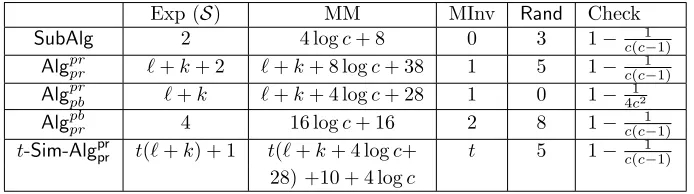
Table 1 Computation Complexity of the Proposed Algorithms Using Single Server
Exp (S) MM MInv Rand Check
SubAlg 2 4 logc+ 8 0 3 1− 1
c(c−1) Algprpr ℓ+k+ 2 ℓ+k+ 8 logc+ 38 1 5 1−c(c1−1)
Algprpb ℓ+k ℓ+k+ 4 logc+ 28 1 0 1− 1
4c2
Algpbpr 4 16 logc+ 16 2 8 1−c(c1−1)
t-Sim-Algprpr t(ℓ+k) + 1 t(ℓ+k+ 4 logc+ t 5 1−c(c1−1) 28) +10 + 4 logc
5 Complexity Analysis of the Proposed Algorithms
In this section, we first illustrate the complexity of our proposed algorithms using Table 1. In this table, we give the complexity results by counting the number of modular exponentiations for the server side; and for the client side the number of modular multiplications (MMs), the number of modular inver-sions (MInvs), the number ofRands and checkability probabilities. Note that we count the number of multiplication in the worst case by using classical double and algorithm, i.e., for anl−bit exponent we require 2l+ 1 MMs.
In Table 2, we give the complexity of the proposed algorithms by setting ℓ=k = 29 andc= 4. We note that by Lemma 3 letting ℓ=k= 29 reduces the probability of privacy leakage to negligible levels.
In order to compare Algprpr with the previous results properly, we need to
Table 2 Computation Complexity for Proposed Algorithms fork=ℓ= 29,c= 4
Exp (S) MMs MInvs Rand Check
SubAlg 2 10 0 3 11/12
Algprpr 60 100 1 5 11/12
Algprpb 58 86 1 0 63/64
Algpbpr 4 48 2 8 11/12
2-Sim-Algprpr 117 184 2 5 11/12
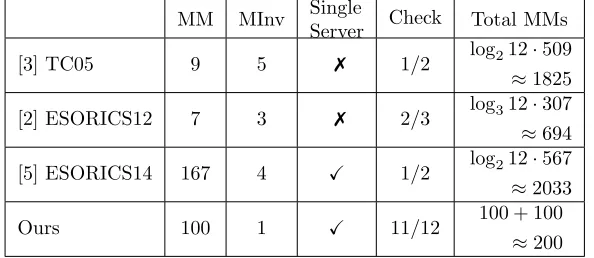
In [3], we have 9 MMs and 5 MInvs in one round. Hence, in log212 rounds we obtain 9·log212 MMs and 5·log212 MInvs. Hence, we have a total number of 9·log212 + 100·5·log212≈1825 MMs for [3].
In [2], we have 7 MMs and 3 MInvs in one round. Hence, in log312 rounds we obtain 7·log312 MMs and3·log312 MInvs. Hence, we have a total number of 7·log312 + 100·3·log312≈694 MMs for [2].
In [5], the goal is to outsource ua, where c = a−bξ with b and c are
known by the server with probability 1/6. Therefore,ξmust be large enough to prevent the brute-force attack. Hence, to have a negligible level, one has to choose ξ≈277. There are 167 MMs and 4 MInvs for the checkability of 1/2. Hence, in log212 rounds we obtain 167·log212 MMs and 4·log212 MInvs. Hence, we have a total number of 167·log212 + 100·4·log212 MMs for [5].
The algorithmAlgprprhas 100 MMs and only 1 MInv. Hence, there is a total number of approximately 100 + 1·100 = 200 MMs.
Table 3 Comparison is shown for the client side. Total MMs are counted after equating the checkability to 11/12 for all schemes.
MM MInv Single
Server Check Total MMs
[3] TC05 9 5 ✗ 1/2 log212·509
≈1825
[2] ESORICS12 7 3 ✗ 2/3 log312·307
≈694
[5] ESORICS14 167 4 X 1/2 log212·567
≈2033
Ours 100 1 X 11/12 100 + 100
≈200