ISSN 2286-4822
www.euacademic.org DRJI Value: 5.9 (B+)
The use of business games as a facilitator in the
learning process, motivation, involvement and
perception of the practice
IVAN CORRER Faculdades Integradas Einstein de Limeira-SP GABRIELA FERNANDA NIELSEN Faculdades Integradas Einstein de Limeira
RAFAELA ARAÚJO Faculdades Integradas Einstein de Limeira BIANCO GALAZZI DA SILVA LEITE Faculdades Integradas Einstein de Limeira
Abstract
as decision making, multidisciplinary teamwork and conflict management.
Keywords: active methodology, business games, engineering education
1. INTRODUCTION
Today's market demands that the Production Engineer be ready to make decisions and manage unpredictable situations. Accordingly to Ribeiro (2007), these new skills defined by the market are often not developed by traditional learning methods.
Regarding production engineering education, the professional should be able to exercise an interdisciplinary approach, correlating different areas for decision making such as engineering knowledge, management, social sciences, among others (NETO & LEITE, 2010).
However, the majority of production engineering students' education is defined by traditional learning methods, which prioritize theoretical content and no longer encourage students to use their knowledge for problem solving and decision making ( Ribeiro, 2007).
Active learning methodology is a practice that focus on developing these new skills and stimulate students in the learning process, in opposition to the traditional learning methods, which the student is no longer just the receiver of information and the teacher becomes a mediator, encouraging the students to develop skills such as decision making, self-confidence, autonomy, among other skills that companies are expecting from their professionals (FIGUEIREDO, 2010).
One of the learning techniques, through the active methodology usage is the Companies’ games that provide an hypothetical business environment using reality simulation techniques (ESCRIVÃO FILHO, 2009; O`GRADY, 2012).
working on themes such as: production management, quality management, manufacturing environments and product design.
Therefore, this article intents to identify the results of the methodology learning active’s concept application through the business games, in the production management’s subject, regarding to knowledge, motivation, involvement, perception of practice and teamwork.
2. THEORETICAL REFERENTIAL
2.1. Engineering Teaching
Production Engineering is based on a function insides an organization’s project, aiming the improvement and integration of systems, machines, men and equipment, in order to specify, predict and evaluate the results obtained. (MEIRELES, 2005).
Silveira (2005) highlights several changes faced by engineers inside the economic, social and technological context, and defines that innovation must be fundamental into the “age of globalized knowledge”, in order to boost industrial development by cooperating with citizenship and the intern market.
In the teaching context, it is common to observe discussions related to the scarcity of the current formation of new professionals (ESCRIVÃO FILHO and RIBEIRO, 2009). In this case, the conventional educational model consisting of data transmission and reception (knowledge), seems no longer being preparing students for the complex professional performance in the labor market.
In engineering education the traditional resumé is still predominant, in which the late integration between theory and practice, between the school and the professional world is considered. Ribeiro (2007) shows that in engineering education, it is common to find the criticism that the learning methods employed do not favor the attributes stipulated in their guidelines or recommended by professional associations, whereas the model of transmission and reception of information does not stimulate the development of creativity, entrepreneurship and the ability to self-learning.
active / collaborative learning, in which teaching methods become constructive, drawing students' attention in their studies.
2.2. Active Learning Methodology
Active methodology can be understood as the whole process of learning (didactic / strategic) whose centrality is effectively in the student (PEREIRA, 2012).
The method encourages a critical approach of the student to reality through teaching situations, as well as the availability of resources to problems’ research and solutions best suited to each situation in order to apply them. In addition, students need to perform tasks that requires complex mental processes such as analysis, synthesis, deduction and generalization (MEDEIROS, 2014).
There are numerous active methodologies available, in which it is necessary to choose the one that best fits the period and profile of the course. It will be designated to the first semesters, methodologies that projects simulations, class discussions, role plays, conceptual and mental maps, while the use of problematization methodologies, case studies and project-based learning are best results for the intermediate and final stages collaborating in formation of the egress (OLIVEIRA, 2010).
2.3. Applied Active Learning Methodology in Engineering: Business Games
According to Santos (2011), students will only learn if they are able to present projects, develop new ideas, solve problems and apply the concept in their life, but for this to happen, teaching methods in which theory and the practice are associated.
According to Cardoso and Borges (2013) and Vieira Filho (2008), the ideal is that students apply the content dynamically and problematized, for example, by simulating “business games”. These games are able to develop students' decision making, enabling them to stimulate a business knowledge model (SILVA and MORAIS II, 2011), and enable a scenario with the simulation that comes close to reality (FERRERA, 2010; SIEWIOREK, 2012)
interests of researchers, who increasingly use different strategies to explore the concepts of production (DEPEXE et al. , 2006).
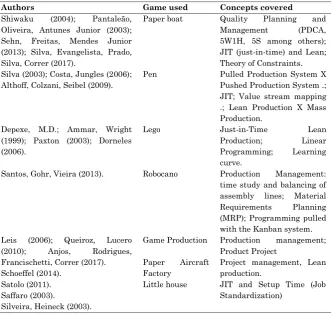
Table 1 presents works developed with the use of games of companies applied in engineering education, with the concepts approached and authors.
Table 1: Business games applied in engineering education
Authors Game used Concepts covered
Shiwaku (2004); Pantaleão, Oliveira, Antunes Junior (2003); Sehn, Freitas, Mendes Junior (2013); Silva, Evangelista, Prado, Silva, Correr (2017).
Paper boat Quality Planning and Management (PDCA, 5W1H, 5S among others); JIT (just-in-time) and Lean; Theory of Constraints. Silva (2003); Costa, Jungles (2006);
Althoff, Colzani, Seibel (2009).
Pen Pulled Production System X Pushed Production System .; JIT; Value stream mapping .; Lean Production X Mass Production.
Depexe, M.D.; Ammar, Wright (1999); Paxton (2003); Dorneles (2006).
Lego Just-in-Time Lean
Production; Linear Programming; Learning curve.
Santos, Gohr, Vieira (2013). Robocano Production Management: time study and balancing of assembly lines; Material Requirements Planning (MRP); Programming pulled with the Kanban system. Leis (2006); Queiroz, Lucero
(2010); Anjos, Rodrigues, Francischetti, Correr (2017). Schoeffel (2014).
Satolo (2011). Saffaro (2003).
Silveira, Heineck (2003).
Game Production Paper Aircraft Factory
Little house
Production management; Product Project
Project management, Lean production.
JIT and Setup Time (Job Standardization)
Source: Authors
3. RESEARCH DEVELOPMENT METHODOLOGY
an individual within a group, and to identify the benefits and difficulties encountered. in relation to the studied process.
The character of the research is exploratory in nature with the aim of providing researchers with greater familiarity with the game, because according to Gil (2007), this type of research aims to make the problem more explicit or help to build hypotheses, and may be divided into 3 steps: Bibliographic search for the theme studied; Definition of a group as a sample for the research; Determination of information collection methods (questionnaire, observation, interview, etc.).
For evaluation, a questionnaire with objective questions was elaborated to quantitatively analyze the results. According to Manzato and Santos (2016), the questionnaire may contain open questions for the interviewee to discuss his point of view and closed or objective when there are options. of answers.
3.1. Company game application: Manufactura®
For the present research, the Manufactura® game was used, whose objective is to simulate the production process of a factory and the commercialization of its products to the market, addressing the concepts of lean production, waste elimination, cost reduction, strategic planning and making decision.
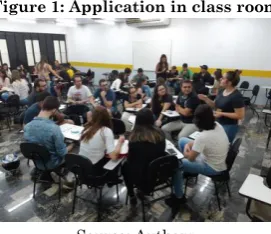
The game was applied to students who were studying Production Management, Production Engineering and Business Administration courses, totaling 76 participating students (Figure 1).
The application of the game took place during the class time and was divided into 3 stages: Presentation of theoretical concepts related to the game with the teacher (30 minutes duration); realization of classroom dynamics (duration 60 minutes); application of the questionnaire aiming to evaluate the results obtained with the application of the game and open discussion with the students about the simulation and learning (duration 30 minutes).
In the first step, the teacher introduced the concepts related to the manufacturing environment, highlighting the concepts of lean production, waste elimination, cost reduction, and how market oscillations and disturbances directly affect the decision making for production planning.
Figure 1: Application in class room
Source: Authors
To start the second stage, students were divide into groups, in which each group had 4 companies, and each company consisted of 2 or 3 students. For each group, there was an instructor to guide students on the rules of the game. Figure 2 presents the characteristics and formation of a group of companies.
Figure 2: Characteristics and formation of a group of companies
Source: Authors
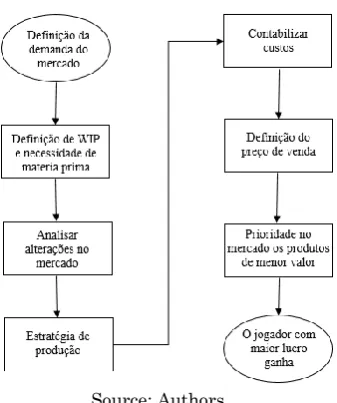
Figure 3: Flowchart of the game.
Source: Authors
The game begins with the definition of market demand. This can range from 2 to 12 products per round, given that it is randomly generated using “lucky dice”.
In the first round, the quantity of raw materials and process products (WIP) is randomly defined using “lucky data”, and on the following wheels the company may acquire new raw materials according to their demand and planning. .
At the beginning of each round, each company receives an “event card” in which it simulates external (market) and internal (company) interference that will occur in the company during the round, which may be beneficial or harmful, forcing the company to make decisions. that maximize or minimize the effects of the event card on the cost of the product.
Figure 4: Process Sheet
Source: Authors
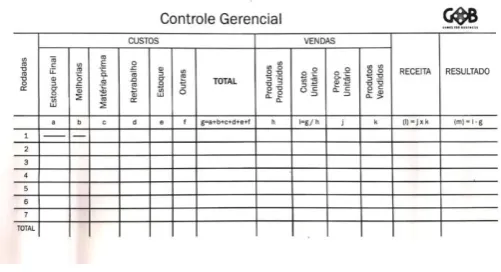
At the end of each round, after accounting for losses and gains on the management control sheet (Figure 5), the company must define its selling price. It has priority in selling those products with lower value.
Figure 5: Managerial Control Sheet
Source: Authors
The game ends after 7 (seven) rounds, or 40 products sold, wins the company that gets the best result (profit) among the participants. It has priority in selling the company with the lowest selling price, in case of a tie, sells the company with the lowest production cost.
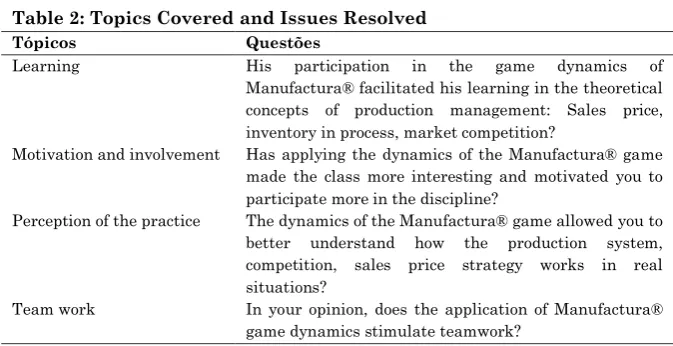
Table 2: Topics Covered and Issues Resolved
Tópicos Questões
Learning His participation in the game dynamics of Manufactura® facilitated his learning in the theoretical concepts of production management: Sales price, inventory in process, market competition?
Motivation and involvement Has applying the dynamics of the Manufactura® game made the class more interesting and motivated you to participate more in the discipline?
Perception of the practice The dynamics of the Manufactura® game allowed you to better understand how the production system, competition, sales price strategy works in real situations?
Team work In your opinion, does the application of Manufactura® game dynamics stimulate teamwork?
Source: Authors
In the answers, students could select from one of five available alternatives: “totally agree”, “agree”, “neither agree nor disagree”, “disagree” and “strongly disagree” according to the usual Likert scale standard, which has the ability to identify agreement or disagreement and frequency, providing an indicator of analysis of the environment studied.
4. RESULTS AND DISCUSSIONS
Figure 6: Learning
Source: Authors
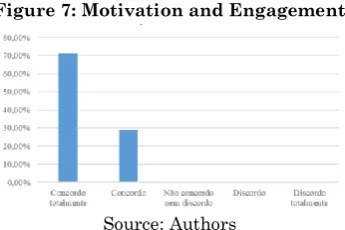
The second question asked if participation in the game increased student interest and motivated them to participate more in the discipline, as can be seen in Figure 7, 100% of students agreed or totally agree, which demonstrates that the use of methodologies Active, through corporate games, arouses the curiosity of students and consequently increases their participation in the classroom.
Figure 7: Motivation and Engagement
Source: Authors
Figure 8: Practice perception
Source: Authors
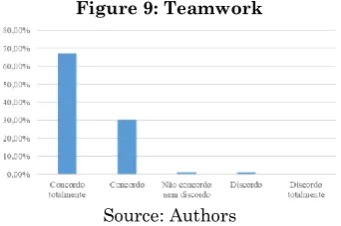
And the fourth question was about stimulating teamwork, 97.36% of the students agreed or totally agreed, and 2.64% did not agree or disagree (Figure 9), which showed a high stimulus index. of teamwork.
Figure 9: Teamwork
Source: Authors
5. CONCLUSIONS
This research aimed to identify the results of the use of active methodology applied through a company game, in relation to learning, motivation and involvement, perception of practice and teamwork. Their analysis of results took place through a questionnaire that involved these topics after the students' participation in the game and open debate in the classroom.
With the results obtained, it was evident that learning through business games was efficient, as can be seen in figures 6, 7, 8 and 9 besides providing a dynamic environment and a new learning method that is beyond traditional learning.
It can be seen that one of the biggest difficulties companies have today is finding professionals with the skills to handle real-life situations required on a daily basis, and Production Engineering is a course that requires the professional to be ready to make decisions involving a large number of internal and external variables, so, in addition to technical skills, the production engineering professional should enhance their behavioral skills, in terms of people management, teamwork, proactivity, leadership, among others.
However, many times traditional teaching methods are no longer efficient for the professional to acquire these skills, and the use of business games can assist in the preparation of students in order to insert them into a simulated, close reality. to the business environment, enabling students to leverage the skills such as decision making, multidisciplinary teamwork and conflict management that the market currently demands.
REFERÊNCIAS
1. ALTHOFF. T.; COLZANI, T. A.; SEIBEL, S. (2009); The dynamics of the pen maker - a game-based simulation of companies in production engineering education. Anais ..., XXIX National Meeting of Production Engineering - ENEGEP, Salvador, Bahia, Brazil.
3. ANJOS, J. M. A.; RODRIGUES, R.; FRANCISCHETTI, C. E.; CORRER, I. (2017).
4. Proposal of a company game, using the concepts of product development and design.
5. BARROWS, H. S. Problem-based learning in medicine and beyond: a brief overview. In: WILKERSON, L.; GIJSELAERS, W. H. (Eds.). Bringing problem-based learning to higher education: theory and practice. San Francisco: Jossey-Bass, 1996. p. 3-12.
6. BRAGHIROLLI, L. F. (2014). Computational game learning in production engineering. PhD Thesis UFRGS, School of Engineering, Postgraduate Program in Production Engineering.
7. CARDOSO, O. E. B.; BORGES; E. M. (2013). Collaborative learning: webquest in higher education at a distance, enhancing research, interactivity. In 5th Hypertext Symposium and Technologies in Education. UFPE, Recife - PE.
8. COSTA, A.C.F.; JUNGLES, A.E. (2006); Value stream mapping applied to a simulated pen assembly plant. Anais, XXVI National Meeting of Production Engineering, Fortaleza, Ceará, Brazil.
9. DEPEXE, M.D.; DORNELES, J.B.; COSTA, A.C.F.; SANTOS, D.G.; HEINECK, L.F. M. (2006); Presentation of a didactic game as a tool to support the teaching of lean production. Industrial Management Magazine, 2 (4), 140–151.
10. DORNELES, J.B.; DEPEXE, M.D.; SILVEIRA, J.P.; GASPARETTO, F.C.; SANTOS, D.G.; HEINECK, L.F.M. (2006); Assembly of trolleys: learning concepts of lean construction through didactic games. Anais…, XI National Meeting of Technology in the Built Environment - ENTAC, Florianópolis, Santa Catarina, Brazil.
11. ESCRIVÃO FILHO, E.; CAMARGO RIBEIRO L. (2009). Learning from PBL - Problem Based Learning: Report of an EESC-USP Engineering Course Experience.
13. FIGUEIREDO, J. Computational Model for Simulation of Application of Constraint Theory. Reach Magazine, v. 17, no. 2, p. 19-31, 2010
14. GIL, A. C. How to draw research projects. 4. ed. Sao Paulo: Atlas, 2007.
15. LEIS, R.P.; KLIPPEL, M.; PELLEGRIN, I.; ANTUNES JÚNIOR, J.A.V.A. (2006); Use of Computer Simulation Games in Production Management Teaching: a comparative study of the application of PSP. Annals, XXX ANPAD - ENANPAD Meeting, Salvador, Bahia, Brazil.
16. MANZATO, Antonio José; SANTOS, Adriana Barbosa. The elaboration of questionnaires in qualitative research.
Available in:
<http://www.inf.ufsc.br/~vera.carmo/Ensino_2012_1/ELABOR ACAO_QUESTIONARIOS_PESQUISA_QUANTITATIVA.pdf > Acesso em: 22 de Abril de 2019.
17. MARGETSON, D. Why is problem-based learning a challenge? In: BOUD, D.; FELETTI, G. (Eds.). The challenge of problem-based learning. London: Kogan Page, 1999. p. 36-44.
18. MEDEIROS, Amanda. Teaching in socio-education. Brasília: Universidade de Brasília, Campus Planaltina, 2014.
19. MEIRELES, M: SILVA, O. R; PAIXÃO, M. R; MARIETTO, M. The role of Production Engineering. In: Brazilian Congress of Engineering Education, 33., Campina Grande, 2005.
20. NETO, Alfredo Iarozinski.; LEITE, Maria Silene. The systemic approach in research in Production Engineering. Production Magazine, v.20, n. 1, p.1- 14, 2010.
21. O’GRADY, G. et al. One-day, One-problem. An approach to Problem-Based Learning. Singapore: Springer, 2012.
22. OLIVEIRA, G.A.; COSTA, E. Active methodologies: applications and experiences in pharmaceutical education. Brasilia: Brazilian Association of Pharmaceutical and Biochemical Education, 2010. p.11-33.
24. PAXTON, J. (2003); A short, simple learning curve classroom exercise. Decision Sciences Journal of Innovative Education, 1 (2), 303–307.
25. PEREIRA, Rodrigo. Active Method: Techniques of Problematization of Reality applied to Basic Education and Higher Education. In: VI International Colloquium. Education and Contemporaneity. Saint Cristopher, SE. 20 a 22setembro de 2012.
26. QUEIROZ, A.Q.; LUCERO, A.G. (2010); Games, an alternative to complement the teaching of production management. Article (Department of Mechanical Engineering) - Federal University of Santa Catarina. Florianópolis: USFC. Brazil.
27. RIBEIRO, L. R. C. X-ray of an engineering class. São Carlos: EDUFSCar, 2007.
28. RIBEIRO, Luis Roberto de Camargo. Problem-based learning (PBL): an implementation in engineering education. 2005. 236 p. Tese (Programa de Pós-Graduação em Educação - Universidade Federal de São Carlos, São Carlos / SP, 2005. 29. RICHARDSON, R.J. Social research: methods and techniques.
3 Ed. 1999.
30. SAFFARO, F.A. et al. (2003); Discussão de princípios da Lean Production através de um jogo didático. Anais.., III Simpósio Brasileiro de Gestão e Economia da Construção – SIBRAGEC, ANTAC, São Carlos, São Paulo, Brasil.
31. SANTOS, J. C. F. (2011).The challenge of promoting meaningful learning.
32. SANTOS, L.C.; GOHR, C. F., VIEIRA JR., M. (2013); Robocano: an alternative dynamic for teaching and learning production management. Industrial Management Magazine, 9, 122–146.
33. SATOLO, E.G. (2011). Simulation model applied to the concept of lean production in production engineering education. Management Magazine.
35. SEHN, M.F.; FREITAS, M.C.D.; MENDES JUNIOR, R. (2014); Paper Boat Production Line: Dynamics of Constraint Theory Principles...., XLI Congresso Brasileiro de Educação em Engenharia – COBENGE, Gramado, Rio Grande do Sul, Brasil.
36. SHIWAKU, M.; BUOSI, J.P.; PAULISTA, P.H.; TURRIONI, J.B.; COSTA JÚNIOR, A.G. (2004); Results of the use of paper boat dynamics to teach quality management. Anais..., XI Simpósio de Engenharia de Produção – SIMPEP, Bauru, São Paulo, Brasil.
37. SIEWIOREK, A.; SAARINEN, E.; LAINEMA, T.; LEHTINEN, E. (2012). Learning leadership skills in a simulated business environment. Computers & Education. v. 58, n. 1, p. 121-135. 38. SILVA, I. K. O.; MORAIS II, M. J. O. (2011). Development of
educational games in support of the teaching-learning process in elementary school.
39. SILVA, M. S. K.; EVANGELISTA, G. M. S.; PRADO, D. O.; SILVA, M. H.; CORRER, I. (2017). Development of a company games methodology, using the concepts of the boat game using the quality tools.
40. SILVA, Maria et al. (2003); Pulled production system and pushed production system: simulation through a didactic pen assembly game, associating ideas and concepts to the construction environment. Anais.., III Simpósio Brasileiro de Gestão e Economia da Construção – SIBRAGEC, ANTAC, São Carlos, São Paulo, Brasil.
41. SILVEIRA, M. A. The formation of the innovative engineer: an international vision. Rio de Janeiro PUC-Rio, Sistema Maxwell, 2005.
42. SILVEIRA, R. HEINECK, L. (2003); Learning the technique of balance line programming through didactic games. Anais..., III Simpósio Brasileiro de Gestão e Economia da Construção, SIBRAGEC, São Paulo, Brasil.