
Beyond Bitcoin – Part I:
A critical look at blockchain-based systems
Pasquale Forte
1, Diego Romano
2, and Giovanni Schmid
∗21
PA Advice, Naples, Italy
2
Cnr ICAR, Naples, Italy
December 1, 2015
An updated and revised version of this work is available for open access at:
10.3390/cryptography1020015
Abstract
After more than six years from the launch of Bitcoin, it has become ev-ident that the decentralized transaction ledger functionality implemented through the blockchain technology can be used not only for cryptocur-rencies, but to register, confirm and transfer any kind of contract and property. In this work we analyze the most relevant functionalities and known issues of this technology, with the intent of pointing out the pos-sible behaviours that are not as efficient as they should when thinking with a broader outlook. Our analysis would be the starting point for the introduction of a new approach to blockchain creation and management, which will be the subject of a forthcoming paper.
1
Introduction
The existence of digital currencies is strictly related to the broad diffusion of In-ternet and on-line markets. A digital currency is similar to electronic money but even if it can be used to buy services or physical goods like traditional money, it is not equivalent or linked to any fiat currency. The idea of using a digital currency became realistic when some important developments in cryptography settled multiple fundamental security challenges in money transfers, e.g. the necessary trust in the transaction.
Several digital cryptocurrencies have been implemented in the last 20 years, but only starting in 2008 the idea of a decentralized currency came out. In fact the first implementations employed a point of control over the money supply, which
led to their failure since it exposed the whole system to attacks for taking con-trol over it. This happened for both governmental and criminal interests [1, 2]. BitCoin [3] has been created to avoid a single point of attack, staying free of any central authority. It includes a peer-to-peer network, with both a distributed currency issuance system and a transaction verification system, backed by a public tansaction ledger calledblockchain.
After more than six years from the its launch, it has become evident that the de-centralized transaction ledger functionality implemented through the blockchain technology can be used not only for cryptocurrencies, but to register, confirm and transfer any kind of contract and property. For example, public records such as vehicle registrations or marriage certificates could be migrated to suit-able blockchains. Blockchain technology ensuit-ables indeed the creation and man-agement of smart contracts [4] and smart properties [4]. On the other hand, these two new digital paradigms can be used to give rise to the creation of decentralized autonomous organizations[5].
In this work we will consider the opportunities given by the blockchain, analysing its most relevant functionalities and known issues. We will evaluate the features specific to Bitcoin, with the intent of pointing out the possible be-haviours that are not as efficient as they should when thinking with a broader outlook. And we will consider some alternatives both in protocols and in sys-tems, which represent the already available solution to some acknowledged flaws. More in details: in§2, we will review some new potential applications, surveying the actual tools that are already implemented and focusing on their functionali-ties related to the blockchain. Then in§3 we will stress the role of the transaction concept in the actualization of the blockchain, followed by an inspection of the components used to manage the public ledger, with a special look at the case of Bitcoin. A discussion on some computational aspects will be presented in§4, where some serious inefficiencies will be highlighted. Finally in§5 we will draw our conclusions on the blockchain-based system.
2
Potential applications
2.1
Smart contracts
Smart contracts represent the implementation of a contractual agreement, whose legal provisions are formalized into programming code and verified through a network of peers [6]. Indeed these contracts are defined through the code and executed or enforced by the code, without the need for a trusted third party. An example of a smart contract is the enforcement of a bet between two users about the maximum humidity level tomorrow. On the following day the contract is automatically completed by a software program checking the humidity levels provided by a qualified weather service or some given sensors, as stated by the contract itself, reading and trasferring funds from the loser’s to the winner’s account. Another example is an inheritance gift that becomes available on the childs eitheenth birthday. As should be clear from these examples, in order to set up a smart contract one needs to choose an event or condition which triggers the transaction expected in the contract, and then check with a program that the event or condition has occurred.
According to [4], smart contracts represent a technological advancement to the practice of law, which allow contracting parties to structure their relation-ships more efficiently, in a self-executing way and without the ambiguity of natural words. Given the reliance on source code, users can model contractual performance and simulate the agreement effectiveness before its execution [6].
We can point out the following three distinctive properties of smart con-tracts: autonomy, self-sufficiency and decentralization [7]. Smart contracts are autonomousin the sense that, after their deployment on the blockchain, they no longer need heed of their creators. Furthermore, they can accumulate capital over time, such as digital currencies or physical assets, and that is what the term self-sufficientstands for. Finally, smart contracts aredecentralizedbecause they are distributed and self-executing across a network of peer nodes.
Some open source projects have been started in the last years to develop pro-gramming languages for the easy creation of smart contracts (e.g. [8, 9]). Using these programming languages, users will be able to get increasingly sophisti-cated smart contracts, designed to satisfy various requirements and to be used in several contexts.
Two main current projects related to smart contracts are Namecoin and Ethereum. We are going to discuss them briefly in the following, in order to gain some insight on goals and functions in this kind of blockchain-based systems.
2.1.1 Namecoin
compe-tence.
Government agencies could contact a registrar and induce it to blacklist some devices and services, for the purpose of political censorship. The extent of Inter-net censorshipvaries on a country-to-country basis: most democratic countries have moderate Internet censorship, whilst other countries go as far as to limit the access of information and suppress discussion among citizens [11].
Namecoin [12] is a blockchain-based DNS that – at least in the intentions of its designers and promoters – cannot be controlled by any government or orga-nization. A blockchain-based DNS system means that DNS lookup tables are recorded on a blockchain and shared this way on a peer-to-peer system, so that naming in TLDs can be managed cooperatively by customers, without control by any registrar. Since domain name registration is nothing else than a special kind of contract between a registrar and its customers, Namecoin is a service for supplying smart contracts which is based on the Bitcoin cryptocurrency. Name-coin has the unique TLD.bit, and domains can be registered directly with the Namecoin system or via registration services likehttps://dotbit.me/. Since
.bitis not managed by ICANN, in order to resolve names within Namecoin tables, one must set up a .bitproxy server for the correct handling of those DNS requests.
2.1.2 Ethereum
The newly introduced Ethereum platform is a blockchain-based system aimed at running applications exactly as programmed, without any possibility of down-time, censorship, fraud or third party interference [13]. Ethereum, by imple-menting a generic programmable blockchain, enables the execution of state-ful, fully-customizable smart contracts. Some examples of applications that Ethereum can be used for are: voting systems, domain name registries, financial exchanges, crowdfunding platforms, company governance, intellectual property and smart property (see§2.2).
2.2
Smart properties
Beyond smart contracts, blockchain technology enables the creation of smart properties. The key idea of smart property [14] is the assertion of ownership rights for an asset through its registration in the blockchain, secured by means of a private key. Only who has got the private key can ascertain its ownership of the asset, which on the other hand can be verifed by anyone thanks to the corresponding public key. The owner could later sell the asset by givig its corresponding private key to another user, e.g. through the completion of a smart contract.
Some types of property like trademarks, copyrights and patents are inher-ently smart properties, and their management as such is natural and can be fruitful. Indeed these entitlements can be easily encoded and processed as dig-ital documents. This is not the case with physical assets, where ownership is more exposed to frauds. In fact in order to register a chattel (e.g a car) in the blockchain, we need to attach a uniquely identifiable tag or a chip to it. If the information contained in that tag or chip could be altered, or the tag/chip could be detached, smart property would not be guaranteed.
An actual implementation of smart properties is colored coins. Using this term we are talking about a class of methods for representing and managing real world assets on top of the Bitcoin blockchain. In fact it is possible to store a small amounts of metadata on the blockchain to represent asset manipulation instructions. One can encode in a Bitcoin transaction the information that some units of a new asset were issued and credited to a given Bitcoin address, and a real world value can correspond to those units with the issuer’s promise to redeem them for some goods or services. For example, a car dealer can issue 100 units of a “Buy car X during the time promotional period Y” asset, and promise to redeem each unit for a right to buy a certain kind of car as part of a promotional offer [15].
2.2.1 Proof of Existence
2.3
Decentralized autonomous organizations
The blockchain technology makes the execution of several smart contracts and smart properties possible, enabling their reciprocal interaction in a decentral-ized and distributed way. Decentralized autonomous organizations [5] operate according to rules and procedures defined by smart contracts, and on the basis of ownerships defined through smart properties. In these organizations, machines and people can cooperate without the need to be incorporated into traditional business identities.
The decentralized autonomous organization concept derived from Artificial Intelligence: a decentralized network of autonomous agents perform tasks, which can be conceived in the model of a corporation running without any human involvement under the control of a set of business rules. Such organizations can charge users for the services they provide, in order to pay others for the resources they need. As long as they receive sufficient funds to operate on their own, they can thus subsist independently of any third party. If a decentralized organization is truly autonomous, no one (including its original creator) can control it after it has been deployed on the blockchain. That is actually a very threatening property: an organization could be conceived to evolve over time in order to adapt to the context in which it operates, thus it can be very difficult to know a priori if it can assume a dangerous state.
From a different point of view, the concept of decentralized autonomous organization can actually be linked to the development of theInternet of Things (IoT). The IoT will consist of billions of Internet-enabled devices, but not all can be blindly trustworthy and some could be even malicious. In order to facilitate private, secure, and (trustless) machine-to-machine coordination, these devices will need a central reference point. In this context theADePT (Autonomous Decentralized Peer-to-Peer Telemetry)[17], by IBM and Samsung, is building a proof of concept system for the next generation of the IoT.
2.3.1 ADePT
The ADePT concept [17] uses blockchain technology to provide the backbone of the system, utilizing a mix of peer-to-peer protocols to get secure and fault-tolerant transactions. In ADePT, the blockchain is seen as a way for devices to understand what other devices do, and the instructions and permissions different users have around these devices. In practice this can mean tracking relationships between a user and a device, and even between two devices, with the consent of the user.
In order to realize the ADePT concept, IBM and Samsung chose three pro-tocols:
• Ethereum, in order to allow devices to understand contracts and capa-bilities (this is where blockchain technology comes into play);
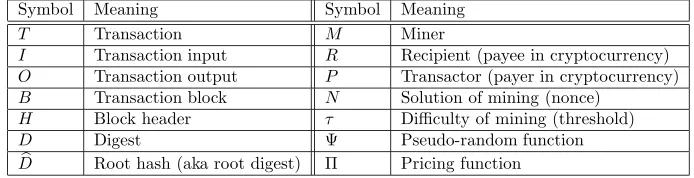
Symbol Meaning Symbol Meaning
T Transaction M Miner
I Transaction input R Recipient (payee in cryptocurrency) O Transaction output P Transactor (payer in cryptocurrency) B Transaction block N Solution of mining (nonce)
H Block header τ Difficulty of mining (threshold)
D Digest Ψ Pseudo-random function
b
D Root hash (aka root digest) Π Pricing function
Table 1: Special symbols used in the present work.
• Bit Torrent[19] a file sharing protocol used to move data around also in case of discontinuous and unreliable connections
According to [?], a Samsung W9000 washing machine was reconfigured to work within the ADePT system. When needed, the machine uses smart con-tracts to issue commands to a detergent retailer in order to receive new supplies. Thanks to these contracts the device has the ability to pay for the order itself, and later receive a notice from the retailer that the detergent has been paid for and shipped. Moreover, if a smartphone is connected to the home network, this information is broadcasted to it, presenting the purchase details to the owner of the washer.
3
Concepts and technologies
Since January 2009, when Bitcoin v0.1 was released and announced on a cryp-tography mailing list, there has been a growing interest on cryptocurrencies from various communities related in some way with Information Technology. In this section we will try to describe the main technical aspects at the basis of what we called “blockchain-based systems”, at the current state of the art. Before going into details it can be useful to recap Bitcoin’s basic strategy by sketching its main operations. This can serve as a guideline before our diving into the technicalities, and we hope it will induce the reader to focus on the functional requirements pursued by the designers of these systems, rather than on their actual implementations. Table 1 reports the main special symbols used throughout the following, alongside with their meaning.
3.1
Bitcoin quick overview
a chain of such blocks, is cooperatively and incrementally constructed by the miners over time, as follows:
• When a miner succeeds in generating a block, meaning that the hash of its block data is smaller than a given difficulty threshold, then it broadcasts such block to the network.
• In case other miners see that the above block is valid, and see that it is the longest extension of the blockchain that they are aware of, they move on and extend the blockchain from such block.
• The existence of the above block in the blockchain ratifies that the newly minted coins and the fees from the transactions included go to the public address that it provided. Only the miner having that address can redeem such coins and transaction fees, by using its corresponding private key.
At the same time, the synchronization among peers and the creation of new coins are managed by the system in a way that:
• The difficulty level readapts to the total hashing power of the miners. This is done by updating the hash threshold value every 2016 blocks, so that so many blocks get generated in about two weeks (i.e. each new block is generated every 10 minutes on average).
• The reward in newly minted coins started at 50 coins in January 2009 and halves every 210,000 blocks, i.e. about every 4 years (see above).
3.2
Transactions
This way parties can more easily keep track of paths followed by coins through the system, and monitor the integrity of the service. Actually, many systems include (optional)transaction feesfor miners, so that the above balance is achieved by including these fees, even if their payee is not known beforehand. Indeed, a transfer for a transaction fee cannot be explicitly recorded in a stan-dard transaction, since its recipient will be known to the system only afterward, resulting as the winner of a computational challenge (see§3.3). Therefore these fees must be included in the amount of the transaction, but they are not explic-itly recorded in the transaction itself.
The specification of a transaction requires an addressing scheme so that transactors, recipients and miners (that is, ultimately,eachnode in the system) can be univocally identified. Moreover, transactions must be uniquely binded to transactors, in a way that - at least in theory - neither a party different from the transactorP can generate a transaction indicatingP as transactor ( authen-ticity), nor P can repudiate a transaction which it has previously generated (non-repudiation).
Transactions are processed locally by each node thanks to a programmable in-terface implemented in the peer-to-peer software. Since that inin-terface makes use of a scripting language (e.g. [20, 9]), we will refer to the code for processing a transaction as thetransaction script. The ultimate goal of a transaction script is allowing any other node in the system different from the transactor node to ascertain what are the conditions for the occurrence of transfers reported in the given transaction. That is accomplished through the signing and the verifica-tion procedures of a suitable digital signature scheme on some elements of the transaction.
These notions were first introduced for Bitcoin [3], and then adopted by many other cryptocurrency systems to date [21]. They can be easily adapted to perform transfers of any resource which admits a suitable, appropriate digital representation. Thus, by definition, we will assume that this approach specifies how resources are managed in any blockchain-based system.
3.2.1 Addressing
Since the validation of transactions relies upon digital signatures verified by system nodes, and nodes are implemented through a special software termed wallet, then there must be a mapping between wallets and (sets of) signature verification keys.
themselves as addresses in the system, since for their purpose they must be kept publicly available. However, this approach is inappropriate if non-volatile addresses are required, since key management imposes practices such as key upgrading and key revocation [23]. These considerations do not seem to have influenced the designers of Bitcoin and many other blockchain-based systems, where addresses are obtained as hash digests from verification keys, apparently at the sole scope of obtaining shorter identifiers [24]. For example, Bitcoin ad-dresses are base58-encoded strings containing an address version number, the digest got by hashing an ECDSA [25] verification key with the RIPEMD-160 algorithm [26], and an error-detection checksum to catch typos [24].
3.2.2 Transaction inputs and outputs
As we told previously, the scope of a transaction is to keep track of the resource paths (both the granting of new resources and resource transfers) occurring among system nodes. In this way each node can verify the amount and address-ing of the newly created resources, as well as the balance between resources requested for the transaction and resources transferred to recipients. In or-der to accomplish that, a transaction encodes those amounts as suitable data structures, called transaction inputs and outputs, respectively.
A transactioninputcomposes of data indicating the source of the resources that a transactorP wishes to transfer, plus a scripting code whose processing should guarantee to every node in the system thatP is actually authorized to redeem per se those resources.
Similarly, a transaction output composes of the indication of the destination whereP intends to transfer those resources and their amount, plus a scripting code whose processing should guarantee that only the system nodes indicated byP as the recipients can actually redeem such resources.
Each input must match with an output related to a previous transaction which was validated (eventually among others) as a blockchain block. The matching between the current transaction input I and a previous transaction outputOtrasformsallthe resources provided byOin resources available forI, so that to each input can correspond one and only one output. A different situation occurs inside a transaction, where zero to many inputs can be associated to one or more outpus. A no-input transaction stands for granting some newly created resources to one or more outputs, and corresponds to the case of a generation transaction in the context of cryptocurrecies. Otherwise, a single- or multi-input transaction records a transfer of resources from its input(s) to its output(s). The matching rule in this last case is as follows: one or more outputs Omn must correspond to each input Im, so that a certain amount of units of
resource provided byImis equal to the sum of the amounts related toOmn, net
of transaction fees which cannot be indicated explicitly.
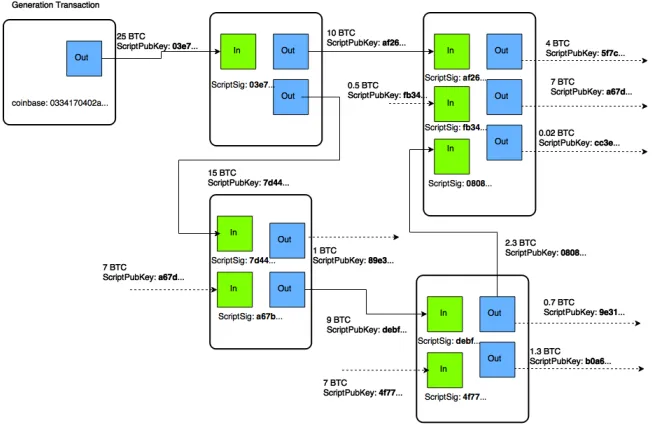
Figure 1: An example of transaction chaining in Bitcoin.
meets such rules.
In Bitcoin, each standard transaction – with its input(s)-output(s) matching – represents a transfer of a certain amount ofsathoshi, which is the smallest possible unit of currency1
. Each inputImust reference a single outputO from a transaction encoded in a previously validated transaction block, so that I must spend the amounts of satoshi inO. Schematically, given a transactionT, each inputI and outputO ofT are defined as:
I:= (sha256(Tp), i,SgnCode) O:= (v,VrfCode), (1)
where:
- sha256(Tp) is the SHA-256 digest of a previous transactionTp. It is used to
identifyTp as the transaction used to get inputI;
- theinput indexiis a non negative integer which indicates the specific output inTp used as an input in the current transactionT;
- thesigning script SgnCode is a set of instructions and data provided by the transactor in order to satisfy the conditions placed in the pubkey script of outputiin Tp. In its simplest form, such script just applies the
trans-actor signature on the SHA-256 digest of all the I/O fields of the current transaction, with the exclusion of SgnCode itself;
- theoutput valuev is the amount of satoshis associated withO;
1
T: a44d97e0290a7979d2a9ff4b0ea4b009cf4d50b9f739693a73c0d7d6d297e650
{
"hash": "a44d97e0290a7979d2a9ff4b0ea4b009cf4d50b9f739693a73c0d7d6d297e650", "ver": 1,
"vin_sz": 1, "vout_sz": 2, "lock_time": 0, "size": 223, "in": [
{
"prev_out": {
"hash": "98ad911be7ff50439110e402745f49bb42e9fdc3b722198b96fd442915392ed6", "n": 1
},
"scriptSig": "30440220362feb8862be8e89442856cc69ac6e8094a2260a76e34fef2c7cd99\ c5f41bbed0220070bde5c073b63427fa211261da8bd5343d31fdeef5a885ed6\ 74e816e4cf463a01033c586247a1abbbf1f3895adaee521b20cb 5e96948278\ 1d0c71dadd8c0d26fad1"
} ], "out": [
{
"value": "608.90406349",
"scriptPubKey": "OP_DUP OP_HASH160 fa6b6e87bd2a264e001ce6ddfce39499d269ade2\ OP_EQUALVERIFY OP_CHECKSIG",
"address": "1Pq6dSvv4UoJ1nC8L2TgWyKzVUMfeCHpPK" },
{
"value": "0.18040121",
"scriptPubKey": "OP_HASH160 f5c9e9ed35bb7405bbd4c1f3c3aeeb17232f663b OP_EQUAL" }
],
"nid": "934d7bc180e7c88699e89a65b5ce50022400a4ce8dc7c66adfd658ccf95de985", "block": "00000000000000000ca23d66664e258fff1293987d1302b8d6e5dcee26b92cd5", "blocknumber": 380336,
"time": "2015-10-24 12:53:20" }
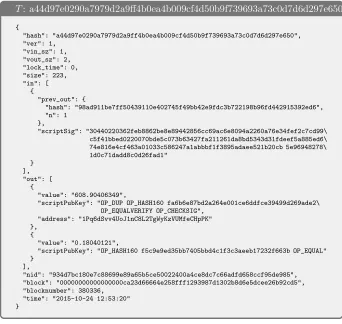
Figure 2: An example of Bitcoin standard transaction.
- thepubkey script VrfCode is a set of instructions and data provided by the transactor that specifies the recipient(s) authorized to collect the value v in satoshi associated with O. The most used VrfCode returns true if matched with a signing script consisting in a signature of a (subsequent) transaction (see§3.2.3).
result of some processing by ablockchain browser, a web tool designed to offer human-readable views of a blockchain (e.g. [27, 28]). For example, values are expressed in BTC in the code of Figure 2, whilst they are recorded in satoshi in the blockchain. Moreover, the fieldblocknumberis not actually recorded in the blockchain [29].
3.2.3 Transaction processing
In order to be validated without the intervention of a trusted third party, trans-actions require some processing at the peer nodes to ascertain with corroborate evidence: their origin (i.e. the identities of their transactors), the fact that the resources deemed to be transacted are effectively possessed by the transactors, and – last but not least – that only the recipients satisfying the conditions re-quired by transactors are accounted for such resources.
A key point in Bitcoin, and more generally in blockchain-based systems, is that transactions include code that can be customized by the transactor in order to allow for different kinds of verification procedures.
To verify that inputs are authorized to collect the values of referenced out-puts, Bitcoin uses a scripting system which resembles to Forth []. With reference to Figure 2, the input’s SgnCode (denoted asscriptSigin the code) and the referenced output’s VrfCode (scriptPubKey) are evaluated, and the input is au-thorized only ifscriptPubKeyreturns true. Through the scripting system, the transactor can create many different conditions that peers have to meet in order to claim the output’s value. For example, it’s possible to create outputs that can be claimed by anyone without any authorization, or that require multiple signatures, or that can be redeemable with a password instead of a key.
A similar approach is used in the other blockchain-based systems to date, although some differences exist in the scripting system used, and in the way transaction processing takes place.
Particularly relevant seems in this respect Ethereum (see§2.1), which uses its own digital coin, calledether, to “fuel” the execution of applications stored on its blockchain.Fuelingis designed as a way to pay for the execution of Ethereum bytecode and storage of data on the blockchain. How much a specific compu-tation will cost is defined by the complexity of the compucompu-tation in term of its basic operations, as follows. Basic operations such as addition, subtraction and multiplication cost one “unit of gas”, as indicated by the parameterGASPRICE; at the moment of writing GASPRICE= 10−6 ether. TheEthereum virtual ma-chine (EVM), after the compilation of the code related to a given transaction, computes the amountNUMBAOPSof its basic operations and fixes the total cost for the transaction as:
TRANCOST=NUMBAOPS∗GASPRICE+STARTGAS,
signature of the transactor, and the amount of ether to send with the trans-action. The three other fields are theSTARTGASand GASPRICEvalues, plus an optional data field.
Notice that each transaction is limited on the number of computational steps for the code execution it can generate, since those steps are proportional to the transaction cost in ether. If a transaction execution “runs out of gas”, then all state changes revert except for the payment of the fees; conversely, if the execution halts with some gas remaining, then the remaining portion of the fees is refunded to the transactor.
One of the high-level programming language used to write Ethereum contracts is termedSerpent[8], which was designed to be very similar to Python. Unlike the Bitcoin scripting language Script, Serpent isTuring-complete [30]; infinite loops in code can indeed be avoided thanks to the fueling mechanism.
3.3
The blockchain technology
As we have seen in the previous sections, blockchain-based systems use digi-tal signatures in order to guarantee the proper attribution of each transfer of resources. However, one main concern for such systems is that of protecting a chain of transfers like that depicted in Figure 1 from tampering. The prob-lem arises since such chains are built incrementally by a network of peer nodes, without the support of any trusted third party. Actually, neither miners nor transactors can be trusted, since each of them could cheat in order to get more resources or to avoid that other parties get the resources they deserve.
Suppose, just to fix ideas, that the system goal is to manage payments for the purchase of goods within a set of parties, where each party can play both the roles of buyer and seller2
. Then, obviously, the sellers want to be assured that payments that were agreed with the buyers – as recorded in the transactions – cannot be declined by the buyers themselves at a later time, when goods have already been shipped. One main question arises in this respect: can a chain of digital signatures protect sellers from buyers who cheat?
The answer is affermative in theory, even if this solution is not currently imple-mented. Indeed a sellerRcan protect herself from attemps to alter a transaction TP in her favor if she creates a subsequent transactionTR which redeems per
se the money provided byTP. Therefore, the only way forP to alterTP is to
collude withR, since onlyRcan generate the input ofTR, and such input must
match with the output ofTP.
Thus, the chains of standard transactions illustrated in§3.2 can protect against the so-called double-spending problem, where malicious users try to transact some resources (the same digital coins, in the context of cryptocurrencies) twice or more.
Things get more complicated if the system has to provide for the creation of new resources (e.g., the coining of money): to which node(s) should in this case
2
the new resources be granted? And how to account such grants in the system? The idea in Bitcoin was to assign the task of assessing the correct matching of standard transactions to special nodes calledminers, and to reward miners for their work with some (optional) transaction fees plus new generated coins. Thus, each miner must associate a generation transaction to the processed stan-dard transactions. Hence stanstan-dard transactions are grouped together so that they refer to the same generation transaction, thus the miner could eventually be awarded with newly generated coins and relative transaction fees (see§3.2). Moreover, it is better to group several standard transactions together, since the network overhead could eventually grow in an unfeasible way if many transac-tions ensues.
Following this idea, the “unit of mining” becomes thetransaction block, a data structure grouping one or many standard transactions (by one or more trans-actors) with a single generation transaction. This is where the blockchain tech-nology comes into play.
To put it simply, the blockchain technology consists of a data structure (the blockchain), plus a protocol for managing the creation of new transaction blocks. The goal pursued with this technology is to have a public ledger of transactions built over time thanks to the miners, and whose consistency and authenticity can be monitored by any node in the peer-to-peer system, without any central authority.
However, the shift from single transactions to transaction blocks exposes again the system to double-spending problems. Indeed, in the context of an organization of recorded data in transaction blocks, chains of transfer paths cannot be easily managed and validated through digital signatures as described in§3.2. To overcome this difficulty, the designer(s) of Bitcoin introduced a new chaining mechanism, in this case between different blocks.
Roughly speaking, it consists in inserting a cryptographic hash digest related to the preceding block in the current block. Since a cryptographic hash digest is supposed to correspond univocally to its originating data with overhelming probability, then the above approach results in the circumstance that any tam-pering in a given block involves changes in all its subsequent blocks. This way, in order to achieve its purpose, a malicious miner has to be faster than the hon-est miners in mining transaction blocks. Therefore the double-spending threat is mitigated by making the mining of a transaction block a costly operation.
Overall, the management of the blockchain - that is, the collection of new transactions and their insertion upon validation in the chain of previous blocks - is a process composed of the following steps:
1. Collecting incoming transactions into new blocks;
2. Mining of new blocks;
3. Blockchain updating.
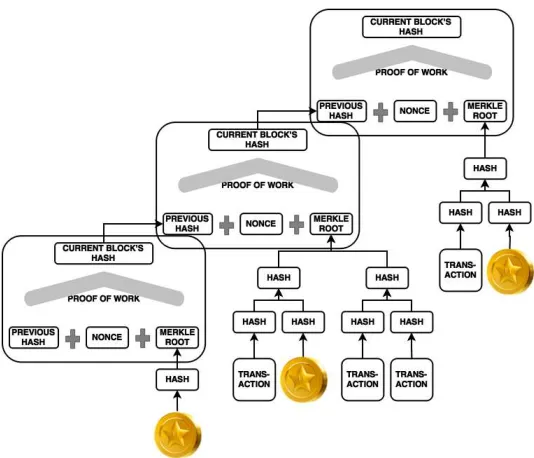
Figure 3: Collecting new transactions into blocks.
preventive and detective controls, and implements the decision-making process required at step 3 through a kind of consensus expressed by the nodes involved in the system. The following sections discuss each step in detail. The core protocol for the construction of a blockchain is illustrated in Figure 3.
3.4
Collecting new transactions into blocks
It’s a miner task to collect new transactions that are taking place on the network in the same time , and to assemble these transactions into a transaction block. In Bitcoin and other cryptocurrencies, miners are totally free to choose which transactions to include in their blocks. Most miners will consider any transac-tion that reaches them over the network, assuming it includes an appropriate fee, but nothing forces their choice. This freedom is intended to get resilience and performance of the system in case of network delays or faults, since new transaction broadcasts do not necessarily need to reach all miners, nor a miner has to wait for a minimum of transactions in order to start on working on a new block [3, 24]. Actually, it could be also the case that a miner with malevolent intentions will decide to mine a block composed of just the generation transac-tion, with the purpose of having a greater chance of getting that block inserted in the blockchain. As we will see later, there are very few deterrents to a such bad behavior, that would eventually result in lack of faith in the system (see
§3.6).
currently 1MB in the Bitcoin system [29]. Such limit was chosen as a tradeoff between constraints on peers resources and the throughput of the transaction management: a bigger limit would result in less nodes being able to mine or validate a full-size block, whilst a smaller limit would imply less transaction throughput [31].
In Bitcoin, the standard transactions T1, . . . , Th that a miner M chooses
to assemble into the current mining blockBc – alongside with the generation
transaction T0 – are processed by M in pairs 3
, in order to calculate a unique hash digest Dbc for all of them (root hash) thanks to a Merkle tree [32]. The
hash function used to generate the Merkle tree is SHA-256 [33], thus Dbc is a
256-bit string. The root hash is then recorded in the so-calledblock headerHcof Bc, alongside with the digestDp of the block headerHp of the previous (valid)
blockBp , where Dp is computed by applying twice SHA-256 to Hp. Besides
the 256-bit fields provided for storing Dp and Dbc, a block header consists of
the 32-bit fields version, time, bitsand noncefor a total of 80 bytes. The first three fields store the block version number, the current time in seconds since 1970-01-01T00:00 UTC and a string encoding the difficulty of the proof-of-work, respectively. Instead, thenoncefield is used to store (part of) a string representing the solution given by M to the proof-of-work (see §3.5) for Bc
[34, 35].
Notice that if a miner generates a block with one or more invalid transactions, whatever the error and the intentions are, then the other (honest) miners will not accept the new block. They will ignore it and continue trying to build a block on top of the last block they think is valid.
3.5
Mining of new blocks
In one form or another,miningis at the heart of any current blockchain-based system. Mining is indeed the way the system imposes a computational cost for the recording of new transaction blocks into the blockchain, so to mitigate the double-spending threat. An important point to stress here, since often misunderstood, is that the goal of a mining protocol does not actually consist in the determination of the miner in charge of block recording, but rather of the set of miners that are eligible for recording a new block in the blockchain (see
§3.6).
The mining protocol chosen in Bitcoin is similar to the (partial inversion) proof-of-work as described in [36], even if in this meaning it has new character-istics and purpose.
In a proof-of-work, a prover demonstrates to a verifier that she has performed a computational work in order to gain access to a resource. The original appli-cation for this type of protocols was in the context of being able to deter spam email, and the main idea was to require the prover to solve a moderately hard but easy to verify computational problem tied to a particular email message [37]. That is conceptually like affixing a postage stamp to a message: for a
3
legitimate sender who is only sending out a small number of messages such type of proof will not amount to very much computational effort, but for a spammer it might be prohibitively expensive.
The proof-of-work implemented in Bitcoin consists in the search for a peculiar hash digestD, calculated applying two subsequent SHA-256 toH, such that
D= sha256(sha256(H))≤τ , (2)
whereτis fixed by the system in a way that we will see later in this discussion, andH is the header of the block of transactions collected by minerM. As seen in §3.4, H consists of the same kind of double-hash digestDp of the previous
valid block header Hp, the root hash Db of the transactions collected by M in
the current working blockB, thenoncefield, and other minor fields. Thenonce
field is 32-bit long and is used for storing (the first part of) a stringN which the miner has to find in order to satisfy condition (2).
With the introduction of special purpose hashing hardware (see§4.1) thenonce
field in the header has become too small, and the workaround was to have an
extraNonce field in a generation transaction so that a solution N has to be found in a much larger string space. This makes the proof-of-work more costly and involved, sinceM must recompute the root digestDb each time it changes theextraNoncestring [35].
The solutionN of the proof-of-work is callednonce; the term was inspired by [38] and refers to the fact that, because of the properties of a cryptographic hash function,N behaves as a pseudo-random string as one or more of the proof-of-work’s parameters change.
A minerM to succeed in the search for aD satisfying (2) will writeN in the
nonceandextraNonce fields of its working blockB, and will broadcast B to the other peers for verification. The other miners in the system express their acceptance of the block by starting to work on the creation of a next block in the chain, therefore they use the digestD of the accepted block as one component of the block header of the new working block, as previously described.
Now the point is to understand how τ is fixed. Practically, the goal of finding aD < τ corresponds to the goal of finding aDsuch that it has a certain number of zeroes as first Hex digits. A SHA-256 digest is always 32 bytes or 64 hexadecimals long, so the probabilistic difficulty of the goal increases as this number of Hex zero digits increases, and therefore it increases inversely as τ decreases.
For example, if we need digests beginning with fifteen zeroes like:
0000000000000001b6b9a13b095e96db41c4a928b97ef2d944a9b31b2cc7bdc4,
thenτ will be the integer number whose Hex representation is given by:
0000000000000010000000000000000000000000000000000000000000000000.
As we are going to better explain in§4, Bitcoin’s proof-of-work is a way to get a valid and reliable transaction processing by ensuring that a set of peer nodes (the miners) compete in solving a computational challenge within a preset time. However, the problem to be solved is a kind of artificial puzzle of no practical concern (besides, of course, the existence of the network), which requires an increasing amount of computational resources over time, and where miners’ fitness is proportional to their hashing rate. In an attempt to overcome these limitations, some alternatives for implementing a requirement like (2) have been proposed over time, concerning both the underlying function used to compute D and the way τ is chosen. These alternatives were introduced mainly in an attempt to mitigate threats deriving from accumulators of hashing power. A single party, or a pool of them 4
could indeed invest in hardware equipment to obtain a substantial percentage of the total hashing power, and with such power they could succeed in double-spending by reversing the recent blockchain history. Or alternatively they could carry out a denial-of-service by refusing to include transactions in the block they generate, unless perhaps the transactions useful to their own purposes.
Although only a percentage greater than 50% of the total hashpower allows an attacker to get the mathematical certainty in subverting sooner or later the system [3], also attackers with a substantial minority of the total hashpower can plausibly attempt double-spending and denial-of-service attacks [3, 39].
Litecoin [40] makes use of a variant of Bitcoin’s proof-of-work that employs sCrypt [41] instead of SHA-256. sCrypt was originally designed as an alterna-tive to the iteraalterna-tive use of pseudo-random functions like MD5 [42] or DES [43] for deriving a key from a password/passphrase. Indeed sCrypt’s goal was to implement a pseudo-random function Ψ which is alsosequential memory-hard, i.e. such that:
• the fastest sequential algorithm for computing Ψ requires an amount of memory roughly proportional to the number of operations to be per-formed;
• it is impossible for a parallel algorithm to asymptotically achieve a signif-icantly lower cost in terms of both $ andsecsthan the fastest sequential algorithm.
This feature is used in Litecoin and a bunch of other cryptocurrencies [21] to
4
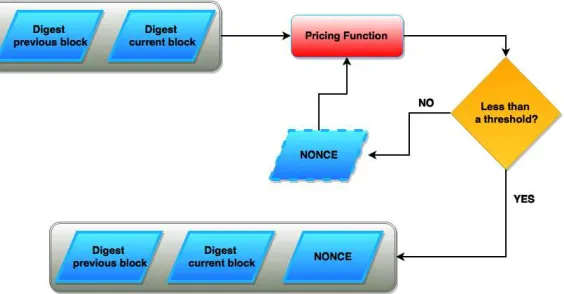
Figure 4: Given the digests of the current and previous blocks, the act of mining the current block is a process which consists in finding a nonce so that the value returned by a suitable pricing function is less than a parametrizable threshold. The output consisting in the association between the digests and the nonce actually represents what is indicated with “proof-of-work” or similar terms (e.g. “proof-of-stake”, ) in the literature.
hinder the use of specialized hardware, thus avoiding the side effects of the rapid shift in mining technologies observed for Bitcoin, as described in§4.
Cryptocurrencies that do not make use of Bitcoin’s proof-of-work - or its variants - commonly rely on theproof-of-stake approach to mining [44]. These are mechanisms that extend the chances in mining new blocks to the stake-holders of the system, with the aim to get a counterweight to hashpower. In a proof-of-stake mechanism the thresholdτ is indeed proportional to the number of coins owned by the miner at current time, meaning that a miner which owns e.g. 100 coins is 10 times more likely to create the new block than a miner which owns 10 coins. By itself this would result in “coin pile issue” similar to the hashing power trouble that a proof-of-stake is intended to mitigate, thus these mechanisms also include some other parameters to compensate such bad behaviour. For example, in the PeerCoin systemτis proportional tocoin age, a number derived from the product of the number of coins owned times the num-ber of days the coins have been held. An important difference here is that the hashing is timed in one digest calculation per second, and not more frequently; moreover it is possible to calculate it only once for each unspent coin in the wal-let [44]. In this way miners are not motivated in accumulating hashing power. However, this comes at the price of a (loose) time synchronization among nodes, which was presumably avoided in Bitcoin to overcome the difficulties of getting a trusted “global clock” without aTime-Stamping Authority[45].
Pricing functionswere introduced in [37], where a such function Π :X×Y →R
can be informally defined as satisfying the following properties:
1. Givenx∈X andt∈R, it is moderately hard to findy∈Y : Π(x, y)≤t; 2. for any (x, y)∈X×Y it is easy to compute Π(x, y);
3. Π is not amenable to amortization: for any finite set x1, . . . , xm ∈ X of
input values and corresponding threshold valuesτ1, . . . , τm∈R, the cost of
findingy1, . . . , ym∈Y with Π(xi, yi)≤ti on the whole set is comparable
to the total cost of findingyi: Π(xi, yi)≤tifrom scratch for each (xi, ti);
Requirement (3) means that there are no “shortcuts” in findingy: Π(x, y)≤t for multiple inputs and thresholds, also if these inputs and thresholds are strictly related. In other words, the solutionyof the search problem related to Π behaves like a random variable inY.
The sense of the workflow of Figure 4 is as follows: through a suitable pricing function Π and a tunable difficulty thresholdτ, a miner nodeM can give corroborate evidence to its peers that it found a solution to a moderately hard computational problem, and that its effort involved processing of the previous block in the blockchain alongside with the current transactions.
3.6
Blockchain updating
As we have described in §3.2.2 and illustrated through Figure 1, the chaining of a single transaction results in a quite complex graph, where a single input may branch in multiple transaction outputs, and multiple inputs may merge in a single transaction output. Things go better when transactions are assembled in blocks and these blocks are chained together to form the blockchain (see
§§3.4, 3.5). The blockchain has indeed a tree data structure: the genesis block is its root, each block is a child of the block it references, and it may be the case that a given block has more than one child, thus resulting in one or more branches in the chain. That sounds odd, since a single coherent history of transactions is desired, and each branch represents one different version of such history. However, it is consequence of the approach chosen to add a new block in current blockchain-based systems. Following [3], indeed, all these systems adopt an implicitly-defined majority decision, consisting in the fact that (honest) miners will spend their next mining work on the “longest chain”5
, that is the chain of blocks with the most mining effort in it. Such effort is measured as the sum of the difficulties that were required to mine all the blocks composing the chain [46]. In proof-of-work based systems, for example, the longest chain is the one with the longest string got by concatenating the “leading zeros” of all the proofs of work that were required to build the chain (see§3.5).
In order to better understand the process of updating a blockchain, it may be worth pointing out here the following circumstances.
5
• The majority decision mechanism described above is not mandatory, and the choice of the block to be referenced in the chain is actually left to each single miner. A minerM is just encouraged to adehere to the mechanism, on the basis of the fact that the longer is the chain linked to M’s new mined blockBM, the more are the chances thatM gets a reward for the
mining activity spent onBM. This design was presumably choosen in [3]
because it is really difficult to guarantee and ascertain the correctness of peers local processing, but – as we are going to discuss shortly – it is the root cause of the double-spending threat.
• The “longest chain” is not actually unique. Indeed, it may be the case that the same mining effort (e.g. the total number of “leading zeros”) corresponds to two or more chains that differs for some block and/or the block order. Thus, also assuming that all the miners follow the majority decision mechanism, branches are possible.
• Each branch must be internally consistent and can never include two con-flicting transactions; however, branches do not need to be consistent with one another, and one branch can include a transaction which contradicts a transaction in another branch.
• The blocks that will be incorporated in the blockchain are determined by the upshot of a sequence of mining activities and, ultimately, by the relative computing powers of all miners working at that section of the blockchain. As we will detail in§4, at least in the case of Bitcoin, this has given rise to a rude mining-hardware race which undermines the confidence of users in the cryptocurrency and its stability on the market.
Branching in a blockchain may result from the fact that different, honest miners are in temporary disagreement about which chain should be considered valid, as they found out different “longest chain”. That could happen, for example, because of network latencies or network outages.
However, secretly minining a branch is at the core of the double-spending attack. Indeed, in its essence a successful such attack consists in what follows. The attackerP broadcasts to the network a transactionTP in favour of the seller R. Then P mines a block which builds on the latest block Bl before the one
that eventually will contain TP, and which contains a conflicting transaction
˜
TP, i.e. a transaction which pays the amount of TP to another party than R (maybe P herself). P waits until R is confident in her payment and sends her the merchandise. In the meantime, P uses the secretly mined block to extend the chain in order to get a branch longer than the one known by the network. Finally, she release the secret branch to the network, thus overriding the payment in favour ofR.
inclusive [47]. Intuitively, the more confirmations a transaction has the more likely that it will remain in the chain permanently. Nakamoto’s paper [3] outlines the number of confirmations versus the relative hashpower of an attacker P, such that the probability of success ofP in a double-spending attack is less than 0.1%. From those calculations, it follows that ifPhas less than 10% of the total hashing power of the network, thenc= 6 confirmations are sufficient. However, ifP has a greater percentage of the hashing power, then an increasingly bigger number cof confirmations is required. For example, if P has 30% of the total hashing power, then c = 24 confirmations are required in order to limit the chances of a double-spending attack to less than 1 in 1000. IfP has more than 50% of the total hashpower, then sooner or later she will inevitably succeed in a double-spending attack; this is know as the “51% attack”.
4
Computational aspects
One important feature in the consensus mechanism implemented in blockchain-based systems is the unpredictability of the miner in charge of recording the next transaction block. First and foremost, this is useful to prevent frauds: with some degree of certainty, and for every single recording, no one should know in advance who would be the peer entitled to record the transaction. If that happened, a malicious user could do a denial-of-service attack against such peer to defraud her of the prize.
At the same time, that unpredictability results in an incentive for peers in doing mining, which is vital for a blockchain-based system. Although there are nodes that have some advantage with respect to others in finding the nonce, which ultimately depends on the specific mining approach in use, even the less fitted node has some chance of finding it (see§4.1).
Another important feature is the time-lapse mechanism implemented through the average time that the miners as a whole spend in mining a new block. In-deed, such average time is somewhat predetermined in each blockchain-based system, and this turns out in a synchronization mechanism for updating the blockchain on every single node in the system.
With this design in mind, and after fixing a specific mining approach, we want to discuss the following two issues: (i) the measure of performance in mining, and (ii) the way the system tunes the difficulty of mining in order to get the preset time-lapse for the blockchain update. In §4.1 we will analyze these two concepts to understand how computation is involved in the Bitcoin blockchain implementation.
4.1
Difficulty and performance in Bitcoin
digest, and at the same time establishing (almost randomly) the peer entitled for the block recording.
Since this is atrial and erroralgorithm, the more peers in the system participate to the race with a fixed τ, the shorter is the average time to find a correct solution. But we know thatt= 10 minutes is the predetermined time that the system should take to find a solution, and on average it should be met. This looks like asoft real-timesystem [48], but we think it is not, as the time expected to have a result should not significantly exceed 10 minutes, but it should neither be less than that.
When actualt <10 repeatedly for a number of blocks, then the system increases the difficulty to make the interval longer, that means the thresholdτin (2) must be lower for the next blocks. As we told in§3.5, lowering the threshold of one single level in Bitcoin corresponds to add one leading zero to the Hex string encoding the previous threshold value or, equivalently, to shift its single “1” digit from positionz to z+ 1. In turn, it can be shown that – at least under the assumption that the hash function is well balanced6
[49] and z ≥10 – the above shift results in a proof of work which is probabilistically harder than the previous one by a factor very close to 216
= 65536.
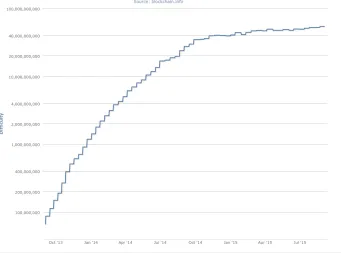
In Figure 5 we can see how the implemented difficulty increased over the last two years. This is referable to two distinct facts:
• the growth in the number of competitors to the race, due to the diffusion of the currency and to the prize offered;
• the growth of the performance of the single computational resource, due to the usage of better hardware.
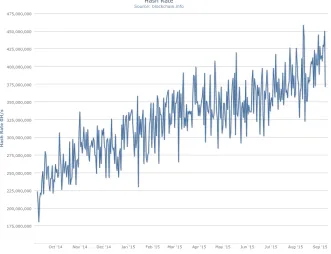
But what is the parameter used for performance measuring in this context? The SHA-256 hash function does not need all the features available in a complex Instruction Set Architecture, as the ones equipped in general purpose comput-ers. Therefore a new appropriate parameter for evaluating the performance of an hashing system has been introduced: the hash-rate, currently measured in GigaHash per second (GH/s).
In Figure 6 we can notice that the global hash-rate of Bitcoin is oscillating in a daily order, depending mainly on the number of participating clients in the global competition, while the trending growth is due to improving computing systems.
But where does this improvement lie in the Bitcoin mining systems?
As we have shown, the solution to our problem can be found through a trial and error algorithm. This immediately leads to the probabilistic observation that the more calculating units the client has, the better chances to win the race. In fact, in the short lifetime of this cryptocurrency, we have seen a shift in terms of technologies used for the computing resources in the mining competi-tion, from single core to multicores, then GPUs, and FPGAs, to end up with ASICs.
6
Technology Device Mhash/s W $ Mhash/s/$ Mhash/J
CPU - Intel Core i7 3930k 66.6 130 670 0.10 0.51
CPU - AMD 4x Opteron 6174 115 320 220 0.52 0.36
Coprocessor
Intel Xeon Phi 5100 140 225 4000 0.03 0.62
GPU - Nvidia Tesla S2070 749.23 900 3000 0.25 0.83
GPU - AMD
(ATI) 5870x6 2568 1200 300 8.56 2.14
FPGA Butterflylabs Mini Rig 25200 1250 15295 1.64 20.16
ASIC AntMiner S5 1155000 590 370 3121 1957
ASIC Spondooliestech SP35 Yukon 5500000 3650 2235 2460 1506
Table 2: Illustrative comparison of different hashing technologies [50, 51]. Mhash/s stands for million hashes per second. W is for watt. $ is the estimated cost at the time when the device has been put on the market. Mhash/s/$ is the performance per dollar. Mhash/J is the throughput per watt.
This is the effect of the quest for the correct solution, or - using a nostalgic pleasant term - the Nonce Rush. Anything looking like something useless is sacrificed in the name of the hash-rate. Multicores had a short life since they were not efficient horse carriages. GPUs had a fancy number of lightweight cores working well (with differences due to the hardware implementation of the instructions) but soon they lost appeal. In fact all these technologies seemed like wasted money since someone had the idea to build specific hardware to compute uniquely the double SHA-256 hash function required to check (2). It resulted to be very fast with FPGAs, and incredibly fast with the introduction of ASICs.
As we can see in Table 2, the convenience of using specialized technologies does not lie just in the computing speed, but also in device cost and power consumption. In fact we have to remark again that Bitcoin mining is a computational race based on casualty and attempts. The key to win virtual coins -which are actually usable to buy real goods - is to have the fastest and overall less expensive computing units. Spending thousands dollars without improving the chances to win the race is a terrible investment.
At the same time, if Ms. Smith would decide to make a good investment today by buying the fastest ASIC available, the repayment plan could not be success-fully accomplished: in fact a new technology could arise and a certain number of investors could decide to rely on it, making Ms. Smith hardware obsolete and unfit to win any competition.
4.2
Making it useful
While some supporter of Bitcoin argue that the costs of the current mining system is a fraction of the costs to maintain the real material currencies, some alternative initiatives are spreading.
An example of such a different proof-of-work algorithm is proposed in Prime-coin [52], where the computing time is used to find prime numbers chains known as Cunningham chains and bi-twin chains, both of high scientific interest. This proof-of-work has the property of being efficiently verifiable, through the Fermat test [53] of base 2 together with Euler-Lagrange-Lifchitz test [54], which verify probable primality for the prime chains. Also difficulty can be implemented using the remainder of Fermat test, so that an approximately linear continuous difficulty curve can be constructed for a given prime chain length.
Some developers proposed to use distributed computing tools like folding@home or SETI@home for the currency mining, so that the user computations could be somewhat useful in the cure of protein misfolding diseases or in the search for signals of alien intelligence in the universe.
However the point is that a consensus-based blockchain needs an efficiently ver-ifiable proof-of-work, like SHA-256, but folding@home and SETI@home do not have such a property. Since now, the participants in the protein folding and SETI networks were volunteers, with probably no intentions other than actu-ally help the goal of the project. If tied to a currency mining, these networks could be weakened by participants searching for profits, not bothered with the actual computations. Instead those miners could be prone to provide fake data that has no value to the humanitarian goals, but that is likely indistinguishable from a genuine output.
Actually there are working implementations of cryptocurrency connected to a protein folding network (CureCoin [55]) and to the BOINC distributed scientific computing network (Gridcoin [56]). In these currencies the research networks are not used for a decentralized consensus, but rather interconnected to another proof-of-work or proof-of-stake system to allot a credit based on the research work done. Let’s take CureCoin: in this system the security of the currency is entrusted by nodes running SHA-256 like in Bitcoin, but there is a percentage of the daily mined CureCoins that are granted to the foldinghome participants in the system. Indeed those involved in the research job get 76% of the total coins, while blockchain maintainers get another 19%. Finally there is also a sort ofdevelopment tax: 2% of the total mined coins are distributed to people who donated to project development, while the remaining 3% is reserved to Curecoin developers, and will be used for compensating development costs and for community care. Let us say this would be a fair reward scheme, but it is significantly more centralized than the original Bitcoin one, and probably less resistant to fraud attacks.
not really care on the costs incurred in the maintenance of working currency, or better she is interested in her direct costs (interest rates, etc.). On the other hand, when talking about mining and making computing power available, some user would prefer to give her hardware to some higher purpose than to a con-sensus mechanism.
Finally in our view the Nonce Rush implemented in Bitcoin does not have any sense when thinking of a blockchain uncoupled from a currency, as it implies an enormous waste of computing power for mostly useless and costly calcula-tions.
5
Conclusions
Nowadays Bitcoin is at the highest international interest because of the prospects both on opportunities and risks. At the time of writing, it has an estimated market capitalization of about 4 billion USD [57], while there is a pletora of alternative cryptocurrencies that try to emerge proposing their specific charac-teristics. If not enough, a new generation of systems relying on concepts and technologies inspired by those of Bitcoin are emerging. All this makes the focus on the features of the blockchain-based systems extremely interesting. There are a number of advantages inherently embedded in these systems. First of all they generally exclude any central authority, avoiding in this way a single point of attack. Besides that, they represent an attempt to coniugate both transac-tor’s and recipient’s privacy with trusted, publicly verifiable transations. All this is possible thanks to protocols that combine different cryptographic prim-itives and schemes into innovative designs, and which in turn pave the way to new very interesting applications with an high impact on society. When talking about currencies, even more advantages emerge. For example merchants are motivated to accept cryptocurrencies because fees are lower than the 2%−3% typically imposed by credit card processors, and futhermore these fees are usu-ally self-imposed and paid by the purchaser, not the vendor.
But at the same time some weaknesses are evident. If the theory behind dependable and secure computing is quite young, as it has only been developed at the beginning of this century [58], then the theory on cryptocurrencies is in its infancy, and no one knows if important issues will arise in the near future. Actually at present time blockchain-based systems can be seen as “moving tar-gets”, above all Bitcoin. Several security threats exist (e.g. 51% attack, other double spending attacks, wallet theft) and from time to time some new vulner-ability is spotted, even if the current practice with these system (Bitcoin, first of all) is encouraging and it indicates that there is a successful effort to face attacks or recover from critical mishaps [59].
similar cryptocurrencies) in “main street” stores, restricting its usage range pri-marily to on-line vendors with postponed delivery services. Another important criticism is about mining costs. Indeed the mining problem is actually a kind of artificial puzzle of no practical concern (besides, of course, the existence of the network), which requires an increasing amount of computational resources over the time. Current alternatives to the Bitcoin proof-of-work can mitigate in a way the Nonce Rush escalation experienced in these last few years (see
§§3.5 and 4.1), but all the blockchain-based system to date use a considerable amount of electric energy in order to perform computing tasks at the sole scope of mining. Some statistics on Bitcoin report that - at the time of writing - the network hashrate would be equivalent to 6809823.32 petaflops, which is more than 200000 times China’s Tianhe-2, the fastest supercomputer in the world [60]. Of course such comparison is not significant in term of the actual abil-ity to solve computational problems, as Bitcoin’s mining does not rely - if not perhaps marginally - on floating point operations, nor are its hash calculations used to solve any problem beside that of mining. But it gives an idea of the tremendous amount of operational energy for these kind of networks when de-ployed on a large scale. Some examples of useful proof-of-work calculations and mining exist, but are limited to specific problems or rely on complex and maybe vulnerable protocols.
In a future work we will show that the use of a workflow like that depicted in Figure 4 is actually a main misconception in blockchain-based systems. We also intend to introduce an alternative system where a computational problem of “public interest” can be solved decoupling it from the system management, as well as from the (optional) currency management and mining. This approach aims to be a more efficient solution when compared to the other currently avail-able systems.
References
[1] Stephanie Condon. Judge spares e-gold directors jail time. http://www. cnet.com/news/judge-spares-e-gold-directors-jail-time/, 2008. Accessed: 2015-10-14.
[2] Jack Cloherty. ’black market bank’ accused of launder-ing $ 6b in criminal proceeds. http://abcnews.go.com/US/ black-market-bank-accused-laundering-6b-criminal-proceeds/ story?id=19275887, 2013. Accessed: 2015-10-14.
[3] Satoshi Nakamoto. Bitcoin: A peer to peer electronic cash system.
https://bitcoin.org/bitcoin.pdf, 2008.
[4] Nick Szabo. Formalizing and securing relationships on public networks.
[5] Vitalik Buterin. Daos, dacs, das and more: An incomplete terminology guide. https://blog.ethereum.org/2014/05/06/ daos-dacs-das-and-more-an-incomplete-terminology-guide/, 2014. Accessed: 2015-07-20.
[6] Aaron Wright and Primavera De Filippi. Decentralized blockchain technol-ogy and the rise of lex cryptographia. http://papers.ssrn.com/sol3/ papers.cfm?abstract_id=2580664, 2015.
[7] Melanie Swan. Blockchain: Blueprint for a New Economy. ” O’Reilly Media, Inc.”, 2015.
[8] Kevin Delmolino, Mitchell Arnett, and Ahmed Kosba. A program-mer’s guide to ethereum and serpent. https://mc2-umd.github.io/ ethereumlab/docs/serpent_tutorial.pdf, 2015. Accessed: 2015-06-08. [9] Solidity documentation. https://solidity.readthedocs.io/en/
develop/. Accessed: 2015-06-08.
[10] Icann (internet corporation for assigned names and numbers). https:// www.icann.org/. Accessed: 2015-07-14.
[11] V. S. Ramaswamy and S. Namakumari. Marketing Management: Indian Context with Global Perspective. MacMillan, 2013.
[12] Namecoin website. https://namecoin.org/. Accessed: 2015-07-14. [13] Ethereum development tutorial. https://github.com/ethereum/wiki/
wiki/Ethereum-Development-Tutorial. Accessed: 2015-07-20.
[14] Bitcoin wiki: Smart property. https://en.bitcoin.it/wiki/Smart_ Property. Accessed: 2015-11-27.
[15] Bitcoin wiki: Colored coins. https://en.bitcoin.it/wiki/Colored_ Coins. Accessed: 2015-08-10.
[16] Proof of existence website. http://www.proofofexistence.com/. Ac-cessed: 2015-06-13.
[17] Adept live demo.https://www.youtube.com/watch?v=U1XOPIqyP7A. Ac-cessed: 2015-07-20.
[18] telehash home page. http://telehash.org/. Accessed: 2015-11-27. [19] Bittorrent home page.http://www.bittorrent.com/. Accessed:
2015-11-27.
[20] Bitcoin wiki: Script. https://en.bitcoin.it/wiki/Script. Accessed: 2015-07-21.
[22] D. Cooper, S. Santesson, S. Farrell, S. Boeyen, R. Housley, and W. Polk. Internet x.509 public key infrastructure certificate and certificate revocation list (crl) profile. http://tools.ietf.org/html/rfc5280, 2008.
[23] Alfred J Menezes, Paul C Van Oorschot, and Scott A Vanstone. Handbook of applied cryptography. CRC press, 2010.
[24] Bitcoin developer guide. https://bitcoin.org/en/developer-guide. Accessed: 2015-07-14.
[25] Don Johnson, Alfred Menezes, and Scott Vanstone. The elliptic curve digital signature algorithm (ecdsa). International Journal of Information Security, 1(1):36–63, 2001.
[26] Hans Dobbertin, Antoon Bosselaers, and Bart Preneel. Ripemd-160: A strengthened version of ripemd. InFast Software Encryption, pages 71–82. Springer, 1996.
[27] Bitcoin block explorer. https://blockexplorer.com/. Accessed: 2015-07-13.
[28] The explorer for the ethereum blockchain. https://etherchain.org/. Accessed: 2015-07-20.
[29] Bitcoin wiki: Protocol documentation. https://en.bitcoin.it/wiki/ Protocol_documentation. Accessed: 2015-07-14.
[30] Turing completeness. https://en.wikipedia.org/wiki/Turing_ completeness. Accessed: 2015-11-29.
[31] StephenM347. Bitcoin@stack exchange: What’s the purpose of a maximum block size? https://bitcoin.stackexchange.com/questions/37292/ whats-the-purpose-of-a-maximum-block-size/37303#37303. Ac-cessed: 2015-07-25.
[32] Ralph C. Merkle. A digital signature based on a conventional encryption function. InAdvances in CryptologyCRYPTO87, pages 369–378. Springer, 1988.
[33] Carlos M. Gutierrez and Patrick Gallagher, editors. SECURE HASH STANDARD, volume 180–3 of Federal Information Processing Standards Publication. National Institute of Standards and Technology, 2008.
[34] Bitcoin wiki: Block hashing algorithm. https://en.bitcoin.it/wiki/ Block_hashing_algorithm. Accessed: 2015-07-25.
[36] Markus Jakobsson and Ari Juels. Proofs of work and bread pudding proto-cols. InProceedings of the IFIP TC6/TC11 Joint Working Conference on Secure Information Networks: Communications and Multimedia Security, CMS ’99, pages 258–272. Kluwer, B.V., 1999.
[37] Cynthia Dwork and Moni Naor. Pricing via processing or combatting junk mail. In Advances in Cryptology - CRYPTO92, pages 139–147. Springer, 1993.
[38] Phillip Rogaway. Nonce-based symmetric encryption. In Bimal Roy and Willi Meier, editors, Fast Software Encryption, volume 3017 of Lecture Notes in Computer Science, pages 348–358. Springer, 2004.
[39] Meni Rosenfeld. Analysis of hashrate-based double spending. arXiv preprint arXiv:1402.2009v1, 2014. http://arxiv.org/abs/1402.2009v1. [40] litecoin website. https://litecoin.org/. Accessed: 2015-07-20.
[41] Colin Percival. Stronger key derivation via sequential memory-hard functions. http://www.bsdcan.org/2009/schedule/attachments/87_ scrypt.pdf, 2009.
[42] Ronald Rivest. The md5 message-digest algorithm. http://tools.ietf. org/html/rfc1321, 1992.
[43] William M. Daley and Raymond G. Kammer, editors. DATA ENCRYP-TION STANDARD (DES), volume 46–3 ofFederal Information Processing Standards Publication. National Institute of Standards and Technology, 1999.
[44] Sunny King and Scott Nadal. Ppcoin: Peer-to-peer crypto-currency with proof-of-stake. https://peercoin.net/assets/paper/peercoin-paper. pdf, 2012. Accessed: 2015-07-20.
[45] Akira Takura, Satoshi Ono, and Shozo Naito. A secure and trusted time stamping authority. In Internet Workshop, 1999. IWS 99, pages 88–93. IEEE, 1999.
[46] Pieter Wuille. Bitcoin@stack exchange: What does the term “longest chain” mean? http://bitcoin.stackexchange.com/questions/5540/ what-does-the-term-longest-chain-mean/5542#5542. Accessed: 2015-11-29.
[47] Joshua Kolden. Bitcoin@stack exchange: What are bitcoin “con-firmations”? http://bitcoin.stackexchange.com/questions/146/ what-are-bitcoin-confirmations/160#160. Accessed: 2015-11-29. [48] Hermann Kopetz. Real-Time Systems: Design Principles for Distributed
![Table 2:Illustrative comparison of different hashing technologies [50, 51].Mhash/s stands for million hashes per second](https://thumb-us.123doks.com/thumbv2/123dok_us/7919265.1314965/27.612.131.478.122.227/table-illustrative-comparison-dierent-hashing-technologies-mhash-million.webp)
