Survey on Soft Computing based
Call Admission Control in Wireless Networks
Mahesh G1, Yeshwanth S2, Manikantan U V3
1
Associate Professor, 2 3 M.Tech Student Department of Information Science and Engineering,
Acharya Institute of Technology, Bangalore
Abstract: Call Admission Control (CAC) is a challenging
problem in wireless networks, the objective of which is to guarantee agreed upon Quality of Service (QoS) to the users. CAC directly controls the number of users in the system and as the number of channels in the system is limited, CAC must be carefully designed. Soft Computing (SC) techniques like Fuzzy Logic (FL), Neural Networks (NN) and Genetic Algorithms (GA) are used to get optimized results in CAC. Choosing the apt SC technique from these three techniques is often challenging task. In this regard an effort is made to present a survey on these three SC techniques.
Keywords: Call Admission Control, Soft Computing, Neural Network, Fuzzy Logic, Genetic Algorithm.
I. INTRODUCTION
The wireless communication field is rapidly growing. Potential research opportunities plus already initiated research activities in this area are abundant. The primary objective of CAC mechanism is to decide whether a new call must be admitted into the network or not. When a new call request is made, CAC checks the current network condition which could be free or slightly impeded or fully impeded and based on this a decision is made whether to accept / reject the call. This decision impacts the QoS of the new call and also the existing calls in the network. Hence a new call must be accepted only if its QoS constraints are fulfilled without affecting the QoS constraints of the existing calls in the network or else it must be blocked. SC is a collection of computational techniques in computer science, machine learning and some engineering disciplines, which focuses on Studying, Modeling and Analyzing very complex phenomena. SC with the use of computation, reasoning and inference reduces computational cost by exploitation of tolerance to imprecision, uncertainty, partial truth and approximation while the conventional modeling techniques demands precision, rigor and certainty and have high computational cost. In addition to computational cost savings, SC is an excellent platform for autonomic computing, owing to its roots in Artificial Intelligence [1].
SC is used to solve problems whose solutions will be in an approximation form rather than an exact form. It differs from hard computing or conventional computing in a way that it can accept results even if it is partially or approximately true. Hence SC can play an important role in CAC where sometimes decision of call admission must be taken using partial results. The decision can be like
accepting or rejecting a new call in the cell, prioritizing the handoff call in the cell etc.
The role of SC in the domain of wireless networks can be classified into three broad categories, namely, optimization, prediction and uncertainty management [1]. The main components of SC include evolutionary computing, FL, NN and GA. Each of these methods has their own ability to compute while solving the problems. Optimization is handled by evolutionary algorithms. Prediction tasks are handled by NN and other learning algorithms and uncertainty management for incomplete modeling and insufficient measurement are handled by FL. For CAC in wireless networks FL, NN and GA are being used and in this paper a survey of these three SC techniques is presented.
II. FUZZY LOGIC
FL developed by Zadeh, is a methodology for representing uncertain and imprecise knowledge. The meaning of term ‘fuzzy’ is- “not certain or inexact”. FL is used to solve problems whose solutions are not in the form of true or false rather solution exists in a range.
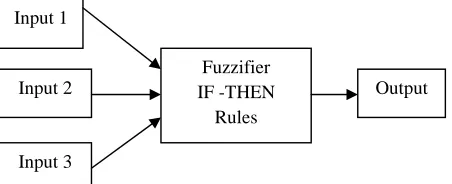
FL mainly works in the form of IF - THEN rules. Two or more input values are sent to fuzzifier and an approximate result is derived from it. In CAC, FL is used for decision making when a new call or handoff call request is received. The new incoming calls or handoff calls are classified into very high, high, low and very low based on the signal strength of the each calls. Inputs are fed to the fuzzifier and later based on the results obtained from the fuzzifier, calls having very high, high and low signal strength are accepted and calls having very low signal strength are rejected or dropped from the network. The main advantage of using FL during the call admission process is that, calls having even low signal strength are also accepted. So using FL the problem of call blocking or call dropping can be minimized to certain extent.
Figure 1: Basic Fuzzy Logic Model
Input 1
Input 2
Input 3
Fuzzifier IF -THEN
Rules
A fuzzy CAC scheme is presented by Yufeng in [2], which guarantees the quality of service provision in wireless networks by searching automatically the optimal number of guard channels in a base station for effective utilization of resource. Simulation results show that the proposed fuzzy CAC performs better by increasing the resource utilization of the network. The fuzzy scheme has better robust performance when compared to adaptive channel reservation.
In [3], Paolo proposes a FL based CAC for Wideband Code Division Multiple Access (WCDMA), mainly Universal Mobile Telecommunication System (UMTS). The performance of the proposed fuzzy CAC has been compared with other algorithm like Interference Admission Control. Here simulation results shows that fuzzy based CAC gives better services in terms of call dropping ratio and transfer delay for services accepted by the network. A FL based power control for WCDMA Wireless Networks is proposed in [4] by Mohan. This proposed technique is aimed at multiple services like voice, video and data for multiclass users [4]. The fuzzy based CAC here is based mainly on three parameters viz. type of service request, total load factor and total power. These three parameters are taken as input to form fuzzy rules. The output is given in the form of fuzzy variables which indicates the acceptability of the new call. Then defuzzification is done to obtain a crisp value of the output. By simulation experiments, it is shown that the proposed FL based CAC reduces energy consumption for a cell with increased throughput.
Radio Resources Management (RRM) functions are used in CDMA to deal with the capacity issues. RRM is the main technique behind supplying optimum coverage, thereby providing the maximum planned capacity and using of the physical resources in an efficient way. In [5], Petr propounds the admission control techniques for UMTS which included a UMTS system model and four FL based admission control algorithms. The simulation results shows that fuzzy algorithm outperforms the other algorithms like Algorithms with Simple Prediction of User Equipments (UEs) Positions based on various parameters such as blocking probability, dropping probability and the number of active UEs in cell.
The Michael in [6] proposes a FL based solution for admission control which efficiently utilizes the resources. The described FL limits the effect of crisp binary admission decision and also the worst case of assumption on traffic behavior. The admission request is decided based on a collective set of fuzzified QoS parameters that foresee the required resource utilization. It is based on the principle of mapping qualitative and quantitative QoS parameters into a single decision metric. The proposed admission control has been assimilated into the Universal Plug and Play (UPnP) QoS architecture. Simulation results indicate that by using FL, the QoS can be improved up to 40% while maintaining an acceptable amount of packet loss.
The concept of a CAC for reverse link transmission can be achieved by using FL in WCDMA. The principle behind the fuzzy CAC is that it follows the estimation of the
effective bandwidth of the call request from the Mobile Station (MS) and its corresponding information about mobility and takes a decision whether to accept or reject the connection request. Such type of decision is loosely dependent on resource availability of the system [7].To illustrate the advantage of the propounded fuzzy CAC mechanism, numerical results are provided in terms of new call blocking probability, probability of handoff call dropping , probability of outage and resource utilization. In [8], a new admission control algorithm for General Packet Radio Service (GPRS) / Enhanced General Packet Radio Service (EGPRS) networks is presented. It is based on an efficient way to cope with the problems arising by the complexity of traffic flow of data and how to meet the QoS requirements for data users, as we evolve from second generation to the third generation cellular systems. In order to achieve an efficient algorithm for admission control in GPRS/EGPRS the basic methodology used here use was Fuzzy if-then rules.
In [9], the propound idea is about FL based CAC. The mechanism involves partitioning of the total bandwidth into three constant bit rate, variable bit rate and handover (HO). FL mainly deals with the HO partition so as to keep the probability of call dropping as low as possible for the available bandwidth. The simulation results shows that FL based CAC performs better when compared to Partition based CAC and Conventional Bandwidth based CAC.
III. NEURAL NETWORKS
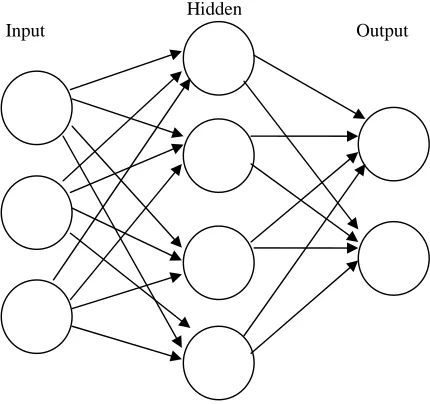
NN are primarily computational or problem solving models which are derived from architecture of the human brain or the central nervous systems. It is modeled in the form of the neurons which are connected to each other. These neurons calculate the results from the inputs which are derived from the network. For example if a network topology is to be setup, all available inputs specific to topology is given into the neurons. Due to this input certain neurons are activated and the results are derived from it. Thus obtained results are fed into other neurons and the subsequent results are obtained from it, this process continues till the final result is obtained. The end result is to describe an efficient topology for the available resources. The area in which NN are widely used are like speech recognition, pattern matching and computer vision.
Hidden
Input Output
Figure 2: Basic Neural Networks Model
Ernst in [10] proposes an Artificial Neural Network (ANN) model for the CAC in ATM networks. Three different ANN models are proposed, all of which concentrate on the implementation of link QoS formula, based on the heterogeneous fluid flow queuing model. The first model uses predefined peak rate parameters, where as the second model is based on a state interpretation of aggregated link traffic, and the third model employs a form of statistical pre–processing of the traffic parameters [12]. All the three models help in computation of accurate cell loss in the heterogeneous fluid flow model.
The natural problem of increasing or maximizing the acceptance of the calls into the network is done using the dynamic programming problem, but it is too complex. Therefore in [11] a Neuro-Dynamic programming which includes decomposition approach is being introduced. Here methodology of neuro-dyanamic programming (NDP) and reinforcement learning (RL), along with a decomposition methodology to develop a dynamic (state-dependent) CAC and routing policies is being introduced. The policies here mainly depend on the state dependent link costs. This is followed by a simulation based learning method which is employed to tune up the parameters that define the link costs. A range of experiments indicates the robustness of the proposed policy and the performance is compared with a commonly used heuristic.
Dakroury in [12] proposes an ANN technique for the adaptive CAC in ATM networks. In the proposed mechanism the controller decisions does not depend on the traffic descriptor registered between the network and the terminal, instead the controller monitors the current traffic state and adapts its decisions according to it. Later the leaky pattern table is slightly modified to enable the neural network to capture traffic variations more accurately and the proposed controller is tested with multimedia traffic by taking node buffer into consideration. The results show that the proposed neural network controller gives better results than other CAC mechanisms that depend on the traffic descriptors.
In [13], Hah present an efficient NN based CAC mechanism for ATM networks with heterogeneous arrivals. Here all the calls are initially categorized into various classes. Based on the number of calls in each class, CAC efficiently and accurately estimates the cell delay and cell loss ratio of each class in real time by means of a pre-trained NN [13]. The author here has constructed a training data from a heterogeneous arrival dual class queuing model representing the Bernoulli process and Interrupted Bernoulli. Simulation results confirm the analytical results of the queuing model. Later these results are profoundly compared with the estimated NN results to justify the viability of the proposed CAC mechanism.
A CAC problem has been presented by Senouci in [14] for a multimedia cellular network. Here the network serves several classes of traffic which have different resource requirements. The main aim here is to solve the Semi-Markov decision process problem. Therefore a real time Neuro Dynamic Programming (NDP) algorithm is being proposed to solve the Semi-Markov problem in multimedia cellular network. Simulation results shows that the proposed policies give better robustness when compared to traditional solutions like guard channel.
In [15], the CAC for a single link in an integrated service is improvised as a Markov Decision problem. The methods of dynamic programming form the principle for computation of optimal admission control. Dynamic Programming algorithms become increasingly infeasible when the Markov chain grows exponentially with respect to number of customers classes. This can be overcome by means of an advanced methodology of NDP. NDP comprises of simulation based algorithms and techniques related to function approximation. These technologies are used to find control methods for high scale Markov Decision Problems. The NDP methods for CAC include the TD (0) algorithm and Approximate Policy Integration. The performance of these methodologies can be analyzed by comparing two heuristic policies. The first one deal with the policy which always accepts the customer newly coming to the network and the second one is the threshold policy.
The use of wireless network resource mainly depends on the mobility of network users in large part. The network can predict the resource use in future and accordingly can take precautionary measures if necessary [16].This can be achieved through a NN prediction system which has the ability to grasp the patterns shown by users moving in a particular wireless environment and accordingly again can forecast the future behavior of users in the network. This can be used to ensure proper and predictable resource usage. Simulation results based on Multiple prediction methods were tested and the corresponding result shows that the prediction mechanism is quite successful in some scenarios, but not in others.
IV. GENETIC ALGORITHM
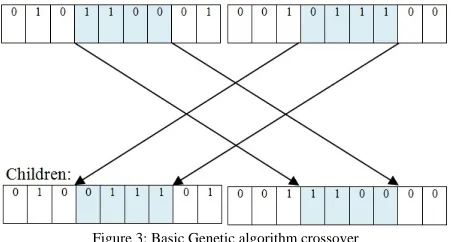
like inheritance, mutation, selection and crossover. Here the input data are collected and sent to the GA, and later the end results are obtained. The end results can be derived in different ways like inheritance and mutation. In inheritance the input data will have direct impact on the end result as it has strong connection with it and in mutation sudden changes are calculated to arrive at end results. Later in crossover two or more results are crossover or exchanged to arrive at the end result. In selection process, only the right one or correct one is selected to obtain a final result. By combining this entire process, the NN solves the problem in a faster rate compare to other methods.
In CAC the GA is used mainly to reduce the call dropping or rejection into the network. Here the new incoming calls or handoff calls are collected and sent to the GA for decision making. The GA using the process of inheritance, crossover, mutation and selection decide whether the calls should be rejected or accepted into the network. The main advantage of using GA in CAC is that, the decision taken is faster than the tradition methods. So using GA the problem of calls dropping or rejection can be reduced to a certain extent.
Figure 3: Basic Genetic algorithm crossover
The GPRS is one of the leading technologies and for successful functioning of this technology major role played is by QoS of the GPRS. It covers areas like traffic scheduling, traffic shaping and CAC techniques. In [17] the author explains an efficient CAC technique for GPRS using the GA. The proposed technique is a novel dynamic admission control and scheduling technique based on GA for different service classes. The described CAC and scheduling criteria is based on 3 parameters viz. dynamic queue length, frequency of resources allocated and QoS index of each service class. The simulation results shows that the proposed algorithm accomplish efficient resource allocation among diverse service classes for GPRS system. Therefore the proposed GA based CAC and scheduling algorithm gives an enhanced control on resource allocation compared to the existing methods like Earliest Deadline First (EDF) and First in First out (FIFO).
Aylin in [18] proposes local CAC polices for one dimensional and two dimensional cellular networks based on partial state information. A best local algorithm is determined using the GA. This algorithm is tested on a large system and results show that it outperforms other local CAC polices in case of maximum packing and best handoff reservation policies for the given system. The final results shows that the determined GA based one
dimensional and Manhattan model always performs better compare to best trunk reservation polices.
In ATM networks the CAC plays a major role during the resource reservation for calls requiring guaranteed services. Especially in case of the multimedia call like video, audio and data the ATM networks has its own QoS requirements like cell loss rate, delay, jitter, etc. So network attempts to deliver this required QoS by allocating a suitable amount of resources to the required multimedia call. Sherif in [19] proposes and analyzes an adaptive allocation of resources algorithm based on GA. The algorithms’ QoS acceptance range is preset as high, medium and low instead of just a single one. As the availability of resources in the wireless network varies, the algorithm selects the best possible QoS level and later solves the optimization problem using GA. Simulation results display that the proposed adaptive algorithm performs well in terms of increasing the number of admitted calls while utilizing the accessible bandwidth reasonably and effectively [19].
In [20] an adaptive threshold-based CAC scheme used in wireless/mobile network for multi-class services is proposed. In this described scheme each class’s CAC thresholds are solved by establishing a reward penalty model. This also tries to maximize network’s revenue in terms of each class’s average new call arrival rate and average handoff call arrival rate, the reward or penalty when network accepts or rejects one class’s call [20]. A real time running of CAC algorithm based on GA is described and compared with Mobile IP Reservation (MIR) scheme. Simulation results show that it performs superior when compared with MIR in terms of average call arrival rate, the average new call blocking probability and the average handoff dropping probability.
M/M/C/C queuing system modeling with m classes of users can be used to model the CAC in a wireless cell in personal communication system. A channel utilization optimization Semi-Markov Decision Process (SMDP) can be used with upper bounds on blocking of handoff with QoS as constraint. But disadvantage of such methodology is that it consumes too much time and gradually fails when state and action space are huge. Therefore in [21] a GA methodology is being proposed which address the situation when the SMDP fails. In this methodology the CAC decisions are coded as binary strings where a value of ‘1’ in the position i(i=1,……m) of a particular decision string points to the decision of accepting a call in the class-I. A value of ‘0’ in the position of ‘i’ points to the decision of rejecting a call in class-i. Then propound GA comes into play as the coded binary string are fed in to them and correspondingly the resulting binary strings are optimized. Results from simulation tools for NN are then compared with the optimal solutions of SMDP methodology. The simulation result approximates the fact that the GA is able to obtain optimal approach with less complexity.
allocation (DCA) is used to avoid traffic modeling for audio/video conferences. This methodology is combined with the advanced concept of GA for management of time and for predicting exact value and results. Advantage of such concept is that it ensures High QOS to wireless Audio/video conference users.
In CDMA the total number of valid and possible sessions does not have a constant value and hence normally called soft capacity. The interference level decides the capacity of the CDMA system. It is the RRM (Radio Resources Management) function which ensures optimum coverage and efficient utilization of physical resources. It also ensures the maximum planned capacity. In [23] various algorithms that are used for Admission control especially in UMTS are compared. Different types of algorithms based on FL, GA and load factor based algorithm are compared via simulations.
V. CONCLUSION
The paper presents a review of SC techniques with prime focus for CAC. Here GA has proved to be a boon for the quality index, fuzzy decision maker is considered best in its section and NN is the best solution for control prediction and classification. But due to complex nature of wireless communication networks many issues crop up one of them is call dropping or call rejection in the network. By using SC techniques like FL, NN and GA the problem of call dropping or rejection can be reduced to a greater extent. But all the three techniques have their own limitation so by combining any two or all the three methods, a better method can be derived. This combination can help to overcome limitations of each SC techniques and can help produce an appropriate result, which will help to have better Quality of Service in the sphere of wireless communications.
REFERENCES
[1] Matthew K. Luka and Aderemi A. Atayero, “Applications of Soft Computing in Mobile and Wireless Communications”, Covenant University, Ota, Nigeria, International Journal of Computer Applications (0975 – 8887) Volume 45– No.22, May 2012.
[2] Y. Ma, X. Hu, Y. Zhang and Y.Shi, “Intelligent call admission control using fuzzy logic in wireless networks,” in proceedings of the 2005 American Control Conference , Jun. 2005.
[3] Dini, Paolo, and Roberto Cusani. "A Fuzzy Logic Approach to Solve Call Admission Control Issues in CDMA Systems." In EUSFLAT Conf., pp. 797-802. 2005.
[4] N. Mohan and T. Ravichandran, “A Fuzzy Logic Based Power Control for Wideband Code Division Multiple Access Wireless Networks”, Journal of Computer Science 8 (8): 1372-1379, ISSN 1549-3636, Science Publications 2012.
[5] Kejik, Petr, Stanislav Hanus, and Jiri Blumenstein, "Advanced FL Based Admission Control for UMTS System." Radioengineering 19, no. 4, page 673-677, 2010.
[6] Ditze, Michael, and Matthias Grawinkel, "Fuzzy Logic Based Admission Control for Multimedia Streams in the UPnP QoS Architecture" In Advanced Information Networking and Applications Workshops, 2007, AINAW'07,21st International Conference on, vol. 1, pp. 970-976, IEEE, 2007.
[7] Ye, Jun, Xuemin Shen, and Jon W. Mark, "Call admission control in wideband CDMA cellular networks by using fuzzy logic." Mobile Computing, IEEE Transactions on 4, no. 2, page: 129-141, 2005. [8] Todinca, Doru, Stefan Holban, Philip Perry, and John Murphy,
"Fuzzy logic based admission control for GPRS/EGPRS networks" Proc. of CONTI, 2004.
[9] Shuaibu, D. S., S. K. Yusof, N. Fisal, S. H. S. Ariffin, R. A. Rashid, N. M. Latiff, and Y. S. Baguda, "Fuzzy logic partition-based call admission control for mobile WiMAX" ISRN Communications and Networking, no 16, 2011.
[10] Nordström, Ernst, Olle Gallmo, Lars Asplund, Mats Gustafsson, and Bo Eriksson. "Neural networks for admission control in an ATM network." In Connectionism in a broad perspective: Selected papers from the Swedish Conference on Connectionism, pp. 239-250, 1992. [11] Marbach, Peter, Oliver Mihatsch, and John N. Tsitsiklis. "Call
admission control and routing in integrated services networks using neuro-dynamic programming" Selected Areas in Communications, IEEE Journal, VOL. 18, No. 2, page: 197-208, Feb 2000.
[12] Dakroury, Yasser, Ahmed Abd, and Osman Badr, "Testing the performance of a neural networks-based adaptive call admission controller with multimedia traffic" In Multiple Approaches to Intelligent Systems, pp. 80-91. Springer Berlin Heidelberg, 1999. [13] Hah, Jen M., Po L. Tien, and Maria C. Yuang. "
Neural-network-based call admission control in ATM networks with heterogeneous arrivals" Computer communications 20, no. 9, pp 732-740, 1997. [14] Senouci, Sidi-Mohammed, André-Luc Beylot, and Guy Pujolle,
"Call admission control for multimedia cellular networks using neuro-dynamic programming", In NETWORKING 2002: Networking Technologies, Services, and Protocols; Performance of Computer and Communication Networks; Mobile and Wireless Communications, Springer Berlin Heidelberg, pp. 1208-1213, 2002. [15] Marbach, Peter, and John N. Tsitsiklis, “A neuro-dynamic
programming approach to call admission control in integrated service networks: the single link case”, Massachusetts Institute of Technology, Laboratory for Information and Decision Systems, 1997.
[16] Capka, Joe, and Raouf Boutaba. "Mobility prediction in wireless networks using neural networks" In Management of Multimedia Networks and Services, Springer Berlin Heidelberg, pp 320-333, 2004.
[17] Thilakawardana, Shyamalie, and Rahim Tafazolli, "Efficient call admission control and scheduling technique for GPRS using genetic algorithms." In Vehicular Technology Conference, VTC 2004-Spring, 2004 IEEE 59th, vol. 5, pp. 2528-2533, 2004.
[18] Yener, Aylin, and Christopher Rose. "Genetic algorithms applied to cellular call admission: local policies." Vehicular Technology, IEEE Transactions on 46, no. 1, page (72-79), 1997.
[19] Sherif, Mahmoud R., Ibrahim W. Habib, Mahmoud Nagshineh, and Parviz Kermani. "Adaptive allocation of resources and call admission control for wireless ATM using genetic algorithms." Selected Areas in Communications, IEEE Journal on 18, no. 2, pp 268-282, 2000.
[20] Wang, Sheng-Ling, Yi-Bin Hou, Jian-Hui Huang, and Zhang-Qin Huang. "Adaptive call admission control based on enhanced genetic algorithm in wireless/mobile network" In Tools with Artificial Intelligence, 2006, ICTAI'06, 18th IEEE International Conference on, pp. 3-9, IEEE, 2006.
[21] Hong, Xiao, Yang Xiao, Qiang Ni, and Tianji Li. "A connection-level call admission control using genetic algorithm for multi-class multimedia services in wireless networks." International Journal of Mobile Communications 4, no. 5, page 568-580, 2006.
[22] Sathyapriya R, and S. Malathy, "Dynamic Channel Allocation and Revenue Based Call Admission Control Using Genetic Algorithm", International Journal of Advanced Research in IT and Engineering, ISSN: 2278-6244, Vol. 1, pp 33-46, Nov 2012.