ANALYSIS RADIAL FOLDED PLATE
Ms.Pranoti Satish Bhamare
1,
Prajakta S. Bramhankar
2,
Pooja G. Baviskar
31,2,3
Assistant Professor, Department of Civil Engineering,
Guru Gobind Singh College of Engineering Reserch Centre, Nashik
ABSTRACT
Folded structures are three-dimensional spatial structures and they belong to the structural system. The term
folded structure defines a folded form of constructions, including structures derived from elements which
forming folded structures by their mutual relationships in space. Development of the research of folded
structures, starting from their earliest days to materials and methods today, followed the innovations and latest
developments in terms of applied of connection the tendency for the cost effective and quicker construction
pushed the folded structures made in reinforced concrete. In this study the behavior various parameters namely
angle of inclined plate, radial angle, width to depth ratio, transverse moment developed at the joint,
longitudinal moment at the midspan , deflection are being studied. There is requirement of study the behavior of
parameters for achieving economy in constructions. The classical methods such as whitney’s method and simpson’s method are the approximate method of analysis. Most analysis procedure of reinforced concrete and
folded plate are based on elastic theory when subjected to large forces, however folded plate deforms beyond
elastic range and the study of their behavior and performance required non-linear analysis
Keywords: folded plate, radial angle, inclined angle, deformation, moment.
I. INTRODUCTION
This dome makes use of tapered folded plates slanting to the centre in the form of a tent. It can be built so that each of the triangular elements is self supporting during construction except for possibly a single shore at the crown. The forms, therefore, can be re-used many times in contrast to the usual dome structure. To obtain natural light, the top may be cut off and a ring inserted with a skylight. The arch thrusts are taken through this ring and the difficult forming of the narrow plates at the crown is avoided
The structure shown here is a circular thrust ring. If the structure is large, there would be very high bending stresses due to the curvature, and the ring would be very large. These stresses are being analyzed in software ANSYS. And in order to make the structure optimized the further design and analysis is done over radial folded plate structure of about 18m diameter where the apex is open or rather close both analysis is performed.
The ASCE task committee on folded plate construction issued a report in 1963 in which they summarized the status of analyses for folded plate structures and provide an extensive list of reference on prismatic shells. Most of the methods are limited to folded plates on simply supported span.
II. FOLDED PLATES
Folded plates are assemblies of flat plates rigidly connected together along their edges. In such a way so as to make the structural system capable of carrying loads without .the need for additional supporting beams along mutual edges.
III. TYPES OF FOLDED PLATES
1-Prismatic: if they consist of rectangular plates. 2-Pyramidal: when non-rectangular plates are used. 3-Prismoidal, triangular or trapezoidal.
Classified as:
•single. •Multiple. •Symmetrical. •Unsymmetrical. •Simple. •Continuous.
•Folded plates with simple joints. •Folded plates with multiple joints. •Folded plates with opened cross sectional. •Folded plates with closed cross sectional.
IV. FOLDED PLATE BEHAVIOURS:
Each plate is assumed to act as a beam in its own plane ,this assumption is justified when the ratio of the span "length" of the plate to its height "width" is large enough. But when this ratio is small, the plate behaves a deep beam.
V. ASSUMPTIONS FOR THE ANALYSIS OF FOLDED PLATES:
1-Material is homogenous, elastic, and isotropic, Hook's Law is valid, thickness of plate is small when compared to plate dimensions.
2-Problem will be treated as one-dimension if plate is assumed to behave in beam action, but in two dimensions if based on the theory of elasticity.
3-Joints are assumed to be rigid enough. When can ridge displacements be neglected
Ridge displacements can be neglected if there is no ridge displacement such as:
closed systems.
If the folded plate system is under symmetrical loading.
But in other cases ridge displacements may take place, yet they are such a small order of magnitude that their effects can be neglected, as folded plate system provided with adequate number of intermediate diaphragms.
VI. FOLDED PLATES WITH SIMPLE JOINT
When the folded plate is that with simple joint , which mean that no more than 2 elements are connected to the joint. But when more than 2 elements are connected to the joint, it can be named as multiple joint. The width of any plate should not be larger than 0.25 its length to be considered to act as beam.
Actions of Folded plate due to loads:
1. 1 Slab action: loads are transmitted to ridges by the bending of plates normal to their planes. 2. Beam action: Loads are transmitted through plates in their planes to diaphragms.
VII. BASIC ELEMENTS
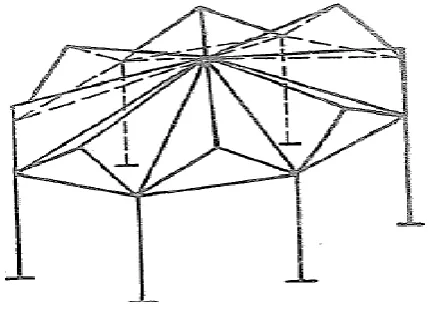
The principle components in a folded plate structure are illustrated in the sketch above. They consist of, 1) the inclined plates, 2) edge plates which must be used to stiffen the wide plates, 3) stiffeners to carry the loads to the supports and to hold the plates in line, and 4) columns to support the structure in the air. A strip across a folded plate is called a slab element because the plate is designed as a slab in that direction. The span of the structure is the greater distance between columns and the bay width is the distance between similar structural units. The structure above is a two segment folded plate. If several units were placed side by side, the edge platessould be omitted except for the first and last plate. If the edge plate is not omitted on inside edges, the form should be called a two segment folded plate with a common edge plate.The structure above may have a simple span, as shown, or multiple spans of varying length, or the foldedplate may cantilever from the supports without a stiffener at the end.
Fig 1Radial folded plate
VIII. THE FINITE ELEMENT METHOD
the continuous structure is approximated by that of a model composed of a finite number of discrete elements interconnected at a finite number of nodal points or nodes, At these nodes , the basic condition of continuity and equilibrium are established.
The finite element analysis is normally carried out by the stiffness method of analysis. The deformed shape of the element is limited to certain pattern by assuming displacement function, which will represent approximately its possible deformed shape under the loading being investigated. The forces at the nodes of the element are calculated in terms of the displacement at these nodes. This relationship between element forces displacement is expressed in terms of the element stiffness matrix. The basic step in FEA is the evaluation of this element stiffness matrix. Then, the stiffness matrix of individual element. This matrix is singular. Therefore it cannot ne inverted to solve the force-displacement relationship for the displacement due to given external loads. This singularity is avoided by applying boundary condition to prevent the rigid body displacements. The resulting matrix equation can then be solved.
The use of the “ordinary method” and “elasticity method” in the analysis of folded plate structures is limited to isotropic ,homogeneous material and to simply supported structure only. The length-width ratio of the plates should be more than two or even three , when using the ordinary method to meet the assumption of one way slab.
The solution of elasticity method requires considerable computational efforts , especially when the structure is subjected to loads other than the most simple ones such as uniform loads or concentrated loads at midspan, where a large number of separate harmonics must be used to represent the applied loads.
The finite element method can be applied to folded plates with orthotropic properties, different loading and boundary conditions, it is therefore considered the most convenient method for the analysis of folded plate structure.
The basic step in applying the finite element method is the selection of an appropriate finite element with satisfactory performance. Several in-plane, plate bending and shell element of different shapes, with different displacement functions and consequently with different numbers of freedom have been developed by many researchers. Only some of these elements are conforming elements, that is the transverse displacement and slopes are continuous between elements. This property leads to monotonic convergence of the finite-element solution to the exact one as the number of element is increased.
IX. ANALYSIS OF RADIAL FOLDED PLATE
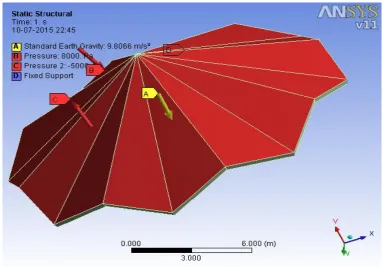
The radial folded plate having apex is being modeled, this folded plate which have closed apex at the top having a diameter of around 18m larger. The thickness given to the folded plate throughout structure is 250mm
Figure 2 Application of loads and support conditions to radial plate with apex
X. RESULTS
Object Name
Total deformation
Equivalent stress
state
solved
Definition
type
Total deformation
Equivalent (von-mises) stress
RESULTS
minimum
0.
mm
5723.9 N/mm
2maximum
9.5868e-001mm
1.4639e+007 N/mm
2XI. CONCLUSION
The literature study was performed in this session of dissertation, also for further analysing the radial folded plate structure, which will contribute to study the gap between the researchers.
In radial folded plate, when the ring is very large it shows very large value of bending stresses. To calculate this bending stress the 18m diameter ring is to modelled and analysed accordingly in the ANSYS.
ANSYs will help to optimise the radial folded plate during its analysis which will give effective results.
REFERENCE
[1] Winter.G. and Pei M. ,”Hipped plate construction”, journal ACI, January 1947
[2] Tibuchacko,ramadass and jayasreeramanujan „parametric study on the transverse and longitudinal moments of trough type folded plate roofs using ansys‟ American journal of engineering research (AJER) 2013vol4 pp22-28
[3]L. X. Peng, S. Kitipornchai and K. M. Liew, “Bending analysis of foldedplates by the FSDT meshless
method,” Thin-Walled Structure, vol 44, issue 11, pp. 1138-1160, 2006.
[4] Bar-Yoseph P, Hersckovitz I. Analysis of folded plate structures. Thin-Walled Structure 1989;7:139– 58.
[5] GH. ATTAR-HASAAN , “a refined finite element analysis of folded plate structure” august 1971 [6] T. Subramani&AthulyaSugathan, “finite element analysis of thin walled-shell by ANSYS and
LS-DYNA
[7] LajosKollar. “Some Problems On Static Analysis Of Folded Plate Structure”
[8] J.N. Bandyopadhya and P.K.Lad „comparative analysis of folded plate structure‟ computers and structures 1990 vol36 no.2 pp291-296