Thermal neutron activation experiments on Ag, In, Cs, Eu, V,
Mo, Zn, Sn and Zr in the MINERVE facility
Pierre Leconte1,a, Benoit Geslot2, Adrien Gruel2, Alexandra Pépino2 1
CEA, DEN, DER/SPRC/LEPh Cadarache, F-13108 Saint Paul-Lez-Durance, France 2
CEA, DEN, DER/SPEx/LPE Cadarache, F-13108 Saint Paul-Lez-Durance, France
Abstract. The MAESTRO experimental program has been designed to improve nuclear data uncertainty on a large range of materials used for detection, absorption, moderation and structures in LWRs. It consists of pile-oscillation and neutron activation experiments, carried out in the MINERVE low power facility. For this program, the core configuration has been designed to be representative of HZP (Hot Zero Power) conditions of a typical PWR. Samples of high purity elements have been manufactured with severe technological constraints to reach a target accuracy of ±2% (1σ) on the measurement. This paper presents a preliminary analysis of activation experiments, based on TRIPOLI4 Monte-Carlo calculations and various nuclear data libraries.
1 Introduction
MAESTRO [1][2] is the follow-up in a series of experimental programs started more than thirty years ago in the MINERVE facility [3-4], which goal is to improve nuclear data uncertainties for Light Water Reactors (LWR) applications (GEN 2 and 3). Past programs mainly consist of pile-oscillation experiments on samples with small amount of separated isotopes, natural elements, fresh or irradiated fuels (UO2, MOX).
Due to the lack of validation (or insufficient accuracy) for structural, moderating, detection and some absorbing materials, the MAESTRO experimental program was designed to improve the prediction of several neutronic parameters which are relevant for several LWR applications: core physics (reactivity of structural elements), instrumentation (EPRTM innovative instruments), reactivity control, criticality/safety (contributions of various elements in concrete), burn-up credit. Some of the experiments are also performed in support of the JHR irradiation reactor, currently being built in Cadarache. This reactor will use metallic fuel plates of U3Si2 cladded with aluminum, a beryllium reflector and hafnium control rods.
This paper describes the experiments and preliminary results on the neutron activation measurements that have been performed on the following natural materials: Ag, In, Cs, Eu, V, Mo, Zn, Sn and Zr.
a
Corresponding author: [email protected] DOI: 10.1051/
C
Owned by the authors, published by EDP Sciences, 201 /201
epjconf 61
6 110 007 1
2 Description of the experiment
2.1 MINERVE core configuration and related experimental techniques
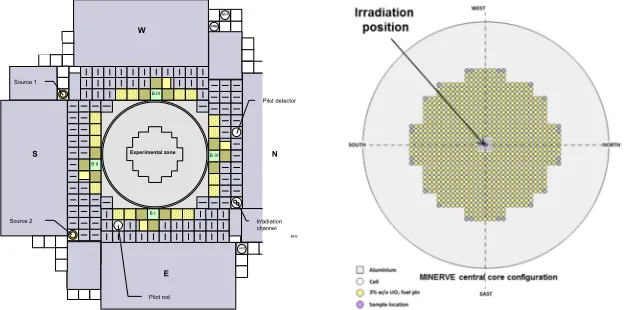
MINERVE is a pool type reactor, located at CEA Cadarache. The core is submerged under 3 meters of light water at room temperature. The outside of the core is made of highly enriched UAl assemblies reflected by large graphite elements, being used as a driver zone. In a central square cavity of 70cm, various configurations can be loaded. For the MAESTRO program, a homogeneous core configuration consisting of ~800 UO2 fuel pins (3% in 235U) has been loaded. In the central position, the neutron
spectrum is closed to the one of a UO2-PWR in Hot Zero Power conditions (HZP).
Experimental zone
S N
E W HN2
BN1
HN1
BN2 B IV
B I B III
B II
Source 1
Pilot detector
Irradiation channel Source 2
Pilot rod
Avant janv. 2004
HN1
Figure 1. Overview of the MINERVE facility (left side) and central core configuration (right side).
Two kinds of experimental techniques have been used during the program. The first one is the pile-oscillation technique which consists in measuring the reactivity worth of a sample of pure material by successive translations between the center of the core and a position outside of the core. The technique is described in more details in [2] and [5]. The second one is the neutron activation techniques which consists in irradiating the sample in the center of the core and then to perform a γ-spectrometry analysis of the radionuclides which have been produced during the irradiation. This method was developed in previous programs to obtain complementary information on the capture rate of some absorbers and actinides, using the same sample in both pile-oscillation and activation techniques [6]. It is a relative method in which the reaction rate of a given isotope is normalized to the reaction rate of a reference isotope which is considered to be a neutron cross section standard.
2.2 Sample characteristics
All the samples used in MINERVE for the last fifty years consist of a mixture between a diluent material (DM) and a material of interest (MOI). For representativity considerations, UO2 was often
chosen as the DM. The MOI was mixed together with the DM, then crushed and sintered in pellets. Due to the possibility of material evaporation during the sintering process, additional pellets were prepared for destructive analysis by mass spectrometry. These analyses are quite expensive, time-consuming and can be complex for some insoluble elements.
- Diluted solutions: this form uses a dilution of the MOI in 4-5% nitric acid. This form is well adapted for materials with high neutron cross section and for materials which are highly soluble. It is inserted in a double watertight cladding, one of welded Zircaloy-4 and one of aluminium alloy (Al-5754). - Pure rods: this form uses cylinders of appropriated diameter for materials with low neutron cross section. The rod is inserted in a single watertight aluminium container.
- Powder mix: this form is a mixture between a DM (Al2O3 powder) and the MOI made of very fine
powder (µm-sized powder). It is considered for materials which cannot be prepared from the two previous forms. The same cladding as for rod samples is used.
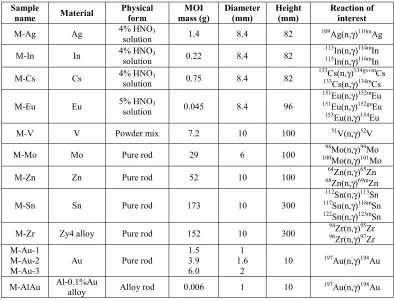
Table 1 summarises the characteristics of the samples used in the neutron activation experiments. Gold samples are used for calibration, as the capture of 197Au is considered as a cross section standard.
Table 1. Characteristics of MAESTRO samples.
Sample
name Material Physical form mass (g) MOI Diameter (mm) Height (mm) Reaction of interest
M-Ag Ag 4% HNO3
solution 1.4 8.4 82
109
Ag(n,γ)110mAg
M-In In 4% HNO3
solution 0.22 8.4 82
113
In(n,γ)114mIn
115
In(n,γ)116mIn
M-Cs Cs 4% HNO3
solution 0.75 8.4 82
133Cs(n,γ)134gs+mCs 133
Cs(n,γ)134mCs
M-Eu Eu 5% HNO3
solution 0.045 8.4 96
151
Eu(n,γ)152mEu
151
Eu(n,γ)152gsEu
153Eu(n,γ)154Eu
M-V V Powder mix 7.2 10 100 51V(n,γ)52V
M-Mo Mo Pure rod 29 6 100
98
Mo(n,γ)99Mo
100
Mo(n,γ)101Mo
M-Zn Zn Pure rod 52 10 100
64
Zn(n,γ)65Zn
68Zn(n,γ)69mZn
M-Sn Sn Pure rod 173 10 300
112
Sn(n,γ)113Sn
117Sn(n,γ)118mSn 122
Sn(n,γ)123mSn
M-Zr Zy4 alloy Pure rod 152 10 300
94
Zr(n,γ)95Zr
96
Zr(n,γ)97Zr M-Au-1
M-Au-2 M-Au-3
Au Pure rod
1.5 3.9 6.0 1 1.6 2
10 197Au(n,γ)198Au M-AlAu Al-0.1%Au
alloy Alloy rod 0.006 1 10
197
Au(n,γ)198Au
2.3 Neutron activation experiments
In order to extrapolate the measured count rate to the saturated activity, the γ-counting rate is modified using several factors:
- the radioactive decay during the cooling and the measurement phases, - the detector efficiency,
- the γ-emission probability of the γ-ray of interest.
A correction factor, called “efficiency transfer correction”, is also required to account for two effects: - A spatial effect which is related to the volumic and heterogeneous distribution of the γ-source within the sample, while the detector efficiency was calibrated with a point source.
- An attenuation effect which accounts for the self-absorption within the sample, especially for the dense materials like gold.
This factor is evaluated by MCNP5 calculations (Fig. 2). More details can be found in [2] and [6].
Figure 2.γ-spectrometry device (left side) and MCNP model for the efficiency transfer correction (right side).
The experimental results are presented as ratios of effective macroscopic capture rate relative to the gold macroscopic capture rate:
I!
I! (1)
Four different gold samples were used and combined together. The combination of pure gold rods and aluminum-gold alloy wires is useful to validate the efficiency transfer correction between one with negligible (M-AlAu) and one with large (M-Au-3) self-absorption effect.
3 Interpretation of the neutron activation experiments
3.1 Calculation code and model
Neutron activation experiments were analysed by Monte-Carlo calculations based on TRIPOLI4 [7]. A detailed 3D model (Fig. 3) was settled including the graphite reflector, the driver zone (with the fuel assemblies explicitly described) and the experimental zone with the sample located in the core centre.
Figure 3. TRIPOLI4 3D detailed model of the MINERVE core.
3.2 Calculation vs Experiment
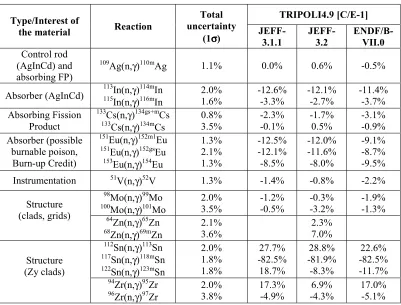
Table 2 presents the relative differences between calculated (C) and measured (E) capture rate ratios. The total uncertainty is a combination of the Monte-Carlo convergence (<0.5%), counting statistics (0.8 to 3%), technological uncertainty related to dimensions and compositions of the materials (<0.5%) and isotopic abundance in the natural element (0-3%).
Table 2. Calculation over measurement comparisons of macroscopic capture cross section ratios.
Type/Interest of
the material Reaction
Total uncertainty
(1σσσσ)
TRIPOLI4.9 [C/E-1]
JEFF-3.1.1 JEFF-3.2 ENDF/B-VII.0 Control rod
(AgInCd) and absorbing FP)
109
Ag(n,γ)110mAg 1.1% 0.0% 0.6% -0.5%
Absorber (AgInCd)
113
In(n,γ)114mIn
115
In(n,γ)116mIn
2.0% 1.6% -12.6% -3.3% -12.1% -2.7% -11.4% -3.7% Absorbing Fission Product 133
Cs(n,γ)134gs+mCs
133
Cs(n,γ)134mCs
0.8% 3.5% -2.3% -0.1% -1.7% 0.5% -3.1% -0.9% Absorber (possible burnable poison, Burn-up Credit) 151
Eu(n,γ)152m1Eu
151
Eu(n,γ)152gsEu
153
Eu(n,γ)154Eu
1.3% 2.1% 1.3% -12.5% -12.1% -8.5% -12.0% -11.6% -8.0% -9.1% -8.7% -9.5%
Instrumentation 51V(n,γ)52V 1.3% -1.4% -0.8% -2.2%
Structure (clads, grids)
98
Mo(n,γ)99Mo
100
Mo(n,γ)101Mo
2.0% 3.5% -1.2% -0.5% -0.3% -3.2% -1.9% -1.3% 64
Zn(n,γ)65Zn
68
Zn(n,γ)69mZn
2.1% 3.6% 2.3% 7.0% Structure (Zy clads) 112
Sn(n,γ)113Sn
117
Sn(n,γ)118mSn
122
Sn(n,γ)123mSn
2.0% 1.8% 1.8% 27.7% -82.5% 18.7% 28.8% -81.9% -8.3% 22.6% -82.5% -11.7% 94
Zr(n,γ)95Zr
96
Zr(n,γ)97Zr
2.0% 3.8% 17.3% -4.9% 6.9% -4.3% 17.0% -5.1%
Here are the conclusions that can be derived from this table:
- Indium: the C/E agreement is within 2σ uncertainty for 115In capture for the three libraries. All of them are also consistent with a 11-13% underestimation of 113In capture. Additional results would be required to separate the contribution of the isomeric ratio to the capture cross section.
- Cesium: the C/E agreement is higher than 2σ uncertainty for 133Cs total capture for the three libraries, with a systematic underestimation of 2-3%. The partial capture to 133mCs is predicted within 1σ, so it can be concluded than the isomeric ratio from EAF-2010 is correctly evaluated within 3.5%.
- Europium: the C/E agreement of the two 151Eu partial capture is consistent for the three libraries, indicating an underestimation of 12% for JEFF-3.1.1 and JEFF-3.2 and 9% with ENDF/B-VII.0. Just like for caesium, one can conclude that the isomeric ratio to the first metastable state is correctly evaluated in EAF-2010. Moreover, it seems that a revision of the capture cross sections would be required to solve the underestimation of this capture rate ratio. Additional information will be provided by the analysis of the pile-oscillation experiments which will give information on the total capture rate of natEu (mostly depend on the one of 151Eu). For 153Eu, there is also an 8-9% capture cross section underestimation in the three libraries. Previous pile-oscillation experiments [10] and irradiation experiments [12] led to the same conclusions.
- Vanadium: the C/E agreement for 51V capture is within 1σ for the JEFF libraries and within 2σ for the ENDF/B-VII.0. This trend confirms preliminary results previously published from the MAESTRO program, based on a pure rod sample [1].
- Molybdenum: the C/E agreement is within 2σ for both 98Mo and 100Mo capture cross section and for the three nuclear data libraries. These results complete the feedback obtained in the past on the 95Mo and on the overall natMo captures [11].
- Zinc: no isotopic evaluations are available in JEFF-3.1.1 and ENDF/B-VII.0 so only the JEFF-3.2 can be computed. The C/E agreement is within 2σ for both 64Zn and 68Zn capture cross section.
- Tin: the C/E agreement for 112Sn and 117Sn capture is significantly outside of the 2σ uncertainty range. Further investigations are required to understand such large differences, reaching up to 80% for
117
Sn. For 122Sn capture, the strong overestimation of 19% observed in JEFF-3.1.1 was reduced to -9% in JEFF-3.2 but it is still outside of the 2σ uncertainty, with the same trend for ENDF/B-VII.0. Additional work would be required to reach the 2σ uncertainty range.
- Zirconium: the C/E agreement for 96Zr capture is within 2σ uncertainty for the three nuclear data libraries. For 94Zr capture, a strong overestimation of 17% is observed with both JEFF-3.1.1 and ENDF/B-VII.0 but it is significantly reduced to 7% in JEFF-3.2. Nevertheless, additional work would be required to reach the 2σ uncertainty range.
4 Conclusions
The MAESTRO experiment benefits from the feedbacks of previous programs in the MINERVE reactor. A careful design of the samples with severe constraints on the material mass, purity and homogeneity, just like some improvements on the irradiation conditions, allows reaching a target accuracy of less than 2% on the experimental results (previously 3-4%).
Preliminary results on neutron activation experiments performed on natural elements were obtained with TRIPOLI4 Monte-Carlo calculations. They confirm JEFF-3.1.1 evaluations of 109Ag,
115
and 151Eu, thanks to the measurement of both ground and metastable states. All these results will have to be confirmed by the analysis of the pile-oscillation measurements that were performed on the same sample, which is currently ongoing.
Acknowledgments
Authors would like to acknowledge their industrial partners AREVA and EDF for their financial support and also the operators and experimentalists of the MINERVE facility.
References
1. P. Leconte et al., MAESTRO: an ambitious experimental programme for the improvement of nuclear data of structural, detection, moderating and absorbing materials - First results for natV,
55
Mn, 59Co and 103Rh, Proceedings of the ANIMMA2013 Conference, paper #1376, May 2013, Marseille, France.
2. A. Gruel et al., Integral (n,γ) Cross-sections Measurement of Standard Light Water Reactors Materials, Proceedings of the IGORR2014 conference, Bariloche, Argentina, November 2014. 3. S. Cathalau et al., More than forty years of neutronics experiments in critical facilities of
Cadarache center: from EOLE and MINERVE to the future ZEPHYR reactor, Proceedings of the IGORR2014 conference, Bariloche, Argentina, Nov. 2014.
4. G. Bignan et al., Reactor Physics Experiments on Zero Power Reactors, Handbook of Nuclear Engineering, Springer Science, pp 2053-2184, 2010.
5. A. Santamarina et al., Reactivity Worth Measurement of Major Fission Products in MINERVE LWR Lattice Experiment, Nuclear Science and Engineering, Vol. 178, 4, December 2014, 562-581.
6. P. Leconte, J.P. Hudelot, M. Antony, Integral Capture rate Measurements of Neutron Absorbers and Minor Actinides by Gamma-Ray Spectrometry on Specific Fuel Samples, Proceedings of the IYNC 2006 Conference, Stockholm, Sweden, June 2006.
7. E. Brun et al., TRIPOLI-4®, CEA, EDF and AREVA reference Monte Carlo code, Joint International Conference on Supercomputing in Nuclear Applications and Monte Carlo 2013, SNA + MC 2013, Volume 82, p 151–160, August 2015.
8. A. Santamarina et al., The JEFF-3.1.1 Nuclear Data Library, JEFF Report 22, OECD, NEA No. 6807, 2009.
9. M.B. Chadwick et al., ENDF/B-VII.0: Next Generation Evaluated Nuclear Data Library for Nuclear Science and Technology, Nuclear Data Sheets, Vol. 107, 12, p. 2931-3060, December 2006.
10. J.C. Sublet et al., The European Activation File: EAF2010 neutron-induced cross section library, EASY Documentation Series, CCFE-R (10) 05, 2010.
11. A. Gruel et al., Interpretation of Fission Product Oscillations in the MINERVE Reactor, from Thermal to Epithermal Spectra, Nuclear Science and Engineering, 169, 229–244, 2011.