K. Supriya, P. Ravisankar*, P. Srinivasa Babu, M. Nitya Satya, Sk. Rijwana
Department of Pharmaceutical Analysis, Vignan Pharmacy College, Vadlamudi, Guntur-522 213, A.P, India.
*Corresponding author’s E-mail:[email protected]
Received: 11-03-2020; Revised: 18-04-2020; Accepted: 25-05-2020. ABSTRACT
The goal of the present study was to develop and validate a novel RP-HPLC method for simultaneous estimation of Ascorbic acid, Sodium metabisulfite, Benzyl alcohol, Methyl Paraben, Propyl Paraben, Butylated Hydroxy Toluene, Benzalkonium chloride preservatives. Chromatographic separation conducted on Waters with a photodiode array detector. The method uses the Zorbax SB-CN (250*4.6 mm, 5 µm) column using a gradient elution system. The mobile phase composed of water: Trifluoroacetic in the ratio of 100:0.1 v/v as mobile phase-A and acetonitrile: Trifluoroacetic acid in the ratio of 100:0.1 v/v as mobile phase-B and the flow rate was set at 1ml /min. Detection carried out at 210 nm. Complete separation of the studied components obtained within a cycle time of 35 min. The method has been validated for linearity, precision, Recovery. The linearity range found to be for all preservatives with the correlation coefficient within limits. Recovery of preservatives was observed in the range of 98.00 – 99.30 %. The proposed method has adequate reproducibility and accurate for the determination of preservatives in pharmaceutical dosage forms.
Keywords: RP-HPLC, Preservatives, Benzalkonium chloride, Butylated hydroxy toluene, Benzyl alcohol, Ascorbic acid, Methyl paraben, Propyl paraben, Sodium metabisulfite.
INTRODUCTION
he determination of the low concentration of
preservatives in pharmaceutical formulation
constitutes a challenging problem in the current pharmaceutical analysis. Preservatives are compounds that commonly added to various pharmaceutical formulations and food products to prolong their shelf life
by protecting from microbial growth1. Parabens
(Methylparaben and Propyl paraben) are the most commonly used preservatives in liquid pharmaceutical formulations. An excess of these preservatives may cause harm to health. Therefore, the minimum acceptable concentrations of parabens are controlled by regulation, and quantitative analysis of these preservatives is essential
for the routine analysis of pharmaceutical products2.
Benzalkonium chloride is a mixture of N-Alkyl-N-benzyl-N-N-dimethyl ammonium chloride, which is commonly used preservative in various dosage forms including ophthalmic formulations. The US FDA specifies that the safe and efficient concentrations for BKC are 0.1 to 0.2 % in first aid
products3. Benzyl alcohol is an aromatic alcohol with the
formula C6H5CH2OH. Benzyl alcohol used as a
bacteriostatic preservative at low concentrations in
intravenous medication, cosmetics, and topical drugs4.
Sodium metabisulfite is used as an antioxidant in the oral, topical, parenteral pharmaceutical formulation at a
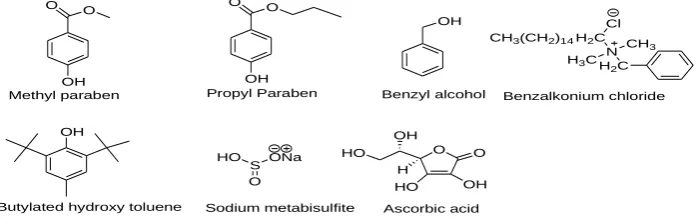
concentration of 0.01-1.0 % w/v5. Figure 1 shows the
structures of preservatives and anti-oxidants used in the present study.
A variety number of analytical methods have been reported for the estimation of Ascorbic acid, Sodium metabisulfite, Benzyl alcohol, Methyl paraben, Propyl
Paraben, Butylated hydroxytoluene, Benzalkonium
chloride in pharmaceutical formulations6-10. Frequently,
RP-HPLC has proven to be useful in diagnostic purposes
and the pharmaceutical industry11-13. Based on the
literature survey, there is no RP-HPLC method for the simultaneous estimation of different preservatives and antioxidants. The present study aimed to develop and validated a method for the simultaneous estimation of different preservatives and antioxidants.
O O
OH Methyl paraben
O O
OH Propyl Paraben
OH
Benzyl alcohol
H2C N H3C
CH3 H2C
Cl CH3(CH2)14
Benzalkonium chloride
OH
Butylated hydroxy toluene
ONa HO
S O
Sodium metabisulfite
O O
OH HO
HO OH
H
Ascorbic acid
Figure 1: Chemical structures of preservatives and anti-oxidants used in the present study
Method Development and Validation of Robust and Time Efficient Combined RP-HPLC Method
for Simultaneous Estimation of Multiple Preservatives and Anti-Oxidants
T
MATERIALS AND METHODS
Chemicals and Reagents
Preservatives are used in this study are Ascorbic acid (Sigma Aldrich), Sodium metabisulfite (Spectrum), Benzyl alcohol (Sigma Aldrich), Methyl Paraben (Spectrum), Propyl Paraben (Merck), Butylated hydroxy toluene (99.0 %),
Benzalkonium chloride (99.0 %),Emparta grade
Trifluoroacetic acid, HPLC grade acetonitrile, HPLC/Milli-Q grade water, HPLC trade orthophosphoric acid all materials got from Merck specialties Pvt. Ltd., Mumbai, India.
Instrumentation
For UV detection of the sample, ELICO SL-210 UV spectrophotometer with 1 cm matched quartz cells used for all spectral and absorbance measurements. For HPLC, the chromatographic system consists of waters model no
W26905, Zorbax SB CN 250 x 4.6 mm, 5m, Agilent
Technologies, Analytical column used. For homogenizing the solution prepared, Ultra-sonicator of BTI-48, Bio Technics India, was used. For the weighing of the sample and excipients, Microbalance model. No BM-20, A&D Company, Ltd used. For measuring the pH of the
prepared solutions, pH meter, LP139SA,
Polmon Instruments Pvt Ltd used.
Preparation of Mobile Phase
Mobile Phase –A: Prepare a mixture of Water: Trifluoroacetic acid in the ratio of 100:0.1 and degas.
Mobile Phase –B: Prepare a mixture of Acetonitrile: Trifluoro Acetic Acid in the ratio of 100:0.1 and degas.
Preparation of Diluent: Prepare the mixture of Water: ACN in the ratio of 1:1 v/v and degas.
Preparation of standard solution
An accurately weighed amount Ascorbic acid (20 mg), Sodium metabisulfite (20 mg), Benzyl alcohol (20 mg), Methyl paraben (20 mg), Propyl paraben (20 mg), Butylated hydroxytoluene (20 mg), and Benzalkonium chloride (20 mg) were transferred to 100 ml volumetric flask and 20 ml of diluent was added, sonicated for 5-10 min, and make up the volume with diluent. (Nominal concentration 0.2 mg/mL).
Analytical Method Validation
Once the chromatographic and the experimental conditions were established, the method was validated by the determination of the following parameters such as linearity,
precision, accuracy, robustness, as per ICH guidelines.14-17
RESULTS AND DISCUSSION
Method development and optimization: The current study aimed at developing a sensitive, rapid, and accurate reversed-phase HPLC gradient method for the analysis of different preservatives and antioxidants. In order to get
decorous retention time, sharp and well-resolved peak, the parameters such as different flow rates, detection wavelength, and a choice of mobile phases containing acetonitrile, methanol, Trifluoroacetic acid and HPLC grade water were studied. Good quality symmetrical sharp peaks, minimum tailing factor in short run time was obtained with
Zorbax SB-CN C18 column and mobile phase composed of
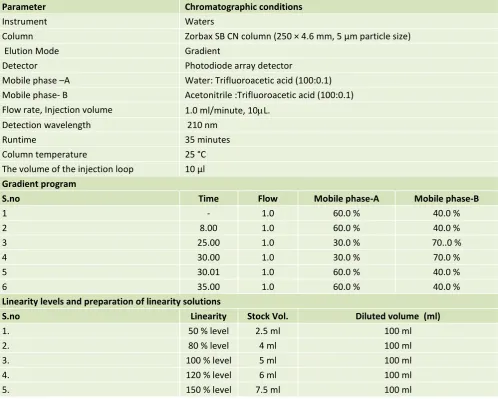
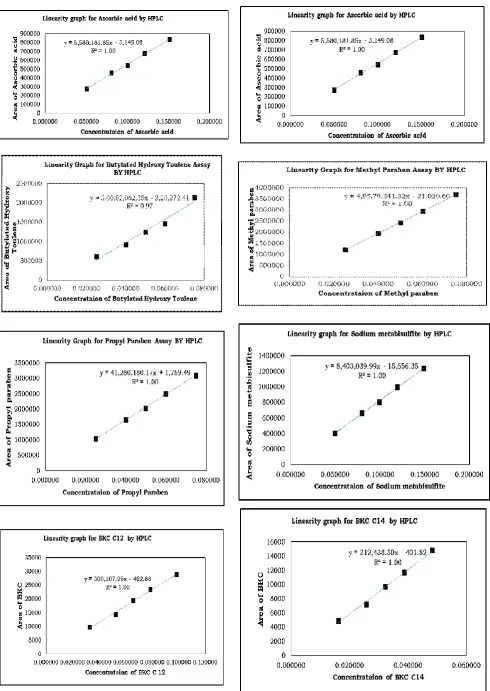
water : Trifluoroacetic in the ratio of 100:0.1 v/v as mobile phase-A and acetonitrile :Trifluoroacetic acid in the ratio of 100:0.1 v/v as mobile phase-B at a flow rate of 1.0 ml/minute with maximum lambda max at 210 nm. The calibration curve of the analytical method was assessed by plotting concentration versus peak area and represented graphically. The correlation coefficient found to be 1-0.97 in all cases. Therefore, the HPLC method found to be linear. The optimum chromatographic conditions, gradient program, and linearity levels and preparation of linearity solutions are shown in Table 1. Linearity graphs of different analytes used in the present study is shown in figure 2. Chromatogram of blank is shown in figure 3. Standard chromatogram of preservatives and antioxidants are shown in figure 4 and 5. Accuracy was performed by preparing the sample solution at 100 % level. The % RSD was calculated, as shown in table 2. The results of these studies indicate the method is accurate for the estimation of preservatives and antioxidants. Acceptance criteria of % recovery values should be in the range of 98 % - 102 % with % RSD NMT.2.0. The Recovery results indicated that the method had an acceptable level of accuracy for the assay of Preservatives at 100 % of test concentration. The precision of the method determined by intra-day and inter-day. Repeatability determined by performing six repeated analyses of the same working solution of seven samples on the same day under the same experimental conditions.
The % RSD of intraday and inter-day precision found to be in the range of 0.4 % - 0.8 %, respectively. As per ICH guidelines %, RSD should be less than 2 % is accepted. Hence the method was found to be precise. The robustness of the established method assessed by small, deliberate changes in method parameters such as flow rate (± 0.2
ml/min) and temperature (± 3˚C). For the flow rates at 0.8
and 1.2, the % RSD was 0.61, 0.70, respectively. For the
temperatures at 22oC and 28oC the % RSD was 0.20, 0.40,
respectively, which is less than two which is to say that that the developed method was robust. The results pertaining to limit of detection (LOD) and limit of quantitation (LOQ) for
ASC,SMB,BA, MP,PP,BKC C12,BKC C14, BHT 0.0208 µg/mL
Table 1: Optimized chromatographic conditions and gradient program, linearity levels
Parameter Chromatographic conditions
Instrument Waters
Column Zorbax SB CN column (250 × 4.6 mm, 5 µm particle size)
Elution Mode Gradient
Detector Photodiode array detector
Mobile phase –A Water: Trifluoroacetic acid (100:0.1)
Mobile phase- B Acetonitrile :Trifluoroacetic acid (100:0.1)
Flow rate, Injection volume 1.0 ml/minute, 10L.
Detection wavelength 210 nm
Runtime 35 minutes
Column temperature 25 °C
The volume of the injection loop 10 µl
Gradient program
S.no Time Flow Mobile phase-A Mobile phase-B
1 - 1.0 60.0 % 40.0 %
2 8.00 1.0 60.0 % 40.0 %
3 25.00 1.0 30.0 % 70..0 %
4 30.00 1.0 30.0 % 70.0 %
5 30.01 1.0 60.0 % 40.0 %
6 35.00 1.0 60.0 % 40.0 %
Linearity levels and preparation of linearity solutions
S.no Linearity Stock Vol. Diluted volume (ml)
1. 50 % level 2.5 ml 100 ml
2. 80 % level 4 ml 100 ml
3. 100 % level 5 ml 100 ml
4. 120 % level 6 ml 100 ml
5. 150 % level 7.5 ml 100 ml
Table 2: Summary of validation parameters
Parameters ASC SMB BA MP PP BKC (C12)
BKC (C14)
BHT
Wavelength (λmax) nm 210 nm 210 nm 210 nm 210 nm 210 nm 210 nm 210 nm
Linearity (R2) 1.00 1.00 1.00 1.00 1.00 1.00 &1.00 0.97
Specificity
Blank No peaks No peaks No peaks No peaks No peaks No peaks No peaks
Separate inj. of individual std. solutions (Min)
Peak at 2.447
Peak at 3.566
Peak at 4.195
Peak at 4.999
Peak at 7.477
Peak at 20.519 &
23.147
Peak at 22.018
Precision (n=6)
Intra day 0.5 0.5 0.6 0.5 0.4 0.6 &0.8 0.8
Inter day 0.4 0.5 0.6 0.4 0.5 0.5 & 0.7 0.7
ACCURACY (n=3) 98.0 % 98.0 % 99.2 % 99.3 % 99.0 % 99.0 % & 99.0 % 99.0 %
Robustness Robust Robust Robust Robust Robust Robust Robust
LOD (µg/mL) 0.0208 0.0138 0.0095 0.0025 0.0056 0.0145&0.0100 0.0379
Figure 3: Chromatogram for blank
Figure 4: Standard chromatogram of preservatives and antioxidants
Figure 4a: Chromatogram for Ascorbic acid and sodium metabisulfite
CONCLUSION
In conclusion, a simple, selective RP-HPLC gradient method development and validation of robust and time-efficient combined RP-HPLC method for simultaneous estimation of multiple preservatives and anti-oxidants have been developed. The optimum privilege of the proposed method was that all preservatives and anti-oxidants such as Benzalkonium chloride, Butylated hydroxy toluene, Benzyl alcohol, Ascorbic acid, Methyl paraben, Propyl paraben and Sodium metabisulfite could be estimated on a single chromatographic system without modifications in the detection wavelength and gradient program. Even though a combination of these all active ingredients would not usually be present in the same tablet formulation, it could provide a useful method for laboratories involved in the routine analysis of these selected chemical entities. This method enables us to detect cross-contamination of the said products. Statistical analysis pellucidly proves that this method was very fast, precise, accurate, sensitive, highly efficient, and suitable than the existing techniques hitherto.
Abbreviations: ASC: Ascorbic acid, SMB: Sodium metabisulfite, BA: Benzyl alcohol, MP: Methyl Paraben, PP: Propyl Paraben, BKC: Benzalkonium chloride, BHT: Butylated hydroxytoluene.
Acknowledgement: The authors are thankful to GVK Bio sciences Pvt limited Mallapur and we also profoundly grateful to Dr. L. Rathaiah, honorable chairman, Vignan group of institutions, Vadlamudi, Guntur.
REFERENCES
1. Parth Patel, Priya Varshney Dhara Patel, Method
development and validation of Benzalkonium chloride in the marketed formulation by UV-Visible spectrophotometry using silver nitrate and eosin solution, 3(2), 2014, 1481-1487.
2. Najmul Hasan, Mathurot Chaiharn, Umair Ali Toor,
Development, Validation, and application of RP-HPLC method: Simultaneous determination of Anti histamine and preservatives with Paracetamol in liquid formulations and human serum the open medical chemistry journal, 10(1), 2016, 33-43.
3. Pratik Kumar Gupta, Vibha Chaturvedi, A study on
forced degradation and validation of stability indicating RP-HPLC method for determination of Benzalkonium chloride in Azelastine Hydrochloride pharmaceutical ophthalmic formulation, Asian J pharm Clin Res, 10(11), 2017, 374-382.
4. Vilas Khade, Sunil Mirgane High-performance liquid
chromatography method for the analysis of Benzyl alcohol, Int, J. of sci & Engineering Research, 5(11), 2014, 887-889.
5. B. Ivkovic, J. Brboric Development and validation of a
New RP-HPLC Method for simultaneous
determination of Sodium metabisulfite and Sodium benzoate in pharmaceutical formulation, Acta Chromatographica, 31(2), 2019, 133-137.
6. Snezana S Mitic, Danijela A Kositic, Rapid and Reliable
HPLC method for the determination of Vitamin C in pharmaceutical samples, Trop J pharm Res, 10(1), 2011, 105-111.
7. Hashem AIAani, Yasmin AINukkary, Determination of
Benzalkonium chloride in ophthalmic solutions by Stability indicating HPLC method: Application to a stability study, J. of Applied Pharmaceutical Science, 6(5), 2016, 080-089.
8. K. Lakshmi Narasimha Rao, K. Sudheer Babu,
Simultaneous estimation of Fluticasone Propionate, Azelastine Hydrochloride, Phenyl ethyl alcohol and Benzalkonium chloride by RP-HPLC method in nasal spray preparations, Int. J. Res. Pharm. Sci, 1(4), 2010, 473-480.
9. Perez-Lozano P, Garcia- Montoya E, A new validated
method for the simultaneous determination of Benzocaine, Propyl paraben, and Benzyl alcohol in a
AU -0.15 -0.10 -0.05 0.00 0.05 0.10 Minutes
0.00 2.00 4.00 6.00 8.00 10.00 12.00 14.00 16.00 18.00 20.00 22.00 24.00 26.00 28.00 30.00 32.00 34.00
B e n z y l a lc o h o l - 4 .1 9 5 M e th y l p a ra b e n 4 .9 9 9 P ro p y l p a ra b e n 7 .4 7 7 B K C _ 1 2 0 .5 1 9 B H T - 2 2 .0 1 8 B K C -2 2 3 .1 4 7 AU -0.20 -0.15 -0.10 -0.05 0.00 0.05 0.10 0.15 Minutes
0.00 2.00 4.00 6.00 8.00 10.00 12.00 14.00 16.00 18.00 20.00 22.00 24.00 26.00 28.00 30.00 32.00 34.00
B e n z y l a lc o h o l - 4 .1 9 5 M e th y l p a ra b e n 4 .9 9 9 P ro p y l p a ra b e n 7 .4 7 7 B K C _ 1 2 0 .5 1 9 B H T - 2 2 .0 1 8 B K C -2 2 3 .1 4 7 AU -0.20 -0.15 -0.10 -0.05 0.00 0.05 0.10 0.15 Minutes
bio adhesive gel by HPLC. J Pharm Biomed Anal. 39, 2005, 920 -7.
10. Shabir GA, A new validated HPLC method for
simultaneous determination of 2- Phenoxyethanol, Methyl paraben, Ethyl paraben and Propyl paraben in pharmaceutical gel. Indian J Pharm Sci 72, 2010, 421-425.
11. Ravi Sankar P, Sai Snehalatha K, Tabassum Firdose
Shaik, Srinivasa Babu P, Applications of HPLC in Pharmaceutical Analysis, Int.J.Pharm.Sci.Rev.Res., 59(1), 2019, 117-124.
12. Bokai Ma, XinLei Gou, et al. Application of
high-performance liquid chromatography in food and drug safety analysis, Journal of food safety and quality, 7, 2016, 295-4298.
13. Ravi Sankar P, Rajyalakshmi G, Devadasu Ch, Devala
Rao G, Instant tips for a right and effective approach
to solve HPLC troubleshooting, Journal of Chemical and Pharmaceutical Sciences, 7(3), 2014, 191-206.
14. Ravisankar P, Naga Navya Ch, Pravallika D, Navya Sri
D, A review on step-by-step analytical method validation. IOSR Journal of Pharmacy, 5, 2015, 7-19.
15. Ravisankar P, Gowthami S, Devala Rao G, A review on
analytical method development, Indian journal of research in pharmacy and Biotechnology, 2, 2014, 1183-1195.
16. Panchumarthy Ravisankar, Anusha S, Supriya K, Ajith
Kumar U, Fundamental chromatographic
parameters, Int. J. Pharm. Sci. Rev.Res., 55(2), 2019, 46-50.
17. ICH Q2 (R1), Validation of analytical procedures, Text,
and methodology. International Conference on Harmonization, Geneva, 2005, 1-17.