AGILE MANUFACTURING SYSTEM
Niraj Ravindra Bagul
1, Mayur Pranay Ahire
2 1Mechanical , Sandip Foundation / Pune University, (India)
2Mechanical , K.B.H.Polytechnic / Msbte , (India)
ABSTRACT
The idea of Agile Manufacturing (AM) now had been around for nearly a decade. AM is the first major manufac turing theory that has sense of history built into it, in fact integral to it. The AM paradigm provides necessary st rategic frame work to allow companies to behave in an adaptive and flexible manner permitting continuous eval uation in an increasing demanding and competitive market. Agility is the measure of manufacturer’s ability to r eact to sudden unpredictable change in customer demand for its products and services and make a profit. The m ajor characteristic of AM is to organize to master change. The main capability indicators of AM are product, pr ocess and people. The vital design strategies comprises of feeder system, conveyor systems, modular worktables and multi purpose arm tooling. Reliability and efficiency in robotic part handling is achieved by accurate gripp er design. Small changes to a product in the initial stages of design show a marked impact during final producti on
About a decade ago, the agile manufacturing paradigm was formulated in response to the constantly changing ` new economy’ and as a basis for returning to global competitiveness. While agility means different things to diff erent enterprises under different contexts, the following elements capture its essential concept: agility is charact erized by cooperativeness and synergism (possibly resulting in virtual corporations), by a strategic vision that e nables thriving in face of continuous and unpredictable change, by the responsive creation and delivery of custo mer-valued, high quality and mass customized goods/services, by nimble organization structures of a knowledge able and empowered workforce, and facilitated by an information infrastructure that links constituent partners i n a electronic network.
I. INTRODUCTION
Manufacturing environments are becoming more dynamic and turbulent than ever before. Traditional manufact
uring facilities, however, are not able to cope with such environments, as no single facility can be flexible enou
gh to cope with such a large magnitude of change in products and production requirements. As a result, new ty
pes of manufacturing facilities are needed for the emerging manufacturing environments. Such facilities must b
e able to be reconfigured over time, both quickly and easily, in order to cope with change. These are often refer
red to as agile manufacturing facilities, and the environments as agile manufacturing environments.
Agile Manufacturing is a term that has seen increased use in industry over the past several years. Agility is mea
sure of manufacturer’s ability to react to sudden, unpredictable change in customer demand for its products and
services and make a profit. Today factories are coming on lines that are agile at tailoring goods to a customer’s
requirements, without halting production. In the past, production was geared toward high-volume production o
nging, customer-driven product line.Agile Manufacturing may be defined as “The ability of an organization to t
hrive in the competitive environment of continuous and unanticipated change and to respond quickly to rapidly
changing markets driven by customer based valuing of products and services.
World-class performance is a moving target that requires constant attention and e ort; the process is a never end
ing journey. In the past, economies of scale ruled the manufacturing world and everybody knew that mass prod
uction and full utilization of plant capacity was the way to make money. Since the early 1980s, in pursuit of gre
ater exhibility, elimination of excess in inventory, shortened lead-times, and advanced levels of quality in both
products and customer service, industry analysts have popularized the terms `world-class manufacturing’ and `l
ean production’ (Sheridan 1993). [1]
In the 1990s, industry leaders were trying to formulate a new paradigm for successful manufacturing enterprise
s in the 21st century; even though many manufacturing were still struggling to implement lean production conc
epts.[1]
In 1991, a group of more than 150 industry executives participated in a study.
The report culminated in a two-volume report titled `21st Century Manufacturing Enterprise Strategy’, which de
scribes how US industrial competitiveness during the next 15 years. As a result, the Agile Manufacturing Revisi
on received For many, `Lean manufacturing ’ and Àgile manufacturing’ sound similar, but they are different. Le
an manufacturing is a response to competitive pressures with limited resources. Agile manufacturing , on the oth
er hand, is a response to complexity brought about by constant change. Lean is a collection of operational techni
ques focused on productive use of resources. Agility is an overall strategy focused on thriving in an unpredictabl
e environment. Focusing on the individual customer, agile competition has evolved from the unilateral producer
-centred customer-responsive companies inspired by the lean manufacturing of mass production to interactive pr
oducer-customer relationships (Goldman et al., 1994). In a similar sense, some researchers contrast exhible man ufacturing systems (FMS) and agile manufacturing systems (AMS) according to the type of adaptation: FMS is r
eactive adaptation, while AMS is proactive adaptation. [1]
Agility enables enterprises to thrive in an environment of continuous and unanticipated change (Richards 1996).
It is a new, post-mass-production system for the creation and distribution of goods and services. Agile manufact
uring requires resources that are beyond the reach of a single company. Sharing resources and technologies amo
ng companies becomes necessary. The competitive ability of an enterprise depends on its ability to establish pro
per relationships, and thus cooperation seems to be the key to possibly complementary relationships. An agile en
terprise has the organizational exhibility to adopt for each project the managerial vehicle that will yield the great
est competitive advantage. Sometimes this will take the form of an internal cross-functional team with participat
ion from suppliers and customers.[1]
II. HISTORY AND EVOLUTION
With fast changes occurring in the demand of the client, the manufacturer has to adopt itself so that it would not
diminish. Survival will depend on the capability to keep up with the continuous and unexpected change. This co
uld be described on how agile an environment can be. Being agile will allow the company to seek for new oppor
In agile production if a product life ends prematurely the system is quickly redesign and retooled for the new dif
ferent product instead of shutting the system or postponing the process a continuously evolution of the work floo
r is of the product is not effected hence agile manufacturing will be deal with things that cannot be controlled thi
s things that agile competitor to be successful be must not only understand the current market and customers wil
l also be understand the potential for the future.[6]
III. CHARACTERSTICS OF AGILE MANUFACTURING
Manufacturing companies that are agile competitors tend to exhibit these principles or characteristics .The four
principles are
1. Organize to Master Change – An agile company is organized in a way that allows it to thrive on change and uncertainty. In a company that is agile, the human and physical resources can be rapidly reconfigured
to adapt changing environment and market opportunities.[2]
2. Leverage the Impact of People and Information – In an agile company, knowledge is valued, innovation is rewarded, and authority is distributed to the appropriate level of organization. Management provides the
resources that personal need. The organization is entrepreneurial in spirit. There is a climate of mutual
responsibility of joint success. [2]
3. Cooperate to Enhance Competitiveness – Cooperation internally and with other companies is an agile competitor’s operational strategy of the first choice. The objective is to bring products to market as
rapidly as possible. The required resources and competencies are found and used, wherever they exist.
This may involve partnering with the other companies, possibly even competing companies, to form
virtual enterprises.[2]
4. Enrich the Customer – An agile company is perceived by its customers as it enriching them in a significant way, not only itself. The products of an agile company are perceived as solutions to customer’s
problems. Pricing of the product can be based on the customer rather on manufacturing cost. [2]
The list of four agility principles indicates agile manufacturing involves more than just manufacturing. It involv
es the firms organizational structures, it involves the way the firm treats it people, it involves partnerships with
IV. AGILITY CAPABILITY INDICATORS
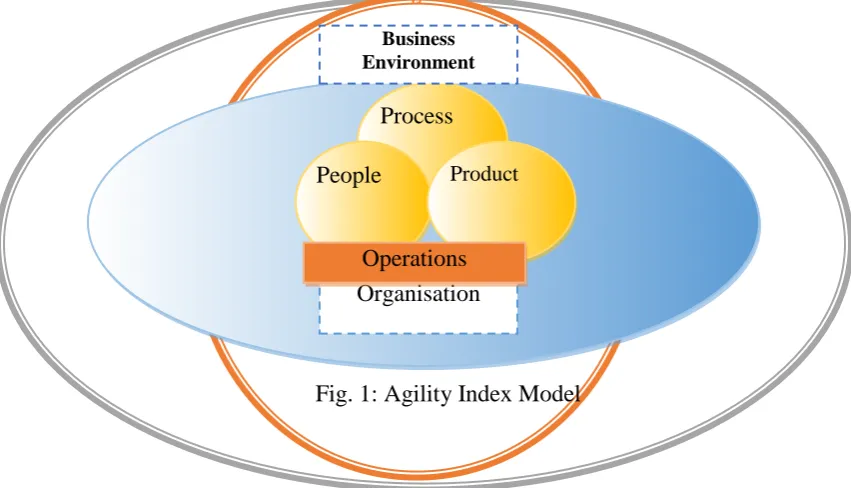
The model of the Agility Capability Indicators tool is shown in Fig. 1. This shows the key factors of an organiza
tion and the relationship between these factors. It is intended that this model should not slavishly follow functio
nal divisions, or processes, but encapsulate the idea of generic organizational relationships.[3]
Product : What is required by a customer to fulfill specific need.
Process : This is how the product (a solution for customer needs) is made.
People : This is the personnel factor involved in fulfilling customer requirements.
Operation : This is how an organization manages their response to customer demand.
Organization : This is the functional boundary, which provides context to all of the above.
V. AGILE WOKCELL
In agile manufacturing rapid changeover is accomplished through the use of reusable software, quick-change gri
ppers for the robotic manipulators, modular worktables, and parts feeders, which are flexible enough to handle s
everal types of parts without needing mechanical adjustment. These feeders use vision, in place of hard fixturing
, to determine the position and orientation of parts. Generic, reusable vision routines permit new parts to be adde
d to the system with a minimum of effort.
A test bed implementation of an agile manufacturing work cell has been developed (Fig. 2). This includes mech
anical manipulators, flexible part feeders, a vision system (cameras, frame grabber, and a library of image proce
ssing routines), as well as a limited number of dedicated sensors and actuators needed to complete a given assem
bly. The central feature of such a work cell is a controller capable of controlling each of the aforementioned com
ponents.[4]
Organisation
Operations
Process
People
Product
Business Environment
Organisation
The agile work cell developed at CWRU consists of a Bosch flexible automation system, multiple Adept SCAR
A robots, as many as four flexible parts feeders per robot, and an Adept MV controller. An important feature of t
he work cell is the central conveyor system, which was implemented using standard Bosch hardware. It is respo
nsible for transferring partially completed assemblies between the robots and for carrying finished units to an un
loading robot. The robots are mounted on pedestals near the conveyor system. Pallets with specialized parts fixt
ures are used to carry assemblies throughout the system, after which the finished assemblies are removed from t
he pallet by the unloading robot. Finally, a safety cage encloses the entire work cell, serving to protect the operat
or as well as providing a structure for mounting overhead cameras.[4]
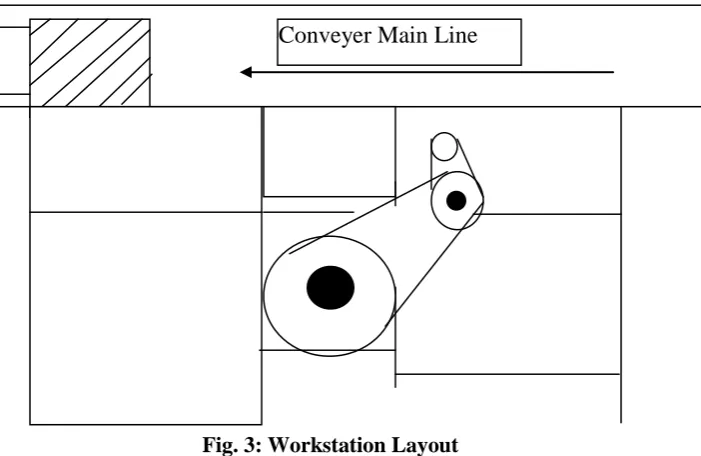
Several assembly station layouts were analyzed in choosing the final layout. After evaluating several features of
each layout, including: placement of the robots relative to the conveyor, impact of feeder placement relative to t
he robot work envelope, and the robot motions necessary for a generic assembly, it was determined that the layo
ut in Fig. 3 would best suit the needs of the work cell. [4]
5.1 Design Strategies for Agile Manufacturing
1. Vision-based flexible parts-feeder systems.
2. The introduction of “spurs” within the conveyor system.
3. The use of modular worktables supporting specialty fixturing and tooling.
4. Multipurpose, modular end-of-arm tooling.
5.2 Flexible Parts Feeders
While flexibility encompasses every part of the workcell design, including hardware and control software, the a
bility to feed parts with a wide variety of sizes and shapes is crucial. Conventional feeding methods, such as vibr
atory bowl feeders, are not practical for flexible workcells because of their specialized nature. When a new or di
fferent assembly is performed, the parts relating to the new assembly need to be fed without downtime for desig
Conveyer Main Line
ning, tuning, and installing a new feeding system. Several flexible parts feeders are currently being marketed. [5
]
Our flexible feeders consist of three conveyors working in concert. The first conveyor is inclined and is used to l
ift parts from a bulk hopper in a qualified manner. By adjusting the angle of inclination, speed of the belt, and be
lt material, the throughput of the inclined conveyor can be altered. [5]
This horizontal conveyor terminates in an underline window within the reach of the robot. A camera, locate
d over the underline window, is used to locate parts on the conveyor. The robot can then take parts from the con
veyor for subsequent assembly. Operating the horizontal conveyor at a higher speed than the inclined conveyor
helps to further singulate the parts. Parts, which are in unsuitable orientations or are overlapping, are dropped on
to the third conveyor, which returns them to the bulk hopper for re-feeding.[5]
5.3 Spurs and Worktables
It has introduced the concepts of “spurs” and modular worktables for flexibility and efficient use of space. The u
se of spurs better exploits a robot’s limited workspace, while modular worktables allow rapid change-out of dedi
cated tooling and fixturing. For both pallets shunted to spurs and modular worktables swapped into pre-defined l
ocations, precise mechanical registration is not necessary. Fiducial marks on pallets and worktables enable comp
utation of actual coordinates using machine vision. [5]
A recent improvement in the modular worktables is the introduction of quick-connect pneumatic and electrical h
arnesses. A single pneumatic connection supplies air to a bank of solenoids mounted on the underside of the tabl
e. These solenoids control all the table hardware. A 37-pin electric plug supplies all the power and signal lines to
the solenoids and sensors on each table. [5]
5.4 Agile Grippers
The gripper design is an important aspect of achieving efficient and reliable robotic part handling. To optimize t
hroughput, gripper designs should help minimize arm motions. Automatic tool changers are useful for rapid cha
ngeover to new assemblies, but for efficient operation, tool changes should be avoided during a given assembly.
Multiple grippers on a single, pneumatic rotary wrist should be utilized wherever possible to minimize arm mov
ements and avoid tool changes. Fig. 7 shows a part being lifted from the feeder and being rotated into an orientat
ion needed for assembly.[5]
VI. DESIGN FOR AGILE MANUFACTURABILITY
Agile work cell should be capable of designing new products. Design for manufacturability teaches that the inter
action of the components in a product is critical to a successful automated assembly. For example, minimizing t
he forces required to assemble a product simplifies the needed hardware. Similarly, designing mating parts with
generous tolerances and chamfers, whenever possible permits them to be self-aligning and less sensitive to posit
ioning inaccuracies. A few, often simple, changes to a product in the early stages of design can have a marked i
VII. SOFTWARE ARCHITECTURE FOR AGILE MANUFACTURING
Descriptions of communicating objects and classes that are customized to solve a general design problem in a p
articular context. The most important design pattern is the Assembler-Supplier-Transporter pattern, which relate s the agents, which assemble parts, the agents, which supply parts to them, and the agent, which transports parts
and assemblies around the work cell. The major classes defined in the software architecture are the assembler, th
e supplier and the transporter agents. An Assembler directly or indirectly employs a robot, the computer vision s ystem, parts feeders, and possibly special assembly hardware. It produces assemblies and places them on convey
or pallets for transport. It also requests parts and subassemblies from Part Suppliers. A Supplier is an agent that is responsible for providing parts to an Assembler. There are essentially two kinds of Suppliers. A Parts Supplie r locates a part for an Assembler to pick up by invoking a flexible parts feeder using computer vision. A Parcel Supplier obtains a fixture of subassemblies from an Assemble invokes the transportation system to move them to another Assembler or to an unloading station.[5]
VIII. ADVANTAGES
1. The company is given a competitive advantage since it is continuosly changing its approach to satisfy its customer.
2. Innovative design based on customer are provided. This in turn gives a wider variety for customer to choose from.
3. Responds quickly to emerging crisis.
IX. DISADVANTAGES
1. Sudden increase in demand will cause shortage. Meanwhile if the demand of product with high production rate decreases drastically this could result in a number of products that could not be sold.
2. To become Agile Manufacturing company will need to invest in trained and highly skilled labourers who are competent to be Agile.
3. Continuous need to keep the machinery and workers up to date to new technologies, and to keep the company competitive due to the short life of product cycle.
4. The maintenance to keep the machinery in good working condition increases cost due to higher cost of the parts.
5. Intensive planning and management of such system is required, since a shift is introduced from mass production ideology to Agile manufacturing.
X. APPLICATIONS
Several companies have implemented what may be considered “agile” manufacturing. Motorola has developed a
n automated factory with the ability to produce physically different pagers on the same production line. At Pana
sonic, a combination of flexible manufacturing and just-in-time processing is being used to manufacture bicycle
s from combinations of a group of core parts.[7]
One of the key enablers of agile manufacturing environments is the industrial robot. Moreover, many light mater
ial-handling applications often require some degree of judgment or decision making beyond the capability of mo
st manufacturing equipment. This is particularly true for electromechanical assembly. For example, snaking ribb
on cables from a motherboard to the spindle drives on a custom computer assembly line is a tricky job best done
by humans. It is equally true, however, that more manufacturers could benefit by adopting agile manufacturing
in many of their operations that do not require such finesse.[7]
XI. CONCLUSION
Product design for manufacturing and assembly play a key roll in facilitating feeding and assembly. Agile parts
feeding can be addressed with flexible part feeders exploiting machine vision. The modular worktable and conv
eyor spurs are important concepts for optimizing use of valuable robot workspace as well as supporting rapid ch
ange over to new assembly tasks. Agile Manufacturing does not contribute any of other manufacturing concepts.
So that elements and extensions of best practices documented in then may be incorporated to support Agile Ma
nufacturing as long as they are integrated to achieve agility collectively.
REFERENCES
[1]. Automation, Production Systems and Computer integrated Manufacturing, Second Edition by MIKELL P.
GROOVER3.
[2]. Manufacturing Engineering and Technology, Fourth Edition by SEROPE KAL PAKJAIN & STEVEN R.
[3]. Http://dora.eeap.cwru.edu/agile/papers/icra96.pdf
[4]. Http://dora.eeap.cwru.edu/agile/papers/icra97.pdf
[5]. Http://iprod.auc.dk/sme2001/paper/ismail.pdf
[6]. http://www.google.com
[7]. Agile manufacturing system in the Automotive Industry by Debra A Elkins, Ningjean Fluang and Jeffrey