Intelligent Railway Security System
George Paul1, Merin Sabu2, Vishnu N S3, Vysali A S4, Shiju Ramachandran5,Minu Mary Joy6,
UG Students, Dept. of EEE, MBITS Engineering College, Kothamangalam, Kerala, India1,2,3,4
Assistant Professors, Dept. of EEE, MBITS Engineering College, Kothamangalam, Kerala, India5,6
ABSTRACT: The objective of this project is to control the railway gate automatically and detect the obstacle present in the tracks. It also prevents the collision between two trains. This paper consists of two parts. One is automatic railway gate control and other is the obstacle detection by using ultrasonic sensors. PIC16F73X microcontroller is used to drive the motors at gate and train. Ultrasonic sensor will measure the distance continuously with transmitter and receiver pins. When train crosses the predetermined range it will give signal to microcontroller and microcontroller controls motor drive and hence motor runs. For gate control, motor runs at gate section with an alarm on closing and for obstacle detection, motor operate at train section to stop the train. The power provided in the gate section is solar power which is a renewable source.
KEYWORDS: PIC
I.INTRODUCTION
Railways being one of the safest and cheapest modes of transportation are preferred over all the other means of transport facilities. In India railway network is the main source of transportation and therefore as any problem occurred during transportation the major damage is getting occurred to the economy-non withstanding a social life. Accidents in level crosses and the obstacle destructions are some reasons for railway accidents. At present railways are using manual methods of obstacle detection through human inspectors and manpower at level crosses. Taking all this to account it will be necessary to develop an automatic gate control and obstacle detection system which helps to reduce the accidents. Economically railway network is comfortable from poor people to rich people even though it would help to growing economy rapidly.
The Indian railway (IR) network today has a track length of 1, 15,000 kilometres over a route of 65,000 kilometres and 7,500stations.So it is essential to maintain and improve the current level of safety. There are regular newspaper reports about railway accidents occurring at different railway level crossings and many people lost their lives in such accidents. These obstacle on the tracks cause many serious railway accidents. Accidents also occur due to the some major errors and inattentiveness of the employees. Unmanned railway cross are the main problem present in India.
II. BLOCK DIAGRAM
Fig 1: Obstacle Detection
Fig 2: Automatic Gate Control
The basic block diagrams of the systems are shown here. It consists of PIC and ultrasonic sensors which are the main components. The ultrasonic sensors transmit a trigger pulse and receive the echo signal when there is an obstacle or train. The sensor output gives to the microcontroller and then to motor by motor drive. For automatic gate control the power supplied by solar energy with sufficient battery backup.
III.COMPONENTS USED 1. PIC16F73
PICI6F73 is a 28pin 8 bit CMOS Flash microcontroller. It requires only law power< 2mA and is cost effective. The 28 pin have 3 I/O ports and also have clock pin, Vcc, Reset pin. The programming is done by the embedded C language.
2. ULTRASONIC SENSOR
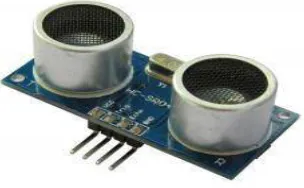
Ultrasonic sensors are great tools to measure distance without actual contact and used at several places like water level measurement, distance measurement etc. This is an efficient way to measure small distances precisely. In this project we have used an Ultrasonic Sensor to determine the distance of an obstacle from the sensor and in the case of gate control, the sensors at certain distance from the gate detects the approaching train and accordingly controls the operation of the gate. Basic principal of ultrasonic distance measurement is based on ECHO. When sound waves are transmitted in environment then waves are return back to origin as ECHO after striking on the obstacle. So we only need to calculate the travelling time of both sounds means outgoing time and returning time to origin after striking on the obstacle. As speed of the sound is known to us, after some calculation we can calculate the distance.
IV. RESULT AND DISCUSSION 1. AUTOMATIC GATE CONTROL
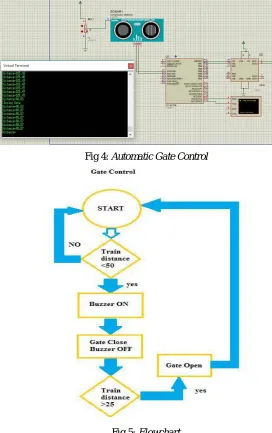
Fig 4: Automatic Gate Control
Fig 5: Flowchart
the result of speed and controller status. When the range is above the predetermined value, it displays as OPENING GATE and during the range below the predetermined value, it displays CLOSING GATE.
2. OBSTACLE DETECTION
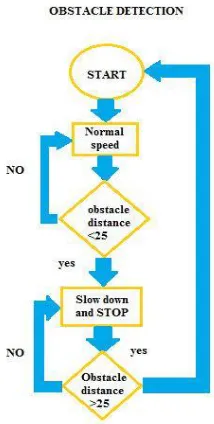
Fig 6: Obstacle Detection
Fig 7: Flowchart
STOPPED when the range is below the predetermined value and TRAIN IS RUNNING when the range is above the predetermined value.
V. FUTURE SCOPE
This paper is completely a prototype of the desired system. It is only having the obstacle detection technique and automatic railway gate control. In future some more features can be added to this system which includes the GSM technology. This helps to identify the accident occurring area and also provide a provision of immediate alert messages to the authorities.
VI.CONCLUSION
In this paper it deals with the automatic railway gate control and obstacle detection system. Automatic railway gate control system is more sensitive and also reduces railway accident to provide safety. This system provides very large benefit for railway management and society. The project is done by using ultrasonic sensors as it is a prototype. In practical cases Radar is the efficient way of ranging. The method is applicable and useful even in bad weather conditions. In this paper the automatic gate control system and obstacle detection is designed, simulated and tested successfully. This is a highly reliable, effective and economical at dense traffic area, sub urban area and the route where frequency of trains are more. Also automatic gate control can reduce the manpower especially for women who are suffered during night shifts. As it saves some auxiliary structure as well as the expenditure on attendant it is more economical at above mentioned places then traditional railway crossing gate system. Even though it is very beneficial, it is also impossible to install such system at each and every place, but it gives certainly a considerable benefit to society, thereby to nation.
REFERENCES
[1] Krishna, ShashiYadav and Nidhi, “Automatic Railway Gate Control Using Microcontroller”, Oriental Journal Of Computer Science
&Technology, Vol.6, No.4, December 2013.
[2] SitiZaharah, “Transit District Advance Automated Train Detector System Case Study Description”, pp: 115 135. 5.
[3] Ahmed Salih Mahdi, Al Zuhairi, “Automatic Railway Gate and Crossing Control based Sensors & Microcon-troller", International
Journal of Computer Trends and Technology (IJCTT), Volume 4, Issue 7, July 2013.
[4] J. Banuchandar, V. Kaliraj, P. Balasubramanian, S. Deepa, N. Thamilarasi,“ Automated Unmanned RailwayLevel Crossing System”, in
International Journal of Modern Engineering Research (IJMER)
[5] Ahmed Salih Mahdi. Al-Zuhairi,“Automatic Railway Gate and Crossing Control based Sensors &Microcon-troller ”, IN International
Journal of Computer T rends and Technology (IJCTT) –Volume 4 Issue 7–July2013.
[6] N. Ramasamy, "Automatic obstacle detection in railway network using embedded system " 2014, vol. 13.
[7] Wang, X.Wang,andH.Zhao,”Safety analysis on the train running control system in Qinghai- Tibet railway”, China
Saf.Sci.J.,no.11,pp.52-57, May 2001 Q.song,Y.
[8] J.Wang, “A New Early Warning Method of Train Tracking Interval Based on CTC“ march,2017
[9] J.-F. Wang, “CTCS-2I: A new train control system suitable for trains with speeds up to 350km/h,” J. Transp. Eng., vol.
137, no. 5, pp. 327–332, May 2011.
[10] C.- S. Hsu, C.Wang, and L. K. Yang, “On board measurement and warning module for irregular vehiclebeha-vior,” IEEE Trans. Intel.
Transp. Syst., vol. 9, no. 3, pp. 501–513, Sep. 2008.
[11] F. Y. Wang, “Parallel control and management for intelligent transportation system: Concepts, architec-