A WELL BEHAVED COMPACT STAR MODEL IN
ISOTROPIC COORDINATES
Pratibha Fuloria
Physics Department, Kumaun University, S.S.J. Campus, Almora
ABSTRACT
We present a static and spherically symmetric solution of the general relativistic field equations in isotropic coordinates for perfect fluid. The solution is regular and well behaved having positive finite central pressure and positive finite central density. The solution is well behaved for all the values of u lying in the range 0 < u < .16. The central red shift and surface red shift are positive and monotonically decreasing. we have constructed
a model for superdense star by assuming the surface density
b 21014 g/cm3. The mass of the compact star comes out to be 1.165 MΘ with linear dimension 10.796 Km and moment of inertia2 45
10 59 .
1 gmcm . The solution is not only well behaved but also having one of the simplest expressions so far known well behaved solutions.
Keywords:
Isotropic coordinates, Einstein’s field equations, Superdense star, General relativity, Exact solutions.I. INTRODUCTION
Ever since the first exact solution of field equations for a perfect fluid sphere of constant density was
obtained by Schwarzschild[1], the relativists have been proposing different models of immensely
gravitating astrophysical objects by solving field equations both in curvature and isotropic
coordinates. Exact solutions with well behaved nature of Einstein’s field equations are of vital
importance in relativistic astrophysics because the distribution of matter in the interior of stellar
object can be easily understood in terms of simple algebraic relations. Due to the nonlinearity of
Einstein’s field Equations it becomes difficult to obtain the new exact solutions. Various exact
solutions of Einstein’s field equations are known till date but not all of them are physically relevant.
Hence a new solution is always welcome which should be regular and well behaved .
A considerable number of known solutions of Einstein’s field equations are of finite central density
and finite central pressure which describe the internal structure of stellar objects[2]. These solutions
are important for describing the interior of compact objects like neutron star and Quark star. Delgaty
which seven in curvature coordinates(Tolman [3], Patvardhav and Vaidya[4], Mehra [5], Kuchowich
[6], Matese and Whiteman[7], Durgapa[8] and only two solutions in isotropic coordinates [9-10].
Many solutions in isotropic coordinates have been explored so far[11-12]. In this paper we have tried
to study in detail one of the solutions earlier obtained by Tewari[13] .
From the physical point of view, the mathematical solutions must satisfy certain
physical requirements to render them physically meaningful. For well behaved nature of the solution
in isotropic coordinates, the following conditions should be satisfied[14].
(i) The solution should be free from physical and geometrical singularities i.e. finite and positive
values of central pressure , central density and non zero positive values of eand e.
(ii) The solution should have positive and monotonically decreasing expressions for pressure and
density( pand
)with the increase of r. The solution should have positive value of ratio ofpressure-density and less than 1(weak energy condition) and less than 1/3(strong energy
condition) throughout within the star, monotonically decreasing as well [15].
(iii) The solution should have positive and monotonically decreasing expression for fluid
parameter 2
c
p
with the increase of r.(iv) The solution should have positive and monotonically decreasing expression for velocity of
sound
d dpwith the increase of r and causality condition should be obeyed at the centre i.e.
1 2
d c
dp
(v) The red shift Z should be positive, finite and monotonically decreasing in nature with the
increase of r.
(vi)
ddp p
, everywhere within the ball.
pd dp d
p dp d
p d
e
e
log log
For realistic matter
1(Pant and Maurya [16])Keeping in view the above mentioned conditions we are trying to study one of the solutions obtained
by Tewari [13] in isotropic coordinates. The solution is well behaved and have been used to
construct the model of superdense objects.The mass of superdense objects based on this solution
II. FIELD EQUATIONS IN ISOTROPIC COORDINATES:
Let us consider a spherical symmetric metric in curvature coordinates
2 2 2 2 2 2
2 2
sin
d
d
r
dr
e
dt
c
e
ds
(1)Where α and β are functions of r. Einstein’s field equations of gravitation for a
nonempty space-time are
j i j
i j
i R Rg
T c
G
2 1 8
4
(2)
Where Rij is a Ricci tensor. Tij is energy- momentum tensor and R is the scalar
curvature. The energy - momentum tensor Tij is defined as
Tij = ( p + ρ )vi v j − p gij (3)
Where p denotes the pressure distribution , ρ the density distribution and
i the velocity vector, satisfying the relation1
j i j ig
(4)
Since we are dealing with static field, therefore,
(5)
For the metric (1) the field equation (2) reduces to the following equations
r
r
e
p
c
G
2
4
8
24
(6)
r
r
p
c
G
2
2
4
2
2
8
24
(7)
r
e
c
G
2
4
8
22
(8)
where prime ( ' ) denotes the differentiation with respect to r .
From (6) and (7) we obtain following differential equation in α and β
0 2
2
2 2
r r
(9)
44 4
3 2
1
1
0
g
v
and
v
v
Our task is to explore the solution of eq. (9) and obtain the fluid parameters p and ρ from Eqs. (6) and
(8).
III. SOLUTION TO BE STUDIED
Equation (9) is solved by assuming an ad hoc relation of gravitational potential g11 and r, analogus to
Tewari [13]and Boutros[17] and considering the arbitrary constants in such a manner that the solution
should be well behaved. We assume
89 12 2 2/
1
Cr
e B
x
Cr
2 anddx d
y
(10)We get the following Riccati differential equation in y
)
1
(
7921
1848
1
89
24
2
2 2x
x
y
y
dx
dy
(11)Which yields the following solution,
2 89 21 2 89 23 2 2 1 1 1 B Cr Cr A e (12)Where A, B, and C are arbitrary constants.
The expressions for pressure and density are obtained as :
2 2
89 154 2 2
2 3204 924
1 7921 4 8 r C C Cr B c G
(13) 89 23 2 2 2 89 23 2 2 2 89 154 2 2 4 ) 1 ( 1 ) 89 65 ( ) 1 ( 23 ) 441 801 ( ) 1 ( 7921 4 8 Cr A C r C Cr A r C C Cr B c p G
(14)I. Properties of the new solution:
The central values of pressure and density are given by
2 0 2
89
144
8
B
C
c
G
(16)The central values of pressure and density will be non zero positive definite, if the following
conditions will be satisfied.
A > - 9/32 , c > 0. (17)
Subjecting the condition that positive value of ratio of pressure-density and less than 1 at the
centre i.e. 2
1
0 0
c
p
which leads to the following inequality,1 1 23 9 36 1 A A (18)
All the values of A which satisfy equation (17) will lead to the condition 2 1 0
0 c p
Differentiating (13) with respect to r,
3 3 2 3 3 2 89 23 2 3 3 2 89 46 2 2 89 243 2 2 89 23 2 257330
168210
240240
606624
1
251680
532576
)
1
(
1
1
1
704969
4
r
C
r
C
r
C
r
C
Cr
A
r
C
r
C
Cr
A
Cr
Cr
A
B
dr
dp
(19)Thus extrema of p occur at the centre if
0
0
r
p (20)
2 2 2 2
2 2
0
4 5984 6816 1890
1 1 7921 4 8 C AC C A A B p c G
r
(21)
= - ve if 2992A2 3408A9450 (22) Thus the expression of right hand side of equation (20) is negative showing thereby that the pressure
p is maximum at the centre and monotonically decreasing.
Now differentiating equation (12) with respect to r.
89
2 3
243 2 2
30030
205590
1
704969
4
r
C
Cr
Cr
B
C
dr
d
(23)
Thus the extrema of ρ occur at the centre if
0
0
r
22 02
7921 9240 8
B C c
G
r
(25)
The right hand side of this equation will be –ve for positive as well negative value of B and C.
Thus , the expressions of right hand side of (22) and (24) are negative showing thereby that the
density ρ is maximum at the centre and monotonically decreasing..
In view of (21) and (24), we observe that central pressure and central density are maximum at the
centre and monotonically decreasing with the increase of radial coordinate r.
The square of adiabatic sound speed at the centre,
0 2
1
r d dp
c
, is given by
2310
1890 6816
5984 1
1
1 2
2 0
2
A A
A d
dp c
r(26)
1and (ve)
If A > -9/32 (27)
In view of (12) and (13) the ratio of pressure-density is given by
2 2
89 23 2
2 2 89 23 2 2
2
2
924
3204
1
1
89
65
1
23
441
801
r
C
C
Cr
A
C
r
C
Cr
A
r
C
C
c
p
(28)IV. BOUNDARY CONDITIONS
The solutions so obtained are to be matched over the boundary with Schwarzschild’s exterior solution
2 2 2 2 2 2 1 2 2
2 2 2
sin
2
1
2
1
dR
R
d
R
d
R
c
GM
dt
c
R
c
GM
ds
(29)
Where M is the mass of the ball as determined by the external observer and R is the radial coordinate
of the exterior region. The usual boundary conditions are that the first and second fundamental forms
are continuous over the boundary r = rb or equivalently R=Rb.
Applying the boundary conditions we get the values of the arbitrary constants in terms of
Schwarzschild’s parameters
b R c
GM
8923 2 2 89 3 2 2 1 89 23 2 1 2 1 2 89 3 2 2 1
1
1
1
2
1
2
1
89
65
1
2
1
89
1
1
1
2
1
b b bCr
k
Cr
u
u
u
k
Cr
u
A
(30) 89 112 2 2 1 89 23 2 2 2 1 2 2 ) 1 ( 89 ) 2 1 ( ) 1 ( 88 ) 2 1 ( 42 ) 1 ( 89 b b b b b Cr u u Cr Cr u Cr Cr u A (31)
From equation (29) and (30) we obtain the value of k as
893 2 89 23 2 89 112 2 2 1 89 23 2 2 2 1 2 2 1 2 1 1 1 ) 1 ( 89 ) 2 1 ( ) 1 ( 88 ) 2 1 ( 42 ) 1 ( 89 b b b b b b b Cr u Cr Cr u u Cr Cr u Cr Cr u k
(32)
where b b r R k
89 12 2 1 2 1 2 1 89 65 1 2 1 89 1 u u k B (33)
22 1 2 1
2
1
89
65
1
2
1
89
br
u
u
C
(34)Surface density is given by
u u
R r c G b b
b 771 2 77 95
3 1 8 2 1 2 2 2
> 0 (35)
Provided, u < .30
1
1
2 0
A
B
Z
(36)
The surface red shift is given by
12 0.51
u Zb
(37)
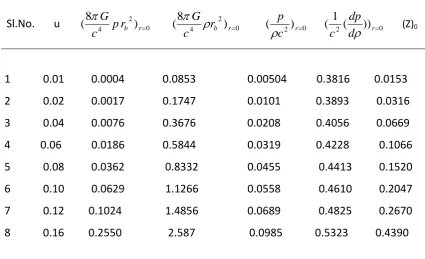
Table 1:
The central values of pressure, density, pressure density ratio, square of sound
speed, red shift for different values of u.
Sl.No. u
02
4 )
8
( prb r c
G
0
2
4 )
8
( rb r c
G
( 2)r0 c p
2 ( )) 01
( r
d dp
c
(Z)01 0.01 0.0004 0.0853 0.00504 0.3816 0.0153
2 0.02 0.0017 0.1747 0.0101 0.3893 0.0316
3 0.04 0.0076 0.3676 0.0208 0.4056 0.0669
4 0.06 0.0186 0.5844 0.0319 0.4228 0.1066
5 0.08 0.0362 0.8332 0.0455 0.4413 0.1520
6 0.10 0.0629 1.1266 0.0558 0.4610 0.2047
7 0.12 0.1024 1.4856 0.0689 0.4825 0.2670
8 0.16 0.2550 2.587 0.0985 0.5323 0.4390
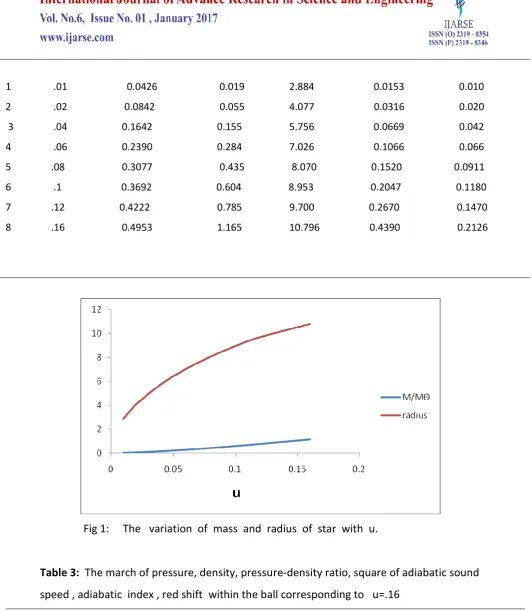
Table 2
: By assuming the surface density
14 3 / 102 g cm
b
,the variation of maximum
Neutron star mass , Radius R
b,central red shift Z
0and surface red shift
12 0.5 1
u
Zb
with u .
Sl. No. u 8 2 brb2 c
G
M M
1 .01 0.0426 0.019 2.884 0.0153 0.010
2 .02 0.0842 0.055 4.077 0.0316 0.020 3 .04 0.1642 0.155 5.756 0.0669 0.042
4 .06 0.2390 0.284 7.026 0.1066 0.066 5 .08 0.3077 0.435 8.070 0.1520 0.0911
6 .1 0.3692 0.604 8.953 0.2047 0.1180
7 .12 0.4222 0.785 9.700 0.2670 0.1470 8 .16 0.4953 1.165 10.796 0.4390 0.2126
Fig 1: The variation of mass and radius of star with u.
Table 3:
The march of pressure, density, pressure-density ratio, square of adiabatic sound
speed , adiabatic index , red shift within the ball corresponding to u=.16
r/r
b2 4 8
b r p c
G
8 4 rb2 c
G
2
c
p
(
)
1
2
d
dp
c
p d dp
/
0.0 0.255 2.587 0.0985 0.5323 5.40 0.4390
0.1 0.245 2.519 0.0976 0.5322 5.45 0.4343
0.2 0.221 2.334 0.0948 0.5317 5.60 0.4211
0.3 0.186 2.074 0.0900 0.5309 5.89 0.4009
0.4 0.149 1.789 0.0833 0.5295 6.35 0.3759
0.5 0.112 1.515 0.0744 0.5274 7.08 0.3481
0.6 0.080 1.271 0.0635 0.5245 8.25 0.3193
0.7 0.053 1.064 0.0505 0.5205 10.30 0.2907
0.8 0.031 0.894 0.0354 0.5151 14.51 0.2631
0.9 0.014 0.756 0.0186 0.5083 27.32 0.2370
1.0 0.000 0.645 0.0000 0.4999 ∞ 0.2126
Fig 2: The variation of
p,
, 2c
p
,
d dp c21
and Z from centre to surface for u = 0.16 .
VI. Application: Slowly Rotating Structures and their Application to the pulsars.
For slowly rotating structures like the Vela pulsars (rotation velocity about 70 rad/sec), one can calculate
the moment of inertia in the first-order approximation which appears in the Lense-Thrirring frame dragging
formula which is based on the numerical results obtained for a large number of theoretical equations of state
(EOS) of dense nuclear matter. For the type of solution considered in the present study, the formula yields in
the following form[15], [18] .
I = (2/5)(1 + y)MR2; (37) where y is the dimensionless compactness parameter measured in units of
M
(in km)/km, i.e y = (M/R) /M
(in km) km-1 (38)we can calculate the moment of inertia, for various super dense objects with the help of Equation (37),
VII. Discussions and Conclusions :
It has been observed that the physical parameters (p, , z c p
, 2
) are positive at the centre and within thelimit of realistic state of equation and monotonically decreasing for 0u0.16. The causality condition is obeyed throughout within the ball. Thus, the solution is well behaved for all the values of u satisfying the
inequality 0u0.16. We now here present a model of super dense star based on the particular solution discussed above by assuming surface density; 14 3
/ 10 2 g cm b
. Corresponding to u = 0.16, the resulting well
behaved model has maximum mass M=1.165
M
with radius Rb 10.796 km and Moment of inertia 245 10 59 .
1 gmcm . References :
1. Schwarzschild K., Sitzer. Preuss. Akad. Wiss. Berlin , p. 189 & 424 (1916). 2. Delgaty, M.S.R., Lake, K.: Comput. Phys. Commun.115, 395 (1998)
3. Tolman, R.C.: Phys. Rev. 55, 364 (1939)
4. Patvardhav, Vaidya: J. Univ. Bombay 12(Part III), 23 (1943)
5. Mehra, A.L.: J. Aust. Math. Soc. 6, 153 (1966)
6. Kuchowicz, B.: Acta Phys. Pol. 34, 131 (1968)
7. Matese, J.J., Whitman, P.G.: Phys. Rev. D, Part. Fields 22, 1270 (1980) .
8. Durgapal, M.C.: J. Phys. A, Math. Gen. 15, 2637 (1982)
9. Nariai: Sci. Rep. Tohoku Univ., Ser. 1 34, 160 (1950)
10. Goldman, S.P.: Astrophys. J. 226, 1079 (1978)
11. Pant, N., et. al.: Astrophys. Space Sci. 340, 407(2012).
12. Pant, N., et. al.: Int J Theor Phys 53, 993,(2014).
13. Tewari, B.C.: Gen. Relativ. Gravit. 45, 1547 (2013)
14.Pant, N., et. al.: Astrophys. Space Sci. 330, 353(2010).
15. Pant, N, Negi P. S.: Astrophys. Space Sci. 338. 163 (2012)
16. Pant, N., Maurya, S. K.: Appll. Math. Comput. 218, 8260 (2012) 17. Hajj Boutros, J.: J. Math. Phys. 27, 1363 (1986)