R E S E A R C H
Open Access
A novel design of physical layer network coding
in strong asymmetric two-way relay channels
Hao Wei
1*, Baoyu Zheng
1and Xiaodong Ji
1,2Abstract
The quality of two-way links is always asymmetric in practical two-way relay channels (TWRC) and therefore, the capacity of TWRC will be limited by the weaker link. An asymmetric modulation scheme, with physical layer network coding, was presented in order to improve the transmission reliability in TWRC. This makes full use of the stronger link to improve the overall transmission rate and also ensures the reliability of the weaker link. The simulation results show that the proposed asymmetric modulation scheme in the case of strongly asymmetric channels, compared to the symmetric transmission, enhances the system capacity significantly and also guarantees the system reliability.
Keywords:Network coding; Asymmetric modulation; Two-way relay channel; Subset constellation
1. Introduction
Network coding (NC) was originally proposed to im-prove the performance of multicast throughput in wired networks by Ahlswede et al. in 2000 [1]. Recently, the broadcast nature of wireless channels has attracted a lot of research activities on the application of NC in wireless networks.
The two-way relay channel (TWRC) is a typical scenario in wireless communications. Physical layer network coding (PLNC) was proposed to improve the throughput of TWRC [2], which maps the superimposition of the signals received simultaneously to a digital bit stream. PLNC improves the system performance by making use of the interference, instead of avoiding it. PLNC can further be classed into two categories - PNCF (PNC over finite field) and PNCI (PNC over infinite field) - according to whether the network coding field adopted is finite or infinite [3]. The capacity of TWRC with PLNC is higher than the traditional communication strategies [4,5]. The design of modulation suited for TWRC with PLNC can be BPSK or QPSK [6], and an unconventional 5-ary modulation which is optimized according to the channel condition [7]. In addition, PLNC can be combined with channel code
to improve bit error rate (BER) performance of the system [8].
The research works reported above are all based on the same assumption that the transmission rate of two end nodes is symmetric. In practical TWRC, however, the quality of two-way links is always asymmetric. Therefore, the capacity of TWRC will be limited by the weaker link. Thus, in the symmetric rate transmission of TWRC, in order to ensure the reliability of the weaker link, the stronger link has to transmit and receive with low-order modulation as same as the weaker link. For this reason, the stronger link does not take advantage of its good channel conditions to improve the overall trans-mission rate, which lowers the validity.
Asymmetric modulation is a method to realize the asymmetric rate transmission. The power matching ratio of the two end nodes in TWRC is corresponding to the performance of symbol error rate in the multiple access phase [9,10]. In the broadcast phase of TWRC, under the same BER constraint, the weaker link can decode at lower signal noise ratio (SNR) compared to the stronger link by exploitinga prioribit information in each transmit symbol [11].
This paper investigates the asymmetric rate transmis-sion both in the multiple access phase and broadcast phase of the two-phase TWRC by designing an asym-metric modulation scheme with PLNC. The simulation results show that the proposed scheme not only
* Correspondence:[email protected] 1
Institute of Signal Processing and Transmission, Nanjing University of Posts and Telecommunications, Nanjing 210003 Jiangsu, People’s Republic of China Full list of author information is available at the end of the article
improves the transmission validity by increasing the system capacity but also guarantees the transmission reliability.
The rest of this paper is organized as follows. Section 2 introduces the system model. Section 3 presents the new scheme of asymmetric modulation with PLNC. Section 4 analyzes the performance of the asymmetric modulation scheme. Simulation experiments and performance com-parisons between the symmetric transmission mode and the proposed scheme will be discussed in Section 5. Finally, Section 6 concludes this paper.
2. System model
We consider the two-phase TWRC system as shown in Figure 1, in which two independent end nodesn1andn2
exchange information with each other via the relay node
nR. As illustrated in Figure 1,Bi,i∈{1, 2,R} denotes the bit information of nodeniwhich is modulated to symbol Xi. The coefficient hij, i,j∈ {1,2,R} is the complex path-loss coefficient for the channel from ni to nj. Wi is the noise at ni to be zero-mean complex Gaussian variable with variance σi2. Pi is the transmitting power of ni. In this paper, the following assumptions are made: (1) all nodes operate in a half-duplex manner, i.e., a node cannot transmit and receive simultaneously; (2) symbol-level time synchronization is assumed; (3) there is no direct link be-tweenn1andn2; (4) channel coefficient is quasi-static and possess reciprocity, i.e.,h1R=hR1=h1,h2R=hR2=h2; (5) nodes can perfectly estimate the channel state information (CSI) to realize the phase synchronization and amplitude pre-equalization; (6) the energy of symbolXiis normalized to unit 1; (7) power constrainsP1+P2= 1,PR= 1.
The process of information exchange comprises of two phases:
1. Multiple access phase (MAC). First,n1andn2 modulateB1andB2respectively toX1andX2. Second,n1andn2transmitX1andX2to the relay nodenRsimultaneously. ThennRdemodulates the superimposition of the signalYRtoBR=B1⊕B2. 2. Broadcast phase (BRC). The relay nodenR
modulatesBRtoXRand broadcasts it ton1andn2, simultaneously. Thenn1demodulatesY1toBRand get the bit information ofn2by using exclusive or (XOR) operationB2=B1⊕BR. Similarly,
n2demodulatesY2toBRand get the bit information ofn1by using XOR operationB1=B2⊕BR.
So,n1andn2can finish the information exchange only by two phases. The importance of the information ex-change is the design of modulation and demodulation at the relay node nR. In multiple access phase, nR is sup-posed to realize the demodulation ofYR→BR=B1⊕B2. In broadcast phase,nR has to realize the modulation of
BR → XR. The performance of the system depends on the design atnR, which is a key point in this paper.
3. Asymmetric rate transmission
The design of the modulation and demodulation forn1,
n2, andnRwill be presented in this section to realize the asymmetric rate transmission both in the multiple access phase and broadcast phase. For simplicity and without loss of generality, we assume σ2
h1>σ
2
h2 (respectively de-note the variances of h1 and h2) which means that the stronger link C1 (the channel between n1 and nR) has better quality than the weaker link C2(the channel be-tweenn2andnR).
3.1 Design of asymmetric modulation
The asymmetric modulation is proposed by utilizing the asymmetric channel quality to make n1and n2transmit and receive at different rates. For simplicity and clarity, QPSK and 16QAM will be as examples to be depicted for the design of the asymmetric modulation, which are respectively 2 bit/symbol and 4 bit/symbol.
2
Figure 1System model of TWRC.
0 0 00 0 0 01
3.1.1 MAC phase
Before transmitting,n1first inserts two dummy zeros‘00’ for each two bits inB1to obtainB1
:
, making‘00’,‘01’,‘10’, and
‘11’become‘0:0:00’,‘0:0:01’,‘0:0:10, and’ ‘0:0:11’(these dummy zeros contain no information and their positions are fixed
and known to bothn1andn2); Thenn1modulates B1
: to
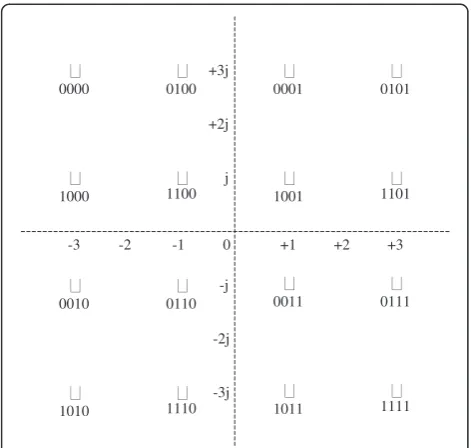
X1by QPSK, andn2modulatesB2toX2by 16QAM (the constellation ofX1andX2are shown in Figures 2 and 3. Finally,n1andn2transmitX1andX2tonR, respectively. So in the same symbol period, n1 transmits two-bit information whilen2transmits four bit information.
As illustrated in Figures 2 and 3, the stronger linkC1
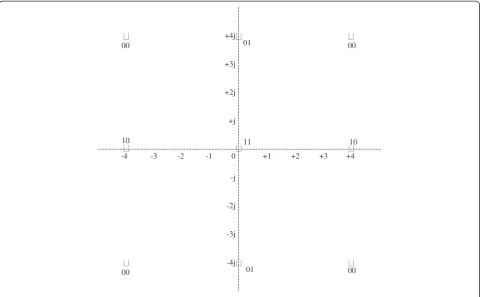
transmits signals by low-order modulation (QPSK), while the weaker linkC2transmits signals by high-order modulation (16QAM). This kind of design might be op-posite to our straight thinking, but it lets the system make use of the stronger link C1to improve the overall transmission rate and also guarantee the transmission reliability of the weaker link C2 in the BRC phase (the specific statement is next). When the transmitting power ratio is PQPSK:P16QAM= 4 : 5, the BER performance of the QPSK-16QAM superimposition signals is optimal in the MAC phase, which is demonstrated in [9]. Note that there are 36 points in the QPSK-16QAM constellation as shown in Figure 4.
3.1.2 BRC phase
In the BRC phase, nRfirst modulatesBRtoXR. ThennR broadcasts XR to n1 and n2. The constellation of XR is shown in Figure 3, which is same as the constellation of
X2in the MAC phase.
0000 0100
Due to the fore 2 bit ‘0:0:’in each 4 bit of B1
:
which is inserted byn1as the dummy zeros, the fore 2 bits ofB2
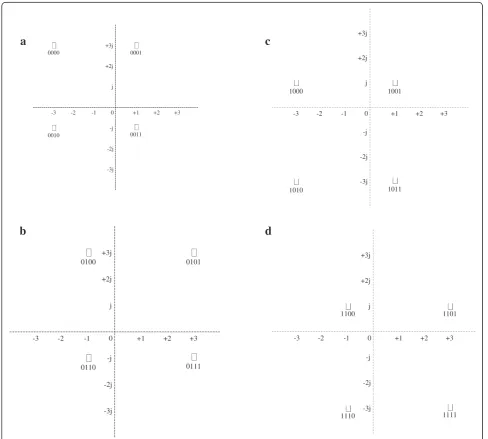
are kept unchanged inBRafter the XOR operation atnR. Son2can exploit these as a priori information and does not need to decode every bit inBR. Noden2can discard the known bits and decode only the latter 2 bits of BR according to the subset of 16QAM constellation (QPSK), which is illustrated in Figure 5. Thenn2can obtain the bit information of n1by executing the XOR operation
B1=B2⊕BR.
As illustrated in Figure 5, the constellation used to de-modulate signals by n2 is QPSK, which is a subset of 16QAM constellation. In this way, the distance of the
adjacent points is increased, so the BER performance is improved and the transmission reliability is guaranteed.
By using this scheme, in BRC phase, the signal modu-lated by high-order modulation (16QAM) is transmitted through the stronger linkC1to improve the transmission rate, while the signal modulated by low-order modulation (QPSK, which is the subset of 16QAM constellation) is transmitted through the weaker link C2 to ensure the transmission reliability.
3.2 Symmetric modulation for comparison
In order to show up the advantages of the proposed asymmetric modulation scheme, we use the symmetric
0000 0001
0010 0011
-1
-3 0 +1 +3
-j
-3j -2j
+2 -2
j +2j +3j
0100 0101
0110 0111
-1
-3 0 +1 +3
-j
-3j -2j
+2 -2
j +2j +3j
1000 1001
1010 1011
-1
-3 0 +1 +3
-j
-3j -2j
+2 -2
j +2j +3j
1100 1101
1110 1111
-1
-3 0 +1 +3
-j
-3j -2j
+2 -2
j +2j +3j
a
c
b
d
modulation QPSK-QPSK as examples for a simple comparison.
By using symmetric modulation, the stronger link C1
has to adopt the same low-order modulation as the weaker link C2 to transmit and receive signals. Both n1 and n2
adopt QPSK modulation to transmit and receive signals, and nR adopt QPSK modulation to transmit the XOR signals. The constellations are shown in Figures 6 and 7.
4. Performance analysis
In this section, we will analyze the performance of the proposed asymmetric modulation and compare it to that of the symmetric modulation. As we known,C1is better thanC2. Without loss of generality, we assumeμ> 1. For simplicity, we assume that the noises at the three nodes have the same variance,σ21¼σ22¼σ2R¼σ2.
4.1 BER analysis 4.1.1 MAC phase
Here, we usedmin to denote the minimum distance be-tween the adjacent points in the constellation of the superimposition of the signals received at nR(as shown in Figures 4 and 7). Thus, we have
dQPSK16QAM min¼2=3 ≈0:667
Then the approximation of the BER can be obtained according to [12,13] as
BERQPSK16QAM≈log2165 Q
Also, we use dmin to denote the minimum distance be-tween the adjacent points in the constellation of the sig-nals received at n1 and n2 from nR (as shown in Figures 3, 5, and 6). Then we have
Further, the approximation of the BER can be obtained according to [12,13] as
BERn116QAMASY≈log2164 Q
whereγ1andγ2denote SNR of the signals received atn1
andn2, respectively.
4.3 Capacity analysis
According to [14,15], the AWGN channel in MAC phase and BRC phase can be regarded as an equivalent virtual channelCVshown in Figure 8.
The input of CV is X and the output is Y =X + W, where W is a zero-mean complex Gaussian random variable W∼CN(0,σ2). CV is a discrete-input and continuous-output channel according to [15]. The input
Xcomprises symbols selected from a finite and discrete input alphabetX=xk(k= 0, 1,…,q−1), and the output is continuousY= {− ∞, +∞}. For a given X, it follows that Y is a complex Gaussian random variable with meanxkand varianceσ2, that is, is a corresponding output sequence of
Yi¼XiþWi ði¼1;2;…;nÞ: ð6Þ
So, the capacity ofCVis defined as
CV¼ maxp xð Þi I Xð ;YÞ
¼ maxp xð Þi X q−1
i¼0 ∫þ∞
−∞p yð jxiÞp xð Þi logp yð jxiÞ
p yð Þ dy ¼ maxp xð Þi
Xq−1
i¼0 ∫þ∞
−∞p yð jxiÞp xð Þi logXq−1 p yð jxiÞ
k¼0
p y xð j kÞp xð Þk dy: ð8Þ
The input X are equally probable symbols, and the probabilityp(xi) can be obtained according to the corre-sponding modulation constellation. Substituting p(xi) and Equation 7 into Equation 8, we can obtain the capacity of the equivalent virtual channelCV.
5. Simulation results
In this section, simulation results are presented to dem-onstrate the performance of our proposed scheme and to verify the accuracy of our analytical analysis in Section 4. In the simulation, all the numerical results are calculated with averaging over 10,000,000 packets, and the number of bits contained by each packet is equal to the bits contained by each symbol in the corresponding constellation. For simplicity and without loss of generality, we consider two scenarios ofμ= 4 andμ= 8. The SNR of the stronger linkC1is 6 and 9 dB higher than that of the weaker linkC2.
5.1 BER performance
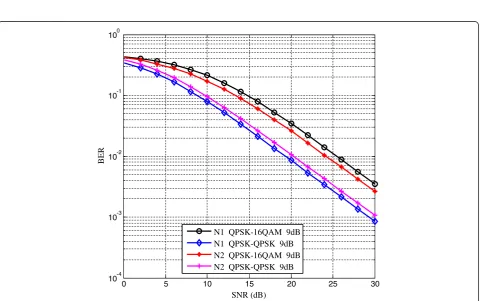
Here, the simulation results are presented to demonstrate the BER performance of the asymmetric modulation atn1
andn2.
Figures 9 and 10 respectively show the BER perform-ance of n1 and n2 when the asymmetric levels of the two-way links are 6 and 9 dB. As can be seen in Figures 9 and 10, when the asymmetric modulation QPSK-16QAM is adopted, although the modulation is different (one is QPSK, another is 16QAM), the BER performance of n1is close to n2. Moreover, the closeness of the BER performance for the symmetric modulation QPSK-QPSK is similar with the asymmetric modulation QPSK-16QAM. When the asymmetric level of the two-way
X
W
Mod
Y B
Dem B
Figure 8Equivalent virtual channel.
01
11
-1
-3 0 +1 +3
-j
-3j -2j
+2 -2
+j +2j +3j 00
10
-4 +4
-4j +4j
00
10
01
00 00
0 5 10 15 20 25 30 10-4
10-3 10-2 10-1 100
SNR (dB)
BER
N1 QPSK-16QAM 6dB N1 QPSK-QPSK 6dB N2 QPSK-16QAM 6dB N2 QPSK-QPSK 6dB
Figure 9BER performance (asymmetric level is 6 dB).
0 5 10 15 20 25 30
10-4 10-3 10-2 10-1 100
SNR (dB)
BER
N1 QPSK-16QAM 9dB N1 QPSK-QPSK 9dB N2 QPSK-16QAM 9dB N2 QPSK-QPSK 9dB
0 5 10 15 20 25 30 0
1 2 3 4 5 6 7
SNR (dB)
Capacity bits/symbol
QPSK-16QAM 6dB QPSK-QPSK 6dB QPSK-16QAM 9dB QPSK-QPSK 9dB Shannon 6dB Shannon 9dB
Figure 11Capacity atn1.
0 5 10 15 20 25 30
0 0.5 1 1.5 2 2.5 3 3.5 4 4.5 5
SNR (dB)
Capacity bits/symbol
QPSK-16QAM 6dB QPSK-QPSK 6dB QPSK-16QAM 9dB QPSK-QPSK 9dB Shannon
links increases (from 6 to 9 dB), the trend remains unchanged.
5.2 Capacity
Here, the simulation results are presented to demonstrate the capacity of the asymmetric modulation at the end nodes n1 and n2. The sum of capacity is also illustrated here.
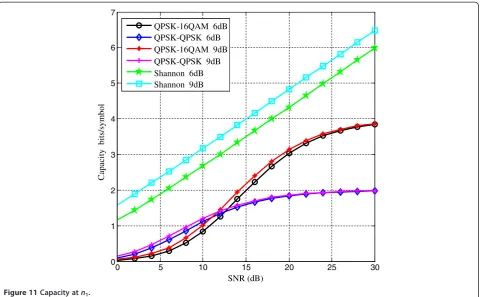
Figures 11 and 12 respectively show the capacity ofn1
and n2. The x-axis is the SNR of C2 in the two figures above, which needs to be paid attention to. As shown in Figure 11, when the SNR of the stronger linkC1is 6 dB higher than that of the weaker link C2 and the SNR is higher than 13 dB, the capacity ofn1by using the asym-metric modulation QPSK-16QAM is higher than by using the symmetric modulation QPSK-QPSK. When the SNR of the stronger linkC1is 9 dB higher than that of the weaker linkC2, the situation is similar when SNR is higher than 11 dB. As shown in Figure 12, when the chan-nel quality is asymmetric, the capacity of n2by using the asymmetric modulation QPSK-16QAM is close to the capacity ofn2by using the symmetric modulation QPSK-QPSK.
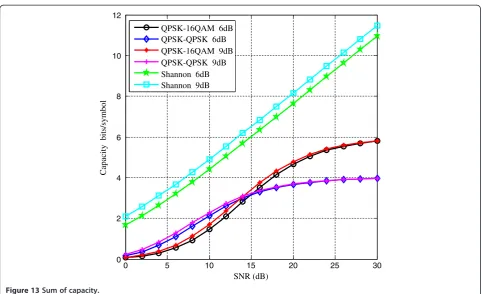
Figure 13 shows the total capacity of n1and n2when the asymmetric level of the two-way links is 6 and 9 dB. As shown in Figure 13, when the SNR of the stronger link C1 is 6 dB higher than that of the weaker link C2
and the SNR is higher than 15 dB, the capacity ofn1by
using the asymmetric modulation QPSK-16QAM is higher than by using the symmetric modulation QPSK-QPSK. When the SNR of the stronger link C1 is 9 dB higher than that of the weaker link C2, the situation is similar when SNR is higher than 13 dB. Overall, under higher SNR, compared with the symmetric modulation, the total capacity has been greatly improved by using the asymmetric modulation.
6. Conclusions
In this paper, an asymmetric modulation scheme with PLNC in TWRC is proposed, which aims to improve both the validity and reliability in two-way relay transmissions. The proposed asymmetric modulation scheme realized the asymmetric rate transmission both in MAC phase and BRC phase of TWRC. In MAC phase, the BER perform-ance at the relay is improved. In BRC phase, the capacity is boosted by making full use of the stronger link, and the BER performance is guaranteed by exploitinga prioribit information to demodulate for the weaker link. We de-rived the approximated BER expressions for the scheme proposed, which were also demonstrated by simulation experiments. Through the comparisons of the symmetric modulation scheme, it is found that by using the proposed asymmetric modulation scheme, the total capacity is improved significantly under the asymmetric level of the two-way links.
0 5 10 15 20 25 30
0 2 4 6 8 10 12
SNR (dB)
Capacity bits/symbol
QPSK-16QAM 6dB QPSK-QPSK 6dB QPSK-16QAM 9dB QPSK-QPSK 9dB Shannon 6dB Shannon 9dB
In addition, as well-known channel coding possesses the correcting ability and can improve the BER performance further, combining channel coding, network coding, and modulation for asymmetric transmissions in TWRC will be our future researches.
Competing interests
The authors declare that they have no competing interests.
Acknowledgement
This work was supported by the National Natural Science Foundation of China under No. 61271240.
Author details
1Institute of Signal Processing and Transmission, Nanjing University of Posts and Telecommunications, Nanjing 210003 Jiangsu, People’s Republic of China.2Key Lab of Broadband Wireless Communication and Sensor Network Technology, Nanjing University of Posts and Telecommunications, Ministry of Education, Nanjing 210003 Jiangsu, People’s Republic of China.
Received: 13 December 2012 Accepted: 28 May 2013 Published: 17 June 2013
References
1. R. Ahlswede, N. Cai, S.Y. Li, R.W. Yeung, Network information flow. J. IEEE Trans. Inform. Theor.)46(4), 1204–1216 (2000)
2. S. Zhang, S. Liew, P.L. Patrick,Proceedings of the 12th Annual International Conference on Mobile Computing and Networking, Los Angeles, 24–29 September 2006(ACM, New York, 2006), pp. 358–365
3. S. Zhang, S. Liew, L. Lu, Physical layer network coding schemes over finite and infinite fields, inGlobal Telecommunications Conference, IEEE GLOBECOM 2008, 30 November-4 December 2008(IEEE Communication Society, New Orleans, 2008), pp. 1–6
4. S. Zhang, S. Liew, H. Wang, X. Lin, Capacity of two-way relay channel. Access Netw.: Inst. Comput. Sci., Soc. Inform. Telecom. Eng. 37(2), 219–231 (2010)
5. P. Popovski, H. Yomo, Physical network coding in two-way wireless relay channels, inIEEE International Conference on Communications, ICC 2007, Glasgow, 24–28 June 2007(IEEE Press, Glasgow, 2007), pp. 707–712 6. K. Lu, S. Fu, Y. Qian, H.-H. Chen, SER performance analysis for physical layer
network coding over AWGN channels, inGlobal Telecommunications Conference, IEEE GLOBECOM 2009, Honolulu, 30 November-4 December 2009 (IEEE Communication Society Press, Honolulu, 2009), pp. 1–6
7. K.A. Toshiaki, P. Popovski, V. Tarokh, Optimized constellations for two-way wireless relaying with physical network coding. EEE J. Sel. Area Comm. 27(5), 773–787 (2009)
8. S. Zhang, S. Liew, Channel coding and decoding in a relay system operated with physical-layer network coding. EEE J. Sel. Area Comm.
27(5), 788–796 (2009)
9. X. Zhang, Y. Li, J. Lin, G. Li, Z. He, On performance of judging region and power allocation for wireless network coding with asymmetric modulation, inIEEE Vehicular Technology Conference, VTC2011-Fall, San Francisco,5–8 September 2011(IEEE Press, San Francisco, 2011), pp. 1–5
10. X. Zhang, Y. Li, J. Lin, J. Di, R. Han, Asymmetric network coding in two-way relay channels for cooperative communications: SER performance and power matching, inIEEE International Symposium on Wireless Personal Multimedia Communications, WPMC 2011, Brest, 3–7 October2011 (IEEE Press, Brest, 2011), pp. 1–5
11. J. Zhao, M. Kuhn, A. Wittneben, G. Bauch, Asymmetric data rate transmission in two-way relaying systems with network coding, inIEEE International
Conference on Communications, ICC 2010, Cape Town, May 23–27, 2010 (IEEE Press, Cape Town, 2010), pp. 1–6
12. C. Fan, L. Cao,The Principle of Communications(National Defense Industry Press, Beijing, 2008)
13. A. Goldsmith,Wireless Communications(Cambridge University Press, Cambridge, 2005)
14. Z. Chen, B. Zheng, X. Ji, X. Xiao, An improved joint design of physical layer network coding and channel coding based on trellis coded modulation in two-way relay channel. J. Electron. Inform. Technol.33(11), 2594–2599 (2011)
15. J. Proakis,Digital Communications(McGraw-Hill, New York, 2000)
doi:10.1186/1687-1499-2013-166
Cite this article as:Weiet al.:A novel design of physical layer network coding in strong asymmetric two-way relay channels.EURASIP Journal on Wireless Communications and Networking20132013:166.
Submit your manuscript to a
journal and benefi t from:
7Convenient online submission
7Rigorous peer review
7Immediate publication on acceptance
7Open access: articles freely available online
7High visibility within the fi eld
7Retaining the copyright to your article