R E S E A R C H
Open Access
What should be fed back for per-cell
codebook-based limited feedback
coordinated multi-point systems?
Di Su
*and Chenyang Yang
Abstract
Per-cell codebook-based limited feedback is highly desirable in coordinated multi-point (CoMP) systems owing to flexibility and compatibility. Except for the per-cell codeword indices, each user should feed back other information for the central unit to reconstruct global channel direction information (CDI) and estimate channel quality information (CQI) for downlink transmission. In this paper, we analyze the essential feedback information for per-cell
codebook-based coherent CoMP systems. To show what should be fed back to estimate the CQI, we first derive a conservative CQI estimation to avoid the outage in transmission, which depends on the quantization accuracy and the norm of the global channel. We then analyze whether the per-cell small-scale fading channel norms are necessary to feed back in obtaining the global channel norm and reconstructing the global CDI. Next, we analyze whether the feedback of phase ambiguity (PA) is necessary. Both the analysis and simulation results show that the global channel norm should be fed back instead of the per-cell channel norms. The benefit of the PA feedback is evident only when the number of base stations is large and the number of antennas at each base station is small.
1 Introduction
Coordinated multi-point (CoMP) transmission has drawn broad attention recently [1,2]. When all the coordinated base stations (BSs) share both data and channel informa-tion, coherent cooperative transmission, also known as joint transmission, can provide high spectral efficiency for cellular systems if the BSs can obtain high-quality channels. This however requires large feedback overhead for frequency division duplexing (FDD) CoMP systems. Though CoMP has various forms, depending on the infor-mation shared among the BSs, we refer coherent cooper-ative transmission as CoMP in the rest of the paper for simplicity.
Limited feedback techniques are widely applied in reporting channel information to the BS in multi-input-multi-output (MIMO) systems and have been extensively studied [3]. To facilitate downlink beamforming, each user needs to feed back quantized channel direction informa-tion (CDI) to the BS. To provide the essential informainforma-tion
*Correspondence: [email protected]
School of Electronics and Information Engineering, Beihang University, Beijing 100191, People’s Republic of China
for spatial scheduling and modulation and coding selec-tion (MCS), each user needs to feed back the estimated channel quality information (CQI) to the BS, which should be signal-to-noise and interference ratio (SINR) in multi-user MIMO (MU-MIMO) systems [4].
Despite that CoMP systems can be viewed as a large MIMO system with a super BS, there are many subtle but critical differences in terms of system setting and channel feature. As a result, the well-explored techniques devel-oped for single-cell MIMO systems cannot be extended to CoMP systems in a straightforward manner.
The CoMP channel is composed of multiple single-cell channels between the coordinated BSs and each user. The coordinated cluster may be formed dynamically [2]. Consequently, in applying vector quantization theory to design a global codebook for quantizing the global CDI of the CoMP channel, there is lack of flexibility and com-patibility [5]. It is more desirable to design a per-cell codebook-based feedback scheme, where each single-cell CDI is first quantized with a codebook, and then the global CDI is reconstructed with the quantized per-cell
CDIs. Such a feedback scheme is suboptimal in nature. Nonetheless, its performance can be improved signifi-cantly by judiciously designing the methods for the code-word selection [5,6], global CDI reconstruction [7], and bit allocation among the per-cell codebooks [6,8]. When the independent codeword selection is applied, which is a codeword selection method extended from the single cell MIMO systems, phase ambiguity (PA) will lead to severe performance degradation [7]. Fortunately, when the PA is quantized and fed back, the performance of CoMP systems will be largely retrieved [8]. This will however introduce extra feedback overhead.
To assist downlink scheduling and MCS, the CQI should be available at the BS side, also in the form of SINR for CoMP systems. CQI estimation has a large impact on system performance. An optimistic estimate will lead to the outage in the downlink transmission. To help each user estimate the SINR accurately, full multiplexing spatial scheduling and equal power allocating among the selected users are usually assumed [4,9]. However, to meet the per-BS power constraint (PBPC) of CoMP system, the powers allocated to the users are not necessarily equal and unknown at the users. Therefore, the CQI is no longer able to be estimated accurately at each user. Instead, the BSs should estimate the SINRs experienced at the users’ end, and each user should feed back necessary information to its master BS for CQI estimation.
In this paper, we strive to answer the following ques-tion: what is the essential feedback information for the estimation of CQI and the reconstruction of global CDI at the BSs in CoMP systems? Single stream transmission is considered to simplify the analysis. To analyze what should be fed back for CQI estimation, we first derive a method to estimate the SINR to avoid the outage in downlink transmission. Then, we analyze the necessity of feeding back the per-cell small-scale fading channel norms by comparing the average quantization performance of the global channel norm and the asymptotic weighting factors in the global CDI with and without the per-cell channel norm feedback. We proceed to analyze the neces-sity of feeding back the PA by comparing the average quantization performance with and without the PA feed-back. Finally, we use numerical and simulation results to validate the analysis and show whether the per-cell channel norms and the PA should be fed back in typical settings.
Notations: The conjugate transpose of a vector (or matrix) is denoted by(·)H. The Euclidean norm is repre-sented by · , and the magnitude of a complex variable is by| · |. TheN×Mcomplex matrixes are denoted by
CN×M.CN(b,N)denotes the complex Gaussian distribu-tion with meanband covarianceN.Idenotes the identity matrix, anddiag{·}is a diagonal matrix.E{·}denotes the expectation operator.
2 System model
2.1 CoMP channel model
Consider a coherent downlink CoMP system with uni-versal frequency reuse, whereNcBSs each equipped with nt antennas cooperatively transmit toMsingle antenna users. The coordinated BSs are connected to a central unit (CU) via backhaul links with unlimited capacity and zero latency.
The downlink global channel of each user, say themth user, is composed of all the per-cell channels from each coordinated BS to the user, which can be represented by
gm=
αm,1hHm,1,. . .,αm,NchHm,NcH =R
1 2
mhm, (1)
where αm,n is the large-scale fading gain including the path loss and shadowing, hm,n ∈ Cnt×1 is the small-scale fading channel vector from the nth
coordi-nated BS to the mth user, hm =
hHm,1,. . .,hHm,Nc H
is the concatenated small-scale fading channel, and
Rm = diag
α2m,1Int,. . .,αm2,NcInt
is the covariance matrix, which reflects the spatial correlation of the global channel and depends on the user location. To simplify the analysis and highlight the feature of CoMP chan-nels, we assume that the per-cell channels hm,n,n = 1,. . .Nc,m = 1,. . .,M are independent and identi-cally distributed (i.i.d.), and each of their entry is sub-ject to CN(0, 1). It is shown that Equation 1 resembles Kronecker’s spatially correlated channel model.
The norm of the global channel is
||gm|| =
Nc
n=1
α2
m,n||hm,n||2, (2)
and the CDI of the global channel is
¯ gm
gm
gm =
[gm,1h¯Hm,1,. . .,gm,Nch¯Hm,Nc]
H, (3)
whereh¯m,n hhmm,,nnis thenth per-cell CDI vector and
gm,n=
αm,nhm,n
gm =
αm,nhm,n
Nc
n=1α2m,nhm,n2 (4)
is a weighting factor, which reflects the contribution of the per-cell CDI to the global CDI, andhm,nis the per-cell small-scale fading channel norm.
per-cell CDI vectors. That is to say, each user selects the codewords forNcper-cell CDI vectors, then feeds back the indices of these codewords to the CU. The global CDI vec-tor for each user is reconstructed at the CU. Assume that the large-scale fading gains are perfectly known at the CU. In practice, they can be obtained by averaging the down-link receive signal energy at each user and feeding back to the CU, which needs low feedback overhead.
2.2.1 Reconstruction of the global CDI
After receiving the indices of the selected codewords for multiple per-cell CDI vectors from each user,{j1,. . .,jNc},
we can reconstruct the global CDI of themth user at the CU only with the large-scale fading gains, which is
ˆ gm=
ˆ
gm,1cHm,j1,. . .,gˆm,Ncc H m,jNc
H
, (5)
wherecm,jnrepresents the selected codeword from thenth
per-cell codebookCnfor quantizingh¯m,nand
ˆ
gm,n=
αm,n
Nc
n=1α2m,n
, (6)
is the estimated weighting factor.
The quantization accuracy of the reconstructed global CDI for usermis expressed as
cos2θm=|¯gHmgˆm|2= Nc
n=1
gm,ngˆm,nh¯Hm,ncm,jn
2
, (7)
since the difference in phase between the reconstructed global CDI gˆm and the actual global CDI g¯m does not affect the performance [3]. The quantization accuracy is associated with theGrassmann choral distance[3], which is 1−cos2θm. The quantization accuracy of the recon-structed global CDI is referred to as ‘global quantization accuracy’ for short in the sequel.
Remark 1.If the per-cell small-scale fading norms
||hm,n||, n = 1,. . .,Nc are perfectly known at the CU, the global CDI can be reconstructed with Equation 5 but replacinggmˆ ,n bygm,n. Then, the global quantization accuracy becomes
cos2θm= Nc
n=1
gm2,nh¯Hm,ncm,jn
2
. (8)
2.2.2 Codeword selection
Per-cell codewords can be selected either independently or jointly according to different criteria at the user side. The criteria depend on the method to reconstruct the global CDI, which determines the global quantization accuracy. Here, we assume that the global CDI is
recon-structed with Equation 5. Two popular codeword selec-tion methods are shown as follows:
◦ Joint codeword selection. Each user jointly selects the per-cell codewords to maximize its global
quantization accuracy, i.e.,
arg max j1,...,jNc
cos2θm
=arg max j1,...,jNc
Nc
n=1
gm,ngˆm,nh¯Hm,ncm,jn 2.
(9)
This codeword selection method requires prohibited complexity for exhaustive searching multiple codewords. Nonetheless, the complexity can be remarkably reduced, e.g., with a serial codeword searching algorithm proposed in [6].
◦ Independent codeword selection. Each user independently selects the per-cell codewords to maximize the quantization accuracy of each per-cell CDI vector, i.e.,
arg max jn
|¯hHm,ncm,jn|,n=1,. . .,Nc. (10)
This method suffers from severe performance degradation, especially whenαm,1=. . .=αm,Nc,
which comes from the PAs,ejξm,n= h H m,ncm,jn |hH
m,ncm,jn|,n=1, . . .,Nc[8]. Nevertheless, the performance can be
significantly retrieved by feeding back the PAs as shown in [7].
3 Feedback for CQI
When the CU obtains the global CDIs from multiple users, it can compute the joint beamforming matrix for downlink cooperative transmission. To facilitate user scheduling as well as the power allocation and MCS for the selected users, the CU also needs to estimate the CQI of each user, which is the SINR experienced at the user’s end [4].
In limited feedback MU-MIMO systems, each user only knows its own channel but is unaware of the beamforming vectors for other users, while the BS knows all the beam-forming vectors but does not know the actual downlink channels of users. As a result, neither each user nor the BS can accurately compute the downlink SINR experienced by the user.
the user’s end accurately if the number of selected users equals tont, i.e., full multiplexing is achieved. Note that the PU2RC implicitly assumes that the transmit power is equally allocated to the users.
In order to borrow the idea of PU2RC, we consider a transmission scheme using semi-orthogonal user schedul-ing (SUS) [4] and zero-forcschedul-ing beamformschedul-ing, which is asymptotically optimal in terms of sum rate in single-cell systems. If the orthogonal threshold in SUS is small and the power is equally allocated among the selected users, such a scheme will resemble the PU2RC. However, in CoMP systems, the PBPC may not be met with the equal power allocation. When considering the power allocation under the PBPC, each user does not know the power allo-cated to it. This suggests that we need to estimate the SINR at the CU for CoMP systems.
If we assume that the threshold in SUS equals to zero, we havegˆHi gˆm = 0,∀i = m. Then, the beamforming vector for themth userwm = ˆgHm, and the SINR can be obtained as
SINRm=
pm||gm||2|¯gHmwm|2
σ2
m+ ||gm||2Mi¯=mpi|¯gHmwi|2
= pm||gm||2cos2θm σ2
m+pm||gm||2iM=¯mρi|¯gHmgˆi|2 ,
(11)
wherepmis the power allocated to userm,σm2 is the vari-ance of noise and inter-cluster interference at the user, and
¯
M is the number of scheduled users. ρi ppmi reflects that the allocated powers to different users may differ, especially when the PBPC is considered.
The relationship of the true value and the quantized global CDI can be described asg¯m=cosθmgˆm+sinθmsm, where cosθmis the global quantization accuracy andsmis a unitary vector withsHmgˆm = 0. Upon substituting into Equation 11, the SINR can be rewritten as
SINRm
= pm||gm||2cos2θm
σ2
m+pm||gm||2iM¯=mρi|cosθmgˆHmgˆi+sinθmsHmgˆi|2
= pm||gm||2cos2θm
σ2
m+pm||gm||2sin2θmiM¯=mρi|sHmgˆi|2 .
(12)
Note that the vectorsmhas the same size with the global CDIg¯m. This means that the required overhead for feed-ing back such a vector will be the same as that for the global CDI. Therefore, we proceed to analyze how to esti-mate the SINR at the CU without knowing sm. To this
end, we estimate the term Im M¯
i=mρi|sHmgˆi|2 in the denominator of the SINR, which can be derived as
Im= ¯ M
i=m
ρisHmgˆigˆHi sm
=sHm ⎛ ⎝M¯
i=m ρigˆigˆHi
⎞
⎠sm=sHmGmsm,
(13)
whereGm M¯
i=mρigˆigˆHi .
When an optimistic SINR estimate is used for MCS, the outage will occur in the downlink transmission. To reduce the outage probability, we try to find a conservative estimation of the SINR. This is equivalent to finding the maximal possible value ofIm by solving the optimization problem as follows:
max sm Im
s.t.||sm||2=1,
(14)
which is a convex optimization problem.
From the Karush-Kuhn-Tucker (KKT) condition, the optimal solutionsopm of Equation 14 should ensure that the Lagrangian functionL(sm,λ)meets ∂L∂(ssmm,λ)|sm=sopm = 0,
whereL(sm,λ) = sHmGmsm−λsHmsmwithλrepresenting the Lagrange multiplier. As a result, its solutionsopm should meet the equationGmsopm =λsopm. It indicates thatsopm is an eigenvector ofGm. To find the maximal value ofIm,Immax, sopm should be the eigenvector corresponding to the max-imal eigenvalue, i.e.,Gmsopm = λmaxm s
op
m, whereλmaxm is the maximal eigenvalue ofGm. Then,Immax =(s
op
m)HGmsopm = λmaxm (sopm)Hsopm =λmaxm .
The SINR can be estimated conservatively at the CU as
SINRm=
pm||gm||2cos2θm σm2 +pm||gm||2sin2θmλmaxm
. (15)
The value of λmaxm can be computed at the CU, which depends on the quantized global CDIs of the co-scheduled users of userm,gˆi,∀i = m, and the allocated powers to the users,pi,i=1,. . .,M¯.
Remark 2.If the transmit power is allocated equally to the selected users, we haveρi=1,∀i=m. Then, it is not hard to show thatGm = Mi¯=mgˆigˆHi meetsG2m = Gm, which suggestsGmis an idempotent matrix. As analyzed in [10], the eigenvalue of an idempotent matrix is either 0 or 1. In this case,Immax = λmaxm = 1, and Equation 15 becomes
SINRm=
pm||gm||2cos2θm σ2
which is the same as the CQI estimate in PU2RC [9]. It implies that the derived method is an extension of the popular method in single-cell systems, where the estimated CQI is accurate with the full multiplexing scheduling [9].
Remark 3.Although the CQI estimation for CoMP transmission is conservative, it does not mean that non-CoMP will outperform the non-CoMP transmission, as will be shown by simulations later. This is because in non-CoMP systems, the CQI is also estimated conservatively for prevalent FDD systems for the same reason of avoiding the outage [9]. It is worthy to note that in many practi-cal systems, hybrid automatic repeat request (HARQ) will be employed when outage occurs. Nonetheless, HARQ requires extra time for retransmission, which leads to the reduction of the overall spectral efficiency. Conse-quently, the CQI estimation is usually conservative even when considering HARQ in order to reduce the outage probability.
It is shown from Equation 15 that each user, say user m, needs to feed back the global channel norm ||gm||2, the noise and inter-cluster interference varianceσm2, the quantized global CDIgˆm, as well as the global quantiza-tion accuracy cosθmto the CU for estimating the CQI. In practice, we only need to feed back the quantized version of||gσm||2 2
m ,gm, and cosθm. As will be shown later, the value
ofσm2does not affect our forthcoming analysis; we assume
σm2 = 1 in the analytical analysis. In practice,σm2 can be estimated at the usermby averaging the received signals then fed back to the CU, which does not need frequent feedback.
Since the large-scale fading gains are assumed known at the CU, we only need to consider the necessity of the feedback of per-cell small-scale fading norms, which are referred to as per-cell channel norms for short in the sequel.
4 Necessity of per-cell channel norm feedback As shown in Equations 2 and 3, per-cell channel norms affect not only the norm but also the CDI of global chan-nel by acting as the weighting factors. The global chanchan-nel norm is a weighted sum of the per-cell norms, whose dimension is the same as that of the per-cell norm. The global CDI vector is an aggregation of the per-cell CDI vectors, whose dimension isNctimes that of the per-cell CDI. In this section, we analyze if the per-cell channel norms are necessary to be fed back for the estimation of the CQI and the reconstruction of the global CDI.
The CQI in Equation 15 only depends on the informa-tion of userm. Therefore, we omit the the subscriptmfor notation simplicity.
4.1 Necessity for global channel norm
For global CDI quantization, the per-cell codebook is more desirable since a global codebook is of high com-plexity, and lack of compatibility for a global channel with dynamic and large dimension. On contrary, for the global channel norm quantization used for estimating the CQI, we can either quantize the per-cell channel norms or the global channel norm. In the following, we ana-lyze the performance of these two feedback mechanisms. Because||gσm||2 2
m should be fed back for estimating the CQI,
we use the average quantization error of global chan-nel energy,E[||g||2−||g||2], as the performance metric, where||g||2is obtained either from the quantized global channel norm or from the quantized per-cell channel norms.
4.1.1 Per-cell channel norm feedback
Denote the per-cell channel norm asYn hn . The quantized version ofYnis defined as the lower end of the quantization interval that includesYn, denoted asYnˆ , to ensureYnˆ ≤ Yn, which can avoid the outage led by opti-mistic estimation of channel norm and also simplify the analysis. The quantization procedure is
ˆ
Yn=y(j), if y(j)≤Yn<y(j+1),j=1,· · ·, 2Bh (16)
where{y(1),. . .,y(2Bh)}is the scalar codebook of sizeB
hfor quantizing the per-cell channel norms andy(2Bh+1) ∞
[11]. Assume thatYnis distributed within an interval with high probability, i.e., P[δ1 ≤ Yn ≤δ2]≈ 1 [12]. Then, we can sety(1)=δ1andy(2Bh)=δ2.
The global channel energy can be expressed asg 2= Nc
n=1αn2Yn2, and its reconstructed version from the per-cell channel norm feedback isg2=Nc
n=1α2nYˆn2. Then, its quantization performance is
Eg2−g2=E
N
c
n=1
α2n(Yn2− ˆYn2)
=
Nc
n=1
αn2(E[Yn2]−E[Yˆn2]). (17)
Because we assume P[δ1 ≤ Yn ≤ δ2]≈ 1 and P[Yn ≤ δ1]≈0, we obtain
E[Yn2]=
∞
0
y2f(y)dy≈ 2Bh
j=1
y(j+1)
y(j) y
2f(y)dy,
E[Yˆn2]= 2Bh
j=1
y(j+1)
y(j)
wheref(y)is the probability distribution function of the per-cell channel normYn, and then
E[Yn2]−E[Yˆn2]≈
To simplify the analysis and gain some useful insights, we consider the case of high-resolution quantization as in [12], where the quantization interval,y(j+1)−y(j), is very small.
Proposition 1. When the codebook size Bhis very large,
E[Yn2]−E[Yˆn2]≈ 2(δ2−δ1) 2Bh−1 E[Yn]+
(δ2−δ1)2
(2Bh−1)2.
Proof. See Appendix 1.
Upon substituting into Equation 17, we have
Eg2−g2 enough for a good approximation.
4.1.2 Global channel norm feedback
Similar to Equation 16, the quantized version of the global channel norm is defined as
which we can obtain the distribution range of the global
channel norm,||g|| =Nc
that the codebook for global channel norm is location-dependent. Nonetheless, because the large-scale fading gains,αn,n = 1,. . .,Nc, are assumed known to the CU, such a codebook can be generated at both the CU and the user by ‘transforming’ the codebook for per-cell
chan-nel norm by multiplying with Nc
n=1α2n as shown in Equation 20.
Again, we consider a high-resolution quantization. In the same manner as in Proposition 1, we can derive the average quantization error of the global channel energy as
Eg2−g2≈ 2(2−1)
which is accurate when Bg is sufficiently large. In fact, Bg≥4 bits is enough for a good approximation.
4.1.3 Comparison of the two feedback strategies
To compare the two channel norm feedback strategies, we first present a proposition, which shows the approximate relation between the average global norm and the average per-cell norm.
Proposition 2. When the number of antennas at each BS
ntis large, we haveE[g]≈nN=c1α2n×E[||hn||].
Proof. See Appendix 2.
In fact, this approximation is accurate even whennt=2. Upon substituting into Equation 21, we have
Eg2−g2
Note that the total number of bits for per-cell chan-nel norm-based feedback is Nc × Bh bits. This means that directly quantizing the global channel norm can achieve the same performance as quantizing the per-cell channel norms but with much less bits, when nt is large.
Equation 20. Note that the global channel norm acts sim-ilarly to the variableNc
n=1αn2× ||hn||since they have the same dynamic range and expectation as shown in Equation 20 and Proposition 2. Be reminded that the assumption that the large-scale fading gains are perfectly known to the CU and each user. As a result, the quanti-zation performance of the variableNc
n=1α2n× ||hn||is exactly the same as that of||hn||. This can also explain why the value ofσ2does not affect our analysis regarding the channel norm feedback.
4.2 Necessity for global CDI
The global CDI depends on the per-cell channel norms as shown in Equation 4. If the per-cell channel norms are not fed back, we can employ the large-scale fading gains to reconstruct the global CDI as in Equation 5. The follow-ing proposition implies that usfollow-ing Equation 5 will lead to minor performance loss when the number of antennas at each BS is sufficiently large.
Proposition 3. When nt → ∞, the weighting factor in global CDI gn is approximately equal to that in the reconstructed global CDIgˆn, i.e., gn≈ ˆgn.
Proof.See Appendix 3.
Actually, the value ofnt does not need to be too large as will be shown in simulations. This suggests that the per-cell channel norms are unnecessary to be fed back for reconstructing the global CDI.
From the analysis, we can conclude that the per-cell channel norms are not necessary for feedback whenntis large.
5 Necessity of PA feedback
The PA may have a large impact on the performance of per-cell codebook-based limited feedback coherent CoMP systems, depending on the methods of codeword selection, as analyzed in [13]. In this section, we investi-gate whether the PA feedback is necessary by comparing the performance with and without the PA feedback. As shown in [13], the performance gain of feeding back the PA with joint codeword selection is not significant, while the performance loss of not feeding back the PA with independent codeword selection is severe. There-fore, we consider the joint codeword selection for the strategy without the PA feedback and consider the inde-pendent codeword selection for the strategy with the PA feedback.
As analyzed in [8], the achievable data rate of each user in CoMP systems depends on the quantization accuracy of its global CDI. Hence, we employ the average quantiza-tion accuracy of global CDI,E[cos2θ], as the performance
metric for comparison and omit the subscriptmfor nota-tion simplicity.
We consider the global CDI reconstruction method shown in Equation 5. Since the PA has the largest impact when α1 = . . . = αNc [7], we will consider this worst
case in the analysis. In this case, the per-cell codebooks for quantizing the per-cell CDI vectors should have an identical size, saybCDI bits. Then, the total bits for each user to quantize all the per-cell CDI vectors areBCDI = Nc×bCDIbits.
5.1 Quantization performance without PA feedback Forjoint codeword selection, the per-cell codewords are selected according to Equation 9. In the case whereα1=
. . . = αNc, the global channel can be viewed as a
chan-nel of single cell MIMO system with a ‘super BS’ having Ncnt transmit antennas. When we quantize this equiva-lent ‘MIMO channel’ with a globally generated codebook with the size ofBCDI, the average quantization accuracy
is upper bounded by 1−2−
BCDI
Ncnt−1, which is tight when
the global codebook is well designed and its size is suffi-ciently large [14]. Moreover, it was shown in [5, lemma 1] that whenNcnt is large, the performance of the per-cell codebook-based feedback achieves the performance of the globally generated codebook. This suggests that the aver-age global quantization accuracy without PA feedback is as follows:
ANPAE[cos2θ|NPA]≈1−2−
BCDI
Ncnt−1, (23)
where cos2θ|NPA represents the quantization accuracy without PA feedback. This approximation is accurate when the following two conditions are met simultane-ously: (1) the total number of feedback bits of each user is sufficient large, i.e.,BCDI→ ∞, and (2) the value ofNc×nt is sufficiently large.
5.2 Quantization performance with PA feedback
For independent codeword selection, the codewords for per-cell CDIs are selected according to Equation 10. Except for theBCDIbits to quantize the CDI, we employ extra BPA bits to quantize the PA. The codewords for quantizing the PA are selected according to the following criterion:
i∗n=arg min in
|ejξn−cξ
in|,∀n=1,. . .,Nc (24)
wherecξin is theinth codeword of the scalar codebook for the quantization ofejξn. Denoteejξˆn cξ
i∗nas the quantized
Denote the quantization accuracy with PA feedback as cos2θ|
PA. Then the average global quantization accuracy with PA feedback can be derived as
APAE[cos2θ|PA]=E
Since the per-cell channel is complex Gaussian, its norm is independent with its direction vector. Then,gnis inde-pendent from cosθnandejξn becauseg
ndepends on the per-cell channel norms, while cosθn andejξn are asso-ciated with per-cell CDIs. Due to the isotropy nature of the per-cell CDI [15], cosθnyandejξnare mutually
inde-pendent. Further considering that per-cell channels are mutually independent, we know thatgn, cosθn, andejξn are independent ofgk, cosθkandejξk,∀n=k. As a result,
Equation 25 can be derived as
APA=
From Proposition 3, we know that
E[gn]≈ ˆgn= 1
√
Nc
, (27)
which is accurate whenntis sufficiently large. Substituting Equation 27 into Equation 26, we have
APA≈
When the per-cell codebook is well designed and the codebook size is sufficiently large, the variance
σcos2 θ
Upon substituting into Equation 28, we obtain
APA≈
In the following, we derive the closed-form expression ofη. From Equation 25, we can see that if we normalize all the PAs with a certain PA, say first PAejξ1, the
quan-tization accuracy of the global CDI will not change. This indicates that the first PA can be equivalently viewed as perfectly quantized, i.e.,ξ1=0. Hence, we have
η= quantize theNc−1 PAs, the number of bit for quantizing each PA is
bPA= BPA Nc−1
. (32)
Since the per-cell channels are isotropic, the PAs are uniformly distributed in [0, 2π] [15]. This indicates that it is optimal to quantize PA with a uniform scalar quan-tizer, and the quantization error of thenth PA is uniformly distributed within [− π
Substituting Equation 34 into Equation 31, we obtain
Substituted Equation 35 into Equation 30, the average global quantization accuracy can be approximated as
APA≈
which is accurate when the following two conditions are met simultaneously: (1) nt → ∞, and (2) the per-cell codebook is well designed andBCDI→ ∞.
It is hard to compare the two strategies with and with-out the PA feedback directly from Equations 23 and 36 because the expression ofηis complicated. To gain some insight, we consider that the number of bits for the PA is sufficiently large. In this case, we have limBPA→∞η =
Nc(Nc−1)
2 . Upon substituting into Equation 36, we obtain
lim BPA→∞
APA=1−2−
BCDI
Ncnt−Nc. (37)
Define the average quantization performance gain brought by the PA feedback asGPA APA−ANPA. We
if nt is large, the impact ofNc will reduce. This means that the performance gain from the PA feedback is not significant for the systems with largerntand smallNc.
6 Simulation and numerical results
In this section, we validate previous analysis where several approximations were introduced and show the necessity for feeding back the per-cell channel norms and the PA by simulations in practical system settings. We consider a homogeneous cellular network and evaluate the perfor-mance of a reference cooperative cluster, which consists ofNccells [17]. To reduce the complexity of simulation, instead of generating multiple interfering cells, we model the interference from the surrounding cells of the clus-ter as white noise, which is the worst-case inclus-terference
and results in pessimistic performance [18]. To show the impact of CDI quantization, the cell-edge SNR is set as 10 dB, such that the system operating in multi-user inter-ference limited the region unless otherwise specified. The users are distributed within a cell-edge region, satisfying
αi2
L/maxn=iLα
2
n<6 dB since cell-edge users prefer CoMP transmission, whereαiLis the large-scale fading gain of a
user with its master BSiLandαn,n=iLare the gains with the coordinated BSs.
Since when orthogonal frequency division multiplex-ing (OFDM) systems are considered, each subcarrier is subject to flat fading, we consider a frequency-flat fad-ing channel. All our analysis and results can then be extended to OFDM systems. The small-scale fading chan-nels between the user and each coordinated BS are i.i.d. Rayleigh channels. All of the results are obtained from 1,000 trails of Monte Carlo simulations, where both user locations and small-scale fading channels are randomly generated.
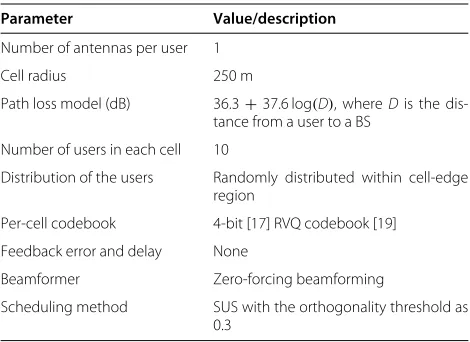
The layout of the reference cooperative cluster is set according to [17], including the cell radius, the number and distribution of candidate users, and the path loss model, which are listed with other simulation parameters in Table 1. In practice, the quantization of global CDI and global channel norm at the user will be based on channel estimation, which is never perfect. Nonetheless, the sim-ulation results with channel estimation errors are similar as those without errors, which are not shown for concise-ness. The SUS is performed at the CU with the quantized global norm and global CDI, and the zero-forcing beam-forming is computed with the quantized CDI, i.e., the reconstructed global CDI with Equation 5. To evaluate the impact of PBPC on the performance, we consider a simple power allocation satisfying PBPC [1]. Specifi-cally, the overall transmit power of the coordinated BS is first equally allocated to the selected users. Then, if the transmit power of a BS exceeds the maximal power,
Table 1 The simulation parameters
Parameter Value/description
Number of antennas per user 1
Cell radius 250 m
Path loss model (dB) 36.3+37.6 log(D), whereDis the dis-tance from a user to a BS
Number of users in each cell 10
Distribution of the users Randomly distributed within cell-edge region
Per-cell codebook 4-bit [17] RVQ codebook [19]
Feedback error and delay None
Beamformer Zero-forcing beamforming
the power allocated to multiple users will decrease at the same time to reduce the transmit power of the BS to the maximal power. The per-user data rate is calcu-lated with the SINR estimate shown in Equation 15. When the estimated SINR exceeds the actual SINR, an outage happens, then the data rate is set to 0 bps/Hz in our simulations.
6.1 Feedback of global quantization accuracy
As analyzed in Section 3, the global quantization accuracy cosθmshould be fed back for the CU to estimate the CQI. We first show how many bits are required to quantize cosθm.
The codebook for quantizing cosθm is generated by Lloyd’s algorithm [12]. Denote its quantized version as
ˆ
cosθm, which is defined as the lower end of the quantiza-tion interval that includes cosθm, similar to Equation 16. This ensures that cosˆ θm ≤ cosθm, which avoids the outage led by the inaccuracy of the quantization of cosθm. We consider Nc = 3 andnt = 4. To emphasize the impact of cosθm quantization here, the global channel norm||gm|| and the noise and inter-cluster interference variance σm2 are assumed to be perfectly known at the CU when estimating the CQI with Equation 15. The
codewords for quantizing the per-cell CDIs are selected jointly with Equation 9, and the feedback of PA is not considered.
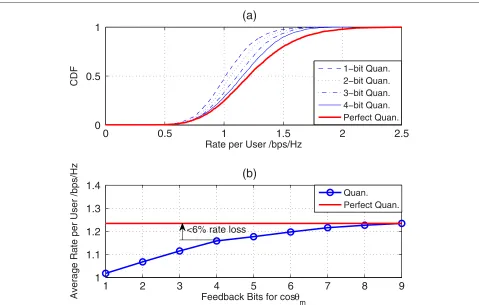
The legends ‘1-bit Quan.’, ‘2-bit Quan.’, ‘3-bit Quan.’, and ‘4-bit Quan.’ represent the results when cosθm is quantized with 1, 2, 3, and 4 bits, respectively. The legend ‘Quan.’ is for the results of quantized cosθmwith different numbers of bits, and ‘Perfect Quan.’ is for the result when cosθmis not the quantization error.
As shown in Figure 1a, the outage probability is 0 when using the CQI estimated with Equation 15, which how-ever leads to a rate loss from that with perfectly quantized cosθm. As shown in Figure 1b, with a 4-bit quantization, the rate loss is less than 6%. In the rest of the simulations, we use 4 bits for quantizing cosθm.
6.2 Necessity of per-cell norm feedback 6.2.1 Impact on CQI estimation
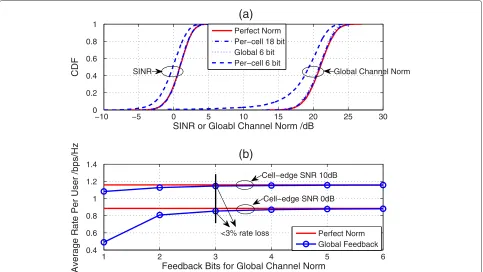
To show the impact of the channel norm feedback mecha-nisms on the CQI estimation, in Figure 2a, we simulate the CDFs of the estimated SINR and quantized global chan-nel norm with two feedback mechanisms: feeding back per-cell channel norms or global channel norm. The total number of bits is set as 6 or 18, then the number of bits for
0 0.5 1 1.5 2 2.5
0 0.5 1
(a)
Rate per User /bps/Hz
CDF
1 2 3 4 5 6 7 8 9
1 1.1 1.2 1.3 1.4
Feedback Bits for cosθ
m
Average Rate per User /bps/Hz
(b)
1−bit Quan. 2−bit Quan. 3−bit Quan. 4−bit Quan. Perfect Quan.
Quan. Perfect Quan.
<6% rate loss
Figure 1Per-user data rate with different quantization bits forcosθm.(a)CDF of per-user data rate whencosθmis quantized with different
−10 −5 0 5 10 15 20 25 30 0
0.2 0.4 0.6 0.8 1
(a)
SINR or Gloabl Channel Norm /dB
CDF
1 2 3 4 5 6
0.4 0.6 0.8 1 1.2 1.4
(b)
Feedback Bits for Global Channel Norm
Average Rate Per User /bps/Hz
Perfect Norm Per−cell 18 bit Global 6 bit Per−cell 6 bit
Perfect Norm Global Feedback
SINR Global Channel Norm
<3% rate loss
Cell−edge SNR 0dB Cell−edge SNR 10dB
Figure 2SINR and average per-user data rate with different quantization mechanisms for channel norm.(a)The CDF of global channel norm and SINR for two feedback mechanisms under 10-dB cell-edge SNR, where the result of ‘Perfect Norm’, ‘Global 6 bit’, and ‘Per-cell 18 bit’ overlap with each other.(b)The average data rates achieved using the perfect and quantized global channel norms, under both 0- and 10-dB cell-edge SNR.
each per-cell channel normN6
c= 2 or 6. The codebooks for
quantizing both the per-cell and global channel norm are generated by Lloyd’s algorithm [12]. The legend ‘Global 6 bit’ is for the case using global channel norm with 6-bit quantization and ‘Per-cell 6 6-bit’ and ‘Per-cell 18 6-bit’ are for the cases using the 2-bit and 6-bit per-cell channel norm quantization, respectively. The codewords for per-cell CDIs are selected jointly with Equation 9, and the PA is not fed back. Again, we considerNc=3 andnt=4 .
The comparisons between the two feedback mecha-nisms for the global channel norm quantization are con-sistent with the previous analysis. The results validate that the global channel norm-based feedback strategy achieves the same performance as the per-cell channel norm-based strategy withN1
c times of feedback overhead. The
perfor-mance gap of the SINRs estimated with the per-cell chan-nel norm and the global chanchan-nel norm is less than the gap of the quantized global channel norm. This is because the multi-user interference dominates in the SINR estimate under the 10-dB cell-edge SNR.
To show how many bits are needed for quantizing the global channel norm, in Figure 2b, we simulate the aver-age per-user rate achieved using the perfect global channel norm (with legend ‘Perfect Norm’) and the global channel norm quantized with different bits (with legend ‘Global Feedback’). Except for the 10-dB cell-edge SNR, we also
consider 0-dB cell-edge SNR, which represents the noise limited case. It shows that in both scenarios, 3 bits is enough for quantizing the global channel norm to ensure the average rate loss less than 3% of that with perfect global channel norm.
6.2.2 Impact on global CDI reconstruction
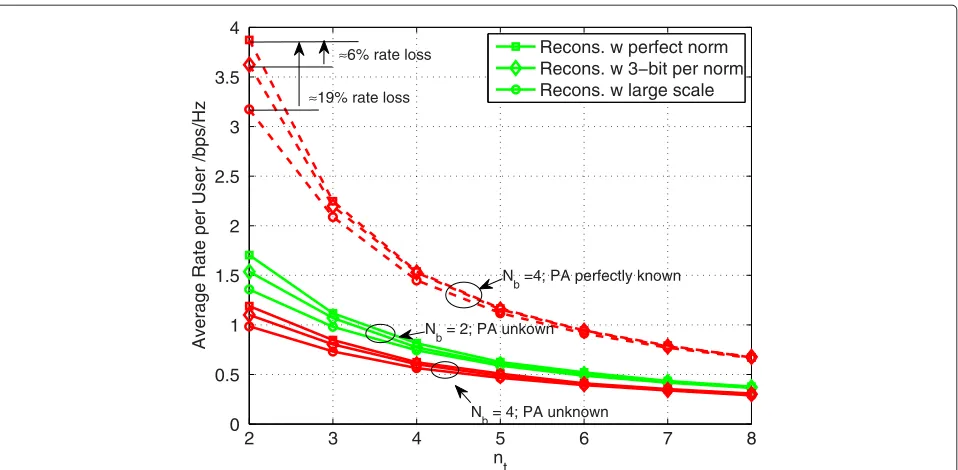
To show the impact of the per-cell channel norm feed-back on the global CDI reconstruction, we compare the performance of the reconstruction methods only with the large-scale fading gains in Equation 5 (with legend ‘Recons. w large scale’) and with the composite per-cell channel norm αm,n||ˆhm,n||, where the per-cell channel norms are quantized individually at each user. The leg-ends ‘Recons. w perfect norm’ and ‘Recons. w 3-bit per norm’ respectively represent the reconstruction meth-ods with perfect composite per-cell channel norms and the per-cell channel norms each quantized with 3 bits. Considering that the simulation is very slow with large values of Nc and nt, we use the statistics of RVQ [19] to reflect the quantization performance of the scheme with independent codeword selection, where the PA is either unknown or perfectly known to the CU in the reconstruction.
2 3 4 5 6 7 8 0
0.5 1 1.5 2 2.5 3 3.5 4
n t
Average Rate per User /bps/Hz
Recons. w perfect norm Recons. w 3−bit per norm Recons. w large scale
N
b = 2; PA unkown
N
b = 4; PA unknown
≈19% rate loss
N
b =4; PA perfectly known
≈6% rate loss
Figure 3Average per-user data rate with different global CDI reconstruction methods.
norms reduces with the increase of nt, and nt ≥ 4 is enough to ensure that the reconstruction method with Equation 5 achieves the same performance with perfect per-cell channel norms. This validates our previous anal-ysis. However, the rate loss becomes evident with small nt, e.g., nt = 2, especially when the PAs are perfectly fed back. It is because, in this case, the reconstruction without the per-cell channel norms becomes the bottle-neck in improving the quantization performance of the global CDI, and at least 3 bits is necessary for each per-cell channel norm to compensate the rate loss. This suggests that the per-cell channel norms are not necessary to be fed back for reconstructing the global CDI when nt ≥ 4 or Nc is small, which is typical for practical CoMP systems.
6.3 Necessity of PA feedback 6.3.1 Accuracy of the approximations
Before showing the necessity of PA feedback, we first evaluate the accuracy of the approximations introduced in deriving the average quantization accuracy with and without PA quantization by simulations.
Consider the worst caseα1 = . . .= αNc in the
simula-tions as in the analysis. To ensure an accurate approxima-tion ofAPA, a large value ofntis required. We setnt=2, 4, which are typical configurations of the LTE standard [17]. As for the approximation ofANPA,Nc×ntneeds to be large enough. We consider a CoMP system with three coordi-nated BSs whereNc×nt=6, 12 to evaluate the accuracy of the approximations.
The simulation results for the average global quanti-zation accuracy with and without the PA feedback are respectively with legends APA and ANPA. The appro-ximated average quantization accuracy with and without PA feedback are numerically computed with Equations 36 and (23), respectively, with legends ‘Appro. of APA’ and ‘Appro. ofANPA’.
As shown in Figure 4, the approximations are accurate for the considered cases. The larger values ofNc×ntand ntprovide more accurate approximations.
6.3.2 Necessity of the PA feedback
We evaluate the necessity of PA feedback by comparing the numerical results of the average global quantization accuracy with and without the PA feedback and the simu-lation results of the average per-user rate with and without the PA feedback. The total number of bits for the per-cell CDI feedback is 4×Ncbits, and the PA feedback needs extraBPAbits. Considering the prohibited complexity of joint codeword selection, we use serial codeword selec-tion [6] in the simulaselec-tion, which performs close to the joint codeword selection but with much lower complex-ity. Since the feedback of PA only decides the global CDI quantization, we use the perfect global channel norm of each user to compute the CQI in the following simula-tion. The reconstruction method shown in Equation 5 is considered.
0 1 2 3 4 5 6 0.2
0.3 0.4 0.5 0.6 0.7 0.8 0.9 1
B PA
E[cos
2 θ
]
A PA Appro. of A
PA Appro. of A
NPA A
NPA N
bnt=6 nt=2
N
bnt=12 nt=4
Figure 4The accuracy of the approximatedANPAandAPAwithNc=3andnt=2, 4.
and Appro. ofAPA are obtained with Equations 23 and 36. To show how the gain in average global quantiza-tion accuracy affects the performance of the system, the simulation results of the average per-user data rate with and without the PA feedback are shown in Figure 5b, where ‘RNPA’ and ‘RPA’ are the average data rate per user with and without PA feedback, respectively. As a performance baseline, we also show the performance of
non-CoMP systems with legend ‘Rnon−CoMP’ in the case of Nc = 3 andnt = 2, where, in other scenarios, the comparison results are similar. For a fair comparison, the users are located within 6-dB cell-edge region in non-CoMP systems. It shows thatBPAshould be large enough to provide an evident performance gain from the PA feed-back, in terms of both the average global quantization accuracy and the average per-user data rate. Moreover,
0 2 4 6
0.2 0.3 0.4 0.5 0.6 0.7 0.8 0.9 1
(a)
BPA /bit
E[cos
2θ
]
0 2 4 6
0.5 1 1.5 2 2.5 3
(b)
BPA /bit
Average Rate per User /bps/Hz
Appro. of ANPA Appro. of A
PA
R
NPA
RPA Rnon−CoMP
Nb=3 nt=2
N
b=3 nt=4
Nb=2 nt=4
Nb=3 nt=2
Nb=2 nt=4
N
b=3 nt=4
the gain becomes smaller with less coordinated BSs and more antennas at each BS, which validates the previous analysis.
In Figure 6, we show the simulation results of the aver-age per-user rate gain provided by the PA feedback, which is defined as RPA−RNPA
RNPA , with 1 ∼ 3 bits for each PA. It
shows that at least 2 bits is required for feeding back each PA to bring a per-user rate gain. The maximal per-user rate gains are 21% ∼ 26% in the cases of nt = 2 and Nc = 2 ∼ 5 with 3 bits for quantizing each PA, but the feedback overhead needs to increase 37.5%∼60% of that without the PA feedback.
7 Conclusions
In this paper, we investigated what should be fed back in per-cell codebook-based limited feedback CoMP systems to facilitate the coherent downlink cooperative transmis-sion. We first presented a conservative CQI estimation method aiming at reducing the outage probability. To estimate the CQI at the CU, the global CDI and the corre-sponding quantization accuracy, the global channel norm, and the noise and inter-cluster interference variance need to be fed back. Considering that both the global chan-nel norm and the global CDI reconstruction depend on the per-cell channel norms, we analyzed if these norms need to be fed back by deriving the average quantization performance of the global channel norm and the asymp-totic weighting factors in the global CDI with and without
the per-cell channel norms. To show if the PA feedback is necessary, we derived the approximated average quan-tization accuracy of the reconstructed global CDI using the joint codeword selection without PA feedback and the independent codeword selection with PA feedback. We used simulation and numerical results to evaluate the accuracy of the approximations and show that the conclusions drawn from the average quantization accu-racy are also true for the average per-user data rate. The following observations were obtained from the analyti-cal and simulation results: (1) the per-cell instantaneous channel norms are unnecessary to be fed back; (2) the global quantization accuracy and the global channel norm need to be fed back, which respectively require 4 and 3 bits for the typical setting of Nc = 3 and nt = 4; and (3) the performance gain provided by the PA feed-back is not significant when Nc is small and nt is large. Considering that the extra overhead exceeds the per-user rate gain from feeding back the PA, using the joint codeword selection without PA feedback may be more desirable than using the independent selection with PA feedback.
Appendix 1
Proof of Proposition 1.We consider high-resolution quantization, which implies that (1) the number of quanti-zation bits,Bh, is infinite and (2) the quantization interval is small compared to the quantization range ofYn, [δ1,δ2]
2 3 4 5
−20% −10% 0 10% 20% 30% 40%
N
b
Rate Gain of PA
(a)
n t = 22 4 6 8
−20% −10% 0 10% 20% 30% 40%
n
t
Rate Gain of PA
(b)
N b = 31−bit per PA 2−bit per PA 3−bit per PA
Figure 6The performance gain in average per-user rate provided by the PA feedback.(a)The average per-user rate gain withnt=2.(b)The
[12]. According to the second assumption, i.e., the quanti-zation interval is small, we can derive
E[Yn2]−E[Yˆn2]≈
According to [12], under the assumption of high-resolution quantization, the performance of any quan-tization method can be approximated by the uniform quantization with the same bits; hence, the quantization interval isy(j+1)−y(j)≈ 2(δ2−δ1)
Based on the property of the integral, we have
2Bh
Upon substituting into Equation 40, we obtain
E[Yn2]−E[Yˆn2]≈ 2(δ2−δ1)
2Bh−1 E[Yn]+
(δ2−δ1)2
(2Bh−1)2. (43)
The approximation is accurate when the value ofBhis large.
Appendix 2
Proof of Proposition 2.Based on the property of vari-ance, we can derive
Var(||hn||
which indicates that the variance of normalized per-cell channel energy ||hnn||2
t approaches zero with largent, and ||hn||2
nt approaches a constant, whose value is the same
as E[|hn,j|2] since the per-cell channels are assumed as i.i.d..
For the per-cell channels with arbitrary distribution, whenntis sufficiently large, we obtain
E[||g||]=E
Proof of Proposition 3.To prove this proposition, in the following, we will prove that limnt→∞gn → ˆgn with probability 1, i.e.,P[limnt→∞gn= ˆgn]=1.
We start by proving a lemma.
Lemma 1.Given two constantsa¯,b¯ > 0, and two non-negative random series{an}and{bn} where{bn} is lower bounded by B > 0, i.e., bn ≥ B,∀n. If{an}approachesa¯ with probability 1 and{bn}approachesb with probability¯ 1, i.e., P[limn→∞an= ¯a]=1and P[limn→∞bn= ¯b]=1, then{an
bn}approaches ¯ a ¯
bwith probability 1, i.e.,
First, we have
where (1) comes from the triangle inequality, and (2) comes from the condition ofbn≥B. Equations 48 and 49 into Equation 47, we obtain
Pε> (1−Bε1)(1−
Now we prove the proposition. Actually, we only need to prove that the proposition satisfies all the conditions in
Lemma 1, then the proposition is established based on the lemma.
Rewrite Equation 4 as follows:
gn=
Define a random variableXn nt
j=1|hn,j|2
nt . Since per-cell
channels are assumed as i.i.d. and subject to CN(0, 1),
|hn,j|is subject to Rayleigh distribution withE[|hn,j|2]=1 and is independent with each other. Based on the law of large numbers, we havePlimnt→∞Xn=E[|hn,j|2] Xnapproaches 1 with probability 1 whenntgoes to infin-ity. Based on the property of limitation, it is easy to prove thatPlimnt→∞√Xn=1=1. Then we have
P[ lim nt→∞αn
Xn=αn]=1. (52)
Again, based on the property of limitation, we have
limnt→∞
It means that the numerator and denominator respectively approach a constant with probability 1.
It is reasonable to assume that Xn,n = 1,. . .,Nc are lower bounded byX>0. Substituting into the denomina-tor ofgn, it is easy to derive that the denominator also has
a lower bound, which isNc
The authors declare that they have no competing interests. Received: 4 January 2013 Accepted: 28 August 2013 Published: 18 September 2013
References
2. D Gesbert, S Hanly, H Huang, S Shamai, O Simeone, W Yu, Multi-cell MIMO cooperative networks: a new look at interference. IEEE J. Sel. Areas Commun.28(9), 1380–1408 (2010)
3. DJ Love, RW Heath, VKN Lau, D Gesbert, BD Rao, M Andrews, An overview of limited feedback in wireless communication systems. IEEE J. Sel. Areas Commun.26(8), 1341–1365 (2008)
4. T Yoo, N Jindal, A Goldsmith, Multi-antenna downlink channels with limited feedback and user selection. IEEE J. Sel. Areas Commun.
25, 1478–1491 (2007)
5. Y Cheng, VKN Lau, Y Long, A scalable limited feedback design for network MIMO using per-cell product codebook. IEEE Trans. Wireless Commun.
9(10), 3093–3099 (2010)
6. X Hou, C Yang,Codebook design and selection for multi-cell cooperative transmission limited feedback systems. IEEE VTC, Budapest, 15–18 May 2011
(IEEE, Piscataway, 2011), pp. 1–5
7. D Su, X Hou, C Yang,Quantization based on per-cell codebook in cooperative multi-cell systems. IEEE WCNC, Cancun, 28–31 March 2011(IEEE, Piscataway, 2011), pp. 1753–1758
8. F Yuan, C Yang, Bit allocation between per-cell codebook and phase ambiguity quantization for limited feedback coordinated multi-point transmission systems. IEEE Trans. Commun.60(9), 2546–2559 (2012) 9. K Huang, JG Andrews, RW Heath, Performance of orthogonal
beamforming for SDMA with limited feedback. IEEE Trans. Veh. Tech.
58, 152–164 (2009)
10. RA Horn, CR Johnson,Matrix Analysis(Cambridge University Press, Cambridge, 1990)
11. B Khoshnevis, W Yu, Bit allocation law for multiantenna channel feedback quantization: single-user case. IEEE Trans. Signal Process.59(5), 2270–2283 (2011)
12. A Gersho, RM Gray,Vector Quantization and Signal Compression(Kluwer, Boston, 1992)
13. D Su, C Yang,Necessity of phase ambiguity quantization for limited feedback coordinated multi-point transmission. IEEE VTC, San Francisco, 5–8 Sept 2011
(IEEE, Piscataway, 2011), pp. 1–5
14. S Zhou, Z Wang, GB Giannakis, Quantifying the power loss when transmit beamforming relies on finite-rate feedback. IEEE Trans. Wireless Commun.
4(4), 1948–1957 (2005)
15. BM Hochwald, TL Marzetta, Unitary space-time modulation for multiple-antenna communications in rayleigh flat fading. IEEE Trans. Inf. Theory.46(2), 543–564 (2000)
16. DJ Love, RW Heath, T Strohmer, Grassmannian beamforming for multiple-input multiple-output wireless systems. IEEE Trans. Inf. Theory.
49(10), 2735–2747 (2003)
17. 3GPP, 3rd Generation partnership project; technical specification group radio access network; coordinated multi-point operation for LTE physical layer aspects (Release 11). TS 36.819 v11.1.0 (2011). http://www.3gpp.org Accessed 12 Sep. 2012
18. H Huang, M Trivellato, A Hottinen, M Shafi, P Smith, RA Valenzuela, Increasing downlink cellular throughput with limited network MIMO coordination. IEEE Trans. Wireless Commun.8(6), 2983–2989 (2009) 19. N Jindal, MIMO broadcast channels with finite-rate feedback. IEEE Trans.
Inf. Theory.52(11), 5045–5060 (2006) doi:10.1186/1687-1499-2013-232
Cite this article as: Su and Yang: What should be fed back for
per-cell codebook-based limited feedback coordinated multi-point systems?
EURASIP Journal on Wireless Communications and Networking20132013:232.
Submit your manuscript to a
journal and benefi t from:
7Convenient online submission 7Rigorous peer review
7Immediate publication on acceptance 7Open access: articles freely available online 7High visibility within the fi eld
7Retaining the copyright to your article