CSEIT172112 | Received: 07 Feb 2017 | Accepted: 18 Feb 2017 | January-February-2017 [(2)1: 55-61 ]
International Journal of Scientific Research in Computer Science, Engineering and Information Technology © 2017 IJSRCSEIT | Volume 2 | Issue 1 | ISSN : 2456-3307
55
Cryo-Preservation for Future Life
Pavankumar Naik
Computer Science and Engineering, Smt Kamala and Sri Venkappa M. Agadi College of Engineering & Technology, Lakshmeshwar, Karnataka, India
ABSTRACT
Cryonics is an effort to save lives by using temperatures so cold that a person beyond help by today's medicine might be preserved for decades or centuries until a future medical technology can restore that person to full health. Cryonics sounds like science fiction, but is based on modern science. It's an experiment in the most literal sense of the word. The word death occurs when the chemistry of life becomes so disorganized that normal operation cannot be restored. (Death is not when life turns off. People can and have survived being "turned off".) How much chemical disorder can be survived depends on medical technology. A hundred years ago, cardiac arrest was irreversible. People were called dead when their heart stopped beating. Today death is believed to occur 4 to 6 minutes after the heart stops beating because after several minutes it is difficult to resuscitate the brain. However, with new experimental treatments, more than 10 minutes of warm cardiac arrest can now be survived without brain injury. Future technologies for molecular repair may extend the frontiers of resuscitation beyond 60 minutes or more, making today's beliefs about when death occurs obsolete. Ultimately, real death occurs when cell structure and chemistry become so disorganized that no technology could restore the original state. This is called the information-theoretic criterion for death. Any other definition of death is arbitrary and subject to continual revision as technology changes. That is certainly the case for death pronounced based on absent "vital signs" today, which is not real death at all.
Keywords : Cryoconservation, Cryonics, neurosuspension, Vitrification.
I.
INTRODUCTION
Cryopreservation or cryoconservation is a process where organelles, cells, tissues, extracellular
matrix, organs or any other biological constructs susceptible to damage caused by unregulated chemical kinetics are preserved by cooling to very low temperatures[1] (typically-80 °C using solid carbon dioxide or -196 °C using liquid nitrogen). At low enough temperatures, any enzymatic or chemical activity which might cause damage to the biological material in question is effectively stopped. Cryopreservation methods seek to reach low temperatures without causing additional damage caused by the formation of ice during freezing. Traditional cryopreservation has relied on coating the material to be frozen with a class of molecules termed cryoprotectants. New methods are constantly
being investigated due to the inherent toxicity of many cryoprotectants.[2] By default it should be considered that cryopreservation alters or compromises the structure and function of cells unless it is proven otherwise for a particular cell population. Cryoconservation of animal genetic resources is the process in which animal genetic material is collected and stored with the intention of conservation of the breed.
We see it all the time in movies. A person gets frozen or put in “cryosleep” and then unfrozen at a later date with no aging taking place, or other ill effects. Sometimes this happens on purpose, like to someone with an incurable disease hoping a cure exists in the future, or sometimes by accident, like someone getting frozen in a glacier. The science behind it does exist and the application of the practice is called cryonics. It‟s a technique used to store a persons body at an extremely low temperature with the hope of one day reviving them. This technique is being performed today, but the technology behind it is still in its infancy. Someone preserved this way is said to be in cryonic suspension. The hope is that, if someone has died from a disease or condition that is currently incurable, they can be “frozen” and then revived in the future when a cure has been discovered. It‟s currently illegal to perform cryonic suspension on someone who is still alive. Those who wish to be cryogenically frozen must first be pronounced legally dead – which means their heart has stopped beating. Though, if they‟re dead, how can they ever be revived?
According to companies who perform the procedure, „legally dead‟ is not the same as „totally dead.‟ Total death, they claim, is the point at which all brain function ceases. They claim that the difference is based on the fact that some cellular brain function remains even after the heart has stopped beating. Cryonics preserves some of that cell function so that, at least theoretically, the person can be brought back to life at a later date.
II.
METHODS AND MATERIAL
A. How is Cryonics Performed?
After your heart stops beating and you are pronounced legally dead, the company you signed with takes over. An emergency response team from the facility immediately gets to work. They stabilize your body by supplying your brain with enough oxygen and blood to preserve minimal function until you can be transported to the suspension facility. Your body is packed in ice and injected with an anticoagulant to prevent your blood from clotting during the trip. A medical team is on standby awaiting the arrival of your body at the cryonics facility.After you reach the cryonics facility, the actual freezing can begin. They don‟t just drop you in a huge pot of liquid nitrogen? They could, and while
you‟d certainly be frozen, most of the cells in your body would shatter and die. As water freezes, it expands. Since cells are made up of mostly water, freezing expands the “stuff” inside which destroys their cell walls and they die. The cryonics companies need to remove and/or replace this water. They replace it with something called a cryoprotectant. Much like the antifreeze in an automobile. This glycerol based mixture protects your organ tissues by hindering the formation of ice crystals. This process is called “vitrification” and allows cells to live in a sort of suspended animation.
After the vitrification, your body is cooled with dry ice until it reaches -202 Fahrenheit. After this pre-cooling, it‟s finally time to insert your body into the individual container that will be placed into a metal tank filled with liquid nitrogen. This will cool the body down to a temperature of around -320 degrees Fahrenheit.
The procedure isn‟t cheap. It can cost up to $200,000 to have your whole body preserved. For the more frugal optimist, a mere $60,000 will preserve your brain with an option known as neurosuspension. They hope the technology in the future will allow them to clone or regenerate the rest of the body.
Many critics say the companies that perform cryonics are simply ripping off customers with the dream of immortality and they won‟t deliver. It doesn‟t help that the scientists who perform cryonics say they haven‟t successfully revived anyone, and don‟t expect to be able to do so anytime soon. The largest hurdle is that, if the warming process isn‟t done at exactly the right speed and temperature, the cells could form ice crystals and shatter.
Despite the fact that no human placed in a cryonic suspension has yet been revived, some living organisms can be, and have been, brought back from a dead or near-dead state. CPR (cryopreservation) and Defibrillators can bring accident and heart attack victims back from the dead daily.
beings. Some frogs and other amphibians have a protein manufactured by their cells that act as a natural antifreeze which can protect them if they‟re frozen completely solid.
Cryobiologists are hopeful that nanotechnology will make revival possible someday. Nanotechnology can use microscopic machines to manipulate single atoms to build or repair virtually anything, including human cells and tissues. They hope one day, nanotechnology will repair not only the cellular damage caused by the freezing process, but also the damage caused by aging and disease. Some cryobiologists have predicted that the first cryonic revival might occur as early as year 2045.
In 1972 Max More saw a children‟s science fiction television show called Time Slip that featured characters being frozen in ice. He didn‟t think much about it until years later, when he started hanging out with friends who held meetings about futurism. “They were getting Cryonics magazine,” he says, “and they asked me about it to see how futuristic I was. It just made sense to me right away.”
More is now the President and Chief Executive officer of Alcor, one of the world‟s largest cryonics companies. More himself has been a member since 1986, and has decided to opt for neuropreservation – just deep freezing the brain – over whole body preservation. “I figure the future is a pretty decent place to be, so I want to be there,” he says. “I want to keep living and enjoying and producing.”
Cryopreservation is a darling of the futurist community. The general premise is simple: medicine is continually getting better. Those who die today could be cured tomorrow. Cryonics is a way to bridge the gap between today‟s medicine and tomorrow‟s. “We see it as an extension of emergency medicine,” More says. “We‟re just taking over when today‟s medicine gives up on a patient. Think of it this way: 50 years ago if you were walking along the street and someone keeled over in front of you and stopped breathing you would have checked them out and said they were dead and disposed of them. Today we don‟t do that, instead we do CPR and all kinds of things. People we thought were dead 50 years ago we now know were not. Cryonics is the same thing, we just have to stop them from getting worse and
let a more advanced technology in the future fix that problem.” of course, the premise of cryonics also makes it essentially untestable. Nobody has ever tried to bring a human back to life after preservation. While researchers working on „suspended animation‟ are finding that they can cool a living being down to appear apparently dead before reviving them, freezing a body for decades is a different matter. More points to studies in which scientists have studied the preservation of cells and tissues and even worms, but scaling that up to a full human body isn‟t a trivial proposition. But whether the science is there or not, people are being frozen in liquid nitrogen with the hope of seeing some distant tomorrow.
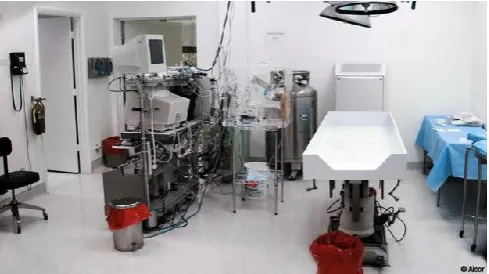
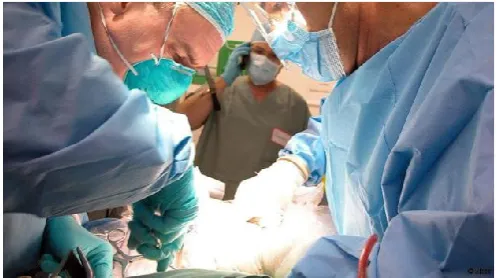
Alcor‟s members come from all over the world. Ideally, More says, the company will have an idea of when their members are going to die. Alcor maintains a watch list of members in failing health, and when it seems as though the time has come they send what they call a “standby team” to do just that – stand by the person‟s bed until they die. “It could be hours, days, we‟ve gone as long as three weeks on standby,” More says. Once the person in question is declared legally dead, the process of preserving them can begin, and it‟s an intense one. First, the standby team transfers the patient from the hospital bed into an ice bed and covers them with an icy slurry. Then Alcor uses a “heart-lung resuscitator” to get the blood moving through the body again. They then administer 16 different medications meant to protect the cells from deteriorating after death. As they note on their website, “Because cryonics patients are legally deceased, Alcor can use methods that are not yet approved for conventional medical use.” Once the patient is iced up and medicated, they move them to a place for surgery.
The next step includes draining as much blood and bodily fluids as possible from the person, replacing them with a solution that won‟t form ice crystals – essentially the same kind of antifreeze solution used in organ preservation during transplants. Then a surgeon opens up the chest to get access to the major blood vessels, attaching them to a system that essentially flushes out the remaining blood and swaps it with medical grade antifreeze. Since the patient will be in a deep freeze, much of the preparatory work involves trying to ensure that ice crystals don‟t form inside the cells of the body.
Once the patient‟s veins are full of this antifreeze, Alcor can begin to cool them down by about one degree Celsius every hour, eventually bringing the body down to -196C after about two weeks. Eventually the body finds its final home for the foreseeable future: upside down in a freezer, often alongside three others.
This is the ideal scenario. But it doesn‟t always go this way – if a patient hasn‟t told Alcor they were sick, or if they die suddenly, the process can be delayed for hours or days. In one of their most recent cases, an Alcor member committed suicide, and Alcor staff had to negotiate with police and the coroner to get access to the body. The longer the wait between death and preservation, the more cells will decay, and the harder it will be to resurrect and cure the patient, more says.
Figure 2. Groups of four are kept in refrigerators cooled
by liquid nitrogen (middle and left), after treatment in the operating room (right) (Courtesy of Alcor Life Extension Foundation)
If this all sounds like a lot of risk for a slim reward, it might be. More is the first to admit that cryonics comes with no guarantees. “We don‟t know for sure, there‟s a lot of things that can go wrong,” he says. It‟s possible that Alcor and companies like it are simply storing a lot of dead bodies in liquid nitrogen. But he also claims that cryonics is unlike a lot of other futuristic technology. “There‟s no fundamental physical limit to be able to repair tissues,” he says, “it‟s not like time travel.” The science of tissue regeneration is steadily advancing. But nobody really knows when they‟ll be able to wake these patients up, or if they‟ll be able to at all. When forced to take a guess at how long we‟ll have to wait for medicine to catch up to save Alcor‟s members More put the number between 50 and 100 years. “But it‟s really impossible to say. We probably don‟t even know what repair technology would be used.”
As of today, 984 people are signed up with Alcor to be preserved when they die. People who sign up for Alcor‟s services pay a yearly membership fee of about $770. When it comes time to actually preserve a person the cost ranges from $80,000 to preserve just the brain up to $200,000 to preserve the whole body. Some of that money, More says, goes into a patient care trust fund that keeps the facilities running and the bodies inside preserved for the long haul. And More is quick to point out that many patients get a life insurance policy that factors in the cost of their eventual freezing. “It‟s not only something for the rich,” he says, “anybody who can afford an insurance policy can afford this.”
B. Literature Survey
damage is from secondary effects via changes in the composition of the liquid phase. Cryoprotectants, simply by increasing the total concentration of all solutes in the system, reduce the amount of ice formed at any given temperature; but to be biologically acceptable they must be able to penetrate into the cells and have low toxicity. Many compounds have such properties, including glycerol, dimethyl sulfoxide, ethanediol, and propanediol. In fact, both damaging mechanisms are important, their relative contributions depending on cell type, cooling rate, and warming rate. A consensus has developed that intracellular freezing is dangerous, whereas extracellular ice is harmless. If the water permeability of the cell membrane is known it is possible to predict the effect of cooling rate on cell survival and the optimum rate will be a tradeoff between the risk of intracellular freezing and effects of the concentrated solutes. However, extracellular ice is not always innocuous: densely packed cells are more likely to be damaged by mechanical stresses within the channels where they are sequestered and with complex multicellular systems it is imperative not only to secure cell survival but also to avoid damage to the extracellular structure. Ice can be avoided by vitrification--the production of a glassy state that is defined by the viscosity reaching a sufficiently high value (approximatly 10(13) poises) to behave like a solid, but without any crystallization. Toxicity is the major problem in the use of vitrification methods. Whether freezing is permitted (conventional cryopreservation) or prevented (vitrification), the cryoprotectant has to gain access to all parts of the system. However, there are numerous barriers to the free diffusion of solutes (membranes), and these can result in transient, and sometimes equilibrium, changes in compartment volumes and these can be damaging. Hence, the processes of diffusion and osmosis have important effects during the introduction of cryoprotectants, the removal of cryoprotectants, the freezing process, and during thawing. These phenomena are amenable to experiment and analysis, and this has made it possible to develop effective methods for the preservation of a very wide range of cells and some tissues; these methods have found widespread applications in biology and medicine.
DTL (decision tree learning Method) and NBC (Naive Bayes Classification Method) were employed on cryopreservation meta-data with NBC demonstrating greater generalizability. These results indicate that the
handles for improving cryopreservation outcomes are: integrin-mediated cryopreservation, the modification (by entrapment of benign CPAs or other means) of the scaffolding material and the modification of cell location in scaffolds. The DTL and NBC models were demonstrated to be robust against tougher validation data from different cell types thereby confirming that cryopreservation/bio-preservation technology can be improved upon using these approaches.
In [3], they have discussed how to evaluate the effects of tissue culture on the viability and development of follicles in frozen-thawed human fetal ovarian tissue before transplantation into severe combined immunodeficient (SCID) mice and to determine the optimal duration of pretransplant tissue culture and they have concluded the work as the viability and development of human fetal follicles may be improved by pretransplant tissue culture. The optimal culture duration before transplantation of fetal ovarian tissue is 6 days.
Oocyte cryopreservation is a technique with considerable potential in reproductive medicine, including fertility preservation, as a way of delaying childbearing and as part of oocyte donation programs. Although the technique was relatively ineffective at first more recently numerous modifications have led to higher success rates. The main moto for this paper is to compare the effectiveness and safety of vitrification and slow freezing as oocyte cryopreservation techniques for fertility outcomes in women undergoing assisted reproduction. From there study the authors conclude that Oocyte vitrification compared to slow freezing probably increases clinical pregnancy rates in women undergoing assisted reproduction. However, the total number of women and pregnancies were low and the imprecision is high which limits applicability. The effect on ongoing pregnancy is uncertain as data were sparse. No data were available on live births or adverse effects.
preservation of memory after cryopreservation (vitrification or slow freezing[5].
In [6], discussed comparative study of earlier methods and protocols to new methods and protocols for cryopreservation related to embryo and oocytes freezing in terms of fertilization rates. Main objective of this paper is to establish and formulate an innovative method and protocol development for cryopreservation as a gold standard for clinical uses in laboratory practice and treatment. The knowledge regarding usefulness of cryopreservation in clinical practice is essential to carry forward the clinical practice and research. Results from his study is the combination of cryoprotectants and regimes of rapid cooling and rinsing during warming often allows successful cryopreservation of biological materials, particularly cell suspensions or thin tissue samples and concluded that cryopreservation technology provided useful cell survivability, tissue and organ preservation in a proper way. Although it varies according to different laboratory conditions, it is certainly beneficial for patient‟s treatment and research. Further studies are needed for standardization and development of new protocol.
III.
RESULTS AND DISCUSSION
Cryonics Today
More than one hundred people have been cryopreserved since the first case in 1967. More than one thousand people have made legal and financial arrangements for cryonics with one of several organizations, usually by means of affordable life insurance. Alcor is the largest organization, and distinguished among cryonics organizations by its advanced technology and advocacy of a medical approach to cryonics.
Alcor procedures ideally begin within moments of cardiac arrest. Blood circulation and breathing are artificially restored, and a series of medications are administered to protect the brain from lack of oxygen. Rapid cooling also begins, which further protects the brain. The goal is to keep the brain alive by present-day criteria for as long as possible into the procedure. It is not always possible to respond so rapidly and aggressively, but that is Alcor's ideal, and it has been achieved in many cases.
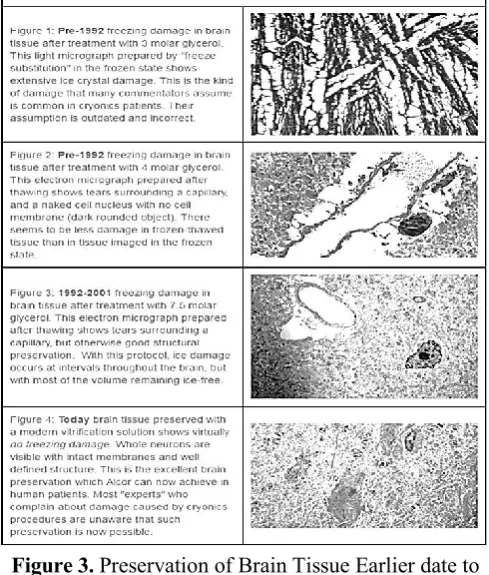
In 2001 Alcor adapted published breakthroughs in the field of organ preservation to achieve what we believe is ice-free preservation (vitrification) of the human brain. This is a method of stabilizing the physical basis of the human mind for practically unlimited periods of time. The procedure involves partly replacing water in cells with a mixture of chemicals that prevent ice formation. Kidneys have fully recovered after exposure to the same chemicals in published studies.
Alcor's future goals include expanding ice-free cryopreservation (vitrification) beyond the brain to include the entire human body, and reducing the biochemical alterations of the process to move closer to demonstrable reversibility. Based on the remarkable progress being made in conventional organ banking research, we believe that demonstrably reversible preservation of the human brain is a medical objective that could be achieved in the natural lifetime of most people living today.
Figure 3. Preservation of Brain Tissue Earlier date to
till date
From the Literature Cryonics is justified by three facts that are not well known:
stop the chemistry of life. Adult humans have survived cooling to temperatures that stop the heart, brain, and all other organs from functioning for up to an hour. These and many other lessons of biology teach us that life is a particular structure of matter. Life can be stopped and restarted if cell structure and chemistry are preserved sufficiently well.
2) Vitrification (not freezing) can preserve biological structure very well. Adding high concentrations of chemicals called cryoprotectants to cells permits tissue to be cooled to very low temperatures with little or no ice formation. The state of no ice formation at temperatures below -120°C is called vitrification. It is now possible to physically vitrify organs as large as the human brain, achieving excellent structural preservation without freezing. 3) Methods for repairing structure at the molecular
level can now be foreseen. The emerging science of nanotechnology will eventually lead to devices capable of extensive tissue repair and regeneration, including repair of individual cells one molecule at a time. This future nanomedicine could theoretically recover any preserved person in which the basic brain structures encoding memory and personality remain intact.
Future Challenges
Still new Technologies should emerge so that the cryopreservation cost might be reduced and even a normal person can take the benefits of cryopreservation. Advances in the cryopreservation of eggs harvested from hormonal treatment cycles may be used to develop egg banks in the same way as sperm banks are used now. Unfertilized eggs developed into normal heal thy children, and the number of successful births can be enhanced greatly. This is a preferred technology in assisted fertility treatment. The use of egg banks allow mothers to delay child bearing until middle age.
Further studies are needed for standardization and development of new protocol and the methods for cryopreservation.
IV.CONCLUSION
The object of cryonics is to prevent death by preserving sufficient cell structure and chemistry so that recovery (including recovery of memory and personality)
remains possible by foreseeable technology. If indeed cryonics patients are recoverable in the future, then clearly they were never really dead in the first place. Today's physicians will simply have been wrong about when death occurs, as they have been so many times in the past. The argument that cryonics cannot work because cryonics patients are dead is a circular argument.
V.
REFERENCES
[1]. "David E. Pegg : Principles of Cryopreservation, Methods in Molecular Biology. DOI 10.1007/978-1-59745-362-2_3, Humana Press 2007 pp 39-57.”
[2]. Sambu Sammy "A Bayesian approach to optimizing cryopreservation protocols". PeerJ. 3. (June 25, 2015) pp 1-15. doi:10.7717/peerj.1039. [3]. Chao Lan, Wang Xiao, Deng Xiao-Hui, Hao
Chun-Yan, Yu Hong-Ling : Tissue culture before transplantation of frozen-thawed human fetal ovarian tissue into immunodeficient mice, Fertility and Sterility, Volume 93, Issue 3, February 2010, Pages 913–919
[4]. "Glujovsky D , Riestra B, Sueldo C, Fiszbajn G, Repping S, Nodar F, Papier S, Ciapponi A : Vitrification versus slow freezing for women undergoing oocyte cryopreservation. Cochrane Gynaecology and Fertility Group, sept 2014. DOI: 10.1002/14651858.CD010047.pub2. [5]. Natasha vita-more and Daniel barranco:
Persistence of Long-Term Memory in Vitrified and Revived C. elegans, 2014 pp 1-38.(This article has been peer-reviewed and accepted for publication, but has yet to undergo copyediting and proof correction. The final published version may differ from this proof). doi: 10.1089/rej.2014.1636