CSEIT1722132 | Received : 22 March 2017 | Accepted: 31 March 2017 | March-April-2017 [(2)2: 429-433 ]
International Journal of Scientific Research in Computer Science, Engineering and Information Technology © 2017 IJSRCSEIT | Volume 2 | Issue 2 | ISSN : 2456-3307
429
Detecting and Minimizing Node Failure Context in Wireless
Sensor Network
S. Parthiban, S. Ramkumar, S. Neranjana
Computer Science and Engineering, Anna University/IFET College of Engineering, Villupuram, Tamil Nadu, India
ABSTRACT
Node failure detection in mobile wireless networks is very challenging due to node movements, the network may not be always connected, and the resources are limited. In this project, propose solutions to address the challenge specific to sensor networks, to design a fault tolerant, energy efficient monitoring system in a distributed manner. In proposed concept focus on fully distributed monitoring algorithms, objective to minimize the number of overall pollers while bounding the false alarm rate. To increase the energy efficiency and reduce the monitoring overhead, take the hop-by-hop aggregation opportunities in sensor network. When building the monitoring architecture, focus on the fundamental tradeoff between the number of monitoring nodes (i.e., poller) the false alarm rate. To achieve the optimal aggregation path problem and propose an opportunistic greedy algorithm, which achieves an approximation ratio
Keywords : Wireless, Sensor Network, ACK, MIS, Poller
I.
INTRODUCTION
Mobile wireless networks have been used for many mission critical applications, including search and rescue, environment monitoring disaster relief, and military operations. Such mobile networks are typically formed in an ad-hoc manner, with either persistent or intermittent network connectivity. Nodes in such networks are vulnerable to failures due to battery drainage, hardware defects or a harsh environment. Detecting node failures is important for keeping tabs on the network. It is even more important when the mobile devices are carried by humans and are used as the main/only communication mechanism. Node failure detection in mobile wireless networks is very challenging because the network topology can be highly dynamic due to node movements. Therefore, techniques that are designed for static networks are not applicable. Secondly, the network may not always be connected. Therefore, approaches that rely on network connectivity have limited applicability. Thirdly, the limited resources (computation, communication and battery life) demand that node failure detection must be performed in a resource conserving manner. One
instead of node failure. In this paper, we propose solutions to address the challenge specific to sensor networks, to design a fault tolerant, energy efficient monitoring system in a distributed manner. The whole architecture is build upon the poller-pollee structure, where sensors self-organize themselves into two tiers, with pollees in the lower tier and pollers in the upper tier. The pollees send status reports to the pollers along multihop paths, during which the intermediate nodes do the aggregation to reduce the message overhead. Each poller makes local decisions based on the received aggregated packets, and forwards its decision towards the sink. When building the monitoring architecture, we focus on the fundamental tradeoff between the number of monitoring nodes (i.e., pollers) and the false alarm rate. We have evaluated our schemes using extensive simulation in both connected and disconnected networks (i.e., networks that lack contemporaneous end-to-end paths). Simulation results demonstrate that both schemes achieve high failure detection rates, low false positive rates, and incur low communication overhead. Compared with approaches that use centralized monitoring, while our approach may have slightly lower detection rates and slightly higher false positive rates, it has significantly lower communication overhead (up to 80% lower). In addition, our approach has the advantage that it is applicable to both connected and disconnected networks.
II.
METHODS AND MATERIAL
Related Work
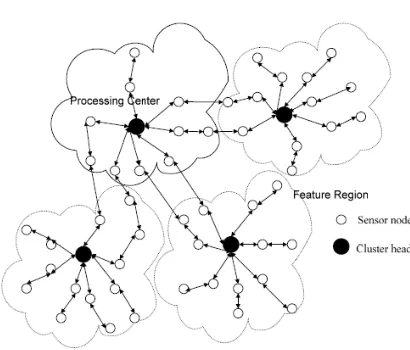
Most of the previous work targets at minimizing the number of pollers only, because selecting more pollers will enhance the difficulty of tracking the status of each poller and thus increase the network management cost. However, in a lossy environment, the false alarm rate can be adversely affected by a smaller number of pollers. For example, if the number of pollers is too small, some pollees will be too far away from the poller, and then the chance of link transient failure will be higher and the false alarm rate will be larger. To balance the tradeoff between the number of pollers and false alarm rate, we propose a distributed deterministic algorithm, which uses two parameters k1,k2 to guide a better distribution of poller and pollee; i.e., no two pollers are less thank1 hops away from each other, and no pollee is more thank2hops away from its poller.
we focus on the fundamental tradeoff between the number of monitoring nodes (i.e., pollers) and the false alarm rate. To balance the tradeoff between the number of pollers and false alarm rate, we propose a distributed deterministic algorithm. To increase the energy efficiency and reduce the monitoring overhead, we take the hopby- hop aggregation opportunities in sensor networks. Overall the proposed work advantages are optimal aggregation path to minimize the transmission energy, to increase the energy efficiency and reduce the monitoring overhead and it is nontrivial to determine which aggregation path should be used in order to achieve better aggregation.
SYSTEM MODEL
Figure 1 : Architecture of Cluster formation
Modules
• Network setup • Link Creation • Aggregation
• Aggregation Aware Monitoring • Location Estimation
1. Network Setup
The two widely used operational modes of the poller-pollee structure, where each poller can either poll the pollee and wait for a reply (i.e., reactive mode) or let the pollee send reports periodically (i.e., proactive mode). As the proactive mode cuts the monitoring traffic by half compared with the reactive mode.
Link Creation Each Link is a logical link, which could be multiple hops of physical links. As a result, the status reports destined to the same poller have the
opportunity to be aggregated at every intermediate node.
2. Aggregation
To do aggregation, each intermediate node may have to wait for reports to arrive from the downstream nodes. Due to the regular pattern of the monitoring traffic, the aggregation rules can be well defined without adding extra delay. The poller, pollees, and the physical link between them form a tree. If a node is at the edge of the tree, it is called an edge node; otherwise it is called a non-edge node.
Figure 2 : System Architecture
3. Aggregation Aware Monitoring
The Aggregation Aware Monitoring can be simply stated as follows. Each pollee schedules a report to the same poller every t. Each non-edge pollee collects reports from each of its children and sends an aggregated report (including its own) to the same poller every t, with the aggregation ratio s; Each poller makes the decision about each pollee’s status every Td, and informs the sink when necessary. It is required t ≤ Td.
4. Location Estimation
absence of messages from N3 is likely because N3 is out of the transmission range. The above decision can be improved through node collaboration. For instance, N1 can broadcast an inquiry about N2 to its onehop neighbors at time t + 1, and use the response from N4 to either confirm or correct its conjecture about N2. The above example indicates that it is important to systematically combine localized monitoring, location estimation and node collaboration, which is the fundamental of our approach. The false alarm results from the lossy nature of the wireless links. The failure characteristics of the wireless link has been studied by analyzing the packet traces over the real sensor test bed. Due to the observed bursty and transient error pattern, the wireless link can be modeled as a continuous time Markov chain we have established the relationship between the false alarm rate and distance. As our work focuses on how to build a poller-pollee architecture, it is independent of the underneath link model. Therefore, we take the result of and apply it here. Assume the link failure rate is fl, and use F(h, Td)to denote the false alarm rate when the pollee is hhops away from the poller, and the detection timer at poller is Td.
III.
RESULTS AND DISCUSSION
The Minimum Poller Selection Problem
In this section, we formulate the poller selection problem as NP-hard and propose distributed algorithms.
A. Problem Formulation
We consider a network of n sensors, where all sensors are capable of being either pollers or pollees. At first hand, we want to select the minimum number of nodes as pollers so that the management cost of pollers can be minimized. On the other hand, if the number of pollers is too small, some pollees will be many hops away from a poller, thus increasing the false alarm rate. Therefore, our goal is to strike a balance between the number of pollers and false alarm rate. Since the pollers may also fail, we associate each pollee with ω≥1 pollers. Each pollee maintains pointers to the different pollers but sends status report to only one poller at a time. When the poller fails, the associated pointers should be outdated and the next poller on the list will be used.
B. Distributed Poller Selection Algorithms
The construction of poller-pollee structure shares some similarity with the traditional clustering scheme, where a poller is similar to a cluster head. However, there is fundamental difference between them. First, the traditional clustering schemes are singlehopped, but the pollee should be within some bounded hops of its poller. Second, with multihops between the poller and pollees, aggregation is used to reduce the monitoring traffic, which is not considered in clustering schemes. Third, each pollee may be associated with ω ≥1 pollers to be fault tolerant, whereas each cluster member only has one cluster head. Thus, the traditional clustering scheme is only a special case of the single-hop poller-pollee structure with ω=1. Below, we first propose a distributed deterministic poller selection algorithm, and then present a hybrid algorithm to further reduce the message overhead. 1) The Randomized Algorithm: The randomized algorithm is presented as a baseline for comparison. Each node elects itself as a poller with probability ρ. Pollers then announce their poller status within k hops. Sensor nodes that did not elect themselves as pollers will be pollees. The randomized algorithm is very simple, yet it may produce some pathological scenario where multiple pollers may cluster together in some area and no poller exists in some other area. To address this problem, we propose a deterministic algorithm.
C. The Deterministic Algorithm
there is no edge between any two nodes. The set is a MIS if no more edges can be added to generate a bigger independent set. In the deterministic algorithm, the concept of MIS is extended to the multihop environment. Two parameters k1,k2 are used to govern the distribution of the pollers and pollees, to ensure that no two pollers are less than k1 hops from each other and no pollee is more thank2 hops from its poller. That is, the poller set Ser is a k1-hop MIS, in which no two nodes are less than k1hops away from each other.
IV.CONCLUSION
In this paper, we focus on the distributed design of monitoring and aggregation algorithm for wireless sensor network. Based on the poller-pollee structure we first proposed fully distributed algorithms to select the minimum number of pollers while bounding the false alarm rate. Then a greedy aggregation scheme was proposed to reduce the messages overhead due to monitoring. Theoretical analyses and extensive simulations show that the deterministic algorithm can flexibly control the pollerpollee distribution property to bound the false alarm rate, it can reduce the message overhead significantly, and the greedy aggregation scheme decreases the monitoring traffic. As future work, we plan to evaluate our schemes using real-world mobility traces and in scenarios with irregular transmission ranges. Our approach relies on location estimation and the usage of heartbeat messages for nodes to monitor each other. Therefore, it does not work when location information is not available or there is communication blackouts.
V.
REFERENCES
[1] Dezun Dong, Yunhao Liu, and Xiang ke Liao, “Self-monitoring for sensor networks,” in MobiHoc, 2008.
[2] R. Badonnel, R. State, and O. Festor. Self-configurable fault monitoring in ad-hoc networks. Ad Hoc Networks, 6(3):458–473, May 2008.
[3] P. Bahl and V. N. Padmanabhan. RADAR: An in-building RF-based user location and tracking system. In Proc. of IEEE INFOCOM, 2000. [4] Y. Bar-Shalom, T. Kirubarajan, and X.-R. Li.
Estimation with Applica-tions to Tracking and Navigation. John Wiley & Sons, Inc., 2002.
[5] D. Ben Khedher, R. Glitho, and R. Dssouli. A Novel Overlay-Based Failure Detection Architecture for MANET Applications. In IEEE International Conference on Networks, pages 130–135, 2007.
[6] C. Bettstetter. Smooth is Better than Sharp: A Random Mobility Model for Simulation of Wireless Networks. In Proc. of ACM International Workshop on Modeling, Analysis and Simulation of Wireless and Mobile Systems, pages 19–27, New York, NY, USA, 2001. ACM. [7] C. Bettstetter. Topology Properties of Ad Hoc Networks with Random Waypoint Mobility. ACM SIGMOBILE Mobile Computing and Commu-nications Review, 7(3):50–52, 2003. [8] J. Broch, D. A. Maltz, D. B. Johnson, Y.- C. Hu,
and J. Jetcheva. A Performance Comparison of Multi-Hop Wireless Ad hoc Network Routing Protocols. In Proc. of MobiCom, pages 85–97, New York, NY, USA, 1998. ACM.
[9] T. D. Chandra and S. Toueg. Unreliable Failure Detectors for Reliable Distributed Systems. Journal of the ACM, 43:225–267, 1996.