SOLUBILITY AND DISSOLUTION RATE ENHANCEMENT OF EZETIMIBE BY SOLID DISPERSION
AND PELLETIZATION TECHNIQUES
VISWANADH KUNAM
1*, VIDYADHARA SURYADEVARA
1, DEVALA RAO GARIKAPATI
2, VENKATA BASAVESWARA
RAO MANDAVA
3, SIVA PRASAD SUNKARA
11Department of Pharmaceutics, Chebrolu Hanumaiah Institute of Pharmaceutical Sciences, Guntur, Andhra Pradesh, India. 2Department
of Pharmaceutical Analysis, KVSR Siddhartha College of Pharmaceutical Sciences, Siddhartha Nagar, Vijayawada, Andhra Pradesh, India.
3Department of Chemistry and Pharmacy, Krishna University, Machilipatnam, Andhra Pradesh, India. Email: [email protected]
Received: 16 November 2018, Revised and Accepted: 26 December 2019
ABSTRACT
Objective: In the present investigation, an attempt was made to improve the surface characters and solubility of the drug by solid dispersion and coating it on the non-pareil sugar beads as pellets.
Methods: Ezetimibe solid dispersions were prepared by solvent evaporation technique using Kollidon VA64 as binder and solubility enhancer. Crospovidone as disintegrant and ethanol was used as solvent. Ezetimibe pellets were prepared by dissolving ezetimibe, kollidonVA64, and crospovidone in ethanol in different ratios and coated on non-pareil sugar beads as a drug layer by pan coating technique.
Results: All the formulations were further evaluated for physicochemical parameters such as particle size, friability, angle of repose, and drug content. In vitro dissolution studies were carried out in 1% sodium lauryl sulfate using USP apparatus II.
Conclusion: It was observed that the dissolution rate of the solid dispersion formulation ESD5 showed better dissolution rate to the extent of 1.05 folds
and 1.824 folds when compared to a marketed formulation and pure drug, respectively. Similarly, formulation EPL5 containing 1:5 ratio of ezetimibe
to Kollidon VA64 showed improved dissolution rate to the extent of 1.091 folds and 1.986 folds when compared to the marketed formulation and pure drug, respectively. Majority of the formulations displayed first-order release kinetics and were found to be linear with R2 values in the range of
0.874–0.993. Fourier transform infrared analysis revealed that there was no major interaction between the drug and excipients used in the design of formulation. Scanning electron microscopy analysis was performed for solid dispersions, pellet formulations, and its polymers to determine the surface characteristics.
Keywords: Ezetimibe, KollidonVA64, Crospovidone, Hydroxypropyl methylcellulose E5, Solid dispersions, Pellets.
INTRODUCTION
Multiparticulate oral drug delivery systems have acquired a center stage in the arena of pharmaceutical research and development and thus provide greater opportunities in extending the first step of future pharmaceutical development. Multiparticulate drug delivery systems include pellets, granules, microparticles (such as microspheres, microcapsules, and nanoparticles), mini tablets, mini depots, and multiparticulate pulsatile drug delivery systems. Pelletized dosage forms date back to the 1950s when the first product was introduced to the market. In 1949, research scientists of SmithKline and French developed tiny drug pellets that are filled into capsules. Since then, these dosage forms have gained considerable popularity due to their distinct advantages such as enhancement of drug dissolution; ease of coating with desirable release characteristics including sustained, controlled, delayed, site-specific, or pulsatile delivery of drug from coated pellets; uniform packing; ease of capsule filling due to better flow properties due to its spherical shape; and even distribution in the gastrointestinal (GI) tract and less GI irritation. Pellets are obtained from diverse starting materials of fine powders or granules of bulk drugs and excipients utilizing different pelletization techniques [1]. Pellets intended for oral use are administered in the form of hard gelatin capsules or disintegrating tablets which quickly liberate their contents in the stomach and get distributed throughout the GI tract without the loss of the depot effect and act as self-contained depots [2,3]. Pellets are prepared by different pelletization techniques such as agitation by balling, compaction by compression and extrusion-spheronization, and layering and globulation by spray drying and spray congealing.
In the present experiment, non-pareil sugar beads were coated with drug solution by layering technique. A well-controlled pelletization technique in which drug is layered onto starter seed materials which are coarse material or non-pareil, in powder, solution or suspension form with the aid of binder that assists heterogeneous pellets, consists of an inner core region and an outer shell region of a different composition [4,5]. The non-pareil seeds must have spherical shape, smooth surface, and uniform particle size distribution for uniform coating [6]. The concentration of the binder is based on the choice of the drug because it influences physical as well as mechanical properties of pellets and drug release from coated pellets. Commonly used binders include gelatin, povidone, carboxymethyl cellulose, hydroxyl propyl methyl cellulose (HPMC), hydroxypropyl cellulose, sodium CMC, and maltodextrins. Layering is classified into three categories: Direct pelletizing, powder layering, and solution or suspension layering [7,8]. Materials suitable for use as starter cores in the production of coated pellets include sugar spheres consisting of saccharides and its derivatives such as sugars, sucrose-starch mixtures, oligosaccharides and polysaccharides, microcrystalline cellulose spheres, and pure drug crystals. Polymers, particularly plastic resins; inorganic substances like silica, glass, hydroxyapatite; organic substances like activated carbon or acids like citric, fumaric, tartaric, ascorbic acids etc. can also be employed [9].
Ezetimibe is a BCS Class II drug. It is an antihyperlipidemic drug and it helps in lowering the cholesterol [10,11]. It actually localizes at the brush borders of the villi in the small intestine region and prevents the absorption of the cholesterol from the intestine. It binds to a carrier of © 2019 The Authors. Published by Innovare Academic Sciences Pvt Ltd. This is an open access article under the CC BY license (http://creativecommons. org/licenses/by/4. 0/) DOI: http://dx.doi.org/10.22159/ajpcr.2019.v12i3.30772
cholesterol absorption, the Niemann-Pick C1-Like 1 protein on the GI tract epithelial cells, and hepatocytes, thus decreasing the low-density lipoprotein in the body leading to prevention of various life-threatening diseases. It has poor aqueous solubility which leads to its limited dissolution, resulting in poor bioavailability (35–65%).
The main aim of the present investigation was to formulate ezetimibe solid dispersions and fast dissolving pellets using non-pareil sugar beads as inert core material with Kollidon VA64 as binder and solubility enhancer, Crospovidone as disintegrant, and ethanol as solvent to prepare the coating suspension to coat on the sugar beads as a drug layer by pan coating technique.
MATERIALS AND METHODS Materials
Ezetimibe was a gift sample from Pellets Pharma Ltd., Hyderabad. Kollidon VA64, ethanol, and HPMC E5 were procured from S.D. Fine Chem. Ltd., Mumbai. Crospovidone was a gift sample from M/S NATCO Pharma Ltd., Hyderabad.
Methods
Preparation of solid dispersions by solvent evaporation method
Solid dispersions of ezetimibe were prepared by mixing different ratios of ezetimibe and KollidonVA64, and the mixture was allowed to dissolve in suitable volume of ethanol. To this solution, Crospovidone was added and mixed for few minutes. Then, the dispersions were evaporated by solvent evaporation technique at 40–50°C in a china dish using heating mantle with constant stirring. The resultant solid dispersions were pulverized and then sieved through sieve no: 60 to get fine solid dispersion [12,13].
Preparation of pellets by pan coating method
A dispersion of crospovidone in purified water was prepared using half of its quantity, and it was initially applied on the sugar beads using spray gun at a pan speed of 300 rpm while maintaining the temperature at 60°C using IR lamp. The crospovidone-coated beads were further dried at room temperature for 12 h. This coat acts as a base coat for applying the medicament on the beads. Coating solution was prepared by dissolving ezetimibe, KollidonVA64, and remaining Crospovidone in ethanol at different ratios. The crospovidone-coated spheres then placed in a pan coater and coating solution was sprayed using sprayer gun. Coating pan was operated at 300 rpm, while hot air is blown at 50°C. Then, these beads were further dried at room temperature for 12 h. The drug-coated beads were finally coated with HPMC E5 dissolved in purified water using spray gun at a pan speed of 300 rpm while maintaining the temperature at 50°C using IR lamp. This coat acts as a protective layer, and the finally coated beads were thoroughly dried in a tray drier at 60°C for 1 h. Then, these beads were stored in a desiccator for further use [14,15].
Evaluation of physicochemical parameters on prepared granules The physical parameters such as particle size, friability, angle of repose, and drug content were evaluated for prepared formulations as per the standards.
Particle size determination
The average particle size of the prepared solid dispersions and pellet formulations was analyzed by sieve analysis method [16].
Friability test
Roche friabilator was used to determine the friability. Pre-weighed pellets were placed in friabilator and rotated at a speed of 25 rpm for 4 min. The pellets were then reweighed after removal of fine, and the percentage of weight loss was calculated.
Angle of repose determination
Angle of repose was determined by passing the solid dispersions and pellet formulations through a funnel fixed to a burette stand at a
particular height (4 cm). A graph paper was placed below the funnel on the table. The height and radius of pile were measured [17]. Angle of repose of the formulations was calculated using a suitable formula.
Angle of repose (ɵ) = tan−1 h/r
Drug content determination
Different formulations of ezetimibe equivalent to 10 mg was weighed and transferred into a 100 ml volumetric flask. To this, a small quantity of methanol was added to dissolve. It was shaken occasionally for about 15 min and the volume was made up to 100 ml by adding 1% sodium lauryl sulfate (SLS). The solution was filtered and the filtrate was subsequently diluted with 1% SLS, and the absorbance was measured at 232 nm using 1% SLS as blank solution.
In vitrodissolution studies
The dissolution test for prepared solid dispersions and pellets was carried out in USP Apparatus Type II (paddle) with 900 ml of 1% SLS as dissolution medium. The temperature and rotations per minute (rpm) were maintained at 37±1°C and 75, respectively. 5 ml of samples were withdrawn at 5, 10, 15, 20, 30, 45, and 60 min. A fresh volume of the medium was replaced with the same volume to maintain the sink conditions and the constant volume throughout the experiment. The samples withdrawn were suitably diluted with the same dissolution medium, and the amount of drug dissolved was estimated by ultraviolet spectrophotometer (UV 3000+) at 232 nm. The dissolution studies were
carried out for 6 times on all the formulations.
Based on dissolution data, various dissolution parameters such as T50
and DE30% first-order constant and Hixson-Crowell constants were
determined for various formulations. T50 is the time required for 50% of
the drug to dissolve in suitable dissolution medium. It can be measured by plotting a graph taking time in minutes on X-axis and cumulative percentage drug dissolved on Y-axis. The dissolution efficiency can have a range of values depending on the time intervals chosen. In any case, constant time intervals should be chosen for comparison. The index DE30% would relate to the dissolution of drug from a particular
formulation after 30 min and could only be compared with DE30% of
other formulations. It was calculated using the dissolved percentage curves of the drug versus time. Here, the region between the area above the curve and the total area of the graph was used for calculation and expressed in percentage.
Characterization of ezetimibe formulations
Based on the dissolution studies, the optimized formulations were selected and Fourier transform infrared (FTIR) studies were performed to know the drug and polymer interactions. Scanning electron microscopy (SEM) analysis was performed for pellet formulation and its polymers to know the surface characteristics.
Accelerated stability studies
The optimized formulations (ESD5 and EPL5) were subjected to
accelerated stability studies as per the ICH guidelines. They were kept in separate Petri dishes after preparation and stored in thermostated oven at a temperature and relative humidity (RH) of 25±2°C and 60±5% RH for 6 months and 40±2°C and 75±5% RH for 3 months. Then, they were evaluated for physical parameters, drug content, and drug release studies.
RESULTS AND DISCUSSION
Evaluation of physicochemical parameters
Ezetimibe formulations prepared were further evaluated for physicochemical parameters such as particle size, friability, angle of repose, and drug content estimation. All the solid dispersions were having the particle size of 250–260 µm, while the pellet formulations were found to have the particle size in the range of 840–845 µm. Friability loss for all pellet formulations was within the limits, i.e., <0.8%. Angle of repose values indicated that all solid dispersion formulations were having good flow characteristics with angle of repose value ranging from 22 to 24°, whereas pellet formulations were having excellent flow properties with the angle of repose 16–18°. Drug content was estimated for all formulations and found to be highly uniform in range of 8.20–9.78 mg/dose. Physicochemical parameters evaluated for ezetimibe formulations indicated that all formulations were stable and possess required limits as per literature. The values of physicochemical parameters of ezetimibe formulations are given in Table 2.
In vitrodissolution studies
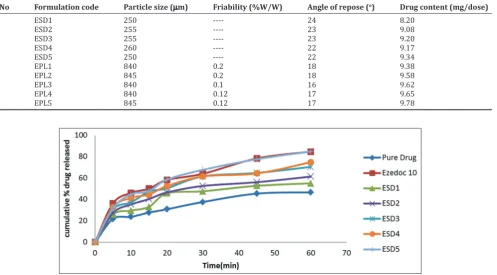
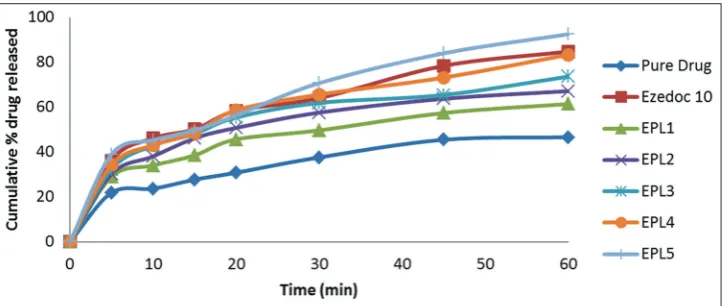
Dissolution studies were conducted for all the ezetimibe fast dissolving formulations along with pure drug and the marketed formulation. Dissolution studies were performed using USP apparatus type II (paddle type) with 1% SLS as medium while maintaining bath temperature at 37±1°C with a paddle operated at 75 rpm. Dissolution
profiles indicated that ezetimibe pure drug released to the extent of 46.53%, whereas the marketed formulation (Ezedoc 10) was released to the extent of 84.72% at 1 h. Solid dispersions ESD1–ESD5 found
to release the drug in the range of 55.04–85.88%. The prepared fast dissolving solid dispersions tend to increase drug release from 1.182 to 1.824 folds when compared to pure drug. Pellet formulations EPL1-EPL5
were found to release the drug from 61.38% to 92.45%. These fast dissolving pellet formulations tend to increase the drug release from 1.319 to 1.986 folds when compared to pure drug and 1.05 to 1.091 folds when compared to the marketed formulation. It was observed that the dissolution rate of the solid dispersion formulation ESD5 showed
better dissolution rate to the extent of 1.051 folds and 1.824 folds when compared to the marketed formulation and pure drug, respectively. Similarly, for formulation EPL5 containing 1:5 ratio of ezetimibe to
Kollidon VA64, the dissolution rate was enhanced to the extent of 1.091 folds when compared to marketed formulation and 1.986 folds when compared to pure drug. It was observed that the rate of dissolution is greatly increased with pellet formulations than compared to solid dispersions prepared. Formulation EPL5 pellets containing 1:5
drug-to-polymer ratio exhibited better release characteristics when compared to formulation ESD5 containing 1:5 ratio of drug and polymer. This was
due to an increased surface area of the pellet formulations [18,19]. Dissolution profiles are given in Figs. 1 and 2.
Table 1: Composition of ezetimibe solid dispersions and pellet formulations
S. No Ingredients (mg/10 doses) ESD1 ESD2 ESD3 ESD4 ESD5 EPL1 EPL2 EPL3 EPL4 EPL5
1 Ezetimibe 100 100 100 100 100 100 100 100 100 100
2 Sugar spheres - - - 1000 1000 1000 1000 1000
3 KollidonVA64 100 200 300 400 500 100 200 300 400 500
4 Crospovidone 25 25 25 25 25 25 25 25 25 25
5 HPMC E5 - - - 25 25 25 25 25
6 Ethanol q.s. q.s. q.s. q.s. q.s. q.s. q.s. q.s. q.s. q.s.
7 Purified water - - - q.s. q.s. q.s. q.s. q.s.
Table 2: Evaluation of physicochemical parameters of ezetimibe formulations
S. No Formulation code Particle size (µm) Friability (%W/W) Angle of repose (o) Drug content (mg/dose)
1 ESD1 250 ---- 24 8.20
2 ESD2 255 ---- 23 9.08
3 ESD3 255 ---- 23 9.20
4 ESD4 260 ---- 22 9.17
5 ESD5 250 ---- 22 9.34
6 EPL1 840 0.2 18 9.38
7 EPL2 845 0.2 18 9.58
8 EPL3 840 0.1 16 9.62
9 EPL4 840 0.12 17 9.65
10 EPL5 845 0.12 17 9.78
Dissolution parameters such as T50 and DE30% values were calculated
for all the formulations. T50 for solid dispersions ranges from 15 to
35 min. Similarly, T50 for pellet formulation ranges from 14.5 to 31 min.
DE30% values for solid dispersions range from 31.16% to 46.6%. DE30%
values for pellet formulations range from 34.16% to 47.2%. Majority of the formulations displayed first-order release kinetics and were found to be linear with R2 values in the range of 0.874–0.993. The
Hixson-Crowell constants for all the formulations were found to be linear with R2 values ranging from 0.829 to 0.995, indicating that the drug release
is by continuous depletion of the drug from the film formed across the spherical bead per unit weight. The results are indicated in Table 3.
Characterization studies
FTIR analysis
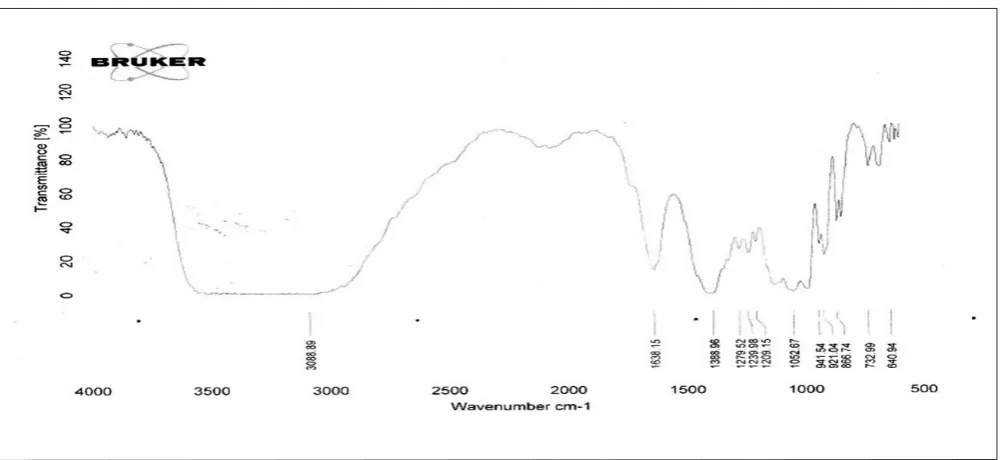
The drug and excipient interactions were further characterized by IR spectral analysis. FTIR spectra of ezetimibe pure drug, Kollidon
VA64, optimized ezetimibe solid dispersion, and optimized ezetimibe pellet formulation were obtained by KBr pelletization process. Spectra
exhibited peaks, indicating the presence of O-H, -C=C, =C-H, and C=O,
stretching and bending functional groups in both pure drug and formulations without any interference. Thus, the FTIR spectral analysis indicated that there were no drug interactions. The detailed spectral elucidations are shown in Figs. 3-6 and indicated in Table 4.
SEM analysis
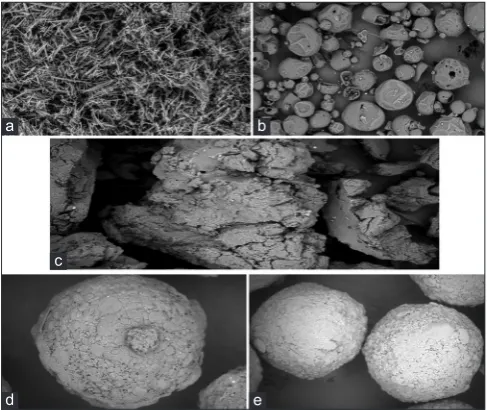
The SEM analysis revealed the structure of ezetimibe as crystalline and KollidonVA64 as spherical which are indicated in Fig. 7. Solid dispersions prepared by solvent evaporation technique were found to be in fine amorphous form of dispersion where the drug is totally entrapped into KollidonVA64. The uncoated and coated sugar beads exhibited smooth surface with a uniform coating on the coated pellets, thereby providing improved surface area for better dissolution rate.
Fig. 2: Dissolution profiles of ezetimibe fast dissolving pellets
Fig. 3: Fourier transform infrared interpretation of ezetimibe
Fig. 5: Fourier transform infrared spectra of optimized solid dispersion (ESD5)
Accelerated stability studies
The optimized formulations ESD5 and EPL5 were subjected to
accelerated stability studies as per the ICH guidelines after storage at different conditions. Physical parameters and drug release studies were carried out on these formulations and the results are indicated in Table 5 and Figs. 8 and 9, respectively.
There was no significant change observed in physical parameters and drug release even stability studies at various storage conditions and indicated that these formulations were found to be stable.
Fig. 6: Fourier transform infrared spectra of optimized pellet formulation (EPL5)
Table 3:In vitrodissolution kinetics of ezetimibe formulations
S. No Formulations T50 (min) DE30 (%) First Order Hixson‑Crowell
R2 K
1 (min−1) R2 K (mg1/3)
1 Pure drug 25 0.960 0.006 0.946 0.003
2 Marketed formulation (Ezedoc 10) 15 43.3 0.993 0.025 0.993 0.011
3 ESD1 35 31.6 0.874 0.009 0.829 0.004
4 ESD2 26 35 0.959 0.011 0.939 0.005
5 ESD3 20 41.6 0.944 0.013 0.925 0.006
6 ESD4 18.5 43.3 0.938 0.020 0.962 0.009
7 ESD5 15 46.6 0.975 0.029 0.988 0.013
8 EPL1 31 34.16 0.970 0.009 0.961 0.006
9 EPL2 20 40 0.944 0.011 0.927 0.007
10 EPL3 16 44.16 0.956 0.013 0.939 0.008
11 EPL4 17 46 0.988 0.023 0.982 0.012
12 EPL5 14.5 47.2 0.982 0.036 0.995 0.017
Table 4: FTIR spectral interpretation for ezetimibe formulations Functional group Wave number (cm−1)
Pure drug Kollidon VA64 ESD5 EPL5
C-H Stretching 3133 3116 3219 3088
C-C Bending 1510 1410 1508 1510
C-N Stretching 1396 - 1389 1388
C-C Bending, aromatic 792 - 779 770
CONCLUSION
Ezetimibe solid dispersions and fast dissolving pellet formulations were prepared using kollidonVA64 as a fast dissolving carrier. Among the various formulations, prepared formulation ESD5and EPL5 prepared
by solid dispersion technique and pelletization technique exhibited faster dissolution than compared to the marketed formulation, and hence, they are considered as optimized formulations. Hence, it is concluded that pellet coating technique is found to be simple and stable when compared to other conventional solid dispersion techniques.
ACKNOWLEDGMENTS
The authors are thankful to Pellets Pharma Ltd., Hyderabad, for gift sample of ezetimibe and management of Chebrolu Hanumaiah Institute of Pharmaceutical Sciences for providing the facilities to carry out the research work.
AUTHORS’ CONTRIBUTIONS
K. Viswanadh performed the basic methodology of this work. S. Vidyadhara guided the entire formulation and principle of the research work. G. Devala Rao helped in the formulation studies. M. V. Basaveswara Rao helped in the interpretation of FTIR data. S. Siva Prasad helped in the interpretation of SEM data.
Fig. 8: Drug release studies of ESD5 before and after storage at different conditions
Fig. 9: Drug release studies of EPL5 before and after storage at different conditions
Table 5: Parameters of formulations ESD5 and EPL5 under accelerated stability conditions
Formulation Storage condition Particle size (µm) Friability (% w/w) Angle of repose (0) Drug content (mg/dose)
ESD5 Before storage 840 - 22 9.34
25±2°C, 60±5% RH 840 - 22 9.32
40±2°C, 75±5% RH 840 - 23 9.31
EPL5 Before storage 250 0.10 20 9.78
25±2°C, 60±5% RH 250 0.10 20 9.76
40±2°C, 75±5% RH 250 0.11 21 9.75
Fig. 7: Scanning electron microscopy images of (a) ezetimibe, (b) Kollidon VA64, (c) solid dispersions,
(d) sugar spheres, (e) coated spheres
a b
c
CONFLICTS OF INTEREST
The authors have no conflicts of interest.
REFERENCES
1. Follonier N, Doelker E. Biopharmaceutical comparison of oral multiple-unit and single multiple-unit sustained release dosage forms. STP Pharm Sci 1992;2:141-5.
2. Vial-Bernasconi AC, Doelker E, Buri P. Prolonged release capsules divided and monolithic forms. STP Pharm Sci 1988;4:397-409. 3. Malinowski HJ, Smith WE. Effect of spheronization process variables
on selected tablet properties. J Pharm Sci 1974;63:285-8.
4. Jackson IM, Roberts S, Timmins P, Sen H. Comparison of laboratory scale processing in the production of coated pellets. Pharm Tech Int 1989;1:29-32.
5. Gamlen MJ. Pellet manufacture for controlled release. Manuf Chem 1985;3:56-9.
6. Nastruzzi C, Cortesi R, Esposito E, Genovesi A, Spadoni A, Vecchio C,
et al. Influence of formulation and process parameters on pellet
production by powder layering technique. AAPS Pharm Sci Tech 2000;1:9.
7. Olsen K. Fluid bed equipment. In: Ghebre-Sellassie I, editor. Pharmaceutical Pelletization Technology. New York: Marcel and Dekker; 1989. p. 39-69.
8. Bauer KH, Lehmann K, Osterwald HP, Rothgang G. Equipment for sugar coating and film coating processes coated pharmaceutical dosage forms. Stuttgart: Medpharm Scientiphic Publishers; 1998.
9. Felton LA. Film coating of oral solid dosage form. In: Swarbrick J, editor. Encyclopedia of Pharmaceutical Technology. New York:
Informa Healthcare; 2007. p. 1729-47.
10. DiPiro JT, Talbert RL, Yee GC, Marzke GR, Wells BG, Posey LM, editors. Pharmacotherapy: A Pathophysiologic Approach. 7th ed. New York: The McGraw-Hill Companies, Inc.; 2008.
11. Calvo MG, Lisnock J, Bull HG, Hawes BE, Burnett DA, Braun MP, The target of ezetimibe is niemann-pick C1-like 1 (NPC1L1). Proc Natl Acad Sci USA 2005;102:8132-7.
12. Sucheta B, Dyandevi M, Mithun VK, Rajendra DP. Solubility enhancement of anti-hypertensive agent by solid dispersion technique. Int J Pharm Life Sci 2011;2:970-5.
13. Margrit A, Azza H, Hanan EN, Fakhr-Eldin G. Enhancing oral bioavailability of carvedilol using solid dispersion technique. Int J Pharm Pharm Sci 2016;8:193-9.
14. Kausalya J, Suresh K, Padmapriya S, Anusha R, Senthilnathan B. Solubility and dissolution enhancement of telmisartan using various techniques. Int J Pharm Tech Res 2011;3:1737-49.
15. Ashwini K, Santosh S, Vivek R, Yogesh K, Ashish J. Review on antihyperlipidemic lipophilic drugs and their novel formulation approaches. Int J Pharm Pharm Sci 2017;9:1-8.
16. Gordon RE, Rosanske TW, Fonner DE, Anderson NR, Banker GS. Granulation technology and tablet characterization. Pharm Dosage Forms 1990;2:324.
17. Train D. Some aspects of the property of angle of repose of powders. J Pharm Pharm 1958;10;S1.
18. Kothawade PC, Belgamwar VS, Deshmukh S. Solid dispersions of telmisartan for enhancing solubility, dissolution rate and oral bioavailability. Ind Am J Pharm Res 2013;3:7035-45.
19. Vishal D, Gaurav J, Vaibhav J, Sheorey R.V. Formulation and in vitro