R E S E A R C H
Open Access
Cognitive radio frequency assignment with
interference weighting and categorization
Zeljko Tabakovic
1*and Mislav Grgic
2Abstract
Cognitive radio is one of the technologies promoting flexible and efficient use of radio frequency spectrum, thus solving spectrum scarcity problem. Frequency assignment is an integral part of the cognitive radio spectrum management and a critical point of success or failure of the cognitive radio concept. In this paper, cognitive radio frequency assignment with a novel interference weighting and categorization is proposed, as an extension of the solution to the graph coloring problem. In our approach, the edge weights quantifying the interference potential are appended to the conflict graph, co- and adjacent channel interference are treated, and dynamically changing local lists of blocked frequencies are included. We propose the improved cognitive radio saturation metric for the dynamic vertex ordering and to introduce interference categorization which will reduce the communication overhead. Using the proposed model, resource manager can quantify individual interference components, as well as aggregate interference from multiple users, resulting in more knowledgeable frequency decisions. Generalization of the proposed model is suggested. The suggested generalization consists of the selection of the central frequency and optimal bandwidth to be used, according to the user requirements. We have developed interference-sensitive algorithms for minimizing the interference and maximizing the throughput, both in centralized and distributed implementation. The results show significant reduction of the interference, improved spectrum efficiency, and increase in network throughput, comparing to the benchmark algorithms.
Keywords: Cognitive radio, Frequency assignment, Resource allocation, Graph coloring, Spectrum management, Dynamic spectrum access, Interference modeling
1 Introduction
The future market demand for the wireless broadband services, internet of things, machine to machine commu-nications, and wireless data offload requires the deploy-ment of the next generation wireless networks, which will need a rapid and a more flexible access to the radio frequency spectrum. Since radio frequencies are a lim-ited natural resource, which cannot be saved for the future use or transferred from underused to overloaded areas, efficient usage of the frequencies has become one of the major concerns of the industry, governments, and scientific research. As a result of these research efforts, many different proposals for better and more efficient usage of the radio frequencies have emerged. One of the promising technologies, which could make
*Correspondence: [email protected]
1HAKOM, Croatian Regulatory Authority for Network Industries, Roberta F. Mihanovica 9, 10000 Zagreb, Croatia
Full list of author information is available at the end of the article
a big paradigm shift towards the future wireless net-works, is a cognitive radio (CR) technology. CR is intro-duced in [1, 2] and refers to intelligent radio commu-nications system employing technology that allows the system to obtain knowledge of its operational environ-ment, using technology to learn from the environment and dynamically adjust its operational parameters and protocols [3].
Problem addressed. CR frequency assignment
repre-sents the core of the cognitive radio process, since its unique features, along with reconfigurability and learn-ing, make the cognitive radio what it is. The frequency assignment (FA) problem in wireless communications is well-studied, due to the extensive research of FA in mobile radio networks, wireless mesh networks, broad-casting networks, or in military applications [4–6]. Most of these studies do not consider primary-secondary spec-trum sharing nor the dynamic availability of the specspec-trum due to the presence of primary users. Taking a deeper look
into these research approaches, we can deduce that the cognitive radio FA has many unique and specific features, which makes CR unsuitable for transposition of the same FA models and algorithms from other types of wireless networks.
Task of the frequency assignment in the CR context is to select the best available radio frequency spectrum to satisfy user’s communication needs, while avoiding causing harmful interference to the primary users (PUs) and minimizing influence to the other concurrent sec-ondary users (SUs) sharing the same frequency band. Since the spectrum opportunities used for dynamic spec-trum access in CR are limited in both time and space, CR has to be very fast and pragmatic in using the available spectrum bands. Suboptimal but fast converg-ing and robust solutions are preferred in relation to the optimal one which usually requires extensive data sets and too much time to obtain results. Having this in mind, we can present basic characteristics of FA in CR:
• CR has to operate as a secondary service on non-interfering, non-protection basis, alongside other services using the same frequency band.
• CR has to work non-intrusively, has to protect PUs, and vacate the spectrum in case of a PU appearance.
• CR FA has to be fast, adaptive and easy to implement and does not necessarily have to provide an optimal FA.
• CR FA has to re-initiate and re-converge in cases of the quality degradation due to a dynamic changes in the radio channel or SU and PU activation.
• CR FA has to allocate the channels and also the spectrum fragments of a different bandwidth.
• CR FA has to work with the limited information in an environment with either cooperative or selfish SUs.
• CR FA has to be flexible, applicable in centralized and distributed manner.
• CR FA has to assign frequencies continuously and sequentially when a part of the PUs and SUs are already operating.
• CR FA has to be applicable in the heterogeneous wireless environment with the different classes of the dynamic spectrum access, different user
requirements, and different protection requirements.
Our contributions. Our paper is focusing on the FA
component of the dynamic spectrum management in the CR context. The problem of quantifying the inter-ference using interinter-ference weighting and categorization in CR FA process, as well as CR FA algorithms with a numerical measure of interference levels between SUs as described in this paper, have not been previously addressed to the best of our knowledge. The FA in
the CR networks presented in this paper is formulated as a variation of the graph coloring problem with the dynamic vertex ordering, where specific CR features are included. In this paper, the special attention is granted to the modeling and control of the interference. Numer-ical quantification of the interference is enabled with the inclusion of the conflict graph edge weights represent-ing co- and adjacent channel interference between the SUs. We have developed the centralized and distributed algorithms with interference minimization and through-put maximization as objectives. Specifically, the contribu-tions and novelty of this paper can be summarized in the following:
• The extension of the CR network conflict graph with:
– Introduction of the continuous value edge weights quantifying the potential level of co-and adjacent channel interference between SUs
– Incorporation of the influence of the adjacent channel interference by introducing an additional layer in the conflict graph
• Introduction of the SU interference categorization for interference susceptibility of the FA algorithms, while reducing the communication overhead
• The proposal of the spectrum fragments assignment with the identification of the central frequency and optimal bandwidth for the CR transmissions
• Introduction of a new saturation metric for a dynamic sorting of the vertices in the process of the sequential FA, taking into consideration the channel limitations due to the PU transmissions as hard constraints and a level of the interference from the adjacent assigned CRs as soft constraints
• The proposal and evaluation of the interference sensitive FA algorithms with the objective of:
– Minimal total CR network interference – Maximal CR network throughput with
consideration of the network interference as a comprehensive metric
the deterioration of the objective function. The objec-tive function takes into consideration the interference among SUs and the throughput achieved by the SU transmissions.
Our work differs from the previous works on the graph coloring-based CR networks FA in several aspects: the level of the interference between the SUs and between the SUs and PUs are numerically quantified using both the continuous and discrete weights; the influence of the co-channel and adjacent co-channel interference are considered; all individual interference contributions and cumulative interference values are monitored in the course of FA process. Proposed FA algorithms use this unique fea-ture of the numerical quantification of the interference to precisely control and assign frequencies that have min-imal interference influence in relation to other users. The advantages of the proposed interference sensitive FA strategy are numerous. It significantly reduces the interference in the CR networks, fully protects the PUs, reduces the frequency reuse distance between the CR users, improves spectrum usage efficiency, and increases the overall networks throughput with the available radio spectrum.
Paper organization.The rest of the paper is organized in the following way. Section 2 presents the overview of the previous research along with the comparison and main differences with respect to our paper. In Section 3, we formulate a CR network FA problem, present the system model and propose a novel framework for the interference sensitive FA in the CR. In Section 4, an inter-ference estimation model used in the algorithm design is elaborated, characterization and categorization of co-and adjacent channel interference is introduced, co-and determination of weighting coefficients is elaborated. We describe the phases of the proposed FA algorithms, sat-uration metric, and coloring label with the objective of interference minimization and throughput maximization and the transmit power control strategy in Section 5. In Section 6, considerations of the centralized and tributed implementation of the FA algorithms are dis-cussed. In Section 7, generalization to the frequency and bandwidth spectrum assignment are proposed, as well as implementation consideration in practical CR systems. In Section 8, we present an evaluation of the proposed algorithms’ performance in the simulated envi-ronment of the PU and CR networks. Finally, we conclude the paper and outline the key results of this paper in Section 9.
2 Related work
Spectrum management is technical, procedural, and pol-icy approach to the planning, coordination, and manag-ing the use of the electromagnetic spectrum as a lim-ited resource. The CR spectrum management functions
have some specific capabilities, since the CR networks are focusing on the secondary access and spectrum shar-ing, while protecting the PUs and minimizing inter-ference with the other SUs. An insightful overview of the spectrum management in the CR networks is pre-sented in [7, 8]. The problem of the FA is commonly solved using different heuristic methods, the graph the-ory, game thethe-ory, or linear programming. In the FA modeled as a the graph coloring problem, the task is to color all the nodes of the graph with the mini-mum number of colors, in a way that no two adja-cent nodes (nodes connected with an edge) have the same color [4–6]. A comprehensive analysis of the fre-quency assignment in the CR networks can be found in [9, 10].
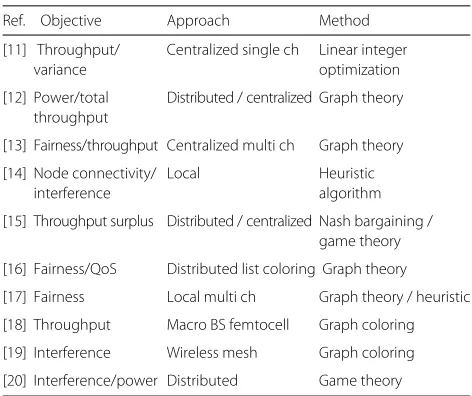
The comparisons of the different target objectives, the approaches for the FA, and the used methods for the selected previous works presented in this section are sum-marized in Table 1. A deeper discussion on the insights of the related work and the main differences with respect to this paper are presented below. In [11], the authors propose a spectrum decision framework determining a set of spectrum bands taking into account the appli-cation requirements and dynamic nature of spectrum bands. For the real time applications, authors propose spectrum decision with the objective of total capacity vari-ance minimization, while for the best effort applications objective is network capacity maximization. The authors propose a new metric for calculating the capacity of a CR user, namely, the expected normalized capacity of a user taking into account network switching delay. This spectrum switching delay includes the time intervals for the spectrum decision process in the base station, signal-ing for establishsignal-ing new channels and the RF front-end
Table 1Summary of FA problem solutions presented in related
work
Ref. Objective Approach Method
[11] Throughput/ Centralized single ch Linear integer
variance optimization
[12] Power/total Distributed / centralized Graph theory throughput
[13] Fairness/throughput Centralized multi ch Graph theory
[14] Node connectivity/ Local Heuristic
interference algorithm
[15] Throughput surplus Distributed / centralized Nash bargaining / game theory
[16] Fairness/QoS Distributed list coloring Graph theory
[17] Fairness Local multi ch Graph theory / heuristic
[18] Throughput Macro BS femtocell Graph coloring
[19] Interference Wireless mesh Graph coloring
reconfiguration. The dynamic resource management for the spectrum decision is elaborated including admission and decision control. The authors propose centralized spectrum management using linear integer optimization method with a single channel assignment. Two phase CR network power control and channel allocation is proposed in [12]. In the first phase, distributed power updating process is employed in order to maximize the coverage of the CR network, while assuring that the signal-to-interference-plus-noise ratio (SINR) constraints at all PU receivers are met. In the second phase, a centralized chan-nel allocation scheme based on weighted bipartite graph matching is used. The objective of the channel assignment is the maximization of the total network throughput while protecting the PUs. Both, uplink and downlink scenarios, are investigated with distributed and centralized imple-mentation. The authors consider a cellular CR network with base and terminal stations, where the interference between the SUs are not considered. Contrary to this, in our approach, the SUs protect the PUs using the local list of blocked channels, the interference between the SUs is measured with conflict edge weights, and FA algorithms consider the interference quantification in the frequency decisions. In [13], the FA problem for the opportunis-tic spectrum access is investigated. The authors propose a novel FA approach using sensitive graph color-ing. The authors present a solution of the graph coloring problem using the sequential coloring with a vertex label-ing. The vertex labeling is based on the channel capacity divided by the vertex degree, giving priority to the most valuable vertices. Based on those premises, the authors propose coloring algorithms with an objective of maximal cumulative reward, maximal minimal reward, and maxi-mal proportional fairness. Results of the simulations show improvement of the network performance in through-put and in interference reduction compared to the other algorithms. In [13], the authors use binary edge conflict graph and interference free channel assignment. In our proposal, the interference is continuous or have discrete characteristic values. The FA algorithms allow the inter-ference with matching network penalty. In [14], localized efficient channel assignment in the CR networks is pro-posed with a goal to maximize node connectivity after the FA, which is important for packet delivery. Partition of the network into two-level trees, conflict resolution strat-egy and trimming of nonessential links are proposed. Two basic localized algorithms and an advanced localized algo-rithm for the FA are presented. In assigning, the priority is given to the nodes with a higher link degree. Node-link-based algorithm with Hungarian method of maximal matching has almost twice the broadcast reachable nodes and assigned link rate, compared to the basic algorithms. As opposed to our approach, in the proposed model, the CR throughput is not considered, all channels have
specified graph density. Comparing to our approach, pro-posed model does not consider the protection of the PUs and only simple binary conflict graphs are considered without interference susceptibility in the FA. In [18], the authors consider downlink resource allocation for hybrid macro/femtocell LTE-advanced network. Both macro and femto base stations have the CR functionalities. The cross tier interference is reduced by using the cross-cognition scheme, where base stations have higher priority in uti-lizing its licensed spectrum and lower priority in oppor-tunistically utilizing non-licensed spectrum. The largest degree first based graph coloring algorithm is applied for the frequency block assignment reducing intra-tier inter-ference between the femtocell nodes. Simulation results show increased throughput of the CR femtocell network compared to non-spectrum shared macro-femto cell net-work and improved interference mitigation of the graph coloring resource allocation compared to the random resource allocation. The problem of the FA to the com-munication links in the multi-hop wireless mesh networks with the objective of minimizing overall network interfer-ence is addressed in [19]. In the proposed mesh network, router nodes have multiple radio interfaces. The authors propose a centralized algorithm based on the heuristic Tabu search technique, where in the first phase, random initial FA solution is improved using the iterative algo-rithm with Tabu list, and in second phase, the algoalgo-rithm eliminates remaining interface constraints. Distributed algorithm is based on a greedy heuristic algorithm for Max K-cut problem of the constrained graph optimiza-tion, where algorithm chooses frequency which produces the largest decrease in the local interference. The authors also propose an extension of the model with consideration of the non-orthogonal channels and non-uniform node traffic useful for practical implementation. The empirical evaluation on randomly generated network graph shows that proposed algorithms perform close to lower bounds established by the semi-definite and integer linear pro-gramming. However, compared to the approach presented in this paper, the authors assume quasi-static assignment of the channels, all channels are not available for the FA to all users, binary interference model is assumed in simulations, and finally, there is no sharing between the primary and the secondary users. In [20], a game theoretic approach for the distributed channel selection and power allocation in the cognitive radio networks is investigated. Proposed algorithm enforces the cooperation between the SUs in order to reduce the energy consumption and to find Nash equilibrium. Game theory model fits well with the cognitive FA problem because the spectrum decision of one of the SU influences the performance of neighboring SUs. Potential game formulation and no-regret learning model have been presented as a solution to the channel allocation problem. The influence of the
cooperation on observed SINR and power consumption is investigated. Results show that the proposed iterative algorithm converges to a pure strategy Nash equilibrium solution.
So far, all the work done on the CR networks graph coloring FA employed simplistic binary co-channel inter-ference model in order to assign frequencies and opti-mize utility function [10, 12–14, 16–19]. As we know, the interference control and management are of utmost importance for the spectrum sharing and efficient spec-trum management in the CR systems. The CR FA algo-rithms have to deal with the mutual interference from co-channel or adjacent channel transmissions, which may cause significant performance degradation. Nevertheless, in the existing work, it was not possible to assess, quantify, or compare interference influence of the CR frequency selection on the neighboring SUs, nor to share spec-trum between users when the interference exists, but it is bearable. Also, the adjacent channel interference was mainly neglected. To alleviate this deficiency, we pro-pose a novel conflict graph model and algorithms with interference weighting and categorization, which enable interference sensitive frequency decisions, better interfer-ence control, and quantitative estimation of the individual components, as well as the calculation of the cumulative interference at the neighboring users. As a result, the pro-posed FA in the CR is performed with the interference sensitivity, achieving the efficient spectrum utilization, while enabling reliable transmissions.
3 The proposed FA framework
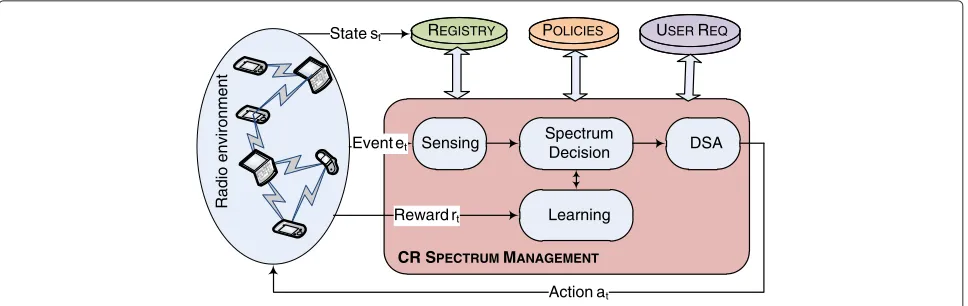
The CR spectrum management task is to achieve efficient wireless communications without causing a harmful inter-ference or service interruptions. The CR spectrum man-agement functions have some specific capabilities since the CR networks are focusing on the secondary access and spectrum sharing, while protecting the PUs and minimiz-ing interference to the other SUs. A functional overview of the CR spectrum management framework is shown in Fig. 1. It consists of four major steps:
• Spectrum sensing. A CR user can only utilize temporary unused parts of the spectrum. Therefore, CR should monitor the available spectrum bands, collect the information on the spectrum use, and identify possible spectrum holes and their characteristics.
Radio environment
REGISTRY POLICIES
CR SPECTRUM MANAGEMENT
Sensing Spectrum
Decision DSA
Action at
Event et
Reward rt
State st
Learning
USER REQ
Fig. 1CR spectrum management framework
channel bandwidth, transmission power, modulation, coding, communication technology, together with other operational, and technical parameters used for the CR operation.
• Dynamic spectrum access (DSA). The CR
reconfigures its technical parameters in line with the selected operational technical parameters and operates in order to satisfy its primary goal of successful communication with a required QoS.
• Learning. Since CR is operating in heterogeneous radio environment with different user characteristics, different requirements and many parameters
determining its environment and performance, CR has to adapt to the constantly changing environment, observe performance of its operation, and has to adapt its spectrum decision function using reinforcement learning.
The process of assigning frequencies to the CR users as part of the spectrum decision step is of crucial importance for the CR network functioning and represents a focal point of the efficient radio spectrum use, distinguishing the CR from other wireless communications systems.
3.1 Problem formulation and system model
In this paper, we are focusing on the FA component of the CR spectrum management. We will interchangeably use the following terms: radio links and vertices, frequencies and colors, interference and edges, cognitive radio and secondary user. The problem of the FA in the CR networks can be informally described as follows: given a set of the transceivers with the CR capabilities, a network of the PU transceivers with the administrative licenses and priority access rights to the radio frequency spectrum, and prede-fined constrained number of the frequencies, we wish to efficiently assign radio frequencies to the CR users. The CR FA has to satisfy the following requirements:
• CR self-goal: successfully transmit as much information as possible with required QoS
• CR network goal:
– Minimizing the total network interference – Maximizing the network throughput
• Requirements towards other users: not to cause excessive interference with the operating PUs, to keep the CR mutual interference under the reasonable limit and to efficiently share the radio frequency spectrum
The FA problem in the wireless communications can be modeled as a graph-theoretical problem by defin-ing an undirected conflict graph describdefin-ing the inter-ference relations and assigning frequencies by coloring vertices. The graph coloring problem is known to be NP-complete problem [21] and therefore computation-ally hard. Although any given solution of the NP-complete problem can be verified in the polynomial time, there is no known efficient way to find the optimal solution. Also, the time required to solve the problem increases very quickly as the size of the problem grows. For example, 3.16 mil-lion years are needed to find a solution to the FA problem using brute force search approach for 20 terminals and 10 frequencies with 1 μs per solution [6]. Considering the basic characteristics of the FA in the CR already men-tioned, and the computational complexity of finding an optimal solution, we are directing towards the use of the heuristic method for solving this problem. Although the heuristic algorithm leads to a suboptimal solution, it pro-vides a reasonably good solution in the limited time, which works well in the practical applications of the assigning frequencies to the CR SUs.
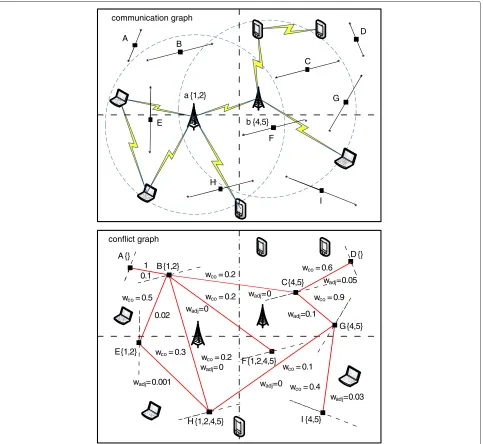
spectrum access scenario is depicted in Fig. 2, with the corresponding communication and conflict graph. The communication graph represents the communication links between the radio transceivers, while conflict graph shows possible interference between the radio links. In the communication graph, the PU and SU transceivers are represented as the vertices, while communication links between radio transceivers are represented by communi-cation graph edges. In the communicommuni-cation graph shown in Fig. 2, PU network is illustrated as two base stations serving a set of PUs, establishing the primary links, while CR network deployed in the same area is represented by a set of CR links {A, B,. . .,I}. The circles illustrate
the service zones of the PU networks. The correspond-ing conflict graph is shown in Fig. 2, where the vertices represent the CR communication links with a dynami-cally changing local list of blocked frequencies due to PU transmissions. In the same figure, the edges show possible interference occurrences where co- and adjacent channel interference levels are proportional to the edge weights coefficients.
Let us assume there are five available frequencies repre-sented by numbers, which are opportunistically available to the CR operation. Since the PU and the CR networks share the same radio frequency band, the frequencies temporarily used by PUs cannot be utilized by the CR
a {1,2}
b {4,5} A
B
C
D
E
F
G
H
I *
*
*
* *
* *
*
* *
*
* *
* *
*
* *
communication graph
A {}
B {1,2}
C {4,5}
D {}
E {1,2}
F {1,2,4,5}
G {4,5}
H {1,2,4,5} I {4,5}
1
0.1 wco = 0.2
wco = 0.6
wadj=0.05
wadj=0 w
co = 0.9
wadj=0.1
wco = 0.5
0.02
wco = 0.4
wadj=0.03
wco = 0.3
wadj=0.001
wco = 0.2
wadj=0
wco = 0.2
wadj=0
wco = 0.1
wadj=0
conflict graph
users if they are in the interference range, and there-fore, those channels are blocked for corresponding CR link indicated by the corresponding blocked channels list. For the CR link, B channels {1, 2} cannot be used due to the possible interference with the service area of the PU base stationa, for the CR linkC channels{3, 4}are blocked, for the CR linkFchannels{1, 2, 4, 5}are blocked, etc. The conflict edges represent the potential interfer-ence between the CR links with two edge weights per edge indicating co-channel and adjacent channel interfer-ence potential. In Fig. 2, the edge between the CR link
A and CR link B has weights of 1 for co-channel and 0.1 for the adjacent channel, indicating very high interfer-ence potential between those links, and therefore, those links cannot use the same channel. The edge between the CR link C and CR link D has a conflict weight of 0.6/0.05 indicating a medium interference potential and the edge between CR link B and CR link F has a weight of 0.2/0 indicating a low co-channel interference and no adjacent channel interference. This indicates the possibil-ity for sharing the channel. The existence of the conflict graph edges and the corresponding weights depends on the propagation channel characteristics and the antenna discrimination between the CR link pairs analyzed. For example, between the CR link A and CR link E, there is no edge because the terrain obstacle prevents possi-ble interference path and corresponding links can use the same channel without danger of the mutual harm-ful interference. Practical implementation of constructing conflict graph and determining its weights is elaborated in Section 7.2.
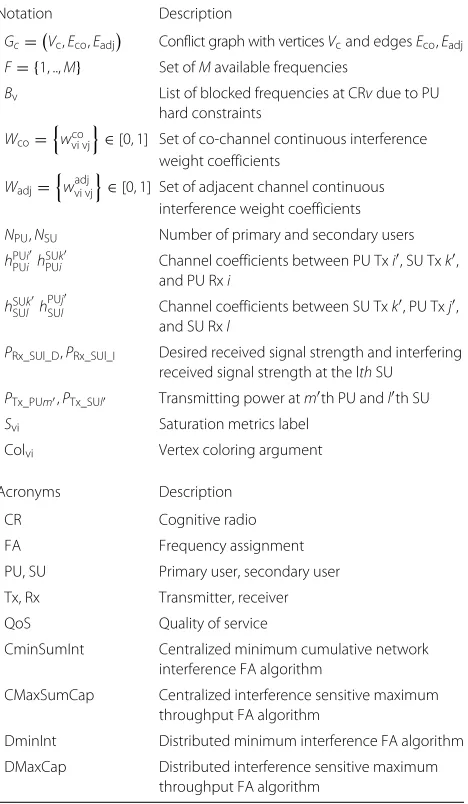
In our work, we abstract the CR network topology into the communication graph G = (V,E) as a general undirected graph over the set of network transceivers rep-resented by the verticesVand PU or CR links represented by the edgesE in Fig. 2. The FA channel selection con-straints and potential interference between the radio links are represented by a conflict graph Gc = (Vc,Eco,Eadj), whereVcis set of conflict graph vertices, andEcoandEadj are co-channel and adjacent channel conflict edges with associated interference potential quantified by the edge weightswcoandwadj. Using the described model, the FA problem can then be further formulated as a complete frequency assignment of the CR network represented by a conflict graph Gc = (Vc,Eco,Eadj). The spectrum of interest is divided inMfrequencies represented by con-strained set of the radio frequenciesF = {1, ..,M}, and the dynamically changing local set of blocked frequencies protecting the PU transmissions represented byBv. Using the abovementioned notation, frequency assignment is a graph coloring functionf :(Gc,Bv,Wco,Wadj)→F, such that the objective function is maximized. To facilitate fur-ther discussion, we will use the notation and acronyms as defined in Table 2.
Table 2Important notation and acronyms
Notation Description
Gc=Vc,Eco,Eadj
Conflict graph with verticesVcand edgesEco,Eadj
F= {1, ..,M} Set ofMavailable frequencies
Bv List of blocked frequencies at CRvdue to PU hard constraints
Wco=
wvi vjco∈[0, 1] Set of co-channel continuous interference weight coefficients
Wadj=
wadjvi vj∈[0, 1] Set of adjacent channel continuous interference weight coefficients
NPU,NSU Number of primary and secondary users
hPUi
PUi hSUk
PUi Channel coefficients between PU Txi, SU Txk,
and PU Rxi
hSUk
SUl h
PUj
SUl Channel coefficients between SU Txk, PU Txj,
and SU Rxl
PRx_SUl_D,PRx_SUl_I Desired received signal strength and interfering received signal strength at the lthSU
PTx_PUm,PTx_SUl Transmitting power atmth PU andlth SU
Svi Saturation metrics label
Colvi Vertex coloring argument
Acronyms Description
CR Cognitive radio
FA Frequency assignment
PU, SU Primary user, secondary user
Tx, Rx Transmitter, receiver
QoS Quality of service
CminSumInt Centralized minimum cumulative network interference FA algorithm
CMaxSumCap Centralized interference sensitive maximum throughput FA algorithm
DminInt Distributed minimum interference FA algorithm
DMaxCap Distributed interference sensitive maximum throughput FA algorithm
3.2 Framework overview
Based on the system model described in Section 3.1, we have developed a novel framework for assigning the frequencies in the CR environment. In the prepara-tory step, input data and the CR technical parameters are determined, including available frequencies, com-patibility criteria, CR coverage area, and the interfer-ence potential. In the second step, the CR adjacency, interference levels, and weights are estimated, followed by communication and the conflict graph construc-tion determining whether the CRs can share radio fre-quencies. In the CR FA step, an iterative process is performed consisting of labeling and ordering of the CRs, selecting the next transmitter to assign the fre-quency, and selecting the frequency maximizing network objective.
In the previous research of the CR FA application of graph coloring, the interference model assumed the con-flict edges to be binary variables representing the interfer-ence or no-interferinterfer-ence occurrinterfer-ence. The adjacent channel interference was not taken into account since the chan-nels were assumed to be orthogonal. In the proposed FA framework, the CR network conflict graph illustrated in Fig. 2 is extended with the novel features:
• The local list of the blocked frequenciesBvassociated
with each conflict graph vertex representing frequencies which cannot be used by CR
• Two layers of edges in conflict graph taking into consideration co-channel interferenceEcoand
adjacent channel interferenceEadj
• Continuous interference weight coefficientsWcoand Wadjassociated to the conflict graph co-channel and
adjacent channel edges incorporating quantification of possible interference between adjacent vertices corresponding to the interference “strength”
• The categorization of the interference weights reducing communication overhead
Since the CR user has to protect and not cause the interference to the licensed PUs, each CR keeps its own list of blocked frequencies and the FA algorithm avoids selecting the channels causing harmful interference to the PUs which are temporarily operating in the close vicin-ity of the observed CR. As the PUs frequency usage is constantly changing, the list of the blocked channels at the CR is dynamically updated using the spectrum sens-ing, the geo-location database or some other method of the spectrum awareness. In the proposed approach, the FA is interference sensitive, as the edges have associated co-channel and adjacent channel weights determining the level of the interference between the vertices. In this paper, we are proposing the algorithms which can be cate-gorized under the sequential graph coloring class of algo-rithms with a saturation degree dynamic vertex ordering.
This class of algorithms was first introduced by Brélaz [22] as saturation largest first algorithm known under the name Degree of saturation algorithm (DSATUR). In DSATUR algorithm, the vertices are ordered by a decreas-ing order of saturation, where the saturation degree is determined as a number of different colors to which a vertex is adjacent. In [13], sensitive graph color-ing is used where dynamic vertex ordercolor-ing is determined using labeling based on channel capacity divided by vertex degree and selecting most valuable SU to assign frequen-cies first (CR link contributing the most to the network throughput).
In our approach, we are also using labeling and dynamic SUs ordering to determine the prioritization of assigning frequencies to the CR users, but with the different sat-uration metric and network objectives compared to the existing literature on graph coloring FA. We are selecting the most difficult SUs to assign frequencies first using a specially designed CR saturation metric. Proposed novel CR saturation metric is determined as a level of freedom in selecting the frequency for the SU, taking into consid-eration channel limitations due to local PUs transmissions and a level of interference from adjacent assigned SUs as a combination of hard and soft frequency assignment constraints. The saturation metric is calculated using the interference weight coefficients. In this paper, we are proposing two different FA problem solutions with objec-tive functions determined as minimal total network inter-ference and as maximal throughput with the interinter-ference susceptibility.
Taking into account the CR network topology, we are considering centralized FA where centralized resource manager optimizes frequency use on the network or cluster level, and distributed FA where the selection of the frequencies is performed on a level of CR and its neighboring nodes. More detailed algorithm descrip-tion and the mathematical formuladescrip-tion of the satura-tion metrics and objective funcsatura-tions are provided in Sections 5 and 6.
4 Interference modeling and characterization
4.1 Interference model
transmitter-PU
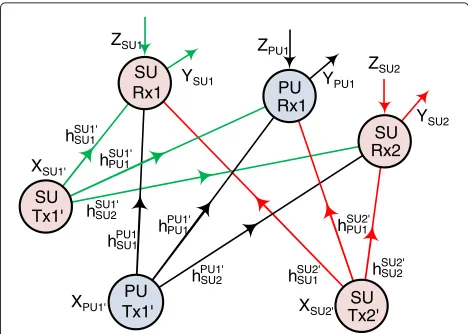
Fig. 3Channel model for scenario of co-existing PUs and SUs
receiver pair (PU Tx1’ - PU Rx1) and two SU transmitter-receiver pairs (SU Tx1’ - SU Rx1, SU Tx2’ - SU Rx2). The received signal at Rx is noted byY, transmitted signal from Tx is noted by X andZ is the noise. Lines between Tx and Rx represent TX-Rx channel paths, where each Tx is connected to all receivers with corresponding channel coefficients h. We assume that the quasi-static fading is present, and the channel coefficients between users are considered to be independent random variables. Channel coefficients take into consideration the total loss of the radio link between the transmitter and the receiver, as well as the antenna gain and the propagation effects (e.g., large scale fading due to the shadowing and small scale fading due to the multipath).
The signal received at the PU or at the SU can be represented with a sum of: the desired received signal, interfering received signal, and the noise. Signal received atith PU and signal received atlth SU is a superposition of various components and can be expressed as
YPUi = hPUi nel coefficient between PU transmitteriand PU receiver
i,hSUPUki is the channel coefficient between SU transmit-ter k and PU receiver i, hSUSUll is the channel coefficient between SU transmitter l and SU receiverl,hPUSUjl is the channel coefficient between PU transmitter j and SU receiver l, NPU is the number of PUs, and NSU is the number of SUs, as illustrated in the Fig. 3.ZPUiandZSUl represent additive white Gaussian noise at the PU receiver
iand SU receiverlwith the variancesσPU2 iandσSU2l. The desired received signal strength represents the power of the useful signal received at the SU receiver from the wanted SU transmitter contributing to the informa-tion data flow. The interfering received signal strength is the superposition of all received interfering signals at the input of the same SU receiver. Accordingly, we can express the desired received signal strengthPRx_SUl_D, and inter-fering received signal strength PRx_SUl_I at SU receiver las wanted and interfering channel gain coefficients. Received interfering powerPRx_SUl_Itakes into account the interfer-ence received from PUs, interferinterfer-ence from other SUs on co-channel, and adjacent channel operating in the inter-ference range of the corresponding SU and the noise. All those interferences add up to the cumulative interference, which reduces quality and reliability of the SU link. Sim-ilarly, we can calculate the desired received signal, and interfering received signal at the PU, which is omitted for brevity.
The SU throughput is proportional to the normalized ergodic channel capacity, which is defined as the maxi-mum achievable rate averaged over all fading blocks and it can be expressed as
C(SINR)=maxElog2
tary cumulative distribution function of SU channel gain
and receiver. In Eq. (5), the theoretical relation between SU throughput and an ergodic channel capacity for the fading channel is shown. In the numerical simulation in Section 8, we assume that SU system utilizes M-ary quadrature amplitude modulation (M-QAM) and we use the approximation (19) for SU throughput. Additionally, in the simulation, we have set up the upper limit of the achievable individual SU throughput in order to avoid unfair spectrum usage between the SUs.
4.2 Weighting coefficients characterization
Since all of the channel parameters and fading statis-tics between interfering nodes are generally unknown to the SUs, it would be demanding to implement full net-work interference model. On the other hand, reliable and precise interference estimation is important for construct-ing the CR conflict graph needed for the FA algorithm implementation. Therefore, to encompass the sensitivity to the potential levels of the interference in the process of assignment of the frequencies to the SUs, we propose the classification of the interference in four categories. This enables an efficient practical implementation of the FA protocol with control and quantification of the interfer-ence levels, while not adding too much of an additional burden to the network communication overhead. Con-sidering the spectrum sharing between the SUs, for each interfering path between SUs we designate co-channel and adjacent channel conflict edge and introduce associated interference weights determining the level of the potential interference between the corresponding SUs as follows:
wco=pco·wi , wadj=padj·wi, (6)
where wco andwadj are co- and adjacent channel inter-ference edge weights,pco and padj are co- and adjacent channel penalties, andwiis the nominal edge weight.
Co- and adjacent channel interference edge weights are the network penalties for violation of the soft FA con-straints in the neighboring vertex, resulting in the deterio-ration of the objective function used for the optimization of the FA process. The channel penaltiespcoandpadj rep-resent the portion of the CR transmitter power which is absorbed by the CR receiver on the same or adjacent channel. Generally, channel penalty is calculated as the reduction of the interference power caused by the filter shape of the transmitter spectrum density mask and the receiver selectivity mask or it can be measured. As we are analyzing network with a predefined set of frequencies and aligned channel bandwidths, in network simulation in Section 8, we assume that the channel penalties are pre-defined and have the constant values. The nominal edge weightwi corresponds to the channel coefficient includ-ing propagation loss, antenna gain, and discrimination between the SU Tx and SU Rx under the consideration.
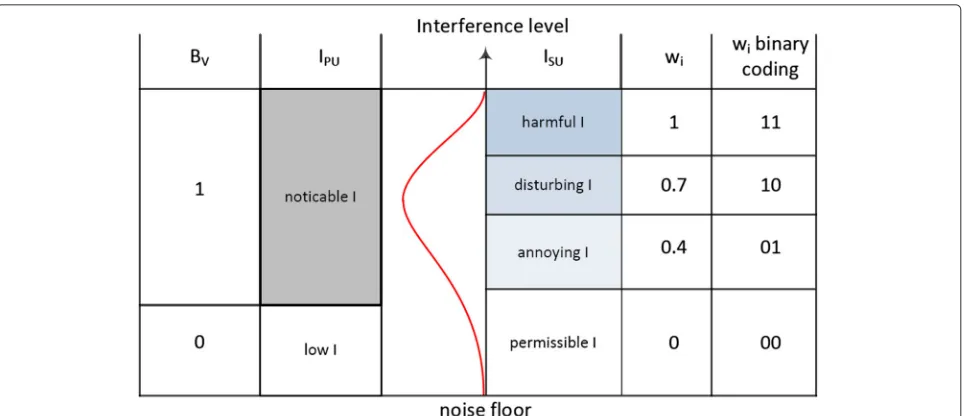
We propose to classify level of the potential interfer-ence in four main categories (harmful—high interfer-ence;disturbing—medium-high interference;annoying— medium-low interference;permissible—low interference) and assign the corresponding conflict edge weight coef-ficients wi ∈ {0; 0.4; 0.7; 1}. To classify the potential interference in the appropriate category, a value of the potential interference between the SU Tx and Rx is com-pared with the cumulative probability density function of the average received interference power between the SUs. The cumulative probability density function (cdf ) is empirically determined from the previous spectrum sensing measurements in the frequency band under con-sideration. On the basis of this comparison, it is identified to which category out of four this potential interference belongs and the characteristic value of the nominal edge weight factor is assigned for the identified interference category. Proposed values for the categorization of the nominal edge weights are calculated by evaluating the cdf of the average received interference power between the SUs. Interference cdf is divided into four non-overlapping areas and a median cumulative probability value for each area is calculated. Channel weights representing each cat-egory are calculated as the ceiling round up (rounded off to the higher value) for the edge weight coefficients
(0.4; 0.7; 1)and as floor round up for edge weight coeffi-cient (0). Specific weights for four different categories of the interference are chosen in such way that the possible harmful interference between SUs is emphasized. We have tested proposed algorithms with the variation of the val-ues of discrete interference weights, and the results show similar behavior as the algorithms with a small variation of the nominal network weight coefficients representing four categories.
This novel interference categorization allows the intro-duction of the susceptibility of the FA protocol to the level of the interference, taking into account the probabilistic nature of the received signal as described above, as well as possible interference estimation errors.
Fig. 4Categorization of interference for FA in CR networks. The criteria for forming list of blocked channels is shown on theleftside. Classification and quantification of SU interference is shown on therightside
Fig. 4. In the right side of Fig. 4, a proposed categorization of the SU interference corresponding to SU interference level, edge weights coefficients, and their binary coding is shown. ISU is the level of the measured interference from the SU transmissions, used for determining the SU adjacency and the conflict edge weights. The SUs edge weights are used for quantitative estimation of the inter-ference in the process of the assigning frequencies. In such a way, we can make more knowledgeable frequency deci-sions and control individual interference components as well as aggregate interference from multiple users during the FA process. In the proposed FA algorithms, we use the continuous edge weights in the interval [ 0, 1], or the discrete weight values as shown in Fig. 4. The protocol for determining the SUs adjacency and the conflict graph edge weights is elaborated in Section 6.
5 Interference sensitive FA algorithms
The proposed FA in the CR networks is based on the efficient heuristic based algorithms that can run reason-ably fast and provide a good quality solution. In this paper, non-uniform traffic on the different communica-tion links and frequencies, weighted interference model, and non-orthogonal channels are considered based on the CR networks specifics.
5.1 Algorithm description
In a proposed model, we have a predefined set of frequen-ciesF = {1, ..,M}and the task is to assign frequencies to all SUs requesting network access, taking into considera-tion the network interference. The SU is not allowed to use any of the frequencies which could cause noticeable
interference to the PU network, determined by the spec-trum awareness and expressed with a set of blocked chan-nelsBv. If there are no available channels in the spectrum pool, SU’s request is rejected or transferred to another spectrum band. In our approach, the SUs connected with the conflict graph edge (i.e., interfering each other) can share the same frequency or an adjacent frequency, but with a corresponding penalty, which is proportional to a level of the mutual interference calculated as a prod-uct of the nominal edge weights and co-/adjacent channel penalty. Having this quantitative metric, resource man-ager selects the frequencies with a minimal interference contribution towards the other users. Proposed FA algo-rithms consist of four main phases with specific tasks in each phase as follows:
• Phase 1. FA preparation:
– Establish the list of the blocked channels at all SUs.
– Determine the SU transmitting power for each available channel at all SUs.
– Calculate the SU throughput for each available channel at all SUs.
– Establish a conflict graph edges and determine the interference weights for co-channel and adjacent channel transmissions.
– Interference categorization.
• Phase 2. Selecting the next SU to assign frequency:
– Dynamically order the SUs with decreasing saturation score.
– Select the SU with the highest saturation metric to assign frequency as the next SU to process.
• Phase 3. Assigning frequency to the selected SU:
– Calculate objective function for each available frequency at the selected SU.
– Select and assign frequency maximizing objective function at the selected SU.
• Phase 4. CR FA performance evaluation and conflict graph update:
– Calculate interference, throughput, and throughput variance for all SUs.
– Determine the overall network performance and update conflict graph.
The initial SU transmitting power for each available channel at SUs is determined in a way that SU does not cause harmful interference to the closest PU using this channel and that the minimal required SINR at the SU user is achieved. In the following phases, the SU calculated transmitting power per channel is updated using power control ratio parameter. The details of the power control mechanism are described in Section 5.3, while establishing the list of blocked chan-nels, calculation of the conflict graph edge weights, and its categorization are performed as described in Section 4.2.
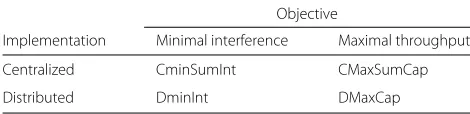
We propose the centralized and distributed algorithms with the objective of minimizing the cumulative CR network interference and with the objective of maximizing the network throughput, as shown in Table 3.
5.2 Saturation metric labeling and coloring
The proposed algorithms process and assign frequencies to the SUs requiring spectrum access in a sequence where in each iteration step the most difficult SU is selected. Most difficult SU is the vertex with the smallest choice of channels determined by the saturation metric. The saturation metrics labelSviis calculated as
Table 3Summary of proposed FA algorithms
Objective
Implementation Minimal interference Maximal throughput
Centralized CminSumInt CMaxSumCap
Distributed DminInt DMaxCap
Svi =
vi∈Vc Bvi+
f∈F, vj∈Vc
Eco vi vj·xvj·wcovi vj
+
f∈F, vk∈Vc
Eadj vi vk·xvk·wadjvi vk, (7)
whereBviare blocked frequencies, which cannot be used at the SU vi, Eco vi vj, and Eadj vi vk are co- and adjacent channel edges indicating the interference between the SUs,wcovi vj andwadjvi vkare the conflict edge weights deter-mining the interference potential of the adjacent SUs,xvj andxvkare variables indicating that the adjacent SUs have the frequency assigned. All the vertices are sorted in the decreasing order of the saturation label. The vertex with the largest label is selected for coloring. Saturation met-rics score is changing in each iteration step due to the continuous process of the assigning frequencies to the SUs, and therefore, the order of the SUs also dynamically changes. In the assignment phase, the selected SU is col-ored with a color which contributes the most to the system utility function. Here, we investigate the different algo-rithms with the objective of the minimal interference and maximal throughput.
5.2.1 Minimum cumulative network interference FA The proposed algorithm is minimizing the total network interference while taking into account co-channel and adjacent channel interference. Vertex coloring is per-formed according to
Colvi = argmin [α+β] , (8)
α = vj∈Eco vi vj
wcovi vj·xvj, (9)
β = vk∈Eadj vi vk
wadjvi vk·xvk, (10)
whereα andβ are co- and adjacent channel cumulative interference at the adjacent vertices. In coloring, the algo-rithm is selecting the frequency which contributes the least to the cumulative network interference. Having the interference represented by edge weights, the individual interference contributions can be quantified and the level of total network interference can be controlled.
5.2.2 Interference sensitive maximum throughput FA The FA is performed using a comprehensive coloring argument that integrates the interference and throughput. The proposed algorithm is maximizing the total network throughput while taking into account co-channel and adjacent channel interference. The coloring argument is calculated as
Colvi =argmax
Cfvi·xvi
vi∈VcBvi+α+β
whereCfviis the SU throughput at frequencyf. The SU throughput is calculated using Eq. (5), and its value can be between 0 and the maximum available throughput per SU. This value is set to 16 Mbit/s in the numerical simula-tion in Secsimula-tion 8. The coloring is done with the preference given to the frequencies having the highest throughput, while having the minimal influence to the rest of the SU network.
5.3 Transmit power control
The proposed transmit power control strategy is based on the balancing of the SU transmit power level between minimal required to satisfy QoS requirements and maxi-mal permissible level in order to avoid interference with the PUs. In order to minimize the interference to the other concurrent SUs, it is recommended to maintain the transmission power level at a minimum, while ensuring an adequate signal quality at the receiving end. Minimum required transmit power is determined by adjusting the power level until the targeted SINR at the SU receiver is satisfied. Maximum acceptable transmit power is estab-lished by considering the permissible interference at the PUs.
The initial SU power is calculated using the path loss estimation determined by spectrum sensing of the PUs as:
PTx_SU=PTx_C−PRx_C+SR−LA+PRx_SU_I, (12)
wherePTx_SUis the initial SU transmit power,PTx_Cis the predetermined transmitted power of the common pilot channel, PRx_C is the measured power of the common pilot channel at the SU receiver,LAis the additional gain, loss, and tolerances,SRis the required SINR, andPRx_SU_I is the interfering power. The initial power level is used for the initial communication between SU terminals and as a starting power level for the process of adaptive adjusting of the transmitter power. Instant transmit power of the secondary user is determined as
PTx_SU=
PTx_SU_R ifPTx_SU_M≥PTx_SU_R 0 ifPTx_SU_M<PTx_SU_R
, (13)
wherePTx_SU_Mis the maximal acceptable transmit power and PTx_SU_R is the required transmit power. The max-imal acceptable transmit power represents the maxmax-imal allowed power of the cognitive SU in order to satisfy the interference constraints, as illustrated in Fig. 4, and is determined by the spectrum sensing of the PU at the SU location. The required transmit power is the trans-mit power level just strong enough to satisfy SINR for obtainable throughput at the SU receiver. The compari-son of the measured SINR at the SU receiver with the required SINR determines the SU transmit power control ratio for the transmit power adjustment. The new mini-mum required transmit power is obtained by multiplying
present minimum required transmit power with the trans-mit power control ratioRTPCas follows:
PTx_SU_R(t+1)=PTx_SU_R(t)RTPC. (14) A possible implementation of the proposed adaptive transmit power control strategy using fuzzy logic power controller is described in [23].
6 Centralized and distributed algorithm 6.1 Centralized FA algorithm
The centralized network resource manager has the advan-tage of collecting all the relevant information and using more complex processing engines. It can, therefore, pro-vide an overall better solution. The centralized algorithm can keep track of the CR user mobility, achieving con-tinuous connectivity of the established CR session. Pseu-docode of the centralized FA algorithm is presented in Fig. 5.
In each iteration, the centralized algorithm calculates the saturation metrics of all unassigned vertices. In order to detect the most difficult vertex to process first, the vertices are sorted and vertex with the largest saturation metrics is selected. For the selected SU, coloring is per-formed with the frequency which maximizes the objec-tive function. In CminSumInt algorithm, the frequency is selected on the basis of the minimal interference caused
to the adjacent vertices. In CMaxSumCap algorithm, the selected frequency maximizes the comprehensive met-ric that integrates both interference and throughput. The centralized solution requires an additional commu-nication overhead to collect and distribute information between the vertices. In that respect, the common com-munication channel and protocol are necessary. Also, the centralized solution is sensitive to the potential failures of the central entity, which can result in the discontinuities of the FA in the CR networks. In the cluster topology, the CR network is subdivided in a number of geographically dis-tinguished clusters. Each cluster uses a different resource manager and an independent algorithm determining the next SU to assign frequency using the saturation metric label and frequency assignment maximizing the network objective.
In order to determine the complexity of the algorithm, it is essential to determine the number of iterations needed for the algorithm to terminate. The number of itera-tions in the centralized algorithm is bounded byO(NSU), whereNSUis the number of the secondary users request-ing access to the CR network. Since the srequest-ingle vertex coloring can be completed inO(M)whereMis the num-ber of available frequencies, the overall complexity of the proposed centralized algorithm isO(NSUM).
6.2 Distributed FA algorithm
The distributed algorithm finds a local objective, but it results in a more robust, flexible, faster and less communication demanding implementation. Proposed distributed algorithm works on a vertex level and each vertex only has the local information, which is communicated between the adjacent incident vertices. Pseudocode of the distributed FA algorithm is shown in Fig. 6.
The algorithm initializes and the SU requesting fre-quency access calculates its own saturation metrics label. Vertex saturation label and set of blocked frequencies are communicated to other adjacent non-assigned vertices requesting access to the same frequency band. In order to avoid transmission collision, contention window for the transmission backoff time is calculated as a random value in the interval [0, window], where the window is calcu-lated as 1/Svi. On the basis of the exchanged information on the local vertex saturation metric, ordering of the ver-tex coloring is determined. Verver-tex with a local maximum saturation score is selected first to color, and then it selects a frequency with the maximum contribution to the objec-tive function. Selected frequency is then communicated to the adjacent vertices and the list of assigned frequen-cies is updated. Subsequently, new saturation labeling is performed and the next vertex to color is determined.
Each iteration of the single vertex coloring can be com-pleted inO(M)where Mis the number of the available
Fig. 6Distributed FA algorithm. The figure shows pseudo code of proposed distributed algorithm
frequencies. The number of the iterations in the dis-tributed algorithm is bounded by O(), where is a maximum degree of a vertex in the conflict graph. The overall complexity of the proposed distributed algorithm isO(M). The complexity of the distributed algorithm is
NSU/times smaller compared to the centralized algo-rithm, indicating that the distributed algorithm is simpler and converges faster.
7 Generalizations and implementation
7.1 Central frequency and bandwidth CR spectrum
assignment
frequency separation, and CR devices by definition should be able to use these spectrum opportunities. The ques-tion of the assigning spectrum fragments of the different sizes is still an open area in research of the CR FA [10]. In this section, we present the generalization of the proposed model of the FA in order to relax input assumptions of the fixed channel division, to an implementation considering bandwidth and central frequency decision. This general-ization is quite useful in the practical deployments of the CR systems.
The proposed solution of the central frequency and bandwidth assignment for the CR consists of the following steps: the admission control, the bandwidth reservation, and the spectrum assignment. In the admission con-trol, the spectrum management system has to determine weather the new incoming CR communication request can be accepted or the request is queued. Fair spectrum bandwidth BSUi, which could be assigned to the SUi is calculated as
BSUi=
CSUr_iBfree
NSU
j=1CSUr_j
, (15)
whereCSUr_iandCSUr_jare the requested throughputs of SUiand SUjandBfree is the available idle spectrum in the frequency band considered and not currently used by PUs.
The SUirequest is accepted, if the achievable through-put in the bandwidth which can be assigned to the SU can support the minimal sustainable throughput needed for satisfying the service requirements for the SU as:
ackSUi=
1 if CSUa=BSUi·cSINR≥CSUs_i 0 if CSUa=BSUi·cSINR<CSUs_i
, (16)
where ackSUi is the binary acceptance variable, CSUa is the achievable SU throughput, cSINR is the normalized channel throughput of the SU with observed SINR and
CSUs_iis the minimal sustainable throughput. Achievable SU throughput of the SU is calculated using Eq. (5) or by approximation Eq. (19) in case of M-QAM.
For the bandwidth reservation, we propose to use MSA algorithm of the spectrum aggregation presented in [24]. The MSA algorithm is utilizing the worst spectrum band which can barely satisfy the bandwidth requirementsBSUi of the SU in consideration relating to all unassigned SUs. In MSA algorithm, the SUs are sorted by the bandwidth requirements and the idle spectrum is sorted by the avail-able bandwidth of the spectrum regions. For the band-width reservation, the MSA algorithm firstly chooses the SU with the highest bandwidth requirements and try to assign the spectrum region with the least available band-width. The reservation continues in the decreasing order of SU’s bandwidth requirements and ascending order of the available spectrum regions, until all users are assigned or there is no available spectrum.
The spectrum assignment phase can use proposed algo-rithms for the CR FA presented in this paper without the need for modification. In the preparatory phase, general-ization of the interference weighting to include interfer-ence potential between the spectrum fragments is pro-posed. As we assign discontinuous spectrum regions of the different bandwidths to SUs, we have to extend the definition of the spectrum weights to be able to accommo-date the evaluation of the level of the interference between the SUs. For each interfering path between the SUs, we designate the conflict edge and introduce the associated interference weightwE determining the level of potential interference between corresponding SUs as follows:
wE=pE·wN0, (17)
wherepEis the conflict edge channel penalty andwN0is the nominal edge weight. The nominal edge weightwN0 corresponds to the channel coefficient including propaga-tion loss, antenna gains, and discriminapropaga-tion between the SU Tx and SU Rx under the consideration. It is deter-mined as described in Section 4. The conflict edge channel penalty pE represents the portion of the SU transmitter power which is absorbed by the SU receiver. It is calcu-lated as the reduction of the interference power caused by the filter shape of the transmitter spectrum density mask and the receiver selectivity mask as follows:
pE =
fh
fl SSUTx
f·SSURx
f −f·df, (18)
where SSUTx is the Tx signal’s power distribution across the frequency spectrum,SSURxis the SU receiver filter fre-quency response, f is the frequency, fl andfh are lower and higher limits of the frequency band in consideration, andf = fTx0−fRx0is the spectrum gap between the SU Tx and Rx center frequency. Iff = 0, both Tx and Rx are operating at the same central frequency and we are coming to the special case of co-channel penalty.
7.2 Implementation considerations
algorithms with the objective of the maximal through-put with the interference susceptibility (CMaxSumCap, DMaxCap) are more appropriate for the capacity oriented applications encompassing different scenarios including internet connectivity, cellular networks, and TV white space applications. The real-world applications could be the cellular networks data offload, realizing femtocells in the cellular networks, the best effort wireless hotspots, the local internet connectivity, the internet of things applica-tions, the public protection and disaster relief networks realizing communication between the emergency respon-dents and the public safety agencies, and the wireless cameras video transfer.
The FA in the CR is an event-based functionality and continuously re-iterated process. In a given moment in time, frequencies for only part of the active SUs have to be assigned. When the PU appears, all active SUs in the inter-ference range have to move to the new spectrum bands [11]. This event triggers re-initiation of the FA process for multiple SUs. When new SU appears in the CR network, it needs to be assigned frequency for its transmissions. Similarly, when the quality of the SU transmissions dete-riorates due to dynamic channel conditions, the SU wants to switch to a better frequency. In those cases, the process of a single frequency selection is initiated.
The network protocol for determining the conflict graph edges and corresponding weights can be as follows. Each of the active SUs interchangeably transmits SU ID and test message on the common communication chan-nel, while all other SUs are temporarily monitoring the channel and receiving. The test message and default trans-mission parameters of the SU are known to all of the SUs in the same geographic area. By monitoring the received signal strength, each of the SUs can determine its adjacent SU transceivers and categorize the interference potential with the corresponding interference category (harmful, disturbing, annoying, permissible). Accordingly, each SU can construct a local conflict network graph with edges corresponding to all of the received SUs transmissions and associated weighting coefficient proportionate to the received signal strength. In the centralized implementa-tion, these network weights are then communicated to the central spectrum management entity, which constructs the network graph and assigns frequencies. The imple-mentation of the protocol determining network conflict graph and corresponding weights is easy to implement and it can be coded by only 2 bits. Since determining of the conflict graph edges and corresponding weights adds additional communication overhead to the CR communi-cation, it is rational to construct the conflict graph and perform weight determining protocol only when needed. In the case of the stationary SU, the weight determining protocol should be performed at the time of the estab-lishing the network or when some change in the network
configuration or propagation parameters occurs, while in the case of moving SUs, the weight determining pro-tocol should be performed more often. This could be determined by a network policy and triggered when the CR terminals determine the increased probability level of dropped or severely disturbed transmissions.
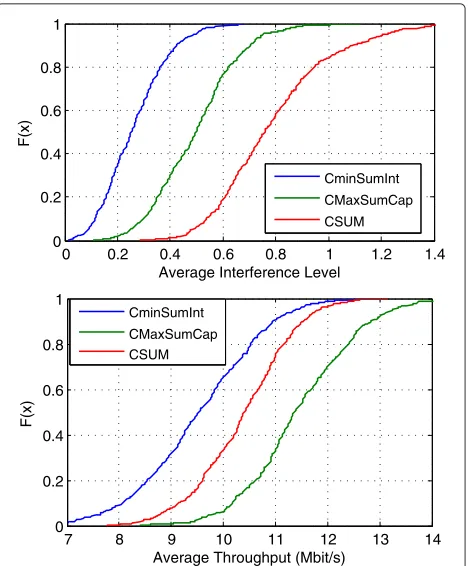
8 Numerical results and discussion
8.1 Simulation setup
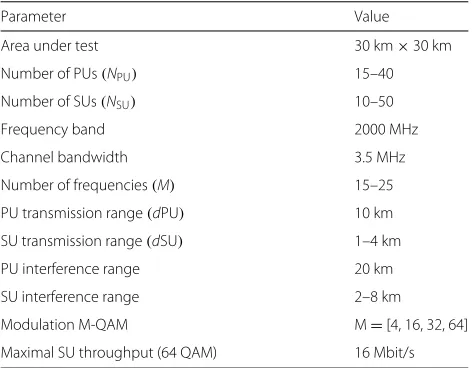
In order to evaluate the performance of the proposed FA algorithms, we have implemented the stochastic simula-tion of the primary and the CR network. In the setup of the stochastic simulation, we assumed that the area under test is a square with dimensions of 30 km×30 km. We consid-ered the SU Tx−Rx pairs that co-exist with a cellular PU network in a configuration similar to the one illustrated in Fig. 2. PU network consists of a number of base sta-tions covering a circular area around them. CR network consists ofNSUshort range secondary links which access radio spectrum opportunistically in the same area. The frequency band considered is 2000 MHz, and available frequencies are consisting of the group of 15 to 25 chan-nels with a channel bandwidth of 3.5 MHz. The number of the PUs active in the area under test is between 15 and 40; the number of the SU links requesting frequency access is between 10 and 50. The whole spectrum is considered to be open for an opportunistic spectrum access scenario, meaning the SUs can use any channel on the condition of not causing harmful interference to the PU network. We summarize the simulation parameters in Table 4.
PU network model.In the simulation, we considered the network of the PU base stations, each of them operating on one channel, which has to be protected by all SUs in the corresponding interference range. We have randomly placed a number of PUs in a given area. For simplicity, we assumed that the PUs have a constant Tx power of 43 dBm
Table 4Simulation parameters
Parameter Value
Area under test 30 km×30 km
Number of PUs(NPU) 15–40
Number of SUs(NSU) 10–50
Frequency band 2000 MHz
Channel bandwidth 3.5 MHz
Number of frequencies(M) 15–25
PU transmission range(dPU) 10 km
SU transmission range(dSU) 1–4 km
PU interference range 20 km
SU interference range 2–8 km
Modulation M-QAM M=[4, 16, 32, 64]