R E S E A R C H
Open Access
Uniformly asymptotic stability of almost
periodic solutions for a delay difference
system of plankton allelopathy
Qinglong Wang and Zhijun Liu
**Correspondence:
[email protected] Department of Mathematics, Hubei University for Nationalities, Enshi, Hubei 445000, P.R. China
Abstract
In this contribution, we investigate a delayed difference almost periodic system for the growth of two species of plankton with competition and allelopathic effects on each other. By using the methods of Lyapunov function and preliminary lemmas, sufficient conditions which guarantee the existence and uniformly asymptotic stability of a unique positive almost periodic solution of the system are established. An example together with its numerical simulations is presented to verify the validity of the proposed criteria.
Keywords: delay difference system; allelopathy; almost periodic solutions; uniformly asymptotic stability; Lyapunov function
1 Introduction
Allelopathy is a biological phenomenon by which individuals of a population release one or more biochemicals that have an effect on the growth, survival, and reproduction of the individuals of another population. As an important factor for ecosystem function-ing, allelopathic interactions have occurred in various aspects: between bacteria [], be-tween bacteria and phytoplankton [, ], bebe-tween phytoplankton and zooplankton [], and also between calanoid copepods []. Especially, allelopathic interactions are widespread in phytoplankton communities, which deeply attract the attention of researchers. Thus, in aquatic ecology, the study of tremendous fluctuations in abundance of many phytoplank-ton communities is a significant theme. Recently, many workers have been aware that the increased population of one species of phytoplankton might restrain the growth of one or several other species by the production of allelopathic toxins. For detailed literature studies, we can refer to [–] and the references cited therein.
In [], Qin and Liu discussed the permanence and global attractivity of the following delay difference system with plankton allelopathy:
⎧ ⎪ ⎪ ⎪ ⎪ ⎪ ⎪ ⎪ ⎪ ⎨ ⎪ ⎪ ⎪ ⎪ ⎪ ⎪ ⎪ ⎪ ⎩
x(n+ ) =x(n)exp{r(n) –a(n)x(n) –a(n)x(n)
–b(n)x(n) M
p=k(p)x(n–p)}, x(n+ ) =x(n)exp{r(n) –a(n)x(n) –a(n)x(n)
–b(n)x(n) M
p=k(p)x(n–p)}, xi()≥, ∈[–p, ]∩Z; xi() > , i= , ,
(.)
wherexi(n) are the population densities of speciesxiat thenth generation,ri(n) stand for the intrinsic growth rates of speciesxiat thenth generation,aii(n) are the intra-specific effects of thenth generation of speciesxion own population, andaij(n) measure the inter-specific effects of thenth generation of speciesxjon speciesxi,bi(n)xi(n)Mp=kj(p)xj(n–
p) denote the effect of toxic substances (i,j= , ;i=j),Mis a positive integer.
Notice that the environment varies due to the factors such as seasonal effects and vari-ations in weather conditions, food supplies, mating habits, harvestingetc.Thus it is rea-sonable to assume that the parameters in system (.) are periodic. However, if the various constituent components of the temporally nonuniform environment is with incommen-surable periods (non-integral multiples), then we have to consider the environment to be almost periodic, which leads to the almost periodicity of the parameters of system (.). The main purpose is to establish sufficient conditions for the existence and uniformly asymptotic stability of a unique positive almost periodic solution of system (.). To do so, we assume that{ri(n)},{aij(n)}and{bi(n)}fori,j= , are bounded nonnegative almost
periodic sequences,ki(p),i= , , is a bounded positive sequence.
Many recent works have been done on the existence and stability of almost periodic so-lutions for the discrete biological models without or with time delays (see [–]). How-ever, to the best of our knowledge, there are few published papers concerning the above almost periodic system (.). For the sake of simplicity and convenience, in the following discussion, the notations below will be used
hu=sup
n∈Z+
h(n), hl= inf
n∈Z+
h(n), (.)
where{h(n)}is a bounded sequence defined on the set of nonnegative integersZ+.
Mean-while, we make a convention thatbn=ah(n) = ifa>b.
The rest of this paper is organized as follows. In Section , we introduce some notations, definitions and lemmas which are useful for our main results. Sufficient conditions for the existence and uniformly asymptotic stability of a unique positive almost periodic solution of system (.) are established in Section . In Section , an example and its numerical simulations are presented to illustrate the feasibility of our main results. Finally, we give some proofs of theorems in the appendices for convenience in reading.
2 Preliminaries
In this section, we give some notations, definitions and lemmas which will be useful for the later sections.
Denote byR,R+,ZandZ+the sets of real numbers, nonnegative real numbers, integers
and nonnegative integers, respectively.RandRkdenote the cone of a two-dimensional
andk-dimensional real Euclidean space, respectively. We also set
[c,d]Z= [c,d]∩Z, c,d∈Z, K= [–M, +∞)Z, whereMis defined in (.).
Definition .(see []) A sequencey:Z→Rkis called an almost periodic sequence if theε-translation set ofy
is a relatively dense set inZfor allε> ; that is, for any givenε> , there exists an integer
l(ε) > such that each interval of lengthl(ε) contains an integerτ =τ(ε)∈E{ε,y}such that
y(n+τ) –y(n) <ε, ∀n∈Z.
τ is called theε-translation number ofy(n).
Definition . (see []) Let g :Z×D→Rk, where D is an open set in C:={φ :
[–τ, ]Z→Rk}.g(n,φ) is said to be almost periodic innuniformly forφ∈Dif for any
ε> and any compact setSinD, there exists a positive integerl(ε,S) such that any inter-val of lengthl(ε,S) contains an integerτfor which
g(n+τ,φ) –g(n,φ) <ε, ∀n∈Z,φ∈S.
τis called theε-translation number ofg(n,φ).
Lemma .(see []) {y(n)}is an almost periodic sequence if and only if for any sequence
{pk} ⊂Zthere exists a subsequence{pk} ⊂ {pk}such that y(n+pk)converges uniformly on n∈Zas k→ ∞.Furthermore,the limit sequence is also an almost periodic sequence.
Consider the following almost periodic delay difference system:
y(n+ ) =g(n,yn), n∈Z+, (.)
where
g:Z+×CB→R, CB=φ∈C:φ<B,C=φ: [–τ, ]Z→R,
withφ=sups∈[–τ,]Z|φ(s)|,g(n,φ) is almost periodic innuniformly forφ∈CB and is continuous inφ, whileyn∈CBis defined asyn(s) =y(n+s) for alls∈[–τ, ]Z.
The product system of (.) is in the form of
y(n+ ) =g(n,yn), z(n+ ) =g(n,zn). (.)
A discrete Lyapunov function of (.) is a functionV:Z+×CB×CB→R+which is
con-tinuous in its second and third variables. Define the difference ofValong the solution of system (.) by
V(.)(n,φ,ψ) =V
n+ ,yn+(n,φ),zn+(n,ψ)
–V(n,φ,ψ),
where (y(n,φ),z(n,ψ)) is a solution of system (.) through (n, (φ,ψ)),φ,ψ ∈CB. And Zhang and Zheng [] obtained the following lemma.
() a(|φ() –ψ()|)≤V(n,φ,ψ)≤b(φ–ψ),wherea,b∈Pwith
P={α: [,∞)→[,∞)|α() = andα(u)is continuous, increasing inu}. () |V(n,φ,ψ) –V(n,φ,ψ)| ≤L(φ–φ+ψ–ψ),whereL> is a constant.
() V(.)(n,φ,ψ)≤–γV(n,φ,ψ),where <γ< is a constant.
Moreover,if there exists a solution y(n)of system(.)such thatyn ≤B∗<B for all n∈Z+, then there exists a unique uniformly asymptotically stable almost periodic solution q(n)of system(.)which satisfies|q(n)| ≤B∗for all n∈K.In particular,if g(n,φ)is periodic with periodω,then system(.)has a unique uniformly asymptotically stable periodic solution with periodω.
Remark .(see []) From the proof of [, Theorem .], it is not difficult to prove that condition () of Lemma . can be replaced by the following condition:
() V(.)(n,φ,ψ)≤–c(|φ() –ψ()|), wherec∈ {β: [,∞)→[,∞)|βis continuous, β() = andβ(s) > fors> }.
Definition .(see []) System (.) is said to be permanent if there exist positive con-stantsMiandMisuch that
Mi≤lim inf
n→+∞xi(n)≤lim supn→+∞ xi(n)≤Mi, i= ,
for any positive solution (x(n),x(n)) of system (.).
Lemma .(see []) Assume that
minrl–auM,rl–auM
> ,
min{M,M}> .
(.)
Then system(.)is permanent.Here,i= au
ii+buiMj(M+)kju
rli–auijMj .
From the proof of [, Lemma .], we have
lim sup
n→+∞
xi(n)≤Midef= exp(r
u i – )
alii (.)
and
lim inf
n→+∞xi(n)≥mi def
= exp[(r
l
i–auijMj)( –iMi)] i
, (.)
wherei,j= , ,i=j. 3 Main result
According to (.) and (.), we denote bythe set of all solutions (x(n),x(n)) of system
(.) satisfyingmi≤xi(n)≤Mi,i= , , for alln∈K. From Lemma ., we first prove that
Theorem . If conditions(.)are satisfied,then=φ. The proof of Theorem . is given in Appendix .
Theorem . If conditions(.)and
–max –alm , –auM –
buku+buku(M+ )MM–auM> ,
–max –alm , –auM –
buku+buku(M+ )MM–auM>
(.)
are satisfied, then system(.)possesses a unique almost periodic solution(x∗(n),x∗(n)),
and it is uniformly asymptotically stable within.
The proof of Theorem . is given in Appendix .
4 Example and numerical simulations
In this section, to verify the validity of our main results, we give an example and its corre-sponding numerical simulations.
Example . Consider the following discrete system with a delay:
⎧ ⎪ ⎪ ⎪ ⎪ ⎪ ⎪ ⎪ ⎪ ⎪ ⎪ ⎪ ⎪ ⎪ ⎪ ⎨ ⎪ ⎪ ⎪ ⎪ ⎪ ⎪ ⎪ ⎪ ⎪ ⎪ ⎪ ⎪ ⎪ ⎪ ⎩
x(n+ ) =x(n)exp{. + .sin(
√
nπ) – (. – .sin(√nπ))x(n)
– (. + .sin(√nπ))x(n)
– (. – .cos(√nπ))x(n)[.x(n) + .x(n– )]}, x(n+ ) =x(n)exp{. + .cos(
√
nπ)
– (. + .cos(√nπ))x(n)
– (. + .sin(√nπ))x(n)
– (. + .sin(√nπ))x(n)[.x(n) + .x(n– )]},
(.)
with the following initial conditions:
x∗(–) = ., x∗() = ., x∗(–) = ., x∗() = .. (.)
By a computation, we get
M≈., M≈., m≈., m≈., ≈., ≈., rl–auM≈. > , rl–auM≈. > , M≈. > , M≈. >
(.)
and
minrl–auM,rl–auM
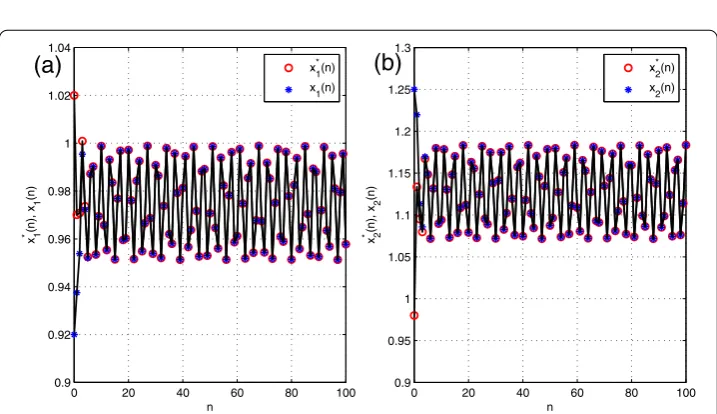
Figure 1 Positive almost periodic solution of system (4.1). (a)Time-seriesx∗1(n) with initial values x∗1(–1) = 1.06,x∗1(0) = 1.02 forn∈[0, 100].(b)Time-seriesx2∗(n) with initial valuesx∗2(–1) = 0.85,x2∗(0) = 0.98 for n∈[0, 100].
A further calculation shows that
–max –alm , –auM
–buku+buku(M+ )MM–auM≈. > ,
–max –alm , –auM
–buku+buku(M+ )MM–auM≈. > .
(.)
Clearly, the assumptions of Theorem . are satisfied, and hence system (.) has a unique uniformly asymptotically stable positive almost periodic solution. From Figure , we can see that there exists a positive almost periodic solution (x∗(t),x∗(t)), and the two-dimensional and three-two-dimensional phase portraits of almost periodic system (.) are revealed in Figure , respectively. Figure shows that any positive solution (x(n),x(n))
tends to the almost periodic solution (x∗(n),x∗(n)).
Appendix 1: Proof of Theorem 3.1
By the almost periodicity of{ri(n)},{aij(n)}and{bi(n)},i,j= , , any sequence{τk} ⊂Z+,
withτk→+∞ask→+∞, is such that
ri(n+τk)→ri(n), aij(n+τk)→aij(n), bi(n+τk)→bi(n), i,j= , , (A.)
ask→+∞forn∈Z+. Letεbe an arbitrary small positive number. It follows from (.)
and (.) that there exists a positive integerNsuch that
mi–ε≤xi(n)≤Mi+ε for alln>N. (A.)
Let xik(n) =xi(n+τk) forn≥N+M–τk, k= , , . . . . For any positive integerq, we
Figure 2 Phase portrait. (a)Two-dimensional phase portrait of almost periodic system (4.1). Time-series x∗1(n) andx2∗(n) with initial valuesx∗1(–1) = 1.06,x∗1(0) = 1.02,x∗2(–1) = 0.85,x2∗(0) = 0.98 forn∈[0, 100].
(b)Three-dimensional phase portrait of almost periodic system (4.1). Time-seriesx∗1(n) andx∗2(n) with the above initial values forn∈[0, 100].
Figure 3 Uniformly asymptotic stability. (a)Time-seriesx∗1(n) with initial valuesx∗1(–1) = 1.06,x∗1(0) = 1.02 andx1(n) with initial valuesx1(–1) = 0.87,x1(0) = 0.92 forn∈[0, 100], respectively.(b)Time-seriesx∗2(n) with
initial valuesx2∗(–1) = 0.85,x∗2(0) = 0.98 andx2(n) with initial valuesx2(–1) = 1.15,x2(0) = 1.25 forn∈[0, 100],
subsequence, denoted by{xik(n)}again, converging on any finite interval ofKask→+∞.
Appendix 2: Proof of Theorem 3.2 We first make the change of variables
p(n) =lnx(n), p(n) =lnx(n).
It follows from system (.) that
+
Using the mean-value theorem, we derive that
epi(n)–eqi(n)=ξ
In view of system (B.) together with (B.) and (B.), we have
+ep(n)
Based on (B.), we calculate the difference ofV along the solution of system (B.)
– p(n) –q(n) – p(n) –q(n) –
asymptotically stable positive almost periodic solution (x∗(n),x∗(n)) of system (.) which satisfiesmi≤x∗i(n)≤Mi,i= , , for alln∈K. The proof is complete.
Competing interests
The authors declare that they have no competing interests.
Authors’ contributions
Each of the authors, QW and ZL, contributed to each part of this work equally and read and approved the final version of the manuscript.
Acknowledgements
The work is supported by the National Natural Science Foundation of China (Nos. 11261017, 61261044), the Key Project of Chinese Ministry of Education (No. 212111), the Scientific Research Foundation of the Education Department of Hubei Province of China (No. B20111906) and the Key Subject of Hubei Province (Forestry).
Received: 5 July 2013 Accepted: 29 August 2013 Published:07 Nov 2013 References
1. Chao, L, Levin, BR: Structured habitats and the evolution of anticompetitor toxins in bacteria. Proc. Natl. Acad. Sci. USA78, 6324-6328 (1981)
2. Cole, JJ: Interactions between bacteria and algae in aquatic ecosystems. Ann. Rev. Ecolog. Syst.13, 291-314 (1982) 3. Kitaguchi, H, Hiragushi, N, Mitsutani, A, Yamaguchi, M, Ishida, Y: Isolation of an algicidal marine bacterium with activity
against the harmful dinoflagellate Heterocapsa circulatisquama (Dinophyceae). Phycologia40, 275-279 (2001) 4. Turner, JT, Tester, PA: Toxic marine phytoplankton, zooplankton grazers, and pelagic food webs. Limnol. Oceanogr.42,
1203-1214 (1997)
5. Folt, C, Goldman, CR: Allelopathy between zooplankton: a mechanism for interference competition. Science213, 1133-1135 (1981)
6. Rice, EL: Allelopathy, 2nd edn. Academic Press, New York (1984)
7. Liu, ZJ, Wu, JH, Chen, YP, Haque, M: Impulsive perturbations in a periodic delay differential equation model of plankton allelopathy. Nonlinear Anal., Real World Appl.11, 432-445 (2010)
8. Liu, ZJ, Hui, J, Wu, JH: Permanence and partial extinction in an impulsive delay competitive system with the effect of toxic substances. J. Math. Chem.46, 1213-1231 (2009)
9. Tian, CR, Lin, ZG: Asymptotic behavior of solutions of a periodic diffusion system of plankton allelopathy. Nonlinear Anal., Real World Appl.3, 1581-1588 (2010)
10. He, MX, Chen, FD, Li, Z: Almost periodic solution of an impulsive differential equation model of plankton allelopathy. Nonlinear Anal., Real World Appl.11, 2296-2301 (2010)
11. Chen, YP, Chen, FD, Li, Z: Dynamics behaviors of a general discrete nonautonomous system of plankton allelopathy with delays. Discrete Dyn. Nat. Soc.2008, Article ID 310425 (2008)
12. Li, Z, Chen, FD, He, MX: Global stability of a delay differential equations model of plankton allelopathy. Appl. Math. Comput.218, 7155-7163 (2012)
13. Liu, ZJ, Chen, LS: Positive periodic solution of a general discrete non-autonomous difference system of plankton allelopathy with delays. J. Comput. Appl. Math.197, 446-456 (2006)
14. Liu, ZJ, Chen, LS: Periodic solution of a two-species competitive system with toxicant and birth pulse. Chaos Solitons Fractals32, 1703-1712 (2007)
15. Qin, WJ, Liu, ZJ: Asymptotic behaviors of a delay difference system of plankton allelopathy. J. Math. Chem.48, 653-675 (2010)
16. Niu, CY, Chen, XX: Almost periodic sequence solutions of a discrete Lotka-Volterra competitive system with feedback control. Nonlinear Anal., Real World Appl.10, 3152-3161 (2009)
17. Zhang, TW, Li, YK, Ye, Y: Persistence and almost periodic solutions for a discrete fishing model with feedback control. Commun. Nonlinear Sci. Numer. Simul.16, 1564-1573 (2011)
18. Wang, Z, Li, YK: Almost periodic solutions of a discrete mutualism model with feedback controls. Discrete Dyn. Nat. Soc.2010, Article ID 286031 (2010)
19. Li, YK, Zhang, TW: Almost periodic solution for a discrete hematopoiesis model with time delay. Int. J. Biomath.5, Article ID 1250003 (2012)
20. Li, Z, Chen, FD, He, MX: Almost periodic solutions of a discrete Lotka-Volterra competition system with delays. Nonlinear Anal., Real World Appl.12, 2344-2355 (2011)
21. Muroya, Y: Persistence and global stability in discrete models of Lotka-Volterra type. J. Math. Anal. Appl.330, 24-33 (2007)
22. Zhang, SN, Zheng, G: Almost periodic solutions of delay difference systems. Appl. Math. Comput.131, 497-516 (2002) 23. Yuan, R, Hong, JL: The existence of almost periodic solutions for a class of differential equations with piecewise
constant argument. Nonlinear Anal., Theory Methods Appl.28, 1439-1450 (1997)
24. He, CY: Almost Periodic Differential Equations. Higher Education Press, Beijing (1992) (Chinese version)
10.1186/1687-1847-2013-283
![Figure 1 Positive almost periodic solution of system (4.1). (a) Time-seriesx x∗1(n) with initial values∗1(–1) = 1.06, x∗1(0) = 1.02 for n ∈ [0,100]](https://thumb-us.123doks.com/thumbv2/123dok_us/963661.1118197/6.595.118.478.81.274/figure-positive-periodic-solution-time-seriesx-initial-values.webp)