Earth’s climate is considered to be stable on the order of>106years, owing to a negative feedback mechanism
in a carbon cycle system. However, any decrease in net input flux of CO2to the atmosphere-ocean system (i.e.,
volcanic-metamorphic CO2 flux minus excess organic carbon burial flux) lowers the surface temperature and
would eventually initiate global glaciation. The FD–FBO diagram (FD: the total CO2 degassing flux, FBO: the
organic carbon burial flux) is proposed as a measure of the susceptibility of the Earth to global glaciations. By using this diagram with the carbon fluxes estimated from a carbon cycle model during the Phanerozoic, the net input flux of CO2 is found to have been very close to the critical condition for a global glaciation at the Late
Paleozoic. During the Proterozoic, a carbon isotope mass balance model with this diagram shows that global glaciations occurred probably due to a decrease in the CO2degassing in addition to an increase in the organic
carbon burial. Because the Sun becomes brighter as it evolves, the critical level of atmospheric CO2pressure to
cause global glaciation will be lower than the critical CO2 pressure for photosynthesis of C4 plants within 500
million years. At this point, the net input flux of CO2will be too large to cause global glaciations. Continuous
volcanic-metamorphic activities (i.e., plate tectonics) may be one of the necessary conditions for the Earth and Earth-like planets in extrasolar planetary systems to keep liquid water and life over the timescales of planetary evolution.
Key words:Carbon cycle, global glaciation, snowball Earth, astrobiology.
1.
Introduction
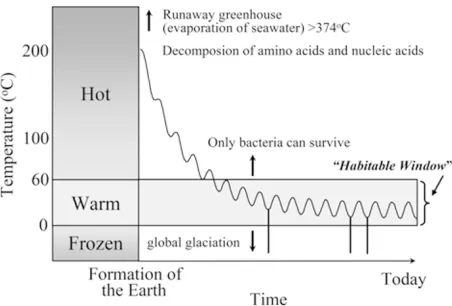
The climate of the Earth has been warm (>0◦C) during most of its geological history (Fig. 1), as suggested from evidence for the continued presence of liquid water and life (Walker, 1982; Kasting, 1989). Such a long-term stabil-ity of the Earth’s climate is explained by a negative feed-back mechanism within the carbon cycle system (Walkeret al., 1981; Kasting, 1989; Kasting and Toon, 1989; Tajika and Matsui, 1990, 1992, 1993; Broecker and Sanyal, 1998). Paleomagnetic studies, however, revealed the evidence of low-latitude ice sheets during the Proterozoic (Evanset al., 1997; Evans, 2000), which could be interpreted to be a re-sult of global glaciations (Kirschvink, 1992, 2002; Hoffman et al., 1998; Hoffman and Schrag, 2002).
Global glaciation may be caused by a decrease of the at-mospheric CO2partial pressure (pCO2) to a certain critical
level (e.g., Caldeira and Kasting, 1992; Ikeda and Tajika, 1999), because the greenhouse effect of CO2 plays a key
role in keeping the Earth’s climate warm (e.g., Walkeret al., 1981). The critical CO2level has been studied by using
gen-eral circulation models (GCMs) combined with ice sheet and/or sea ice models under the conditions of reduced solar flux and paleocontinental distribution during the Neopro-terozoic (e.g., Jenkins and Smith, 1999; Hydeet al., 2000; Donnadieuet al., 2004a).
Copyright cThe Society of Geomagnetism and Earth, Planetary and Space Sci-ences (SGEPSS); The Seismological Society of Japan; The Volcanological Society of Japan; The Geodetic Society of Japan; The Japanese Society for Planetary Sci-ences; TERRAPUB.
There are, however, several possibilities which would decrease pCO2 in the carbon cycle system. For
exam-ple, an increase in the organic carbon burial may have de-creased pCO2, causing the global glaciations during the
Neoproterozoic (Kaufman et al., 1997; Hoffman et al., 1998). Tajika (2004) showed that the reduction of volcanic-metamorphic activities would have been required to cause the global glaciations, in addition to the increased rate of organic carbon burial. In contrast, Donnadieuet al.(2004b) argued that the decrease of pCO2 could have been caused
by an increase in silicate weathering rate, owing to an in-crease in runoff and emplacement of flood basalt through the break-up of the supercontinent Rodinia.
It is, therefore, important to clarify the condition of the carbon cycle system to cause global glaciations. Because the susceptibility of the Earth to global glaciations may change with time, it is useful to estimate the generalized condition of the carbon cycle system to cause global glacia-tions over the Earth’s evolution (from the past to the future). Such an attempt has never been made to date, but will be im-portant for understanding the susceptibility of the Earth to global glaciations and also the evolution of Earth-like plan-ets which will be found in extrasolar planetary systems in the near future.
In this study, the general condition of the carbon flux re-quired for the initiation of global glaciation is estimated by analyzing a simple climate model with a carbon cycle system. We propose the FD–FBO diagram (FD: the total
CO2 degassing flux, FBO: the organic carbon burial flux)
Fig. 1. Climate evolution of the Earth. The climate of the Earth may have been warm (>0◦C) and suitable for life during the most of the geological history, although global glaciations have occurred at least three times during the Proterozoic (e.g., Kirschvink, 1992, 2002; Hoffmanet al., 1998; Hoffman and Schrag, 2002). The early Earth could have been “hot” (>60◦C) if the land masses were small (e.g., Tajika and Matsui, 1990, 1992, 1993) and there were no microbial activity on the land surface (e.g., Schwartzman and Volk, 1989).
as a measure of the susceptibility of the Earth to global glaciations. By using this diagram and carbon cycle models during the Phanerozoic and the Neoproterozoic, variations of carbon fluxes during these two geological ages are dis-cussed in the context of global glaciations. Finally, the sus-ceptibility of the Earth to global glaciations in its evolution is discussed.
2.
Long-term
Climate
Stability
and
Global
Glaciations
A mechanism to stabilize the Earth’s climate on geolog-ical time scales (more than 106years) resides in the carbon cycle system (Walkeret al., 1981; Berneret al., 1983). The dominant process for the atmospheric CO2 consumption is
the weathering of silicate minerals, followed by the precip-itation of carbonates in the ocean. Silicate weathering rate (FS
W) depends strongly on temperature (T) andpCO2(e.g.,
Walkeret al., 1981; Schwartzman and Volk, 1989), that is,
FWS ∝ fE · fB(T,pCO2) (1)
where fE and fBrepresent the soil biological activity (=1
at present) and the weathering feedback function, respec-tively. Mass balance of carbon in the atmosphere-ocean system is represented simply by
d MAO
dt =Fi n−F
S
W(T,pCO2) (2)
whereMAOis the amount of CO2in the atmosphere-ocean
system, and Fi n is the net CO2 input flux via
volcanism-metamorphism (e.g., Walkeret al., 1981).
Figure 2 shows the schematic behaviors of the solution of Eq. (2). We assume here that the average flux of CO2
degassing via volcanism-metamorphism does not change on the order of 106years. If the surface temperature increases
for any reason (a certain perturbation or a short-term event), then CO2 would be removed from the atmosphere-ocean
system by increased rate of silicate weathering, followed
Fig. 2. Concept of the negative feedback mechanism for surface tem-perature of the Earth due to carbon cycle (Walkeret al., 1981). (a) Amount of CO2in the atmosphere-ocean system. MAO(thus, pCO2 orT), changes so thatMAOmay be in a steady state. WhenMAOis
larger than the steady-state level, a warmer climate would remove extra amount of CO2owing to silicate weathering followed by carbonate pre-cipitation in the ocean. WhenMAOis smaller, CO2would accumulate in the atmosphere-ocean system owing to CO2degassing via volcan-ism-metamorphism. (b) The steady-state level ofMAOshould change
according to the net CO2input fluxFi ninto the atmosphere-ocean
sys-tem. WhenFi nis large, the steady-state level becomes large (climate
becomes warm). When Fi n is small, the steady-state level becomes
small (climate becomes cool).
by carbonate precipitation in the ocean. Similarly, if the surface temperature decreases, CO2 would accumulate in
the atmosphere-ocean system through the decreased rate of silicate weathering. In either case, deviation from the steady state would be damped, and the system tends to maintain a steady state (Fig. 2(a)). Because of this negative feedback mechanism, the Earth’s climate may have been suitable for life throughout the geological history despite variations of climate factors, such as solar luminosity (Walker et al., 1981; Kasting and Toon, 1989; Tajika and Matsui, 1990).
It is, however, noted that several boundary conditions to control Fi n and the efficiency of FWS should have changed
with time. Such factors include volcanic-metamorphic activities, organic carbon budget (imbalance of weather-ing and burial of organic carbon), soil biological activity (Walker et al., 1981; Berner et al., 1983; Lasaga et al., 1985; Schwartzman and Volk, 1989; Tajika and Matsui, 1992, 1993; Tajika, 1998, 1999; Berner, 1994).
The boundary conditions change the steady-state levels ofT and pCO2(Fig. 2(b)). WhenFi nis large, steady-state
levels become large (climate becomes warm), and climate becomes cool for smallFi n. IfFi nwere below a certain
crit-ical level, the Earth would be globally ice-covered. There-fore, global glaciations are caused even if the system has a mechanism to stabilize the climate.
cli-Fig. 3. The steady-state solutions of 1-D EBM for two cases of the nor-malized solar fluxSe f f (1 for today and 0.94 for Neoproterozoic). Solid
lines, dashed lines, and solid circles represent stable solutions, unstable solutions, and critical conditions (where stable solution disappears), re-spectively. Arrows represent climate jump due to climate instability for the case ofSe f f =1.
mate models (1-D EBMs). The 1-D EBM considers en-ergy balance among the solar incident flux, the latitudinal heat transport, and the outgoing infrared radiation at each latitude, and ice cap with high surface albedo is assumed to extend from poles to lower latitudes (e.g., Northet al., 1981). When we assume the outgoing radiation as func-tions of pCO2 and T (Caldeira and Kasting, 1992; Ikeda
and Tajika, 1999), the surface temperature at each latitude and the latitude of the ice line (ice cap edge) against pCO2
can be obtained (Figs. 3 and 4).
Figure 3 shows typical results for steady-state solutions of latitude of ice line against pCO2 for two cases of the
normalized solar flux (1.0 for today and 0.94 for the Neo-proterozoic). It is well known that there are three kinds of stable climate states: the free branch, the partially ice-covered branch, and the globally ice-ice-covered branch (North et al., 1981), as represented by solid curves in Fig. 3.
As pCO2 decreases from the partially ice-covered
branch, the ice cap extends to lower latitudes. When pCO2
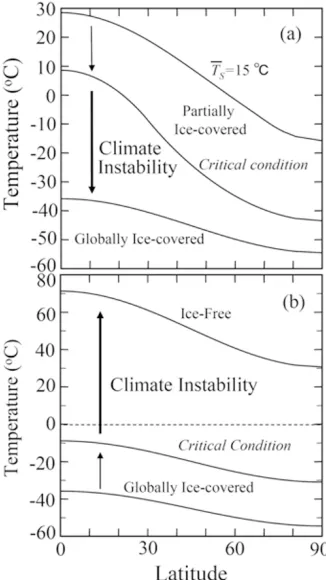
reaches a critical value and the ice line reaches ≈30◦, the Earth falls into the globally ice-covered branch, ow-ing to the climate instability (Northet al., 1981). Figure 4 shows changes in the surface temperature distribution (a) from the partially ice-covered to the globally ice-covered branch and (b) from the globally ice-covered to the ice-free branch, obtained from the same model. The surface tem-perature decreases drastically through the climate instabil-ity (Fig. 4(a)), because the planetary albedo becomes very high.
The global glaciation would not continue because CO2is
released via volcanism-metamorphism and accumulates on the order of 0.1 bar in the atmosphere in several million years on the globally glaciated Earth (Kirschvink, 1992; Hoffman et al., 1998). Then, the globally ice-covered branch disappears, and the climate shifts to the ice-free branch (Figs. 3 and 4(b)).
In these respects, we conclude that the concept of the long-term climate stability and the occurrence of global
Fig. 4. Changes in the latitudinal temperature distribution through the snowball Earth event. (a) Change in the temperature distribution from a warm climate (the globally-averaged surface temperature is 15◦C) to the critical condition, and to the globally ice-covered state. (b) Change in the temperature distribution from the globally ice-covered state to the critical condition, and to the ice-free state.
glaciations do not contradict with each other.
3.
Critical Condition of CO
2Flux
We now estimate the critical condition of the CO2 flux
in the carbon cycle system to cause the climate instability described in the previous chapter.
When we consider more detailed mass balance of carbon in the atmosphere-ocean system than Eq. (2), we should describe the net CO2 input flux to the atmosphere-ocean
system,Fi n, as follows (see Tajika (2003)):
Fi n=FD+FWO−F O
B (3)
whereFDis the total degassing rate of CO2via
volcanism-metamorphism, FWO is the weathering rate of organic
car-bon, andFO
B is the burial rate of organic carbon. Note that
we regarded Fi n ≈ FD (i.e., FWO ≈ F O
B) in the previous
chapter.
For the time scale of more than 105years, we can assume
that the atmosphere-ocean system is in a steady state. Then, Eq. (2) is rewritten by
Fi n =FWS(T,pCO2) (4)
The critical value of Fi n to cause the climate instability
may be estimated from Eq. (4) with the pCO2 level and
Fig. 5. The net CO2input flux (normalized to the present rate) and the atmospheric CO2 level (in PAL = present atmospheric level) for the normalized solar fluxSe f f = 1.0 (today) and 0.94 (Neoproterozoic).
The critical condition is represented by a solid circle for each case.
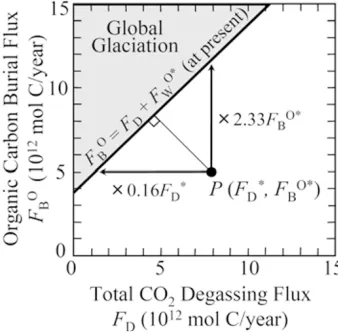
Fig. 6. TheFD–FBO diagram as a measure of the susceptibility of the
Earth to global glaciations. The thick solid line represents the critical condition for the carbon fluxes to cause a climate instability to the glob-ally ice-covered state. The solid circlePrepresents the flux condition today. Superscript∗represents the present-day value.
each latitude. Figure 5 shows the relation between Fi n
and the steady-state level of pCO2. The critical value of Fi n is estimated to be ≈ 5.0×10¹¹ mol/year at present
and≈1.5×10¹¹ mol/year at 750 million years ago (Ma),
which are less than 1/10 and 1/40 of the present-day flux (≈6.65×10¹² mol/year; Berner, 1994), respectively. The
criticalFi nshould be such low values becauseFWS becomes
very low under the climate at the critical condition. We therefore approximateFi n(=FWS)≈0 at the critical
condition. This approximation provides thelower limitof the critical condition regardless of the choice of models and model parameters, and does not depend on the precise value of the criticalpCO2because the approximationFWS ≈
0 corresponds to the assumption T < 0◦C even at the equator. As a result, from Eq. (3), the critical condition is represented by
FBO =FD+FWO. (5)
This relation can be expressed by a line in aFD–FBOspace,
as shown in Fig. 6 (hereafter we call this “the FD–FBO
diagram”).
Fig. 7. Trajectory of temporal variation of CO2fluxes during the Phanero-zoic estimated from a carbon cycle model (GEOCARB II: Berner, 1994). Hatched regionGrepresents the conditions for the Late Pale-ozoic glaciation at around 300 Ma. Lines, solid circle, and solid square represent the critical condition, the flux condition today, and the average flux condition obtained from averaging the calculated results throughout the Phanerozoic, respectively. Note that the average condition during the Phanerozoic is very close to the condition today.
The susceptibility of the Earth to global glaciations is measured by a distance between this line and the CO2 flux
condition. For example, the present CO2 flux condition
(FD∗ andFO∗
B where∗represents the present-day value) is
represented by the solid circle P in Fig. 6. Then, in order to cause global glaciation, FD should become <1.25×
1012mol/year (= F∗
D−Fi n∗, or<0.16-fold the present-day
value) when FO B and F
O
W remain constant. Similarly, F O B
should become>11.65×10¹²mol/year (=FO∗
B +Fi n∗, or
>2.33-fold the present-day value) whenFDandFWOremain
constant. Note that the minimum distance between the line and P does not correspond to Fi n∗, but to Fi n∗/
√
2 in this diagram. This means that simultaneous variations of FD
andFBOaffect the climate change effectively.
In the following, we evaluate the CO2 flux condition in
the Phanerozoic and the Neoproterozoic, respectively, and discuss the susceptibility of the Earth to global glaciations in these ages.
3.1 Phanerozoic
In order to evaluate the condition for CO2 fluxes
dur-ing the Phanerozoic, we adopt a carbon cycle model called GEOCARB (Berner, 1994). This model considers carbon mass balance and carbon isotope mass balance by param-eterizing each geochemical process as functions of various factors, such as the seafloor spreading rate. Carbon isotopic composition of marine carbonate is used as boundary condi-tions. We recalculate the carbon cycle during the Phanero-zoic with the GEOCARB model to evaluate the CO2 flux
condition during this time interval by plotting the results on theFD–FBOdiagram.
Figure 7 shows the resulting trajectory of carbon fluxes (FD and FBO) during the Phanerozoic. The weathering
rate of organic carbon (FO
W) also varies, but within a range
(Fig. 3), supporting the idea that the Late Paleozoic glacia-tion may have been close to the critical condiglacia-tion for a global glaciation.
The large-scale glaciation of this period is considered to have been caused by a large drop in pCO2 as a result of
the rise of vascular plants which accelerated the rate of CO2
uptake by weathering (Berner, 1993, 1997). These plants also provided a new source of bacterially resistant organic matter, such as lignin, removing CO2by the massive burial
of sedimentary organic carbon during this period (Berner, 1993, 1997). For some unknown reason, however, the crit-ical condition was not achieved at that time, and the Late Paleozoic glaciation did not develop into global glaciation.
3.2 Neoproterozoic
It has been argued that global glaciations occurred during the Proterozoic (Kirschvink, 1992; Hoffmanet al., 1998). If the Earth really experienced global glaciations during this period, how was the critical condition achieved?
One possible cause for global glaciations during the Pro-terozoic could be the significant reduction of the net CO2
input flux, owing to an increase in the organic carbon burial and/or a decrease in the CO2 degassing rate. According to
studies of carbon isotopic composition of seawater during the Neoproterozoic, the average value of δ13C was much
higher than that for the Phanerozoic, and theδ13C value
in-creased up to 1‰ before the glaciations (Kaufman et al., 1977; Hayeset al., 1999). This is interpreted as a result of the high rate of organic carbon burial, resulting in a large re-duction of the net input flux of CO2and causing the global
glaciations (Kaufmanet al., 1997; Hoffmanet al., 1998). The above possibility was evaluated by Tajika (2004), us-ing a carbon isotope mass balance model combined with the 1-D EBM and with the record of carbon isotopic com-position of marine carbonates during the Neoproterozoic. Tajika (2004) found that an increase in the organic carbon burial alone cannot cause global glaciations. Here we recal-culate the carbon cycle with the same model and evaluate the resulting carbon flux conditions in theFD–FBOdiagram
(Fig. 8). Because we do not know the temporal variations of FDandFWOduring the Neoproterozoic, these parameters
are assumed to be constant. We use several constant values for these parameters to evaluate the conditions for global glaciations.
The flux of the organic carbon burial increased at the tim-ing of positive excursions ofδ13C during the Neoprotero-zoic. The increase in the organic carbon burial alone cannot, however, cause global glaciations when the present values
Fig. 8. Temporal variations of the organic carbon burial flux,FO B, through
the Neoproterozoic estimated from a carbon isotope mass balance model with carbon isotope data (Hayes et al., 1999). Weathering rate of organic carbon, FWO, and the total CO2degassing flux,FD, are given
as constant values in the model.
of FDand FWO are assumed in the model (Fig. 8): the
av-erage surface temperature varies within the range of a very warm condition in this case (Fig. 9). This is because there were no vascular land plants before the Silurian—hence the soil biological activity, fE, was low (<1), and so the
cli-mate should have been warm in order to balance the silicate weathering rate with a large net CO2input rate (see Eqs. (1)
and (4)).
When the CO2 degassing rate is assumed to be low
(<1/4), however, the condition for global glaciation can be achieved at an extensive burial rate of organic carbon (Figs. 8 and 9). Such a decrease in the CO2 degassing
rate could have been resulted from a reduction of volcanic-metamorphic activities or a decrease in the average carbon-ate content in the subducting deep-sea sediments, owing to the changes in distribution (shallow/deep) of carbonate pre-cipitation in the ocean. Lower weathering rate of organic carbon due to a lower level of oxygen content in the atmo-sphere during the Neoproterozoic than those of today (e.g., Canfield, 2005) might have also provided a favorable con-dition for the initiation of global glaciations (Fig. 8).
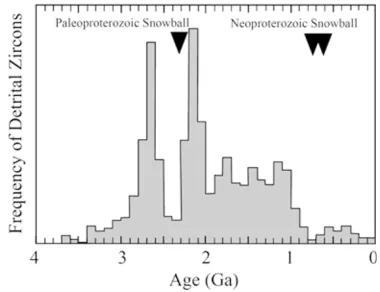
A recent study on the U-Pb age of detrital zircons from river sands in three major rivers in North and South Amer-ica reveals that a time interval between 800–600 Ma is char-acterized by one of the lowest levels of continental growth (that is, subduction volcanism) during the geological history (Fig. 10; Rinoet al., 2004). This suggests that the period of the Neoproterozoic global glaciations seems to coincide with the period of the lowest volcanic activity, at least, at subduction zones. Because a significant portion of CO2
de-gassing occurs via subduction volcanism today (Sano and Williams, 1996; Marty and Tolstikhn, 1998), the lowest ac-tivity of subduction volcanism might have resulted in the reduction of global CO2input.
Fig. 9. Temporal variations of globally-averaged surface temperature during the Neoproterozoic for the case of the present CO2degassing rate (dashed curve) and the case of the low CO2degassing rate (1/4 of the present rate; solid curve).
Fig. 10. Age population of zircons in river sands of the North and South American continents (modified from Rinoet al., 2004).
Supergroup on the Kaapvaal craton in South Africa (Evans et al., 1997; Kirschvinket al., 2000). Therefore, the Pa-leoproterozoic global glaciation could have been also ex-plained by a low CO2degassing rate due to a reduction of
volcanic-metamorphic activities.
4.
Susceptibility to Global Glaciations throughout
the Earth’s Evolution
According to studies of thermal evolution of the Earth, the potential temperature of the mantle has decreased through the Earth’s history (e.g., Christensen, 1985). Then, an efficiency of magma generation, volcanism, and activity of plate tectonics (hence the CO2degassing via
volcanism-metamorphism) may have decreased with time, suggesting that it might be more likely to cause global glaciations with time.
On the other hand, because the luminosity of the Sun increases as the Sun evolves (Gough, 1981), the critical level of CO2 for the climate instability also changes with
time (Fig. 5). Figure 11 shows temporal variations of the critical level of CO2and the atmospheric CO2level required
for maintaining the average surface temperature at 15◦C in the past and the future.
As the atmospheric CO2level decreases owing to the
in-Fig. 11. Temporal variations of the atmospheric CO2level for the critical condition and for a warm climate (globally-averaged surface tempera-ture=15◦C) from 2.6 billion years before to 2.4 billion years after the present. Solid triangles represent the global glaciations during the Pro-terozoic. The horizontal line represents the critical CO2level for pho-tosynthesis of C4 plants. Note that the climate model adopted here may not be accurate for lowpCO2 levels predicted for the future because radiative parameters were approximated with an error under 5 W/m2for 10−4bar<pCO2<2 bar (Caldeira and Kasting, 1992). Nevertheless, this result may represent a qualitative trend of the critical CO2 level variation with time.
crease in the solar flux (e.g., Walkeret al., 1981), it will be under the limit for photosynthesis of C3 plants, and finally fall under the limit for photosynthesis of C4 plants (<10 ppm). But before that, the critical CO2level (notthe
atmo-spheric CO2level) fall under the limit for photosynthesis of
C4 plants after 500 million years from now (Fig. 11). Then, if a reduction of volcanic-metamorphic activities occurs and the atmospheric CO2 level decreases to this limit, the net
CO2 input flux should become large because CO2 cannot
be fixed as organic carbon efficiently. In such a situation, even if CO2degassing rate becomes zero, global glaciation
does not occur any more.
Although the susceptibility of the Earth to global glacia-tions in the evolution should depend on the competition of mantle cooling and solar luminosity enhancement, it will take a much longer time for the mantle activity to decrease drastically (e.g., the average mantle temperature would have decreased 150–250◦for the last 3 billion years; Christensen, 1985). Therefore, before the mantle becomes cool enough to cause permanent global glaciation, the influence of the solar luminosity becomes important. As a consequence, the Earth will not be globally glaciated after 500 million years from now.
The Earth’s climate could have been suitable for life dur-ing the most of the geological history because a certain level of volcanic-metamorphic activities due to spreading and subduction of oceanic plates has maintained sufficient net CO2input flux. As described earlier, even if the Earth was
globally glaciated, the Earth could have escaped from such a regime, owing to an accumulation of CO2via
volcanism-metamorphism.
because the Sun becomes brighter as it evolves. Continuous volcanic-metamorphic activities (i.e., plate tectonics) may be one of the necessary conditions for Earth-like planets in extrasolar planetary systems to keep liquid water and life on their surface over the timescales of the planetary evolution.
Acknowledgments. I would like to thank N. Shikazono and an anonymous reviewer for their reviews and helpful comments. This research was partially supported by the grants-in-aid for Scientific Research (No. 14403004 and No. 18340128) of Japan Society for the Promotion of Science.
References
Berner, R. A., Paleozoic atmospheric CO2: importance of Solar Radiation and plant evolution,Science,261, 68–70, 1993.
Berner, R. A., GEOCARB II: A revised model of atmospheric CO2over Phanerozoic time,Am. J. Sci.,294, 56–91, 1994.
Berner, R. A., The rise of plants and their effect on weathering and atmo-spheric CO2,Science,276, 544–546, 1997.
Berner, R. A., A. C. Lasaga, and R. M. Garrels, The carbonate-silicate geochemical cycle and its effect on atmospheric carbon dioxide over the past 100 million years,Am. J. Sci.,283, 641–683, 1983.
Broecker, W. S. and A. Sanyal, Does atmospheric CO2police the rate of chemical weathering?,Global Biogeochem. Cycles,12, 403–408, 1998. Caldeira, K. and J. F. Kasting, Susceptibility of the early Earth to irre-versible glaciation caused by carbon dioxide clouds,Nature,359, 226– 228, 1992.
Canfield, D. E., The early history of atmospheric oxygen,Annu Rev. Earth Planet. Sci.,33, 1–36, 2005.
Christensen, U. R., Thermal evolution models for the Earth,J. Geophys. Res.,90, 2995–3007, 1985.
Donnadieu, Y., Y. Godderis, G. Ramstein, A. Nedelec, and J. Meert, A ‘snowball Earth’ climate triggered by continental break-up through changes in runoff,Nature,428, 303–306, 2004a.
Donnadieu, Y., G. Ramstein, F. Fluteau, D. Roche, and A. Ganopolski, The impact of atmospheric and oceanic heat transports on the sea-ice-albedo instability during the Neoproterozoic,Climate Dynamics,22, 293–306, 2004b.
Evans, D. A., Stratigraphic, geochronological, and paleomagnetic con-straints upon the Neoproterozoic climatic paradox,Am. J. Sci.,300, 374–433, 2000.
Evans, D. A., N. J. Beukes, and J. L. Kirschvink, Low-latitude glaciation in the Paleoproterozoic era,Nature,386, 262–266, 1997.
Frakes, L. A. and J. E. Francis, A guide to Phanerozoic cold polar climates from high-latitude ice-rafting in the Cretaceous,Nature,333, 547–549, 1988.
Frakes, L. A., J. E. Francis, and J. I. Syktus,Climate Modes of the Phanero-zoic, 274 pp., Cambridge Univ. Press, Cambridge, 1992.
Gough, D. O., Solar interior structure and luminosity variations,Sol. Phys., 74, 21–34, 1981.
Hayes, J. M., H. Strauss, and A. J. Kaufman, The abundance ofδ13C in marine organic matter and isotopic fractionation in the global biogeo-chemical cycle of carbon during the past 800 Ma,Chem. Geol.,161, 103–125, 1999.
Hoffman, P. F. and D. P. Schrag, The snowball Earth hypothesis: testing the limits of global change,Tera Nova,14, 129–155, 2002.
Hoffman, P. F., A. J. Kaufman, G. P. Halverson, and D. P. Schrag, A Neoproterozoic Snowball Earth,Science,281, 1342–1346, 1998. Hyde, W. T., T. J. Crowley, S. K. Baum, and W. R. Peltier, Neoproterozoic
terminal Proterozoic earth history,Nat. Acad. Sci. Proc.,94, 6600–6605, 1997.
Kirschvink, J. L., Late Proterozoic low-latitude global glaciation: the Snowball Earth, inThe Proterozoic Biosphere, edited by J. W. Schopf and C. Klein, 1348 pp., Cambridge Univ. Press, 51–52, 1992. Kirschvink, J. L., When all of the oceans were frozen,La Recherche,355,
26–30, 2002 (in French).
Kirschvink, J. L., E. J. Gaidos, L. E. Bertani, N. J. Beukes, J. Gutzmer, L. N. Maepa, and R. E. Steinberger, Paleoproterozoic snowball Earth: Extreme climatic and geochemical global change and its biological consequences,Proc. Natl. Sci. Acad.,97, 1400–1405, 2000.
Lasaga, A. C., R. A. Berner, and R. M. Garrels, An improved geochemical model of atmospheric CO2fluctuations over past 100 million years, in
The Carbon Cycle and Atmospheric CO2: Natural Variations Archean
to Present, edited by E. T. Sundquist and W. S. Broecker, 635 pp., American Geophysical Union, Washington, DC, 397–411, 1985. Marty, B. and I. N. Tolstikhn, CO2fluxes from mid-ocean ridges, arcs and
plumes,Chem. Geol.,145, 233–248, 1998.
Mora, C. I., S. G. Driese, and L. Colarusso, Middle to late Paleozoic atmospheric CO2levels from soil carbonate and organic matter,Science, 271, 1105–1107, 1996.
North, G. R., R. F. Cahalan, and J. A. Coakley, Energy balance climate models,Rev. Geophys. Space Phys.,19, 91–121, 1981.
Rino, S., T. Komiya, B. F. Windley, I. Katayama, A. Motoki, and T. Hirata, Major episodic increases of continental crustal growth determined from zircon ages of river sands; implications for mantle overturns in the Early Precambrian,Phys. Earth Planet. Int.,146, 369–394, 2004.
Sano, Y. and S. N. Williams, Fluxes of mantle and subducted carbon along convergent plate boundaries,Geophys. Res. Lett.,23, 2749–2752, 1996. Schwartzman, D. W. and T. Volk, Biotic enhancement of weathering and
the habitability of Earth,Nature,340, 457–460, 1989.
Tajika, E., Climate change during the last 150 million years: Reconstruc-tion from a carbon cycle model,Earth Planet. Sci. Lett.,160, 695–707, 1998.
Tajika, E., Carbon cycle and climate change during the Cretaceous inferred from a carbon biogeochemical cycle model,The Island Arc,8, 293–303, 1999.
Tajika, E., Faint young Sun and the carbon cycle: Implication for the Proterozoic global glaciations,Earth Planet. Sci. Lett.,214, 443–453, 2003.
Tajika, E., Analysis of carbon cycle system during the Neoproterozoic: Im-plication for snowball Earth events, inMultidisciplinary Studies Explor-ing Extreme Proterozoic Environment Conditions, edited by G. Jenkins, C. Mckay, and L. Sohl, 220 pp., AGU Geophysical Monograph, Amer-ican Geophysical Union, 146, 45–54, 2004.
Tajika, E. and T. Matsui, The evolution of the terrestrial environment, in
Origin of the Earth, edited by H. E. Newsom and J. H. Jones, 378 pp., Oxford Univ. Press, New York, N.Y., pp. 347–370, 1990.
Tajika, E. and T. Matsui, Evolution of terrestrial proto-CO2-atmosphere coupled with thermal history of the Earth,Earth Planet. Sci. Lett.,113, 251–266, 1992.
Tajika, E. and T. Matsui, Degassing history and carbon cycle: From an impact-induced steam atmosphere to the present atmosphere,Lithos,30, 267–280, 1993.
Walker, J. C. G., Climatic factors on the Archean Earth,Palaeogeogr. Palaeoclimat. Palaeoecol.,40, 1–11, 1982.
Walker, J. C. G., P. B. Hays, and J. F. Kasting, A negative feedback mech-anism for the long-term stabilization of Earth’s surface temperature,J. Geophys. Res.,86, 9776–9782, 1981.