R E S E A R C H
Open Access
A new scenario of triple-hop mixed
RF/FSO/RF relay network with generalized
order user scheduling and power allocation
Anas M. Salhab
Abstract
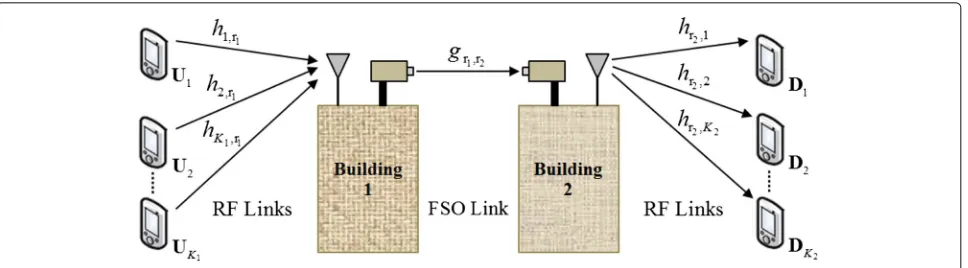
This paper proposes and evaluates the performance of multiuser (MU) triple-hop mixed radio frequency (RF)/free-space optical (FSO) relay network with generalized order user scheduling. An important example on the applicability of this scenario is in cellular networks where two sets of various users are communicating with their own base stations (BSs) over RF links and these BSs are connected together via an FSO link. The considered system includesK1sources or
users, two decode-and-forward (DF) relays, andK2destinations or users. The sources and destinations are connected
with their relay nodes through RF links, and the relays are connected with each other through an FSO link. To achieve MU diversity, the generalized order user scheduling is used on the RF hops to select among sources and
destinations. In the analysis, the RF channels are assumed to follow the Rayleigh fading model and the FSO channel is assumed to follow the Gamma-Gamma fading model including the effect of pointing errors. Closed-form expressions are derived for the outage probability, average symbol error probability (ASEP), and ergodic channel capacity. Moreover, in order to gain more insight onto the system behavior, the system is studied at the signal-to-noise ratio (SNR) regime whereby the diversity order and coding gain are provided and studied. The asymptotic results are used to obtain the optimum transmission power of the system. Monte Carlo simulations are given to validate the achieved exact and asymptotic results. The results show that the diversity order and coding of the proposed scenario are determined by the worst link among the three links. Also, results illustrate the effectiveness of the proposed power allocation algorithm in enhancing the system performance compared to the case with no power allocation.
Keywords: Mixed RF/FSO/RF relay network, Generalized order user scheduling, Multiuser diversity, Rayleigh fading, Gamma-Gamma fading, Power allocation
1 Introduction
The free-space optical (FSO) communication has been recently proposed as an efficient means to deal with the “last-mile” problem in wireless networks [1]. In such sys-tems, the data transmission takes place between an opti-cal transmitter and a receiver located, for example, on high buildings, separated by several hundred meters. Hav-ing the ability to operate on unlicensed optical beams and the potential for providing broadband communica-tion capacity, the FSO communicacommunica-tions represent a cost-effective alternative and/or a complement to radio fre-quency (RF) counterparts. In addition, features such as
Correspondence: [email protected]
1Electrical Engineering Department, King Fahd University of Petroleum and
Minerals, 31261 Dhahran, Saudi Arabia
high security, flexibility, rapid deployment time, and rigid-ity to RF interference have made FSO communications appealing for emergency situation recovery and military applications [2].
Cooperative relay networks have recently attracted the attention of many researchers as an efficient solution for the multipath fading problem in wireless communications [3]. Using relays in wireless networks aims to provide diversity, widen the coverage area, and reduce the need for high-power transmitters. In such networks, a relay node or a set of relays help a source node in sending its message to the destination via either an amplify-and-forward (AF) scheme or a decode-and-forward (DF) scheme. Despite its requirement for more signal processing, the DF relaying protocol gives better results compared to the AF proto-col, especially at low signal-to-noise ratio (SNR) values.
Recently, a mixture of relay and FSO networks has been introduced in the literature aiming to increase the cover-age distance of FSO networks which is usually limited to a few hundred meters in realistic conditions due to atmo-spheric turbulence condition effects [4]. In such networks, the source message is transmitted to a relay node over an RF link and then forwarded to the destination over an FSO link. Having relays in wireless networks helps in increas-ing the communication distance as well as in providincreas-ing diversity.
The new scenario of mixed RF/FSO relaying network can be also used for user multiplexing where multiple users with only RF capability can be multiplexed into a single FSO link [5]. The RF/FSO relay communication has the ability to fill the connectivity gap between the last-mile network and the backbone network as in developing countries where the last-mile connectivity can be deliv-ered via high-speed FSO links [6]. Such mixed relaying scheme conserves economic resources by avoiding unnec-essary modifications to the current mobile devices and, at the same time, saves bandwidth by utilizing FSO capa-bilities. These attractive features of mixed RF/FSO relay networks make them a strong candidate for current and soon-to-come wireless networks.
The FSO relaying networks with single relay have been studied in the literature under various conditions [7, 8]. The outage performance of AF and DF FSO relaying net-works over log-normal fading channels was studied in [7] assuming the presence of a direct link between the source and the destination. The log-normal fading model is usually used to model the FSO links assuming weak atmospheric turbulence conditions, whereas the Gamma-Gamma fading model is more accurate and can be used to model the FSO links under both weak and strong turbu-lence conditions. The performance of FSO relay networks over Gamma-Gamma fading channels was studied in [8]. The exact outage and error probabilities of two-way FSO relay networks were derived in addition to the derivation of an approximate expression for the symbol error prob-ability. The effect of pointing errors was combined with the turbulence-induced fading as one channel statistic in studying the performance of dual-hop mixed RF/FSO relay networks in [5].
In the area of parallel FSO relaying, the authors in [9, 10] studied the performance of dual-hop FSO net-works over log-normal channels for DF and AF schemes, respectively. The performance of dual-hop FSO selective relaying network where the source message is forwarded to the destination along the direct link or along the best relay was studied in [11]. Closed-form and asymptotic expressions were derived for the bit error probability assuming Rayleigh and log-normal fading channels. A key paper which provides some new exact and approx-imate statistics of the sum of Gamma-Gamma variates
and their application in RF and FSO DF relay networks was presented in [12]. The outage performance of chan-nel state information (CSI)-assisted and semi-blind AF opportunistic FSO relay networks was studied in [13] assuming composite channels.
Recently, the scenario of mixed RF/FSO relay networks with multiple users has induced several researchers to turn their attention to work on this hot topic. In [5, 14], the outage and error probabilities in addition to chan-nel capacity of dual-hop multiuser DF and fixed-gain AF mixed RF/FSO relay networks were derived and analyzed, respectively. Despite the presence of multiple users, only one user was assumed to communicate with a relay node through an RF link and the relay was assumed to be connected with a destination through a Gamma-Gamma-modeled FSO channel with pointing errors. No multiuser diversity was achieved in that study. In [15], Miridakis et al. studied the outage and error probability perfor-mance of multiuser dual-hop DF mixed RF/FSO relay network with the V-BLAST technique. A resource alloca-tion scheme for multiuser mixed RF/FSO relay network was proposed in [16], where the data of users on the RF hop are generated according to a zero-mean rotation-ally invariant complex Gaussian distribution. The authors claimed the effectiveness of the proposed link allocation protocol even in the conditions where the FSO link is affected by severe atmospheric conditions. The area of hybrid RF-FSO networks has been recently of interest for many researchers. In [17], considering the cases with and without hybrid automatic repeat request (HARQ) and joint transmission and reception of the RF and FSO mes-sages, the authors derived closed-form expressions for the message decoding probabilities, the throughput, and the outage probability of the RF-FSO setups. The same sce-nario was also studied by the same authors in [18] but with consideration to the effect of adaptive power allocation on the system throughput and outage probability.
and Gamma-Gamma fading models, respectively, with consideration to the effect of pointing errors on the FSO link. The authors derived closed-form expressions for the outage probability, average symbol error probability (ASEP), and channel capacity as reliability performance measures for the authorized mixed RF/FSO relay network and closed-from expression for the intercept probabil-ity as a securprobabil-ity measure. Asymptotic expressions were also derived for the outage probability at high SNR values and used for achieving the optimum transmission powers of the selected user and relay node, where opportunistic scheduling was used to select among the users of the first hop.
Most of the previous studies considered the scenario of the dual-hop mixed RF/FSO relay network. This sce-nario could be seen in applications where multiple users communicate with a relay node via RF links and the relay forwards their massages to a base station (BS) over an FSO link. Also, such a scenario can be seen in indoor applica-tions where multiple users communicate with an access point that is in turn connected to a macro BS via an FSO link [16]. Another important scenario which can be seen in practice is the triple-hop mixed RF/FSO/RF relay net-work. Example of such applications are as follows: (1) in cellular networks where two sets of various users com-municate with their own BSs over RF links and these BSs are connected together via an FSO link and (2) in indoor applications where two sets of users communicate with their access points inside two buildings and these access points are connected via an FSO link. The same setup of triple-hop relay network can be also used in other types of networks such as in mixed mmWave RF/FSO/mmWave RF relaying network, mixed RF/visible light communica-tion (VLC)/RF relaying network, and mixed VLC/RF/VLC relaying network. To exploit the presence of multiple users and achieve the multiuser diversity in such networks, a single user can be selected/scheduled among the avail-able users and allowed to conduct its transmission. The opportunistic scheduling is among the well-known and efficient user selection schemes that are usually used to select among the users. In this scheme, the user with the best channel is always allowed to conduct its transmission in a downlink or an uplink scenario. Also, this scheme is usually used to achieve the maximum sum-rate capacity in wireless networks. A generalization to the opportunistic user scheduling is the generalized order user scheduling, where the user of theNthbest channel is selected for con-ducting its communication. This scheme is applicable in situations where the scheduling unit fails in error in select-ing the best user among the available users due to error in estimating the users’ channels. More papers can be found in the literature on mixed or hybrid networks with and without relay nodes [22–24]. Also, it is worthwhile to mention here that the scenario of triple-hop relaying was
already considered in literature by many researchers but for one type of links [25, 26].
In this paper, we introduce the new scenario of triple-hop mixed RF/FSO/RF relay network with the generalized order user scheduling scheme to select among the users of the first and third RF links. The considered system includesK1sources or users, two DF relays, andK2 desti-nations. The sources and destinations are connected with their relay nodes through the RF links, and the relays are connected with each other through an FSO link. Using the generalized order user scheduler, the source with theN1th best SNR among the available sources is allowed to com-municate with the first relay node. Also, using the same scheduling criterion, the destination which has the N2th best SNR is selected to receive its message from the sec-ond relay. Furthermore, the RF links are assumed to follow the Rayleigh fading model and the FSO link is assumed to follow the Gamma-Gamma fading model with the effect of pointing errors. Closed-form expressions are derived for the outage probability, ASEP, and ergodic channel capac-ity. Moreover, the system performance is studied at the high SNR regime, where approximate expressions for the outage probability, the diversity order, and coding gain are derived and analyzed. Furthermore, the asymptotic results are used to obtain the optimum transmission powers of the selected user on the first hop, the first relay, and the second relay. Some simulation and numerical examples are provided to study the effect of the number of users and order of selected users on both the first and third hops, atmospheric turbulence parameters, pointing errors, and power allocation on the system performance.
The rest of this paper is organized as follows. Section 2 presents the system and channel models. The exact per-formance analysis is evaluated in Section 3. Section 4 provides the asymptotic outage performance analysis and power allocation. Some simulation and numerical results are presented and discussed in Section 5. Finally, conclu-sions are given in Section 6.
2 System and channel models
Fig. 1Multiuser triple-hop mixed RF/FSO/RF relay network with generalized order user scheduling
and destinations are assumed to be in deep fade, and hence, they are not considered in the analysis of this paper. Also, we assume block fading model where the channel coefficient stays constant over an entire block of commu-nication. The communication is assumed to operate in a half-duplex mode and to be conducted over three phases: selected userUSel→R1,R1 → R2, andR2 → DSel. The received signal atR1from thekth user can be expressed as
yk,r1 =
Pkhk,r1xk,r1+nr1, (1)
where Pk is the transmit power of the kth user, hk,r1 is the channel coefficient of the Uk → R1 link,xk,r1 is the transmitted symbol ofUk withE{|xk,r1|2} = 1, andnr1 ∼
N(0,N01) is an additive white Gaussian noise (AWGN) term, whereE{·}is the mathematical expectation.
Using (1), the SNR atR1due toUkcan be written as
γUk,R1 = Pk N01|hk,r1|
2. (2)
According to the generalized order user scheduling, the source with the N1th best γUk,R1 or equivalently, the N1th largest |hk,r1|2 among the other sources is selected to transmit its message to R1 in the first communica-tion phase. In other words, the source is selected such that γUSel,R1 = N1thmax
k
γUk,R1
. The subcarrier
inten-sity modulation (SIM) scheme is employed at the relay R1, where a standard RF coherent/noncoherent modulator and demodulator can be used for transmitting and recov-ering the source data [27–29]. At R1, after filtering by a bandpass filter (BPF), a direct current (DC) bias is added to the filtered RF signal to ensure that the optical signal is non-negative. Then, the biased signal is sent to a contin-uous wave laser driver. The retransmitted optical signal at R1is written as [4]
yOptr1 =
POpt(1+MySel,r1), (3)
wherePOptdenotes the average transmitted optical power and it is related to the relay electrical power Pr by the electrical-to-optical conversion efficiency η1 as POpt =
η1Pr1,Mdenotes the modulation index, andySel,r1 is the RF received signal at R1 from the selected source. The optical signal atR2received fromR1at the second phase of communication can be expressed as
yr1,r2=gr1,r2
POpt
1+MPSelhSel,r1xSel,r1+nr1 +nr2, (4)
where nr2 ∼ N(0,N02)is an AWGN term at R2. More-over, the channel coefficient of theR1 →R2link which is given bygr1,r2 is modeled asgr1,r2 =gagf, wheregaandgf are the average gain and the fading gain of the FSO link, respectively, and are given by [30]
ga=
erf √
πq √
2φdFSO 2
×10−κdFSO/10,
gf ∼GGamma(α,β), (5)
whereqis the aperture radius,φ is the divergence angle of the beam, dFSO is the distance between the FSO transmitter and the receiver,κ is the weather-dependent attenuation coefficient, and GGamma(α,β)represents a Gamma-Gamma random variable with parametersαand β. Assuming spherical wave propagation, the parameters α andβ in the Gamma-Gamma distribution which rep-resent the fading turbulence conditions are related to the physical parameters as follows [31]:
α=
exp
0.49ϑ2
1+0.18ξ2+0.56ϑ12/57/6
−1
−1 ,
(6)
β=
exp
0.51ϑ2[ 1+0.69ϑ12/5]−5/6
1+0.9ξ2+0.62ξ2ϑ12/55/6
−1
−1 ,
(7)
When the DC component is filtered out atR2 and an optical-to-electrical conversion is performed and assum-ing M = 1, the received signal can be expressed as follows:
yr1,r2 =gr1,r2
PEle
PSelhSel,r1xSel,r2+nr1
+nr2, (8)
wherePEle = η2POpt = η1η2Pr1 is the electrical power received atR2withη2is the optical-to-electrical conver-sion efficiency.
From (8), the SNR atR2can be written as
γR2 = γUSel,R1γR1,R2 γSel,R1+γR1,R2 +1
, (9)
whereγUSel,R1 = PSel N01|hSel,r1|
2andγ R1,R2 =
η1η2Pr1 N02 |gr1,r2|
2,
wherePr1is the transmit power atR1.
The SNR in (9) can be rewritten using the standard approximationγR2∼=min(γUSel,R1,γR1,R2)as [5, 14]
γR2 =
γUSel,R1γR1,R2 γUSel,R1+γR1,R2
. (10)
The signal received atDjfromR2in the third phase of communication can be written as
yr2,dj =
Pr2hr2,jxdj+ndj, (11)
wherePr2 is the transmit power atR2,hr2,jis the channel coefficient of theR2→Djlink,xdjis the transmitted
sym-bol ofdjwithE{|xdj|2} = 1, and ndj ∼ N(0,N03)is an
AWGN term.
Using (11), the SNR atDjcan be written as
γR2,Dj =
Pr2 N03|
hr2,j|2. (12)
According to the generalized order user scheduling, the destination with theN2thbestγR2,Djor equivalently, theN2th largest|hr2,j|2among the other destinations is selected to receive its message fromR2in the third communication phase. In other words, the destination is selected such that γR2,DSel =N2thmax
j
γR2,Dj
.
We assume that the channel coefficients of the RF links hk,r1 (k = 1 = · · · = K1) and hr2,j (j = 1 = · · · = K2) follow the Rayleigh fading model and hence, the channel gains|hk,r1|2and|hr2,j|2are exponential dis-tributed random variables with mean powers k,r1 and r2,j, respectively. Therefore, the probability density func-tions (PDFs) of γUk,R1 and γR2,Dj are, respectively, given
byfγUk,R1(γ ) = λk,r1exp
−λk,r1γ
, whereλk,r1 = 1/γk¯,r1 with γk¯,r1 =
Pk
N0E{|hk,r1|
2} = Pk
N01k,r1 andfγR2,Dj(γ ) =
λr2,jexp
−λr2,jγ
, where λr2,j = 1/γ¯r2,j with γ¯r2,j = Pk
N03E{|hr2,j| 2} = Pr2
N03r2,j. On the other hand, it is assumed that the FSO link experiences a unified Gamma-Gamma
fading model including the pointing errors effect whose SNR PDF is given by [5]
fγR1,R2(γ )=
ζ2 rγ (α)(β)G
3,0 1,3
ζ2+
1 αβλr1,r2γ
1
r
ζ2,α,β
,
(13)
whereζ is the ratio between the equivalent beam radius at the receiver and the pointing error displacement stan-dard deviation (jitter) at the receiver (i.e. whenζ → ∞, we get the non-pointing error case) [5],r is the param-eter defining the type of detection technique (i.e.r = 1 represents heterodyne detection and r = 2 represents intensity modulation (IM)/direct detection (DD)),α and β are the fading parameters related to the atmospheric turbulence conditions with lower values indicating severe atmospheric turbulence conditions, (.) is the Gamma function as defined in [32, Eq. (8.310)],λr1,r2 = 1/γ¯r1,r2 withγ¯r1,r2 =
η1η2Pr1
N02 E{|gr1,r2|
2} = η1η2Pr1
N02 μr1,r2, and G(.)is the Meijer G-function as defined in [32, Eq. (9.301)].
The end-to-end (e2e) SNR at the selected destination can be written using the standard approximationγD ∼= min(γR2,γR2,DSel)as [5, 14]
γD= γR2γR2,DSel γR2+γR2,DSel
. (14)
Achieving the system performance measures requires obtaining the statistics of the e2e SNR provided in (14).
3 Exact performance analysis
In this section, we derive the exact outage probability, ASEP, and channel capacity of the considered system.
3.1 Outage probability
Pout = FγD(γout). This CDF can be written in terms of CDFs of the three hops’ SNRs as [34]
FγD(γ )=1− of first hop, second hop, and third hop SNRs, respectively. It is clear from (15) that the system gets in outage once at least one of the three hops gets in outage or, equiva-lently, the SNR of that hop becomes less thanγout. With a direct expansion, the CDF in (15) can be rewritten in a more detailed form as follows:
FγD(γ )=FγUSel,R1(γ )+FγR1,R2(γ )+FγR2,DSel(γ )
−FγUSel,R1(γ )FγR1,R2(γ )−FγUSel,R1(γ )FγR2,DSel(γ ) −FγR1,R2(γ )FγR2,DSel(γ )+FγUSel,R1(γ )FγR1,R2(γ ) ×FγR2,DSel(γ ).
(16)
In order to calculate (16), the CDF of each hop of the three hops needs to be obtained first as follows.
1. First hop link
Using the generalized order user selection, the PDF fγUSel,R1(γ )can be written for independent identically a source channel’s SNR at the first hop, respectively, which are given for the Rayleigh fading channels by fγU,R1(γ )=λu,r1exp the selected source. In other words, the PDF in (17) represents the PDF of theN1thbest SNR or,
equivalently, the source of the bestN1thSNR is selected by the first relay.
Upon substituting these statistics in (17) and using the binomial rule, the PDF in (17) can be rewritten as
fγUSel,R1(γ )=K1λu,r1
2. Second hop link The CDFFγR
1,R2(γ )can be obtained by integrating the PDF in (13) using0γfγR1,R2(t)dtand with the help of Eq. 07.34.21.0003.01 in [36] to get
FγR1,R2(γ )=AG
r comprises of3rterms. Note that introducing these parameters primarily aims to simplify the calculations and expressions of the paper.
3. Third hop link
Similar to the first hop link, the PDF and CDF of the SNR of the selected destination can be, respectively, written as
where the users on the third hop have been assumed to have independent identical distributed channels in (21) and (22), that is, (λr2,1=λr2,2=. . .=λr2,K2 = λr2,u). Again, the PDF in (21) represents the PDF of theN2thbest SNR or, equivalently, that the
Upon substituting (19), (20), and (22) in (15) and after some simplifications, we get
FγD(γ )=
The CDF in (23) represents an important statistic to the e2e SNRγDand allows to derive several
performance measures in closed-form expressions as will be seen in the next sections of the paper. Up to now, the outage probability can be obtained by replacingγ byγoutin (23).
3.2 Average symbol error probability
For evaluating the ASEP, we use the CDF-based method where the ASEP can be expressed in terms of the CDF of γDas [37]
whereaandbare modulation-specific parameters. Note that we adopt the SIM scheme and hence the known dig-ital modulation techniques can be used, such as phase shift keying (PSK) [38]. Therefore, the error probability computing method (24) used in RF wireless communica-tion systems can be used to evaluate the error probability performance in FSO systems.
Upon substituting (23) in (24) and using Eq. 7.813.1 in [32] and Eq. 3.381.4 in [32], we get
3.3 Ergodic channel capacity
method, the ergodic capacity can be expressed in terms of
It is clear that evaluating (26) requires the evaluation of fγD(γ )first. Upon differentiating (23) with respect to γ and using Eq. 07.34.20.0001.01 in [36], we get the follow-ing:
in integrals which include Meijer
The integrals I1 and I
1 can be obtained using Eq. 4.337.2 in [32], and the other integrals can be obtained with the help of the integral properties of Mei-jer G-function ([36, Eq. 07.34.21.0011.01] and [36, Eq. 07.34.21.0081.01]). Upon doing these integrations, we get the following:
where Ei(.)is the exponential integral function defined by Eq. 8.211.1 in [32], and G [Z1,Z2|.|.|.] is the extended gen-eralized bivariate Meijer G-function. Note that in order to evaluate the expression in (36), a Mathematica code sim-ilar to the one provided in Table 2 in [41] has been used here.
4 Asymptotic outage performance and power
allocation
Due to complexity of the achieved expressions in the pre-vious section, it is hard to easily study the effect of various system parameters and get more insights about the sys-tem performance. Therefore, we see that it is important to derive simple expressions for the outage probability which will be helpful in achieving more insights about the system behavior. These expressions will be used also in allocating the transmission power for the transmitting nodes of the system (first hop source’s power, second hop relay’s power, and third hop relay’s power).
4.1 Asymptotic outage probability
The outage probability can be written at the high SNR regime as Pout (GcSNR)−Gd, where Gc and Gd are the coding gain and diversity order of the system, respec-tively [42]. Obviously,Gcrepresents the horizontal shift in the outage probability performance relative to the bench-mark curve(SNR)−GdandGdrefers to the increase in the slope of the outage probability vs SNR curve. Therefore, the parameters on which the diversity order depends will affect the slope of the outage probability curves and the parameters on which the coding gain depends will affect the position of the curves. Obtaining the outage probabil-ity in this simple form allows us to easily study and know the effect of each system parameter on the system perfor-mance instead of dealing with the long/complex expres-sions derived in Section 3. Notice that such an accurate approximation has been widely used in the conventional cooperative diversity systems.
Here, we consider the case of identical sources’ channels (λ1,r1 = λ2,r1 = · · · = λK1,r1 = λu,r1)and identical des-tinations’ channels(λr2,1 = λr2,2 = · · · =λr2,K2 = λr2,u). Again, we follow the same procedure that we followed before in Section 3 in obtaining the outage probability of the proposed scenario by dealing with the approxi-mate CDF of each hop separately and then calculating the approximate CDF of the e2e SNR.
4.1.1 First hop link
(λu,r1γ )3
The CDF in (37) is still dominant for the first term of the summation and hence, it can be further simplified to
FγUSel,R1(γ )
4.1.2 Second hop link
From Eq. 07.34.06.006.01 in [36], as γ¯r1,r2 → ∞ or, equivalently, as z → 0, the Meijer G-function can be approximated using the following series representation:
where p ≤ q is required. Here, we use the same approach that was used in [43] in writing the outage prob-ability for this case. Defining ν = min{ζ2,α,β}, then
whereϒ is constant. In order to find the value ofϒ, we first rewrite the CDFFγR1,R2(γ )provided in (20) using the asymptotic expression of the Meijer provided in (39). By matching the Meijer function with its asymptotic repre-sentation, we find thatm=3r,n=1,p=r+1,q=3r+1. Now, the asymptotic CDFFγR1,R2(γ )can be written with ignoring the high order terms as
FγR1,R2(γ )=A second term of (40) shows that the constantϒequals
ϒ=A
4.1.3 Third hop link
Similar to first hop link analysis, asγ¯r2,u→ ∞, the CDF and PDF of the third hop SNRFγR2,D(γ )andfγR2,D(γ ) sim-plify to λr2,uγ and λr2,u, respectively. Upon substituting these statistics in (18) and integrating the result using
γ
The CDF in (44) is still dominant for the first term of the summation and hence, it can be further simplified to
FγR2,DSel(γ )
With the aim of obtaining the diversity order and coding gain of the system, the CDF in (16) can be simplified at high SNR values to be
FγD(γ )FγUSel,R1(γ )+FγR1,R2(γ )+FγR2,DSel(γ ), (46)
Substituting (38), (39), and (45) in (46), the outage prob-ability can be written at high SNR values as
P∞out=
It is clear from (47) that the performance of the con-sidered relay network will be dominated by the worst link among the available three links, the first RF link, the FSO link, and the third RF link. This domination depends on the parameters of these links. Therefore, the diversity order (Gd) of the triple-hop mixed RF/FSO/RF relay net-work with generalized order user scheduling is equal to min(K1−N1+1,ν/r,K2−N2+1)and based on the value of the diversity order, one of the following three cases could represent the overall system performance:
Case 1(One hop is dominant).In this case, the coding gain (Gc) can be written as
Case 2(Two hops are dominant).In this case, the cod-ing gain can be written as
In summary, the system performance could be domi-nated by the following: (1) the first hop link (i.e.,K1and N1) when it is the worst link among the three links; (2) the second hop link (i.e.,ζ2,α, andβ) when it is the worst link among the three links; and (3) the third hop link (i.e.,K2 andN2) when it is the worst link among the three links. It is very important to mention here that if the diversity orders of two hops are equal and they are the minimum compared to that of the third hop, the coding gain of the system in this case equals the summation of the coding gains of the two hops which dominate the system perfor-mance divided by 2. Similarly, if the diversity orders of the three hops are equal, the coding gain of the system in this case equals the summation of the coding gains of the three hops divided by 3.
4.2 Power allocation
In this section, we aim to derive the optimum adaptive power allocation for the transmitting nodes in the system. In the proposed power allocation protocol, the powers of all transmitting nodes (selected source, first relay, and sec-ond relay) in the system are considered to be variables. Assuming that we may have two different cases in regard to the transmission power of the first relay: the allocated power for the first relay is less than the peak/maximum allowed power and in this case, the power allocation pro-tocol is optimum and the second case where the allocated power for the first relay is larger than the peak power and here the extra allocated power will be saved.
We denote the distance between the first hopK1sources and relayR1 byds,r1, the distance between the relays R1 andR2bydr1,r2, while the distance between the relay R2 and third hop K2 destinations by dr2,d. We consider a total distance ofDtot between the first hop sources and third hop destinations. The total distanceDtotcan be writ-ten as Dtot = ds,r1 +dr1,r2 + dr2,d. Under the scenario where the received power decays with the distance, we
Gc=
Case 3(Three hops have the same diversity order).In this case, the coding gain can be written as
can express the average value of SNR in the hop between AWGN power which is assumed equal for the three hops. Similarly, we can express the average value of SNR in the second hop as γ¯r1,r2 = Pr1,r2d
−μ
r1,r2, where Pr1,r2 = Er1,r2
N0 . The average value of SNR in the hop between the relayR2 andK2destinations can be expressed asγ¯r2,d =Pr2,dd
N0 . Finally, the power constraint can be written asPtot=Ps,r1+Pr1,r2+Pr2,d.
We derive the optimal power allocation that minimizes the outage probability subject to sum power constraint as below
The asymptotic expression forFγD(γout)can be rewrit-ten as follows
To simplify the understanding of the next steps of opti-mization, we introduce here the Lagrangian multipliers method which is used in deriving of the optimal trans-mission powers of the transmitting nodes of the system. This method is a very common strategy used for find-ing the local maxima and minima of a function subject to equality constraints. The method depends on defining a Lagrange multiplier, Lagrange function, and a constraint. The Lagrange function is then defined as a summation of the constraint multiplied by the Lagrange multiplier and the original constrained problem or function. Note that the original constrained function and constraint are functions of the unknowns which we need to find their optimum values. Then, the Lagrange function is differ-entiated with respect to each unknown and equated by zero trying to find a solution to that unknown in terms of the Lagrange multiplier. Then, the unknowns are written again (in terms of the Lagrange multiplier) to formulate the constraint. After that, the constraint is solved in order to obtain the Lagrange multiplier. Finally, the obtained Lagrange multiplier is used in finding the optimal values of the unknowns.
Now, using the Lagrangian multipliers method for our problem, we define the Lagrange function as
F(Ps,r1,Pr1,r2,Pr2,d,λ)=FγD(Ps,r1,Pr1,r2,Pr2,d)
+λg(Ps,r1,Pr1,r2,Pr2,d), (53) whereλis the Lagrange multiplier andg(.)is the power constraint. The function in (53) can be rewritten as
F(Ps,r1,Pr1,r2,Pr2,d,λ)=
Taking the first derivative with respect to Ps,r1 and equate it by zero, we get
∂F
Similarly, differentiating F with respect to Pr1,r2 and equating the result by zero and solving forPr1,r2, we get
P∗r1,r2 =ABdμr1,r2γout
1
2λ−21. (57)
Following the same method of the first hop with the third hop, we get
P∗r
Now, summing the three individual powers’ results in the total power as
/
solution can be found by standard iterative root-finding algorithms, such as the Bisection’s method and Newton’s method. It is worthwhile to mention that the closed-form expressions for some special cases can be found such as the case whereK1 =K2 = 1 andN1= N2 = 1. For this case, (59) reduces to
dsμ,r1γoutλ −1
2 +ABdμr 1,r2γout
1
2 λ−21 +dμ r2,dλ
−1 2 =Ptot.
(60)
Solving forλgives
λ=
⎧ ⎨ ⎩
Ptot
γout(dμs,r1+dμr2,d)+
ABdμr1,r2γout
1 2
⎫ ⎬ ⎭
−2
. (61)
Upon substituting (61) in (56), (57), and (58), we get the optimum transmission powers as
P∗s,r1 = d
μ
s,r1γoutPtot
γout(dμs,r1 +drμ2,d)+
ABdμr1,r2γout
1 2
, (62)
P∗r1,r2 =
ABdμr1,r2γout
1 2 P
tot
γout(dsμ,r1+d
μ
r2,d)+
ABdμr1,r2γout
1 2
, (63)
P∗r2,d=
dμr
2,dγoutPtot
γout(dμs,r1 +dμr2,d)+
ABdμr 2,dγout
1 2
. (64)
The effectiveness of the derived optimal power allo-cation solutions will be verified in the following section
where a numerical example which compares the system performance with and without power allocation is pro-vided and discussed.
5 Simulation and numerical results
In this section, we validate the accuracy of the achieved analytical and asymptotic expressions via comparison with Monte Carlo simulations. Additionally, some numer-ical examples are provided and discussed to illustrate the impact of the number of available sources and order of selected source at the first hop, number of available desti-nations and order of selected destination at the third hop, and turbulence fading parameters and pointing errors on the system performance. The effectiveness of the pro-posed power allocation algorithm is also shown in this section. A total number of 2×10⁵samples/SNR value have been used in generating the simulation results. Also, the BPSK modulation scheme has been used in the results of ASEP.
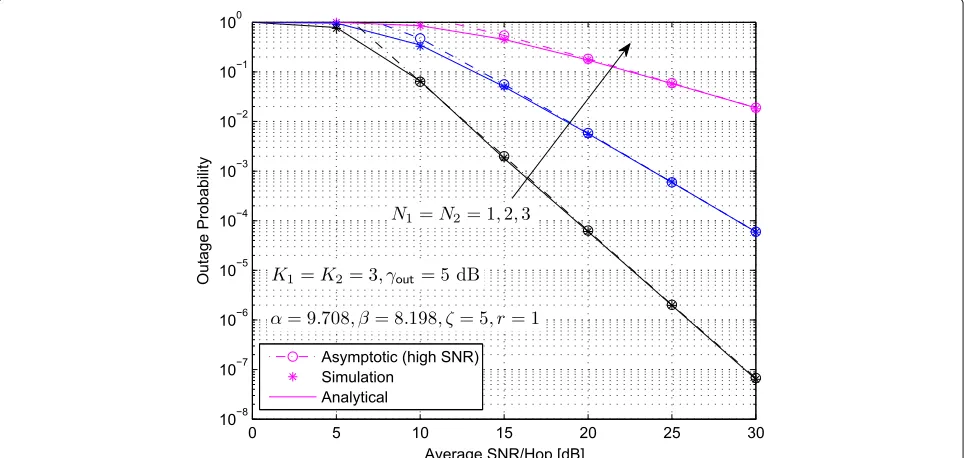
The effect of the order of selected source at the first hop (N1) and order of selected destination at the third hop (N2) is illustrated in Fig. 2 for the case whereN1 = N2. Excellent matching between the analytical and asymptotic results with Monte Carlo simulations can be seen in this figure. Also, it is clear that under weak turbulence condi-tions (α = 9.708 andβ = 8.198), asN1 = N2decreases or, equivalently, as the quality of the selected source and destination enhances, better the achieved performance. This is because, for weak turbulence conditions, the sys-tem performance is dominated by both the first and third RF hops and hence, the diversity order of the system (Gd)
equals toK1−N1+1= K2−N2+1. For fixed number of sources and destinations (K1=K2), reducingN1=N2 increases the diversity order of the system and enhances the system performance. For this case, the coding gain of the system (Gc) is expressed by the first case in (49).
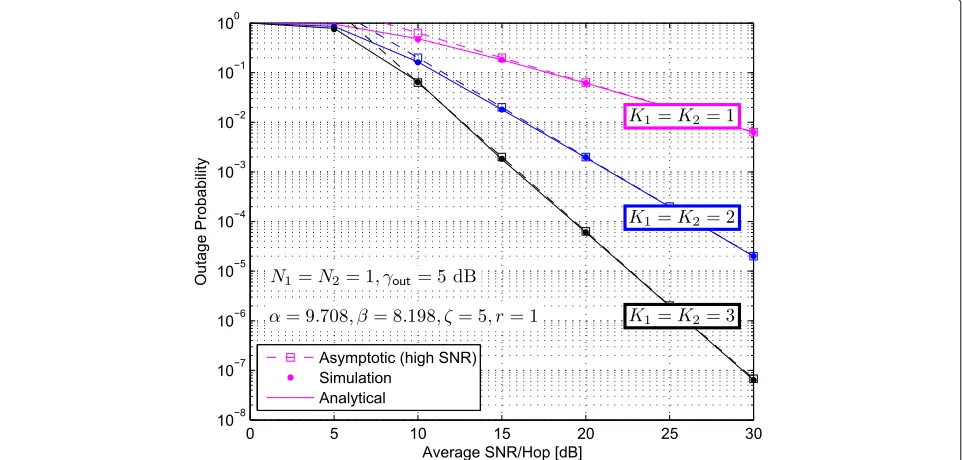
Figure 3 portrays the outage behavior of the system under weak turbulence conditions for different numbers of sources and destinations when they are equal (K1 = K2). Again, it can be seen from this figure that the exact and asymptotic results perfectly match with the Monte Carlo simulations. Additionally, it is clear that under weak turbulence conditions (α = 9.708 and β = 8.198), as K1 = K2 increases or, equivalently, the more the num-ber of available sources and destinations, the better the achieved performance. This is because, for weak turbu-lence conditions, the system performance is dominated by both the first and third RF hops and hence, the diver-sity order of the system (Gd) equals to K1−N1+1 = K2−N2+1. For fixed order of selected source and des-tination (N1 = N2), increasing K1 = K2 increases the diversity order of the system and enhances the system performance. Again, the coding gain (Gc) for this case is expressed by the first case in (49). It is important to men-tion here that for both Figs. 2 and 3, the diversity order of the system is linearly proportional with the number of available sources and destinations and order of selected source and destination.
It is worth mentioning here that the issue of achiev-ing the best performance and satisfyachiev-ing fairness among users is indeed a trade-off. The scheduling schemes which exist in literature can be divided according to two criteria:
sum-rate capacity and fairness among users. Maximum rate or conventional scheduling maximizes the sum capac-ity of the system at the expense of fairness among users, whereas proportional fair user selection scheme satisfies fairness among users at the expense of system sum-rate [44, 45]. Therefore, the selection of the scheduling scheme depends on the system requirements and nature of the system. As an example on the suitability of the scheme to be used, although the proportional fair user scheduling could be helpful for users of weak channels, the loss that occurs in throughput when this scheduling scheme is used can be large in situations where users are scattered across the cell [46]. In summary, the opportunistic and even the generalized order user selection schemes are suitable for systems where the system overall sum-rate capacity or the overall performance is the main requirement of the system; conversely, the proportional fair user scheduling scheme is more desirable in systems where fairness among users is the first priority.
The outage performance vs SNR is portrayed in Fig. 4 under weak turbulence conditions (α = 8.650 andβ = 7.142) for different values of outage thresholdγout. Two main cases are illustrated in this figure: the case where all links’ average SNRs are increasing with increasing thex -axis value and the case where one of these SNRs is fixed. In the case where all SNRs are varying, the performance keeps enhancing as SNR increases and no noise floor appears in the results, whereas in the case where one SNR is kept fixed, a noise floor appears in the results, and a zero diversity order is achieved by the system. This behavior is expected as the system performance is dominated by the
Fig. 4Poutvs SNR of multiuser mixed RF/FSO/RF relay network with generalized order user scheduling for different values ofγoutwith fixed average SNRs and varying average SNRs
worst link among the three links. It is clear also from this figure that in both cases, the outage thresholdγoutaffects the system performance by only affecting its coding gain.
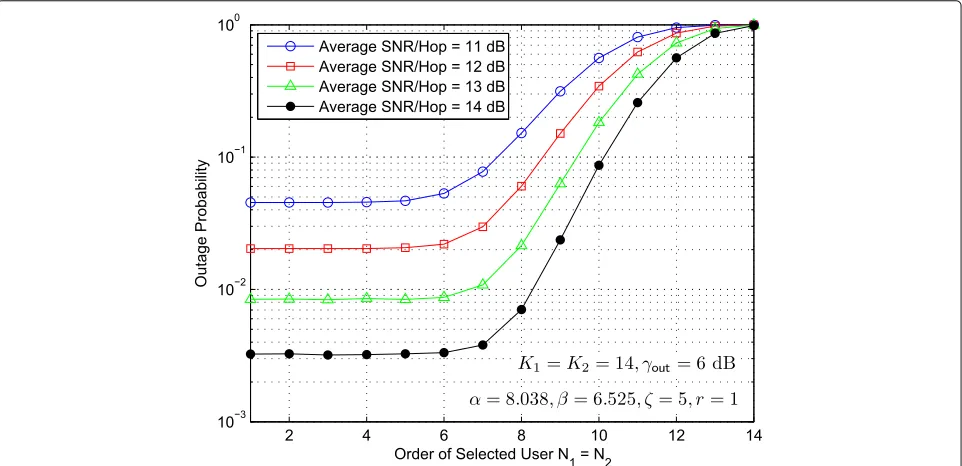
Figure 5 studies the outage performance of the system vs order of selected source/destination (N1 = N2) under weak turbulence conditions for different values of average
SNR/hop. As expected, increasingN1 = N2or, equiva-lently, decreasing the quality of the selected source and destination increases the outage probability and degrades the system performance. Also, it is obvious from this figure that the best performance is achieved at the largest value of SNR.
Fig. 6Poutvs SNR of multiuser mixed RF/FSO/RF relay network with generalized order user scheduling for different values ofγoutwithout and with power optimization
The effectiveness of the proposed power allocation algo-rithm is illustrated in Fig. 6 under weak turbulence condi-tions for different values of outage thresholdγout. Clearly, the system with optimum power allocation gives better performance compared to the case with no power alloca-tion. Also, this figure shows that the outage thresholdγout degrades the system performance through reducing the coding of the system and not the diversity order. This is in
a full match with the asymptotic results which show that the outage threshold affects only the coding gain of the system. Note that in plotting this figure, the total distance (Dtot) between the sources and destinations was assumed to be 1 and divided between the three hops as follows: Ds,r1 =0.3,Dr1,r2 =0.3, andDr2,d=0.4.
Figure 7 studies the impact of pointing error, repre-sented by ζ on the error probability performance of the
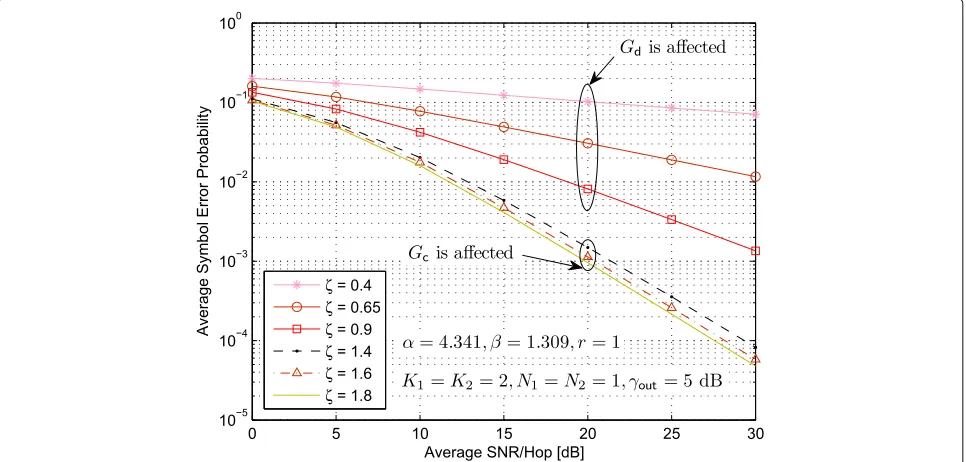
system under severe atmospheric turbulence conditions (α = 4.341 andα = 1.309). As the figure is generated for severe atmospheric turbulence conditions, the system performance will be dominated by the FSO link param-eters (α, β and ζ2). Based on the values of these three parameters, the curves in this figure could be divided into two sets: the set of curves where the diversity order (Gd) is affected by changingζ and the set of curves where the coding gain (Gc) is affected by changingζ. In the first case, the diversity order of the system is affected/determined by ζ2as it is the minimum parameter amongα,β, andζ2. On the other hand, when the minimum value of these three parameters becomes equalβ, changingζ affects the cod-ing gain of the system and not the diversity order which is in this case determined byβ. This result is in a full match with the asymptotic result provided in the second part of (48). Note that in this figure, the type of the detector, represented byr, should also affect the diversity order of the system. It is assumed to be a heterodyne receiver with r=1.
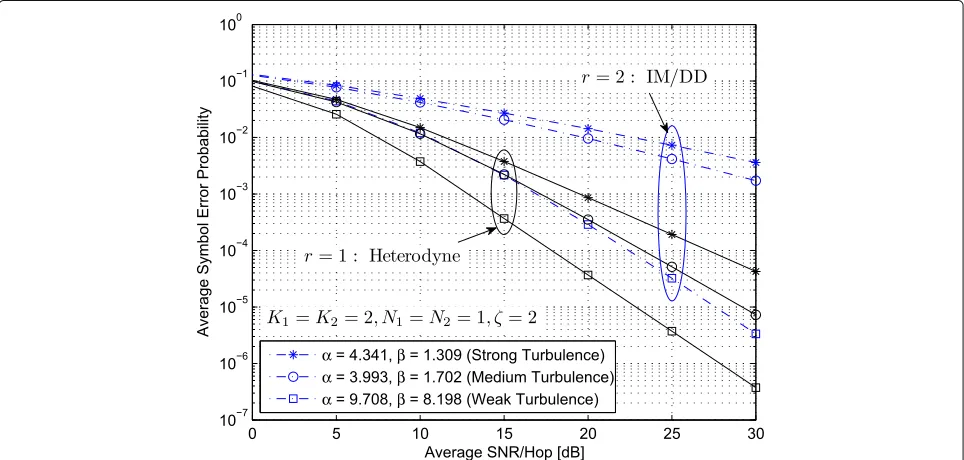
The two types of detection (heterodyne and IM/DD) are studied in Fig. 8, where the error probability performance is portrayed versus SNR under various atmospheric tur-bulence conditions. As expected, due to its ability to better overcome the thermal noise effect in the FSO systems, the heterodyne detection mode (i.e.,r=1) gives better results compared to the IM/DD detection mode (i.e.,r=2). This gain in the system performance is achieved at the expense of system complexity. For one type of detection, sayr=1 orr =2, it is clear that under strong and medium atmo-spheric turbulence conditions, the system performance is
dominated by the FSO link parameters and as the min-imum value among the parameters (α, β, andζ2) which isβ is almost constant, moving from strong to medium turbulence conditions is only affecting the coding gain of the system and not the diversity order. Whereas, moving from medium turbulence conditions to weak turbulence conditions makes the RF links dominate the system per-formance, where the diversity order equalsK1−N1+1= K2−N2+1. This new value for the diversity order is clearly larger than its value in the severe and medium turbulence conditions which explains why the system performance gets better under weak turbulence conditions compared to the other two cases.
Figure 9 illustrates more on the effect of the number of sources/destinations (K1andK2) and order of selected sources/destinations (N1andN2) on the error probabil-ity performance of the considered system. Two main cases are shown in this figure: severe atmospheric turbulence conditions (α = 4.341 andβ = 1.309) and weak atmo-spheric turbulence conditions (α=6.993 andβ=5.460). It is clear that under severe turbulence conditions (α = 4.341 and β = 1.309), trying to increase K1 = K2 is not beneficial for the diversity order and coding gain of the system as they are determined by the FSO parameters that dominate the overall system performance. This case is represented by the brown and black curves on the figure. Whereas under weak turbulence conditions (α = 6.993 and β = 5.460), it is obvious that the diversity order and coding gain of the system are dominated by the RF links parameters (K1,N1,K2, andN2). We can see that the diversity order of the system in this case is determined by
Fig. 9ASEP vs SNR of multiuser mixed RF/FSO/RF relay network with generalized order user scheduling for different values of (K1,N1), and (K2,N2)
the minimum value among the terms K1 −N1+ 1 and K2−N2+1. Keeping one term constant and increasing the other one enhances the coding gain of the system but not the diversity order. Finally, increasing both terms affects the minimum value among them and hence, increases the system diversity order as can be seen in the last curve in this figure (green-star curve).
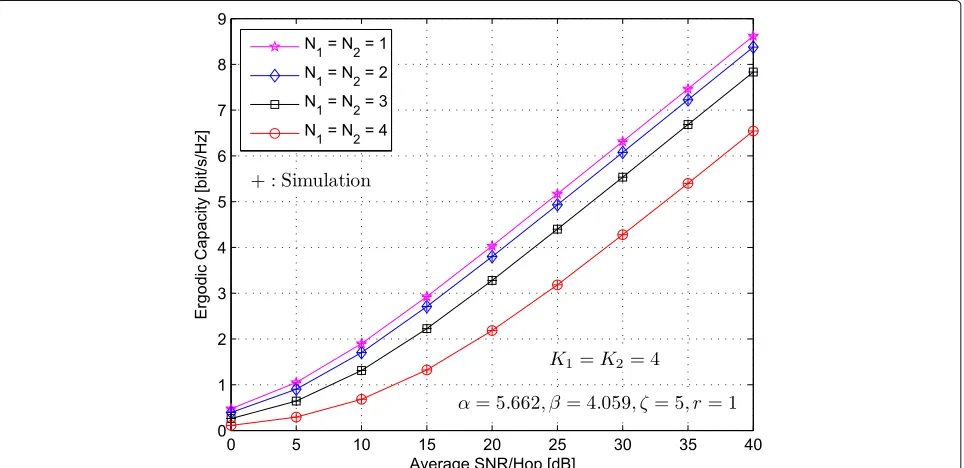
The ergodic channel capacity versus SNR is plotted in Fig. 10 under weak atmospheric turbulence conditions for
different values of N1 = N2. The gain achieved in the system capacity due to decreasing N1 = N2 or, equiva-lently, due to selecting a better source and destination is shown in this figure. This gain in the system performance is expected as enhancing the quality of the RF parts of the system is beneficial for the system performance under weak turbulence conditions. It is clear also from this figure that the analytical expressions are in excellent match with the simulation results.
6 Conclusions
In this paper, the performance of a new scenario of triple-hop multiuser mixed RF/FSO/RF relay network with generalized order user scheduling was evaluated. Also, a power allocation algorithm to calculate the optimum transmission power was proposed. Closed-form expres-sions were derived for the outage probability, average symbol error probability, and channel capacity assuming Rayleigh and Gamma-Gamma fading models for the RF and FSO links, respectively. The effect of pointing errors was also considered in the derivations. Furthermore, the system performance was studied at the high-SNR regime where an approximate expression for the outage proba-bility, in addition to the diversity order and coding gain were provided. Monte Carlo simulations were provided to illustrate the validity of the achieved exact and asymptotic results. The main results illustrated that the system per-formance is dominated by the worst hop among the three hops. The diversity order and coding gain are determined by the parameters of the link/s which dominate the system performance. These parameters are: number of users and order of selected users in the RF links and atmospheric turbulence parameters, pointing error, and type of detec-tor in the FSO link. Finally, the results showed that the proposed power allocation algorithm clearly enhances the system performance compared to the case with no power allocation.
Acknowledgements
This work was funded by the National Plan for Science, Technology and Innovation (Maarifah)—King Abdulaziz City for Science and
Technology—through the Science and Technology Unit at the King Fahd University of Petroleum and Minerals (KFUPM)—the Kingdom of Saudi Arabia, under grant number 15-ELE4157-04.
Competing interests
The author declares that he has no competing interests.
Authors’ information
Anas M. Salhab is a member of IEEE.
Received: 11 June 2016 Accepted: 6 October 2016
References
1. D Kedar, S Arnon, Urban optical wireless communications networks: the main challenges and possible solutions. IEEE Commun. Mag.42(5), 2–7 (2003)
2. ND Chatzidiamantis, HG Sandalidis, GK Karagiannidis, M Matthaiou, Inverse Gaussian modeling of turbulence-induced fading in free-space optical systems. IEEE/OSA J. Lightw. Technol.29(10), 1590–1596 (2011) 3. JN Laneman, DNC Tse, GW Wornell, Cooperative diversity in wireless
networks: efficient protocols and outage behavior. IEEE Trans. Info. Theory.50(12), 3062–3080 (2004)
4. E Lee, J Park, D Han, G Yoon, Performance analysis of the asymmetric dual-hop relay transmission with mixed RF/FSO links. IEEE Photon. Technol. Lett.23(21), 1642–1644 (2011)
5. IS Ansari, F Yilmaz, M-S Alouini, Impact of pointing errors on the performance of mixed RF/FSO dual-hop transmission systems. IEEE Wirel. Commun. Lett.2(3), 351–354 (2013)
6. N Saquib, MSR Sakib, A Saha, M Hussain, inProc. Int. Conf. Education Technol. and Computer. Free space optical connectivity for last mile solution in Bangladesh (IEEE, Shanghai, 2010), pp. 484–487
7. M Karimi, M Nasiri-Kenari, Outage analysis of relay-assisted free-space optical. IET Commun.4(12), 1423–1432 (2010). doi:10.1049/iet-com.2009.0335 8. P Puri, P Garg, M Aggarwal, Outage and error rate analysis of
network-coded coherent TWR-FSO systems. IEEE Photon. Technol. Lett.
26(18), 1797–1800 (2014)
9. BT Vu, TC Thang, AT Pham, inProc. 9th Int’l Symp. on Commun. Systems, Netw. and Digital Signal Process. Selective relay decode-and-forward QAM/FSO systems over atmospheric turbulence channels (IEEE, Manchester, 2014), pp. 407–410
10. SI Hussain, MM Abdallah, KA Qaraqe, inProc. IEEE GCC Conf. and Exhibition. Power optimization andkth order selective relaying in free space optical networks (IEEE, Doha, 2013), pp. 330–333
11. C Abou-Rjeily, Performance analysis of selective relaying in cooperative free-space optical systems. IEEE/OSA J. Lightw. Technol.31(18), 2965–2973 (2013)
12. ND Chatzidiamantis, GK Karagiannidis, On the distribution of the sum of Gamma-Gamma variates and applications in RF and optical wireless communications. IEEE Trans. Commun.59(5), 1298–1308 (2011) 13. J-Y Wang, J-B Wang, M Chen, X Song, Performance analysis for free-space
optical communications using parallel all-optical relays over composite channels. IET Commun.8(9), 1437–1446 (2014).
doi:10.1049/iet-com.2013.0754
14. IS Ansari, Yilmaz Fe, M-S Alouini, inProc. IEEE Veh. Technol. Conf. On the performance of mixed RF/FSO variable gain dual-hop transmission systems with pointing errors (IEEE, Las Vegas, 2013), pp. 1–5
15. NI Miridakis, M Matthaiou, GK Karagiannidis, Multiuser relaying over mixed RF/FSO links. IEEE Trans. Commun.62(5), 1634–1645 (2014)
16. V Jamali, DS Michalopoulos, M Uysal, R Schober, inProc. IEEE Global Commun. Conf. Mixed RF and hybrid RF/FSO relaying (IEEE, San Diego, 2015), pp. 1–6
17. B Makki, T Svensson, T Eriksson, M-S Alouini, inProc. IEEE Global Commun. Conf. On the performance of HARQ-based RF-FSO links, (San Diego, 2015), pp. 1–7
18. B Makki, T Svensson, T Eriksson, M-S Alouini, On the performance of RF-FSO links with and without hybrid ARQ. IEEE Trans. Wirel. Commun.
15(7), 4928–4943 (2016)
19. AM Salhab, F Al-Qahtani, RM Radaydeh, SA Zummo, H Alnuweiri, Power allocation and performance of multiuser mixed RF/FSO relay networks with opportunistic scheduling and outdated channel information. IEEE/OSA J. Lightw. Technol.PP(99) (2016). doi:10.1109/JLT.2016.2555944 20. AM Salhab, Performance of multiuser mixed RF/FSO relay networks with
generalized order user scheduling and outdated channel information. Arabian J. Sci Eng.40(9), 2671–2683 (2015)
21. AA El-Malek, AM Salhab, SA Zummo, Security-reliability trade-off analysis for multiuser SIMO mixed RF/FSO relay networks with opportunistic user scheduling. IEEE Trans. Wireless Commun.15(9), 5904–5918 (2016) 22. PV Trinh, AT Pham, inProc. IEEE Veh. Technol. Conf. Outage performance of
dual-hop AF relaying systems with mixed MMW RF and FSO links (IEEE, Boston, 2015), pp. 1–5
23. I Stefan, H Haas, inProc. IEEE Veh. Technol. Conf. Hybrid visible light and radio frequency communication systems (IEEE, Vancouver, 2014), pp. 1–5 24. M Kashef, M Ismail, M Abdallah, KA Qaraqe, E Serpedin, Energy efficient
resource allocation for mixed RF/VLC heterogeneous wireless networks. IEEE J. Sel. Areas Commun.34(4), 883–893 (2016)
25. VK Sakarellos, CI Kourogiorgas, D Skraparlis, AD Panagopoulos, JD Kanellopoulos, End-to-end performance analysis of millimeter wave triple-hop backhaul transmission systems. Springer Wirel. Pers. Commun.
71(4), 2725–2740 (2013)
26. SQ Nguyen, HY Kong, Outage performance and diversity analysis of cognitive triple-hop cluster-based networks under interference constraint. Springer Wirel. Pers. Commun.85(3), 1669–1688 (2015) 27. KP Peppas, CK Datsikas, Average symbol error probability of general-order
rectangular quadrature amplitude modulation of optical wireless communication systems over atmospheric turbulence channels. J. Opt. Commun. Netw.2(2), 102–110 (2010)
28. WO Popoola, Z Ghassemlooy, BPSK subcarrier intensity modulated free-space optical communications in atmospheric turbulence. IEEE/OSA J. Lightw. Technol.27(8), 967–973 (2009)
30. W Zhang, S Hranilovic, C Shi, Soft-switching hybrid FSO/RF links using short-length raptor codes: design and implementation. IEEE J. Sel. Areas Commun.27(9), 1698–1708 (2009)
31. B He, R Schober, Bit-interleaved coded modulation for hybrid RF/FSO systems. IEEE Trans. Commun.57(12), 3753–3763 (2009)
32. IS Gradshteyn, IM Ryzhik,Tables of Integrals, Series and Products, 6th ed. (Acadamic Press, San Diago, 2000)
33. TM Duman, A Ghrayeb,Coding for MIMO Communication Systems. (John Wiley & Sons, Ltd, Chichester, 2007). doi:10.1002/9780470724347 34. SS Ikki, S Aissa, A study of optimization problem for amplify-and-forward
relaying over Weibull fading channels with multiple antennas. IEEE Commun. Lett.15(11), 1148–1151 (2011)
35. RJ Vaughan, WN Venables, Permanent expressions for order statistics densities. J. Roy. Statist. Soc. Ser. B.34(2), 308–310 (1972)
36. Wolfram, The Wolfram functions site (2013). http://functions.wolfram. com. Accessed Jan 2016
37. MR McKay, AL Grant, IB Collings, Performance analysis of MIMO-MRC in double-correlated Rayleigh environments. IEEE Trans. Commun.55, 497–507 (2007)
38. X Song, J Cheng, Optical communication using subcarrier intensity modulation in strong atmospheric turbulence. IEEE/OSA J. Lightwave Technol.30(22), 3484–3492 (2012)
39. A Farid, S Hranilovic, Outage capacity optimization for free-space optical links with pointing errors. IEEE/OSA J. Lightw. Technol.25(7), 1702–1710 (2007)
40. ND Chatzidiamantis, AS Lioumpas, GK Karagiannidis, S Arnon, inProc. IEEE Global Commun. Conf. Optical wireless communications with adaptive subcarrier PSK intensity modulation (IEEE, Miami, 2010), pp. 1–6 41. IS Ansari, S Al-Ahmadi, F Yilmaz, M-S Alouini, H Yanikomeroglu, A new
formula for the BER of binary modulations with dual-branch selection over generalized-Kcomposite fading channels. IEEE Trans. Commun.
59(10), 2654–2658 (2011)
42. MK Simon, M-S Alouini,Digital Communication over Fading Channels, 2nd ed. (John Wiley & Sons, Inc., Hoboken, 2005)
43. L Yang, X Gao, M-S Alouini, Performance analysis of relay-assisted all-optical FSO networks over strong atmospheric turbulence channels with pointing errors. IEEE/OSA J. Lightw. Technol.32(23), 4011–4018 (2014) 44. J-W So, JM Cioffi, Capacity and fairness in multiuser diversity systems with
opportunistic feedback. IEEE Commun. Lett.12(9), 648–650 (2008) 45. L Yang, M Kang, M-S Alouini, On the capacity-fairness tradeoff in multiuser
diversity systems. IEEE Trans. Veh. Technol.56(4), 1901–1907 (2007) 46. L Yang, M-S Alouini, inProc. IEEE Int. Conf. Commun. Performance analysis
of multiuser selection diversity (IEEE, Paris, 2004), pp. 3066–3070
Submit your manuscript to a
journal and benefi t from:
7 Convenient online submission 7 Rigorous peer review
7 Immediate publication on acceptance 7 Open access: articles freely available online 7 High visibility within the fi eld
7 Retaining the copyright to your article