R E S E A R C H
Open Access
Spectrum sharing with secure transmission
Ngoc Son Pham and Hyung Yun Kong
*Abstract
In this paper, we propose a cooperative scheme between primary and secondary networks. In this scheme, a
secondary user (SU) accepts a lease of a part of the licensed band according to a cooperative request of a primary user (PU). Hence, the SU helps the PU in transmitting primary signals and has an opportunity to access the frequency spectrum. On the other hand, the SU owns important data and may mistrust the intention of a primary transmitter. Physical layer security is applied to evaluate the cooperative efficiency in terms of the data transmission and data security. The numerical and simulative results show that the system performance of the primary network in the cooperative scheme is improved in terms of the outage probability and the symbol error rate and is compared with that in the direct transmission scheme. In addition, the secure performance of the secondary network, as expressed by the outage secrecy probability and the average secrecy capacity, is maintained under the eavesdropping of the primary transmitter.
Keywords: Spectrum sharing; Cooperative communication; Physical layer security; Decode-and-forward; Outage probability; Symbol error rate; Outage secrecy probability; Average secrecy capacity
1 Introduction
Cognitive radio (CR) is a concept that enhances the uti-lization efficiency of the licensed frequency spectrum in that wireless devices are continuously developed for modern applications, but the spectrum bands are lim-ited [1]. In cognitive radio networks, unlicensed users, which are known as secondary users (SUs), only access the licensed bands without causing interference to licensed users, which are known as primary users (PUs). To do this, SUs always opportunistically sense the presence or absence of the licensed bands to make a transmission deci-sion. When the quality of service (QoS) of the primary network is very high, the transmission of the secondary network depends on the cooperative request of the PU. In this scheme, the PU leases a part of the licensed band to the SU to increase the QoS of the primary network as well as the spectrum access capacity of the secondary network [2-5]. At this time, a SU has the right to use the licensed band, but the SU does not know the artifice of PUs which PUs want to eavesdrop on the information of the SU.
Due to the broadcast characteristic of the wireless environment, the secrecy of data transmissions is very important. Physical layer security is proposed to solve the
*Correspondence: [email protected]
Department of Electrical Engineering, University of Ulsan, 680-749 Ulsan, Republic of Korea
security problem in which the secrecy principle is based on the exploitation of the physical characteristics of the wireless channel [6-24]. In [6], Wyner showed that the important data is secure if the quality of the main channel is larger than that of the wiretap channel. Physical layer security has been investigated in the Gaussian channel [7], the broadcast channel [8], and the wireless fading chan-nels [9] and has been extended to the relay-eavesdropper channel [10], the parallel relay-eavesdropper channel [11], and the multi-access channel [12,13,15]. The achievable secrecy rate (ASR) is the metric used to measure the amount of secure data that is successfully received at the intended user [17]. In [17,19], global channel state infor-mation (CSI) is available in which Dong et al. regarded a practical assumption that the eavesdropper nodes are active and their CSIs are monitored by the center network [17]. Kim et al. assumed that the source and relay nodes can detect the CSI based on frequent response messages of the eavesdropper nodes. These messages will be used to inform the source node that the eavesdropper nodes want to be served in the next phases [20]. Exploitation of relays has been proposed to overcome the fading environment as well as to enhance secrecy capacity [10,11,17-24]. Optimal relay selection methods [18,23] and weight optimization methods of the cooperative relays [17,19] have been stud-ied to maximize the ASR and satisfy a total transmit power
constraint. In [21-24], a utilization of jamming signals has been investigated in which friendly wireless nodes or relays operate as jammers to create artificial interfer-ence to reduce the quality of the eavesdropping channel. The authors assumed that the jamming signals are known at both the destination nodes and the relays; hence, the quality of the desired channel cannot be affected by the interference signals. A special case in which the coopera-tive relay does not behave as a trusted node is proposed [25].
In [4,5], the SUs have opportunity to wiretap the pri-mary data of the PUs, and then these SUs are mistrusted as eavesdropper nodes. In [16-18,20], the eavesdropper nodes are assumed as special wireless nodes, whereas the primary data are wiretapped by nodes as relays in [19,25]. Motivated by the above issues, in this paper, we propose a cooperative scheme between the primary and secondary networks in which the PU leases a part of the licensed band to the SU to improve the performance of its system. In this proposed scheme, the SU uses the licensed band to perform two jobs as follows: First, the SU helps the PU by decoding and using the amount of power needed for forwarding the primary signals. Sec-ond, the SU uses the remaining power to transmit the important data against the eavesdropping of the primary transmitter. The cooperative efficiency of the primary net-work is obtained in terms of the outage probability and symbol error rate (SER) and is compared with the direct transmission scheme. For the secondary network, the out-age secrecy probability and the averout-age secrecy capacity are presented to evaluate the efficiency of the spectrum lease.
The rest of the paper is organized as follows: In Section 2, we present the cooperative system model and operation principle. The performance analysis of the pri-mary and secondary networks is presented in Section 3. Section 4 discusses the numerical and simulative results using the Monte Carlo method and theoretical expres-sions. The conclusions are summarized in Section 5.
2 System model
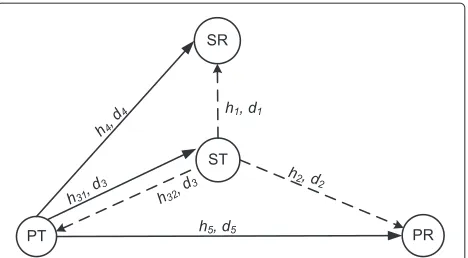
Figure 1 presents a system model of cooperative commu-nication between primary and secondary networks. The primary network includes the primary transmitter (PT) and primary receiver (PR) and has a licensed spectrum band. On the other hand, the primary network does not share this spectrum band, because its QoS is very high. The secondary network has two nodes, denoted as a sec-ondary transmitter (ST) and a secsec-ondary receiver (SR), where the ST only transmits its data when receiving a spectrum lease contract from the PT. We assume that each node has a single antenna and the same transmit power
P and that all nodes suffer the zero-mean additive white Gaussian noise (AWGN) with the same varianceN0.
Figure 1System model of cooperative communication between primary and secondary networks.
In Figure 1, (h1,d1), (h2,d2), (h31,d3), (h32,d3), (h4,d4), and(h5,d5)denote the Rayleigh fading channel coefficients and the link distances of ST-SR, ST-PR, PT-ST, ST-PT, PT-SR, and PT-PR, respectively. Therefore, the channel gainsgi = |hi|2andg3j = h3j2are exponential distribution random variables (RVs) with parameters λi andλ3, respectively, which are given asλi =dβi andλ3= d3β whereβ is the path loss exponent,i ∈ {1, 2, 4, 5},j ∈ {1, 2}. We note that links PT-ST and ST-PT have the same distance but different direction.
Before transmitting a data packet, a connection estab-lishment phase is performed using the media access control (MAC) layer protocol, which is similar to the CoopMAC in [26]. First, PT broadcasts a request-to-send (RTS) message to nodes ST, SR, and PR. Hence, ST can estimate the fading channel coefficienth31when receiving the RTS message. Because of the transmission desire of the secondary network on the licensed band, ST will imme-diately reply to the RTS message by sending a helper-ready-to-send (HTS) to nodes PT, PR, and SR. Relying on the receipt of the RTS and HTS messages, nodes PR and SR can estimate the fading channel coefficient pairs (h5, h2) and (h4, h1), respectively, and then these nodes will broadcast clear-to-send (CTS) messages that include their estimated fading channel coefficients. If PT wants to cooperate with ST, it will send a RTS message which includesh32estimated from the HTS message to notify a cooperative acceptance to ST. Based on the above steps of the setup phase, ST will know the fading channel coeffi-cients (h31,h32) from the RTS messages, (h4,h1) from the CTS message of SR, and (h5,h2) from the CTS message of PR. Therefore, ST can select a power sharing param-eter as well as evaluate the secrecy performance of the secondary network. Similarly, PT will know the fading channel coefficientsh31,h2, andh5for selecting the coop-erative method and analyzing the system performance of the primary network.
In the first time slot, PT broadcasts a signalxP to ST, SR, and PR by using a RTS message [26]. The received signals at ST, SR, and PR are given, respectively, as
yPT-ST= √
Ph31xP+nST (1)
yPT-SR= √
Ph4xP+nSR (2)
yPT-PR= √
Ph5xP+nPR (3)
where nST, nSR, and nPR are the zero-mean AWGN at nodes ST, SR, and PR, respectively.
In this case, ST can successfully decode the signalxP. Then, if the PR cannot successfully decode the signalxP, it will send a CTS message. After that, PT receives the CTS message, and it will send a RTS message to ST to require cooperation. Because the secondary network cannot use the licensed spectrum band of the primary network, ST will accept the cooperation request of PT by leasing a part of the licensed spectrum band. This procedure is per-formed at ST by combining the signalxPwith its signalxS based on the power allocation strategy, which is proposed in [4,5] as
xC= √
αPxP+
(1−α)PxS (4)
whereα (0< α <1)is the fraction of the transmit power allocated to the signal xP and αP is like the money of the secondary network for payment of a leased spectrum band.
Then, ST broadcasts the combined signalxC to nodes SR, PR, and even PT. The received signals at SR, PR, and PT in the second time slot can be given, respectively, as
yST-SR=
√
αPxP+
(1−α)PxS
h1+nSR (5)
yST-PR=
√
αPxP+
(1−α)PxS
h2+nPR (6)
yST-PT=
√
αPxP+
(1−α)PxS
h32+nPT (7)
wherenPTis the zero-mean AWGN at node PT.
At node PR, the well-known maximal ratio combining (MRC) technique is employed from two signals that are received from PT (the first time slot) and ST (the second time slot) to decodexP [4], Equation 23, so the received signal-to-noise ratio (SNR) at PR can be expressed as
γMRC = P|h5|2
N0 +
αP|h2|2 (1−α)P|h2|2+N0
= γg5+ αγ
g2 (1−α) γg2+1
(8)
whereγ =P/N0is the transmit SNR.
Because SR also receives the signalxP in the first time slot, there are two cases for decoding the signalxP from
the received signal (2) as + SR successfully decodesxP, and then SR can cancel the interference componentxPin (5). The received signal after canceling the interference at SR is given as
yST-SR=(1−α)PxSh1+nSR (9)
and the corresponding received SNRγ1at SR is given to decodexSas
γ1= (1−α)P|h1|2
N0 =(
1−α) γg1 (10)
+ SR does not successfully decode xP, and then the received SNRγ1at SR is expressed as
γ1= (1−α)P|h1|2 αP|h1|2+N0 =
(1−α) γg1 αγg1+1
(11)
In addition, the secondary network has important data and suspects the help request of the primary network, so physical layer security is applied to the secondary net-work in evaluating the secure performance. In this system model, we assume that PT wants to eavesdrop the sig-nalxS of ST while PR only receives the signalxP of PT in the second time slot. The received ASR at SR is given as [17]
ASR= {RST-SR−RST-PT}+ (12)
where {x}+ is noted for max(0,x) function; RST-SR and
RST-PT are the achievable data rates of links ST-SR and ST-PT, respectively, and are given as
RST-SR= 1
2log2(1+γ1) (13)
RST-PT = 1
2log2(1+γ32) (14)
where the factor (1/2) means that the signals are transmit-ted in two time slots, andγ32 is the received SNR at PT from ST to decode the signalxS.
From (7),xP is the transmitted signal of the eavesdrop-per PT. The xP can be considered as a side information that is available at the transmitter ST and the eavesdrop-per PT [27]. Hence, the eavesdropeavesdrop-per PT can cancel the self-interferencexP. As a result, the received SNRγ32at PT is given as
γ32= (1−α)P|h32|2
N0 =(
1−α) γg32 (15)
3 Performance analysis
3.1 The primary network: outage probability and symbol error rate
3.1.1 Outage probability
between PT and ST is given in the first time slot from (1)
If the achievable data rateRPT-ST is less than the target data rateRPof the primary network, ST cannot success-fully decodexP. The outage probability at ST in this case is given as meanings because these symbols are calculated in the dif-ferent time slots and directions. Hence, we can assume thatg31andg32are independent exponential RVs with the same parameterλ3. When ST successfully decodes the sig-nalxP, ST accepts the help request of PT and combines xP with its signalxSasxC in (4). After applying the MRC technique, the achievable data rate at PR is given as
RMRCPT-PR= 1
2log2(1+γMRC) (18) The outage probability at PR is expressed as
PMRCPT-PR=Pr
where FγMRC(x) is the cumulative distribution function
(CDF) of the RVγMRC.
Theorem 1. The following single-integral form expression is valid for FγMRC(x)
Proof. The proof is performed in Appendix 1.
From Theorem 1, the outage probability at PR is obtained in the single-integral form as
PMRC forming a function survey method, m(u) is minimum at m(u∗), is a decreasing function in [0,u∗], and is an increasing function in [u∗,∞), where u∗ = √αλ2/λ5. Hence, Theorem 2 will obtain a lower bound ofPMRCPT-PRas
Theorem 2. The following lower bound expression is valid for PPTMRC−PR
Proof. Given in Appendix 2.
When node ST does not successfully decode xP, node PR only receives the direct signal from PT in the first time slot, soγMRCequalsγg5in (8). The outage probability at PR in this case is given as
PPT-PRout =Prγg5< θ
=1−e−λ5θ/γ (23)
Finally, based on the operation principle of coopera-tive communication between primary and secondary net-works, the outage probability of the primary network is a combination of the outage probabilities, which are obtained in (17), (21), and (23) as
Pccout=1−PoutPT-STPPT-PRMRC +PoutPT-STPoutPT-PR (24)
wherePoutPT-ST,PMRCPT-PR, andPoutPT-PRare obtained in (17), (21) and (23), respectively.
In addition, from Theorem 2 and (24), the lower bound form of the outage probability of the primary network is expressed as
Pout_lowercc =1−PoutPT-STPMRC_lowerPT-PR +PoutPT-STPoutPT-PR (25)
wherePPT-PRMRC_loweris obtained in (22).
evaluation, PT will transmit the same signalxPduring two time slots, and PR will use the MRC technique to combine these received signals to increase the decoding capacity. The received SNR at PR is given as
γDT
where g51 and g52 are the channel gains of link PT-PR in the first and second time slots, respectively, and we assume thatg51andg52are independent exponential RVs with the same parameterλ5.
Lemma 1. The CDF of RVγMRCDT can be expressed in the exact closed form as
FγDT
MRC(x)=1−
1+λ5x γe−λ5x/γ (27)
Proof.The CDF ofγMRCDT is expressed as
FγDT
probability density function (PDF) and CDF of RVsg51and
g52, respectively.
Hence,Fg52(x γ −t)in (28) is calculated asFg52(x γ − t) = 1 − e−λ5(x/γ−t). Then, substituting fg
51(t) and Fg52(x γ −t)into (28), Lemma 1 is proven.
From Lemma 1, the outage probability of the DT proto-col is given as
PoutDT=Pr
3.1.2 Symbol error rate
The average SER of link PT-ST in the first time slot can be calculated [28, Eq. (27)] as
SERPT-ST=
whereaandbare constants that depend on the modula-tion type, e.g.,a = b = 1 for BPSK modulation,γg31 is the received SNR at ST, andFγg31(x)is the CDF of the RV
γg31and is given asFγg31(x)=1−e−λ3x/γ.
Then, (30) is solved as
SERPT-ST=
When ST successfully decodesxP, PR receives two sig-nal paths such as the direct path from PT and the coopera-tive path from ST at the different time slots. To restorexP, PR performs the MRC decoding by storing the received signalyPT-PR(3) at the first time slot and then waiting to the second time slot to combine with the received sig-nalyST-PR (6). Two received signalsyPT-PR andyST-PR in the two-phase transmission can be seen as an equiva-lent single-input multi-output (SIMO) [5]. As described in [4,5], the MRC decoding is easier to implement. With the help of the equation [28, Eq. (27)], the average SER at PR after applying the MRC technique is expressed as
SERMRCPT-PR= a
Note that the regeneration ofxP can be performed by the minimum mean square error decoding (MMSE decod-ing) [29,30]. The analysis of SER in the MMSE decoding is complex because it relates resolution of posterior distri-butions. The MMSE decoding will be our future work.
To solve SERMRCPT-PR in the formula (32), Theorem 3 is obtained as follows:
Theorem 3. The following representation is valid for SERMRCPT−PR
After some manipulations of (34), the proof of Theorem 3 is completed.
From the result of Theorem 3, the integral component α analysis of SERMRCPT-PRin the lower bound form asPMRCPT-PRin Theorem 2 is not feasible.
When node ST does not successfully decodexP, PR only directly receives the signalxP in the first time slot. The average SER at PR in this case is given as
SERPT-PR =
Using the law of total probability, the average SER of the cooperative communication between the primary and secondary networks is given as
SERcc=
1−SERPT-ST
SERMRCPT-PR+SERPT-STSERPT-PR
(36)
where SERPT-ST, SERPT-PR, and SERMRCPT-PRare obtained in (31), (35), and Theorem 3, respectively.
For the DT protocol with a fair evaluation, PT also transmits the same signalxP during two time slots, and PR uses the MRC technique. The average SER of the DT protocol is expressed as
SERDT=
3.2 The secondary network: outage secrecy probability and average secrecy capacity
3.2.1 Outage secrecy probability
When ST successfully decodes the signalxP, it will then transmit the combined signalxC as (4). However, the ST
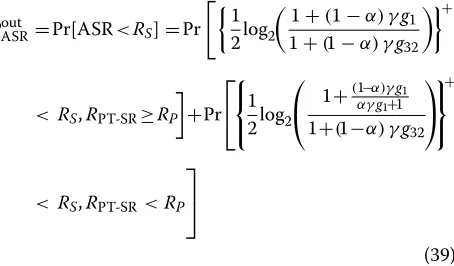
does not believe the help request of PT, because ST thinks that PT wants to get its information. Therefore, ST only considers the security of the important information. Phys-ical layer security is applied at the secondary network in Figure 1, where ST wants to secure the important infor-mation against the eavesdropping of PT in the second time slot. The outage secrecy probability of link ST-SR is given as
where ASR is given in (12),RSis the target secrecy rate [18], andRPT-SRis the achievable data rate from PT to SR and is obtained from (2) as
RPT-SR=
Substituting (40) into (39), we obtain
PoutASR=Pr
Theorem 4. The following closed-form expression is valid for PASR1
P1ASR=1−λ3e
−λ1(ρ−1)/((1−α)γ )
Proof.By expanding the expression {x}+in PASR1 (41), the probabilityP1ASRis given as
P1ASR=Prg1≤g32 Theorem 4 is provided.
Likewise, the probability PASR2 is solved in the next theorem.
Theorem 5. The following single-integral form represen-tation is valid for PASR2
PASR2 =
Proof.The proof is provided in Appendix 3.
We set asn(y) = λ3y ρ − λ1 y, y ∈ 0,(1−ρα) (1−α). By performing a function survey method,n(y)
is an increasing function in 0,(1−ρα) (1−α). As a result of the increasing functionn(y), we have an inequal-ity as n(y) ≤ n(1−ρα) (1−α). Hence, the lower bound ofP2ASRis obtained as
P2_lowerASR =
Substituting the result of Theorems 4 and 5 into (41), we havePoutASRin hand. Finally, the outage secrecy probability of the secondary network during two time slots is given as
PoutSN =1−PPT-STout PoutASR+PPT-STout (46) wherePoutPT-STis given in (17).
In addition, from the lower bound ofP2ASRin (45), the lower bound form ofPoutSN is expressed as
Pout_lowerSN =1−PPT-STout PASRout_lower+PPT-STout (47)
wherePout_lowerASR is obtained from (41) as
PASRout_lower=e−λ4θ/γP1
ASR+
1−e−λ4θ/γP2_lower
ASR (48)
3.2.2 Average secrecy capacity
In the operation protocol of the secondary network, ST only transmits the secrecy signals when ST successfully decodes the primary signalxPof PT. The average secrecy capacity of the secondary network is defined by calculat-ing the expected value over ASR [32], ([33] Eq. (8)), ([34] Eq. (3)). In addition, the ASR expression in (12) depends on the decoding of the primary signal xP at SR (10-11). Hence, the average secrecy capacity of the secondary network is formulated as
CavgSN= successfully decodexP
0 1. /
Cavg2 ≈ E
%2 1 2log2
g1 αγg1+1
g32
!3+
-= 1
2E %
log2 &
Z g32
'(+
-(52)
whereZ=g1 αγg1+1as defined in Appendix 3.
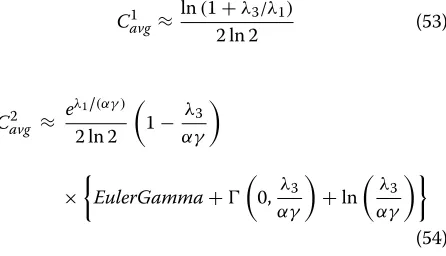
Theorem 6. The following asymptotic expressions are valid for Cavg1 and Cavg2 , respectively
Cavg1 ≈ ln(1+λ3/λ1)
2 ln 2 (53)
Cavg2 ≈ e
λ1/(αγ )
2 ln 2 &
1− λ3 αγ
'
×
EulerGamma+
& 0, λ3
αγ
'
+ln &λ3
αγ
'(
(54)
where (n,x) is the ‘upper’ incomplete gamma func-tion ([31] Eq. (8.350.2)) ( (n,x) = x∞tn−1e−tdt),
and EulerGamma is Euler’s constant (EulerGamma ≈
0.577216) ([31] Eq. (8.367.1)).
Proof. The proof is solved in Appendix 4.
Substituting (17), (50), and the results of Theorem 6 into (49), we obtain the asymptotic form of the average secrecy capacity of the secondary network as
CavgSN ≈ e
−λ3θ/γ
2 ln 2
e−λ4θ/γ ×ln(1+λ3/λ1)
+1−e−λ4θ/γ
eλ1/(αγ )(1− λ3
αγ)
×
EulerGamma+
& 0, λ3
αγ
'
+ln &λ3
αγ
'((
(55)
4 Numerical and simulative results
In this section, the performance of the primary and sec-ondary networks is analyzed by using the Monte Carlo simulation method and the theoretical expressions. The performance analyses include the outage probability and SER of the primary network and the outage secrecy prob-ability and the average secrecy capacity of the secondary network. We note that the single-integral expression of
(21) and (44) and the double-integral expression of (33) are not presented in the closed forms but are easily solved by the numerical method in Matlab. In a two-dimensional plane, the coordinates of the primary and secondary nodes are set to PT (0, 0), PR (1, 0), ST (0.5,
y1), and SR (0.5, y2). Hence, the distance of the PT-PR link is 1 (d5 = 1) during the simulation intervals, and ST and SR move on the median line of the PT-PR line segment, which depend on the values of the variablesy1 andy2on they-axis. We assume that the path loss expo-nent, the target data rate of the primary network, and the target secrecy rate of the secondary network are con-stants (β = 3,RP = 1 bit/s/Hz,RS = 0.1 bit/s/Hz),
and the SNR symbol in the x-axis is defined as
SNR=P/N0.
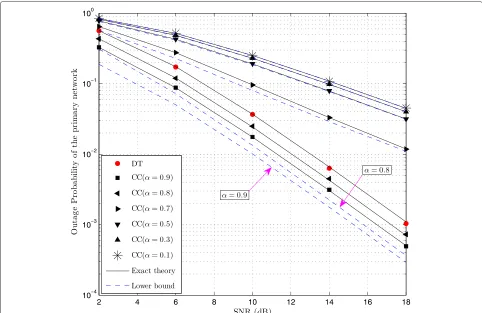
Figure 2 presents the outage probability of the primary
network at PR versus SNR (dB) when y1 = 0.1 and
with different values of the power allocation at ST (α). In Figure 2, for the cooperative communication protocol (called the CC protocol), the outage probability of the pri-mary network is the smallest whenα is the largest (α = 0.9), and the primary system performance is improved when the SNR increases. These results are explained that when the fraction of the transmit powerαincreases, ST uses more power for forwarding the signal of PT to PR in the second time slot. For comparison purposes, the CC protocol outperforms the DT protocol when ST shares the high power to help PT (α ≥ 0.8). In addition, the the-oretical expressions match very well with the simulation results, and the lower bound forms converge to the exact theories when the fractions of the transmit powerα are small.
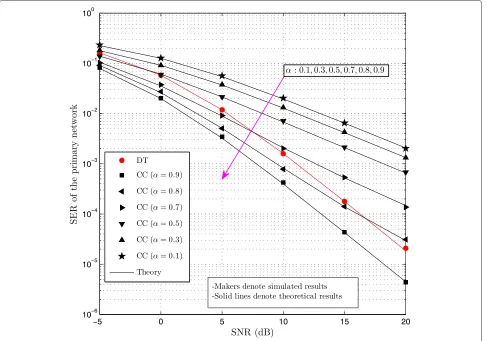
In addition to the outage probability, the SER is suitable for evaluating the QoS of the primary network. Figure 3 presents the SER of the primary network with the same ST location as in Figure 2. In this simulation result, we assume that the cooperative system uses the BPSK modu-lation (e.g.,a=b=1) and coherent maximum likelihood detection [35]. The SER of the CC protocol is the small-est at α = 0.9. For different values of α, the SER of the CC protocol is smaller than that of the DT proto-col when SNR ≤ −1 dB forα = 0.5, SNR < 8 dB for α = 0.7, and SNR < 17 dB forα = 0.8. These results are explained as follows. In the symmetric network model, when the fraction of the transmit powerαis enough large (such asα = 0.5, 0.7, 0.8), the demodulation of the pri-mary data at PR depends on the total transmit powerP
Figure 2Outage probability of the primary network at PR versus SNR (dB) wheny1=0.1.The markers denote simulated results, whereas
solid and dash lines refer to theoretical results and lower bounds, respectively.
From Figures 3 and 4, the performance of the CC protocol is better than that of the DT protocol at high val-ues ofα (e.g.,α = 0.9), because the located power for helping the primary user PT is higher by far than that for transmitting the own signal of the secondary user ST.
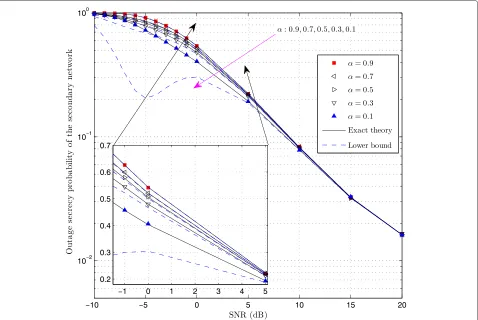
Figure 4 presents the outage secrecy probability of the secondary network versus the SNR (dB) wheny1 = 0.1 andy2 = 0. In Figure 4, the outage secrecy probability decreases when the SNR increases andα decreases (the secrecy performance is the best whenα = 0.1). These results are explained that when α decreases, ST uses more power for transmitting the own signal than for-warding the signal of PT to PR in the second time slot. In addition, with the high SNR (SNR ≥ 10 dB), the outage secrecy probability is almost independent of the values of α. Hence, from Figures 2, 3 and 4, ST can provide the high power to help the primary network so that the performance of the cooperative primary network (the CC protocol) outperforms the DT protocol and the secure performance of the secondary network is main-tained, especially in the high SNR region. For example,
when SNR ≈ 12 dB, the outage secrecy probability
of the secondary network is maintained at 5 × 10⁻², and ST can assign the parameter α = 0.9 to improve the performance of the primary network. In addition, the theoretical expressions are valid for the simulation results, and the lower bound forms converge to the exact results when the fractions of the transmit power α are large.
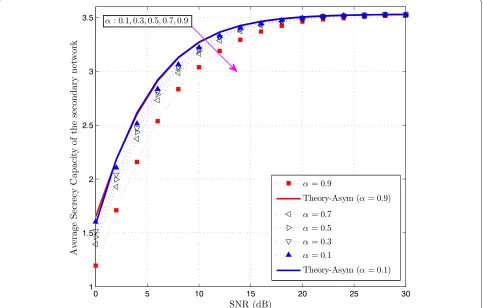
Next, we discuss the average secrecy capacity of the secondary network when ST cooperates with the pri-mary network. Figure 5 presents the average secrecy capacity versus the SNR (dB) when the locations of nodes ST and SR are the same as in Figure 4. In Figure 5, the average secrecy capacity increases when α decreases because the allocated power for transmit-ting the signal of ST increases. In addition, the aver-age secrecy capacity also converges to the asymptotic value when the transmit SNR is high, but the conver-gence of the average secrecy capacity is faster whenα is smaller.
Figure 3SER of the primary network at PR versus SNR (dB) wheny1=0.1.
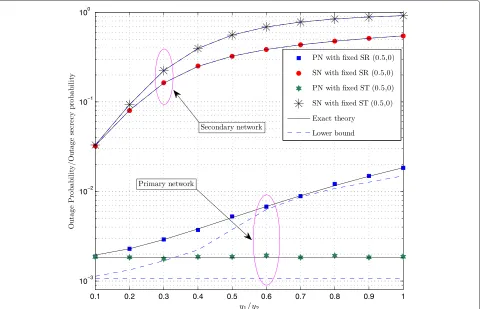
probability and the outage secrecy probability of the pri-mary network and the secondary network, respectively, when the parameterαis set toα=0.9. In Figure 6, when SR is fixed at (0.5, 0) and the ST moves on the median line of the PT-PR line segment where y1 ranges from 0.1 to 1, the performance of both networks decreases. These results are explained as follows. Because of the movement of ST, the distances of links PT-ST, ST-PR, and ST-SR increase, so it is difficult for ST to decode the received signal from PT, and the data rate at SR decreases. Whereas, when ST is set at the central point (0.5, 0) and SR moves on the median line of the PT-PR line segment where y2ranges from 0.1 to 1, the outage probability of the primary network does not change, while the outage secrecy probability of the secondary network increases. These results are explained by three factors as follows. First, the primary network does not depend on the action of SR. Second, because SR goes farther, SR hardly decodes the signal of PT to cancel the inter-ference elements. Third, the distance of the ST-SR link increases. For these reasons, the performance of the sec-ondary network is poor, while that of the primary network is stable. From Figure 6, the lower bound forms of the
out-age secrecy probabilities well converge to the exact results whenα=0.9.
5 Conclusions
Figure 4The outage secrecy probability of the secondary network versus SNR (dB) wheny1=0.1 andy2=0.The markers denote
simulated results, whereas solid and dash lines refer to theoretical results and lower bounds, respectively.
Appendices Appendix 1 Proof of Theorem 1
We setU = αg2 (1−α) γg2+1
, so the CDF ofU is given as
FU(x)=Pr
α
g2 (1−α) γg2+1<
x
=Prg2(α−x(1−α) γ )<x
=
2
1 ,x≥ (1−αα)γ
1−e−λ2x/(α−x(1−α)γ ) ,x< α
(1−α)γ
(56)
From (8), the CDF ofγMRCis expressed as
FγMRC(x)=Pr [γMRC<x]=Prγg5+γU<x
=Pr
g5+U<
x
γ
=
x/γ
0
fg5(t)×FU(x γ−t)dt
(57)
wherefg5(t)=λ5e−λ5tis the PDF of the RVg5.
The termFU(x γ −t)is calculated from (56) as
FU(x γ−t)=
2
1 ,t≤ γx − (1−αα)γ
1−e−λ2t/(α−t(1−α)γ ),t> x
γ − (1−αα)γ (58)
Substituting (58) into (57), the CDF ofγMRCis obtained as
FγMRC(x)
=
⎧ ⎪ ⎪ ⎪ ⎪ ⎨ ⎪ ⎪ ⎪ ⎪ ⎩
1−e−λ5x/γ −λ5
x/γ
x γ−(1−α)γα
e−λ5t−α−(θλ/2γ(θ−/tγ)(−1t−α)γ) dt,x≥ α 1−α
1−e−λ5x/γ−λ5
x/γ
0
e−λ5t−α−(θλ/2γ(θ−/tγ)(−1t−α)γ) dt ,x< α
1−α
(59)
Performing a variable transformation method as u =
α−θ γ −t(1−α) γ,FγMRC(x)is solved in the
Figure 5Average secrecy capacity of the secondary network versus SNR (dB) wheny1=0.1 andy2=0.
Appendix 2 Proof of Theorem 2
First, we consider the conditionθ ≥ α (1−α)and the integral expression in the regionu ∈ [0,α] in (21), there are two minimum values of the functionm(u)as
minm(u)
. /0 1
u∈[0,α] =
2
m(α) whenα <u∗
m(u∗) whenα≥u∗ (60)
Substitutingu∗=√αλ2/λ5into (60), we obtain as
minm(u)
. /0 1
u∈[0,α] =
2
m(α) whenθ ≥α (1−α),η > α
m(u∗)whenθ ≥α (1−α),η≤α (61)
whereη=λ2/λ5.
When the conditionθ < α (1−α) and the integral expression in the region u ∈ [α−θ (1−α),α], three minimum values of the functionm(u)are given as
min m. /0 1(u) u∈[α−θ(1−α),α]
=
⎧ ⎨ ⎩
m(α) whenα <u∗
m(u∗) whenα≥u∗> α−θ (1−α)
m(α−θ (1−α))whenu∗≤α−θ (1−α) (62)
After some manipulations of (62), we obtain as
min m(u) . /0 1
u∈[α−θ(1−α),α]
= ⎧ ⎪ ⎪ ⎨ ⎪ ⎪ ⎩
m(α) whenθ < α (1−α),η > α
m(u∗) whenθ < α (1−α),α≥η > (α−θ (1−α))2 2
m(α−θ (1−α))whenθ < α (1−α),η≤(α−θ (1−α))2 2
(63)
Substituting (61) and (63) into (21), the lower bound form ofPMRCPT-PRis given as
PMRC_lowerPT-PR
=
⎧ ⎪ ⎪ ⎪ ⎪ ⎨ ⎪ ⎪ ⎪ ⎪ ⎩
1−e−λ5θ/γ−λ5e
&
−λ5θ+αλ(15−α)+λ2
'
/γ (1−α)γ
α
0
e−(1−α)γ du ,θ≥ α 1−α
1−e−λ5θ/γ−λ5e
&
−λ5θ+αλ(15−α)+λ2
'
/γ (1−α)γ
α
α−θ(1−α)
e−(1−α)γ du,θ < α 1−α (64)
where =
m(α) ,η > α
m(u∗),η≤α and =
⎧ ⎨ ⎩
m(α) ,η > α
m(u∗) ,α≥η >(α−θ (1−α))2 2
Figure 6The outage probability and the outage secrecy probability versusy1/y2withα=0.9.The markers denote simulated results,
whereas solid and dash lines refer to theoretical results and lower bounds, respectively.
By solving the integrals in (64), the proof of Theorem 2 is completely provided.
Appendix 3 Proof of Theorem 5
By expanding the expression{x}+inPASR2 (41), the proba-bilityP2ASRis given as
P2ASR=
g1 αγg1+1 ≤
g32
+Pr
g32<
g1 αγg1+1 <
ρ−1
(1−α) γ +ρg32
=Pr
g1 αγg1+1 <
ρ−1
(1−α) γ +ρg32
(65)
We setZ = g1 αγg1+1
and look at the CDF of the RVUin (56), the CDF ofZis given as
FZ(x)=Prg1 αγg1+1<x
=
2
1 , x≥(αγ )−1
1−e−λ1x/(1−αγx), x< (αγ )−1
(66)
From (66),P2ASRis obtained as
P2ASR=
∞
0
fg32(x)×FZ &
ρ−1
(1−α) γ +ρx
'
dx
=
⎧ ⎪ ⎨ ⎪ ⎩
1 ,ρα≥1
1−λ3
1−ρα (1−α)αγρ
0 e−
λ3x+1−((ρ−(ρ−11)/(()/((11−α)γ )+ρ−α)γ )+ρxx)αγ
dx,ρα <1
(67)
After performing a variable transformation method as
y=1−(ρ−1) ((1−α) γ ) +ρx) αγ,PASR2 is obtained in the single-integral form as (44). Hence, the proof of Theorem 5 is completed.
Appendix 4 Proof of Theorem 6
We setX = g1 g32, and the CDF and PDF of RVXare given as
FX(x)=Pr
g1
g32 <
x
=Prg1<xg32
=
∞
0
fg32(y)×Fg1(xy)dy=1−
λ3 λ3+xλ1
fX(x)= ∂ FX(x)
∂x =
λ1λ3
(λ3+xλ1)2 (69)
From (69) and the expression of the expected operation [36, Eq. (5.55)],C1avgin (51) is formulated as
Solving the integral in (70),C1
avgis obtained as (53). To solveCavg2 , we setY = Z g32, whereZis a RV and is defined in Appendix 3, and the CDF of RVYis given as
FY(x)=Pr (72) goes to 1. Hence,FY(x)is asymptotically obtained as
FY(x)≈1−λ3
From (74) and the expression of the expected operation [36, Eq. (5.55)],Cavg2 in (52) is formulated in the asymptotic form as
Solving the integral in (75), we obtainCavg2 as (54). Hence, the proof of Theorem 6 is proven.
Competing interests
The authors declare that they have no competing interests.
Acknowledgements
This paper was supported by the 2014 Research Funds of Hyundai Heavy Industries for University of Ulsan.
Received: 16 December 2013 Accepted: 5 August 2014 Published: 18 August 2014
References
1. J Mitola, GQ Maguire, Cognitive radio: making software radios more personal. IEEE Pers. Commun.6(4), 13–18 (1999)
2. M-D Weng, B-H Lee, J-M Chen, Two novel price-based algorithms for spectrum sharing in cognitive radio networks. EURASIP J. Wireless Commun. Netw.2013, 1–16 (2013)
3. L Lu, X Zhou, U Onunkwo, GY Li, Ten years of research in spectrum sensing and sharing in cognitive radio. EURASIP J. Wireless Commun. Netw.2012, 1–16 (2012)
4. TT Duy, H-Y Kong, Performance analysis of two-way hybrid
decode-and-amplify relaying scheme with relay selection for secondary spectrum access. Wireless Pers. Commun.69(2), 857–878 (2013) 5. Y Han, A Pandharipande, SH Ting, Cooperative decode-and-forward
relaying for secondary spectrum access. IEEE Trans. Wireless Commun. 8(10), 4945–4950 (2009)
6. AD Wyner, The wire-tap channel. Bell Syst. Tech. J.54(8), 1355–1367 (1975) 7. S Leung-Yan-Cheong, ME Hellman, The Gaussian wire-tap channel. IEEE
Trans. Inform. Theory.24(4), 451–456 (1978)
8. I Csiszar, J Korner, Broadcast channels with confidential messages. IEEE Trans. Inform. Theory.24(3), 339–348 (1978)
9. Y Liang, HV Poor, S Shamai, Secure communication over fading channels. IEEE Trans. Inform. Theory.54(6), 2470–2492 (2008)
10. L Lai, HE Gamal, The relay-eavesdropper channel: cooperation for secrecy. IEEE Trans. Inform. Theory.54(9), 4005–4019 (2008)
11. ZH Awan, A Zaidi, L Vandendorpe, Secure communication over parallel relay channel. IEEE Trans. Inform. Forensics Secur.7(2), 359–371 (2012) 12. ZH Awan, A Zaidi, L Vandendorpe, On multiaccess channel with
unidirectional cooperation and security constraints, in50th Annual Allerton Conference on Communication, Control, and Computing (Allerton)
(Monticello, 1–5 Oct 2012), pp. 982–987
13. ZH Awan, A Zaidi, L Vandendorpe, Multiaccess channel with partially cooperating encoders and security constraints. IEEE Trans. Inform. Forensics Secur.8(7), 1243–1254 (2013)
14. E Tekin, A Yener, The Gaussian multiple access wire-tap channel. IEEE Trans. Inform. Theory.54(12), 5747–5755 (2008)
15. E Tekin, A Yener, The general Gaussian multiple access and two-way wire-tap channels achievable rates and cooperative jamming. IEEE Trans. Inform. Theory.54(6), 2735–2751 (2008)
16. Z Han, N Marina, M Debbah, A Hjørungnes, Physical layer security game: interaction between source, eavesdropper, and friendly jammer. EURASIP J. Wireless Commun. Netw.2010, 1–10 (2010)
17. L Dong, Z Han, A Petropulu, H Poor, Improving wireless physical layer security via cooperating relays. IEEE Trans. Signal Process.58(3), 1875–1888 (2010)
18. H Sakran, O Nasr, M Shokair, S El-Rabaie, AA El-Azm, Proposed relay selection scheme for physical layer security in cognitive radio networks. IET Communications.6(16), 2676–2687 (2012)
19. H-M Wang, Q Yin, X-G Xia, Distributed beamforming for physical-layer security of two-way relay networks. IEEE Trans. Signal Process.60(7), 3532–3545 (2012)
20. J Kim, A Ikhlef, R Schober, Combined relay selection and cooperative beamforming for physical layer security. J. Commun. Netw.14(4), 364–373 (2012)
21. Z Ding, M Xu, J Lu, F Liu, Improving wireless security for bidirectional communication scenarios. IEEE Trans. Vehicular Technol.61(6), 2842–2848 (2012)
22. I Krikidis, JS Thompson, S McLaughlin, Relay selection for secure cooperative networks with jamming. IEEE Trans. Wireless Commun.8(10), 5003–5011 (2009)
24. I Stanojev, A Yener, Improving secrecy rate via spectrum leasing for friendly jamming. IEEE Trans. Wireless Commun.12(1), 134–145 (2013) 25. X He, A Yener, Cooperation with an untrusted relay: a secrecy perspective.
IEEE Trans. Inform. Theory.56(8), 3801–3827 (2010)
26. L Pei, T Zhifeng, L Zinan, E Erkip, S Panwar, Cooperative wireless communications: a cross-layer approach. IEEE Wireless Commun.13(4), 84–92 (2006)
27. ML Treust, A Zaidi, S Lasaulce, An achievable rate region for the broadcast wiretap channel with asymmetric side information, in49th Annual Allerton Conference on Communication, Control, and Computing (Allerton)
(Monticello, 28–30 Sept 2011), pp. 68–75
28. Y Liang, K Qaraqe, E Serpedin, M Alouini, Performance analysis of amplify-and-forward two-way relaying with co-channel interference and channel estimation error. IEEE Trans. Commun.61(6), 2221–2231 (2013) 29. HL Li, PM Djurie, MMSE estimation of nonlinear parameters of multiple
linear/quadratic chirps. IEEE Trans. Signal Process.46(3), 796–800 (1998) 30. JA Gonzalez, AM Peinado, AM Gomez, JL Carmona, Efficient MMSE
estimation and uncertainty processing for multienvironment robust speech recognition. IEEE Trans. Audio Speech Lang. Process.19(5), 1206–1220 (2011)
31. IS Gradshteyn, IM Ryzhik, A Jeffrey, D Zwillinger,Table of Integral, Series and Products, 7th edn. (Elsevier, Amsterdam, 2007)
32. M Bloch, J Barros, M Rodrigues, S McLaughlin, Wireless information-theoretic security. IEEE Trans. Inform. Theory.54(6), 2515–2534 (2008)
33. L Wang, N Yang, M Elkashlan, PL Yeoh, J Yuan, Physical layer security of maximal ratio combining in two-wave with diffuse power fading channels. IEEE Trans. Inform. Forensics Secur.9(2), 247–258 (2014) 34. X Sun, J Wang, W Xu, C Zhao, Performance of secure communications over
correlated fading channels. IEEE Signal Process. Lett.19(8), 479–482 (2012) 35. A Nasri, R Schober, M Uysal, Enhanced MRC for decode-and-forward
cooperative diversity systems. IEEE Trans. Wireless Commun.11(10), 3418–3423 (2012)
36. A Papoulis, SU Pillai,Probability, Random Variables and Stochastic Processes, 4th edn, (McGraw-Hill, New York, 2002)
doi:10.1186/1687-1499-2014-134
Cite this article as:Pham and Kong:Spectrum sharing with secure transmission.EURASIP Journal on Wireless Communications and Networking 20142014:134.
Submit your manuscript to a
journal and benefi t from:
7 Convenient online submission
7 Rigorous peer review
7 Immediate publication on acceptance
7 Open access: articles freely available online 7 High visibility within the fi eld
7 Retaining the copyright to your article