Cite as: Can Urol Assoc J 2016;10(3-4):E94-8. http://dx.doi.org/10.5489/cuaj.3104.
Abstract
Introduction: In this study, we present our experience managing bladder exstrophy (BE) in a low-volume centre over 24 years. Methods: Charts of patients with BE between 1990 and 2014 were retrospectively reviewed. Patients with BE closure and ≥5 years followup were included. BE closure was carried out in the first two days of life using either complete primary repair (CPRE) or modern-staged repair (MSRE). Daytime urinary continence (UC) was evalu-ated by the age of five years. Patients were considered continent if completely dry for ≥3 hours using no or one pad/day. Incontinent patients with bladder capacity (BC) ≥100 ml underwent bladder neck reconstruction (BNR) and bilateral ureteric reimplantation (BUR), while patients with BC <100ml underwent simultaneous augmentation cystoplasty (ACP).
Results: Sixteen (16) patients met our inclusion criteria with a mean followup time of 18±5 years. Ten (10) underwent CPRE, while six underwent MSRE. Four surgeons were involved in patients’ management. Two surgeons had previous experience in BE sur-gery while working in other institutions. Complications included dehiscence in five patients, vesicocutanous fistula in three and breakthrough UTI in eight. Continence was achieved in 15/16 patients: two after BE closure only, seven with BNR, and six who required ACP and BNR.
Conclusions: Despite the small number of patients and the retero-spective nature of the study, some observations are noteworthy. Although continence rate post-primary BE closure was initially low, it rose to 93.8% after auxiliary continence procedures. This might be at the cost of urethral voiding, which was achieved in 60% of patients. Our small cohort did not show clear advantage of CPRE vs. MSRE. Our outcomes may not be different from high-volume centres due to the fact that two exstrophy-experienced surgeons performed most primary or subsequent surgeries. For this reason, we recommend assigning designated centres for BE repair for both new and repeat cases.
Introduction
Bladder exstrophy (BE) was once a perplexing subject.1
Today, with advancement of surgical techniques, improve-ment of anesthesia, and better understanding of underlying pathology, goals of BE reconstruction started to target far beyond successful anatomical restoration to reach accept-able functional performance in terms of continence, upper tract (UT) preservation, and future sexual function.2
In the U.S. and U.K., there are several designated centres for BE repair that receive most new and repeat cases.2 Such
a system has not been well established in other countries. As such, patients are still being managed in local major health centres, resulting in low volume for each specific centre and interfering with development of adequate experience in the management of this rare condition.
In this study, we present the long-term treatment out-comes of classic BE patients over 24 years in a low exstro-phy-volume centre. These cases were mostly managed by two pediatric urologists who gained vast experience in exstrophy surgery while working at other institutions.
Methods
We retrospectively reviewed charts of patients with classic BE managed at our institution from 1990‒2014 who were followed for at least five years post-BE closure.
BE closure was carried out in the first two days of life, with or without osteotomy, using either complete primary repair (CPRE) or modern-staged repair (MSRE) of BE based on surgeon preference. All patients were kept on antibiotic prophylaxis initially and followed up every three months in the first year, every six months in the second year, and yearly thereafter with history, examination, urinalysis, and ultrasonography (US). Voiding cystourethrogram (VCUG) was done at the three-month visit to assess status of vesico-ureteric reflux (VUR). Patients with high-grade VUR (G3‒5)
Ossamah Alsowayan, MD;
1,2John Paul Capolicchio, MD;
1Roman Jednak, MD;
1Mohamed El-Sherbiny, MD
11Department of Pediatric Surgery, Division of Pediatric Urology, Montreal Children’s Hospital and McGill University Health Centre, Montreal, QC, Canada; 2Department of Urology, College of Medicine and King Fahd Hospital of the University, University of Dammam, Kingdom of Saudi Arabia
according to the international reflux study grading system, or urinary tract infection (UTI) were maintained on antibi-otic prophylaxis. Male patients with epispadias post-MSRE underwent repair by the age of 1.5‒2 years.
Daytime urinary continence was evaluated by the age of five years. Patients were considered continent if they were completely dry for ≥3 hours using no or one pad/day.3
Bladder capacity (BC) was measured by VCUG until VUR appeared, using uroflowmetry (UFM) data by add-ing volume of voided urine to residual volume estimated by bladder scan, cystometry, or during cystoscopic exami-nation. Incontinent patients with BC ≥100 ml underwent classic Young-Dees-Leadbetter bladder neck reconstruction (BNR) and bilateral ureteric reimplantation (BUR) or blad-der neck injection (BNI), while patients with BC <100 ml underwent simultaneous augmentation cystoplasty (ACP) and Mitrofanoff.
Data were collected and stratified according to type of repair, looking at postoperative complications, UTI, UFM for urethral voiders, continence, and UT status. Sexual function was evaluated when applicable.
Mean ± standard deviation (SD) was used to describe continuous variables. Fisher exact test was used to com-pare categorical variables, with p value <0.05 considered significant.
Results
Medical records of 18 patients were reviewed. Sixteen of 18 (seven males, nine females) were eligible for the study. Two patients with <5 years followup were excluded. Mean follow up was 18±5 years. Because of the long study period, four surgeons were involved in patients’ management. Two surgeons had previous experience in BE surgery while work-ing in other institutions.
Of the 16 patients included in the assessment, 10 were reconstructed using CPRE and six using MSRE. None under-went BUR at time of closure. Bladders were maintained dry using ureteric and suprapubic catheters. Seven patients (four female, three male; three post-CPRE, four post-MSRE) required anterior iliac osteotomy at time of closure. All patients were immobilized for three weeks using hip spica cast or mummy wrap.
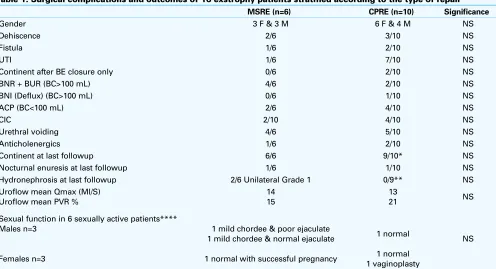
Surgical complications and outcomes are summarized in Table 1. Dehiscence of the primary closure was observed in five of 16 (31.3%) patients. In one boy who had osteotomy at time of CPRE, reclosure was carried out urgently at age of three weeks. Four patients who were initially closed with-out osteotomy and immobilized with mummy wrap were reclosed with osteotomy at the age of one year. Three of 16 (18.8%) had vesicocutanous fistula, and corrected at a later stage. None of the male patients post-CPRE had corporal loss after the procedure. Eight of 16 (50.0%) had breakthrough
UTI. Two of them required further surgical treatment — lapa-roscopic nephrectomy in one with poorly functioning kidney and bladder diverticulectomy with BUR in the second.
By the age of five years, only two girls (12.5%) were continent, while the remaining 14 patients (87.5%) were incontinent. Seven of 14 patients (50.0%), three male and four female, with BC ≥ 100 ml underwent BUR and BNR, or BNI. BNI was done in only one patient post-CPRE with mild incontinence and acceptable BN by cystoscopic exam. Options of BNR vs. BNI were given to the family and they chose BNI. We believe BNI should be offered to patients who have some degree of continence and not soaking wet.4
The remaining seven patients, four male and three female, with BC <100 ml (three with history of dehiscence) under-went ACP, BNR, BUR, and Mitrofanoff , except one girl, who continued to refuse augmentation.
By the end of followup period, ranging from 10.2‒24.6 years, daytime continence was achieved in 15/16 (93.8%) patients, of whom three patients without ACP required anti-cholinergic medications. Nine of 15 (60.0%) patients, three male and six female, could void through urethra, while the remaining six patients who had ACP required clean inter-mittent catheterization (CIC). Two of 15 (13.3%) continent patients, one (6.7%) post-BE closure only, and one (6.7%) post-BNR and BUR had nocturnal enuresis.
UFM data at last followup was available for seven of nine patients who void per urethra. Mean Qmax was 13.1 ml/sec; mean average flow 12.3 ml/sec; mean voided volume 164.7 ml, with a mean residual of 47.1 ml. The mean residual urine percentage of the whole BC was 18%. Flow curve was bell-shaped in three, flattened in three, and plateau in one.
The mean BC for patients who underwent BE repair only was 158 ml at mean age of 95±20 months. For patients who underwent BNR and BUR, or BNI the mean BC was 221 ml at mean age of 116±30 months. Patients who underwent ACP, BNR, and BUR had a mean BC of 445±122 ml at mean age of 106±30 months.
The final status of the UT, as evaluated by US and dimer-captosuccinic acid (DMSA) scan is depicted in Table 1. Sexual function in six sexually active patients is depicted in Table 1.
Discussion
There has been always debate in the literature about the percentage of patients with classic BE who could achieve continence and void per urethra in reasonable frequency, as well as empty their bladders almost completely, while maintaining normal UT.3
The definition of continence varied in the literature. Herein, we followed the agreement of the majority to con-sider three hours dry interval in children ≥5 years as a fair and satisfactory dryness period that allows these children to manage most of their daily activities without social embar-rassment or abstinence.3
Continence rates after BE repair vary widely in the litera-ture. Johns Hopkins experience of 67 male and 41 female patients post-MSRE showed that continence (three-hour dry interval, nighttime dryness and urethral voiding) was achieved in 47/67 (70.1%) and 31/41 (75.6%) of patients, respectively. Thirteen (13) of 67 (19.4%) of boys failed BNR and seven of 13 underwent continent diversion, while the
remaining six were still incontinent. On the other hand, seven of 41 girls failed BNR, four of whom underwent ACP, BNC, and Mitrofanoff, while the other three remained incon-tinent. Their reports lacked data on UT status or urodynamic evaluation.5,6
The Seattle group reviewed their prolonged experience of 39 CPRE cases and identified 23/39 (59.0%) valid for conti-nence evaluation.7 Continence was reported in 17/23 (73.9%)
using two-hour dry interval and urethra voiding. This was achieved through CPRE alone in five of 17 (29.4%), BNI in three of 17 (17.6%), BNR in four of 17 (23.5%), or combined BNR and BNI in five of 17 (29.4%). ACP was needed only in one patient upon view of small BC. CIC was used as an assist to fully evacuate the bladder in four of 17 patients and was used exclusively by one to gain continence. They did not pres-ent urodynamic data and the UT status was prespres-ented collec-tively for the whole cohort and was not stratified to show the impact of different combinations, especially in the continent group. Valid renal units available for evaluation were 56, of whom 17 (30.4%) had no hydronephrosis (HN), 25 (44.6%) had mild, 10 (17.9%) had moderate, and four (7.1%) had severe HN. VUR was managed collectively in 21/39 patients with BUR and in three of 39 patients by Deflux®.
Boston experience with regard to continence was avail-able for 21/32 (65.6%) who underwent CPRE and were older
Table 1. Surgical complications and outcomes of 16 exstrophy patients stratified according to the type of repair MSRE (n=6) CPRE (n=10) Significance
Gender 3 F & 3 M 6 F & 4 M NS
Dehiscence 2/6 3/10 NS
Fistula 1/6 2/10 NS
UTI 1/6 7/10 NS
Continent after BE closure only 0/6 2/10 NS
BNR + BUR (BC>100 mL) 4/6 2/10 NS
BNI (Deflux) (BC>100 mL) 0/6 1/10 NS
ACP (BC<100 mL) 2/6 4/10 NS
CIC 2/10 4/10 NS
Urethral voiding 4/6 5/10 NS
Anticholenergics 1/6 2/10 NS
Continent at last followup 6/6 9/10* NS
Nocturnal enuresis at last followup 1/6 1/10 NS
Hydronephrosis at last followup 2/6 Unilateral Grade 1 0/9** NS Uroflow mean Qmax (Ml/S)
Uroflow mean PVR %
14 15
13
21 NS
Sexual function in 6 sexually active patients**** Males n=3
Females n=3
1 mild chordee & poor ejaculate 1 mild chordee & normal ejaculate
1 normal with successful pregnancy
1 normal
1 normal 1 vaginoplasty
NS
than four years. Three of 21 (14.3%) required BNI, while six of 21 (28.6%) required BNR. Dry intervals were <1 hour in seven of 21 patients (33.3%), 1‒2 hours in six (28.6%), 2‒3 hours in four (19.0%) and >3 hours in four of 21 (19.0%). None of the patients in their series needed ACP, while two needed CIC.8 Seventeen (17) of 32 required BUR, six after
BNR. Of the remaining 15 patients, six had unilateral, six had bilatera , and three didn’t have VUR. At the end of their followup period, seven of 32 patients had mild-moderate HN, four bilateral and three unilateral. Nine of 32 patients had pyelonephristis, six with scarring. Urodynamic study (UDS) was available for 27/32 patients. All except one patient had a BC <70% of the predicted value for age. Two of 27 had dertruser overactivity. Simultaneous electromyo-gram (EMG) was done in 13/27 patients and showed normal synergic sphincter with voiding.
Results of continence after BNR vary extensively in the-literature. Mouriquand et al reported 45% continence rate of 80 children with BE.9 Capolicchio et al reported 94%
continent female compared to 69% male, flagging the gen-der impact on results.10 In the present report, seven of 16
(43.8%), four female and three male, were continent after BNI or BNR only.
The need for ACP is widely variable between series, reported in 0–70% of children. This reduces the ability to void spontaneously to about 50% of children.11 In our series,
augmented patients (37.5%) enjoyed bigger BC and a safe UT, but at the cost of need for CIC.
One of the questions still awaiting an answer is how far we can go to achieve the best possible continence while keeping UT safe? It is a management dilemma, which should not overlook other factors, such as each patient and fam-ily preferences, motivation, and tolerance to the available options.
The main objective of this study is to find out the outcome of these patients while managed in a low-volume centre and not to directly compare different surgical approaches. The high rate of fistula and dehisce may be explained by the fact that some of the earlier patients in this series were managed initially by adult urologists.
Data from our series showed that continence follow-ing successful BE closure only is 12.5%. This increased to 93.8% after successful BNI, BNR, or ACP, considering a dry interval of three hours, regardless of the method of voiding. Continence decreased to 60% if we considered the ability of urethral voiding. Our outcomes may not be different from high-volume centres due to the fact that most primary or subsequent surgical interventions were performed by two surgeons who developed exstrophy experience while work-ing at other institution.
Patients with BE have normal libido compared to the normal population.12 Reconstructing the genitalia in a way
that allows normal sexual intercourse is a matter of priority.13
Short penis, chordee, and poor ejaculation quality are the most common complaints faced in clinical practice.
In this series, six of 16 (37.5%) were sexually active, three male and three female. Of the male patients, two had mild chordee and unconventional position for successful penetration, while one had poor ejaculation. Of the female patients, one required vaginoplasty because of stenosed vaginal introitus, while the other two had normal sexual activity, one with successful pregnancy.
The main restriction to our work is the small number of cases, lack of complete documentation of some variables (such as bladder plate size), and the retrospective nature. Although only few centres around the world are able to recruit enough cases to generate reportable conclusions, there is still room for smaller series to probe debatable issues. There is generally a lack of prospective studies on BE in the literature, therefore, retrospective ones are still the most used reporting tool.
Conclusion
Despite the small number of patients and the reterospec-tive nature of the study, some observations are noteworthy. Continence following successful BE closure only is low at 12.5%. An auxiliary continence procedure to achieve conti-nence seems to be inevitable. Conticonti-nence rate after success-ful auxiliary procedure rose to 93.8%. This might be at the cost of urethral voiding, which was achieved in 60%. Our outcomes may not be different from high-volume centres due to the fact that most primary or subsequent surgical interventions were performed by two exstrophy-experienced surgeons. For this reason, we recommend assigning des-ignated centres for BE repair that receive most new and repeat cases.
Competing interests: The authors declare no competing financial or personal interests.
This paper has been peer-reviewed.
References
1. Ezell WW, Carlson HE. A realistic look at exstrophy of the bladder. Br J Urol 1970;42:197-202. http:// dx.doi.org/10.1111/j.1464-410X.1970.tb10022.x
2. Nelson CP, Dunn RL, Wei JT, et al. Surgical repair of bladder exstrophy in the modern era: Contemporary practice patterns and the role of hospital case volume. J Urol 2005 174:1099-102. http://dx.doi. org/10.1097/01.ju.0000169132.14799.33
3. Lloyd JC, Spano SM, Ross SS, et al. How dry is dry? A review of definitions of continence in the con-temporary exstrophy/epispadias literature. J Urol 2012;188:1900-4. http://dx.doi.org/10.1016/j. juro.2012.07.017
4. Shah BB, Massanyi EZ, Dicarlo H,et al. Role of urethral bulking agents in epispadias-exstrophy complex patients. J Pediatr Urol 2014;10:176-80. http://dx.doi.org/10.1016/j.jpurol.2013.08.004 5. Baird AD, Nelson CP, Gearhart JP. Modern staged repair of bladder exstrophy: A contemporary series. J
6. Purves JT, Baird AD, Gearhart JP. The modern staged repair of bladder exstrophy in the female: A contemporary series. J Pediatr Urol 2008;4:150-3. http://dx.doi.org/10.1016/j.jpurol.2007.08.003 7. Shnorhavorian M, Grady RW, Andersen A, et al. Long-term followup of complete primary repair of exstrophy: The Seattle experience. J Urol 2008;180:1615-9; discussion 1619-20. http://dx.doi.org/10.1016/j. juro.2008.04.085
8. Gargollo PC, Borer JG, Diamond DA, et al. Prospective followup in patients after complete primary repair of bladder exstrophy. J Urol 2008;180:1665-70; discussion 1670.
9. Mouriquand PD, Bubanj T, Feyaerts A, et al. Long-term results of bladder neck reconstruction for inconti-nence in children with classical bladder exstrophy or incontinent epispadias. BJU Int 2003;92:997-1001; discussion 1002. http://dx.doi.org/10.1111/j.1464-410X.2003.04518.x
10. Capolicchio G, McLorie GA, Farhat W, et al. A population-based analysis of continence outcomes and bladder exstrophy. J Urol 2001;165:2418-21. http://dx.doi.org/10.1016/S0022-5347(05)66218-0
11. Woodhouse CR, North AC, Gearhart JP. Standing the test of time: Long-term outcome of reconstruction of the exstrophy bladder. World J Urol 2006; 24(3):244-9. http://dx.doi.org/10.1007/s00345-006-0053-7
12. Woodhouse CR. Sexual function in boys born with exstrophy, myelomeningocele, and micropenis. Urology
1998;52:3-11. http://dx.doi.org/10.1016/S0090-4295(98)00121-6
13. Stein R, Hohenfellner K, Fisch M, et al. Social integration, sexual behaviour and fertility in patients with bladder exstrophy: A long-term followup. Eur J Pediatr 1996; 155:678-83.