International Journal of Computer Science and Mobile Computing
A Monthly Journal of Computer Science and Information Technology
ISSN 2320–088X
IJCSMC, Vol. 4, Issue. 7, July 2015, pg.588 – 596
RESEARCH ARTICLE
Age Grouping with Central Local Binary Pattern
Value Flooding Matrix based Shape Patterns
Dr. P.Chandra Sekhar Reddy
Professor, CSE Departement, Gokaraju Rangaraju Institute of Engineering and Technology, Hyderabad
Abstract- In this paper a novel method based on facial skin aging features is proposed to classify the human face images into two age groups. The facial skin aging features are extracted as shape patterns on Central Local Binary Pattern Value Flooding Matrix (CPFM). The shape patterns Lower Triangular Matrix Pattern (LTMP), Upper Triangular Matrix Pattern (UTMP) and Tri-Diagonal Matrix Pattern (TDMP) on CLBPVFM of facial images are calculated and these features are used for age grouping. This framework is trained and tested with FG-Net aging database has shown considerable improvement in the grouping of adult and child groups.
Keywords: Age classification, Central Local Binary Pattern Value Flooding Matrix, LTMPC, UTMPC.
1. INTRODUCTION
2. METHODOLOGY
In this method LBP of the facial image is computed and central lbp value based texel are determined, and then shape patterns are evaluated, is explained in the following sections.
Step -1: Color image to Gray Image conversion
The original colour image is converted into a grey level image using RGB color quantization method.
Step-2: Local Binary Pattern
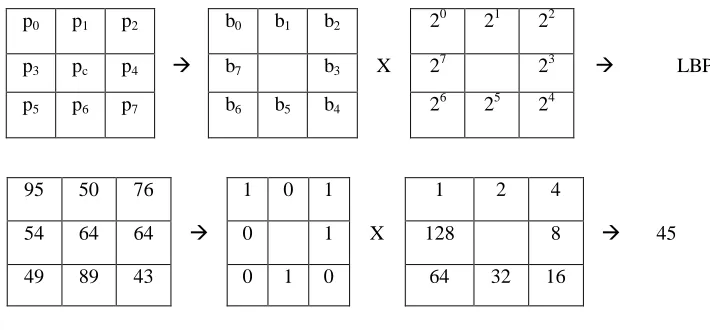
The LBP is computed on the image for obtaining local neighborhood information of pixels [18]. The computation of LBP with an example is illustrated in figure1. A 3×3 neighborhood consists of a set of nine elements, P = {pc, p0, p1,…, p7}, where pc represents the gray level value of the central pixel and pi (0≤i≤7) represent the gray level values of neighbor pixels. Each 3×3 neighborhood then can be characterized by a set of binary values bi (0≤i≤7) as given in equation1.
0
0
1
0
i i ip
p
b
(1)where ∆pi= pi-pc.
For each 3×3 neighborhood, a unique LBP is derived from the equation2.
7 0 ,2
i i i i R Pb
LBP
(2)Every pixel in an image generates an LBP code. A single LBP code represents local micro texture information around a pixel by an integer code in between 0 and 255.
p0 p1 p2 b0 b1 b2 20 21 22
p3 pc p4 b7 b3 X 27 23 LBP
p5 p6 p7 b6 b5 b4 26 25 24
95 50 76 1 0 1 1 2 4
54 64 64 0 1 X 128 8 45
49 89 43 0 1 0 64 32 16
Fig. 1: Computation of LBP.
Step-3: Computing Central Local Binary Pattern Value Flooding Matrix (CLBPVFM)
process is called a central lbp value flooding. The CLBPVFM is computed over the whole image is described as follows.
(1) Central lbp value floodings I1(x,y), I2(x,y), I3(x,y) and I4(x,y) are computed starting from position (1,1), (1,2), (2,1) and (2,2) respectively with 3x3 block from left-to-right and top-to-bottom throughout LBP image I(m,n) with a step-length of three along both horizontal and vertical directions.
(2) The final Central Local Binary Pattern Value Flooding Matrix, denoted by CLBPVFM (x,y) is computed using equation 3.
CLBPVFM (x,y) = p (3)
Where p is avg (or) avg_g
avg= (I1(x,y) +I2(x,y)+ I3(x,y)+ I4(x,y) ) /r , r is the number of non-zero intensity values .
avg_g = a value which is just greater than avg and equal to one of four intensity values I1(x,y), I2(x,y), I3(x,y) and I4(x,y) at position (x,y).
An example of central pixel flooding matrix detection is shown in Fig.2.
8
7
8
8
0
8
8
8
4
8
8
0
5
8
9
0
8
0
(a) 3x3 block with gray values (b) Central lbp value flood
5
5
7
9
2
3
8
0
0
0
0
0
0
0
4
6
9
1
8
8
8
0
6
0
0
8
8
0
3
3
6
1
3
4
4
0
0
6
0
0
0
0
8
5
5
3
1
6
4
8
0
0
0
1
0
0
5
8
9
5
1
4
4
0
8
0
0
1
0
0
4
8
9
9
5
4
6
0
8
0
0
0
0
0
8
9
5
3
5
4
4
0
0
0
0
0
0
0
0
0
0
9
0
0
8
0
0
0
0
0
0
0
0
0
9
0
8
8
8
0
0
0
0
0
0
0
0
0
0
0
0
0
0
3
3
0
0
3
0
0
0
0
0
0
1
0
4
0
0
0
3
0
0
0
0
0
9
0
1
4
4
0
8
0
5
0
0
0
0
0
9
9
0
4
0
0
8
0
0
5
0
0
0
0
0
0
0
0
0
8
0
0
0
5
0
0
(e) I2(x,y) (f) I3(x,y)
0
0
0
0
0
0
0
0
0
0
9
0
0
8
0
6
0
0
0
0
0
0
6
9
0
8
8
0
0
0
6
0
0
4
4
3
3
6
0
0
4
4
0
0
0
0
0
0
4
8
0
0
3
1
0
4
0
0
9
0
0
4
4
0
8
9
5
1
4
4
0
0
9
9
0
4
0
0
8
9
9
5
4
0
0
0
0
0
0
4
4
8
0
0
0
5
4
4
(g) I4(x,y) (h) Central Local Binary Pattern Value Flooding Matrix
Fig.2. Detection of Central pixel flood matrix
Step 4: Evaluation of Matrix Shape Patterns
N
0
0
N
N
N
N
N
0
N
N
0
0
N
N
N
N
N
N
N
N
0
0
N
0
N
N
(a) (b) (c)
Fig 3: a) Lower Triangular Matrix Pattern (LTMP) b) Upper Triangular Matrix Pattern (UTMP)
c) Tri Diagonal Matrix Pattern(TDMP) , where N is a nonzero element
3. RESULTS AND DISCUSSIONS
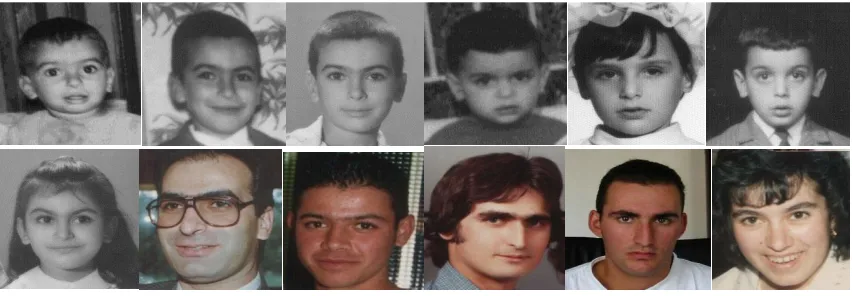
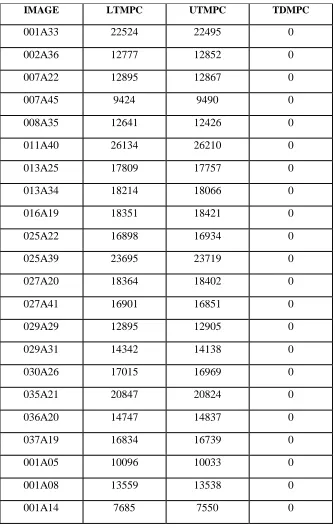
The proposed method established a database of the 1002 face images collected from FG-NET database and other 600 images collected from the scanned photographs and sample of these images are shown in Fig.4. In this method, images are classified into two groups as a child (upto 18 years) and adult (above 18 years) based on count of shape patterns. The count of each shape patterns i.e. LTMPC, UTMPC, and TDMPC on CLBPVFM are evaluated on facial images and the results for a sample of 20 images is listed out in table1.
From the table1 it is observed that LTMPC and UTMPC are dominant patterns and TDMPC patterns are not dominant patterns as these are zero for age varying images. So LTMPC and UTMPC can be considered for age classification. The algorithm1 is proposed to classify images adult and child groups.
Table 1. The count of LTMP, UTMP, TDMP patterns
IMAGE LTMPC UTMPC TDMPC
001A33 22524 22495 0
002A36 12777 12852 0
007A22 12895 12867 0
007A45 9424 9490 0
008A35 12641 12426 0
011A40 26134 26210 0
013A25 17809 17757 0
013A34 18214 18066 0
016A19 18351 18421 0
025A22 16898 16934 0
025A39 23695 23719 0
027A20 18364 18402 0
027A41 16901 16851 0
029A29 12895 12905 0
029A31 14342 14138 0
030A26 17015 16969 0
035A21 20847 20824 0
036A20 14747 14837 0
037A19 16834 16739 0
001A05 10096 10033 0
001A08 13559 13538 0
Let LTMPC, UTMPC, and TDMPC be count of LTMP, UTMP and TDMP patterns
Begin
If (((LTMPC>17044)&&(LTMPC<7288))&&((UTMPC>17055)&&(UTMPC<7249)))
{
Write(„Child Image‟);
}
Else
{
Write(„Adult Image‟);
}
End
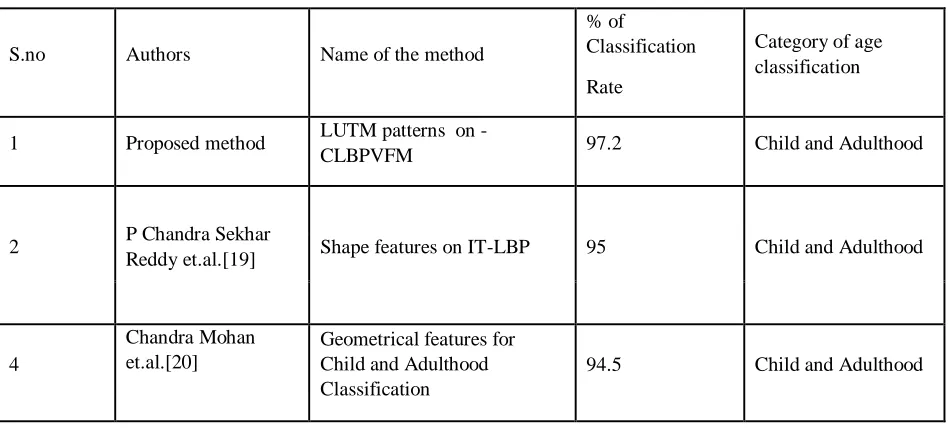
The algorithm1 classified the FG-Net facial images into two groups with 97.2% correct classification rate. The proposed method for age grouping is compared with the existing methods, Age classification with shape features on lbp based texton by P Chandra Sekhar Reddy et.al.[19] and Child and adulthood classification with geometrical features by Chandra Mohan et.al.[20]. The comparison table for proposed and existing methods with the percentage of classification rate is listed in table2. The results indicate that the proposed scheme outperforms with other methods.
Table 2: Comparison of the proposed LUTM patterns on CLBPVFM with other methods.
S.no Authors Name of the method
% of
Classification
Rate
Category of age classification
1 Proposed method LUTM patterns on
-CLBPVFM 97.2 Child and Adulthood
2 P Chandra Sekhar
Reddy et.al.[19] Shape features on IT-LBP 95 Child and Adulthood
4
Chandra Mohan et.al.[20]
Geometrical features for Child and Adulthood Classification
4. CONCLUSION
The present paper evaluated shape patterns on a 3x3 mask using CLBPVFM. The age changing in images is identified with count of LTMP, UTMP. This is a new method for identifying variation of skin wrinkles in facial images of age varying people with shape patterns. So classification algorithm uses only these two shape pattern features. The percentage of classification rate is 97.2% and this is good classification rate from table2. The proposed method for age classification is easy to implement and also efficient compared to other schemes. The CLBPVFM with new shape patterns can be extended in future work.
REFERENCES
[1] Iga, R., Izumi, K., Hayashi, H., Fukano, G., Ohtani, T.: A gender and age estimation system from face images. SICE Annual Conference in Fukui (2003) ,202–209.
[2] Lanitis, A.: On the significance of different facial parts for automatic age estimation. 14th International Conference on Digital Signal Processing 2 (2002) 1027–1030.
[3] Kwon, Y., Lobo, N.: Age classification from facial images. Computer Vision and Image Understanding 74(1) (1999) 1–21.
[4] Horng, W., Lee, C., Chen, C.: Classification of age groups based on facial features. Tamkang Journal of Science and Engineering 4(3) (2001) 183–192.
[5] Young-Hwan Choi , Kyungrok Kim, and Eenjun Hwang , “ classification based skin aging analysis”, International Asia-Pacific Web Conference, 2010, pp. 347-349.
[6] Yun, F., Ye, X. and Huang,2007, Estimating Human Age by Manifold Analysis of Face Pictures and Regression on Aging Features, Proc. of 2007 IEEE International Conference on Multimedia and Expo, pp. 1383-1386.
[7] Rama Nathan and Chellappa R.,2006, Modeling age progression in young faces , proc. IEEE conf CVPR, vol.1, 387-394.
[8] Xin Geng, Zhi-Hua Zhou, Yu Zhang, Gang Li, Honghua Dai,2006, Learning from facial aging patterns for automatic age estimation Proceedings of the 14th annual ACM international conference on Multimedia,307-316.
[9] Lanitis, A. , Draganova, and Christodoulou, 2004, Comparing different classifiers for automatic age estimation. IEEE Transactions on Systems, Man, and Cybernetics, Part B, 34(l), 621-628.
[10] Fu Y., Huang, T.S,2008, Human age estimation with regression on the discriminative aging manifold ,IEEE Tran multimedia, vol 10,4, 578-584.
[11] Lanitis, A. ,C Taylor, and Cootes ,2002, Towards automatic simulation of aging effects on facial images , IEEE Trans. Pattern Anal.macine intelligence Vol 24,4, 442-455.
[12] Yan,S., Wang, T.S, Huang and Tang X.,2007, Ranking with uncertain labels , IEEE International Conference on Multimedia and Expo,96-99,2007.
[13] Mina Hashemian, Hossein Pourghassem,2013, Facial Emotion Processing in Autism Spectrum Disorder Based on Spectral Features of EEG Signals, International Journal of Imaging and Robotics, Volume 11, Issue Number 3, 68-80.
[14] Juha Ylioinas, Abdenour Hadid, Matti Pietikäinen, 2012, Age Classification In Unconstrained Conditions Using LBP Variants, proc. ICPR 2012, 1257-1260.
Image Compressed and Fuzzy Reduced Grey Level (SICFRG) Model, International Journal On Computer Science And Engineering (IJCSE), Vol. 5 No. 06, 481-492.
[17] P.Chandra Sekhar Reddy, B.Eswara Reddy and V.Vijaya Kumar, ”New Method for Classification of Age Groups Based on Texture Shape Features,” International Journal of Imaging and Robotics(IJIR), Volume 15(1), pp.19-30, 2015.
[18] T. Ojala, M. Pietikäinen, D. Harwood, A comparative study of texture measures with classification based on featured distributions, Pattern Recogn. 29 (1) (1996) 51–59.
[19] P.Chandra Sekhar Reddy, B. Eswara Reddy and V. Vijaya Kumar”Texton Based Shape Features on Local Binary Pattern for Age Classification,” International Journal of Image, Graphics, and Signal Processing(IJIGSP), Volume4(7), pp.54-60, 2012.
[20] M. Chandra Mohan, V. Vijaya Kumar and B. Sujatha, “Classification of child and adult based on geometric features of the face using linear wavelets”, International Journal of Signal and Image Processing, Vol. 1, No. 3, pp. 211 -220, 2010.
AUTHORS PROFILE
Dr. P. Chandra Sekhar Reddy completed his B.Tech in Computer Science & Engineering from Sri Krishna Devaraya University. He received the Master‟s Degree in
M.Tech in Computer Science & Engineering from Jawaharlal Nehru Technological University Hyderabad. He received his Ph.D. Degree in Computer Science & Engineering