Available Online atwww.ijcsmc.com
International Journal of Computer Science and Mobile Computing
A Monthly Journal of Computer Science and Information Technology
ISSN 2320–088X
IMPACT FACTOR: 6.017IJCSMC, Vol. 6, Issue. 6, June 2017, pg.430 – 440
APPLICATION OF COLOR BASED IMAGE
SEGMENTATION PARADIGM ON RGB COLOR PIXELS
USING FUZZY C-MEANS AND K MEANS ALGORITHMS
Ramaraj.M
*1, S.Niraimathi*
21
Research Scholar, Department of Computer Science, NGM College, Pollachi, India
Associate Professor, Department of Computer Science, NGM College, Pollachi India
ABSTRACT: Color is one of the properties which add information to the images. Classes of pixels are difficult to
be identified when the color distributions of the different objects highly overlap in the color space and when the
color points give rise to non-convex clusters. Color based image segmentation using fuzzy c means and k means
algorithms can be used for the clustering of color image. This method is used to cluster and measure accuracy of
the color images by segmenting each color pixels in the color images. Once segmentation is done, the fuzzy c
means method is used for creating membership operation functions to define the degree to which a pixel belongs
to an edge or a uniform region. The k- means clustering is used to partition n data points into k clusters. This
unsupervised clustering approaches has a strong affinity to get trapped into local minima while generating an
optimal solution. Hence, it makes clustering wholly dependent on the distribution of primary cluster centre. This
research work is employed to find the distance between color pixels of the RGB color spaces. Implementation has
been done using MATLAB Simulation tool which generates the better result of this clustering algorithms.
Keywords: image segmentation- color image segmentation, RGB color spaces, Clustering- k-means, fuzzy
INTRODUCTION
Image segmentation is one the most important task of image processing and steps in image partitioning and their
analysis. Many of the application requires highly accurate and computationally faster image processing algorithms.
Segmentation is usually the first task of any image analysis process and thus subsequent task rely heavily on the
quality of segmentation. Image segmentation is typically used to locate object and boundaries of lines curves etc…
in the images. And more precisely, image segmentation is a process of assigning a label to every pixel in an image
such that pixel with the same label share the same visual characteristics. A type of segmentation is color based
image segmentation which this paper details. This might be color information that is used to create histograms, or
information about the pixels that indicate edges or boundaries or texture information. The color based image
segmentation is widely used in most of the multimedia application.
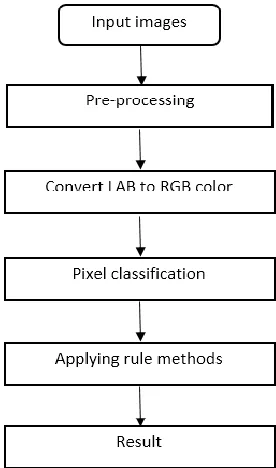
Figure 1: block diagram for pixel classification.
Figure 1 shows the pixel classification task and step-by-step process followed for segmenting input images.
1.1 Color Based Image Segmentation
Color image segmentation is useful in many applications. From the segmentation results, it is possible to identify
regions of interest and objects in the scene, which is very beneficial for the subsequent image analysis or annotation.
The problem of segmentation is difficult because of the image texture. If an image contains only homogeneous color
regions, clustering methods in color space such as are sufficient to handle the problem. In reality, natural scenes are
The color information in each image region can be represented by a few quantized colors, which is true for most
color images of natural scenes. The colors between two neighboring regions are distinguishable - a basic assumption
of any color image segmentation algorithm.
1.2 Pixel Classification and image classification
The intent of the classification process is to categorize all pixels in a digital image into one of several land cover
classes, or "themes". This categorized data may then be used to produce thematic maps of the land cover present in
an image. Normally, multispectral data are used to perform the classification and, indeed, the spectral pattern present
within the data for each pixel is used as the numerical basis for categorization
1.3 Minimum distance Classification
Minimum distance classifies image data on a database file using a set of 256 possible class signature segments as
specified by signature parameter. Each segment specified in signature, for example, stores signature data pertaining
to a particular class. Only the mean vector in each class signature segment is used. Other data, such as standard
deviations and covariance matrices, are ignored (though the maximum likelihood classifier uses this).The gray-level
value used to encode a class is specified when the class signature is created. If the theme map is later transferred to
the display, then a pseudo-color table should be loaded so that each class is represented by a different color.
1.4 Color Pixel Pattern matching
The color pixel pattern matching method has to be used on every individual pixel to inter connect with other color
pixel. They have every pixel of RGB color value starting and ending with 0 to 255. Color Pixel Pattern Matching is
represented using multi-dimensional array and the value is calculated.
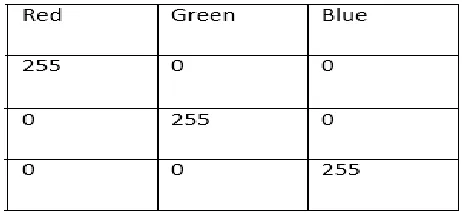
Table 1: it shows the value of RGB color range
Table 1 is represented with RGB color range values. The pixel range value is starting with 0 to 255 and grouping
with each pixel has been representing with array value. Example R= [255 0 0] this is a red value, G= [0 255 0] and
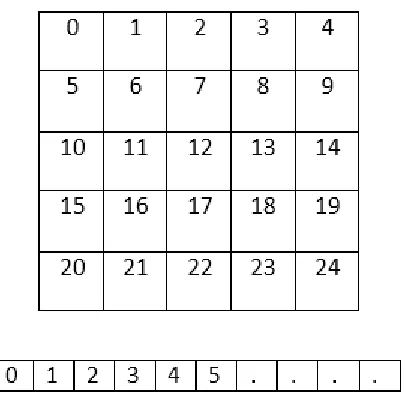
Table 2: storing the color pixel values in an array format.
Table 2 shows that the pixels are familiar with idea of each color pixel on the screen having an x and y position on
the two dimensional array. The array of pixels has only one dimensional of storing color values in linear sequence.
LITERATURE REVIEW
The literature review details the several authors description on color spaces, Fuzzy Logic and K-means algorithm.
K. Sakthivel et al [2014] describes a color image segmentation using SVM pixel classification of image. This paper
is based on image segmentation that cluster pixels into salient image regions. Segmentation could be used for object
recognition, occlusion boundary estimation within motion or stereo systems, image compression, image editing, or
image database lookup. These features are extracted using the homogeneity model and Gabor Filter. With the
extracted pixel level features, the SVM Classifier is trained by using FCM (Fuzzy C-Means).The image
segmentation takes the advantage of both the pixel level information of the image and also the ability of the SVM
Classifier.
Nikita Sharma et al [2012] describes that color image segmentation techniques can be compared with many
methods such as K-means, threshold edge based techniques and region based techniques. The threshold is to be done
based on color. The segmentation allows the elimination of a great amount of unwanted pixels, and it retains only
those pixels in object we are interested in the researchers would evaluate their image segmentation techniques.
Fatenabushmmala et al [2013] describes various color based image segmentation techniques that has been applied to
different version of K-means in two dimensional spaces and shows authors calculation and observation on the
performance of three different study as K-means, Weighted K-means, and inverse weighted K-means clustering
algorithms for different types of color spaces (RGB and LAB color spaces).
Preeti rani et al [2016] describes a color based image segmentation methodology that has been used for partitioning
similar attributes. This work tries to find the PSNR values to be calculated to the segment the images and to generate
the output accurately in terms of color segmentation.
Arashabadpour et al [2008] describes a new color image segmentation method, which utilizes the general clustering
algorithm with an innovative distance function. Comparison of the proposed method with an available clustering
method which searches for similar cylindrical structures in the pixel domain. Dina khattab et al [2014] describes the
evaluation of the performance of color based image segmentation using the automatic Grab cut techniques. The
method has been applied to some color spaces the experimental results have been analyzed using different images
with different color spaces.
S.M.Aqil Burney et al [2014] describes the analysis of K-means clustering algorithm for image segmentation
methods. This work proposes how to work on the K-means clustering algorithm for some color spaces, (RGB and
LAB color spaces to be compared with this article) find some measurement and to calculate the accuracy of the
color space in RGB and other color spaces.
Gunjanmathur et al [2014] describes a method to analyze the performance of K-means clustering algorithm in
different color spaces of color image segmentation. K-means clustering algorithm divides into K clusters based on
the similarity between the pixels in that cluster. The Euclidean distance formula is used to define the K-means
clustering, and applied across variety of color spaces in various color images. NameirakpamDhanachandra et al
[2015] analyzes the various clustering techniques, such as, K-means clustering, Fuzzy C-means clustering algorithm
that is applied for the segmentation of the color image and compared with the classical methods. R.R.Gharieb et al
[2015] describes a new clustering technique for Fuzzy C-means clustering algorithm. Fuzzy C-means with local
membership based on weighted pixel distance and Kullback-Leibler divergence for image segmentation. A local
membership which is based on weighted distance and KL information divergence FCM algorithm has been used.
The local membership has been used for weighting the pixel to cluster center distance and for formulating KL
membership divergence acting as a fuzzification and regularization function.
E.A.Zanaty [2012] analyzes the number of clusters for kernelized fuzzy c-means algorithm that does automatic
segmentation of MRI images. The original Euclidean distance in the FCM is replaced by a Gaussian radial basic
function classifier (GRBFC) and the corresponding algorithm FCM methods are derived. The derived algorithm are
called as the kernelized fuzzy c-means and kernalized fuzzy c-means with spatial constraints (SKFCM).the hope is
that the number of clusters with in an image can be determined automatically.
METHODOLOGY
3.1 color models
A color space is a specific organization of colors. In combination with physical device profiling, it allows for
reproducible representations of color, in both analog and digital representations. A color space may be arbitrary.
A color model is an abstract mathematical model describing the way colors can be represented as tuples of numbers
an absolute color space is a more or less arbitrary color system with no connection to any globally understood
system of color interpretation.
3.1.1 RGB color Spaces
An RGB color space is any additive color space based on the RGB color model. A particular RGB color space is
defined by the three chromaticity’s of the red, green, and blue additive primaries, and can produce any chromaticity
that is the triangle defined by those primary colors.
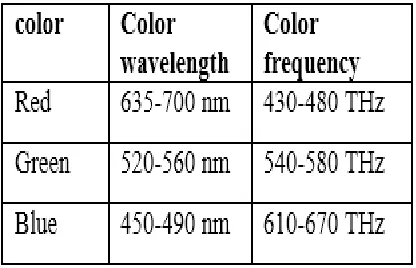
Table 2: The range of RGB color is representing with wavelength and frequency.
Table 2 shows the range of RGB color values Range of Color wave length in nanometer and level of color frequency
values used to generate the particular color.
3.1.2 Calculate the Number of Pixel
Pixel is the smallest element of an image. Each pixel corresponds to any one value. In an 8-bit gray scale image, the
value of the pixel between 0 and 255. Each pixel store a value proportional to the light intensity at that particular
location of x and y.
The mathematically formula to calculate the pixel value is as:
Where x and y coordinates denotes that the total no of pixel to be calculated. The value of the color pixel at any
point denotes the intensity of color image at that location, in more detail about the value of the pixels in the image
storage and bits per pixel value of color image. Each pixel can have only one value and each value denotes the
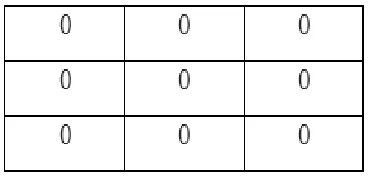
Table 3: standard black pixel value.
Table 3 shows that, any color pixel can have a very unique value 0. The value is 0 means absence of light. It means
that is 0 denotes dark. Whenever, a pixel has a value of 0, it means at that point, black color would be formed.
3.2 K-means clustering
K-means clustering algorithm is a partitioning algorithm that relocates instance by moving from one cluster to
another until desired clustering structure is obtained. K-means clustering algorithm partitions data into K-cluster
(C1, C2, ……., Ck), represented by their centers or mean.
∑ ∑ ‖ ( ) ‖2
……….(1)
Where ‖ ( ) ‖ is a chosen to be the distance measure between a ( ) data point and the cluster center , which
is an indicator of the distance of n data points from their respective cluster center.
∑ ‖ ( ) ‖……….. (2)
Where ( ) be an input pixel to the cluster for each RGB color channel, i=3 and be the cluster center of i
channel of color image, after that the new position of the cluster center of the pixel is recalculated using equation 3.
∑ ∑ ( ) ……… (3)
The center of the each cluster is calculated as the mean of all the instance belonging to that cluster as following the
equation 4:
∑ ……….. (4)
Where is the number of instance belonging to cluster k and and the mean of cluster k. This produces a
separation of the objects into groups from which the metric is calculated as the distance of color pixels.
3.3 Fuzzy clustering
Fuzzy image processing is the collection of all approaches that understand, represent and process the images, their
segments and features as a fuzzy sets. The representation processing depends on the selected fuzzy techniques. The
de-the intensity values of de-the image used. It’s used on FCM, because it is simple and effective algorithm for FCM. All
the color pixels of the image are considered in a vector space. All the color pixels of the image are represented as
[ ]T
where is denoted on intensity of color pixels and N is a total number
of pixels.
3.3.1 Calculate the membership function of
Fuzzy algorithm allows a pixel to belong to more than one class. This property is very helpful because the pixel
resolution depends on the scanning equipment. Membership function values are assigned to each pixel.
∑ ‖ ‖
{‖ ‖}
……….. (5)
If number of classes is c, then is the membership function of ithpixel in the jthclass. Where xi is the intensity of ith
pixel and i varies from 1 to N, and j varies from 1to c (which should have a minimum value of 2). The membership
matrix U is calculated using Equation 1, which considers the dataset values from the image.
3.4 Distance Matric Function
The Euclidean distance between the centerpoint and the data pixels is calculated using the formula as given below
∑
∑ ……….. (6)
‖ ‖ ……….. ……. (7)
The Euclidean distance between the centerpoint and the data pixels is calculated using the formula‖ ‖ other
distances can also be used to measure theconvergence of centroids.
Result and Discussion
Data set
In order to check the performance of our color image segmentation approach, the benchmark image data sets has
been used. The data sets are collected from various resources on the web page and stored. The data that are spread in
the image database are of different types of size of images and different format as .gif, .jpg, .png, .trf.
Implementation Process
Image segmentation process is carried out and demonstrated using matlab tool. The version of Matlab tool is
Original color images and output images:
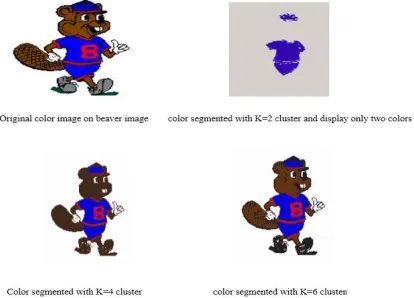
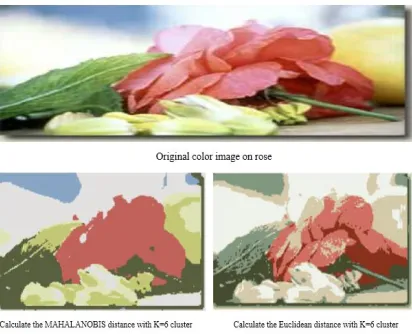
Figure 2: the original color images on texture, rose, beaver image.
Figure 3: color image segmented with the texture image using K=3 and K=5 cluster
Figure 5: comparison between MAHALANOBIS and Euclidean distance of K=6 cluster and generate the output is differ.
CONCLUSION
This paper, describes the color based image segmentation using Fuzzy C-means and K-means clustering algorithm
that can be applied to RGB color pixels. Color image segmentation can be obtained by clustering these pixels into
different groups of coherent spatial connectivity and color, a clustering algorithm with similarity measures, which
are used to segment the images with clustering methods has been proposed. The unsupervised learning process can
be applied for color pixel based clustering. Then color pixel based pattern matching method is used on RGB color
and each color pixel is grouped based on pixel value. Euclidean distance measure is employed to calculate the pixels
minimum and maximum distance in the color image. In future, the various clustering methods and matrix for the
color pixel can be used to improve the fuzzy c means clustering that can be used on color based color pixel
segmentation methods.
REFERENCES
1. A. Abadpour and S. Kasaei “ Principal Color and its Application to Color Image segmentation” ScientiaIranica,
Vol. 15, No. 2, pp 238-245 @ Sharif University of Technology, April 2008.
2. ArashAbadpour and ShohrehKasaei “Principal Color and Its Application to Color Image Segmentation”
ScientiaIranica, Vol: 15, No: 2, pp: 238-245, 2008.
3. S.M.Aqil Burney and Humera Tariq “K-Means Cluster Analysis for Image Segmentation” IJCA ISSN:
0975-8887, Volume 96, No: 4, 2014.
4. Dina Khattab, HalaMousherEbied, Ashraf Saad Hussein And Mohamed FahmyTolba “Color Image Segmentation Based On Different Color Space Models Using Automatic Grabcut” The Scientific World Journal, Hindawi
Publishing Corporation, Volume 2014.
6. R.R. GhariebandG.Gendy “Fuzzy C-Means with Local Membership Based Weighted Pixel Distance and Kl
Divergence for Image Segmentation” Journal of Pattern Recognition Research 1, pp: 53-60, 2015.
7. GunjanMathur And Hemant Purohit “Performance Analysis Of Color Image Segmentation Using K-Means
Clustering Algorithm In Different Color Spaces” ISOR Journal Of VSLI And Signal Processing, Volume 4, Issue 6,
Ver III, P-ISSN: 2319-4197, E-ISSN: 2319-4200, pp: 01-04, 2014.
8. NameirakpamDhanachandra And YambemJinaChanu “Image Segmentation Method Using K-Means Clustering Algorithm For Color Image” International Journal Of Advanced Research In Electrical And Electronic Engineering,
P-ISSN: 2349-5804, E-ISSN: 2349-5812, Volume 2, Issue 11, pp: 68-72, 2015.
9. Nilima Kulkarni “Color Thresholding Method for Image Segmentation of Natural Images” I.J. Image, Graphics
and Signal Processing, 1, pp: 28-34, 2012
10. Nikita Sharma, Mahendra Mishra, Manish Shrivastava “Colour Image Segmentation Techniques and Issues: An Approach” International Journal of Scientific & Technology Research ISSN 2277-8616 Volume 1, Issue 4, May 2012.
11. Preeti Rani And Raghuvinder Bhardwaj “An Approach Of Colour Based Image Segmentation Technique For
Differentiate Objects Using MATLAB Simulation” IJARCCE, Vol: 5, Issue: 7 E-ISSN: 2278-1021, P-ISSN:
2319-5940, 2016.
12. K. Sakthivel, R. Nallusamy, C. Kavitha “Color Image Segmentation Using SVM Pixel
Classification Image” World Academy of Science, Engineering and Technology International Journal of Computer,
Electrical, Automation, Control and Information Engineering Vol: 8, No: 10, 2014.