Improved Analysis of
ECHO
-256
∗Jérémy Jean1, María Naya-Plasencia2, and Martin Schläer3
1 Ecole Normale Supérieure, France
2 FHNW, Windisch, Switzerland
3 IAIK, Graz University of Technology, Austria
Abstract. ECHO-256 is a second-round candidate of the SHA-3 competition. It is an
AES-based hash function that has attracted a lot of interest and analysis. Up to now, the best known attacks were a distinguisher on the full internal permutation and a collision on four rounds of its compression function. The latter was the best known analysis on the compression function as well as the one on the largest number of rounds so far. In this paper, we extend the compression function results to get a distinguisher on 7 out of 8 rounds using rebound techniques. We also present the rst 5-round collision attack on the
ECHO-256 hash function.
Keywords: hash function, cryptanalysis, rebound attack, collision attack, distinguisher
1 Introduction
ECHO-256 [1] is the 256-bit version of one of the second-round candidates of the SHA-3
competition. It is an AES-based hash function that has been the subject of many studies. Currently, the best known analysis of ECHO-256 are a distinguisher on the full 8-round
internal permutation proposed in [13] and improved in [10]. Furthermore, a 4-round colli-sion attack of the comprescolli-sion function has been presented in [4]. A previous analysis due to Schläer in [14] has been shown to be incorrect in [4], but it introduced an alternative description of theECHO round-function, which has then been reused in several analyses,
including this paper. The best results of this paper are a collision attack on the hash function reduced to 5 rounds and a distinguisher of the compression function on 7 rounds. Additionally, we cover two more attacks in the Appendix. The complexities of previous results and our proposed attacks are reported in Table 1.
Apart from the improved attacks onECHO-256, this paper also covers a number of new
techniques. The merging process of multiple inbound phases has been improved to nd solutions also for the hash function, where much less freedom is available in the chaining input. For the hash function collision attack on 5 rounds, we use subspace dierences which collide with a high probability at the output of the hash function. Additionally, we use multiple phases also in the outbound part to reduce the overall complexity of the attacks. For the 7 round compression function distinguisher, we use the new techniques and algorithms introduced in [10,11].
Outline. The paper is organized as follows. In Section 2, we describe the 256-bit version of theECHOhash function and detail an alternative view that has already been used
in several analysis [4,14]. In particular, we emphasize theSuperMixColumnsandSuperSBox
∗This work was supported in part by the French ANR project SAPHIR II, by the French Délégation
Table 1: Best known cryptanalysis results onECHO-256.
Rounds Time Memory Generic Type Reference
8 2182 237 2256 Internal Permutation Distinguisher [13]
8 2151 267 2256 Internal Permutation Distinguisher [10]
4 252 216 2256 Compression Function Collision [4]
4 264 264 2128 Hash Function Collision Section B
5 2112 285.3 2128 Hash Function Collision Section 3
6∗ 2160 2128 2256 Compression Function Collision Section A
6 2193 2128 2256 Compression Function Collision Section 4
7∗ 2160 2128 2240 Compression Function Distinguisher Section A
7 2193 2128 2240 Compression Function Distinguisher Section 4
∗with chosen salt
transformations that ease the analysis. In Section 3, we provide a collision attack on this hash function reduced to 5 rounds and a distinguisher of the 7-round compression function in Section 4.
2 ECHO-256 description
ECHO is an iterated hash function and the compression function of ECHO updates an
internal state described by a16×16matrix of GF 28elements, which can also be viewed
as a 4×4 matrix of 16 AES states. Transformations on this large 2048-bit state are
very similar to the one of the AES, the main dierence being the equivalent S-Box called
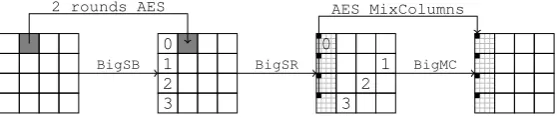
BigSubWords, which consists in two AES rounds. The diusion of the AES states inECHO
is ensured by two big transformations:BigShiftRowsand BigMixColumns(Figure 1).
BigSB
0 1 2 3
BigSR
0 1 2 3
BigMC 2 rounds AES AES MixColumns
Figure 1: One round of theECHOpermutation. Each of the 16 cells is an AES state.
At the end of the permutation, the BigFinal operation adds the current state to the
initial one (feed-forward) and, in the case of ECHO-256, adds its four columns together
to produce the new chaining value. In this paper, we only focus on ECHO-256 and refer
to the original publication [1] for more details on bothECHO-256 and ECHO-512 versions.
Note that the keys used in the two AES rounds are an internal counter and the salt, respectively: they are mainly introduced to break the existing symmetries of the AES unkeyed permutation [6]. Since we are not using any property relying on symmetry and adding constants does not change dierences, we omit these steps in the following.
Two versions of the hash function ECHO have been submitted to the SHA-3 contest: ECHO-256 andECHO-512, which share the same state size and round function, but inject
size, followed by the 16-byte message length. Focusing on ECHO-256 and denoting f its
compression function, Hi the i-th output chaining value, Mi = Mi0 ||Mi1||Mi2 the i-th
message block composed of three chunks of 512 bits each Mij and S = [C0C1C2C3] the four 512-bitECHO-columns constituting stateS, we have (H0 =IV):
C0 ←Hi−1, C1 ←Mi0, C2 ←Mi1, C3←Mi2.
AES. We recall that one round, among the ten ones, of the AES-128 permutation is the succession of four transformations: SubBytes (SB), ShiftRows (SR), MixColumns (MC)
andAddRoundKey (AK). We refer to the original publication [15] for further details.
Notations. We consider each state in theECHOinternal permutation, namely after each
elementary transformations. We start withS0, where the IV and the message are combined
and end the rst round after eight transformations inS8. To refer to the AES-state at row iand column j of a particular ECHO-state Sn, we use the notation Sn[i, j]. Additionally,
we introduce column-slice to refer to a thin column of size16×1 of theECHO state. The
process of merging two lists L1 and L2 into a new list L is denoted L = L1 ./ L2. In the event that the merging should be done under some relation t, we use the operator ./|t|, where |t| represents the size of the constraint to be veried in bits. Finally, in an
AES-state, we consider four diagonals (from 0 to 3): diagonal j ∈ [0,3] will be the four
elements(i, i+j (mod 4)), withi∈[0,3].
2.1 Alternative description
For an easier description of some of the following attacks, we use an equivalent description of one round of the ECHO permutation. First, we swap the BigShiftRows transformation
with theMixColumnstransformation of the second AES round. Second, we swapSubBytes
with ShiftRows of the rst AES round. Swapping these operations does not change the
computational result of ECHOand similar alternative descriptions have already been used
in the analysis of AES. Hence, one round of ECHO results in the two transformations
SuperSBox (SB-MC-SB) and SuperMixColumns (MC-BMC), which are separated just by
byte-shuing operation. TheSuperSBoxhas rst been analyzed by Daemen and Rijmen in
[2] to study two rounds of AES and has been independently used by Lamberger et al. in [5] and Gilbert and Peyrin in [12] to analyze AES-based hash functions. TheSuperMixColumns
has been rst introduced by Schläer in [14] and reused in [4]. We refer to those articles for further details as well.
3 Attack on the 5-round ECHO-256 Hash Function
In this section, we use a sparse truncated dierential path and the properties ofSuperMixColumns
to get a collision attack on 5 rounds of theECHO-256 hash function. The resulting
complex-ity is2112 with memory requirements of285.3. We rst describe the truncated dierential
path (a truncated dierential path only considers whether a byte of the state is active or not) and show how to nd conforming input pairs. Due to the sparse truncated dierential path, we are able to apply a rebound attack with multiple inbound phases toECHO. Since
at most one fourth of eachECHO state is active, we have enough freedom for two inbound
3.1 The Truncated Dierential Path
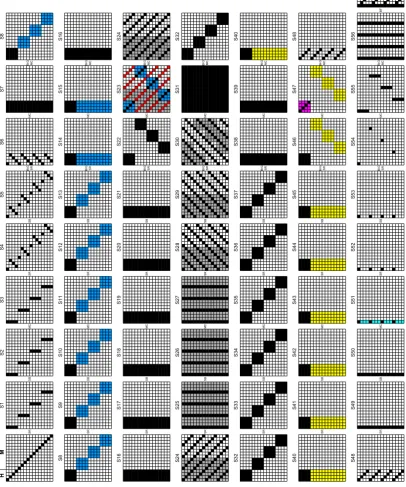
In the attack, we use two message blocks where the rst block does not contain dierences. For the second message block, we use the truncated dierential path given in Figure 2. We use colors (red, yellow, green, blue, cyan) to describe dierent phases of the attack and to denote their resulting solutions. Active bytes are denoted by black color, and active AES states contain at least one active byte. Hence, the sequence of active AES states for each round of ECHO is as follows:
5−→r1 16−→r2 4−→r3 1−→r4 4−→r5 16.
Note that in this path, we keep the number of active bytes low, except for the beginning and end. Therefore, we have enough freedom to nd many solutions. We do not allow dierences in the chaining input (blue) and in the padding (cyan). The last 16 bytes of the padding contain the message length and the two bytes above contain size of the hash function output. Note that the AES states containing the chaining values (blue) and padding (cyan) do not get mixed with other AES states until the rst BigMixColumns
transformation. Since the lower half of the state (row 2 and 3) is truncated to compute the nal hash value, we force all dierences to be in the lower half of the message: the feed-forward will then preserve that property.
3.2 Colliding Subspace Dierences
In the following, we show that the resulting output dierences after 5 rounds lie in a vector space of reduced dimension. This can be used to construct a distinguisher for 5 rounds of theECHO-256 hash function. However, due to the low dimension of the output vector
space, we can even extend this subspace distinguisher to get a collision attack on 5 rounds of theECHO-256 hash function.
First, we need to determine the dimension of the vector space at the output of the hash function. In general, the dimension of the output vector space is dened by the number of active bytes prior to the linear transformations in the last round (16 active bytes after the
last SubBytes), combined with the number of active bytes at the input due to the
feed-forward (0 active bytes in our case). This would results in a vector space dimension of
(16+0)×8 = 128. However, a weakness in the combined transformationsSuperMixColumns,
BigFinal and the output truncation reduces the vector space to a dimension of 64 at the
output of the hash function for the truncated dierential path in Figure 2.
We can move the BigFinal function prior to SuperMixColumns, since BigFinal is a
lin-ear transformation and the same linlin-ear transformation MSMC is applied to all columns
in SuperMixColumns. Then, we get 4 active bytes at the same position in each AES
state of the 4 resulting column-slices. To each active column-slice C16, we rst apply
theSuperMixColumnsmultiplication withMSMC and then, a matrix multiplication using
Mtrunc= [I8|08]which truncates the lower 8 rows. Since only 4 bytes are active in C16, these transformations can be combined into a transformation using a reduced4×8matrix
Mcomb applied to the reduced input C4, which contains only the 4 active bytes of C16:
Mtrunc·MSMC·C16=Mcomb·C4,
The multiplication with zero dierences of C16 removes 12 columns of MSMC while the
leads to:
Mtrunc·MSMC·
h
a0 0 0b0 0 0c0 0 0d0 0 0
iT
=
4 6 2 2 6 5 3 3 2 3 1 1 4 6 2 2 2 3 1 1 2 3 1 1 6 5 3 3 2 3 1 1
T
| {z }
Mcomb
·ha b c d iT
Analyzing the resulting matrix Mcomb for all four active column-slices shows that in
each case, the rank ofMcombis two, and not four. This reduces the dimension of the vector
space in each active column-slice from 32 to 16. Since we have four active columns, the total dimension of the vector space at the output of the hash function is 64. Furthermore, columni∈ {0,1,2,3} of the output hash value depends only on columns 4iof state S38.
It follows that the output dierence in the rst column i = 0 of the output hash value
depends only on the four active dierences in columns0,4,8and12of stateS38, which we
denote bya,b,cand d. To get a collision in the rst column of the hash function output,
we get the following linear system of equations:
Mcomb·
h a b c d
iT
=h0 0 0 0 0 0 0 0
iT .
Since we cannot control the dierences a,b, cand d in the following attack, we need
to nd a solution for this system of equations by brute-force. However, the brute-force complexity is less than expected due to the reduced rank of the given matrix. Since the rank is two,216solutions exist and a random dierence results in a collision with a probability
of2−16instead of2−32for the rst output column. Since the rank of all four output column
matrices is two, we get a collision at the output of the hash function with a probability of
2−16×4 = 2−64 for the given truncated dierential path.
3.3 High-Level Outline of the Attack
To nd input pairs according to the truncated dierential path given in Figure 2, we use a rebound attack [8] with multiple inbound phases [5,7]. The main advantage of multiple inbound phases is that we can rst nd pairs for each inbound phase independently and then, connect (or merge) the results. Furthermore, we also use multiple outbound phases and separate the merging process into three dierent parts which can be solved mostly independently:
1. First Inbound betweenS16 and S24: nd296partial pairs (yellow and black bytes)
with a complexity of 296 in time and 264 memory.
2. First Outbound between S24 and S31: lter the previous solutions to get 1 partial
pair (green, yellow and black bytes) with a complexity of296 in time and264 memory.
3. Second Inbound between S7 and S14: nd 232 partial pairs (red and black) for each of the rst threeBigColumnsand264partial pairs for the lastBigColumn of state
S7 with a total complexity of264 in time and memory.
4. First Part in Merging the Inbound Phases: combine the 2160 solutions of the
previous phases according to the 128-bit SuperMixColumnscondition given in [4]. We
get232partial pairs (black, red, yellow and green bytes between stateS7 andS31) with
complexity 296 in time and264 memory.
5. Merge Chaining Input: repeat from Step 1 for 216 times to get 248 solutions for
the previous phases. Compute2112 chaining values (blue) using2112 random rst
mes-sage blocks. Merge these solutions according to the overlapping 20 bytes (red with blue/cyan) in stateS7 to get248×2112×2−160= 1partial pair with complexity 2112
6. Second Part in Merging the Inbound Phases: nd one partial solution for the rst two columns of state S7 according to the 128-bit condition atSuperMixColumns
between S14 andS16 with complexity 264 in time and memory.
7. Third Part in Merging the Inbound Phases: nd one solution for all remaining bytes (last two columns of stateS7) by fullling the resulting 192-bit condition using
a generalized birthday attack with 4 lists. The complexity is 264 in time and memory
to nd one solution, and285.3 in time and memory to nd264 solutions [16].
8. Second Outbound Phase to get Collisions: in a nal outbound phase, the result-ing dierences at the output of the hash function collide with a probability of 2−64
and we get one collision among the264 solutions of the previous step.
The total time complexity of the attack is 2112 and determined by Step 5; the memory
complexity is285.3 and determined by Step 7.
3.4 Details of the Attack
In this section, we describe the each phase of the collision attack on 5 rounds ofECHO-256
in detail. Note that some phases are also reused in the attacks on the compression function of Section 4.
First Inbound between S16 and S24. We rst search for internal state pairs
con-forming to the truncated dierential path in round 3 (yellow and black bytes). We start the attack by choosing dierences for the active bytes in stateS16such that the truncated
dierential path of SuperMixColumnsbetween state S14 and S16 is fullled (Section 2.1).
We compute this dierence forward to stateS17through the linear layers.
We continue with randomly chosen dierences of stateS24and compute backwards to
stateS20, the output of theSuperSBoxes. Since we have 64 active S-boxes in this state, the
probability of a dierential is about2−1×64. Hence, we need264starting dierences but get 264 solutions for the inbound phase in round 3 (see [8]). We determine the right pairs for
each of the 16SuperSBoxbetween stateS17andS20 independently. Using the Dierential
Distribution Table of theSuperSBoxes, we can nd one right pair with average complexity
one. In total, we compute296 solutions for this inbound phase with time complexity 296
and memory complexity of at most 264. For each of these pairs, dierences and values of
all yellow and black bytes in round 3 are determined.
Second Outbound between S24 and S31. In the outbound phase, we ensure the
propagation in round 4 of the truncated dierential path by propagating the right pairs of the previous inbound phase forwards to state S31. With a probability of 2−96, we get
four active bytes afterMixColumnsin stateS31 (green) conforming to the truncated path.
Hence, among the296right pairs of the inbound phase betweenS16 andS24 we expect to
nd one such right pair.
The total complexity to nd this partial pair betweenS16andS31is then296. Note that
for this pair, the values and dierences of the yellow, green and black bytes between states
S16 and S31 can be determined. Furthermore, note that for any choice of the remaining
bytes, the truncated dierential path between stateS31 and stateS40 is fullled.
Second Inbound between S7 and S14. Here, we search for many pairs of
inter-nal states conforming to the truncated dierential path between statesS7 and S14. Note
BigColumnsstay independent until they are mixed by the followingBigMixColumns
trans-formation between statesS15 and S16. For each BigColumn, four SuperSBoxes are active
and we need at least216 starting dierentials for each one to nd the rst right pair.
The dierence in S14 is already xed due to the yellow inbound phase but we can
still choose at least 232 dierences for each active AES state in S7. Using the rebound
technique, we can nd one pair on average for each starting dierence in the inbound phase. Then, we independently iterate through all 232 starting dierences for the rst,
second and third column and through all264starting dierences for the fourth column of
state S7. We get 232 right pairs for each of the rst three columns and 264 pairs for the
fourth column. The complexity to nd all these pairs is264 in time and memory.
For each resulting right pair, the values and dierences of the red and black bytes between statesS7 andS14 can be computed. Furthermore, the truncated dierential path
in backward direction, except for two cyan bytes in the rst states, is fullled. In the next phase, we partially merge the right pairs of the yellow and red inbound phase. But rst, we recall the conditions for this merge.
First Part in Merging the Inbound Phases. For each pair of the previous two phases, the values of the red, yellow and black bytes of stateS14and S16are xed. These
two states are separated by the linear SuperMixColumns transformation: taking the rst
column-slice as an example, we get
MSMC·[A0 x0 x1 x2 A1 x3 x4 x5 A2 x6 x7 x8 A3 x9 x10 x11]T
= [B0 B1 B2 B3 y0 y1 y2 y3 y4 y5 y6 y7 y8 y9 y10 y11]T,
where MSMC is the SuperMixColumns transformation matrix, Ai the input bytes
deter-mined by the red inbound phase andBithe output bytes determined by the yellow inbound
phase. All bytesxiandyiare free to choose. As shown by Jean and Fouque [4], we only get
a solution with probability2−8for each column-slice due to the low rank of theMSMC
ma-trix. In [4] (Appendix A), the 8-bit condition for that particular column-slice that ensures the system to have solutions has been derived and is given as follows:
2·A0+ 3·A1+A2+A3 = 14·B0+ 11·B1+ 13·B2+ 9·B3. (1)
Similar 8-bit conditions exist for all 16 column-slices. In total, each right pair of the two (independent) inbound phases results in a 128-bit condition on the wholeSuperMixColumns
transformation between statesS14and S16.
Remember that we have constructed one pair for the yellow inbound phase and in total, 232×232×232 ×264 = 2160 pairs for the red inbound phase. Among these 2160 pairs, we expect to nd 232 right pairs which also satisfy the 128-bit condition of the
SuperMixColumns between states S14 and S16. In the following, we show how to nd all
these232 pairs with a complexity of 296.
First, we combine the232×232= 264 pairs determined by the two rstBigColumnsof
stateS7 in a listL1 and the232×264= 296pairs determined by the last two BigColumns of state S7 in a list L2. Note that the pairs in these two lists are independent. Then, we
separate Equation (1) into terms determined byL1 and terms determined byL2:
2·A0+ 3·A1=A2+A3+ 14·B0+ 11·B1+ 13·B2+ 9·B3. (2)
We apply the left-hand side to the elements of L1 and the right-hand side to elements of
Then, we can simply merge (join) these lists to nd those pairs which satisfy the 128-bit condition imposed by the SuperMixColumnsand store these results in list L12 =L1 ./128
L2. This way, we get264×296×2−128= 232right pairs with a total complexity of296. We
note that the memory requirements can be reduced to264 if we do not store the elements
ofL2 but compute them online. The resulting232 solutions are partial right pairs for the black, red, yellow and green bytes between stateS7 and S31.
Merge Chaining Input. Next, we need to merge the232results of the previous phases
with the chaining input (blue) and the bytes xed by the padding (cyan). The chaining input and padding overlap with the red inbound phase in stateS7 on 5×4 = 20 bytes.
This results in a 160-bit condition on the overlapping blue/cyan/red bytes. To nd a pair verifying this condition, we rst generate2112 random rst message blocks, compute the
blue bytes of stateS7 and store the results in a listL3.
Additionally, we repeat216times from the yellow inbound phase but with other starting
points4in stateS24. This way, we get216×232= 248right pairs for the combined yellow and red inbound phases, which also satisfy the 128-bit condition ofSuperMixColumnsbetween
statesS14and S16. The complexity is216×296= 2112. We store the resulting248pairs in
listL12.
Next, we merge the lists according to the overlapping 160-bits (L12./160L3) and get
248×2112×2−160 = 1right pair. If we compute the2112 message blocks of listL
3 online, the time complexity of this merging step is2112 with memory requirements of248. For the
resulting pair, all dierences between statesS4 andS33 and all colored byte values (blue,
cyan, red, yellow, green and black) between statesS0 and S31can be determined.
S7 S8 S14 S16
S
R
S
B
M
C
S
B
S
R
B
S
R
B
M
C
M
C
B
M
C
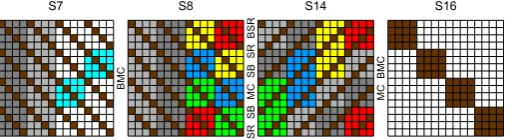
Figure 3: States used to merge the two inbound phases with the chaining values. The merge inbound phase consists of three parts. Brown bytes show values already determined (rst part) and gray values are chosen at random (second part). Green, blue, yellow and red bytes show independent values used in the generalized birthday attack (third part) and cyan bytes represent values with the target conditions.
Second Part in Merging Inbound Phases. To completely merge the two inbound phases, we need to nd according values for the white bytes. We use Figure 3 to illustrate the second and third part of the merge inbound phase. In this gure, we only consider values and therefore, do not show active bytes (black). Furthermore, all brown and cyan bytes have already been chosen in one of the previous steps. In the second part of the merge inbound phase, we only choose values for the gray and light-gray bytes. All other colored bytes show steps of the following merging phase.
We rst choose random values for all remaining bytes of the two rst columns in state
S7 (gray and light-gray) and independently compute the columns forward to state S14.
Note that we need to try 22×8+1 values for AES state S7[2,1] to also match the 2-byte
(cyan) and 1-bit padding at the input in AES state S0[2,3]. Then, all gray, light-gray,
4Until now, we have chosen only296out of
cyan and brown bytes have already been determined either by an inbound phase, chaining value, padding or just by choosing random values for the remaining free bytes of the two rst columns ofS7. However, all white, red, green, yellow and blue bytes are still free to
choose.
By considering the linear SuperMixColumns transformation, we observe that in each
column-slice, 14 out of 32 input/output bytes are already xed and 2 bytes are still free to choose. Hence, we expect to get216solutions for this linear system of equations.
Unfor-tunately, also for the given position of already determined 14 bytes, the linear system of equations does not have a full rank. Again, we can determine the resulting system using the matrix MSMC of SuperMixColumns. As an example, for the rst column-slice, the
system is given as follows:
MSMC·[A0 L0 L1 L2 A1 L00 L01 L02 A2 x6 x7 x8 A3 x9 x10 x11]T
= [B0 B1 B2 B3 y0 y1 y2 y3 y4 y5 y6 y7 y8 y9 y10 y11]T.
The free variables in this system arex6, . . . , x11(green). The valuesA0,A1,A2,A3,B0,B1,
B2,B3(brown) have been determined by the rst or second inbound phase and the values
L0, L1, L2 (light-gray) and L00, L01, L02 (gray) are determined by the choice of arbitrary values in state S7. We proceed as before and determine the linear system of equations
which needs to have a solution:
3 1 1 3 1 1 2 3 1 2 3 1 1 2 3 1 2 3 1 1 2 1 1 2
·
h
x6x7x8x9x10x11
iT
=
h
c0c1c2c3
iT
. (3)
The resulting linear 8-bit equation to get a solution for this system can be separated into terms depending on values ofLiand onL0i, and we getf1(Li) +f2(L0i) +f3(ai, bi) = 0,
wheref1,f2 andf3 are linear functions. For all other 16 column-slices and xed positions of gray bytes, we get matrices of rank three as well. In total, we get 16 8-bit conditions and the probability to nd a solution for a given choice of gray and light-gray values in statesS14andS16is2−128. However, we can nd a solution to these linear equations using
the birthday eect and a meet-in-the-middle attack with a complexity of264 in time and
memory.
We start by choosing 264 values for each of the rst (gray) and second (light-gray)
BigColumns in stateS7. We compute these values independently forward to stateS14and
store them in two lists L and L0. We also separate all equations of the 128-bit condition
into parts depending only on values ofLandL0. We apply the resulting functionsf1, f2, f3 to the elements of listsLi andL0i, and merge two listsL ./128L0 using the birthday eect.
Third part in Merging Inbound Phases. We continue with a generalized birthday match to nd values for all remaining bytes of the state (blue, red, green, yellow, cyan and white of Figure 3). For each column in stateS14, we independently choose 264 values for
the green, blue, yellow and red columns, and compute them independently backward to
S8. We need to match the values of the cyan bytes of stateS7, which results in a condition
on 24 bytes or 192 bits. Since we have four independent lists with264 values in state S8,
we can use the generalized birthday attack [16] to nd one solution with a complexity of
2192/3 = 264 in time and memory.
In more detail, we need to match values after the BigMixColumns transformation in
containing only XOR conditions on bytes between the target value and elements of the four independent lists, which can be solved using a generalized birthday attack.
To improve the average complexity of this generalized birthday attack, we can start with larger lists for the green, blue, yellow and red columns in state S14. Since we need
to match a 192-bit condition, we can get 23·x×2−192 = 2x solutions with a time and
memory complexity of max{264,2x} (see [16] for more details). Note that we can even
nd solutions with an average complexity of 1 using lists of size 296. Each solutions of the generalized birthday match results in a valid pair conforming to the whole 5-round truncated dierential path.
Second Outbound Phase to get Collisions. For the collision attack on 5 rounds, we start the generalized birthday attack of the previous phase with lists of size285.3. This
results in 23·85.3×2−192 = 264 solutions with a time and memory complexity of285.3, or
with an average complexity of221.3 per solution. These solutions are propagated outwards
in a second, independent outbound phase. Since the dierences at the output collide with a probability of 2−64, we expect to nd one pair which collides at the output of the
hash function. The time complexity is determined by merging the chaining input and the memory requirements by the generalized birthday attack. To summarize, the complexity to nd a collision for 5 rounds of the ECHO-256 hash function is given by about 2112
compression function evaluations with memory requirements of285.3.
4 Distinguisher on the 7-round ECHO-256 Compression Function
In this section, we detail our distinguisher on 7 rounds in the known-salt model. First, we show how to obtain partial solutions that verify the path from the state S6 to S23 with
an average complexity of264in time, as we obtain264 solutions with a cost of2128. These
partial solutions determine also the values of the blue bytes (in Figure 4). Next, we show how to do the same for the yellow part of the path from S30 to S47. Finally, we explain
how to merge these partial solutions for nding one that veries the whole path.
4.1 Finding pairs between S6 and S23
We explain here how to nd 264 solutions for the blue part with a cost of 2128 in time and 264 in memory. This is done with a stop-in-the-middle algorithm similar to the one
presented in [11] for improving the time complexity of the ECHO-256 distinguisher. This
algorithm has to be adapted to this particular situation, where all the active states belong to the sameBigColumn.
We start by xing the dierence inS8 to a chosen value, so that the transition between S6 and S8 is veried. We x the dierence in the active diagonals of the two AES-states S23[0,0]and S23[3,1] to a chosen value.
From stateS8 to S13, we have four dierent SuperSBoxgroups involved in the active
part. From statesS16to S22, we have4×4 SuperSBoxgroups involved (4 per active AES
state). Those 16 groups, as well as the 4 previous ones, are completely independent from
S16 to S22 (respectively from S8 to S13). From the known dierence inS8, we build four
lists of values and dierences in S13: each list corresponds to one of the four SuperSBox
groups. Each list is of size 232 because once we know the input dierence, we try all the
H M S 1 S 2 S 3 S 4 S 5 S 6 S 7 S 8 B IG B IG S R S B M C S R S B M C S R M C S 8 S 9 S 1 0 S 11 S 1 2 S 1 3 S 1 4 S 1 5 S 1 6 B IG B IG S R S B M C S R S B M C S R M C S 1 6 S 1 7 S 1 8 S 19 S 2 0 S 2 1 S 2 2 S 2 3 S 2 4 B IG B IG S R S B M C S R S B M C S R M C S 2 4 S 2 5 S 2 6 S 27 S 2 8 S 2 9 S 3 0 S 3 1 S 3 2 B IG B IG S R S B M C S R S B M C S R M C S 3 2 S 3 3 S 3 4 S 35 S 3 6 S 3 7 S 3 8 S 3 9 S 4 0 B IG B IG S R S B M C S R S B M C S R M C S 4 0 S 4 1 S 4 2 S 43 S 4 4 S 4 5 S 4 6 S 4 7 S 4 8 B IG B IG S R S B M C S R S B M C S R M C S 4 8 S 4 9 S 5 0 S 51 S 5 2 S 5 3 S 5 4 S 5 5 S 5 6 B IG B IG S R S B M C S R S B M C B F S R M C
Figure 4: Dierential path for the seven-round distinguisher.
we said, the four groups are independent in this part of the path). In the sequel, those lists are denotedL0
A,L1A,L2Aand L3A.
There are 64 bits of dierences not yet xed in S23. Each active diagonal only aects
the AES state where it is in, so we can independently consider232 possible dierences for
one diagonal and232dierences for the other. We can now build the 16 lists corresponding
to the 16SuperSBoxgroups as we did before, but considering that: the 8 lists corresponding
to 8 groups of the two AES states S16[0,0]and S16[3,0], as they have their dierences in
S22already xed, have a size of 232(corresponding to the possible values for each group).
state. But the listsLi1,0, Li2,0, withi∈[0,3], as they do not have yet the dierence xed,
have a size of232+32each, as we can consider the232possible dierences for each not xed
diagonal independently. Next, we go through the 264 possible dierences of the two rst
diagonals (diagonals 0 and 1) of the active AES state in S15. For each one of these 264
possible dierences:
The associated dierences in the two same diagonals in the four active AES states of
S16can be computed. Consequently, we can check in the previously computed ordered
lists Lij,0 with j ∈ [0,3] and i ∈ [0,1] where we nd this dierence5. For j ∈ {0,3},
on average, we obtain one match on each one of the lists L00,0, L10,0, L03,0 and L13,0.
For j ∈ {1,2}, we obtain 232 matches, one for each of the 232 possible dierences in
the associated diagonals inS23. That is232 matches forL10,0 andL11,0, where a pair of
values formed by one element of each list is only valid if they were generated from the same dierence in S23. Consequently, we can construct the list L01,,10 of size 232 where
we store the values and dierences of those two diagonals in the AES stateS16[1,0]as well as the dierence inS23from which they were generated. Repeating the process for L02,0 and L12,0, we construct the list L02,,10 of size 232. We can merge the lists L01,,01,L02,,10
and the four xed values for dierences and values obtained from the matches in the lists L00,0,L01,0,L03,0 and L13,0, corresponding to the AES states S16[0,0] and S16[3,0]. This generates the list L0,1 of size 264. Each element of this list contains the values
and dierences of the two diagonals 0 and 1 of the four active AES states in S16. As
we have all the values for the two rst diagonals in the four AES states, for each one of these elements, we compute the values in the two rst diagonals of the active state in S15 by applying the inverse of BigMixColumns. We order them according to these
values.
Next, we go through the 264 possible dierences of the two next diagonals (diagonals
2 and 3) of the active AES state inS15. For each one of these264 possible dierences:
• All the dierences in the AES stateS13[0,0]are determined. We check in the lists
L0A,L1A,L2AandL3Aif we nd a match for the dierences. We expect to nd one in
each list and this determines the values for the whole stateS15[0,0](as the elements in these lists are formed by dierences and values). This means that the value of the active AES state in S15is also completely determined. This way, we can check
in the previously generated listL0,1 if the correct value for the two diagonals0and 1 appears. We expect to nd it once.
• As we have just found a valid element fromL0,1, it determines the dierences in the
AES statesS23[1,0]andS23[2,0]that were not xed yet. Now, we need to check if, for those dierences in S23, the corresponding elements in the four lists Li1,0,Li2,0
for i∈ [2,3]that match with the dierences xed in the diagonals 2 and 3 of S15
6, satisfy the values inS
15 that were also determined by the lists LiA. This occurs
with probability 2−64.
All in all, the time complexity of this algorithm is264·(264+264) = 2129with a memory
re-quirement of264. The resulting expected number of valid pairs is264·264·264·2−64·2−64= 264.
4.2 Finding pairs between S30 and S47
In quite the same way as the previous section, we can nd solutions for the yellow part with an average cost of264. To do so, we take into account the fact that theMixColumns
5 iis either0or1because we are just considering the two rst diagonals.
andBigMixColumnstransformations commute. So, if we exchange their positions between
statesS39 andS40, we only have one active AES state inS39. We x the dierences inS47
and in two AES states, sayS32[0,0]andS32[1,1], and we still have232possible dierences for each of the two remaining active AES states inS32. Then, the lists LiA are generated
from the end and contain values and dierences fromS40. Similarly, the lists Lij,j contain
values and dierences from S38. We can apply the same algorithm as before and obtain
264 solutions with a cost of2128 in time and264in memory.
4.3 Merging solutions
In this section, we explain how to get a solution for the whole path. As explained in our Section 4.1, we can nd 264 solutions for the blue part, that have the same dierence for
the active AES states of columns 0 and 1 in S23. We obtain 264 solutions from a xed
value for the dierences in S8 and the AES states S23[0,0] and S23[3,1]. Repeating this process for the232 possible dierences in S8, we obtain in total296 solutions for the blue
part with the same dierences in the columns0 and1 inS23. The cost of this step is2160
in time and296 in memory.
The same way, using the algorithm explained in Section 4.2, we can also nd 296
solutions for the yellow part, that have the same dierence value for the AES active states of columns0and 1 inS32 (we x the dierence value of this two columns in S32, and we
try all the232 possible values for the dierence in S47). The cost of this step is also 2160
in time and296 in memory.
Now, from the partial solutions obtained in the previous steps, we want to nd a solution that veries the whole dierential path. For this, we want to merge the solutions from S23 with the solutions from S32. We know that the dierences of the columns 0,1
ofS24 andS31 are xed. Hence, fromS24 to S31, there are four AES states for which we
know the input dierence and the output dierence, as they are xed7. We can then apply a variant of the SuperSBox[3, 5] technique in these four AES states: it xes the possible
values for the active diagonals of those states.
The dierences in the other four AES states inS24that are xed are associated to other
dierences that are not xed8. There are 264 possible dierences, each one associated to
232solutions forS
32-S47given by the solutions that we found in the second step. For each one of these 264 possible dierences, one possible value is associated by the SuperSBox.
When computing backwards these values to stateS24, as we have also the values for the
other four AES states of the columns 0 and 1 that are also xed (in the third step), we can compute the values for these two columns inS23, and we need32×2bit conditions to
be veried on the values. So for each one of the264 possible dierences in S31, we obtain
296−64 = 232 that verify the conditions on S23. In total, we have 264+32 = 296 possible
partial matches.
For each of the264possible dierences inS
31, its associated232possible partial matches also need to verify the 128-bit condition inS30-S32at theSuperMixColumnslayer [4] and the
remaining2×32 bit conditions on the values of S23. Since for each of the264 dierences
we have 232 possible associated values in S
32, the probability of nding a good pair is
296−128−64+32 = 2−64.
If we repeat this merging procedure264times, namely for232dierences in the columns
0 and 1 of S23 and for 232 dierences in the columns 0 and 1 of S32, we should nd a
solution. We then repeat the procedure for the cross product of the232 solutions for each
7S
24[0,0],S24[0,1],S24[1,1],S24[3,0]correspond toS31[0,0],S31[0,1],S31[1,0],S31[3,1], respectively.
8 S
side. As we do not want to compute them each time that we use them, as it would increase the time complexity, we can just store the264+32+32 = 2128 solutions for the rst part and
use the corresponding ones when needed, while the second part is computed in sequence. The complexity would be: 2192 + 2192 + 296+64 in time and 2128 in memory. So far, we
have found a partial solution for the dierential part for rounds fromS6 to S48. We still
have the passive bytes to determine and the condition to pass from S50 to S51 to verify.
This can be done exactly as in the second and third part of the merge inbound phase of Section 3.4 with no additional cost.
Moreover, since we can nd x solutions with complexitymax{x,296} in time and 296
memory for the (independent) merge inbound phase, we can get x <2193 solutions with time complexity 2193+ max{x,296} ∼2193 and 2128 memory. We need only 296 of these
solutions to pass the probabilistic propagation in the last round fromS50 to S51. Hence,
we can nd a complete solution for the whole path with a cost of about2193 in time and 2128in memory. Furthermore, with a probability of2−128, the input and output dierences
inS0 and S48 collide in the feed-forward and BigFinal transformation. Therefore, we can
also generate free-start collisions for 6 rounds of the compression function with a time complexity of2193+ 2128∼2193 and 2128 memory.
5 Conclusions
In this work, we have presented new results on the second-round candidate of the SHA-3 competition ECHO-256 that improve considerably the previous published cryptanalysis.
Our analysis are based on multi-inbound rebound attacks and are summarized in Table 1. The main results are a 5-round collision of the hash function and a 7-round distinguisher of its compression function. All of our results take into account the condition observed in [4], which is needed to merge the results of multiple inbound phases, and satisfy it. The 7-round distinguisher on the compression function uses the stop-in-the-middle algorithms proposed in [10].
References
1. Benadjila, R., Billet, O., Gilbert, H., Macario-Rat, G., Peyrin, T., Robshaw, M., Seurin, Y.: SHA-3
proposal: ECHO. Submission to NIST (updated) (2009), http://crypto.rd.francetelecom.
com/echo/doc/echo_description_1-5.pdf
2. Daemen, J., Rijmen, V.: Understanding Two-Round Dierentials in AES. In: Prisco, R.D., Yung, M. (eds.) SCN. LNCS, vol. 4116, pp. 7894. Springer (2006)
3. Gilbert, H., Peyrin, T.: Super-Sbox Cryptanalysis: Improved Attacks for AES-Like Permutations. In: Hong, S., Iwata, T. (eds.) FSE. LNCS, vol. 6147, pp. 365383. Springer (2010)
4. Jean, J., Fouque, P.A.: Practical Near-Collisions and Collisions on Round-Reduced ECHO-256 Com-pression Function. In: FSE. pp. 107128. LNCS (2011)
5. Lamberger, M., Mendel, F., Rechberger, C., Rijmen, V., Schläer, M.: Rebound Distinguishers: Re-sults on the Full Whirlpool Compression Function. In: ASIACRYPT. LNCS, vol. 5912, pp. 126143. Springer (2009)
6. Le, T.V., Sparr, R., Wernsdorf, R., Desmedt, Y.: Complementation-Like and Cyclic Properties of AES Round Functions. In: Dobbertin, H., Rijmen, V., Sowa, A. (eds.) AES Conference. LNCS, vol. 3373, pp. 128141. Springer (2004)
7. Matusiewicz, K., Naya-Plasencia, M., Nikolic, I., Sasaki, Y., Schläer, M.: Rebound attack on the full lane compression function. In: Matsui, M. (ed.) ASIACRYPT. LNCS, vol. 5912, pp. 106125. Springer (2009)
9. Mendel, F., Peyrin, T., Rechberger, C., Schläer, M.: Improved cryptanalysis of the reduced Grøstl compression function, ECHO permutation and AES block cipher. In: Jacobson, Jr., M.J., Rijmen, V., Safavi-Naini, R. (eds.) Selected Areas in Cryptography. LNCS, vol. 5867, pp. 1635. Springer (2009) 10. Naya-Plasencia, M.: How to Improve Rebound Attacks. In: Advances in Cryptology - CRYPTO 2011, 31th Annual Cryptology Conference, Santa Barbara, CA, USA, August 14-18, 2011. Proceedings. LNCS, Springer (2011), to appear.
11. Naya-Plasencia, M.: How to Improve Rebound Attacks. Cryptology ePrint Archive, Report 2010/607
(2010), (extended version).http://eprint.iacr.org/
12. Peyrin, T.: Improved Dierential Attacks for ECHO and Grøstl. In: Advances in Cryptology -CRYPTO 2010, 30th Annual Cryptology Conference, Santa Barbara, CA, USA, August 15-19, 2010. Proceedings. LNCS, vol. 6223, pp. 370392. Springer (2010)
13. Sasaki, Y., Li, Y., Wang, L., Sakiyama, K., Ohta, K.: Non-Full-Active Super-Sbox Analysis Applica-tions to ECHO and Grøstl. In: ASIACRYPT. LNCS (2010), to appear
14. Schläer, M.: Subspace Distinguisher for 5/8 Rounds of the ECHO-256 Hash Function. In: Biryukov, A., Gong, G., Stinson, D.R. (eds.) Selected Areas in Cryptography. LNCS, vol. 6544, pp. 369387. Springer (2010)
15. National Institute of Standards, Technology (NIST): Advanced E.D.F.-G.D.F.ncryption
Stan-dard (FIPS PUB 197) (November 2001), http://www.csrc.nist.gov/publications/fips/
fips197/fips-197.pdf
16. Wagner, D.: A generalized birthday problem. In: Yung, M. (ed.) CRYPTO. LNCS, vol. 2442, pp. 288303. Springer (2002)
A Chosen-Salt Attacks on the ECHO Compression Function
In this section, we show how to get a collision attack for 6 rounds and a subspace distin-guisher for 7 rounds of theECHO-256 compression function in the chosen-salt model. For
both attacks, we get a complexity of2160 compression function evaluations with memory
requirements of2128.
The attacks on the hash functions ofECHOcan be extended to the compression function
in a straightforward way. In this case, instead of the chaining value, a 512-bit value of another inbound phase is merged with the rst inbound phase. In fact, we can continue with a similar 3-round path in backward direction as we have in the hash function case in forward direction. Then, the full activeECHOstate is located in the middle round and we
can construct attacks for up to 7 rounds for the compression functions of ECHO-256 (see
Figure 5).
A.1 The Truncated Dierential Path
We use the 7-round truncated dierential path given in Figure 5. Black bytes are active and colored bytes show the dierent inbound and outbound phases. Since this path is sparse, we are able to nd many right pairs conforming to the path. We can already compute the expected number of right pairs by considering theMixColumnsandSuperMixColumns
transformations. At the input, we can freely choose the 256-byte values, the 16-byte dif-ference between the values and the 16-byte salt. We get a reduction of pairs at the rst
MC and SMC of round 1, the second MC of round 3, the rstMC and SMC of round 4,
theBMCof round 5 and the secondMCof round 6. The dierential probability (in base-2
logarithm) for the path is given as follows:
8×(−12−3−48−48−12−48−12) =−8×183.
To summarize, the expected number of pairs conforming to this 7-round truncated dier-ential path is
28×(256+16+16)×2−8×183 = 2800,
H M S 1 S 2 S 3 S 4 S 5 S 6 S 7 S 8 B IG B IG S R S B M C S B S R M C S R M C S 8 S 9 S 1 0 S 1 1 S 1 2 S 1 3 S 1 4 S 1 5 S 1 6 B IG B IG S R S B M C S B S R M C S R M C S 1 6 S 1 7 S 1 8 S 1 9 S 2 0 S 2 1 S 2 2 S 2 3 S 2 4 B IG B IG S R S B M C S B S R M C S R M C S 2 4 S 2 5 S 2 6 S 2 7 S 2 8 S 2 9 S 3 0 S 3 1 S 3 2 B IG B IG S R S B M C S B S R M C S R M C S 3 2 S 3 3 S 3 4 S 3 5 S 3 6 S 3 7 S 3 8 S 3 9 S 4 0 B IG B IG S R S B M C S B S R M C S R M C S 4 0 S 4 1 S 4 2 S 4 3 S 4 4 S 4 5 S 4 6 S 4 7 S 4 8 B IG B IG S R S B M C S B S R M C S R M C S 4 8 S 4 9 S 5 0 S 5 1 S 5 2 S 5 3 S 5 4 S 5 5 S 5 6 B IG B IG S R S B M C S B S R M C B F S R M C
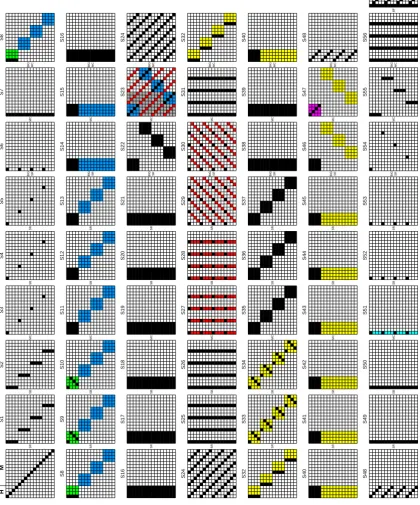
Figure 5: The truncated dierential path to get collisions for 6 rounds and near-collisions for 7 rounds
of theECHO-256 compression function. Black bytes are active, red bytes are values computed in the rst
inbound phase, yellow bytes in the second, blue bytes in the third and green bytes in the fourth inbound or second outbound phase, and cyan bytes in the third outbound phase. Purple bytes are determined in the rst outbound phase and gray bytes are chosen in the merge inbound phase.
A.2 Outline of the Attack
The main idea of the attack is to nd solutions for the forward and backward parts independently for xed dierences at the same layer between statesS30 and S32. For the
yellow/purple part, we can nd 2128 pairs with a complexity of 2128 by choosing the salt
complexity of2160 by constructing the salt. Then, we just need to match the 128-bit salt
values of the forward and backward parts and fulll the 128-bit condition on the input (red) and output (yellow) values of SuperMixColumnsfor the merge to be possible. Since
we get2128 independent pairs for both the forward and backward parts, we can fulll the
resulting 256-bit condition by merging the two resulting lists.
A.3 Finding Right Pairs for Sparse Paths of the Permutation
In this section, we show how to nd a pair for the rst 6 rounds of the 7-round truncated dierential path of Figure 5. We detail how to nd such a right pair in time2160 with2128
memory. We use this path in the chosen-salt model to get a collision for 6 rounds and a distinguisher for 7 rounds of theECHO-256 compression function.
Inbound between S30 and S40. We choose a dierence for state S32 such that the
truncated dierential path of SuperMixColumns between state S30 and S32 is fullled.
Then, for each of the2128 dierences in stateS40, we perform an inbound phase between
statesS32 and S40. In average, we get one solution with average complexity one: we can
then compute2128pairs for the yellow inbound phase with complexity2128. We store these
pairs sorted by their dierence in stateS40in list L1.
Outbound between S40 and S47. We continue to nd pairs which also satisfy the
truncated dierential path until stateS47. We choose2128 random pairs for the AES state
inS47(according to the given truncated dierential path) and compute backwards to state S40. For each resulting dierence in S40, we lookup the matching dierence in list L1. To
match also the values, we can construct the 128-bit salt value accordingly. Thus, we get
2128pairs with complexity2128 according to the truncated dierential path from stateS32
to stateS48.
Inbound between S23 and S30. The red inbound phase is the same as in the hash
function attack: we start with the dierence between states S30 and S32, which has been
chosen in the yellow inbound phase. Then, we do four independent inbound phases for each
BigColumnin stateS23. Since we can start with at least 232dierences for each column in
stateS23, we also get 232 pairs for each column with a time complexity of232.
Inbound between S15 and S23. Independently from the previous step, in the blue
inbound phase, we start with a xed dierence in state S15 and compute this dierence
forward to stateS17. Again, we can choose all 232 dierences for each BigColumnof state
S23 and perform the blue inbound phases independently for each active AES state in the
backward direction. For each column, we get232 pairs with a complexity of 232.
Merge Inbounds. When merging the solutions of the blue and red inbound phases, we want to get one pair with average complexity one. Note that for each inbound phase and each column of state S23, we have 232 right pairs. Moreover, we are allowed to set
the salt value. We then start by matching the dierences in the overlapping four bytes of
eachBigColumn. Since we have232solutions for each of the blue and the red part, we get
232×232×2−32= 232 pairs with matching dierences but non-matching values.
salt such that the values also match. We sort the resulting list according to the 4-byte salt value and repeat the same for all four BigColumns of state S23. Then, we just need
to iterate through all four lists and search for matching salt values. Note that for some salt values, we will get no solution, but for some we will get more than one solution. On average, we expect to get232matching pairs with a complexity of232with chosen diagonal
bytes of the salt.
Inbound between S6 and S15. To nd a pair of states conforming to the green part,
we rst choose a dierence verifying the truncated dierential path between stateS6 and
state S8. The second starting point for the green inbound phase is the dierence in state S15, which has been chosen in the blue inbound phase. Again, we get one pair on average
for each starting dierential. This pair needs to be connected with the solutions of the blue inbound phase. To do so, we rst match the values in the diagonal bytes of state
S15. Remember that in the previous phases, we have constructed 232 pairs for a single
dierence in state S15. Among these pairs, we expect to nd one such that the diagonal
4-byte values between the green and blue inbound phase match. To connect the other 12 bytes, we can simply set the remaining 12 bytes of the salt value. Hence, we get one solution for the combined green, blue and red part with an average complexity of232.
First Part in Merging Inbound Phases. To merge the inbound phases, we rst compute2128 pairs for the yellow/purple part with a time and memory complexity of2128
and store these pairs in a listL2. Similarly, we compute2128 pairs for the green/blue/red part. Since the complexity to compute one solution for this part is232, the time complexity
to compute all 2128 pairs is 2160. To connect the resulting pairs between states S30 and S32, we need to satisfy two bit conditions. First, we need to verify the linear
128-bit SuperMixColumns condition observed by Jean and Fouque in [4]. Second, since each
solution of the yellow/purple and green/blue/red part has also a dierent salt value, we need to match the 128-bit salt as well. In the end, this leads to a 256-bit condition, which we can be satised by merging the two lists L1 and L2 under that condition to produce
2128×2128×2−256= 1 right pair, which satises the whole 6-round truncated dierential
path. The time complexity of this step is2160 with memory requirements of2128.
Second Part in Merging Inbound Phases. In the second part of the merge inbound phase, we need to nd values for the two rst columns of Figure 3. This part of the attack is the same as in the hash function attack onECHO-256 (see Section 3.4).
Third Part in Merging Inbound Phases. The only dierence in the third part of the merge inbound phase is that we change the time-memory trade-o slightly to get an average complexity of 1 for each solution. Again, we do a generalized birthday attack but this time, we start with296 independent values for each column of state S30 (Figure 3).
Since we have a 192-bit condition in stateS23, we get23×96×2−192 = 296solutions with a
complexity of296in time and memory, or with an average complexity of 1 per solution [16].
It follows that we can nd up to2160right pairs for the 6-round truncated dierential path
with a total complexity of2160 and memory requirements of 2128.
A.4 Chosen-Salt Collision Attack for 6 Rounds
To get a collision for 6 rounds of the 512-bit compression function of ECHO-256 in the
dierences of the permutation: this happens with a probability of2−128. Since we can nd 2160 pairs for the truncated dierential path with a complexity of2160, we expect to nd 232 collisions at the output of the 6-round compression function with a time complexity
of2160 and memory requirements of2128.
A.5 Chosen-Salt Distinguisher for 7 Rounds
To get a chosen-salt distinguisher for 7 rounds of the compression function of ECHO-256,
we use the whole truncated dierential path given in Figure 5. Note that the last round of this truncated dierential path is veried with a probability of2−96. Furthermore, with
an additional 32-bit condition on the active bytes in state S52, we can x the dierence
at the output of the permutation, prior to the feed-forward. In this case, only the 16-byte dierences in the diagonal bytes of the output of the compression function change for each additional found pair. In other words, the dierence vector space at the output of the compression function reduces to a dimension of 128. We use a third outbound phase to satisfy these conditions in the last round. Since we can nd one solution for the white bytes of the 6-round path with an average complexity one, we can nd one pair which also satises the conditions in the last round with a time and memory complexity 2128.
Note that we can nd up to 232 such pairs with a total complexity of 2160 in time and
2128 memory.
Again, we use [5, Equation 19] to compute the complexity of a generic distinguishing attack on the ECHO-256 compression function. We get the parameters N = 512
(com-pression function output size),n= 128(dimension of output dierence vector space) and
t = 232 (number of outputs in vector space) for the subspace distinguisher. Then, the
generic complexity to construct 232 elements in a vector space of dimension128 is about 2207.8 compression function evaluations. All in all, we get a chosen-salt distinguisher for 7
rounds of theECHO-256 compression function with a complexity of2160 in time and2128
memory.
Note that we can use almost the same attack to construct 232 near-collisions with a
zero dierence in the same 320 bits. Again, we need to satisfy the 96-bit condition in the cyan bytes in the last round. However, we now require that the overlapping 4-byte dierences in the feed-forward cancel each other. This 32-bit condition ensures that we get only 4×6 = 24 active bytes at the output of the compression function for 232 pairs
with a total complexity of2160 in time and2128 memory in the chosen-salt model.
B Collision Attack on the 4-round ECHO-256 Hash Function
In this section, we describe a way to extend the compression function collision attack presented in [4] into a collision attack on the 4-round hash functionECHO-256 with a time
and memory complexity of264. That published attack nds a message pair(M1, M10)and a chaining valueh such thatf(h, M1) =f(h, M10), wheref is the ECHO-256 compression function. To get a collision in the hash function, the dierence then consists in nding a message block M0 which veries f(IV, M0) = h. This way, the collision in the hash function is the result of an internal collision in the compression function: consequently, we do not need to take care of the padding in that scenario. For any message M, we
would have: ECHO4R(IV, M0||M1||M) = ECHO4R(IV, M0||M10||M), where || denotes the concatenation of messages andECHO4R the 4-round ECHO-256 hash function.
Figure
6:
The
truncated
dieren
tial
path
used
in
the
4-round
collision
attac
k
on
the
ECHO
-256
hash
used here is depicted in Figure 6. The rst inbound is located in the second round between statesS7 and S14and can be done in parallel on the fourBigColumnsand the second one
is in the third round between statesS16 and S24. We extend the latter by a probabilistic
outbound phase to lter out some of its valid pairs in order to reduce the number of active bytes in the nal fourth round. In the sequel, we consider the alternative description of the permutation (see 2.1).
At rst, we precompute and store the Dierential Distribution Table∆of theSuperSBox
in time and memory264. Then, we randomize the dierences around the merging point:
theSuperMixColumnsat the end of the second round. Using ∆, we nd a pair of internal
states conforming to the second inbound and the outbound phase. This can be done in the same way as in [4] in less than 264. We then nd a valid pair of BigColumns for the
rstBigColumn in the rst inbound: this xes the value of diag(S7[0,0]) overlapping with
an AES state directly coming from the previous chaining value yet to be determined.
By generating 264 message M0, we obtain a list L of 232 chaining values sharing
the same value on diag(S7[0,0]). We now generate all the 232 possible BigColumns pairs for the second BigColumn in the rst inbound. For each pair, we compute the value of
diag(S7[3,1]): we expect one element of L to share this value becauseL contains 232 ele-ments. Consequently, we can update Lby completing each of its entry by the associated
pair for the secondBigColumnand get 232 pairs forLagain. For the third BigColumn, we
compute264pairs conforming to the path among the296possible ones. With the same ar-gument, for any element ofL, we expect to nd232 pairs where the value of diag(S7[2,2]) matches the one dictated by that particular chaining value. We link each of the 232
ele-ments ofLwith a setE of232valid pairs for the thirdBigColumn. In other words, we get
264 pairs where the three rstBigColumnsmatch the respective chaining value.
At this point, each of the232 entries of L consists of a chaining valueh =f(IV, M 0), a pair of BigColumns for the two rst BigColumns and a set E of 232 valid pairs for the
thirdBigColumn, all conforming to the rst inbound. As demonstrated in [4], the 128-bit
condition to merge the two inbound phases is deported to the fourth BigColumn in the
rst inbound. More precisely, once we know a pair for each of the three rstBigColumns,
we can deduce the fourth one so that the merge around the SuperMixColumns layer is
possible. For each entry inL and for each associated setE, we are in that case so that we
can deduce the pair for the fourthBigColumn. Finally, we check if the truncated path is
veried for thatBigColumnand if the value in diag(S7[3,1])matches the expected one. The two events occur with probability2−64 but since we can repeat the check 232×232= 264
times, we should nd oneM0 and one pair for each of the four BigColumns.
Finally, we can nish the attack as in [4] by ensuring that the dierences cancel out in the feed-forward and by merging the two partial solutions. We note that the merging is slightly dierent since we need to take care of the known AES states in S7 but is still