Minimizing Non-interactive Zero-Knowledge Proofs Using Fully
Homomorphic Encryption
Jens Groth∗
University College London
January 6, 2011
Abstract
A non-interactive zero-knowledge proof can be used to demonstrate the truth of a statement without revealing anything else. It has been shown under standard cryptographic assumptions that non-interactive zero-knowledge proofs of membership exist for all languages in NP. However, known non-interactive zero-knowledge proofs of membership of NP-languages yield proofs that are larger than the corresponding membership witnesses.
We investigate the question of minimizing the communication overhead involved in making non-interactive zero-knowledge proofs and show that if fully homomorphic encryption exists then it is possible to minimize the size of non-interactive zero-knowledge proofs and get proofs that are of the same size as the witnesses.
Our technique is applicable to many types of non-interactive zero-knowledge proofs. We apply it to both standard non-interactive zero-knowledge proofs and to universally composable non-interactive zero-knowledge proofs. The technique can also be applied outside the realm of non-interactive zero-knowledge proofs, for instance to get witness-size interactive zero-knowledge proofs in the plain model without any setup.
Keywords: Non-interactive zero-knowledge proofs, fully homomorphic encryption.
1
Introduction
Non-interactive zero-knowledge (NIZK) proofs [BFM88] allow the construction of a proof that can convince others about the truth of a statement. We will consider statements of the form x ∈ L, where L can be an arbitrary language in NP. While the proof should guarantee the truth of the statement it should not reveal anything else. More precisely, we require that the NIZK proof is complete, sound and zero-knowledge.
Completeness: Given a witness w for the statement x ∈ L there is an efficient algorithm to construct a convincing proofπ.
Soundness: A malicious prover should not be able to convince anybody if the statement is false. We focus on unconditional soundness, where even an adversary with infinite computing power cannot create a convincing proofπ forx /∈L.
Zero-knowledge: A malicious verifier learns nothing but the truth of the statement. In particular, the proofπ does not reveal the witness wthat the prover used when constructing the proofπ.
∗
Only languages in BPP have NIZK proofs in the plain model without any setup [Ore87, GO94, GK96]. Blum, Feldman and Micali [BFM88] therefore suggested the common reference string model, where the prover and the verifier have access to a bit-string that is assumed to have been generated honestly according to a specific distribution. The common reference string can for instance be generated by a trusted third party or by a set of parties executing a multi-party computation protocol. Groth and Ostrovsky [GO07] has as an alternative suggested NIZK proofs in the multi-string model, where many parties generate a random multi-string and the security of the NIZK proof relies on a majority of the strings being honestly generated.
1.1 Related work
NIZK proofs have many applications, ranging from early chosen-ciphertext secure public-key cryp-tosystems [DDN00] to recent advanced signature schemes [BW06, CGS07]. There is therefore a significant body of research dealing with NIZK proofs.
Blum, Feldman and Micali [BFM88] proposed an NIZK proof for all of NP based on a number theoretic assumption related to factoring. Feige, Lapidot and Shamir [FLS99] gave an NIZK proof for all of NP based on the existence of trapdoor permutations.
While these results established the existence of NIZK proofs based on general assumptions, other works have aimed at defining stronger security properties such as non-malleability [Sah01], robustness [DDO+02] and universal composability [Can01, GOS06b].
There has been significant progress in reducing the complexity of NIZK proofs based on general assumptions [Dam92, DDP02, KP98, Gro10] and Groth, Ostrovsky and Sahai [GOS06b, GOS06a, Gro06, GS08] have constructed practical NIZK proofs using techniques from pairing-based cryptog-raphy. Recently Gentry [Gen09b, Gen09a] proposed a fully homomorphic encryption scheme and demonstrated that fully homomorphic encryption can be used to construct NIZK proofs that are proportional to the size of the witness.
1.2 Our contribution
We construct NIZK proofs for arbitrary NP-languages. The size of the common reference string is poly(k) and the size of the proof is essentially the same as the witness, i.e.,|π|=|w|+ poly(k) where
kis the security parameter.
In Table 1, we compare our NIZK proofs with the current state of the art NIZK proofs for Circuit Satisfiability based on respectively trapdoor permutations [Gro10] and specific cryptographic assumptions [GOS06b, GOS06a, Gro10, Gen09a]. All of these NIZK proofs are publicly verifiable by anybody who sees the common reference string, the statement and the proof.
CRS size Proof size Assumption Groth [Gro10] |C| ·poly(k) |C| ·poly(k) Trapdoor perm. GOS [GOS06b, GOS06a] poly(k) |C| ·poly(k) Pairing-based Groth [Gro10] |C| ·polylog(k) + poly(k) |C| ·polylog(k) + poly(k) Naccache-Stern Gentry [Gen09a] poly(k) |w| ·poly(k) + poly(k) FHE and NIZK This work poly(k) |w|+ poly(k) FHE and NIZK
Table 1: Comparison of NIZK proofs for security parameterk, circuit size |C|and witness size|w|.
universal composability [Can01]. Universally composable NIZK proofs have the property that they retain their security properties in any environment, even an environment where arbitrary protocols are running concurrently with the NIZK proof. We propose a universally composable NIZK proof that is secure against adaptive malicious adversaries assuming provers are able to securely erase data from their system after constructing their proofs. The universally composable NIZK proofs consist of|w|+ poly(k) bits.
1.3 Our technique
Gentry in his seminal paper [Gen09b] presented a fully homomorphic public-key cryptosystem based on lattices. A fully homomorphic encryption scheme allows taking two ciphertexts and computing new ciphertexts containing the sums or products of their plaintext even if the secret key is unknown. More generally we can take tciphertexts and compute a new ciphertext containing the evaluation of an arbitrary circuit on the plaintexts. Recent works have aimed at improving the efficiency and proposing fully homomorphic encryption schemes under other assumptions [SV10, vDGHV10, SS10]. There are many applications of fully homomorphic encryption schemes. It is not known whether they imply the existence of NIZK proofs though. However, if NIZK proofs do exist then fully homomorphic encryption can be used to reduce the size of the proofs. Gentry [Gen09a] showed that using fully homomorphic encryption it is possible to get NIZK proofs where the proof size is proportional to the witness size. If we are looking at the satisfiability of a large circuit with a few input gates, i.e., a small witness for satisfiability, this is a significant improvement over other NIZK proofs that tend to grow proportionally to the circuit size.
Gentry proposed to encrypt every bit of the witness using a fully homomorphic encryption scheme. Using the operations of the fully homomorphic cryptosystem it is then possible to eval-uate the circuit on the plaintexts to get a ciphertext that contains the output. Using an NIZK proof the prover then constructs a proof for the public key being valid, the encrypted inputs being valid ciphertexts and the output ciphertext being an encryption of 1. Since the proof contains|w| ciphertexts and|w|proofs of their correctness the total complexity is |w| ·poly(k).
In this paper, we present a simple modification of Gentry’s NIZK proof that decreases the proof size to |w|+ poly(k). The idea is to encrypt the witness w using a symmetric key cryptosystem, for instance using a one-time pad with a pseudorandom string, and then use the fully homomorphic encryption both to decrypt the encrypted witness and then evaluate the circuit on the witness.
More precisely, the prover will given a witness w for the satisfiability of a circuit C construct (u, pk,s¯), whereuis an encryption ofwandpkis a public key for the fully homomorphic encryption scheme and ¯sis a fully homomorphic encryption of the secret seed sused to construct u. Now the prover gives an NIZK proof for pk being a valid public key, ¯s being a valid encryption of a seed s
and that after decryptinguusingsand evaluatingCon the resulting plaintext the output is 1. The length ofu is|w|and the polynomially many other components are of size poly(k) each so the total size of the proof is|w|+ poly(k).
2
Preliminaries
Given two functionsf, g :N→ [0,1] we write f(k) ≈g(k) when |f(k)−g(k)|=O(k−c) for every constantc >0. We say thatf isnegligible iff(k)≈0 and that f is overwhelming iff(k)≈1.
We writey=A(x;r) when the algorithmA on inputx and randomnessr, outputsy. We write
y←A(x) for the process of picking randomnessr at random and settingy=A(x;r). We also write
y←S for samplingy uniformly at random from the setS.
We will now define non-interactive zero-knowledge proofs and describe three tools that will be used in our constructions of minimal size NIZK proofs, namely fully homomorphic encryption schemes, pseudorandom generators and strong one-time signatures.
2.1 Fully homomorphic public-key encryption
A fully homomorphic bit-encryption scheme enables computation on encrypted bits. There is an evaluation algorithm Eval that takes as input an arbitrary Boolean circuit and an appropriate number of ciphertexts and outputs a new ciphertext containing the output of the circuit evaluated on the plaintexts.
The cryptosystem consists of four algorithms (KFHE, E, D,Eval). The probabilistic polynomial time key generation algorithm KFHE on input 1k (and randomness ρ ← {0,1}`KFHE(k)) outputs a public key pk and a decryption key dk. The probabilistic polynomial time encryption algorithm
E given a public key pk and a bit b outputs a ciphertext c. The deterministic polynomial time decryption algorithmD given a public keypk and a ciphertextcreturns a bitb or an error symbol ⊥. Finally, the deterministic polynomial time evaluation algorithm Eval takes a public key pk, a Boolean circuitC withtinput gates, andtciphertexts as input and returns a ciphertext. We require that the cryptosystem is compact, which means that there is a polynomial upper bound `C(k) on the size of the ciphertexts output by Eval.
We will often encrypt an entire bit-string one bit at a time. We therefore defineEpk(m) to be the tuple (Epk(m1), . . . , Epk(m|m|)), wherem1, . . . , m|m|are the bits ofm. When being explicit about the randomness used, we define Epk(m; ¯r) = (Epk(m1;r1), . . . , Epk(m|m|;r|m|)) for ¯r = (r1, . . . , r|m|) ∈ ({0,1}`E(k))|m|.
The properties we need from the fully homomorphic encryption scheme is correctness and indis-tinguishability under chosen plaintext attack as defined below.
Definition 1 (Correctness) (KFHE, E, D,Eval) is (perfectly) correct if for all Boolean circuitsC
and all inputsm of appropriate length we have
Prh(pk, dk)←KFHE(1k); ¯m←Epk(m);v= Evalpk(C; ¯m) :Ddk(v) =C(m)
i
= 1.
Definition 2 (IND-CPA security) (KFHE, E, D,Eval) is indistinguishable under chosen plain-text attack (IND-CPA secure) if for all non-uniform polynomial time A we have
Prh(pk, dk)←KFHE(1k);c←Epk(0) :A(c) = 1
i
≈Prh(pk, dk)←KFHE(1k);c←Epk(1) :A(c) = 1
i
.
2.2 Pseudorandom generators
A length-flexible pseudorandom generator is a deterministic polynomial time algorithm Gthat on input (s, `) where s∈ {0,1}`G(k) for a polynomial `
G specified in the description of G returns an
Definition 3 (Pseudorandom generator) Gis a pseudorandom generator if for all non-uniform polynomial timeA and all polynomially bounded ` we have
Pr
h
s← {0,1}`G(k);y=G(s, `(k)) :A(y) = 1
i
≈Pr
h
y← {0,1}`(k):A(y) = 1
i
.
Length-flexible pseudorandom generators can be constructed from one-way functions [HILL99]. The existence of fully homomorphic encryption therefore implies the existence of length-flexible pseudo-random generators.
2.3 Strong one-time signatures
A strong one-time signature scheme consists of three algorithms (KSIG,Sign,Vfy). The key
gen-eration algorithm KSIG is a probabilistic polynomial time algorithm that on input 1k returns a verification key vk and a signing key sk. The signing algorithm Sign is a probabilistic polynomial time algorithm that on inputsk and an arbitrary messagem returns a signature sig. The signature verification algorithm Vfy is a deterministic polynomial time algorithm that given a verification key
vk, a message m and a signature sig returns 1 (acceptance) or 0 (rejection). We require that the scheme is correct and strongly existentially unforgeable under a single chosen message attack as defined below.
Definition 4 (Correctness) (KSIG,Sign,Vfy)is (perfectly) correct if for all m∈ {0,1}∗ we have
Pr
h
(vk, sk)←KSIG(1k); sig←Signsk(m) : Vfyvk(m,sig) = 1
i
= 1.
Definition 5 (Strong existential unforgeability under one-time chosen message attack)
(KSIG,Sign,Vfy) is strongly existentially unforgeable under chosen message attack if for all
non-uniform polynomial time A we have
Prh(vk, sk)←KSIG(1k);m← A(vk); sig←Signsk(m); (m0,sig0)← A(sig) : (m0,sig0)6= (m,sig) ∧ Vfyvk(m0,sig0) = 1
i
≈0.
We will use a strong one-time signature scheme that has fixed-length signatures, i.e., where there is a polynomial upper bound`SIG on the length of the signatures.
Fixed-length strong one-time signatures can be constructed from one-way functions (from uni-versal one-way hash-functions and Lamport signatures used in combination with Merkle trees for instance). The existence of fully homomorphic encryption therefore implies the existence of fixed-length strong one-time signatures.
2.4 Non-interactive Zero-Knowledge Proofs
LetRbe a polynomial time computable binary relation. For pairs (x, w)∈Rwe callxthe statement andw the witness. LetL be the NP-language consisting of statements with witnesses in R.
An efficient-prover non-interactive zero-knowledge proof for the relation R consists of three probabilistic polynomial time algorithms (K, P, V). K is the common reference string generator that takes the security parameter written in unary 1k and outputs a common reference string σ.
P is the prover algorithm that takes as input the common reference string σ, a statement x and a witness w so (x, w) ∈ R and outputs a proof π. V is the verifier algorithm that on a common reference stringσ, a statement x and a proof π outputs 0 or 1. We interpret a verifier output of 0 as a rejection of the proof and a verifier output of 1 as an acceptance of the proof.
Definition 6 (K, P, V) is a non-interactive zero-knowledge proof for R if it is complete, sound and zero-knowledge as described below.
Perfect completeness. Completeness means that a prover with a witness can convince the verifier. For all adversariesAwe have
Prhσ←K(1k); (x, w)← A(σ);π ←P(σ, x, w) :V(σ, x, π) = 1 if (x, w)∈Ri= 1.
Statistical soundness. Soundness means that it is impossible to convince the verifier of a false statement. For all adversariesA we have
Pr
h
σ ←K(1k); (x, π)← A(σ) :x /∈Land V(σ, x, π) = 1
i
≈0.
If the probability is exactly 0, we say (K, P, V) is perfectly sound.
Computational zero-knowledge. (K, P, V) is zero-knowledge if it is possible to simulate the proof of a true statement without knowing the witness. Formally, we require the existence of a probabilistic polynomial time simulator S = (S1, S2). S1 outputs a simulated common reference string σ and a simulation trapdoor τ. S2 takes the simulation trapdoor and a statement as input
and produces a simulated proof π. We require for all non-uniform polynomial time adversaries A that
Prhσ←K(1k) :AP(·,·)(σ) = 1i≈Prh(σ, τ)←S1(1k) :AS(·,·)(σ) = 1
i
,
where P(·,·) on input (x, w) ∈ R returns π ← P(σ, x, w) and S(·,·) on input (x, w) ∈ R returns
π←S2(τ, x).
3
Minimal NIZK Proofs from Fully Homomorphic Encryption
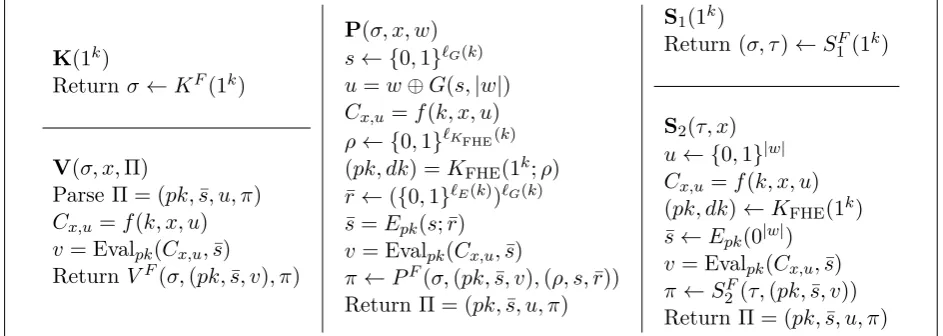
We will now construct an NIZK proof system for an arbitrary NP-relationR. The common reference string has length poly(k) and the proof for a statement x has size |w|+ poly(k), where |w| is the size of witnesses forx. This is likely to be close to the optimal size for both the common reference string and the proofs [GH98].
In order to make this more precise, define given a relationR and a pseudorandom generatorG
the deterministic polynomial time computable functionf that takes as input the security parameter
k, a statement x and a string u of length|w|and outputs a Boolean circuit Cx,u with`G(k) input wires such thatCx,u(·) =R(x, u⊕G(·,|w|)). Define also given a fully homomorphic cryptosystem (KFHE, E, D,Eval) the relation
RF ={((pk,s, v¯ ),(ρ, s,r¯)) :
ρ∈ {0,1}`KFHE(k)∧(pk, dk) =KFHE(1k;ρ)∧r¯∈({0,1}`E(k))|s|∧s¯=Epk(s; ¯r)∧D
dk(v) = 1}.
Let (KF, PF, VF) be an NIZK proof system forRF. We can now give the detailed specification of the NIZK proof forR in Figure 1.
K(1k)
Return σ←KF(1k)
V(σ, x,Π)
Parse Π = (pk,s, u, π¯ )
Cx,u=f(k, x, u)
v= Evalpk(Cx,u,s¯)
Return VF(σ,(pk,s, v¯ ), π)
P(σ, x, w)
s← {0,1}`G(k)
u=w⊕G(s,|w|)
Cx,u=f(k, x, u)
ρ← {0,1}`KFHE(k) (pk, dk) =KFHE(1k;ρ)
¯
r←({0,1}`E(k))`G(k) ¯
s=Epk(s; ¯r)
v= Evalpk(Cx,u,s¯)
π ←PF(σ,(pk,s, v¯ ),(ρ, s,¯r)) Return Π = (pk,¯s, u, π)
S1(1k)
Return (σ, τ)←S1F(1k)
S2(τ, x) u← {0,1}|w|
Cx,u=f(k, x, u) (pk, dk)←KFHE(1k)
¯
s←Epk(0|w|)
v= Evalpk(Cx,u,s¯)
π←S2F(τ,(pk,s, v¯ )) Return Π = (pk,¯s, u, π)
Figure 1: NIZK proof system forR.
Theorem 7 (K, P, V) described in Figure 1 is an NIZK proof system for R.
Proof. Perfect completeness follows from the perfect completeness of (KF, PF, VF) and the perfect correctness of the fully homomorphic cryptosystem. The prover generates a valid key pair (pk, dk), makes valid encryptions of the bits insand by the correctness of the fully homomorphic cryptosystem
v decrypts to 1 providedw=u⊕G(s,|w|) is a witness for x. The statement and witness provided toPF is therefore valid and the completeness of (KF, PF, VF) implies that the resulting proofπ is acceptable.
Statistical soundness follows from the statistical soundness of (KF, PF, VF) and the correctness of the fully homomorphic cryptosystem. To see this, consider a proof Π = (pk,¯s, u, π) for a statement
x. By the statistical soundness of π there exists ρ such that (pk, dk) = KFHE(1k;ρ) and v =
Evalpk(Cx,u,s¯) decrypts to 1 under dk. Furthermore, the statistical soundness also guarantees that ¯
s=Epk(s; ¯r) for some seed sand randomness ¯r. The perfect correctness of the fully homomorphic cryptosystem now guarantees thatw=u⊕G(s,|w|) is a witness forx∈L.
Computational zero-knowledge follows from the computational zero-knowledge of (KF, PF, VF), the pseudorandomness of G and the IND-CPA security of (KFHE, E, D,Eval). Figure 1 describes a zero-knowledge simulator (S1, S2) and we will now show that for every non-uniform polynomial
timeA
Prhσ←K(1k) :AP(·,·)(σ) = 1i≈Prh(σ, τ)←S1(1k) :AS(·,·)(σ) = 1
i
,
Consider generating the common reference string using (σ, τ)←S1F(1k) instead of usingK =KF
and consider a modified oracleP0(·,·) that on (x, w)∈R returns a proof Π = (pk,¯s, u, π) generated as a normal prover P(σ, x, w) would do except simulating π ← S2(τ, x). By the zero-knowledge
property of (KF, PF, VF) we have for all non-uniform polynomial timeA
Pr
h
σ←K(1k) :AP(·,·)(σ) = 1
i
≈Pr
h
(σ, τ)←SF1(1k) :AP0(·,·)(σ) = 1
i
.
LetP00 be a modification ofP0 where the responses Π = (pk,s, u, π¯ ) are generated by computing ¯
s ← Epk(0`G(k)). By the IND-CPA security of (KFHE, E, D,Eval) we have for all non-uniform
polynomial timeA
Prh(σ, τ)←S1F(1k) :AP0(·,·)(σ) = 1i≈Prh(σ, τ)←SF
1 (1k) :AP 00(·,·)
(σ) = 1i.
Finally, sinceS1 =S1F we can viewSas a modification ofP00where the responses Π = (pk,s, u, π¯ ) are generated such that u← {0,1}|w|. By the pseudorandomness of G we have for all non-uniform polynomial timeA
Pr
h
(σ, τ)←SF1(1k) :AP00(·,·)(σ) = 1
i
≈Pr
h
(σ, τ)←S1(1k) :AS(·,·)(σ) = 1
i
.
We conclude that (S1, S2) is a zero-knowledge simulator for (K, P, V).
The transformation preserves many properties of the underlying NIZK proof (KF, PF, VF). IfKF
outputs uniformly random common reference strings, then so doesK. If the underlying NIZK proof has perfect soundness, then so does (K, P, V). If the underlying NIZK proof is a proof of knowledge, i.e., given a secret extraction key ξ related to the common reference string it is possible to extract the witness, then so is the resulting witness-length NIZK proof.
4
Universally Composable NIZK Proofs from Fully Homomorphic
Encryption
The universal composability (UC) framework [Can01] enables strong security statements of the form that a protocolφsecurely realizes an ideal functionality F, which implies that φis secure even if it is running in an environment where arbitrary other protocols are running concurrently withφ. The ideal functionality specifies the ideal security properties of the protocol. The parties use a secure channel to forward their inputs to the ideal functionality that computes each party’s outputs. The universal composition theorem that says if a protocolφF0 securely realizes an ideal functionalityF in anF0-hybrid model where it can make calls to an ideal functionalityF0, then for any protocolψ
securely realizing F0 we have thatφψ securely realizesF.
We are interested in securely realizing the ideal non-interactive zero-knowledge functionality FR
NIZK described in Figure 2. The session ids sidare used to distinguish different invocations of the
same functionality, and the proof idspidare used to distinguish different queries to the functionality. The functionality allows a prover to compute a proofπ for a statementx if it has a witnesswsuch that (x, w)∈Rand will always verify such proofs as being correct. However, the proofπis computed without any knowledge of the witnessw and therefore the functionality captures an ideal notion of zero-knowledge. The ideal functionality also captures an ideal form of soundness, since the only way a proof π for a statementx can be accepted is if at some point a witness w such that (x, w) ∈R
Ideal NIZK Proof Functionality FR
NIZK
Parameterized with NP-relationR and running with parties ˜P1, . . . ,P˜n and adversaryS.
Proof: On input (prove, sid, pid, x, w) from a partyPi ignore if (x, w)∈/ R. Send
(prove, Pi, sid, pid, x) to S and wait for answer (proof, π). Upon receiving the answer store (x, π) and send (proof, sid, pid, π) toPi.
Verification: On input (verify, sid, pid, x, π) from a party Pj check whether (x, π) is stored. If not send (verify, Pj, sid, pid, x, π) to S and wait for an answer (witness, w). Upon receiving the answer, check whether (x, w)∈R and in that case, store (x, π). If (x, π) has been stored return (verification, sid, pid,1) toPj, else return
(verification, sid, pid,0) toPj.
Figure 2: Ideal NIZK proof functionalityFR
NIZK.
Let us clarify what it means to securely realizeFR
NIZK. We will construct a protocolφto be run
by parties P1, . . . , Pn that receive protocol inputs from the environment and make outputs to the environment in which they are operating. We model the environment as a non-uniform polynomial time algorithmZ. The execution of the protocol itself is attacked by a non-uniform polynomial time adversary A that may communicate with the environment and corrupt parties adaptively. When corrupting a partyPi the adversary learns the present state of the party and takes control over the actions ofPi.
We say the protocol φ securely realizes FR
NIZK if there is a simulator S that can simulate the
protocol execution on top of the ideal functionality FR
NIZK. The simulator S runs with dummy
parties ˜P1, . . . ,P˜n that instead of running φsimply forward their inputs to the ideal functionality FR
NIZK and return the responses from FNIZK to the environment. The simulator S has the same
ability as A to corrupt dummy parties and to communicate with the environment, but does not have access to the internal workings of the ideal execution taking place inside FNIZK.
Formally, it is said φ securely realizes FR
NIZK if for any non-uniform polynomial time
adver-sary A there is a non-uniform polynomial time simulator S such that no non-uniform polynomial time environment can distinguish between φ executed by real parties P1, . . . , Pn under attack by A and FR
NIZK being used by dummy parties ˜P1, . . . ,P˜n in the simulation by S. There are known examples of protocols securely realizing FNIZK for Circuit Satisfiability in the common reference
string model [DDO+02, Gro06, GOS06b] and in the multi-string model [GO07]. Also a related functionality has been securely realized in the registered public key model [BCNP04].
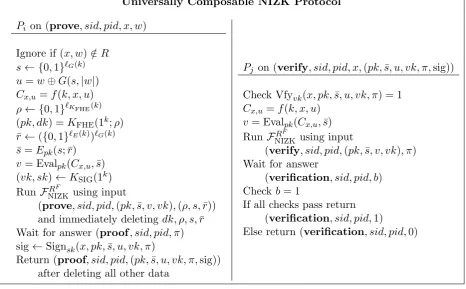
We will now present a non-interactive protocol φ that securely realizes FR
NIZK for an arbitrary
NP-relation R with minimal communication. A proof for a statement x with witnesses of size |w| consists of |w|+ poly(k) bits. We make two assumptions, namely that a fully homomorphic encryption scheme (KFHE, E, D,Eval) exists and thatFR
F
NIZKcan be securely realized for the relation
RF ={((pk,s, v, vk¯ ),(ρ, s,r¯)) :
ρ∈ {0,1}`KFHE(k)∧(pk, dk) =K
FHE(1k;ρ)∧r¯∈({0,1}`E(k))|s|∧s¯=Epk(s; ¯r)∧Ddk(v) = 1}. Note that we have generalizedRF slightly compared to the previous section by allowing statements to have an arbitraryvk in the end.
Universally Composable NIZK Protocol
Pi on (prove, sid, pid, x, w)
Ignore if (x, w)∈/ R s← {0,1}`G(k)
u=w⊕G(s,|w|)
Cx,u =f(k, x, u)
ρ← {0,1}`KFHE(k) (pk, dk) =KFHE(1k;ρ) ¯
r←({0,1}`E(k))`G(k) ¯
s=Epk(s; ¯r)
v= Evalpk(Cx,u,¯s) (vk, sk)←KSIG(1k) RunFRF
NIZK using input
(prove, sid, pid,(pk,¯s, v, vk),(ρ, s,¯r)) and immediately deleting dk, ρ, s,¯r
Wait for answer (proof, sid, pid, π) sig←Signsk(x, pk,s, u, vk, π¯ )
Return (proof, sid, pid,(pk,s, u, vk, π,¯ sig)) after deleting all other data
Pj on (verify, sid, pid, x,(pk,¯s, u, vk, π,sig))
Check Vfyvk(x, pk,¯s, u, vk, π) = 1
Cx,u =f(k, x, u)
v= Evalpk(Cx,u,¯s) RunFRF
NIZK using input
(verify, sid, pid,(pk,¯s, v, vk), π) Wait for answer
(verification, sid, pid, b) Checkb= 1
If all checks pass return (verification, sid, pid,1)
Else return (verification, sid, pid,0)
Figure 3: Universally composable NIZK proof forR.
Theorem 8 The protocol φ in Figure 3 securely realizes FR
NIZK in the FR
F
NIZK-hybrid model.
Proof. We have to show that for any adversary A there is an ideal process adversary S such that no environment Z has more than negligible advantage in distinguishing between φ running with
P1, . . . , Pn and A and FNIZKR running with dummy parties ˜P1, . . . ,P˜n and S. Our proof strategy is to start with φ running with A and modifying the experiment in steps that the environment has negligible probability of distinguishing. For this purpose we define three additional simulators SREAL,SEXT,SSIM that are used in intermediate steps and have the ability to control FR
NIZK in
various ways. Informally,SREAL running with the ideal functionality FNIZKR takes full control over
FR
NIZK and makes a perfect simulation of A running with φ. SEXT modifies the simulation such
that whenever an NIZK proof that has not been created by FNIZK is verified as being valid it extracts the corresponding witness and inputs it to FR
NIZK. SSIM and S complete the security
proof by enabling the simulation of honest parties making NIZK proofs without knowledge of the corresponding witnesses.
We now give the details of the simulators and the security proof.
SREAL: SREAL learns the inputs to FNIZKR and controls the outputs. It can therefore run a perfect
simulation ofP1, . . . , Pn and A runningπNIZK in theFR
F
NIZK-hybrid model.
SREAL simulates A and forwards all communication between the simulated A and the envi-ronmentZ. Whenever the simulatedAcorrupts a simulatedPi,SREAL corrupts ˜Pi and lets it interact with the environment asAinstructs the simulatedPito interact with the environment.
WhenSREAL receives (prove, Pi, sid, pid, x) from FNIZKR it is because an honest ˜Pi has input (prove, sid, pid, x, w) with (x, w)∈R. SinceSREAL knows the inputs toFNIZKR it can simulate Pi runningπNIZK in the FR
F
NIZK-hybrid model including FR
F
to A and on getting the answer (proof, π) making the signature sig to complete the proof Π = (pk,¯s, u, vk, π,sig). SREAL answers (proof,Π) toFR
NIZK.
On input (verify, Pj, sid, pid, x,Π) from FNIZKR the simulator SREAL knows that the honest
party ˜Pj has queried (verify, sid, pid, x,Π) to FNIZKR , where (x,Π) has not been stored before
and hence not been created by an honest party. SREAL simulates Pj running the verification protocol on input (verify, sid, pid, x,Π). The simulator forces FR
NIZK to return the resulting
answer (verification, sid, pid, b) and stores (x,Π) inFR
NIZK ifb= 1.
The simulation is exactly like runningπNIZKin theFRF
NIZK-hybrid model, except for the fact that
a proof Π for a statementx output by an honest party ˜Pi is guaranteed to be accepted in the verification phase and once a proof Π for a statementxis accepted, it will always be accepted byFR
NIZK. However, if we look at a real execution of πNIZK we see that the correctness of the
signature scheme, the correctness of the fully homomorphic cryptosystem and the properties of FRF
NIZK guarantees that proofs Π created by honest parties Pi are accepted and also that accepted proofs will always be accepted again. To the environment, a real execution ofπNIZK
in theFRF
NIZK-hybrid model with adversaryAis perfectly indistinguishable from the simulation
bySREAL running withFR
NIZK.
SEXT: SEXT runs like SREAL when proofs are constructed, but changes the way proofs are verified.
AsSREAL it simulatesPj getting input (verify, sid, pid, x,Π) in the execution of πNIZK, but if
the answer is (verification, sid, pid,1) then it extracts a witness w such that (x, w)∈R and aborts the simulation if the extraction fails.
More precisely, on input (verify, Pj, sid, pid, x,Π) from FNIZKR the simulator SEXT
sim-ulates the honest Pj getting input (verify, sid, pid, x,Π) in πNIZK. If Pj outputs (verification, sid, pid,0) then SEXT returns (witness,⊥) to FNIZKR and forwards the
re-sulting (verification, sid, pid,0) message to P˜j. On the other hand, if Pj outputs (verification, sid, pid,1) then SEXT will try to extract a witness w such that (x, w) ∈ R, return (witness, w) toFR
NIZK and send the resulting (verification, sid, pid,1) message to ˜Pj. SEXT parses Π = (pk,s, u, vk, π,¯ sig). We only need to extract a witness for Π, where
the signature sig on (x, pk,¯s, u, vk, π) is valid, because otherwise the protocol πNIZK will reject the proof. Part of the verification protocol also consists in querying FRF
NIZK on
(verify, sid, pid,(pk,¯s, v, vk), π), where v = Evalpk(Cx,u,¯s). The simulated FR F
NIZK will only
return (verification, sid, pid,1) if an honest party created the proofπ on (pk,¯s, v, vk) or ifA supplies a witness (ρ, s,r¯) such that (pk, dk) =KFHE(1k;ρ) and ¯s=Epk(s; ¯r) andDdk(v) = 1. In the latter case, this tellsSEXTwhatdkis and hence it can computesandw=u⊕G(s,|w|). The correctness of the fully homomorphic cryptosystem shows that in this case, the witnessw
satisfies (x, w)∈Rand thereforeSEXTcan submit (witness, w) toFNIZKR . On the other hand,
if an honest party created the proofπon (pk,¯s, v, vk) then the strong existential unforgeability of the one-time signature scheme implies that there is negligible probability of the adversary producing a different valid signature sig using vk. There is therefore only negligible risk of SEXT not being able to extract a witness w.
SSIM: SEXT runs the verification process of FNIZKR without interference, but in the proof process
it uses knowledge of the inputs the honest parties provide to FR
NIZK. In the next couple of
modification of the simulator, we will move towards simulating the proofs instead of using knowledge of the inputs toFR
NIZK.
Let SSIM be a modification of SEXT that instead of running a perfect simulation of FRF
NIZK
This means, FRF
NIZK may ask A for a proof π for a false statement (pk,¯s, v, vk) and store
((pk,¯s, v, vk), π) as being a valid proof and return (proof, sid, pid,(pk,s, v, vk¯ ), π) to the re-questing partyPi.
SEXT can now change the way it constructs ¯s to instead set ¯s ← Epk(0`G(k)). Due to the IND-CPA security of the fully homomorphic encryption scheme this tuple of ciphertexts ¯s
is indistinguishable from a bit-wise encryption of s. Running FR
NIZK with SSIM is therefore
computationally indistinguishable from runningFR
NIZK withSEXT.
S: We will now make a modification of SSIM to get a simulator that does not have access to the internals ofFR
NIZK. S is a modification ofSSIM that simulates the proof created by an honest
partyPi by settingu← {0,1}|w|instead of usingu=w⊕G(s,|w|). SinceGis a pseudorandom generator, it is not possible for the environment to distinguish whether SSIM orS is making the simulation withFR
NIZK.
SinceS does not need to know the witness when simulating a proof for an honest party Pi, it runs entirely without access to or control over the workings ofFR
NIZK. As we have shownS running with
FR
NIZK is indistinguishable from the protocolπNIZKrunning withAin theFR
F
NIZK-hybrid model. The
protocolπNIZK therefore securely realizes FR
NIZK in the FR
F
NIZK-hybrid model.
There may be many ways to securely realizeFRF
NIZKand by the universal composition theorem [Can01]
our result shows that all of them imply the existence of witness-length universally composable NIZK proofs if fully homomorphic encryption exists. In particular, we get witness-length universally com-posable NIZK proofs in the common reference string model [BFM88], the multi-string model [GO07] or under any other setup assumption under which universally composable NIZK proofs exist.
We have assumed a dynamic corruption model in the construction. However, our construc-tion also shows that if FRF
NIZK can be securely realized against static adversaries, then we get a
witness-length universally composable NIZK proof for any NP-relation R that is secure against static adversaries.
References
[BCNP04] Boaz Barak, Ran Canetti, Jesper Buus Nielsen, and Rafael Pass. Universally compos-able protocols with relaxed set-up assumptions. InFOCS, pages 186–195, 2004.
[BFM88] Manuel Blum, Paul Feldman, and Silvio Micali. Non-interactive zero-knowledge and its applications. InSTOC, pages 103–112, 1988.
[BW06] Xavier Boyen and Brent Waters. Compact group signatures without random oracles. InEUROCRYPT, volume 4004 of Lecture Notes in Computer Science, pages 427–444, 2006.
[Can01] Ran Canetti. Universally composable security: A new paradigm for cryptographic protocols. InFOCS, pages 136–145, 2001.
[CGS07] Nishanth Chandran, Jens Groth, and Amit Sahai. Ring signatures of sub-linear size without random oracles. InICALP, volume 4596 ofLecture Notes in Computer Science, pages 423–434, 2007.
[DDN00] Danny Dolev, Cynthia Dwork, and Moni Naor. Non-malleable cryptography. SIAM Journal of Computing, 30(2):391–437, 2000.
[DDO+02] Alfredo De Santis, Giovanni Di Crescenzo, Rafail Ostrovsky, Giuseppe Persiano, and Amit Sahai. Robust non-interactive zero knowledge. In CRYPTO, volume 2139 of
Lecture Notes in Computer Science, pages 566–598, 2002.
[DDP02] Alfredo De Santis, Giovanni Di Crescenzo, and Giuseppe Persiano. Randomness-optimal characterization of two NP proof systems. In RANDOM, volume 2483 of
Lecture Notes in Computer Science, pages 179–193, 2002.
[FLS99] Uriel Feige, Dror Lapidot, and Adi Shamir. Multiple non-interactive zero knowledge proofs under general assumptions. SIAM Journal of Computing, 29(1):1–28, 1999.
[Gen09a] Craig Gentry. A fully homomorphic encryption scheme. PhD thesis, Stanford Univer-sity, 2009.
[Gen09b] Craig Gentry. Fully homomorphic encryption using ideal lattices. In STOC, pages 169–178, 2009.
[GH98] Oded Goldreich and Johan H˚astad. On the complexity of interactive proofs with bounded communication. Inf. Process. Lett., 67(4):205–214, 1998.
[GK96] Oded Goldreich and Hugo Krawczyk. On the composition of zero-knowledge proof systems. SIAM Journal of Computing, 25(1):169–192, 1996.
[GO94] Oded Goldreich and Yair Oren. Definitions and properties of zero-knowledge proof systems. Journal of Cryptology, 7(1):1–32, 1994.
[GO07] Jens Groth and Rafail Ostrovsky. Cryptography in the multi-string model. In
CRYPTO, volume 4622 ofLecture Notes in Computer Science, pages 323–341, 2007.
[GOS06a] Jens Groth, Rafail Ostrovsky, and Amit Sahai. Non-interactive zaps and new techniques for NIZK. InCRYPTO, volume 4117 ofLecture Notes in Computer Science, pages 97– 111, 2006.
[GOS06b] Jens Groth, Rafail Ostrovsky, and Amit Sahai. Perfect non-interactive zero-knowledge for NP. In EUROCRYPT, volume 4004 of Lecture Notes in Computer Science, pages 339–358, 2006.
[Gro06] Jens Groth. Simulation-sound NIZK proofs for a practical language and constant size group signatures. InASIACRYPT, volume 4248 ofLecture Notes in Computer Science, pages 444–459, 2006.
[Gro10] Jens Groth. Short non-interactive zero-knowledge proofs. In ASIACRYPT, volume 6477 of Lecture Notes in Computer Science, pages 341–358, 2010.
[GS08] Jens Groth and Amit Sahai. Efficient non-interactive proof systems for bilinear groups. InEUROCRYPT, volume 4965 of Lecture Notes in Computer Science, pages 415–432, 2008.
[IKOS09] Yuval Ishai, Eyal Kushilevitz, Rafail Ostrovsky, and Amit Sahai. Zero-knowledge proofs from secure multiparty computation. SIAM Journal of Computing, 39(3):1121–1152, 2009.
[KP98] Joe Kilian and Erez Petrank. An efficient noninteractive zero-knowledge proof system for NP with general assumptions. Journal of Cryptology, 11(1):1–27, 1998.
[KR08] Yael Tauman Kalai and Ran Raz. Interactive pcp. In ICALP, volume 5126 ofLecture Notes in Computer Science, pages 536–547, 2008.
[Ore87] Yair Oren. On the cunning power of cheating verifiers: Some observations about zero knowledge proofs. InFOCS, pages 462–471, 1987.
[Sah01] Amit Sahai. Non-malleable non-interactive zero-knowledge and adaptive chosen-ciphertext security. InFOCS, pages 543–553, 2001.
[SS10] Damien Stehl´e and Ron Steinfeld. Faster fully homomorphic encryption. In ASI-ACRYPT, volume 6477 ofLecture Notes in Computer Science, pages 377–394, 2010.
[SV10] Nigel P. Smart and Frederik Vercauteren. Fully homomorphic encryption with relatively small key and ciphertext sizes. In Public Key Cryptography, volume 6056 of Lecture Notes in Computer Science, pages 420–443, 2010.