Fast Quadrupling of a Point on Elliptic Curves
Cryptography
Duc-Phong Le Temasek Laboratories National University of Singapore
Abstract
Ciet et al. proposed a very elegant method for trading inversions for multiplications when computing 2P +Qfrom given points P and Q on elliptic curves of Weierstrass form. In this paper we extend their method and present a fast algorithm for computing 4P with only one inversion in affine coordinates. Our algorithm is faster than two repeated doublings whenever the cost of one field inversion is more expensive than the cost of four field multiplications plus three field squarings (i.e. I>4M+ 4S). It saves one filed multiplication and one field squaring in comparison with Sakai-Sakurai’s method. We also show that on particular curves (i.e. a = 0 or b = 0), our algorithm gains better results.
Keywords: Elliptic curve cryptography, fast arithmetic, affine co-ordinates.
1
Introduction
The use of elliptic curve in cryptography was suggested independently by Miler in [1] and Koblitz in [2] in 1985. Since then, Elliptic Curve Cryptog-raphy (ECC) have received a lot of attention due to the fast group law on elliptic curves and because there is no subexponential attack on the discrete logarithm problem defined over elliptic curves. Thus, it can provide the same security level as RSA (or Diffie-Hellman) but with much shorter keys. In particular, this is mainly relevant for small embedded devices.
Recently, Ciet et al. [3] introduced a fast algorithm trading one inversion for some multiplications, to compute 2P +Q from given points P and Q
Ciet et al. [3] went further and showed that the x-coordinate of the point (P +Q) can also be omitted and two divisions from calculation of λ1 and
λ2 can obtained by one inversion.
The idea of trading field inversions for field multiplications when com-puting 4P has been appeared in [5], where the authors presented a general formulas for computing 2kP in both of affine and projective coordinates. In affine coordinates, their method requires one field inversion, (4k+ 1) field multiplications and (4k+ 1) field squarings. For k = 2, the cost of their algorithm is one inversion, 9 multiplications and 9 squarings.
In this paper, due to the Ciet et al.’s method, we present new formulas for quadrupling of point on elliptic curves over finite fields of odd characteristic
p >3 in affine coordinates. Our algorithm requires one field inversion, 8 field multiplications and 8 field squarings on general curves. Thus, the algorithm saving one field multiplication and one field squarings from the results of Sakai-Sakurai [5] is faster than two repeated doublings if the cost of one field inversion is more expensive than the cost of four field multiplications plus four field squarings.
We also present new quadrupling formulas for special curves witha= 0 orb= 0 which are even faster than that on general curves.
The rest of the paper is organized as follows. We briefly recall definitions elliptic curve cryptography in Section 2. Section 3 presents our algorithms. We also give some analysis in this section. The conclusion will be given in Section 4.
2
Preliminaries
In this section, we first recall some basic definitions in elliptic curve cryp-tography. For much more material on elliptic curve cryptography we refer to [6]. Then we review the algorithm of Ciet al et. [3] for tripling a point.
2.1 Elliptic curves over finite fields
Forp prime andp >3, an elliptic curve defined overFp in short Weierstrass
form is the set of solutions (x, y) to the following equation:
E:y2 =x3+ax+b, (1) together with an extra point O which is called the point at infinity. Where a, b ∈ Fp such that the discriminant ∆ = −16(4a3+ 27b2) is
non-zero.
We usually use the notationE(Fq) for the set of points (x, y) with
coor-dinates in the fieldFq together with the pointO, the identity element of the
We usually use the notationE(Fp) for the set of points (x, y) with
coor-dinates in the fieldFp. The set of points on an elliptic curve forms a group
under a certain addition rule.
The set of points on an elliptic curve forms a group under a certain ad-dition rule. The negative of the pointP = (x1, y1) is given−P = (x1,−y1).
Let P1 = (x1, y1) and P2 = (x2, y2) be two points on elliptic curve E with
P1 6=−P2. Then the coordinates ofP3 =P1+P2= (x3, y3) can be computed
as follows:
x3 =λ2−x1−x2, y3=λ(x1−x3)−y1, where
λ= 3x
2 1+a
2y1
ifP1 =P2, λ=
y2−y1
x2−x1
ifP1 6=P2.
The doubling and addition costs are 1I+2M+2S and 1I+2M+1S re-spectively in affine coordinates, whereI,MandSdenote field inversion, field multiplication and field squaring, respectively.
2.2 Ciet et al.’s Algorithm
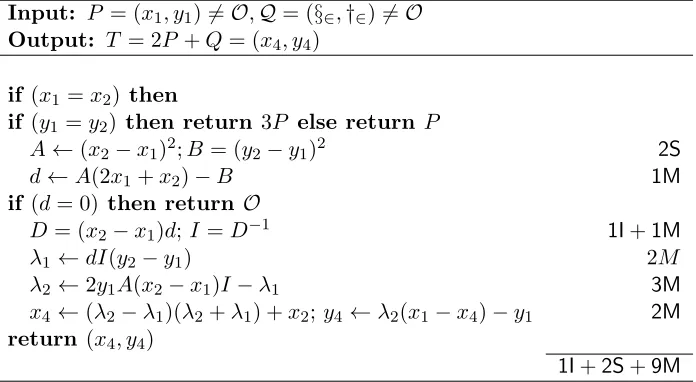
In [3], the authors gave formulas to directly compute 2P +Q from given pointsP and Q on elliptic curves with one field inversion, 2 field squarings and 9 field multiplications. The algorithm is described as in Table 1.
Input: P = (x1, y1)6=O,Q= (§∈,†∈)6=O
Output: T = 2P+Q= (x4, y4)
if (x1 =x2) then
if (y1=y2) then return 3P else return P
A←(x2−x1)2;B = (y2−y1)2 2S
d←A(2x1+x2)−B 1M
if (d= 0) then return O
D= (x2−x1)d;I =D−1 1I+1M
λ1 ←dI(y2−y1) 2M
λ2 ←2y1A(x2−x1)I−λ1 3M
x4 ←(λ2−λ1)(λ2+λ1) +x2;y4 ←λ2(x1−x4)−y1 2M
return (x4, y4)
1I+2S+9M
3
The Algorithm
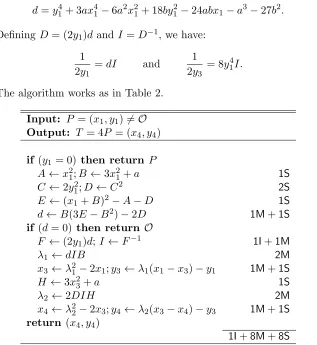
Our algorithm performs a quadrupling 4P on an elliptic curve E in affine coordinates using only one field inversion, 8 field multiplications, and 8 field squarings.
3.1 Description of the Algorithm
LetP = (x1, y1), we need to compute 4P = (x4, y4). Let
d= (3x21+a)(12x1y21−(3x21+a)2)−8y14. (2)
we see that d = 8y13y3, where y3 is y-coordinate of the point 2P. The
computation of the valuedrequires1M+5S. Ifaandbare small,dcan be computed by 4S as follows:
d=y14+ 3ax41−6a2x21+ 18by21−24abx1−a3−27b2. (3)
DefiningD= (2y1)dand I =D−1, we have:
1 2y1
=dI and 1
2y3
= 8y14I.
The algorithm works as in Table 2.
Input: P = (x1, y1)6=O
Output: T = 4P = (x4, y4)
if (y1= 0) then return P
A←x21;B ←3x21+a 1S
C ←2y12;D←C2 2S
E ←(x1+B)2−A−D 1S
d←B(3E−B2)−2D 1M+1S
if (d= 0) then return O
F ←(2y1)d;I ←F−1 1I+1M
λ1 ←dIB 2M
x3←λ21−2x1;y3 ←λ1(x1−x3)−y1 1M+1S
H ←3x23+a 1S
λ2 ←2DIH 2M
x4←λ22−2x3;y4 ←λ2(x3−x4)−y3 1M+1S
return (x4, y4)
1I+8M+8S
Quadrupling on curves with b = 0 In the case of b = 0, d should be set to
d= (x21−a)((x12+a)2+ 4ax21).
That is because, in this setting, y3 = (x21−a)((x21+a)2+ 4ax21)/(8y13).
Thus, we need2M+2Sto compute the value of d. By performing similarly as in Table 2, the quadrupling computation of a point on an elliptic curve requires1I+5S+9M.
Quadrupling on curves with a = 0 In the case of a = 0, the slopes
λ1 = 3x21/2y1 and λ2 = 3x31/2y3 are particularly simple. The value din the
Eq. (2) can be replaced by
d=y14+ 18by12−27b2,
which requires only two squarings. We save one multiplication and two squarings for computingd.
In this setting, x3 =λ21−2x1 =x1(y12−9b)/(4y12), which will be used
for computingλ2. We have:
λ2 =
3x23
2y3
= 3x
2
1(y21−9b)2
32y14y3
= 3x
2
1(y14−18by21+ 81b2)
2D
= 3 2(x
2
1(y41−18by21+ 81b2)I),
whereD= (2y1)d= 16y14y3 and I =D−1.
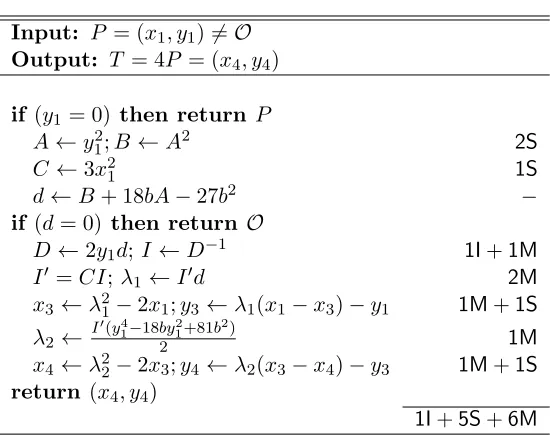
The following formulas compute a quadrupling in 1I+5S+6M.
3.2 Analyze
From the operation count we see that the algorithm is faster than two re-peated doublings if one field inversion is more expensive than 4M+4S on general curves. In comparison with the Sakai-Sakurai [5] algorithm, our method saves one field multiplication and two field squarings.
Input: P = (x1, y1)6=O
Output: T = 4P = (x4, y4)
if (y1= 0) then return P
A←y12;B ←A2 2S
C ←3x21 1S
d←B+ 18bA−27b2 −
if (d= 0) then return O
D←2y1d;I ←D−1 1I+1M
I0 =CI;λ1 ←I0d 2M
x3←λ21−2x1;y3 ←λ1(x1−x3)−y1 1M+1S
λ2 ← I
0(y4
1−18by21+81b2)
2 1M
x4←λ22−2x3;y4 ←λ2(x3−x4)−y3 1M+1S
return (x4, y4)
1I+5S+6M
Table 3: Quadrupling algorithm of a point on elliptic curves with the short Weierstrass form
multiplication, this ratio is roughly 80 (see benchmarks reported in [7]). In the cases when the Mersenne prime cannot used (e.g. pairing-based cryptog-raphy), theI/M-ratio is often reported to be 13 on 32-bits Intel processors (see benchmarks reported in [9]).
In this setting, our algorithm is better than two repeated doubling in the case 1I>7.2M.
On special elliptic curves, our algorithms are even better. For curves with b= 0, our algorithm requires only 1I+5S+9M, it is faster than two repeated doublings if 1I>5.8M. In particular, for curves with a = 0, our algorithm requiring only1I+5S+6Mis faster than two repeated doublings if1I>2.8M.
4
Conclusion
In this paper, we presented the fast algorithms for quadrupling of point on three forms of elliptic curves that offer a better performance than a repeated doubling if 1I>7.2M, 1I>5.8M, and 1I>2.8M, respectively. This can be helpful to speedup the scalar multiplication in elliptic curve cryptography as indicated in [5, 3].
References
Springer-Verlag New York, Inc., New York, NY, USA, 1986, pp. 417– 426.
URLhttp://portal.acm.org/citation.cfm?id=18262.25413
[2] N. Koblitz, Elliptic curve cryptosystems, Mathematics of Computation 48 (177) (1987) 203–209.
[3] M. Ciet, M. Joye, K. Lauter, P. Montgomery, Trading inversions for multiplications in elliptic curve cryptography, Designs, Codes and Cryp-tography 39 (2006) 189–206, 10.1007/s10623-005-3299-y.
[4] K. Eisentr¨ager, K. Lauter, P. L. Montgomery, Fast Elliptic Curve Arith-metic and Improved Weil Pairing Evaluation, in: M. Joye (Ed.), CT-RSA, Vol. 2612 of Lecture Notes in Computer Science, Springer, 2003, pp. 343–354.
[5] Y. Sakai, K. Sakurai, Efficient scalar multiplications on elliptic curves with direct computations of several doublings, IEICE Transactions Fun-damentals E84-A(1) (2001) 120–129.
[6] D. Hankerson, A. J. Menezes, S. Vanstone, Guide to Elliptic Curve Cryp-tography, Springer-Verlag New York, Inc., Secaucus, NJ, USA, 2003.
[7] M. Brown, D. Hankerson, J. L´opez, A. Menezes, Software Implemen-tation of the NIST Elliptic Curves Over Prime Fields, in: Proceedings of the 2001 Conference on Topics in Cryptology: The Cryptographer’s Track at RSA, CT-RSA 2001, Springer-Verlag, 2001, pp. 250–265.
URLhttp://portal.acm.org/citation.cfm?id=646139.680803
[8] M. Seysen, Using an RSA Accelerator for Modular Inversion, in: J. R. Rao, B. Sunar (Eds.), Cryptographic Hardware and Embedded Systems – CHES 2005, Vol. 3659 of Lecture Notes in Computer Science, Springer Berlin / Heidelberg, 2005, pp. 226–236.
URLhttp://www.iacr.org/cryptodb/archive/2005/CHES/769/769.pdf