Available Online atwww.ijcsmc.com
International Journal of Computer Science and Mobile Computing
A Monthly Journal of Computer Science and Information Technology
ISSN 2320–088X
IMPACT FACTOR: 5.258
IJCSMC, Vol. 5, Issue. 3, March 2016, pg.423 – 430
TRACKING EYE MOVEMENT BY
CHARACTERIZING A SEQUENCE
THROUGH HIERARCHICAL CLUSTERING
A.Vetrivel
[1], T.Pandiyavathi
[2][1]
B.E Student, Department of Computer Science and Engineering, IFET College of Engineering,
Villupuram, India, E-mail id: [email protected]
[2]
Assistant Professor, Department of Computer Science and Engineering, IFET College of
Engineering, Villupuram, India, E-mail id: [email protected]
ABSTRACT: Eye tracking is an evolving concept in the field of computer science it has emerges to the extent
of gaze-based mouse usage to the system that may be implemented in the upcoming era. This concept can
also be applied for the security purpose. An algorithm was developed to characterize, compare, and analyze
eye movement sequences that occur during visual tracking of multiple moving targets. The most notable gaze
features in the face image are the iris centre and eye corner. The eyeball moves in the eye socket when
looking at different positions on the screen. The developed algorithm characterizes a sequence by
hierarchically clustering the targets that an individual interrogated through an unordered transition matrix
created from the frequencies of eye fixation transitions among the targets. Then, the resulting sets Of
clustered targets, which we define as multilevel visual groupings (VGs), can be compared with analyze
performance. The algorithm was applied to an aircraft conflict detection task. The algorithm supported
identifying different eye movement characteristics between experts and novices. Scans of the experts had
multilevel VGs around the conflict pairs, whereas those of the novices included different aircraft. Our
Existing method, though insensitive to light conditions, achieves only average accuracy results show promise
for using the compact representation of eye movements for performance analysis.
I. INTRODUCTION
F
ace is the index of mind and eyes are the window to the soul. Eye movements provide a richand informative window into a person’s thought and intentions. Thus the study of eye
movement may determine what people are thinking based on where they are looking. Eye
tracking is the measurement of eye movement/activity and gaze (point of regard) tracking is
the analysis of eye tracking data with respect to the head/visual scene. Researches of this field
often use the terms eye-tracking, gaze-tracking or eye-gaze tracking interchangeably. Eye
tracking is mostly used in the applications like drowsiness detection [Picot et al. (2010)],
diagnosis of various clinical conditions or even iris recognition [Xu et al. (2006)]. But gaze
tracking methods can be used in all the ways that we use our eyes, to name a few, eye typing
for physically disabled, Cognitive and behavioural therapy, visual search,
marketing/advertising, neuroscience, Psychology and Human Computer Interaction (HCI).
Usually the integration of eye and head position is used to compute the location of the gaze in
the visual scene. Simple eye trackers report only the direction of the gaze relative to the head
(with head-mounted system, electrodes, sceleral coils) or for a fixed position of the eyeball
(systems which require a head fixation). Such eye tracking systems are referred as intrusive
or invasive systems because some special contacting devices are attached to the skin or eye to
catch the user’s gaze. The systems which do not have any physical contact with the user and
the eye tracker apparatus are referred as non-intrusive systems or remote systems.
Several recent studies have shown that manipulating the gaze direction of face stimuli
could influence their later recognition. Authors have reported that faces seen with a direct
gaze (i.e., the gaze directed to the observer) are more likely to be recognised at a subsequent
recognition task compared to faces seen with a laterally deviated gaze. In a surprise
recognition task, the participants’ performance was better for targets presented with a direct
gaze during the initial classification task.
II. LITERATURE SURVEY
A variety of eye-gaze (eye-movement) tracking techniques have been reported in the
literature [l]. A brief list of them includes Electra-Oculography [2], Limbus, Pupil and Eyelid
Tracking, Contact Lens Method, Cornea1 and Pupil Reflection Relationship, Purkinje Image
Tracking, Artificial Neural Networks and Head Movement Measurement. Computer vision is
intrinsically non-intrusive, and does not require any overly expensive equipment.
Nonobtrusive sensing technology - such as video cameras and microphones - has received
constructed using a web camera in a desktop environment. An MTAHC(Maximum
Transaction based agglomerative hierarchical clustering algorithm) algorithm was developed
to characterize, compare, and analyze eye movement sequences that occur during visual
tracking of multiple moving targets.
The concept of this paper is organized as follows: Section II describes related study. The
details of the proposed gaze tracking method are presented in Section III, which includes
Existing System, Problem Definition, Proposed System, Advantages. In Section IV, we study
the architecture diagram. Section V explain proposed algorithm. Section VI is the conclusion.
III. RELATED WORK
Nowadays most eye-tracking systems work on video-based pupil detection and a
reflection of an infrared LED. Video cameras became cheap over the last years and the price
for a LED is negligible. Many computer devices come already with built-in cameras, such as
mobile phones, laptops, and displays. Processor power still increases steadily and standard
processors are powerful enough to process the video stream necessary to do eye tracking, at
least on desktop and laptop computers. Head-tracking systems, which are necessary to give
the users the freedom to move in front of their display, are also video-based. Such systems
can be implemented unobtrusively with a second camera. If produced for the mass market, a
future standard eye tracker should not cost much more than an optical mouse or a webcam
today. Some people interact with the computer all day long, for their work and in their leisure
time. As most interaction is done with keyboard and mouse, both using the hands, some
people suffer from overstressing particular parts of their hands, typically causing a carpal
tunnel syndrome. With a vision of ubiquitous computing, the amount of interaction with
computers will increase and we are in need of interaction techniques which do not cause
physical problems. The eyes are a good candidate because they move anyway when
interacting with computers. Using the information lying in the eye movements could save
some interaction, in particular hand-based interaction.
Eye Gaze is defined as the line of sight of a person. It represents a person’s focus of
attention. Eye gaze tracking has been an active research topic for many decades because of its
potential usages in various applications such as Human Computer Interaction, Eye Disease
Diagnosis, Human Behavior Study, etc. Earlier eye gaze trackers were fairly intrusive in that
they require physical contacts with the user, such as placing a reflective white dot directly
properties, most of these technologies also require the viewer’s head to be motionless during
eye tracking.
With the rapid technological advancements in both video cameras and microcomputers,
eye gaze tracking technology based on the digital video analysis of eye movements has been
widely explored. Since it does not require anything attached to the user, the video technology
opens the most promising direction to build a non-intrusive eye gaze tracker. Based on the
eye images captured by the video cameras, various techniques have been proposed to do the
eye gaze estimation. Yet most of them suffer from two problems, the need of calibration per
user session and the large restriction on head motion.
Among them, the PCCR technique is the most commonly used approach to perform the
video-based eye gaze tracking. The angle of the visual axis (or the location of the fixation
point on the display surface) is calculated by tracking the relative position of the pupil center
and a speck of light reflected from the cornea, technically known as “glint”.
A. EXISTING SYSTEM
In existing system, infrared imaging and visible imaging approaches are commonly used.
As infrared-imaging techniques utilize invisible infrared light sources to obtain the controlled
light and a better contrast image. As a result, an infrared imaging-based method is capable of
performing eye gaze tracking. Unfortunately, an infrared-imaging-based gaze tracking system
can be quite expensive. In visible imaging methods there is no need of any specific infrared
devices and infrared light sources. But ambient light is uncontrolled, so iris centre detection
will become more difficult.
B. PROBLEM DEFIFINTION
Infrared-imaging-based gaze tracking system is quite expensive
An infrared-imaging system will not be reliable
Not all users produce the bright-dark effect
The reflection of infrared light sources on glasses is still an issue.
Ambient light is uncontrolled
Lower contrast images
C. PROPOSED SYSTEM
In proposed system, the implemented technique is an MTAHC algorithm which
characterizes a sequence by hierarchically clustering the targets that an individual
interrogates through an unordered transition matrix created from the frequencies of eye
fixation transitions among the targets. The resulting sets of clustered targets, which is
defined as multilevel visual groupings (VGs), can be compared with analyze performance.
The algorithm supported identifying different eye movement characteristics between experts
and novices. The results show promise for using the compact representation of eye
movements for performance analysis.
D. ADVANTAGES
Low cost
Improved accuracy
Achieve robustness for the gaze estimation
Gaze tracking has been constructed using a web camera in a desktop environment.
Locate the iris centre and Utilizing the piecewise eye corner detector to detect the eye
corner.
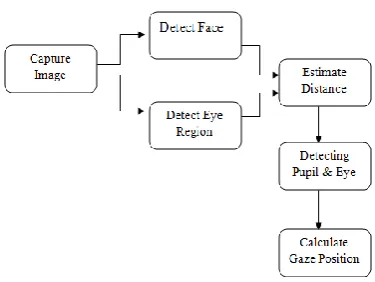
IV. SYSTEM ARCHITECTURE
System architecture is the conceptual model that defines the structure, behavior, and
more views of a system. An architecture description is a formal description and
representation of a system, organized in a way that supports reasoning about
the structures and behaviours of the system.
V. MTAHC ALGORITHM
A proof of concept experiment was conducted in part to find out whether the MTAHC
algorithm can be used to analyze performance by characterizing scanpaths with multilevel
VGs, and to characterize the possible differences in the cognitive processes among groups of
individuals with different expertise for a conflict detection task. The MTAHC algorithm was
applied to a task of interrogating multiple aircraft on a radar screen in order to detect conflicts
that would occur in the near future. Multilevel VGs were evaluated based on the expertise
(experts and novices) and the difficulty of the task (easy, moderate, and hard). Oculomotor
statistics were calculated. Conflict detection rates for the novices were investigated for
relationships to their multilevel VGs.
Step 1: Obtain an unordered transition matrix from a scanpath.
Step 2: Iteratively cluster the targets using the single linkage Function
Where Ci and Cj are clusters and t (x, y) is the number of transitions between the targets in the
clusters.
Step 3: Assign levels based on the size of the clusters (multilevel VG sets).
Step 4: (For comparing between groups) Compare proportions of obtained VG sets from
the total obtained VG sets at each level of VG.
VI. CONCLUSION
A model for gaze tracking has been constructed using a web camera in a desktop
environment. We proposed MTAHC algorithm is introduced to create multilevel visual
groupings (VGs), defined as sets of targets that have higher number transitions between or
among them compared with other targets. The algorithm supported identifying different eye
movement characteristics between experts and novices. Scans of the experts had multilevel
VGs around the conflict pairs, whereas those of the novices included different aircraft. The
results show promise for using the compact representation of eye movements for performance
REFERENCES:
[1] Laurencr. Young And David Sheee Na, Survey of Eye Movement Recording Methods,
Behavior Research Methods and Instrumentation, Vol. 7, No. 5, pp. 397-429 and 1975.
[2] Arie E. Kaufman, Amit Bandopadhay, Bernard D. Shaviv, An Eye Tracking Computer
User Interface , Research Frontier in Virtual Reality Workshop Proceedings, IEEE Computer
Society Press, pp. 78-84. October 1993.
[3] M. Mason, B. Hood, andC.N. Macrae, “Look into my eyes: Gaze direction and person
memory,” Memory, vol. 12, no. 5, pp. 637–643, 2004.
[4] Z. Kang and S. J. Landry, “An eye movement analysis algorithm for a multielement target
tracking task: Maximum transition-based agglomerative hierarchical clustering,” IEEE Trans.
Human Mach. Syst., vol. 45, no. 1, pp. 13–24, Feb. 2015.
[5] D. A. Robinson, “A method of measuring eye movement using a sclera search coil in a
magnetic field,” IEEE Trans. Bio-med. Electron., vol. 10, no. 4, pp. 137–145, Oct. 1963.
[6] A. E. Kaufman, A. Bandopadhay, and B. D. Shaviv, “An eye tracking computer user interface,” in Proc. IEEE Symp. Res. Frontiers Virtual Reality, 1993, pp. 120–121.
[7] J. S. Babcock and J. B. Pelz, “Building a lightweight eyetracking headgear,” in Proc.
Symp. Eye Tracking Res. Appl., 2004, pp. 109–114.
[8] K. Takemura, K. Takahashi, J. Takamatsu, and T. Ogasawara, “Estimating 3-D
point-of-regard in a real environment using a head-mounted eye-tracking system,” IEEE Trans.
Human Mach. Syst., vol. 44, no. 4, pp. 531–536, Aug. 2014.
[9] J. J.Cerrolaza, A.Villanueva, and R. Cabeza, “Taxonomic study of polynomial regressions
applied to the calibration of video-oculographic systems,”in Proc. Symp. Eye Tracking Res.
Appl., 2008, pp. 259–266.
[10] A. Haro, I. Essa, and M. Flickner, “A non-invasive computer vision system for reliable eye tracking,” in Proc. Extended Abstracts Human Factors Comput. Syst., 2000, pp. 167–168.
[11] D. W. Hansen and A. E. Pece, “Eye tracking in the wild,” Comput. Vis. Image
[12] E. D. Guestrin and E. Eizenman, “General theory of remote gaze estimation using the pupil center and corneal reflections,” IEEE Trans. Biomed. Eng., vol. 53, no. 6, pp. 1124–
1133, Jun. 2006.
[13] J. Zhu and J. Yang, “Subpixel eye gaze tracking,” in Proc. 5th IEEE Int. Conf. Autom.
Face Gesture Recog., 2002, pp. 124–129.
[14] R.Valenti, N. Sebe, and T. Gevers, “Combining head pose and eye location information for gaze estimation,” IEEE Trans. Image Process., vol. 21, no. 2, pp. 802–815, Feb. 2012.
[15] D. Torricelli, S. Conforto, M. Schmid, and T. DAlessio, “A neural-based remote eye