Nofish : A new stream cipher
Marius Oliver Gheorghita
331 Cotofenii Fata 207013,Dolj, Romania e-mail: [email protected]
Abstract
The purpose of this paper is to provide a description of the Nofish cryptographic algorithm. This paper is intended to release the algorithm to the cryptographic community, for its future analysis and possible use. The name of the algorithm comes in respect to other well-known secure crypto algorithms like Blowfish and Twofish and since this one has not gained this status, I call it Nofish.
1. Algorithm description
The proposed algorithm is a synchronous stream cipher, more precisely a binary additive stream cipher because it using the XOR function to encrypt the plaintext.
The design is based on HENKOS stream cipher (http://eprint.iacr.org/
2004/080.pdf), the functions used in the internal state are kept, the initialization and mixing key part being modified with respect to its revealed weaknesses. This stream cipher uses a named key of 64 bytes (512 bits) as a secret key and no initialization vector.
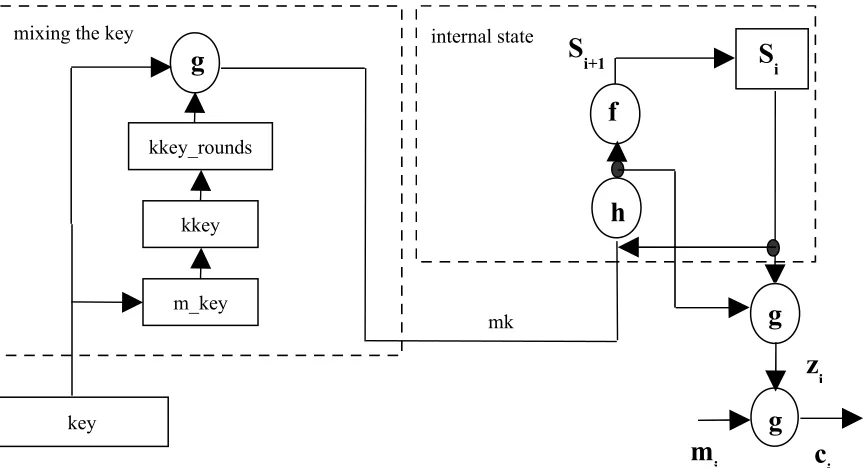
Figure 1. Structure of the Nofish stream cipher
m
imixing the key
m_key kkey kkey_rounds
g
S
i+1S
if
g
h
z
iinternal state
key
g
c
iNotations:
mi – stream of plaintext
ci – stream of ciphertext
zi – keystream
h=SW function; f=AD function;
Si – internal state i; S0 – initial state;
g=XOR;
Key mixing
Role of this module is to mix enough the provided key and is using as an initialization value kkey, set to 512; the ouput is a new kkey value.
m_key[i]= i, i=0,63
There are four sets of values that are used to mix the both halves of the key: S1=[7,26]
S2=[5,22] S3=[3,16,29] S4=[2,13,24]
If j (for j=0,31) is in first set of values then kkey value is decreased with i^(key[j] +key[j+32]), and if j it is in the second set of values kkey value becomes the reminder of the division with i^(key[j]+key[j+32]) to which is added a fixed value of 512 in order to avoid possible intermediate zero values.
If j it is in the third set, kkey is incresead with i^(key[j]+key[j+32]) and for the last set it is multiplied with i value.
A number of rounds equal with kkey value is performed for mixing the m_key vector, in each round being calculated the sum of the m_key values and used to calculate the next m_key values as the reminder of the division with the value 67-i, i=0,63.
Key initialization
In this part of the algorithm, transform key in order to obtain a proper initialization before it can be used to generate the keystream. It is done using two major functions: one is the “switch” function (SW), which will mix the bytes of the data key as follows: every byte j is switched with byte k in the data key, where k is the
value from the mixed key (mk) in the i position.
The next function is an additive function (AD) that will replace the value from each position with the sum between two near bytes, excepting the last value, which is obtained as a sum between the last byte and the first byte.
Keystream generation
To obtain the keystream, zi = g(Si+1 ,t(Si)), where Si is the output from the last
cycle of key initialization.
For generation of a keystream with predefined length, function g must be applied
as long as necessary.
Encryption/decryption
The encryption/decryption between the plaintext/ciphertext is done using XOR: ci = h ( mi, zi) ; mi = h ( ci, zi) ;
ci = ciphertext, mi = plaintext, zi = keystream;
2. Performance
The provided source code from the annex implementation using C language running on a Celeron 1.73 GHz reporting speed about 60MB/s at keystream generation, an optimized or assembler version could perform better.
3. Security analysis
Time/Memory/Data tradeoff attacks
This kind of attack has two phases: During pre-computation phase the attacker exploits the structure of the stream cipher and summarizes his findings in large tables. During the attack phase, the attacker uses these tables and the observed data to determine the secret key or the internal state of the stream cipher.
The size of the tables in the pre-computation stage, the required keystream, and the computational effort required to recover the secret key determine the feasibility of this attack. A simple way to provide security against this attack in stream ciphers is to increase the search space. In Nofish stream cipher the size of the internal state and the secret key space is 512 bits.
Related key Attack
Related key attack is attempted to find two different keys that will produce the same keystream. The cipher isn’t vulnerable to this kind of attack, it was verified correlation between keystream produces from keys that differ through one bit one of another.
It can be assumed that for keys that differ through more bits, the possibility to appear correlation between produced keystreams under the same data key become negligible.
Statistical tests analysis
A keystream generator that exhibits basic statistical biases or detectable characteristics is weak. The output from Nofish has been tested using the statistical test packages like Ent, Diehard, Rabigete and have detected no statistical weaknesses.
4. Summary
Acknowledgments The author would like to thank Philipp Gühring for valuable comments, bug fixes and the help provided in the optimization of the code.
References:
[1] Handbook of applied cryptography, A. Menezes, P. van Oorschot and S. Vanstone, CRC Press, 1996.
[2] Applied cryptography second edition, B. Schneier, J Wiley &Sons Inc. 1996. [3] Analysis and design of stream ciphers, R.A Rueppel, Springer-Verlag, 1996. [4] An introduction to new stream cipher design, Tor E. Bjorstad, University of Bergen, Norway, 2008.
[5] Turing a fast stream cipher, G. Rose, P. Hawkes, Qualcomm Australia, 2002. [6] Primitive specification for SOBER-128, P. Hawkes, G. Rose, Qualcomm Australia, 2003.
[7] Design and primitive specification for Shannon, P.Hawkes, C. McDonald, M. Paddon, G. Rose, M. Wiggers de Vries, Qualcomm Australia, 2007.
[8] eSTREAM project Ecrypt II –European Network of excellence in Cryptology II http://www.ecrypt.eu.org/
Appendix A
This appendix presents the ANSI C source code for Nofish.
/* filename nofishg.c*/
/*Author: Marius Oliver Gheorghita e-mail: [email protected]*/ /*Bugfixes and Changes: Philipp Guehring e-mail: [email protected] */ /*THIS SOFTWARE IS PROVIDED ``AS IS'' AND ANY EXPRESS OR IMPLIED WARRANTIES, INCLUDING, BUT NOT LIMITED TO, THE IMPLIED WARRANTIES OF MERCHANTABILITY AND FITNESS FOR A PARTICULAR PURPOSE AND AGAINST INFRINGEMENT ARE DISCLAIMED. IN NO EVENT SHALL THE AUTHOR OR CONTRIBUTORS BE LIABLE FOR ANY DIRECT, INDIRECT, INCIDENTAL, SPECIAL, EXEMPLARY, OR CONSEQUENTIAL DAMAGES (INCLUDING, BUT NOT LIMITED TO, PROCUREMENT OF SUBSTITUTE GOODS OR SERVICES; LOSS OF USE, DATA, OR PROFITS; OR BUSINESS INTERRUPTION) HOWEVER CAUSED AND ON ANY THEORY OF LIABILITY, WHETHER IN CONTRACT, STRICT LIABILITY, OR TORT (INCLUDING
NEGLIGENCE OR OTHERWISE) ARISING IN ANY WAY OUT OF THE USE OF THIS SOFTWARE, EVEN IF ADVISED OF THE POSSIBILITY OF SUCH DAMAGE. */
#include <stdio.h> #include <stdlib.h> #include <string.h> #include <time.h> #include <stdio.h>
#define keylen 65 #define isize 65
FILE *fd=NULL,*fp=NULL;
unsigned long cacheidx=0,cachesize=0,kkey=0; long num_blocks=0;
unsigned int input[isize]; unsigned int m_key[isize];
unsigned char *cache=NULL,key[isize]; unsigned int start,stop,sump;
/* Takes 64 bytes from key[64] and distributes the entropy to kkey, m_key[64] and input[64] */ void mix_key()
{
int j=0; kkey=512; for(i=0;i<32;i++) {
if(i%19==7) kkey-=i^(key[i]+key[j+32]);
else if(i%17==5) kkey=kkey%(i^(key[i]+key[j+32]))+512; else if(i%13==3) kkey+=i^(key[i]+key[j+32]);
else if(i%11==2) kkey*=i; }
kkey=abs(kkey);
for(i=0;i<64;i++) m_key[i]=i;
for(j=0;j<=kkey;j++) {
sump=0; for(i=0;i<64;i++) sump+=m_key[i]; for(i=0;i<64;i++) m_key[i]=sump%(67-i); }
for(i=0;i<64;i++) {
input[i]=m_key[i]^key[i]; }
}
/* Generates the stream into output.
* Please fill key[64] with 64 byte key before calling this function. */
void generare_secv(unsigned char *output,unsigned long X) {
register int i,x; cacheidx=0; k=0;
memset(input,0,sizeof(input)); cachesize=X;
cache=output; if(X<1) return; if(cache==NULL) {
printf("Not enough memory to store result\n"); return;
}
mix_key();
while(k<(64+kkey%64)) {
for(i=0;i<64;i++) {
x=input[m_key[i]]; input[m_key[i]]=input[i]; input[i]=x;
}
primul=input[0]; for(i=0;i<(keylen-1);i++)
input[i]=((input[i]+input[i+1])%256)^(int)key[i];
input[keylen-1]=((input[keylen-1]+primul)%256)^(int)key[keylen-1]; k++;
}
num_blocks=(X+keylen-1)/keylen; while(num_blocks--)
{
x=input[m_key[i]]; input[m_key[i]]=input[i]; input[i]=x;
}
primul=input[0]; for(i=0;i<(keylen-1);i++)
input[i]=((input[i]+input[i+1])%256)^(int)key[i];
input[keylen-1]=((input[keylen-1]+primul)%256)^(int)key[keylen-1]; for(i=0;i<keylen-1 && cacheidx<X;i++)
cache[cacheidx++]=(char)(input[i]^((input[i]+input[i+1])%256)^key[i]); if(cacheidx<X)
cache[cacheidx++]=(char)(input[keylen-1]^((input[keylen-1]+input[0])%256)^key[keylen-1]); }
}
#ifndef __MAIN__
int main(int argc, char* argv[]) {
if(argc<4) {
printf("\n usage: nofishg <key_path> <stream_number_of_bytes> <stream_path>\n"); printf("key_path path to keyfile with 64 bytes binary key\n");
return -1; }
if((fd=fopen(argv[1],"rb"))==NULL) {
printf("Error opening key file %s",argv[1]); return -1;
}
memset(key,0,sizeof(key)); for(i=0;i<64 && !feof(fd) ; i++) {
key[i]=(int)fgetc(fd); }
fclose(fd);
num_blocks=atol(argv[2]); fd=fopen(argv[3],"wb"); if(fd!=NULL)
{
unsigned char buffer[100000]; start=clock();
generare_secv(buffer,num_blocks); num_blocks=atol(argv[2]); fwrite(buffer,1,num_blocks,fd); stop=clock();
fclose(fd);
printf("\r\nTime: %f s\n",(double)(stop-start)/CLOCKS_PER_SEC); }
return 0; }