A Secure and Efficient Authenticated Diffie–Hellman Protocol
Augustin P. Sarr1, Philippe Elbaz–Vincent2, and Jean–Claude Bajard3 1Netheos R&D
1,2Institut Fourier – CNRS, Université Grenoble 1 3LIP6 – CNRS, Université Pierre et Marie Curie
Abstract. The Exponential Challenge Response (XRC) and Dual Exponential Challenge Response (DCR) signature schemes are the building blocks of the HMQV protocol. We pro-pose a complementary analysis of these schemes; on the basis of this analysis we show how impersonation and man in the middle attacks can be mounted against the HMQV protocol when some session specific information leakages happen. We define the Full Exponential Challenge Response (FXRC) and Full Dual Exponential Challenge Response (FDCR) sig-nature schemes; using these schemes we propose the Fully Hashed MQV protocol (with security arguments), which preserves the remarkable performance of the (H)MQV protocols and resists the attacks we present.
1 Introduction
Implicitly authenticated key exchange protocols have gained wide acceptance; in addition to providing implicit authentication, these protocols are usually more efficient than the explicitly authenticated ones. The HMQV protocol [11], inspired by the famous MQV protocol [14, 1,2,
9,10,20,8], was proposed with security arguments in the Canetti–Krawczyk model [5]. HMQV was designed in accord with the principle that “a good security system is not one that denies the possibility of failures but rather one designed to confine the adverse effects of such failures to the possible minimum” [11]. Session secret leakages may happen; in that case the exposed session may be compromised, but this should have no effect on the security of any other unexposed session.
In this paper, we propose a complementary analysis of the Exponential Challenge Response (XCR) and Dual Exponential Challenge Response (DCR) signature schemes. On the basis of this analysis we show how impersonation and man in the middle attacks can be performed against HMQV when some session specific information leakages happen. We propose the Full Expo-nential Challenge Response (FXRC) and Full Dual ExpoExpo-nential Challenge Response (FDCR) signature schemes. With these schemes we define the Fully Hashed MQV protocol (with security arguments), which resists the attacks we present and preserves the remarkable performance of the (H)MQV protocol.
This paper is organized as follows. In section 2 we analyze some aspects of the XCR and DCR signatures schemes; we show how session specific information leakages can be used for impersonation and man in the middle attacks against (H)MQV. In section3we define a Canetti– Krawczyk type security model [5,13] for the (H)MQV type protocols. In section4, we propose the FXCR and FDCR signature schemes; and using these schemes we propose the FHMQV protocol. Section 5 deals with the FHMQV security arguments; in section 6 we present the FHMQV–C protocol (the ‘C’ stands for key confirmation) , which provides additional security attributes, namely key confirmation and perfect forward secrecy. We conclude in section 7.
and G∗
is the set of non–identity elements in G; all public keys are supposed to belong to G∗
. For a group elementX∈ G, the lowercasexdenotes the discrete logarithm ofX in baseG. The identity of an entity with public keyA(and private keya) is denoted ˆA( ˆAis supposed to contain
A, or sufficient information to learnA); For two identities ˆA6= ˆB, we suppose that no substring of ˆA equals ˆB, and conversely. H is aλ–bit hash function whereλ is the length of the desired session key, and ¯H is al–bit hash function wherel= (⌊log2q⌋+ 1)/2 (see [11, Remark 4.2] for a discussion on the value ofl); the concatenation ofnstringss1, . . . , snis denoted (s1, . . . , sn). The symbol “∈R” stands for “chosen uniformly at random in.” The Computational Diffie–Hellman (CDH) assumption is supposed to hold in G, i.e. given U =Gu and V =Gv with U, V ∈
RG∗, computing CDH(U, V) =Guv is infeasible.
2 Complementary Analysis of the HMQV design
We show in this section how session specific information leakages, can be used for impersonation and man in the middle attacks against HMQV.
Note. In our description of HMQV, the ephemeral public keys are tested for membership inG∗
. Ephemeral public key validation is voluntarily omitted in [11], but the HMQV protocol is known to be insecure if ephemeral keys are not correctly validated [18,17].
2.1 Exploiting Secret Leakage in the XCR and DCR Signature Schemes
Definition 1 (Exponential Challenge–Response Signature [11]). Let ˆB be an entity with public key B ∈ G∗, and ˆA a verifier. ˆB’s signature on a message m and challenge X provided by ˆA
(X=Gx,x∈R[1, q−1] is chosen and kept secret by ˆA) isSig
ˆ
B(m, X) = (Y, XsB), whereY =
Gy,y∈R[1, q−1] is chosen by ˆB, andsB=y+ ¯H(Y, m)b. The verifier ˆAaccepts a pair (Y, σB) provided by ˆB as a valid signature ifY ∈ G∗
and (Y Be)x =σ
B, where e= ¯H(Y, m).
In this scheme, the information sB “allows” an attacker to generate valid signatures. Indeed, given the sB, “corresponding” to some message m and some challenge Y, one can generate a valid signature on any message–challenge pair (m, X1) (X1is a new challenge and the message is
unchanged). In a (H)MQV1 session between ˆAand ˆB, the identity of ˆB stands for ˆA’s message to ˆB, and thus does not change from one session (between ˆA and ˆB) to another; this can be exploited whensB leakage happens.
Proposition 1. Let Bˆ be an entity, with public key B ∈ G∗
, signing a message–challenge pair (m, X). If an attacker learns the β most significant bits of sB, then it can generate a valid
signature with respect toBˆ’s public key, on any message–challenge pair(m, X1)(the message is unchanged); this requires O 2|q|−2β time complexity andO 2
|q|−β
2 space complexity.
Proof. From Shank’s Baby Step Giant Step (BSGS) lemma [25], givenσB =XsB,X ∈ hGi, and theβmost significant bits ofsB, one can computesBinO 2
|q|−β
2 time complexity andO 2
|q|−β
2
space complexity. Hence given a message–challenge pair (m, X1), the attacker replays Y (since Y is chosen by the signer) and produces (Y, XsB
1 ) as a signature.
Shank’s method is deterministic, but requires a large storage; using the Pollard’s Kangaroo method [24,25] one can computesB with negligible storage in probabilistic run timeO 2
|q|−β
2 .
Definition 2 (Dual XCR Signature [11]). Let ˆA and ˆB be two parties with keys A, B ∈ G; and m1, m2 two messages. The Dual XCR (DCR) signature of ˆA and ˆB on m1, m2 is DSigA,ˆBˆ(m1, m2, X, Y) =G(x+da)(y+eb),where X=Gx,Y =Gy ∈RG
∗
are chosen respectively by ˆA and ˆB,d= ¯H(X, m1), ande= ¯H(Y, m2).
1When regarded through a XCR scheme, the XCR variant corresponding to MQV does not use a message in
the computation ofsB (sB =y+ ¯Y b, with ¯Y = 2l+ ( ˙Y mod 2l) where ˙Y is the integer representation ofY), and
The DCR signature of ˆA and ˆB on messages m1, m2 is a XCR signature of ˆA on m1 and
challenge Y Be. Hence, an attacker which learns the β most significant bits of s
A = x+da can, for any message m′2, and any challenge Y′ from ˆB, compute a valid DCR signature of ˆA
and ˆB on messages m1, m′2 and challengesX, Y ′
. This requires O 2|q|−2βtime complexity and
O 2|q|−2βspace complexity.
2.2 Exploiting Session Secret Leakages in the HMQV Protocol
A HMQV key exchange between two parties ˆAand ˆB is as in Protocol1; if any verification fails, the execution aborts.
Protocol 1 HMQV key exchange
I) The initiator ˆA does the following:
(a) Choosex∈R[1, q−1] and computeX =Gx. (b) Send ( ˆA,B, Xˆ ) to ˆB.
II) At receipt of ( ˆA,B, Xˆ ), ˆB does the following: (a) Verify that X ∈ G∗
.
(b) Choose y∈R[1, q−1] and compute Y =Gy. (c) Send ( ˆB,A, Yˆ ) to ˆA.
(d) Compute d= ¯H(X,Bˆ) and e= ¯H(Y,Aˆ).
(e) ComputesB =y+ebmodq,σB= (XAd)sB, and K=H(σB). III) At receipt of ( ˆB,A, Yˆ ), ˆA does the following:
(a) Verify that Y ∈ G∗
.
(b) Compute d= ¯H(X,Bˆ) and e= ¯H(Y,Aˆ).
(c) ComputesA=x+damodq,σA= (Y Be)sA, and K=H(σA). IV) The shared session key isK.
Roughly speaking, the secret shared between ˆA and ˆB is a DCR signature with messages fixed to ˆAand ˆB. In [11], Krawczyk presents the XCR scheme as a new variant of the following Schnorr’s identification scheme:
(a) The signer ˆB choosesy ∈R[1, q−1] and sends Y =Gy to ˆA. (b) The verifier ˆAchooses e∈R[1, q−1] and sendse to ˆB. (c) ˆB computes s=y+eband sends sto ˆA.
(d) ˆA acceptss as a valid signature ifY ∈ G∗
and Gs=Y Be.
There is however a subtlety: in Schnorr’s scheme the random element e, used by ˆB when computing s, is always provided by the verifier ˆA; while in the XCR and DCR schemes, when
ˆ
A’s messagem1 is fixed (to ˆB as in all the sessions between ˆAand ˆB) the value ofe, used when
computing sB, dependsonly on the ephemeral key Y provided by (the signer) ˆB. This is what makes the replay attacks possible against the XCR and DCR schemes, and the (C, H)MQV(–C) protocols, when ephemeral secret exponent leakage happens.
2.2.1 Impersonation Attack using Session Secret Leakage
We show in this section how ephemeral secret exponent (sA or sB) leakage can be used for impersonation attack2. The following definition gives a broader view of the points needed for impersonation attack; these points are recalled to make the analysis reading easier.
2This attack is also reported in [3] (Appendix C). This work is however independent from [3], as we submitted
Definition 3 (Point for impersonation attack, i–point). Let ˆA and ˆB be two entities with respective keys A,B ∈ G∗
. A group element R ∈ G∗
is said to be a HMQVi–point for ˆA to ˆB
if there exists somek∈[1, q−1] such thatR=GkA−H¯(R,Bˆ);kis said to be the decomposition.
Proposition 2. LetG=hGibe a group with prime orderq,AˆandBˆ two entities with respective keys A, B ∈ G∗
. There is at least q−(2l+ 1) HMQVi–points forAˆto Bˆ.
Proof. LetGbe the image ofG through (R−→H¯ R¯= ¯H(R,Bˆ)). Since ¯H is al–bit hash function, the cardinal of G is 6 2l. For every ¯Y ∈ G there is at most one element R
0 ∈ G such that
¯
R0= ¯Y and R0AR¯0 = ¯1; since the existence of another elementR′0∈ G, which satisfies ¯R ′ 0 = ¯Y
and R′0AR¯0′ = ¯1, would imply R0AY¯ =R′
0A ¯
Y i.e.R′ 0=R0.
Let R0 be the set of such R0 points. The cardinal of R0 is at most 2l. Every element R ∈ G∗
\ R0 is a HMQV i–point for ˆA to ˆB. Indeed for a such element R, RAR¯ 6= ¯1 and
since R and A are in G∗
, there exists somek ∈[1, q−1] such that RAR¯ =Gk, or equivalently
R=GkA−R¯. Hence there is at leastq−(2l+ 1) HMQVi–points for ˆAto ˆB.
As shown in Attack2given a HMQVi–point for ˆAto ˆB X′ and its decompositionk, one can impersonate ˆAto ˆB with no more computations than needed by a HMQV execution. Notice that the important aspect is knowing the decomposition of an i–point.
Attack 2 HMQV impersonation of ˆA to ˆB
Require: A HMQV i–point for ˆA to ˆB X′ and its decomposition k. (1) Send ( ˆA, ˆB,X′
) to ˆB.
(2) Intercept ˆB’s message to ˆA ( ˆB, ˆA,Y) and do the following: (a) Verify that Y ∈ G∗.
(b) Compute σA= Y Be k
wheree= ¯H(Y,Aˆ). (c) ComputeK =H(σA).
(3) Use K to communicate with ˆB on behalf of ˆA.
A naive approach for decomposedi–point for ˆAto ˆB search consists in choosing u∈ {0,1}l and computing the 2lpointsRku =GkA−u, fork= 1, . . . ,2l. If the hash function ¯H is supposed to be a random oracle, the probability that ¯H(Rku,Bˆ) equals u is P r( ¯H(Rku,Bˆ) = u) = 1/2l. The number of successes (Rku : ¯H(Rku,Bˆ) = u) in these computations is a binomial random variable with parameters (2l,1/2l); hence these computations lead to a decomposedi–point with probability P rs= 1−(1−1/2l)2l ≈1−e−1 ≈0.63>1/2 for l sufficiently large. Pollard’s rho algorithm [24,26,25] can be modified to take into account decomposedi–points detection, the resulting algorithm produces either a decomposedi–point or a discrete logarithm; this approach is expected to duplicate the efficiency of the rho algorithm.
It is worthwhile to mention that the MQV variant wherein the shared secret between two parties ˆA and ˆB is computed as σ = XAH¯(X)y+ ¯H(Y)b
= Y BH¯(Y)x+ ¯H(X)a
(and the session as K = H(σ)) presents the following unfortunate aspect. If an attacker finds x0 ∈ [1, q−1]
such thatH(Gx0) = 0, then it can impersonateany entity toany other entity. Finding such an
x0 requires O(2l) operations. To impersonate a party, say ˆA, to a party ˆB the attacker sends
( ˆA,B, Xˆ 0) to ˆB, intercepts ˆB’s message to ˆB, and computes σ = (Y BH¯(Y))x0 and K =H(σ);
it then uses K to communicate with ˆB on behalf of ˆA.
In the following proposition, we link partial ephemeral secret exponent leakage to imperson-ation attack.
Proposition 3. Let Aˆ be an entity executing the HMQV protocol with some peer B.ˆ If an
indefinitely impersonate Aˆ to B.ˆ This requires O 2|q|−2β time complexity and O 2
|q|−β
2 space
complexity.
Proof. If an attacker learnssA, then it knows a HMQVi–point for ˆAto ˆB and its decomposition (XAH¯(X,Bˆ) =GsA i.e.X =GsAA−H¯(X,Bˆ)); using Attack 2, it impersonates ˆA to ˆB.
Remark 1.
(a) For the MQV(–C) protocol, if an attacker (partly) learns the ephemeral secret exponent in a session at ˆA, it can not only impersonate ˆA to its peer in the leaked session, but also to any other entity. A weaker form of this attack was proposed in [15].
(b) To meet the two–and–half exponentiations per party performance, which partly makes the attractiveness of the HMQV protocol, the ephemeral secret exponents have to be computed, and the exponentiation ((Y Be)sA or (XAe)sB) performed. Ephemeral secret exponent
leak-age may happen (through side channel attacks for instance), independently of the ephemeral private keys.
(c) Ephemeral secret exponent leakage does not imply neither static of ephemeral private key discloser. Indeed, one can show that from any algorithm A with complexity CA, which given sA,X,Aand ˆB, finds ˆA’s ephemeral private keyx or the static onea, one can derive an algorithm which solves two instances of the DLP in G∗
, inCA+CDLP time complexity where CDLP is the complexity for solving one instance of the DLP inG.
(d) The leakage of consecutive middle part bits on an ephemeral secret exponent is not discussed, but with tools from [7], the analysis we propose applies in this case with minor modifications.
Ephemeral secret exponent leakage implies (but is not equivalent to)session key reveal, and does not imply neither static key reveal norephemeral key reveal; while it is not difficult to see that both ephemeral secret exponent and ephemeral key leakages on thesame session imply the session owner’s static key discloser.
2.2.2 Man in the Middle Attack using Session Secret Leakages
If in addition to sA, an attacker learns sB in a session at ˆB, it can perform man in the middle attacks, between ˆA and ˆB, as in Algorithm3. We denote by sA(l) and s(Bl) the ephemeral secret exponents the attacker learned at ˆA and ˆB respectively; X(l) and Y(l) are ˆA and ˆB’s outgoing
ephemeral keys in the sessions in which leakages happened. Notice that it is not required that the (sAand sB) leakages happened in matching sessions.
Attack 3 Man in the middle attack
(a) Send ( ˆA, ˆB,X(l)) to ˆB.
(b) Intercept ˆB’s response to ˆA ( ˆB, ˆA,Y). (c) Send ( ˆB, ˆA,Y(l)) to ˆA.
(d) Intercept ˆA’s response to ˆB ( ˆA, ˆB,X).
(e) ComputedA=H(X,Bˆ) andKA=H((XAdA)s
(l)
B).
(f) ComputeeB =H(Y,Aˆ) and KB=H((Y BeB)s
(l)
A).
(g) Use KB to communicate with ˆB on behalf of ˆA. (h) Use KA to communicate with ˆA on behalf of ˆB.
Algorithm 3 is merely a simultaneous impersonation of ˆA to ˆB, and ˆB to ˆA. The session key that ˆA derives is KA = H((Y(l)BeA)x+dAa) = H((XAdA)s
(l)
B), where eA =H(Y(l),Aˆ) and
dA = H(X,Bˆ). This is the KA the attacker computes at step (e). Similarly, the session key that ˆB derives is KB = H((Y BeB)s
(l)
A ). Notice that the attack remains possible when
3 Security Model
We define a security model, inspired by the (extended) Canetti–Krawczyk model [5,13], for the (H)MQV type protocols. We aim to a better capture of session specific information leakages. While both ephemeral secret exponent and ephemeral key leakages on the same session imply the session owner’s static private key disclosure, resistance to ephemeral secret exponent leakage is a desirable security attribute. We propose a security model which takes into account this security attribute.
Rationale of the model. In the extended Canetti–Krawczyk (eCK) model [13], session–
specific information leakages are captured through anephemeral key revealquery. The ephemeral key of a session is required to contain all session specific information. When this requirement is fully satisfied, it becomes difficult to simulate consistently information leakages. In prac-tice, ephemeral keys are not always defined to contain all session specific information; in the NAXOS[13] and CMQV [27] security arguments, ephemeral keys are not defined to contain the ephemeral Diffie–Hellman (DH) exponents.
In addition, session key derivation generally involves some intermediate results, on which leakages may happen; these intermediate results cannot always be computed, given only the ses-sion’s ephemeral key. Hence leakages on these intermediate results are not necessarily captured in the eCK model. In the CMQV protocol (shown eCK secure) an ephemeral secret exponent leakage, allows an attacker to impersonate indefinitely the leaked session owner.
In the Canetti–Krawczyk (CK) model [5], session secret leakages are captured through a session state reveal query. However, it is not always clear, which information in a session can be revealed, as this is left to be specified by each protocol. Moreover, the ephemeral information that can be available in a session depend on the reached step in the session’s computations. Contrary to the ephemeral key reveal query, the session state reveal query cannot be issued on a test session, while it is desirable that an attacker which does not know both the static and ephemeral DH exponents of an entity implicated in a session should not be able to compute the session key. It is also difficult to figure out the practical meaning of the CK–security, as a protocol (HMQV for instance) may be both secure and insecure, depending on the session state’s definition.
The ephemeral information that can be available in a session state depends on the reached step in the session’s tree of computations. To capture precisely ephemeral information leakages, one has to consider sessions’ tree of computations. In the model we propose, the eCK model is completed with reveal queries on sessions intermediate results. We define a reveal query on any intermediate value which computation requires a secret information. With these queries, we aim to an exhaustive capture of ephemeral information leakages. It is however difficult to simultaneously and consistently simulate leakages on both ephemeral keys and intermediate results. This is the reason why our model follows two stages. In the first, leakages on the intermediate results are considered; the second deals with ephemeral private keys leakages.
Session. We supposen6P(|q|) (for some polynomialP) parties ˆPi,i=1,...,n modeled as proba-bilistic polynomial time machines, and a certification authority (CA) trusted by all parties. All the static public keys are supposed to belong to G∗, this corresponds to the fact that the CA is (only) required to verify that public keys are valid ones. Each party has a static public key together with a certificate binding his identity to his public key.
is updated to ( ˆA,B, X, Yˆ ). Two sessions with identifiers ( ˆB,A, Y, Xˆ ) and ( ˆA,B, X, Yˆ ) are said to be matching. Notice that the session matching ( ˆB,A, Y, Xˆ ) can be any session ( ˆA,B, X, ⋆ˆ ); asXandY are chosen uniformly at random inG∗, a session cannot have (except with negligible probability) more than one matching session.
Adversary and Security. The adversary, denotedA, is a probabilistic polynomial time
ma-chine. It is a common assumption that an adversary is able to eavesdrop, modify, delete any mes-sage sent in a cryptographic protocol, or inject its own mesmes-sages. This is captured through the assumption that outgoing messages are submitted to Afor delivery (Adecides about messages delivery);Ais also supposed to control session activations at each party ˆPi via theSend(Pˆi,Pˆj) and Send(Pˆj,Pˆi, Y) queries, which make ˆPi initiate a session with peer ˆPj or respond to ˆPj.
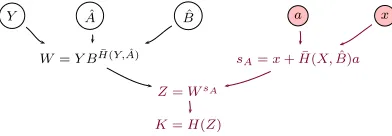
Y Aˆ Bˆ a x
W=Y BH¯(Y,Aˆ) s
A=x+ ¯H(X,Bˆ)a
Z=WsA
K=H(Z)
Figure 1: Tree of computations in a HMQV session.
The adversary is also provided with the reveal queries from one of the following sets. At the beginning of its run, it adopts one of the following sets of queries; it can then perform queries from the selected set (and only those queries).
In Set 1, the following queries are allowed.
• StaticKeyReveal(party) to obtain the static private key of a party. • SessionKeyReveal(session) to obtain the derived key in a session.
• SecretExponentReveal(session) to obtain the ephemeral secret exponent (s = x+da or
y+eb) in a session.
• SecretGroupElementReveal(session) to obtain the session signatureZ =WsA.
• EstablishParty(party) to register a static public key on behalf of a party; from there, the party is supposed totally controlled by A. A party against which this query is not issued is said to be honest.
Notice that, we consider only the intermediate values which evaluation requires a secret informa-tion; as the attacker is supposed to control the communication links between parties, considering leakages on the other intermediate values is superfluous. We also implicitly assume that the con-sidered protocol has a tree of computations “matching” that of the (H)MQV protocols; otherwise some queries (SecretExponentReveal for instance) may become meaningless.
InSet 2, the allowed queries are the following; the definitions remain unchanged for the queries belonging also to Set 1.
• EphemeralKeyReveal(session) to obtain the ephemeral private key used by the session owner.
• StaticKeyReveal(party). • SessionKeyReveal(session). • EstablishParty(party).
Definition 4 (Session Freshness). Letsidbe the identifier of a completed session at an honest party ˆA, with some honest peer ˆB, andsid∗
the matching session’s identifier. The sessionsidis said to beck–fresh, if none of the following conditions hold:
• A issues aSecretExponentReveal query onsidorsid∗
(ifsid∗
exists); • A issues aSecretGroupElementReveal query onsid orsid∗
; • A issues aSessionKeyReveal query onsid orsid∗;
• sid∗
does not exist andA makes aStaticKeyReveal query on ˆB. And sidis said to be eck–fresh, if none of the following conditions hold:
• A issues aStaticKeyReveal query on ˆAand an EphemeralKeyReveal query onsid; • sid∗
exists andAmakes aStaticKeyRevealquery on ˆB and anEphemeralKeyReveal query on sid∗;
• sid∗
does not exist andA makes aStaticKeyReveal query on ˆB.
Definition 5 (Protocol Security). Let Π be a protocol, such that if two honest parties complete matching sessions, then they both compute the same session key.
• The protocol Π is said to be ck–secure, if no polynomially bounded adversary (performing queries from Set 1) can distinguish a ck–fresh session key from a random value, chosen under the distribution of session keys, with probability (taken over the random coins of the adversary and the choices of static and ephemeral public keys in G) significantly greater than 1/2.
• Π is said to beeck–secure, if no polynomially bounded adversary (performing queries from Set 2) can distinguish an eck–fresh session key from a random value, chosen under the distribution of session keys, with probability significantly greater than 1/2.
• And Π is said to besecure, if it is both ck–secure and eck–secure.
4 A New Authenticated Diffie–Hellman Protocol
In this section, we define the Full Exponential Challenge Response (FXCR) and Full Dual expo-nential Challenge Response (FDCR) schemes, which confine to the minimum the consequences of ephemeral secret exponent leakages. Using these schemes, we define the Fully Hashed MQV (FHMQV) protocol, which preserves the performance of the (H)MQV protocol, in addition to provide resistance to the attacks we presented in section 2.
4.1 Full Exponential Challenge Response Signature Scheme
Definition 6 (FXCR signature scheme). Let ˆB be an entity with public key B ∈ G∗
, and ˆA
a verifier. ˆB’s signature on a messagemand challengeX provided by ˆA(X=Gx,x∈R[1, q−1] is chosen and kept secret by ˆA) is F SigBˆ(m, X) = (Y, XsB), where Y = Gy, y ∈R [1, q−1] is chosen by ˆB, and sB = y+ ¯H(Y, X, m)b; the verifier ˆA accepts the pair (Y, σB) as a valid signature ifY ∈ G∗
and (Y BH¯(Y,X,m))x=σ B.
The FXCR scheme delivers all the security attributes of the XCR scheme; in addition the “replay attack” we presented in section 2 does not hold anymore. Indeed, suppose an attacker which has learnedsB(l)=y(l)+ ¯H(Y(l), X(l), m)b. When it is provided with a new challengeX (chosen at random) and the same message m, except with negligible probability X6=X(l) (and
¯
H(Y(l), X(l), m)6= ¯H(Y(l), X, m)). Hence, to replayY(l) on the message–challenge pair (m, X),
the attacker has to findsB=y(l)+ ¯H(Y(l), X, m)b; it is not difficult to see that if it can compute
sB from sB(l), then he can find bfrom sB, which is not feasible.
Definition 7 (FXCR Scheme Security). The FXCR scheme is said to be secure inG, if given a public keyB, a challengeX0(B, X0∈RG∗), together with hashing and signing oracles, no
adap-tive probabilistic polynomial time attacker, can output with non negligible success probability a triple (m0, Y0, σ0) such that:
• (Y0, σ0) is a valid signature with respect to the key B, and the message–challenge pair
(m0, X0);
• (Y0, σ0) was not obtained from the signing oracle with a query on (m0, X0).
Using the “oracle replay” technique [22, 23], we show that the FXCR scheme is secure in the sense of definition 7. Recall that a function F with parameter ζ is said to be negligible, if for every polynomial P, and every sufficiently large ζ, F(ζ) < (||P(ζ)||)−1
(|| · || denotes here the absolute value); otherwise F is said to be non–negligible.
Proposition 4. Under the CDH assumption in G and the RO model, the FXCR signature
Proof. Suppose an attackerA, which givenB, X0 ∈RG∗succeeds with non–negligible probability
in forging a FXCR signature, with respect to the public key B and the challenge X0. Using A
we build a polynomial time CDH solver S which succeeds with non–negligible probability. The solver S provides A with random coins, and simulates the digest and signature queries. The interactions between S and Aare described in Figure 4.
Figure 4 A CDH solver fromA
Run of A:
(a) AtA’s digest query on (Y, X, m),Sresponds as follows: (i)if a value is already assigned to ¯H(Y, X, m), S returns ¯H(Y, X, m); (ii) otherwise S responds with e∈R{0,1}l, and sets ¯H(Y, X, m) =e.
(b) At A’s signature query on (m, X),S responds as follows: (i)S choosessB∈R[1, q−1],
e ∈R {0,1}l, sets Y = GsBB−e and ¯H(Y, X, m) = e. If ¯H(Y, X, m) was previously defined,S aborts. (ii) Else,S responds with (Y, XsB).
(c) At A’s halt, S verifies that A’s output (m0, Y0, σ(1)0 ) (if any) satisfies the following
conditions. If not,S aborts.
• Y0 ∈ G∗ and ¯H(Y0, X0, m0) was queried from ¯H.
• (Y0, σ0(1)) was not returned by ˆB at signature query on (m0, X0).
Repeat: S executes a new run ofA, using the same input and coins; and answering to all the digest queries before ¯H(Y0, X0, m0) with the same values as in the previous run. The
new query of ¯H(Y0, X0, m0) and subsequent ¯H queries are answered with new random
values.
Output: If A outputs a second forgery (m0, Y0, σ(2)0 ) satisfying the conditions of step (c),
with a hash value ¯H(Y0, X0, m0)2 = e(2)0 6= e (1)
0 = ¯H(Y0, X0, m0)1, then S outputs
(σ0(1)/σ0(2))(e(1)0 −e(2)0 )−1
as a guess forCDH(B, X0).
Under the RO model, the distribution of the simulated signatures is indistinguishable from the that of the real signatures generated by ˆB, except the deviation that happens when ¯H(Y, X, m) was queried before. Let Qh and Qs be respectively the number of queries that A asks to the hashing and signing oracles. Since A is polynomial (in |q|) and Y is chosen uniformly at ran-dom in G, this deviation happens with probability less than (Qh +Qs)/q, which is negligible. Hence this simulation is perfect, except with negligible probability. Moreover the probability of producing a valid forgery without querying ¯H(Y0, X0, m0) is 2−l. Thus under this simulation, A
outputs with non–negligible probability a valid forgery (m0, Y0, σ(1)0 ); we denote ¯H(Y0, X0, m0)
by e(1)0 . From the Forking lemma [23], the repeat experiment produces with non–negligible probability a valid forgery (m0, Y0, σ(2)0 ) with a digest e
(2)
0 , which with probability 1−2 −l, is
different from e(1)0 . Then the computation
σ(1)0 σ(2)0
e
(1) 0 −e(2)
0
−1
= Y0B
e(1)0 x0
Y0Be
(2)
0
x0
! e
(1) 0 −e(2)0
−1
=Bx0
givesCDH(B, X0) with non–negligible success probability.
4.2 Full Dual Exponential Challenge Response Signature Scheme
Definition 8 (FDCR Signature Scheme). Let ˆA and ˆB be two entities with public keys
A, B ∈ G∗
, and m1, m2 two messages. The FDCR signature of ˆA and ˆB on messages m1, m2
is F DSigA,ˆBˆ(m1, m2, X, Y) = (XAd)y+eb = (Y Be)x+da, where X = Gx and Y = Gy (x, y ∈R [1, q−1]) are chosen respectively by ˆA and ˆB,d= ¯H(X, Y, m1, m2), ande= ¯H(Y, X, m1, m2).
Notice that contrary to the DCR and XCR schemes, the FDCR signature of ˆA and ˆB on messages m1, m2 and challenges X, Y, is not a FXCR signature of ˆA on the message m1 and
Definition 9 (Security of the FDCR Scheme). Let A = Ga, B, X
0 ∈R G∗ (A 6= B). The
FDCR scheme is secure in G, if given a, A, B, X0, and a message m10, together with hashing
and signing oracles, no adaptive probabilistic polynomial time attacker can output with non negligible success probability a triple (m20, Y0, σ0) such that:
• (m10, m20, X0, Y0, σ0) is a valid FDCR signature with respect to the public keysA, B.
• (Y0, σ0) was not obtained from the signing oracle with a query on a message–challenge pair
(m′1, X0) such that (m′1, m ′
2) = (m10, m20), where (m10, m20) denotes the concatenation of
m10 and m20, and m
′
2 is the message returned at signature query on (m ′
1, X0) (if any).
Remark 2. Since we suppose that if ˆA6= ˆA′
, no substring of ˆA equals ˆA′
(and conversely), if ˆ
A6= ˆA′
or ˆB 6= ˆB′
then ( ˆA,Bˆ) cannot equal ( ˆA′ ,Bˆ′
).
Proposition 5. Under the RO model, and the CDH assumption in G, the FDCR scheme is
secure in the sense of Definition 9.
Proof. Suppose an attackerA, which givena, A, B, X0, m10 (A6=B) outputs with non–negligible
probability a valid and fresh FDCR forgery (m20, Y0, σ0). Using A we build a polynomial time
FXCR forger which succeeds with non–negligible probability. The FXCR forger S provides A with random coins, a,A,B ,X0,m10, and simulates ˆB’s role as follows.
(a) AtA’s digest query on (X, Y, m1, m2),S responds as follows: (i)if a value is already assigned
to ¯H(X, Y, m1, m2),S returns ¯H(X, Y, m1, m2); (ii) elseS responds with d∈R{0,1}l, and
sets ¯H(X, Y, m1, m2) =d.
(b) At signature query on (m1, X), S responds as follows: (i) S chooses m2 ∈R {0,1}∗, sB ∈R [1, q−1], d, e ∈R {0,1}l, computes Y = GsBB−e, and sets ¯H(X, Y, m1, m2) = d
and ¯H(Y, X, m1, m2) =e; if ¯H(X, Y, m1, m2) or ¯H(Y, X, m1, m2) was previously defined,S
aborts. (ii) S providesA with the signature (m2, Y,(XAd)sB).
The simulated environment is perfect, except with negligible probability. The deviation happens when the same message–challenge pair (m2, Y) is chosen twice in two signature queries on the
same pair (m1, X). Let Qmax is the maximum number of queries that A asks to the signing
oracle. Since Y is chosen uniformly at random inG and A is polynomial, the deviation occurs with probability less than Qmax/q, which is negligible (as A is polynomial in |q|.) Then, if A
succeeds with non–negligible probability in FDCR forging attack, it succeeds also with non– negligible probability under this simulation. And since S knows a, it outputs, from any valid forgery σ0,
σ0(Y0Be)−da= (Y0Be)x0+da(Y0Be)−da =X0y0+eb.
This is valid FXCR forgery on the message (m10, m20) (the concatenation of m10 and m20)
and challenge X0 with respect to the public key B. And if A succeeds with non–negligible
probability, so does S, contradicting Proposition 4.
4.3 The Fully Hashed MQV Protocol.
We can now derive the FHMQV protocol, which provides the efficiency and security attributes of the (H)MQV protocols, in addition to ephemeral secret exponent leakage resilience.
The FHMQV protocol does not only provide a stronger security than the (C, H)MQV pro-tocols; it seems more suited for implementations using computationally limited devices, to store (and protect) the private keys. Suppose an implementation of FHMQV or (H)MQV (using such devices) in which session keys are used by some application running in a untrusted host ma-chine. Suppose that the ephemeral keys are computed in the device in idle–time. This idle–time pre–computation is common in practice. As (H)MQV is not ephemeral secret exponent leakage resilient, the exponentiation σ = (Y Be)sA = (XAd)sB has to be performed in the device (in
Protocol 5 FHMQV key exchange
I) The initiator ˆA does the following:
(a) Choosex∈R[1, q−1] and computeX =Gx. (b) Send ( ˆA,B, Xˆ ) to ˆB.
II) At receipt of ( ˆA,B, Xˆ ), ˆB does the following: (a) Verify that X ∈ G∗.
(b) Choose y∈R[1, q−1] and compute Y =Gy. (c) Send ( ˆB,A, Yˆ ) to ˆA.
(d) Compute d= ¯H(X, Y,A,ˆ Bˆ) ande= ¯H(Y, X,A,ˆ Bˆ).
(e) ComputesB =y+ebmodq,σB= (XAd)sB, and K=H(σB,A,ˆ B, X, Yˆ ). III) At receipt of ( ˆB,A, Yˆ ), ˆA does the following:
(a) Verify that Y ∈ G∗.
(b) Compute d= ¯H(X, Y,A,ˆ Bˆ) ande= ¯H(Y, X,A,ˆ Bˆ).
(c) ComputesA=x+damodq,σA= (Y Be)sA, and K=H(σA,A,ˆ B, X, Yˆ ). IV) The shared session key isK.
used in the host machine, and a leakage of only the ephemeral secret exponent, in a FHMQV session, does not compromise any other session.)
In FHMQV the computational effort of the device, in non idle–time can be safely reduced to few non–costly operations (two integer additions, one integer multiplication, and two digest computations), while for (H)MQV at least one exponentiation has to be performed in the device in non idle–time (in addition to few non–costly operations).
5 Security Analysis of the FHMQV Protocol
We suppose n 6 P(|q|) (for some polynomial P) parties modeled as probabilistic polynomial time machines. In accord with our security model, the following queries are allowed.
• Send(Aˆ, Bˆ)which makes ˆAperform the step I of Protocol5. • Send(Aˆ, Bˆ,X)which makes ˆB perform the step II of Protocol5.
• Send(A,ˆ B, X, Yˆ ) which makes ˆA update the session identifier ( ˆA,B, X, ⋆ˆ ) (if any) to ( ˆA,B, X, Yˆ ), and perform the step III of Protocol 5; if ˆA does not hold a session with identifier ( ˆA,B, X, ⋆ˆ ), the call is ignored.
5.1 Ck–Security Arguments
Proposition 6. Under the CDH assumption in G, and the RO model, the FHMQV protocol is
ck–secure.
It is immediate from the FHMQV definition that, if two honest parties complete matching sessions, then they both compute the same session key. Suppose an adversaryAwhich succeeds, with probability significantly greater than 1/2, in distinguishing a session key of a ck–fresh session (that we designate by ( ˆA, ˆB, X0, Y0) or test session) from random a value chosen under the
distribution of session keys. A can only distinguish a ck–fresh session key from a random value in one of the following ways.
Guessing attack: A guesses correctly the test session key.
Key replication attack: A succeeds in making two non–matching sessions yield the same
session key, it can then query a session key reveal on one of the two sessions and use the other as test session.
Under the RO model, the probability of guessing correctly the output of the hash function is 2−k; and non–matching sessions cannot have (except with negligible probability) the same session key. It thus remains that if A succeeds with probability significantly greater than 1/2 in distinguishing a ck–fresh session key, from a random value chosen under the distribution of session keys, then it succeeds with non–negligible probability in forging attack. We thus suppose that A interacts in an nparties environment, and ends its run with non–negligible probability with an output (sid0, σ0), where sid0 is a ck–fresh session identifier, and σ0 a guess of the sid0
session signature.
LetEdenote the event “Asucceeds in forging the session signature of some ck–fresh session.” The event E divides in: (a)E.1: “A succeeds in forging the session signature of some ck–fresh session, which matching session exits”, and(b)E.2: “Asucceeds in forging the session signature of some ck–fresh session without matching session.” Since a session is required to be ck–fresh, inE.1 theStaticKeyRevealquery is allowed on both ˆAand ˆB. InE.2 theStaticKeyReveal query is allowed on ˆA(but not on ˆB). Now sinceAsucceeds with non–negligible probability, eitherE.1
orE.2 occurs with non–negligible probability; it then suffices to show that neither E.1 nor E.2
can happen with non–negligible probability.
5.1.1 Analysis of E.1
Suppose that E.1 occurs with non–negligible probability. Using A, we build a polynomial time CDH solver which succeeds with non–negligible probability. The solver S takes as input
X0, Y0∈RG∗ and interacts with Aas described below.
(1) S simulates A’s environment, with n parties ˆP1, . . . ,Pˆn; recall that A is supposed to be polynomial, we thus suppose that each party is activated at most m times, m6P(|q|) for some polynomial P.
(2) S chooses i, j ∈R {1, . . . , n}, i6=j (the case i=j, reflection attack, is analyzed in subsec-tion 5.1.3), and t∈R {1, . . . , m} (with the choice of (i, j, t),S is guessing the test session). We refer to ˆPias ˆAand ˆPj as ˆB. Sassigns to each ˆPka random static key pair (pk, Pk =Gpk), and answers toAqueries as follows; ¯H queries are simulated in the usual way (see the proof of Proposition 5).
(3) At A’s Send( ˆPl,Pˆm) query, S choosesx ∈R[1, q−1], computesX =Gx, creates a session state with identifier ( ˆPl,Pˆm, X, ⋆), and provides A with the message ( ˆPl,Pˆm, X).
(4) At A’s Send( ˆPm,Pˆl, Y) S chooses x ∈R [1, q−1], computes X = Gx, creates a session state with identifier ( ˆPl,Pˆm, X, Y), providesAwith the message ( ˆPl,Pˆm, X); and completes the session with identifier ( ˆPl,Pˆm, X, Y) as responder (stepIIeof Protocol 5).
(5) AtA’sSend( ˆPl,Pˆm, X, Y) query,Supdates the session identifier ( ˆPl,Pˆm, X, ⋆) to ( ˆPl,Pˆm, X, Y); and completes the session with identifier ( ˆPl,Pˆm, X, Y) as initiator (stepIIIcof Protocol5). (Notice that S can compute the session FDCR signature of any session different from the
t–th session at ˆA — and its matching session.)
(6) When A activates the t–th session at Aˆ, if the peer is Bˆ, S provides A with the message ( ˆA,B, Xˆ 0); otherwise,S aborts.
(7) When A activates the session matchingt–th session atAˆ,S providesA with( ˆB,A, Yˆ 0).
(8) At A’s digest query on(σ,Pˆl,Pˆm, X, Y),S responds as follows:
• If there exists a completed session with identifiersid= ( ˆPl,Pˆm, X, Y)orsid= ( ˆPm,Pˆl, Y, X) and with initiator Pˆl, and if σ is thesid session’s FDCR signature, S returns the sid session key.
• Else, if the same query was made previously, S returns the previously returned value. • Else S responds withπ ∈R{0,1}λ, and setsH(σ,Pˆ
l,Pˆm, X, Y) =π.
(9) If A issues a StaticKeyReveal, SecretExponentReveal, SecretGroupElementReveal, Session-KeyReveal, or an EstablishParty query, S answers faithfully.
(10) In any of the following situations, S aborts.
• A halts with a test session different from thet–th session atAˆ.
query on the t–th session atAˆor its matching session. • A issues anEstablishParty query onAˆ orBˆ.
(11) IfAˆprovides a guessσ0of the signature of thet–th session atAˆ,Soutputs (σ0)(X0Ad) −eb
Y0−da
as a guess for CDH(X0, Y0). OtherwiseS aborts.
Fact. If A succeeds with non–negligible probability in E.1,S outputs with non–negligible proba-bility CDH(X0, Y0).
Proof. The simulation ofA’s environment is perfect except with negligible probability; whenA activates the t–th session at Aˆ, the X0 provided to A is chosen uniformly at random inG∗, its
distribution is the same as that of the realX. The same argument holds forY0. The probability
of guessing correctly the test session is (n2m)−1; and if E.1 occurs and S guesses correctly
the test session, S does not abort. Thus S succeeds with probability (n2m)−1
Pr(E.1) where negligible terms are ignored. In addition, when A outputs a correct guess for the test session signature, S outputs
(σ0)(X0Ad) −ea
Y0−da = (X0Ad)y0+ae(X0Ad) −ea
Y0−da = Yx0+da
0 Y
−da
0 = CDH(X0, Y0).
Moreover if A is polynomial, S is also polynomial. This shows that E.1 cannot happen with non–negligible probability.
5.1.2 Analysis of E.2
IfE.2occurs with non–negligible probability, usingA, we build a polynomial time FDCR forger, with non–negligible success probability. For this purpose, we modify the simulation in the analysis ofE.1 as follows.
• S takes as inputa∈R[1, q−1], and X0, B∈RG∗.
• Aˆ’s key pair is set to (a, Ga), andBˆ’s public key toB (Bˆ’s private key is unknown toS). • At A’sSend( ˆPl,B, Xˆ ) query, S answers as follows:
– S choosessB∈R[1, q−1],d, e∈R{0,1}l, and setsY =GsBB−e,H¯(X, Y,Pˆl,Bˆ) =d, and H¯(Y, X,Pˆl,Bˆ) = e; if Y was previously used as outgoing ephemeral key in a session at Bˆ with peerPˆl,S aborts.
– S creates a session state with identifier( ˆB,Pˆl, Y, X), and providesAwith( ˆB,Pˆl, Y).
– S completes the session( ˆB,Pˆl, Y, X) as responder. • At A’sSend( ˆB,Pˆl) query:
– S choosessB∈R[1, q−1],d, e∈R{0,1}l, and sets3 Y =GsBB−e,H¯(⋆, Y,B,ˆ Pˆl) =d, ¯
H(Y, ⋆,B,ˆ Pˆl) = e; if Y was previously used as outgoing ephemeral key in a session atBˆ with peerPˆl,S aborts.
– S creates a session state with identifier( ˆB,Pˆl, Y, ⋆), and providesAwith the message ( ˆB,Pˆl, Y).
• When Aactivates the t–th session atAˆ, if the peer is not Bˆ,S aborts; else, S provides A with( ˆA,B, Xˆ 0).
• S aborts in any of the following situations.
– A activates at Bˆ a session matching thet–th session atAˆ.
– A halts with a test session different from thet–th session atAˆ.
– A issues aStaticKeyReveal query on Bˆ, or an EstablishParty query onAˆorBˆ.
– Aissues aSecretExponentReveal,SessionSignatureReveal, or aSessionKeyRevealquery on the t–th session atAˆ.
• IfAˆhalts with thet–th session atAˆ,( ˆA,B, Xˆ 0, Y0) as test session, and with a guessσ0 of
the session’s signature,Soutputs the triple(( ˆA,Bˆ), Y0, σ0)as a FDCR forgery on messages
ˆ
A,Bˆ, and challenges X0, Y0 with respect to public keysA, B. OtherwiseS aborts.
3To simulate consistently the ephemeral exponent leakage on ˆB,S has to assign values to ¯Hquery with a
par-tially unknown input, namely the incoming ephemeral key is unknown. For these queries, random values are taken in{0,1}las ¯H(Y, ⋆, ˆ
B,Pˆl) and ¯H(⋆, Y,B,ˆ Pˆl); and whenS is later queried ¯H(Y, X,B,ˆ Pˆl) (resp. ¯H(X, Y,B,ˆ Pˆl),
The simulation ofA’s environment is perfect, except with negligible probability. The deviation happens when the same Y is chosen twice as ephemeral key in two sessions atBˆ with the same peer Pˆl; this happens with probability less than m/q, which is negligible. Hence, under this simulation, A succeeds with non–negligible probability in E.2. And when A outputs a correct forgery, andSguesses correctly the test session,S outputs a valid FDCR forgery on messagesAˆ,
ˆ
B, and challengesX0, Y0, with respect to the public keysA andB; contradicting Proposition5.
Neither E.1 nor E.2, can happen with non–negligible probability; the FHMQV protocol is ck–secure.
5.1.3 Resistance to Reflection Attacks
We show here that the FHMQV protocol provides resistance to reflection attacks (for ck–fresh sessions). A session with identifier sid = ( ˆA,A, X, Yˆ ) is said to be ck–fresh if none of these conditions hold:
• A issues a SecretExponentReveal, a SecretGroupElementReveal, or a SessionKeyReveal query onsid orsid∗
(if sid∗
exists);
• sid∗ does not exist andA makes aStaticKeyReveal query onAˆ.
Recall that under the RO model, guessing and key replication attacks cannot succeed, except with negligible probability. It suffices to show that no polynomially bounded adversary can compute, with non–negligible success probability, the session signature of a ck–fresh session ( ˆA,A, Xˆ 0, Y0).
Let F be the event “A succeeds in forging the session signature of some ck–fresh session
( ˆA,A, Xˆ 0, Y0).” The eventFdivides inF.1: “Asucceeds in forging the session signature of some
ck–fresh session( ˆA,A, Xˆ 0, Y0), which matching session exists”, andF.2: “A succeeds in forging
the session signature of some ck–fresh session ( ˆA,A, Xˆ 0, Y0) without matching session.” It thus
suffices to show that neitherF.1 norF.2 can happen with non–negligible probability.
Analysis of F.1. IfF.1 happens with non–negligible probability, usingA, we build a polyno-mial time CDH solver which succeeds with non–negligible probability. To do this, we reuse the simulation in the analysis ofE.1, except the following differences.
• S takes as inputa, X0, Y0;a∈R[1, q−1],X0, Y0 ∈RG∗.
• Bˆ’s key pair and identity are set to that ofAˆ.
A’s simulated environment remains perfect except with negligible probability; and ifAsucceeds with non–negligible probability, in event F.1, then under this simulation it outputs with non– negligible probability a valid signature forgery σ0. And then S outputs with non–negligible
probabilityCDH(X0, Y0)fromσ0, a, d, and e.This shows that under the CDH assumption and
RO model,F.1 cannot happen, except with negligible probability.
Analysis ofF.2. IfF.2 occurs with non–negligible probability, usingA, we build a polynomial time machine, which given A = Ga outputs with non–negligible probability G(a2)
. Such a “squaring” CDH solver can in turn be used as a general CHD solver, which succeeds with non–negligible probability [16].
We simulate A’s environment as in the analysis ofE.1, with the following modifications. • S takes as inputA∈RG∗ (Aˆ= ˆB).
• Aˆ’s public key is set to A; its roles are simulated in the same way as that of Bˆ in the analysis E.2.
• When A activates the t–th session at Aˆ, S chooses x0 ∈R[1, q−1], and provides A with
the message ( ˆA,A, Xˆ 0 =Gx0); and if Aactivates at Bˆ a session matching t–th session at
ˆ
A,S aborts.
The simulated environment remains perfect, except with negligible probability; and ifA suc-ceeds with non–negligible probability in F.2, then under this simulation, it outputs with non– negligible probability a valid forgery σ0 of the test session’s signature. And then sinceS knows x0 it outputs with non–negligible probability
(σ0)(Y0Ae)
−x0d−1
= (Y0Ae)x0+da(Y0Ae)
−x0d−1
= (Y0Ae)dad −1
= (Y0Ae)a =Ay0+ea.
Hence, given a public keyA,S outputs with non–negligible probability a valid and fresh FXCR signature, on message ( ˆA,Bˆ)(concatenation ofAˆandBˆ), and challengeA(the challenge equals the public key) with respect to the public key A. Using the “oracle replay” technique (as in the proof of Proposition 4),S yields a polynomial machine, which givenA=Ga, outputs with non–negligible probabilityAa=G(a2)
; contradicting the CDH assumption.
5.2 Ephemeral Private Keys Leakage Resilience (eck–security)
The arguments for this security attribute do not derive from the analysis in section 4. The reason is that we cannot simultaneously and consistently simulate both SecretExponentReveal and EphemeralKeyReveal.
5.2.1 Hashed Full Dual Challenge Response Scheme
Definition 10 (Hashed FDCR (HFDCR) signature scheme). Let Aˆ, Bˆ be two entities with
public keysA, B ∈RG∗. The HFDCR signature of Aˆand Bˆ on messages m1, m2 is
HF DCRA,B(X, Y, m1, m2) =H(σ, m1, m2, X, Y),
where σ is the FDCR signature of Aˆ andBˆ on messagesm1, m2, and challenges X, Y.
Definition 11 (Security of the HFDCR Signature Scheme). Let A,ˆ Bˆ be two entities with public keys A, B ∈R G∗. The HFDCR scheme is secure, if given A, B, and x0, y0 ∈R [1, q−
1] together with hashing and signing oracles, no adaptive probabilistic polynomial time at-tacker can produce with non negligible success probability a triple (m10, m20, π0) such that:
HF DCRA,B(X0, Y0, m10, m20) = π0, and π0 was not obtained from the signing oracle with a
query on a quadruple (X0, Y0, m′1, m2′) such that (m10, m20) = (m
′ 1, m′2).
For the HFDRC security arguments, we need the Gap Diffie–Hellman (GDH) assumption.
Definition 12 ([21]). Let G =hGi be a cyclic group. An algorithm is said to be aDecisional Diffie–Hellman Oracle (DDHO) for G, if on input G, X = Gx, Y = Gy, Z ∈ G, it outputs 1 if and only if Z = Gxy. The Gap Diffie–Hellman (GDH) assumption is said to hold in G, if given a DDHO for G, no polynomially bounded algorithm can solve the CDH problem in G, with non–negligible success probability.
We now prove the security of the HFDCR scheme, under the GDH assumption and the RO model.
Proposition 7. Under the GDH assumption in G, and the RO model, the HFDCR scheme is
secure in the sense of definition 11.
Proof. Suppose a polynomially bounded attacker A, which given a DDHO, A, B ∈R G∗, and
x0, y0 ∈R [1, q−1], outputs with non–negligible success probability a valid and fresh HFDCRA,B signature on some messagesm10, m20 with respect to challengesX0 =G
x0,Y =Gy0.
Non–matching HFDCR signature queries cannot have the same signature value, except with negligible probability. And guessing the output of the hash function cannot be performed with non–negligible success probability. We can thus suppose that A succeeds with non–negligible probability in forging attack. UsingAand a DDHO, we build a polynomial time CDH solverS which succeeds with non–negligible probability. The solverS providesAwith random coins and simulates the signature queries; it takes as input A, B ∈R G∗
, x0, y0 ∈R [1, q−1], and outputs
(1) At A’s H¯ digest query on (X, Y, m1, m2),S does the following:
• If a value is already assigned to H¯(X, Y, m1, m2), S provides A with the value of
¯
H(X, Y, m1, m2).
• Else S choosesd∈R{0,1}l, setsH¯(X, Y, m
1, m2) =d, and providesA withd.
(2) At A’s signature query on (X, Y, m1, m2),S responds as follows:
• If a value is already assigned toHF DCRA,B(X, Y, m1, m2), thenSreturns the value of HF DCRA,B(X, Y, m1, m2); elseS takesπ ∈R{0,1}λ, sets HF DCRA,B(X, Y, m1, m2)
=π, and providesA withπ.
• If no value is assigned to H¯(X, Y, m1, m2) (resp. H¯(Y, X, m1, m2)), S chooses d ∈R
{0,1}l and setsH¯(X, Y, m
1, m2) =d(resp. H¯(Y, X, m1, m2) =d).
(3) At A’s digest query on(σ, m1, m2, X, Y),S does the following:
• If a value is assigned to HF DCRA,B(X, Y, m1, m2), and if σ = CDH(XAd, Y Be),
where d = ¯H(X, Y, m1, m2), e = ¯H(Y, X, m1, m2) (if a value is already assigned to HF DCRA,B(X, Y, m1, m2), d and e are defined, and the verification is performed
using the DDHO), S returns the value of HF DCRA,B(X, Y, m1, m2).
• Else, (i) if the same query was made previously, S returns the previously returned value; (ii) else S chooses π ∈R {0,1}λ, sets H(σ, m1, m2, X, Y) = π, and provides A
with π.
• If no value is assigned to H¯(X, Y, m1, m2) (resp. H¯(Y, X, m1, m2)), S chooses d ∈R
{0,1}l and sets H¯(X, Y, m
1, m2) = d (resp. H¯(Y, X, m1, m2) = d); and if σ = CDH(XAd, Y Be),S setsHF DCRA,B(X, Y, m1, m2) =π.
(4) IfAhalts with a forgeryπ0, X0, Y0, m10, m20,S verifies that the digests valueπ0 was queried
from the random oracle, asH(σ0, m10, m20, X0, Y0)for someσ0, and thatσ0=CDH(X0A
d,
Y0Be), whered= ¯H(X0, Y0, m10, m20), ande= ¯H(Y0, X0, m10, m20)(ifπ0 was queried from
the hashing oracle, H¯(X0, Y0, m10, m20) and H¯(Y0, X0, m10, m20)are defined).
Under the RO model,A’s simulated environment is perfect except with negligible probability; hence if A succeeds with non–negligible probability in forging a HFDRC signature, it succeeds under this simulation with the same probability, except a negligible difference. Since S knows
x0, y0, andAsucceeds with non–negligible probability,Soutputs with non–negligible probability
(σ0)(Y0Be)−x0d −1
A−y0e−1
= (Y0Be)x0+da(Y0Be)−x0d −1
A−y0e−1 = (Y0Be)dad
−1
A−y0e−1
= (Y0Be)aA−y0e −1
= Ay0+ebA−y0e−1
=CDH(A, B);
contradicting the GDH assumption.
5.2.2 Application to FHMQV
Using the HFDCR security, we now show that the FHMQV protocol meets the eck–security definition.
Proposition 8. Under the GDH assumption in G, and the RO model, the FHMQV protocol is
eck–secure.
Proof of Proposition8. Since guessing and key replication attacks cannot succeed with non– negligible probability, supposeA succeeds with non–negligible probability in forging attack.
LetE’be the event“Asucceeds in forging an eck–fresh session signature.” E’ divides inE’.1: