On Compression of Data Encrypted with Block
Ciphers
Demijan Klinc, Carmit Hazay, Ashish Jagmohan, Hugo Krawczyk, and Tal Rabin
Abstract
This paper investigates compression of data encrypted with block ciphers, such as the Advanced Encryption Standard (AES). It is shown that such data can be feasibly compressed without knowledge of the secret key. Block ciphers operating in various chaining modes are considered and it is shown how compression can be achieved without compromising security of the encryption scheme. Further, it is shown that there exists a fundamental limitation to the practical compressibility of block ciphers when no chaining is used between blocks. Some performance results for practical code constructions used to compress binary sources are presented.
Index Terms
Compression, encrypted data, block ciphers, CBC mode, ECB mode, Slepian-Wolf coding.
I. INTRODUCTION
We consider the problem of compressing encrypted data. Traditionally in communication systems, data
from a source is first compressed and then encrypted before transmission over a channel to the receiver.
While in many cases this approach is befitting, there exist scenarios where there is a need to reverse
the order in which data encryption and compression are performed. For example, consider a network
of low-cost sensor nodes that transmit sensitive information over the internet to a recipient. The sensor
nodes need to encrypt data to hide it from potential eavesdroppers, but they may not be able to perform
compression as that would require additional hardware and thus higher implementation cost. On the other
D. Klinc was with the Georgia Institute of Technology, Atlanta, GA. He is now with Apple Inc. Email: [email protected] C. Hazay is with Aarhus University, Aarhus, Denmark. Email: [email protected]
hand, the network operator that is responsible for transfer of data to the recipient wants to compress the
data to maximize the utilization of its resources. It is important to note that the network operator is not
trusted and hence does not have access to the key used for encryption and decryption. If it had the key,
it could simply decrypt data, compress and encrypt again.
We focus on compression of encrypted data where the encryption procedure utilizes block ciphers
such as the Advanced Encryption Standard (AES) [1] and Data Encryption Standard (DES) [2]. Loosely
speaking, block ciphers operate on inputs of fixed length and serve as important building blocks that can
be used to construct secure encryption schemes.
For a fixed key a block cipher is a bijection, therefore input and output have the same entropy. It follows
that it is theoretically possible to compress the source to the same level as before encryption. However,
in practice, encrypted data appears to be random and the conventional compression techniques do not
yield desirable results. It was long believed that encrypted data is practically incompressible. A surprising
paper [3], breaks that paradigm and shows that the problem of compressing one-time pad encrypted data
translates into the problem of compressing correlated sources, which was solved by Slepian and Wolf
in [4] and for which practical and efficient codes are known. Compression is practically achievable due to
a simple symbol-wise correlation between the key (one-time pad) and the encrypted message. However,
when the correlation is more complex, as in the case of block ciphers, the approach to Slepian-Wolf
coding utilized in [3] is not directly applicable.
In this paper we investigate if data encrypted with block ciphers can be compressed without access
to the key. We show that block ciphers in conjunction with the most commonly used chaining modes in
practice (e.g., [5], [6]) are practically compressible for some types of sources. To our knowledge this is
the first work to show that substantial compression gains can be achieved for cryptographic algorithms
like AES and DES when they are used in non-stream modes. In particular, this work offers a solution to
the open problem formulated in [7, Sec. 3.3].
Moreover, by using standard techniques in the cryptographic literature we prove that the proposed
compression schemes do not compromise the security of the original encryption scheme. We also show
that there exists a fundamental limitation to the compression capability when the input to the block cipher
is applied to a single-block message without chaining (see Section III-B).
The outline of this paper is as follows. Section II defines the problem that we seek to solve and
summarizes existing work on the subject. Section III focuses on block ciphers and explains how they can
be compressed without knowledge of the secret key in various modes of operation. Section IV discusses
encrypted with public-key encryption schemes. Section VI presents some simulation results for binary
memoryless sources and finally, Section VII concludes the paper.
II. PRELIMINARIES
We begin with a standard formal definition of an encryption scheme as stated in [8]. A private-key
encryption scheme is a triple of algorithms(Gen, Enc, Dec), whereGenis a probabilistic algorithm that
outputs a keyK chosen according to some distribution that is determined by the scheme; the encryption
algorithm Enc takes as input a key K and a plaintext message X and outputs a ciphertext EncK(X);
the decryption algorithmDectakes as input a keyK and a ciphertextEncK(X) and outputs a plaintext
DecK(EncK(X)) =X. It is required that for every key K output by Gen and every plaintext X, we
have DecK(EncK(X)) =X.
In private-key encryption schemes of concern to us in this paper the same key is used for encryption
and decryption algorithms. Private-key encryption schemes are divided in two categories: stream ciphers
and block ciphers. Stream ciphers encrypt plaintext one symbol at a time, typically by summing it with
a key (XOR operation for binary alphabets). In contrast, block ciphers accomplish encryption by means
of nonlinear mappings on input blocks of fixed length; common examples are AES and DES. Block
ciphers are typically not used as a stand-alone encryption procedure; instead, they are combined to work
on variable-length data using composition mechanisms known as chaining modes or modes of operation,
as described in Section III.
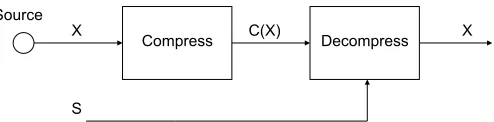
We proceed with a formulation of the source coding problem with decoder side-information illustrated
in Figure 1. Consider random variablesX(termed the source), andS (termed the side-information), both
over a finite-alphabet and with a joint probability distribution PXS. Let a sequence of independent n
realizations of (X, S) be denoted by{Xi, Si}ni=1 .
Source
Compress
X C(X)
S
Decompress X
Fig. 1. Lossless source coding with decoder side-information.
The problem at hand is to losslessly encode {Xi}n
Source
Compress Encrypt
Key (K)
X C(X) Y
Decompress Decrypt
Key (K)
X C(X)
Encoder
Decoder
(a)
Source
Encrypt Compress Key (K)
X Y C(Y)
Joint Decryption and Decompression
Key (K) X
Encoder
Decoder
(b)
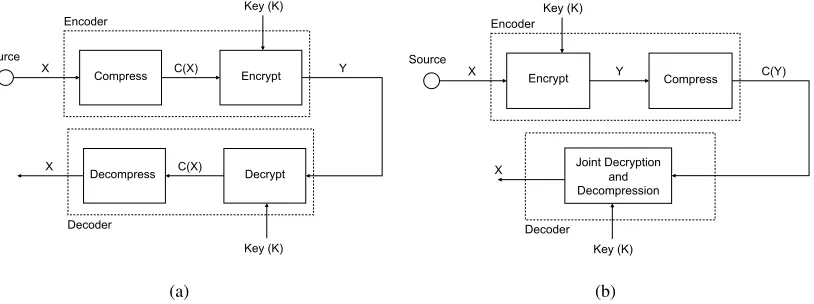
Fig. 2. Systems combining compression and encryption. (a) Traditional system with compression preceding encryption. (b) System with encryption subsequent to compression.
close to the conditional entropyH(X|S).Practical Slepian-Wolf coding schemes use constructions based
on good linear error-correcting codes [9]–[11].
We are interested in systems that perform both compression and encryption, wherein the compressor has
no access to the key. In such systems encryption is performed after compression as depicted in Figure
2(a). This is a consequence of the traditional view which considers encrypted data hard to compress
without knowledge of the key. In [3] a system similar to that of Figure 2(b) is considered instead, but
with the order of encryption and compression reversed, while only the encryptor has access to the key.
The authors consider encryption of a plaintext X using a one-time pad scheme, with a finite-alphabet
key (pad) K, to generate the ciphertextY using
Yi ,Xi⊕Ki.
This is followed by compression, which is agnostic ofK, to generate the compressed ciphertext C(Y).
The key insight underlying the approach in [3] is that the problem of compression in this case can be
formulated as a Slepian-Wolf coding problem. In this formulation the ciphertext Y is cast as a source,
and the shared key K is cast as the decoder-only side-information. The joint distribution of the source
and side-information can be determined from the statistics of the source. For example, in the binary case
with a uniformly distributedKi andXi with Pr[Xi= 1] =p, we have
Pr(Yi 6=k|Ki =k) =p. (1)
The decoder has knowledge of K and the source statistics. It uses this knowledge to reconstruct the
formulation is leveraged in [3] to show that exactly the same lossless compression rate, H(X), can be
achieved asymptotically by the system shown in Figure 2(b), as by the one in Figure 2(a), and all the
while maintaining information-theoretic security.
The one-time pad and stream ciphers, while convenient for analysis, are not the only forms of encryption
in practice. In fact, the prevalent method of encryption uses block ciphers, thus an obviously desirable
extension of the technique in [3] would be to conventional encryption schemes such as AES. Attempting
to do so, however, proves to be problematic. The method in [3] leverages the fact that in a one-time pad
encryption scheme there exists a simple symbol-wise correlation between the key K and the ciphertext
Y, as seen in Eq. (1). For block ciphers such as AES no such correlation is known. Any change in the
plaintext is diffused in the ciphertext, and quantifying the correlation (or the joint probability distribution)
of the key and the ciphertext is believed to be computationally infeasible.
In the remainder of this paper, we show how to circumvent this problem by exploiting the chaining
modes popularly used with block ciphers and present methods for compressing data encrypted with
block ciphers without knowledge of the key. As in [3], the proposed methods are based on the use of
Slepian-Wolf coding.
To begin we define the notion of apost-encryption compression(PEC) scheme which is used throughout
this paper:
Definition 1 (Post-Encryption Compression (PEC) Scheme): Let E = (Gen, Enc, Dec) be an
encryp-tion scheme with plaintext domainX and ciphertext rangeQ, and letP be a probability distribution over
X. LetCbe a compression function defined overQ, andDbe a (possibly probabilistic) decoding function
with the property that, for any keyK generated byGen,DK(C(EncK(X)) =Xwith probability 1−δ.
Then the pair (C, D) is said to be (E,P, δ)-PECscheme.
Note that in this definition, D is given access to the encryption key while C operates independently
of the key. Both C and D may be built for a specific plaintext probability distribution P, for only in
such case may correct decoding be guaranteed with high probability. We often assume that the plaintext
distribution P is efficiently samplable, which means that there exists an efficient randomized algorithm
whose output distribution is P. The probability of error δ is taken over the choice of X and the choice
of random coins if D is randomized. To simplify notation, we shall omit the (E,P, δ) designation if
evident from the context, and use the term PEC scheme.
PEC schemes may be tailored to a specific cipher, but most often, one is interested in schemes that can
schemes. Since all PEC schemes presented in this paper work with any block cipher, we say that they
are generic. A generic PEC scheme cannot be tailored to the specific details of the particular cipher but
rather handles ciphers as a black boxes. That is, the decoderDdoes not need to know the specifics of the
encryption scheme nor its encryption/decryption key. It suffices thatDhas access to a pair of encryption
and decryption oracles, denoted by Enc and Dec, that provide D with encryptions and decryptions,
respectively, for any plaintext or ciphertext queried by D.
III. COMPRESSINGBLOCK-CIPHERENCRYPTION
As opposed to stream ciphers, such as the one-time pad, block ciphers are highly nonlinear and the
correlation between the key and the ciphertext is, by design, hard to characterize. If a block cipher
operates on each block of data individually, two identical inputs will produce two identical outputs.
While this weakness does not necessarily enable an unauthorized user to decipher an individual block,
it can reveal valuable information; for example, about frequently occurring data patterns. To address this
problem various chaining modes, also called modes of operation, are used in conjunction with block
ciphers. The idea is to randomize each plaintext block by using a randomization vector derived from
previous encryptor inputs or outputs. This randomization prevents identical plaintext blocks from being
encrypted into identical ciphertext blocks.
Consider a sequence of plaintext blocks Xn ={Xi}n
i=1, where each block Xi is drawn from the set Xm ={0,1}m. Assume that the blocksX
i are generated by an i.i.d. source with a probability distribution PX and encrypted with a block-cipher based private-key encryption scheme (Gen, Enc, Dec). In most
cases of interest, block-cipher based encryption schemes use an initialization vector (IV) that is drawn
uniformly at random from Xm by the encryption algorithm Enc
K. Let the encryption algorithm be
characterized by the mappingEncK : (Xm)n→ Xm×(Xm)n. For the sequence of plaintext blocksXn
at input, the encryption algorithm generates EncK(Xn) = {IV,Yn}, where Yn = {Yi}ni=1 denotes a
sequence of ciphertext blocks and each block Yi ∈ Xm. The problem at hand is to compressEncK(Xn)
without knowledge of K.
In the remainder of this section we focus on the cipher block chaining (CBC) mode and the electronic
code book (ECB) mode. The CBC mode is interesting because it is the most common mode of operation
used with block ciphers (e.g. in Internet protocols TLS and IPsec), while our treatment of the ECB mode
provides fundamental insight about the feasibility of performing compression on data compressed with
block ciphers without chaining. The solution to compressing the output feedback (OFB) mode and the
it is presented in Appendix A.
A. Cipher Block Chaining (CBC)
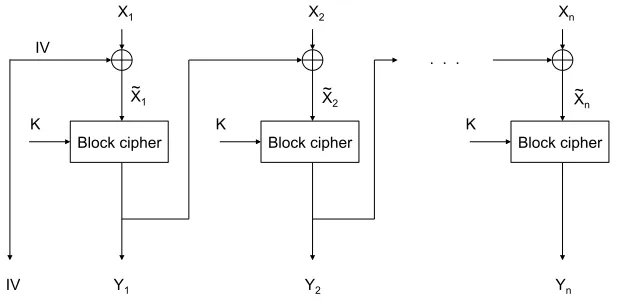
The most common mode of operation is CBC. Depicted in Figure 3, block ciphers in CBC mode are
employed as the default mechanism in widespread security standards such as IPSec [5] and TLS/SSL [6]
and hence it is a common method of encrypting internet traffic.
X1
Block cipher
X2 Xn
Y1
K K K
IV
Block cipher Block cipher
. . .
X~1 X~2
Y2 Yn
X~n
IV
Fig. 3. Cipher block chaining (CBC).
In the CBC mode each plaintext block Xi is randomized prior to encryption, by being XOR-ed with
the ciphertext blockYi−1corresponding to the previous plaintext blockXi−1 to obtainX˜i. The ciphertext
block Yi is generated by applying the block cipher with key K to the randomized plaintext block X˜i
according to
Yi =BK Xi⊕Yi−1
, (2)
whereY0 =IV andBK :Xm→ Xm is the block cipher mapping using the keyK. At the output of the
encryption algorithm we have EncK(Xn) = (IV,Yn).
Notice that, contrary to OFB and CFB modes, ciphertext blocks in Yi are not obtained by means of a
bitwise XOR operation, but rather as outputs of highly nonlinear block ciphers; therefore, the compression
methods from [3] cannot be applied directly in CBC mode.
The key insight underlying the proposed method for compression can now be described. While the
statistical relationship between the key K and the ciphertext block Yi is hard to characterize, the joint
probability distribution of the randomization vector Yi−1 and the block cipher input X˜i is easy to
the i.i.d source case considered here, Yi−1 andX˜i are related through a symbol-wise model governed by
PX. This correlation induced by the chaining mode can be exploited to allow compression of encrypted
data using Slepian-Wolf coding, as we will now show.
Let (CCBC, DCBC) be a Slepian-Wolf code with encoding rate R and block length m. Denote the
Slepian-Wolf encoding function asCCBC :Xm→ {1, . . . ,2mR}, and the Slepian-Wolf decoding function
asDCBC:{1, . . . ,2mR} × Xm → Xm. The proposed compression method is illustrated in Figure 4. The
Compressor
IV, Y1, Y2, … Yn-1, Yn C(IV), C(Y
1), C(Y2) … C(Yn-1), Yn
Compressor
Fig. 4. Compressor.
input to the compressor is EncK(Xn) = (IV,Yn). Since Yi is in Xm, the length of the input sequence
in bits is (n+ 1)mlog|X |. The compressor applies the encoding function CCBC to IV and each of the
first n−1 ciphertext blocks independently, while the n-th block is left unchanged. Thus, the output
of the compressor is the sequence (CCBC(IV), CCBC(Y1), . . . CCBC(Yn−1), Yn). The length of the output
sequence is nmR+mlog|X | bits and the compression factor
(n+ 1) log|X | nR+ log|X |
is achieved, which tends to log|X |/Rfor largen. Note that the compressor does not need to know the
key K and that this approach yields a compressed IV, which by itself (when there is no chaining) is
incompressible; therefore, no performance loss is inflicted by the uncompressed last block.
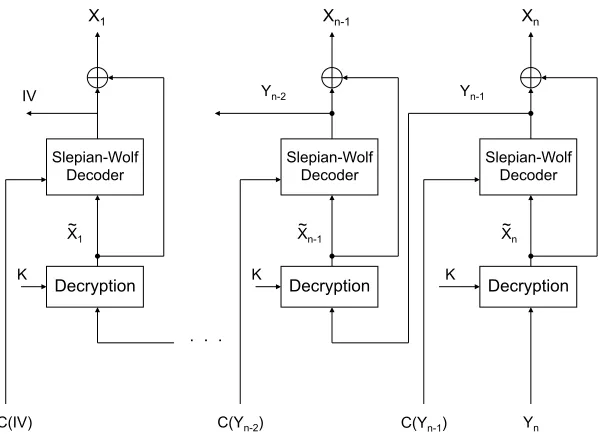
A diagram of the proposed joint decompression and decryption method is shown in Figure 5. The
received compressed sequence is decrypted and decompressed serially, from right to left. In the first
step Yn, which is received uncompressed, is decrypted using the key K to generate X˜n. Next,
Slepian-Wolf decoding is performed to reconstruct Yn−1 usingX˜n as side-information, and the compressed bits
CCBC(Yn−1). The decoder computes Yˆ , DCBC(CCBC(Yn−1),X˜n), such that Yˆ = Yn−1 with high-probability if the rateRis high enough. Once Yn−1 has been recovered by the Slepian-Wolf decoder, the
plaintext block can now be reconstructed asXn=Yn−1⊕X˜n. The decoding process now proceeds serially,
withYn−1 decrypted to generateX˜n−1, which then acts as the new side-information; this continues until
Xn Decryption K Xn-1 Decryption K . . . X1 Decryption Slepian-Wolf Decoder K IV Yn C(Yn-1)
C(Yn-2) C(IV) Yn-1 Yn-2 Xn-1 ~ X n ~ X1 ~ Slepian-Wolf Decoder Slepian-Wolf Decoder
Fig. 5. Joint decryption and decoding at the receiver. It is performed serially from right to left.
For large m, it follows from the Slepian-Wolf theorem that the rate R required to ensure correct
reconstruction of the (i−1)-th block with high probability is given by
R = 1
mH Yi−1|
˜
Xi
= 1
mH Yi−1|Yi−1⊕Xi
= 1
mH Yi−1, Yi−1⊕Xi|Yi−1⊕Xi
= 1
mH Yi−1, Xi|Yi−1⊕Xi
= 1
mH Xi|Yi−1⊕Xi
≤ 1
mH(Xi). (3)
As IV is drawn uniformly at random, Yi is uniformly distributed for all i. Consequently, the inequality
R≤ 1
mH(Xi) in Eq. (3) becomes equality R= 1
mH(Xi).
In practice, as will be seen later, the block cipher input length m is typically small. In this case, the
rate R is a function of PX, the block cipher input length m, the acceptable decoding error probability,
and the non-ideal Slepian-Wolf codes used.
B. Electronic Code Book (ECB)
As we have seen, ciphertexts generated by a block cipher in OFB, CFB, and CBC modes can be
compressed without knowledge of the encryption key. The compression schemes that we presented rely
a block cipher be compressed without chaining, i.e. when a block cipher is applied to a single block of
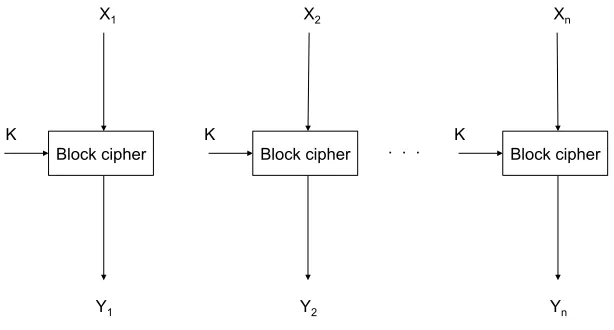
plaintext. This mode of operation, depicted in Figure 6, is called the electronic code book (ECB) mode.
X1
Block cipher
X2 Xn
Y1
K K K
Block cipher . . . Block cipher
Y2 Yn
Fig. 6. Electronic Codebook (ECB).
Since a block cipher with fixed key is a permutation, the entropy of a ciphertext is the same as the
entropy of a plaintext. In effect, compression in ECB mode is theoretically possible, but the question is,
whether it is possible to design a generic and efficient post-encryption compression scheme such as for
other modes of operation.
We claim the answer to this question is negative, except for some low-entropy distributions or very low
compression rates (e.g., compressing a ciphertext by only a few bits). For a given compressed ciphertext
C(Yi) the decoder cannot do significantly better than to operate in one of the following two exhaustive
decoding strategies:
(1) enumerate all possible plaintexts in decreasing order of probability and compute a ciphertext for
each plaintext until the ciphertext Yi that compresses to C(Yi) is found;
(2) enumerate all ciphertexts that compress to C(Yi) and decrypt them to find the original plaintext
Xi.
We show that a generic compression scheme that compresses the output of a block cipher and departs
significantly from one of the two strategies can be converted into an algorithm that breaks the security
of the block cipher. In other words, a scheme that compresses the output of a secure block cipher either
requires an infeasible amount of computation, i.e. as much as needed to break the block cipher, or it
must follow one of the two exhaustive strategies.
that(C, D) is an exhaustive PEC scheme.
The following result on the compressibility of block ciphers in ECB mode can now be stated.
Theorem 3: Let B be a secure block cipher1, let E = (Gen, Enc, Dec) be an encryption scheme,
where Gen chooses K uniformly from K and Enc = BK, Dec = BK−1, and let P be an
efficiently-samplable plaintext distribution. Let (C, D) be a (E,P, δ)-PEC scheme. If (C, D) is generic for block
ciphers, then(C, D) is either exhaustive or computationally infeasible (or both).
The proof of Theorem 3 is given in Appendix C, which also includes more details on the computational
bounds that were omitted in Theorem’s statement for simplicity. The following remarks are worth noting:
(a) The exhaustive strategies are infeasible in most cases, but for very low-entropy plaintext distributions
or for very low compression rates these strategies can be efficient. For example, consider a plaintext
setX of 1,000 uniformly distributed 128-bit values. One can compress the output of a 128-bit block
cipher applied to this set by truncating the ciphertext to 40 bits. Using a birthday-type bound it can
be shown that the probability of two values inX being mapped to the same ciphertext is about2−20.
Hence, the exhaustive strategy (1) would succeed in recovering the correct plaintext with probability
1−2−20. In general, the compression capabilities of this strategy will depend on the guessing entropy
[12], [13] of the underlying plaintext distribution. Another compression method is to drop some bits
of the ciphertext and let the decoder search for the original ciphertext until the correct plaintext is
recovered, as in the strategy (2). This assumes that the dropping some bits allows for almost-unique
decodability. The fact that these exhaustive compression strategies can be efficient for some plaintext
distributions shows that Theorem 3 cannot not exclude existence of efficient generic coding schemes
for some plaintext distributions.
(b) Ciphertext compression is theoretically possible. If efficiency is not of concern, one could consider a
brute-force compression algorithm that first breaks the block cipher by finding its key2, uses the key to decrypt, and then compresses the plaintext. If several blocks of plaintext are compressed sequentially,
they can be re-encrypted by the compression algorithm resulting in an effective ciphertext
compres-sion. This method might be impractical, but it shows that the existence of generic compressors can
be ruled out only if the PEC scheme is subject to computational constraints. Moreover, the above
1For the definition of a secure block cipher see Appendix B.
2This can be done by exhaustive search based on a known plaintext-ciphertext pair or (for suitable plaintext distributions)
method could work efficiently against an insecure block cipher (in which case the key can found
efficiently), and this confirms that both efficiency and security are essential to our result.
(c) Theorem 3 holds for generic compressors that do not use the internals of an encryption algorithm
or the actual key in the (de)compression process. It does not rule out the existence of good PEC
schemes for specific secure block ciphers, like for instance AES. To achieve compression, though,
the PEC scheme would have to be contingent on the internal structure of a block cipher.
IV. SECURITY OF THE CBC COMPRESSIONSCHEME
In this section we formally prove that compression and decompression operations that we introduced
on top of the regular CBC mode do not compromise security of the original CBC encryption. The proof
follows standard techniques in the cryptographic literature and shows that any efficient attack against
secrecy of a PEC scheme can be transformed into an efficient attack against the original CBC encryption.
Please refer to Appendix B for background on cryptographic definitions that are used in this section.
We start by formalizing the notion of security of a PEC scheme as a simple extension of the standard
definition of chosen plaintext attack (CPA) security recalled in Appendix B. The essence of the extension
is that in the PEC setting the adversary is given access to a combined oracle (EncK+C)(·) which first
encrypts the plaintext and then compresses the resultant ciphertext.
Definition 4 (CPA-PEC Indistinguishability Experiment): Consider an encryption scheme(Gen, Enc,
Dec) and a PEC scheme (C, D). The CPA-PEC indistinguishability experiment ExptcpaA −pec is defined
as follows:
1) a key K is generated by runningGen;
2) the adversary A has oracle access to (EncK+C)(·), and queries it with a pair of test plaintexts
X0, X1 of the same length;
3) the oracle randomly chooses a bitb← {0,1}and returns the compressed ciphertextc←(EncK+
C)(Xb), called the challenge, to A;
4) the adversaryAcontinues to have oracle access to(EncK+C)(·)and is allowed to make arbitrary
queries. Ultimately it makes a guess about the value of b by outputtingb0;
5) the output of the experiment, ExptcpaA −pec, is defined to be 1 if b0 = b, and 0 otherwise. If
ExptcpaA −pec= 1, we say that Asucceeded.
Definition 5 (Post-Encryption Compression Security): A PEC scheme(C, D) is called(T, ε)
T,
Pr
h
ExptcpaA −pec= 1
i
< 1
2 +ε,
where the probability is taken over all random coins used by A, as well as all random coins used in the
experiment.
We now formulate the security of our CBC compression scheme by the following theorem.
Theorem 6: Let E = (Gen, Enc, Dec) be a CBC encryption scheme that is (T, ε)-indistinguishable
under chosen plaintext attacks, let P be an efficiently-samplable plaintext distribution, and let (C, D)
be a (E,P, δ)-PEC scheme. Then (C, D) is (T /TC, ε)-indistinguishable under chosen plaintext attacks,
where TC is an upper bound on the running time ofC.
Proof:Our proof employs a reduction to the security ofE. We show that if there exists an adversary
AC that runs in time T /TC and is able to distinguish between two compressed encryptions, then there
exists an adversaryAE that runs in timeT and compromises the security ofE. The latter implies a break
of security of the underlying block cipher using the well-known result by Bellare et al. [14].
For contradiction, assume the existence of such an adversary AC and construct an adversary AE as
follows. AE invokes AC and emulates its oracle(EncK+C)(·). For every queryX made by AC, AE
uses its oracle EncK(·) to compute EncK(X). Subsequently, it applies the compression algorithm C
on EncK(X) and forwardsC(EncK(X))toAC. When AC outputs the test messages X0 andX1,AE
outputs X0 and X1 to its own oracle EncK(·). Let c∗ denote the challenge ciphertext that its oracle
returns.AE computesc=C(c∗) and forwardsc toAC. WhenAC outputs a bitb0,AE outputs the same
value.
Given that AC makes at most T /TC queries and the running time of C is upper-bounded by TC, the
running time of AE is at mostT. Let 12+ denote the probability that AC distinguishes successfully in
its game. It follows thatAE distinguishes successfully in its game with the same probability, which is in
contradiction to the security of E.
V. PUBLIC-KEYENCRYPTIONSCHEMES
After a feasibility study of post-encryption compression in private-key encryption schemes, one may
wonder whether these results can be extended to public-key encryption schemes. Loosely speaking, the
key generation algorithm in public-key encryption schemes produces two different keys: a public key,
known to everyone, and a secret key. Any party who knows the public key can encrypt messages, but
Public-key encryption schemes are computationally expensive; therefore, one typically encrypts streams
of data in two stages. In the first stage, a public-key encryption scheme is used to encrypt a private key,
and in the second stage, a private-key encryption scheme (using the private key from the first stage) is
used to encrypt the data. The legitimate recipient is assumed to have the secret key, so it can decrypt
the private key and subsequently use the private key to decrypt the data. The results in this paper can
be applied to compress data encrypted in the second stage, while the question whether the private key
encrypted with a public-key encryption scheme in the first stage can be compressed deserves further
study and is beyond the scope of this paper. For completeness, we provide some observations toward the
resolution of this question.
In the El Gamal cryptosystem [15] one of the two components of the ciphertext can be compressed
if XOR is used to combine the ephemeral El-Gamal key with the message. For El Gamal over elliptic
curves there exists a well-known technique called “point compression” [16], which reduces the ciphertext
to half its length. Yet, in public-key encryption the ciphtertext is often longer than the plaintext, so one
could hope for better post-encryption compression. One result in this direction is Gentry’s technique for
compressing Rabin’s ciphertexts [17], but it can only be applied prior to encryption, not post-encryption.
Interestingly, the related result by Gentry regarding compression of Rabin’s signatures does allow for
compression after the signature generation and without the need for the signing key; however, there is
no known analogous result that applies to Rabin’s encryption function.
It is worth mentioning that the recent development of fully homomorphic encryption (FHE) [18]
provides a generic mechanism for compressing text encrypted under an FHE scheme, which can be
either symmetric-key or public-key. The characterizing property of FHE schemes is that for a given
ciphertext Enc(X), one can efficiently compute the value Enc(F(x)) for any efficiently computable
and fixed-length output function F without knowledge of the decryption key. It follows that if F is a
compression function with fixed-length output, a post-encryption compression for the FHE scheme is
obtained immediately. For example, consider a compression functionC that achieves a compression rate
of at least 50% on any plaintext X from the plaintext domain X. In order to enforce the fixed-length
output requirement of FHE, one could define a function F that applies C but always produces outputs
of exactly half the size of the input. Then for any X ∈ X and ciphertext Enc(X), its compressed
and encrypted value Enc(F(X)) can be computed efficiently. The relationship between plaintext and
ciphertext lengths in an FHE scheme is typically linear; therefore, the length of Enc(F(X)) is half the
length of Enc(X). Since the receiver can decrypt Enc(X) it can also decrypt Enc(F(X)) to obtain
The drawback of FHE schemes is their high computational complexity and the length of
cipher-texts which tend to be considerably longer than plaincipher-texts. The latter is particularly unfortunate for
post-encryption compression as the compressed ciphertext could end up being longer than the original
uncompressed plaintext. Hence, while in theory FHE provides a remarkable solution to post-encryption
compression, its practical applicability is very limited (at least with current FHE schemes).
VI. COMPRESSIONPERFORMANCE
Codes used to compress stream ciphers can have arbitrary block lengths, since the cipher itself does
not directly impose any constraints on the block length. On the other hand, the compression methods
proposed for CFB and CBC mode must operate block-wise, since decompression occurs serially and
depends upon the preceding decompressed block. In effect, the block length of Slepian-Wolf codes must
be equal to the block cipher input length m.
Efficiency of the Slepian-Wolf compression depends on the performance of underlying Slepian-Wolf
codes and it was shown in [19], [20] that it approaches entropy with O(
q
logn
n ), which is considerably
slower thanO(n1) of arithmetic coding. It follows that for efficient Slepian-Wolf compression the block
length of Slepian-Wolf codes must be long.
Slepian-Wolf codes over finite block lengths have non-zero frame-error rates (FER), which implies
that the receiver will occasionally fail to recoverEK(Xi−1)correctly. Such errors must be dealt with on
the system level, as they can result in catastrophic consequences due to error-propagation to subsequent
blocks. In the following it is assumed that as long as FER is low enough, the system can recover
efficiently, for instance by supplying the uncompressed version of the erroneous block to the receiver.
The compression performance will therefore depend on the target FER.
We consider a binary i.i.d. source with a probability distribution Pr(X = 1) = p and Pr(X = 0) =
1−p, which produces plaintext bits. A sequence of plaintext bits is divided into blocks of sizem, which are
encrypted and compressed as described in Section III. The receiver’s task is to reconstructEK(Xi−1)from
˜
Xi and side informationC(EK(Xi−1)). For the considered source Slepian-Wolf decoding is equivalent
to error-correction over a binary symmetric channel (BSC) and thus the underlying codes should yield
a FER that is lower or at most equal to the target FER over the BSC. Compression efficiency can be
evaluated using two methods:
(a) fix probabilityp and determine the compression rate of a Slepian-Wolf code that satisfies the target
(b) pick a well-performing Slepian-Wolf code and determine the maximum probability p for which
target FER is satisfied.
We use low-density parity-check (LDPC) codes [21], which are known to be very powerful and evaluate
compression performance according to method (b). In our simulations we use two LDPC codes3, of which the first yields compression rate 0.5 and has degree distribution pairλ(x) = 0.3317x+ 0.2376x2+
0.4307x5, ρ(x) = 0.6535x5 + 0.3465x6 and the second yields compression rate 0.75 and has degree
distribution pair λ(x) = 0.4249x+ 0.0311x2+ 0.5440x4, ρ(x) = 0.8187x3+ 0.1813x4. All codes are
constructed with the Progressive Edge Growth algorithm [22], which is known to yield good performance
at short block lengths. Belief propagation [21] is used for decoding and the maximum number of iterations
is set to 100.
TABLE I
COMPRESSION RATES AND HIGHEST ATTAINABLE PROBABILITYpFOR BLOCK LENGTHm= 128BITS.
Compression Rate Target FER p Source Entropy
0.50 10−3 0.026 0.1739
0.50 10−4
0.018 0.1301
0.75 10−3 0.068 0.3584
0.75 10−4 0.054 0.3032
Simulation results for block lengths of 128 and 1024 bits are shown in Tables I and II, respectively.
First, consider the current specification of the AES standard [23], wherem is 128 bits. At FER of 10−3
the binary source to be compressed to rate 0.5, can have the probability p of at most 0.026, where
its entropy equals 0.1739. The large gap between the achievable compression rate and the entropy is
a consequence of the very short block length. Note that for a fixed compression rate the maximum
probability p decreases with the decreasing target FER.
An increase in block length to 1024 bits results in a considerable improvement in performance (see
Table II). For instance, at FER = 10−3 and compression rate 0.5, the source can now have probabilityp
up to 0.058. In future block cipher designs one could consider longer block sizes, in order to allow for
better post-encryption compression.
3
TABLE II
COMPRESSION RATES AND HIGHEST ATTAINABLE PROBABILITYpFOR BLOCK LENGTHm= 1024BITS.
Compression Rate Target FER p Source Entropy
0.50 10−3 0.058 0.3195
0.50 10−4 0.048 0.2778
0.75 10−3 0.134 0.5710
0.75 10−4
0.126 0.5464
VII. CONCLUSION
We considered compression of data encrypted with block ciphers without knowledge of the key.
Contrary to the widespread belief that such data are practically incompressible, we show that compression
can be attained. Our method is based on the Slepian-Wolf coding and hinges on the fact that chaining
modes widely used with block ciphers introduce a simple symbol-wise correlation between successive
blocks of data. The proposed compression was shown to preserve the security of the encryption scheme.
Further, we showed the existence of a fundamental limitation to compressibility of data encrypted with
block ciphers when no chaining mode is employed.
Some simulation results are presented for binary memoryless sources. The results, while still far
from theoretical limits, indicate that considerable compression gains are practically attainable with block
ciphers, and improved performance can be expected with future increase of block sizes.
APPENDIXA
COMPRESSINGOFBANDCFB MODE
The main part of the paper describes how compression can be performed on data encrypted with block
ciphers when they operate in the CBC mode. This section outlines how compression is achieved in other
two common modes associated with block ciphers, output feedback (OFB) and cipher feedback (CFB).
A. Output Feedback (OFB)
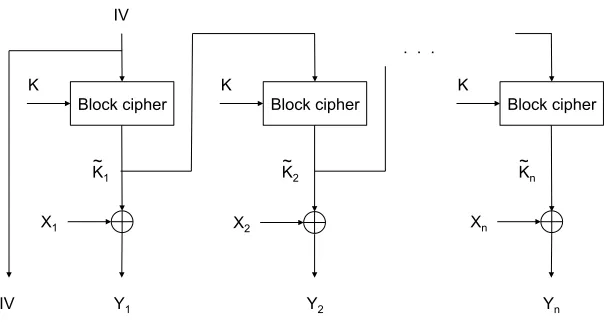
The mode depicted in Figure 7 is called output feedback (OFB). Plaintext blocks inXnare not directly
encrypted with a block cipher. Rather, the block cipher is used to sequentially generate a sequence of
pseudorandom blocks K˜n={K˜i}ni=1 which serve as a one-time pad to encrypt the plaintext blocks. At
Block cipher
Y1 K
IV
. . .
X1
IV
Block cipher
Y2 K
X2
Block cipher
Yn K
Xn K1
~
K2 ~
Kn ~
Fig. 7. Output feedback (OFB).
Notice that each block K˜i is independent of plaintext blocks, therefore the OFB mode is analogous to
the one-time pad encryption scheme andYncan be compressed in the same manner as described in [3].
Most importantly,K˜n andXn are independent, therefore the block length of Slepian-Wolf codes that are
used to compressYn can be chosen arbitrarily. The IV is uniformly distributed and thus incompressible.
Formally, the compression and decompression algorithms can be described as follows. Let(COFB, DOFB)
denote a Slepian-Wolf code with encoding rate R and block length nm. The Slepian-Wolf encoding
function is defined as COFB : (Xm)n → {1, . . . ,2mnR}, and the Slepian-Wolf decoding function as
DOFB:{1, . . . ,2mnR} ×(Xm)n→(Xm)n. Given an output sequence from the encryptor EncK(Xn) =
(IV,Yn), compression is achieved by applying the Slepian-Wolf encoder function COFB to Yn, so that
at the output we have(IV, COFB(Yn)). Note that COFB does not require knowledge of K.
Decompression and decryption are performed jointly. The receiver has(IV, COFB(Yn))and knows the secret keyK, thus it can generate the sequence of pseudorandom blocksK˜n using the IV. Subsequently,
it applies the Slepian-Wolf decoder function DOFB to (COFB(Yn),K˜n) to recover Yn. The original
sequence of plaintext blocks Xn then equalsK˜n⊕Yn.
Note that K˜n is not an i.i.d. sequence; therefore the original Slepian-Wolf theorem from [4] does
not apply directly. Nevertheless, the Slepian-Wolf theorem was also shown to hold for correlated general
sources [24], [25, Chapter 7] and so the compression rate approaches entropy of the source asymptotically
B. Cipher Feedback (CFB)
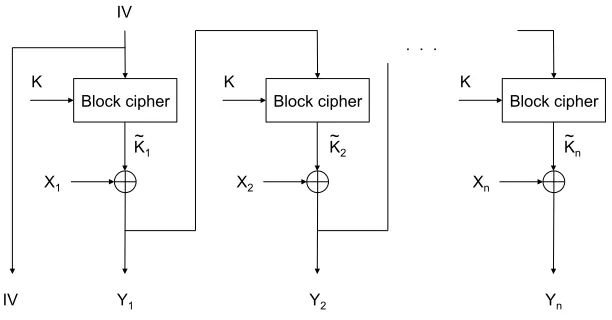
Next, we discuss the cipher feedback (CFB) mode, which is depicted in Figure 8. Similarly as in
OFB, the plaintext blocks are not subject to block cipher encryption and Yn is obtained by XOR-ing
plaintext blocks Xn with pseudorandom blocks K˜n. At the output of the encryption algorithm we have
EncK(Xn) = (IV,Yn).
Block cipher
Y1 K
IV
. . .
X1
IV
Block cipher
Y2 K
X2
Block cipher
Yn K
Xn K1
~
K2 ~
Kn ~
Fig. 8. Cipher feedback (CFB).
However, in CFB mode, the pseudorandom blocksK˜n are not independent ofXn. Let the block cipher
using a secret keyK be characterized by the bijective mappingBK :Xm → Xm. Each blockK˜idepends
on the preceding plaintext block Xi−1 as follows:
˜
Ki=BK(Xi) =BK(Xi−1⊕K˜i−1), (4)
where X0 is defined to be the IV.
Due to the dependence between K˜n and Xn, the proposed compression algorithm for the CFB mode
operates on individual ciphertext blocksYi, rather then onYnall at once like in the OFB mode. Without
this distinction, the joint decompression and decryption as proposed in [3] would not be possible. Let
(CCFB, DCFB) denote a Slepian-Wolf code with encoding rate R and block length m. The Slepian-Wolf
encoding function is defined as CCFB : Xm → {1, . . . ,2mR}, and the Slepian-Wolf decoding function
asDCFB:{1, . . . ,2mR} × Xm→ Xm. Compression is achieved by applying the Slepian-Wolf encoding
function CCFB to each of the ciphertext blocks in Yn individually. The compressed representation of
EncK(Xn) is then(IV, CCFB(Y1), . . . , CCFB(Yn)). Note again, thatCCFB does not require knowledge of
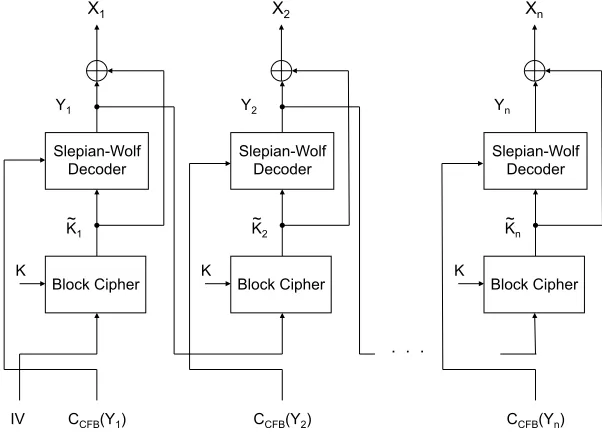
Joint decompression and decryption, depicted on Figure 9 is performed sequentially from left to
right, since decryption of the ith ciphertext block requires knowledge of the (i−1)th plaintext block.
Initially, IV is mapped to K1˜ by the block cipher. The Slepian-Wolf decoder function DCFB is applied
X2
. . . X1
Block Cipher Slepian-Wolf Decoder
K
CCFB(Y2)
IV K~1
CCFB(Y1)
Y1
Block Cipher Slepian-Wolf Decoder
K K~2
Y2
Xn
CCFB(Yn)
Block Cipher Slepian-Wolf Decoder
K K~n
Yn
Fig. 9. Joint decryption and decoding in the CFB mode at the receiver is performed serially from left to right.
to (CCFB(Y1),K1˜ ) to obtain Y1. The first plaintext can now be obtained:X1 = ˜K1⊕Y1. Subsequently, Y1 is mapped to K2˜ . The same process repeats to obtain X2, and later all remaining plaintext blocks
{Xi}ni=3.
Notice that in contrast to the OFB mode, this compression scheme is generally optimal only ifm→ ∞.
For finite m, the compression is generally suboptimal, even if n→ ∞.
APPENDIX B
SOMEDEFINITIONS FROMCRYPTOGRAPHY
For completeness, we recall some standard definitions from cryptography that are used in this paper.
See [8] for details. These definitions assume a fixed computational model over which time complexity
is defined.
Definition 7 (Block Cipher): A block cipherB with block sizem is a keyed family{BK}K∈K where
for each K, BK is a permutation over m bits4 andK is the set of all possible keys.
4
The security of a block cipher is defined via the notion of indistinguishability. Ideally, we would
like the behavior of a block cipher to be indistinguishable by computational means from that of a purely
random permutation overmbits. However, since a block cipher is a much smaller family of permutations
than the family ofall permutations, the above is not fully achievable. Yet, if we restrict our attention to
“computationally feasible distinguishers” then we can obtain a meaningful notion of security applicable
to actual block ciphers such as AES.
Hence, the main ingredient in such definition is that of adistinguisher. A distinguisherDistis defined
as a randomized algorithm with oracle access to two m-bit permutations Enc and Dec where Dec=
Enc−1. Dist can make arbitrary queries to the oracles and eventually outputs a single bit 0 or 1. We
consider the runs ofDistin two cases: when the oracles are instantiated with a truly random permutation
and when instantiated with a block cipher (i.e., with the functionsBK andBK−1 where K is chosen with
uniform probability from the setK). LetPREAL be the probability thatDistoutputs a 1 when the oracle
was instantiated with B, where PREAL is computed over all random coins of Dist and all choices of
the key forB. Further, letPRP be the probability thatDistoutputs a 1 when the oracle was instantiated
with a random permutation, wherePRP is computed over all random coins ofDist and all permutations
Enc. Intuitively, we can think of Dist as trying to decide if the oracles are instantiated with a random
permutation or with a block cipher; hence, a distinguisher is considered successful if the difference
|PREAL−PRP|, which is referred to as the advantage, is non-negligible. Formally, this leads to the
following definition.5
Definition 8 (Block Cipher Security): A block cipher B is called(T, ε)-secureif no distinguisherDist
that runs in time T has advantage larger thanε.
This definition tries to capture the idea that, for secure block ciphers, even distinguishers that have the
ability to run for extremely large time T, say T = 280, gain only negligible distinguishing advantage,
say ε= 2−40. In other words, for any practical purpose the quality of the block cipher is as good as if
it was instantiated by a “perfect cipher” (purely random permutation).
A secure block cipher by itself does not constitute a secure private-key encryption scheme due to its
deterministic nature. Namely, two identical plaintexts are mapped into two identical ciphertexts, therefore
valuable information about data patterns can be leaked to eavesdroppers. Rather, secure block ciphers are
used as building blocks that can be used to construct private-key encryption schemes that eliminate this
vulnerability. Note that a secure private-key encryption scheme must be probabilistic or stateful.
Toward a formal definition of a secure encryption scheme, consider the following experiment:
Definition 9 (CPA Indistinguishability Experiment): Consider an adversaryAand an encryption scheme
(Gen, Enc, Dec). The chosen plaintext attack (CPA) indistinguishability experiment ExptcpaA is defined
as follows:
1) a key k is generated by runningGen;
2) the adversary A has oracle access to EncK(·), and queries it with a pair of plaintexts X0, X1 of
the same length;
3) the oracle randomly chooses a bit b ← {0,1} and returns the ciphertext q ← EncK(Xb), called
the challenge, to A;
4) the adversary A continues to have oracle access to EncK(·) and is allowed to make arbitrary
queries. Ultimately it makes a guess about the value of b by outputtingb0;
5) the output of the experiment,ExptcpaA , is defined to be 1ifb0 =b, and 0otherwise. IfExptcpaA = 1,
we say that A succeeded.
Definition 10 (Private-Key Encryption Security): A private-key encryption scheme (Gen, Enc, Dec)
is called (T, ε)-indistinguishable under chosen plaintext attacks (or CPA-secure) if for every adversary
A that runs in time T,
PrhExptcpaA = 1i< 1
2 +ε,
where the probability is taken over all random coins used by A, as well as all random coins used in the
experiment.
APPENDIX C
PROOF OFTHEOREM3
The proof of Theorem 3 is by contradiction. We assume a generic PEC scheme (C, D) that departs
in some noticeable way (later made more precise by means of the parameter ε) from the exhaustive
strategies when it is applied to a block cipherB. Subsequently, we show how to use such a PEC scheme
to build a distinguisher Dist that distinguishes with advantage strictly larger than ε between the block
cipher B and a random permutation, in contradiction to the security ofB.
For simplicity, and without loss of generality, we assume that D does not make redundant queries to
Enc orDec. Namely, no query X to Encor query Y toDecis repeated in a run. If X was output by
Dec (resp., Y output by Enc) it is not entered into Enc (resp., into Dec). In addition, if the decoded
output fromD isX, we assume thatX was either input toEncor output byDec. If Ddoes not follow
ForX ∈RP 6 andY =Enc(X), assume that C(Y) is passed as input to D. We say thatDdecodes
correctly if it queries eitherXfromEncorY fromDecduring its run. In other words,Dis not required
to have the ability to identify the correct plaintext, which simplifies our presentation without weakening
our results. On the contrary, it shows that even if such a relaxed decoding requirement is acceptable, the
lower bound we prove still holds.
Finally, note that the formulation of the theorem assumes that the plaintext distributionP is efficiently
samplable. This assumption is used in an essential way in our proof, though the efficiency requirement
from the P sampler is very weak. In addition, we assume that, for a given compressed ciphertextC(Y),
one can sample uniformly from the set YC(Y)=C−1(C(Y)), which is the set of all ciphertexts mapped
by C toC(Y). Additional discussion related to this assumption is given after the proof.
The proof of Theorem 3 uses the following lemma.
Lemma 11: Let T be a time-bound parameter, let B be a (T, ε)-secure block cipher and let E =
(Gen, Enc, Dec) be an encryption scheme, where Genchooses K ∈RK andEnc=BK, Dec=BK−1.
LetP be a plaintext distribution samplable in timeT /4and let(C, D)be a generic(E,P, δ)-PEC scheme.
Then either (C, D) runs in time that exceeds T /4(and hence is infeasible7) or the following holds: (i) LetX ∈RP andY =Enc(X). Consider a run ofD on inputC(Y)in whichD queriesEnc(X),
and letX0 be a random element drawn fromP independently ofX. Then, the probability thatDqueries
Enc(X0) before Enc(X) is at least 1/2−ε/(1−δ).
(ii) Let X∈RP andY =Enc(X). Consider a run ofDon input C(Y)in which DqueriesDec(Y),
and let Y0 be an element drawn uniformly from YC(Y) = C−1(C(Y)). Then, the probability that D
queries Dec(Y0) beforeDec(Y) is at least 1/2−ε/(1−δ).
We first show how the Lemma 11 suffices to prove Theorem 3.
Proof of Theorem 3: For case (i), the probability thatX is queried first is withinε/(1−δ) of the
probability that X0 is queried first, where the latter is the probability of querying a plaintext that bears
no information (the run ofDis independent ofX0). Assuming thatδ <1/2, we getε/(1−δ)<2εand
sinceεis negligible (say2−40) so is 2ε. This implies a plaintext-exhaustive strategy byD. Similarly, for
case (ii), the probability that the value Y is computed first is withinε/(1−δ) of the probability that an
independent Y0 ∈RYC(Y) is computed first. This implies a ciphertext-exhaustive strategy by D.
6
We useX∈RPto denote thatX is chosen at random according to the probability distributionP.
7
Proof of Lemma 11: First, consider the error-free case, i.e. δ= 0. We show that if(C, D) runs in
time less than T /4 and conditions (i), (ii) do not hold, we can build a distinguisher (see Appendix B)
that runs in time at most T and distinguishes between B and a random permutation with an advantage
larger than ε, in contradiction to the security of B. A distinguisher interacts with oracles Enc andDec
and its goal is to identify whether the oracles are instantiated with the real block cipher B or with a
random permutation. For clarity, we represent the output 0 fromDist by the symbol RP (Dist decided
that the oracles are instantiated with a random permutation) and the output 1 by REAL (Dist decided
that the oracles are instantiated by the block cipher B).
We build a distinguisher Dist that uses the scheme (C, D) and responds to the encryption and
decryption queries made byD with its Enc/Dec oracles. WhenEnc is a random permutation, (C, D)
may run much longer than whenEnc isB. Thus, to bound the time complexity ofDist, we set a time
limitT0 =T /4, such that if the total time of(C, D) exceedsT0,Diststops as well. As we show below,
the parameterT0 is chosen as T /4 to ensure that the total running time of Dist is no more thanT.
Initially,DistchoosesX ∈RP and receives the valueY =Enc(X)from itsEncoracle. It computes
C(Y) and passes it as input to D. In addition, Distchooses an independent X0 ∈RP and independent
Y0 ∈RYC(Y). It is assumed that Y0 can be sampled within time T /4. Subsequently,Dist monitors the
queries to Enc/Decas requested by Dand reacts to the following events:
1) if X is queried from Enc, stop and outputREAL;
2) if X0 is queried fromEnc, stop and output RP;
3) if Y is queried fromDec, stop and output REAL;
4) if Y0 is queried fromDec, stop and output RP.
5) if the run of (C, D) exceeds T0, stop and output RP
It is possible that multiple such events take place in one run of D, for instance both X and X0 may
be queried from Enc. In such case Dist stops as soon as it identifies first such event.
Let PREAL and PRP be defined as in Appendix B. We evaluate the advantage of Dist, namely, the
difference |PREAL−PRP|. First, consider a run of Dist whenEnc/Dec are instantiated by a random
permutation. The behavior of(C, D) depends onY which is chosen at random and independently ofX
and X0, therefore the run is independent of bothX andX0. In effect, the probability that X is queried
before X0 is exactly 1/2. Similarly, if Y is queried from Dec, the behavior of D depends on C(Y),
while both Y and Y0 have the same probability to be the chosen as the preimage of C(Y). Therefore,
the probability that Y precedes Y0 is exactly 1/2. It follows that Dist outputs REAL with probability
PRP ≤1/2.
Now, consider a run of Dist when Enc/Dec are instantiated by a block cipher B and its inverse,
respectively. Assume, for contradiction, that (C, D) stops before time T0 and either (i) the probability
thatX0 is queried before X is strictly less than 1/2−ε or (ii) the probability thatY0 is queried before
Y is strictly less than1/2−ε. It follows that the probability that Distoutputs RPis strictly smaller than
1/2−ε, therefore PREAL>1/2 +ε.
Thus, Dist distinguishes with advantage|PREAL−PRP|, which is strictly larger than ε. The running
time of Dist is upper-bounded byT: it includes three samplings (of X, X0 and Y0), each assumed to
take at most T /4 time, and the work of (C, D) which Dist runs for total timeT /4 at most. In all, we
have built a distinguisher againstB that runs timeT and has advantage larger than εin contradiction to
the security of the block cipher B.
Assume now that δ > 0. When a positive probability of error for D is allowed, it can occur that D
stops before timeT0 and beforeDistseesX, X0, Y orY0. To deal with this situation, we add a clause to
the specification of Distsaying that if (C, D) stops before time T0 and before seeing any of the values
X, X0, Y, Y0, thenDist chooses a random bitband outputs REAL ifb= 1 and RPif b= 0. We slightly
increased the probability thatX0 is queried before X (orY0 before Y) in the block cipher case, however
it is still negligibly far from 1/2. The proof is now a straightforward extension of the case whenδ= 0.
Remark. The proof of Lemma 11 assumes that the set YC(Y) is samplable in time T /4. While this
assumption is likely to hold, we note that it is enough to know the size of YC(Y). In such case, rather
than samplingYC(Y), the events 3) and 4) in the proof are replaced with the following one: if the number
of queries to Dec performed byD exceeds|YC(Y)|/2 before Y is queried, stop and output RP.
We now sketch the proof of the theorem when none of the above conditions holds, namely whenYC(Y)
is of unknown size and not samplable in timeT /4. Assume that(C, D) performs noticeably better than
the exhaustive strategies when the Enc/Dec oracles are instantiated with the block cipher B. Then it
must hold that (C, D) runs noticeably faster when the Enc and Dec oracles are instantiated with the
block cipherB than with a random permutation, for the exhaustive strategies are optimal for a random
permutation (as shown above). Using this (assumed) discrepancy between the runs of(C, D)overB and
the runs of (C, D) over a random permutation, we can build a distinguisher against B in contradiction
to the security ofB. In the following, we formalize this discrepancy and outline the construction of the
For any plaintext X let TB(X) denote the runtime of (C, D) on input X when Enc/Dec oracles
are instantiated with the block cipher B. Further, let TR(X) denote the runtime of (C, D) on input X
when Enc/Dec oracles are instantiated with a random permutation. We assume that there is a known
time bound T0 such that TB(X) < T0 for all X (we relax this assumption below) and there exists a
non-negligible ε such that Pr[TB(X) < TR(X)] ≥ 1/2 +ε. The probability is over all choices of X
and all random coins of (C, D). Further, it is over all key choices for B for TB and over all random
permutations for TR. We build a distinguisher Dist as follows:
1) Choose X ∈RP and run (C, D) using the input oracles. If time T0 is exceeded, stop and output
RP, otherwise proceed to Step 2.
2) Let T1 denote the running time of(C, D)in step (1). Run (C, D) again on X (same X as in step
1)) but this time ignore the given Enc/Dec oracles. Instead, answer queries from (C, D) with a
random permutation. If time T1 is exceeded then output REAL, otherwise output RP.
We have the following:
• If theEnc/Decoracles are instantiated with B, step (1) always completes and in step (2) REAL is
output with the probability that equalsPr[TR(X)> TB(X)], which is at least 1/2 +ε.
• If theEnc/Decoracles are instantiated with a random permutation,REALis output only ifTR(X)≤ T0 and the runtime on X in step (2) exceeds the runtime on X in step (1). The probability of the
latter is at most 1/2 since both runs are over a random permutation.
Thus,Dist will output REAL with probability at least1/2 +ε when the oracles are instantiated withB,
while it will output REAL with probability at most 1/2when the oracles are instantiated with a random
permutation. It follows that Dist is a (T, ε)-distinguisher for B where T = 2T0 since in each of the
steps (1) and (2) Dist runs time at mostT0.
Note that the requirement that TB(X)< T0 for allX can be relaxed such that the joint probability of
TB(X)< T0 and TB(X)< TR(X) is at least 1/2 +ε.
REFERENCES
[1] U. D. of Commerce/National Institute of Standards and Technology, “Advanced encryption standard (AES),” inFIPS PUB 197, Nov. 2001.
[2] N. B. of Standards,Data Encryption Standard (DES). U.S. Department of Commerce, Washington D.C, 1977. [3] M. Johnson, P. Ishwar, V. Prabhakaran, D. Schonberg, and K. Ramchandran, “On compressing encrypted data,” IEEE
Trans. Signal Processing, vol. 52, pp. 2992–3006, Oct. 2004.
[5] S. Kent and K. Seo, “Security achitecture for the internet protocol,” inRFC 4301, Dec. 2005. [6] T. Dierks and E. Rescorla, “The TLS protocol – version 1.2,” inRFC 5246, Aug. 2008.
[7] M. Johnson, D. Wagner, and K. Ramchandran, “On compressing encrypted data without the encryption key,” inProc. of the Theory of Crypto. Conf., Cambridge, MA, Feb. 2004.
[8] J. Katz and Y. Lindell,Introduction to Modern Cryptography. Chapman&Hall/CRC, 2007.
[9] A. Aaron and B. Girod, “Compression with side information using turbo codes,” inIEEE Data Compression Conf., 2002, pp. 252–261.
[10] J. Garcia-Frias, “Compression of correlated binary sources using turbo codes,”IEEE Communications Letters, vol. 5, pp. 417–419, Oct. 2001.
[11] A. Liveris, Z. Xiong, and C. Georghiades, “Compression of binary sources with side information at the decoder using LDPC codes,”IEEE Communications Letters, vol. 6, pp. 440–442, Oct 2002.
[12] J. L. Massey, “Guessing and entropy,” inIEEE Inter. Symp. on Info. Theory, Seattle, WA, June 1994. [13] C. Cachin, “Entropy measures and unconditional security,” Ph.D. dissertation, ETH Z¨urich, 1997.
[14] M. Bellare, A. Desai, E. Jokipii, and P. Rogaway, “A concrete security treatment of symmetric encryption: Analysis of the DES modes of operation,” inIEEE Proc. of 38th Annual Symp. on Foundations of Computer Science, 1997.
[15] T. ElGamal, “A public-key cryptosystem and a signature scheme based on discrete logarithms,” inCRYPTO ’84. Springer-Verlag (LNCS 196), 1984, pp. 10–18.
[16] I. F. Blake, G. Seroussi, and N. P. Smart,Eliptic Curves in Cryptography. Cambridge University Press, 2000.
[17] C. Gentry, “How to compress Rabin ciphertexts and signatures (and more),” inCRYPTO ’04. Springer-Verlag (LNCS 3152), 2004, pp. 179–200.
[18] ——, “Fully homomorphic encryption using ideal lattices,” inProc. 41st Annu. ACM Symp. Theory of Computing, 2009, pp. 169–178.
[19] D. He, L. Lastras-Monta˜no, and E. Yang, “A lower bound for variable rate Slepian-Wolf coding,” inIEEE Inter. Symp. on Info. Theory, Seattle, WA, July 2006.
[20] ——, “On the relationship between redundancy and decoding error in Slepian-Wolf coding,” inIEEE Information Theory Workshop, Chengdu, China, Oct. 2006.
[21] T. Richardson and R. Urbanke,Modern Coding Theory. Cambridge University Press, 2008.
[22] X. Hu, E. Eleftheriou, and D. Arnold, “Regular and irregular progressive edge-growth Tanner graphs,”IEEE Transactions on Information Theory, vol. 51, no. 1, pp. 386–398, Jan 2005.
[23] W. Mao,Modern Cryptography: Theory and Practice. Prentice Hall, 2003.
[24] S. Miyake and F. Kanaya, “Coding theorems on correlated general sources,” IEICE Transactions on Fundamentals, vol. E78-A, no. 9, pp. 1063–1070, 1995.