An argument for rank metric
Vadym Fedyukovych
August 16, 2008
Abstract
A protocol is introduced to show an upper bound for rank of a square matrix.
1
Introduction
Prover shows his knowledge of matrix elements committed, as well as a statement regarding the matrix with a protocol introduced in this report. He shows that rank of the matrix is at most a threshold with responses of a variant of Schnorr protocol [Oka92, Sch89]. Condition tested is root multiplicity of characteristic function of another matrix with elements that are Prover responses. Responses are validated with commitments to ma-trix elements. Pedersen commitment scheme [Ped91] is used with this protocol.
An upper bound for error in a damaged codeword of Goppa code (in Hamming metric) can be shown with a related protocol [Fed08]. Set ap-proximate matching can be shown with another related protocol [Fed07].
2
Preliminaries
LetFqbe a finite field withqelements. LetE = {eij}be a square matrix
of sizenwith elements fromFq, and letΛ= {λij}be an identity matrix:
λii=1,λij=0,j6=i. Notation|E|is used for matrix determinant.
Definition 1. Matrix characteristic functionis a mapping from all square matrices to the ring of polynomials:
Commitment schemeit a tuple of algorithmsGen(),Commit(),Open() such thatbindingandhidingholds. Withhomomorphic commitment
schemeone can open a linear combination of values committed. Some
commitment schemes also have protocols to show knowledge of values committed. Pedersen commitment scheme is computationally binding and unconditionally hiding, is additively homomorphic, and have an ar-gument of knowledge protocol.
Interactive protocol is an interactive pair of algorithms such that
completenessand soundnessholds. Soundness is unconditional for a
proof, and depends on hardness of a problem for an argument.Extractor
algorithmexists for some protocols that can produce auxiliary input of
Prover machine from Prover responses given oracle access to Prover. A protocol with an extractor isof knowledge.Simulator algorithmexists for some protocols that produces simulated transcript indistinguishable from protocol transcript with a Prover. A protocol with a simulator is
zero knowledge. A protocol with a simulator producing transcripts
in-distinguishable from all protocol transcripts with the same challenges is
honest verifier zero knowledge.
Schwartz-Zippel lemma [Sch80] is the core of our verification tech-nique and soundness proof.
3
Protocol
Lemma 1. For a square matrixEof rankkand sizen
f(x;E) =xn−kfk(x) (2)
where fk(x)is a monic polynomial of powerk.
We showx−(n−T)f(x;E)is a polynomial with a protocol introduced in this report such thatrank(E)≤T.
Let{Wij}be a set of commitments, and{Rij}be a set of responses of
Chaum-Pedersen protocol with a challengec∈Fq:
Wij= geijhζij (3)
Rij= rij(c), rij(y) =yeij+αij (4)
Consider a matrix of polynomials:B(y) ={rij(y)}. It is clear that
f(xy;B(y)) =
n
∑
l=0
al(x)yl, an(x)≡ f(x;E) (5)
Verifier tests that
f(xy;B(y))≡ ynxn−T
T
∑
=
xsbs+ n−1
for x = d and y = c chosen at random, and for some {al(x)}, {bs}.
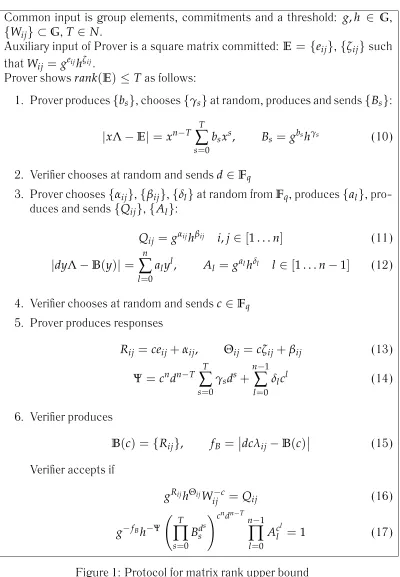
Protocol is shown on Figure 1.
Lemma 2 (Soundness). Probability for a honest Verifier to accept while running protocol shown on Figure 1 for any polynomial Prover
and any matrixEof rank more thanTis at most 2n
q.
Proof. (Concise) Any Prover producing a pair of responsesRij,Θijother
than estimates of linear polynomials
fR(y) =yeij+αij, fΘ(y) =yζij+βij (6)
aty=cthat fit (16) for someαij,βij,ζij
Rij6= fR(c), Θij6= fΘ(c) (7)
will also produce a solution to DL problem:
logh(g) =−
Rij− fR(c)
Θij− fΘ(c) (8)
In the following we consider all responsesRijto be estimates of
polynomi-als linear in challenge. Any Prover running protocol shown on Figure 1 with any square matrix of rank more than T will result in estimating a non-zero polynomial
F(y,x) =−f(xy;B(y)) +ynxn−T
T
∑
s=0
xsbs+ n−1
∑
l=0
al(x)yl (9)
It can be shown there is at most 2qn probability for a honest Verifier to choose roots of (9) at random. For all other cases it follows that either F(y,x) ≡ 0holds, or Prover can get logh(g)from his responses. From
F(y,x)≡0it follows (2) holds such that rank of the matrix is at mostT.
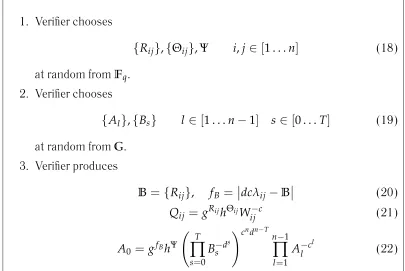
Lemma 3(Zero knowledge). Protocol shown of Figure 1 is honest
ver-ifier zero knowledge.
Proof. Simulator algorithm is shown of Figure 2. It is clear Ahas flat
4
Discussion
Protocol introduced may be useful with rank codes [Gab85, GL08]. Namely, an error in a corrupted codeword may be shown to be of a low enough weight, without disclosure of the codeword and the weight, and in zero knowledge. To show a statement regarding rank of a non-square matrix, Prover introduces additional rows chosen by Verifier at random to produce a square matrix.
References
[Fed07] Vadym Fedyukovych. A signature scheme with approximate key matching (in Russian). InInformation Security conference, Kiev, 2007. Presentation available.
[Fed08] Vadym Fedyukovych. Argument of knowledge of a bounded er-ror. In(submitted), 2008. Presentation available.
[Gab85] Ernst M. Gabidulin. Theory of codes with maximum rank dis-tance. Problems of Information Transmission, 21(1):1–12, 1985.
[GL08] Ernst M. Gabidulin and Pierre Loidreau. Properties of subspace subcodes of optimum codes in rank metric. AMC, 2(2):147– 157, 2008.
[Oka92] Tatsuaki Okamoto. Provably secure and practical identification schemes and corresponding signature schemes. InCRYPTO, pages 31–53, 1992.
[Ped91] Torben P. Pedersen. Non-interactive and information-theoretic secure verifiable secret sharing. InCRYPTO, pages 129–140, 1991.
[Sch80] J. T. Schwartz. Fast probabilistic algorithms for verification of polynomial identities. J. ACM, 27(4):701–717, 1980.
Common input is group elements, commitments and a threshold: g,h
∈
G,{
Wij} ⊂
G,T∈
N.Auxiliary input of Prover is a square matrix committed: E
=
{
eij}
,{
ζij}
suchthatWij
=
geijhζij.Prover showsrank
(
E)
≤
Tas follows:1. Prover produces
{
bs}
, chooses{
γs}
at random, produces and sends{
Bs}
:|
xΛ−
E|
=
xn−TT
∑
s=0
bsxs, Bs
=
gbshγs (10)2. Verifier chooses at random and sendsd
∈
Fq3. Prover chooses
{
αij}
,{
βij}
,{
δl}
at random fromFq, produces{
al}
,pro-duces and sends
{
Qij}
,{
Al}
:Qij
=
gαijhβij i,j∈
[
1 . . .n]
(11)|
dyΛ−
B(
y)
|
=
n
∑
l=0
alyl, Al
=
galhδl l∈
[
1 . . .n−
1]
(12)4. Verifier chooses at random and sendsc
∈
Fq5. Prover produces responses
Rij
=
ceij+
αij, Θij=
cζij+
βij (13)Ψ
=
cndn−TT
∑
s=0
γsds
+
n−1∑
l=0
δlcl (14)
6. Verifier produces
B
(
c) =
{
Rij
}
, fB=
dcλij
−
B(
c)
(15)
Verifier accepts if
gRijhΘijW−c
ij
=
Qij (16)g−fBh−Ψ
T
∏
s=0 Bdss
!cndn−T
n−1
∏
l=0
Acll
=
1 (17)1. Verifier chooses
{
Rij}
,{
Θij}
,Ψ i,j∈
[
1 . . .n]
(18) at random fromFq.2. Verifier chooses
{
Al}
,{
Bs}
l∈
[
1 . . .n−
1]
s∈
[
0 . . .T]
(19)at random fromG.
3. Verifier produces
B
=
{
Rij}
, fB=
dcλij−
B(20)
Qij
=
gRijhΘijW−cij (21)
A0
=
gfBhΨT
∏
s=0 B−s ds
!cndn−T
n−1
∏
l=1
A−l cl (22)