Adaptive Security of Concurrent Non-Malleable Zero-Knowledge
Zhenfu Cao
Computer Science&Engineering Department
Shanghai Jiao Tong University, China
[email protected]
Zongyang Zhang
∗Computer Science&Engineering Department
Shanghai Jiao Tong University, China
[email protected]
Yunlei Zhao
†Software School
Fudan University, China
[email protected]
Abstract
A zero-knowledge protocol allows a prover to convince a verifier of the correctness of a statement without disclosing any other information to the verifier. It is a basic tool and widely used in many other cryptographic applications. However, when stand-alone zero-knowledge protocols are used in complex environments, e.g., the Internet, the basic properties may not be sufficient. This is why researchers considered security of zero-knowledge protocols under concurrent composition and man-in-the-middle attacks. Moreover, it is very likely that an adversary might break computers that run the protocol and get internal information of the parties. It is thus necessary to take account of the security of zero-knowledge protocols when adaptive corruptions are allowed.
Previous adaptively secure zero-knowledge protocols work either in a stand-alone setting, or in a concurrent setting with trusted setup assumptions. In this paper, we study adaptive security of zero-knowledge protocols under both concurrent self composition and man-in-the-middle attacks in the plain model (i.e., without any set-up assumptions). We provide a construction of adaptively secure concurrent non-malleable zero-knowledge proof/argument for every language inNP.
Keywords: Zero-knowledge protocol, concurrent non-malleability, adaptive corruption, commit-ment schemes
1
Introduction
Zero knowledge proofs, introduced by Goldwasser, Micali and Rockoff [GMR85], allow a prover to con-vince a verifier the validity of a statement without disclosing any other information to him. It was shown that everyNP language has a zero-knowledge proof system [GK96]. Zero-knowledge proofs are widely used in many cryptographic applications and are one of the most fundamental cryptographic building blocks. As application execution environments change from one to another, stand-alone zero-knowledge proofs might fail to satisfy security requirements in these various settings.
Consider a setting where there are many instances of protocols which are invoked at arbitrary times. Here, many verifiers are receiving proofs from various independent provers, and trying to collude together to learn something non-trivial from the provers. It was shown that a stand-alone zero-knowledge protocol fails to preserve the zero-knowledge property in the above setting [DNS98]. Thus, researchers considered the notion of concurrent zero-knowledge. Another setting is that there are man-in-the-middle attacks. A man-in-the-middle adversary may convince a verifier of a statement that it otherwise cannot do by interacting with an honest prover. The notion of non-malleable zero-knowledge proofs was first introduced by Dolev, Dwork and Naor [DDN00] to capture security requirements in this setting.
The notion of concurrent non-malleable zero-knowledge (CNMZK) considers both of the above set-tings. An adversary may interact with many provers while playing the role of the verifier, and si-multaneously interact with many verifiers while playing the role of the prover. Barak, Prabhakaran
and Sahai [BPS06] gave the first CNMZK argument in the plain model. Ostrovsky, Pandey and Vis-conti [OPV10] improved this result and gave more efficient instantiations of CNMZK arguments for a special class ofNP launages. Lin, Pass, Tseng and Venkitasubramanian (LPTV) [LPTV10] presented the first construction ofCNMZKproofs.
PreviousCNMZKprotocols in the plain model only considered settings where an adversary is allowed to control/corrupt parties before the start of protocol executions, but, is not allowed to corrupt parties during protocol executions. However, in reality, based on the information that was already gathered, adversaries (e.g., hackers, viruses, insiders) may break into computers, possibly while they are executing secure protocols. Thus, it is very necessary to model adaptive security of zero-knowledge protocols since this models realistic security threats better and so provides a better security guarantee. We call a zero-knowledge protocol secure in this setting an adaptively secure CNMZK, or CNMZK against adaptive adversaries. Previous results on adaptive security of zero-knowledge protocols either work in the stand-alone setting [Bea96, LZ09], or under concurrent composition with trusted setup assumptions [CF01, DN02, CLOS02, LZ09]. This raises the following intriguing question:
Does there exist a concurrent non-malleable zero-knowledge proof/argument system for every NPagainst adaptive corruptions in the plain model?
To design an adaptively secure protocol is always believed to be a more challenging work than designing its statically secure counterpart. Therefore, researchers tend to resort to other assumptions (e.g., parties have tamper proof hardware tokens [Kat07], or parties can reliably erase information [Lin09]) to overcome obstacles and simplify the design. As we focus on the plain model, we intend not to use these stronger physical assumptions. We will explain the main obstacles in detail in the next section and show how to overcome them step by step.
1.1
Our Results
In this work, we give a positive answer to the above question and show the following result.
Theorem 1.1. Assume the existence of one-way functions. Then there exists apoly(n)-round adaptively secure concurrent non-malleable zero-knowledge proof for everyNP. Furthermore, assuming the existence of collision-resistant hash-functions, the round complexity is O˜(logn).
As an additional contribution, we give a construction of adaptively secure CNMZKargument.
Theorem 1.2. Assume the existence of one-way functions. Then there exists apoly(n)-round adaptively secure concurrent non-malleable zero-knowledge argument for every NP. Furthermore, assuming the existence of collision-resistant hash-functions, the round complexity is O˜(logn).
Other related work. Recently, Yao, Yung and Zhao [YYZ10] presented the first construction of
CNMZKprotocol with full adaptive input selection in the bare public-key model. They allow the inputs of both left and right interactions to be adaptively chosen by an adversary; moreover, the input to an interaction can be decided adaptivelyat any timeduring this interaction. Lin and Pass [LP11a] provided the first construction of CNMZK protocol with adaptive inputs in the plain model. Furthermore, the input of an interaction is adaptively chosen by an adversaryat the outsetof each interaction. They called this notion adaptiveCNMZK, which is a bit confusing with our notion of adaptively secureCNMZK. The main difference is that we focus on adaptive corruptions by an adversary, whereas Lin and Pass focused on adaptive inputs selected by an adversary. We believe that our technique might be extended to design adaptively secureCNMZKprotocols with adaptive input selection based on the work of Lin and Pass [LP11a].
commit phase. To prove security, the LPTV simulator uses rewindings to extract out trapdoors in the preamble phases and then commits to the trapdoors in the commit phases. Using the “fake witnesses” (i.e., decommitment information to the commitments in the commit phases), the simulator is able to run the zero-knowledge proof in a straight-line manner in the proof phases. For all right accepting interactions, the LPTV simulator again uses rewindings to extract out the witnesses committed to by the adversary (fromCEComin the commit phases).
When considering adaptive corruptions to verifiers on the right, the LPTV simulator can be directly adjusted to handle this case. As the LPTV simulator follows the honest verifier strategy in all right interactions and the verifier has no secret information, the simulator just provides randomness for the simulated verifier when a verifier is corrupted. However, when considering adaptive corruptions to provers on the left, several problems arise. First, if a prover is corrupted after completion of theCEComin the commit phase, the simulator is given a witnesswto the proof statementx, and now it has to provide the adversary with the randomness of the simulated prover in theCECom. Recall that the LPTV simulator commits to a trapdoor instead of the witnessw, and the commitmentCEComis binding. Now the LPTV simulator gets stuck in explaining the commitment as tow. Second, the same problem arises forNMCom
in the commit phase. The LPTV simulator again gets stuck if the adversary corrupts a prover after the completion of NMCom, since it committed to a trapdoor and has to explain the commitment as to w. Finally, upon corruption of a prover of the zero-knowledge proof in the proof phase, the LPTV simulator has to explain a proof as one generated using the real witness, whereas it is actually generated using a “fake witness”. The LPTV simulator again cannot handle this case.
Our idea for circumventing the above three problems can be described as follows:
• For the first problem, we rely on a concurrently extractable commitmentCECTCom which is also concurrent trapdoor. The trapdoor property guarantees that there exists a simulator for the com-mitment, such that knowing the trapdoor, it is able to open the commitment to arbitrary values. Using CECTCom, theCNMZKsimulator is able to explain a commitment to a trapdoor (i.e., the value committed by an adversary in the preamble phase) as to the real witnessw. Our construction ofCECTComuses a concurrent trapdoor commitment schemeCTComwhich is statistically binding. At first sight, it seems that it is impossible to designCTComagainst fully adaptive corruptions in the plain model, since we have to achieve seemingly contradicting goals that, on one hand, even an infinitely powerful committer is not able to equivocate the commitment, and on the other hand, an expected PPT simulator can equivocate the commitment. However, we overcome this obstacle with the help of the technique of the work [CO99]. Roughly, we rely on the property of Naor’s commit-ment scheme which is equivocal if the result of the first message can be programmed/controlled by the simulator. We let this message be generated by a coin-tossing protocol between the committer and the receiver. Through this way, the simulator is able to hand the corruption of a committer after execution of theCTCom(and thenCECTCom).
• For the second problem, we rely on a robust non-malleable commitment schemeNMCTComthat is concurrent trapdoor. The NMCTComis based on the non-malleable commitment in [LPV08] and a concurrent trapdoor commitment schemeCTCom.1Using similar analysis as above, the trapdoor
property ofNMCTComcan be used to handle adaptive corruptions. Another problem related with
NMCTCom is how to handle adaptive corruptions during special-sound witness-indistinguishable (WI) proofs.2 The simulator has to interpret the proof generated using a “fake witness” as one generated using a real witness. Here we resolve the above problem by requiring an honest prover to commit using CTCom in each of the special-sound proofs.3 Through this way, we ensure that the simulator is able to provide all the corresponding randomness upon corruption of a committer after the execution ofNMCTCom.
• For the third problem, we rely on an adaptive instance-dependent scheme AIDComproposed by
1A possible efficient way to design an adaptively secureNMCTComis to modify the recent constant-round concurrent
non-malleable commitment schemes [LP11b, Goy11] and make them adaptively secure. However, we cannot work it out and left it as an open problem.
2In the non-malleable commitment scheme [LPV08], the receiver first computes a random imagesof a one-way function,
then the committer commits to its message and proves using a sequence of special-soundWIproofs that it knows either the opening of the commitment or the preimage ofs.
3 The proof system is identical to Blum’s basic protocol for Hamiltonicity. It consists of three (or four) rounds. The
Lindell and Zarosim [LZ09]. An instance-dependent commitment scheme is a commitment whose properties depend on whether the instance in question is in the language or not. Lindell and Zarosim uses AIDCom to construct (stand-alone) zero-knowledge proof systems against adaptive corruptions. We also use AIDComto handle adaptive corruptions for the zero-knowledgeproof in the proof phase. However, to make our simulation go through, we are unable to apply the analysis in [LZ09]. We have to explain a proof generated using a “fake witness” as one generated using a real witness.
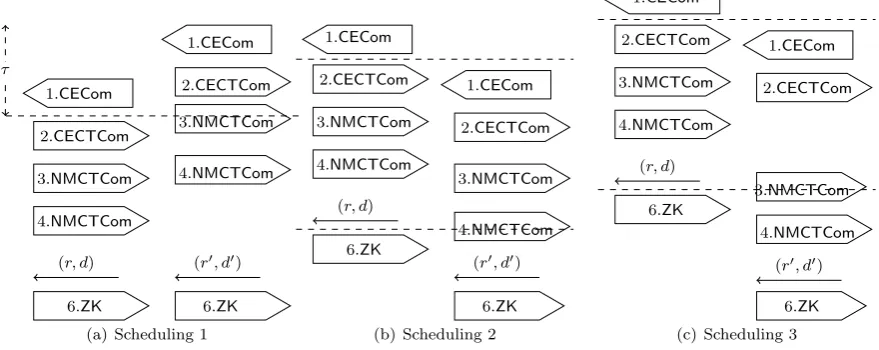
The approaches to solving the above three problems result in a new problem. In the simulation, we have to run the extractor ofCEComin the preamble phases, in addition to the concurrent trapdoor simulator of bothCECTComandNMCTComin the commit phases. It seems that we have to compose the (possibly conflicting) individual rewinding strategies and present a complicated analysis. In order to get rid of this obstacle, we combine part of commitment CECTComandNMCTCom (i.e., the part for extraction) withCECom in the preamble phase, and need only a new uniform rewinding strategy. In the following, we will present constructions of protocolsCECTComandNMCTComof which the properties satisfy this simulation strategy.
Organization. We present the definition ofCNMZKin Section 2. In Section 3 we introduce all basic tools that we use in the construction ofCNMZK. In Section 4, we give a construction ofCNMZKproof systems for allNP.
2
Preliminaries and Definitions
LetNbe the set of all positive integers. For any integern∈N, let [n] denote the set {1,2, . . . , n}. Let
{0,1}n be the set ofn-bit strings. We assume familiarity with computational/statistical
indistinguisha-bility, interactive proofs, zero-knowledge, commitment schemes, and (strong) witness-indistinguishability.
2.1
Adaptively Secure Concurrent Non-Malleable Zero-Knowledge
Adaptively concurrent man-in-the-middle attack. Let hP,Vi be an interactive proof for NP
language L with witness relation RL. Consider a man-in-the-middle adversary A that participates in
many left and right interactions. Without loss of generality, suppose that at most m = m(n) proofs take place. Prior to all interactions, all parties in the system receives as common input the security parameter in unary 1n, andAreceives as auxiliary inputz∈ {0,1}∗. The concurrent man-in-the-middle
setting proceeds as follows. First, the input statements to honest provers, i.e., statementsx1, . . . , xm∈ L∩ {0,1}n, and the corresponding tagsid
1, . . . ,idm∈ {0,1}t(n)are chosen. Ainteracts with the honest
prover Pi with common inputxi and idi while playing the role of a verifier. Pi receives as local input
the witnesses wi such that wi ∈ RL(xi). These interactions are called “left” interactions. During the
left interactions,Acan corrupt arbitrary honest provers. At any point,Amay adaptively choose a new statement ˜xi and tag ˜idi and start a new proof with a verifier Vi while acting as the role of a prover.
These interactions are called the “right” interactions. Furthermore, during the right interactions,A is able to corrupt arbitrary honest verifiers. Once a party is corrupted, its common input, random input, and the entire history of the messages sent and received by the party are already known toA. We denote byX~ the input vector (x1, . . . , xm) andID~ the tag vector (id1, . . . ,idm). LetviewA(1n, ~X, ~ID, z) be the
view of the adversaryAin the above experiment, i.e., it consists ofA’s random coins, all common inputs and the transcripts of all left and right interactions betweenAand honest provers and verifies, and all collected information of corrupted parties. Given a functiont=t(n), we use the notation{·}n, ~X, ~
ID,z as
shorthand for{·}n∈N,x1,...,xm∈L∩{0,1}n,id1,...,idm∈{0,1}t,z∈{0,1}∗.
Definition 2.1(Adaptively Secure Concurrent Non-Malleable Zero-Knowledge). An interac-tive proofhP,Vifor membership in anNPlanguageLwith witness relationRLis calledadaptively secure
concurrent non-malleable zero-knowledgewith tags of lengtht=t(n) if for everyPPTman-in-the-middle adaptive adversaryAthat participates in at mostm=m(n) concurrent executions, there exists aPPT simulator-extractorS such that,
• The two ensembles {S1(1n, ~X, ~ID, z)}n, ~X, ~ID,z and {viewA(1 n, ~X, ~
ID, z)}n, ~X, ~ID,z are
computation-ally indistinguishable over the security parameter n ∈ N, where S1(1n, ~X, ~ID, z) denote the first
output ofS(1n, ~X, ~ ID, z).
• Denote by (ν,( ˜w1, . . . ,w˜m)) the output of S(1n, ~X, ~ID, z). Let (˜x1, . . . ,x˜m) be the statements
of right interactions in the view ν. Let ˜id1, . . . ,id˜m be the identities of the right interactions in
the view ν. For every i ∈ [m], if the verifier Vi is not corrupted, the transcript of the ith right
interaction is accepting and ˜idi 6=idj for all j ∈[m], then ˜wi is the witness to membership ˜xi in
the language L∩ {0,1}n except with negligible probability, i.e., R
L(˜xi,w˜i) = 1. Otherwise, ˜wi is
set to⊥.
3
Basic Tools
3.1
Concurrently Extractable Commitment Schemes
The notion of concurrently extractable commitment scheme is first introduced by Micciancio et al. [MOSV06]. This is an abstraction of the preamble stage of the concurrent zero-knowledge protocol of [PRS02]. Roughly, a commitment scheme is concurrently extractable if there exists an efficient extractor that is able to generate a view that is statistically indistinguishable with the view of a malicious committer in the commit phases, and moreover, extract the committed values from any valid commitments sent by the committer. In this paper, we will use a concurrently extractable statistically hiding commitment schemeCEComshand a concurrently extractable statistically binding commitment schemeCEComsb.
3.2
Concurrent Trapdoor Commitment Schemes
Roughly, a trapdoor commitment is a commitment scheme with an additional property such that there exists a simulator, with knowledge of some trapdoor information, can overcome the binding property and open a commitment arbitrarily. We extend this notion to concurrent execution settings and define concurrent trapdoor commitment schemes.
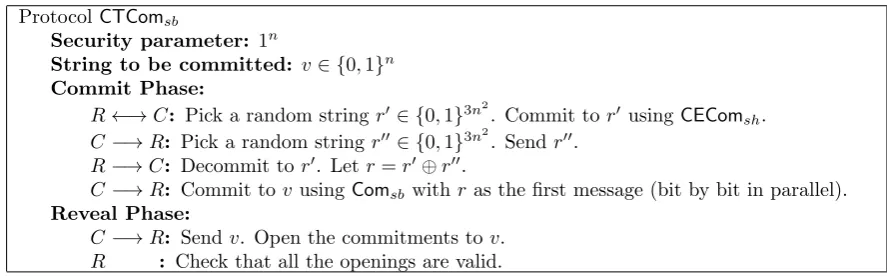
On a high level view, our concurrent trapdoor commitment scheme is build upon the trapdoor com-mitment scheme in [CO99] and a concurrently extractable comcom-mitment scheme. The committer and the receiver together first run a coin-tossing protocol to generate a random string r. Then the committer commits to its value using Naor’s commitment scheme withras the first message. LetComsb be Naor’s
two-round statistically binding commitment scheme. Let CEComsh be a concurrently extractable
sta-tistically hiding commitment scheme. The commitment schemeCTComsb is shown in Figure 1. Due to
space constraints, the proof ofCTComsbis shown in Appendix B.1.
ProtocolCTComsb
Security parameter: 1n
String to be committed: v∈ {0,1}n
Commit Phase:
R←→C: Pick a random stringr0 ∈ {0,1}3n2. Commit tor0 usingCECom
sh.
C−→R: Pick a random stringr00∈ {0,1}3n2. Send r00.
R−→C: Decommit tor0. Letr=r0⊕r00.
C−→R: Commit tov usingComsbwithras the first message (bit by bit in parallel).
Reveal Phase:
C−→R: Sendv. Open the commitments tov. R : Check that all the openings are valid.
To commit to ann-bit stringvunder schemeCTComsb, the receiver first commits to a random 3n2-bit
string r0 using CEComsh. Then the committer sends a random stringr00. Next the receiver opens its
random stringr0 and the committer commits tovusing Com
sb withr0⊕r00as the first message. In the
reveal phase, the committer just opens its commitment tov.
It would be worth noting explicitly that in the reveal phase, all the randomness used in the commit phase will be revealed. This property is very useful when proving adaptive property of the concurrent non-malleable zero-knowledge protocol in Section 4.
3.3
Concurrently Extractable and Concurrent Trapdoor Commitment Schemes
On a high level view, our concurrently extractable and concurrent trapdoor statistically binding com-mitment schemeCECTComsb follows the structure of the concurrently extractable commitment scheme
in [PRS02, MOSV06]. We simply replace the commitment used by the committer with a concurrent trapdoor one. The commitment scheme is shown in Figure 2. Due to space constraints, the proof is shown in Appendix B.2.
ProtocolCECTComsb
Security parameter: 1n
Inputs: a valuev∈ {0,1}n
Commit Phase:
C−→R: Generaten` pairs of random n-bit strings (αi,j0 , α1i,j), i ∈[n], j ∈[`] such that for alli, j v=α0
i,j⊕α1i,j. Commit tov and alln`pairs strings usingCTComsbone by one.
For j= 1 to `:
R−→C: Send a randomn-bit stringej = (e1,j, . . . , en,j).
C−→R: Open the correspondingαei,j
i,j for alli∈[n].
Reveal Phase:
The committer opens all the remainingn`+ 1 commitments. The receiver checks the correct-ness of openings andv=α0
i,j⊕α1i,j for alli∈[n], j∈[`]
Figure 2: Concurrently extractable and concurrent trapdoor commitment scheme
Let ` = `(n) be any super-logarithmic function. To commit to an n-bit string v under scheme of
CECTComsb, the committer generates n` pairs of random n-bit strings such that each pair is a (2,2)
share of the committed valuev, i.e.,v=α0i,j⊕α1i,j for alli∈[n], j∈[`]. The committer then commits tov and each of the 2n` strings in parallel usingCTComsb. This is followed by`rounds of interactions.
In thejth interaction, the receiver sends a randomn-bit challengeej = (e1,j. . . en,j) and the committer
opens the commitment ofαei,j
i,j for alli∈[n]. In the reveal phase, the committer opens all the remaining
n`+ 1 commitments, and the receiver checks that all the openings are correct and the opened values satisfyv=α0
i,j⊕α1i,j for alli∈[n], j∈[`].
We also point out a nice property of CECTComsb that in the reveal phase, all the randomness used
in the commit phase will be revealed. This property is very useful when proving adaptive property of the concurrent non-malleable zero-knowledge protocol in Section 4.
3.4
Non-Malleable Concurrent Trapdoor Commitment Schemes
Roughly speaking, a commitment is non-malleable if an adversary cannot transform a commitment to a value into a commitment to a related value. This definition is introduced by Dolev, Dwork and Naor [DDN00]. A robust non-malleable commitment is non-malleable with respect to any protocol that has a small round complexity (i.e., less than ˜O(logn) rounds). This definition is introduced by Lin and Pass [LP09]. A non-malleable concurrent trapdoor commitment is a commitment that is non-malleable and concurrent trapdoor.
Special-sound proofs. Ak-round interactive proof for the language L∈NPwith witness relationRL
is special-sound with respect to RL if the following holds: there exists a deterministic polynomial-time
(~α, β0, γ0). By parallel running Blum’s basic protocol for Hamiltonicity, we get a 4-round special-sound
WI proofs forNP assuming the existence of one-way functions. Moreover, if the commitment scheme used by the protocol [Blu86] is aCTComsb, then it becomes ak-round special-soundWI proofs, where
kdepends on the round complexity ofCTComsb. In the following, unless explicitly mentioned, when we
say special-soundWI proofs, we actually mean the abovek-round one.
We construct a concurrent non-malleable concurrent trapdoor commitment scheme CNMCTComin Figure 3. The protocol is based on the commitment in [LPV08] and adapted to to our setting. The scheduling in Stage 3 of the protocol is shown in Figure 4. Due to space constraints, the proof is shown in Appendix B.3.
Protocol CNMCTCom
Common Input: Security parameter 1n, a tagid∈ {0,1}t(n).
String to be committed: valuev∈ {0,1}n.
Commit Phase: Stage 1:
C ←→ R : Commit to v using CTComsb. Let com be the commitment. Let decbe the
decommitment information.
Stage 2:
R−→C: Uniformly chooser1, r2∈ {0,1}n. Computes1=f(r1), s2=f(r2). Sends1, s2.
R←→C: Prove using a WI proof of knowledge that there exists a value r ∈ {0,1}n such
that s1=f(r) ors2=f(r).
Stage 3:
C←→R: 4tspecial-soundWI proofs of the statement:
• Either there exists values v,dec s.t (v,com,dec) is a valid commitment and decommit-ment transcript forCTComsb,
• or there exists values r∈ {0,1}n andb∈ {0,1} s.ts
b=f(r).
with the following two additional requriments:
1. The prover usesCTComsbinstead ofComsbin each proof, and
2. The length of the verifier challenge is 2nin the following schedule: Forj= 1 tot: execute designid
j followed by design1−idj.
Reveal Phase:
C sends v,decand R checks that v,com,dec is a valid commitment and decommitment transcript forCTComsb.
Figure 3: Concurrent non-malleable concurrent trapdoor commitment scheme
~ α1
β1
γ1
~ α2
β2
γ2
(a)design0
~ α2
~ α1
β1
γ1
β2
γ2
(b)design1
Figure 4: Two schedules
Extension toO(logn)-round non-malleable concurrent trapdoor commitment schemes. Just as the technique in [LPV08], we show how to construct a O(logn)-round commitment scheme that is stand-alone non-malleable and concurrent trapdoor using any O(n)-round commitment scheme that is concurrent non-malleable concurrent trapdoor. The protocol NMCTCom is constructed as follows. To commit to a value v ∈ {0,1}n, a committer chooses random strings v
v=v1⊕. . .⊕vn. Ifid∈ {0,1}n is the tag of the protocolNMCTCom, then the committer commits to
vi in parallel usingCNMCTComunder tag (i,idi), whereidi is theith bit ofid. The protocolNMCTCom
is a non-malleable and concurrent trapdoor commitment scheme. The non-malleability proof is much similar with that in [LPV08]. The trapdoor property follows from the concurrent trapdoor property of
CNMCTCom. We defer the proofs to the full version.
Extension to non-malleable concurrent trapdoor commitment scheme robust w.r.t k-round protocols. Actually, the aboveO(logn)-round non-malleable commitment scheme is robust w.r.t log n-round protocols, since it has at least lognrewinding slots. By choosing the parameter carefully, we can prove the following lemma.
Lemma 3.1. Let `(n) be a super-logarithmic function. Then there exists a O(`(n))-round concurrent trapdoor statistically binding commitment scheme that is robust w.r.t`(n)-round protocols.
3.5
Adaptive Instance-Dependent Commitment Schemes
Instance-dependent commitments were first introduced in [IOS97]. Roughly speaking, an instance-dependent commitment scheme is a commitment whose properties depend on whether the instance in question is in the language or not. Typically, it is defined for a languageLas follows. Let xbe a state-ment. Ifx∈Lthen the commitment associated withxis computationally hiding, and ifx /∈Lthen the commitment associated with x is statistically binding. The adaptive instance-dependent commitment scheme AIDCom = (Com,Com0,Adapt) was first introduced by Lindell and Zarosim [LZ09]. Roughly, it has the additional property that commitments are equivocal. It has a “fake” committing algorithm
Com0which generates fake commitments. If knowing the witness to the statement, the fake commitment can be opened to arbitrary value by the adaptive opening algorithmAdapt; otherwise, it cannot neces-sarily be opened to any value. Due to space constraints, the definition of adaptive instance-dependent commitment is shown in Appendix A.6.
4
Adaptively Secure Concurrent Non-Malleable Zero-Knowledge
In this section, we construct an adaptively secure concurrent non-malleable zero-knowledge proof for everyNPlanguage. LetCEComshbe a concurrently extractable statistically hiding commitment scheme.
LetCECTComsbbe a concurrently extractable and concurrent trapdoor statistically binding commitment
scheme. LetNMCTCom be a non-malleable concurrent trapdoor commitment scheme. Let AIDCom= (Com,Com0,Adapt) be an adaptive instance-dependent commitment scheme for the language of Hamil-tonicity. LetMBZKProof be a modification of Blum’s ω(1)-round zero-knowledge proof system for the language of Hamiltonicity, in which the prover commits to the adjacency matrices usingAIDCom. The instance used byAIDComis the statement proved in protocolMBZKProof.
Our concurrent non-malleable zero-knowledge protocol CNMZKProof is a variant of the LPTV pro-tocol in [LPTV10]. The propro-tocol CNMZKProof for an NP language L proceeds in six stages, given a security parameter n, a common input statement x ∈ {0,1}n∩L, a tag id ∈ {0,1}t(n), and a private
inputw∈RL(x) to the prover.
Stage 1: The verifierV chooses a random stringr∈ {0,1}n and commits torusingCECom sh.
Stage 2: The proverP commits to the witnessw usingCECTComsb.
Stage 3: The proverP commits to the witnessw usingNMCTComunder tagid.
Stage 4: The proverP commits to the witnessw usingNMCTComunder tagidagain.
Stage 5: The verifierV decommits its commitment in Stage 1 to valuer.
Stage 6: The prover P proves using MBZKProof that the the commtments in Stage 2, 3 and 4 all commits to the same value ˜w, and either ˜w∈RL(x) or ˜w=r.
The main difference between our protocol CNMZKProof and the LPTV protocol is that we replace primitives used by the prover with corresponding “adaptive” ones on which the simulator relies to handle adaptive corruptions of provers. A formal description of the protocolCNMZKProof is shown in Figure 5.
Protocol CNMZKProof
Common Input: an instance ofx∈L∩ {0,1}n, a tagid∈ {0,1}t(n).
Auxiliary input to prover: a witnessws.t (x, w)∈RL.
Stage 1: V uniformly choosesr∈ {0,1}n. It commits torusingCECom
sh. LetT1be the
commit-ment transcript.
Stage 2: P commits towusingCECTComsb. LetT2 be the commitment transcript.
Stage 3: P commits towusingNMCTCom and tagid. LetT3 be the commitment transcript.
Stage 4: P commits towusingNMCTCom and tagid. LetT4 be the commitment transcript.
Stage 5: V decommitsT1to valuer. P aborts if the decommitment fails.
Stage 6: P ↔ V : Denote byL0 the language {(x,T2,T3,T4, r)}, where an instance inL0 satisfies:
there exists ˜wsuch that
• w˜ is a valid opening ofT2,
• and ˜wis valid opening ofT3 andT4 under tagid,
• and ˜w∈RL(x) or ˜w=r.
Prove using MBZKProof that (x,T2,T3,T4, r)∈L0, i.e., both the prover and the verifier run
a Cook-Levin reduction fromL0 to Hamiltonicity, and then invokeMBZKProof.
Figure 5: Adaptively secure concurrent non-malleable zero-knowledge proof for NP
make a better use of the simulation strategy of the LPTV protocol. Roughly, the reason is follows: in the simulation, we need run the extractor of CEComsh in Stage 1, in addition to the concurrent
trapdoor simulator of bothCECTComsbandNMCTCom. It seems that we have to compose the (possibly
conflicting) individual rewinding strategies and present a complicated analysis. In order to get rid of this obstacle, we combine the CEComsh part in CECTComsb and NMCTComwith Stage 1, and need only a
new uniform rewinding strategy. Recall that in the protocolCECTComsb, a committer first commits to
its value and many independent shares of the value usingCTComsb. In the the protocol NMCTCom, a
committer first commits to its value usingCTComsb, and also commits in the special-sound WI proof
using CTComsb. The commitment CTComsb requires the receiver first commits to a random challenge
using aCEComsh. TheCEComsh part ofCECTComsbin Stage 2 and ofNMCTComin Stage 3 and 4 can
be merged into the Stage 1 of protocol CNMZKProof. So, we can view the Stage 1 consisting of four parts of parallel executions ofCEComsh.4
Remark 2. For ease of description, we actually useCNMCTCominstead ofNMCTCom in the proof. In the proof, we invoke the concurrent trapdoor simulator of a variant of CNMCTCom, which is denoted byCNMCTCom0. CNMCTCom0 is the same as CNMCTComexcept that allCEComshparts are executed
in parallel beforehand. The reader is refereed to Section B.3.1 for details. Here without confusion of notation, we instead useNMCTCom in the protocol.
Properties of MBZKProof. Note that we use a modification of Blum’s ω(1)-round zero-knowledge proof MBZKProof in Stage 6 (For reference, Blum’s basic protocol for Hamiltonicity is shown in Ap-pendix D. ). We first show it is still a zero-knowledge proof for the language of Hamiltonicity. The completeness is straightforward. Recall that in MBZKProof, the prover commits to the adjacency ma-trix of a random permutation of the graph using an adaptive instance-dependent commitmentAIDCom
instead of a statistically binding one. The soundness proof in [Blu86] relies on the binding property of the commitment, andAIDCom is statistically binding when an input instance is not a Hamiltonian graph, thus, the soundness property is preserved using almost the same analysis as in [Blu86]. On the other hand, the zero-knowledge simulation in [Blu86] relies on the hiding property of the commitment. Moreover, theAIDComis computationally hiding when an input instance is a Hamiltonian graph. Thus, the zero-knowledge simulation is the same as that in [Blu86]. Lindell and Zarosim [LZ09] also designed a ZK simulator when adaptive corruptions are allowed. However, this ZK simulator does not suffice in the proof of the protocol CNMZKProof. We will design a different ZK simulator forMBZKProof which is especially suited to handle adaptive corruptions in our case.
Claim 4.1. The protocol CNMZKProof is an adaptively secure concurrent non-malleable zero-knowledge proof system forNP.
4Note that the third and the fourth part each consists of many parallel executions ofCECom
Proof. We need to prove that the protocolCNMZKProof satisfies the following three properties: com-pleteness, unconditional soundness, and simulation-extractability. Due to space constraints, we only give the construction of simulator-extractorS as required by Definition 2.1, and the formal proof is shown in Appendix C.
Simulation-extractability. The definition of CNMZK requires a simulator-extractorS that is able to simulate the view of a man-in-the-middle adaptive adversaryA, while simultaneously extracting the witnesses of statements proved in the right interactions. Roughly,S proceeds as follows.
Simulation of right interactions: S simply runs as honest verifiers in all right interactions.
Simulation of left interactions: In each protocol execution,S proceeds as follows:
1. In Stage 1,S first extracts a “fake witness”r, a challengee2forCECTComsb, a challenge vector
~
e3 forNMCTComin Stage 3 and a challenge vector~e4 forNMCTComin Stage 4 fromCEComsh
committed to byA. (See Remark 1.)
2. In Stage 2, S commits using the concurrent trapdoor simulatorTs2 ofCECTComsb. Denote by
τ2,aux2the simulated view and the auxiliary information, respectively.
3. In Stage 3, S commits using the concurrent trapdoor simulator Ts3 of NMCTCom. 5 Note
that knowing ~e3 in advance, the construction of theTs3 is straightforward. In more detail, S
simulates Stage 1 ofNMCTCom by invoking the concurrent trapdoor simulator ofCTComsb. S
simulates Stage 2 ofNMCTComby following the honest committer strategy. S simulates Stage 3 of NMCTCom as follows. It uses the concurrent trapdoor simulator ofCTComsb to generate
the commitments and answer queries from the adversary. For simplicity and without loss of generality, we only present the simulation for Blum’s basic protocol for Hamiltonicity (which is used as the basic special-soundWI proof). Denote byGthe input.
(a) S first picks a random permutationπon the vertices and commits to the adjacency matrix of random graphG0=π(G) using the concurrent trapdoor simulator ofCTComsb.
(b) The adversary picks a random bit challenge b.
(c) If b = 0, S sends π along with the revealing of all commitments. That is, S invokes the concurrent trapdoor simulator ofCTComsbto open the commitments to corresponding value,
i.e., for each entry (i, j)∈ G, it opens the commitment corresponding to (π(i), π(j)) to 1, and for all other entries, it opens to 0. Ifb= 1,S chooses a random cycleC and reveals to the adversary only the commitments to entries (π(i), π(j)) with (i, j)∈C(and the adversary checks that all revealed values are 1 and the corresponding entries form a simplen-cycle).
Denote byτ3,aux3the simulated view and the auxiliary information, respectively.
4. In Stage 4, S commits using the concurrent trapdoor simulator Ts4 of NMCTCom. It works similarly as in Stage 3. Denote by τ4,aux4 the simulated view and the auxiliary information,
respectively.
5. In Stage 5,S receives decommitment information torfromAand checks the correctness of the opening. If the opening fails, abort the current execution.
6. In Stage 6, S invokesTs2 on inputs (r,aux2) and gets the decommitment information tor. It
also invokes Ts3on inputs (r,aux3) and gets the decommitment information tor. Moreover, it
invokes Ts4 on inputs (r,aux4) and gets the decommitment information tor. S transforms all
the decommitment information to a witnessC(i.e., a Hamiltonian cycle) to the reduced directed graph G. S executes theMBZKProof protocol using C as witness. Note that S generates the commitment inMBZKProof using “fake” commiting algorithmCom0 ofAIDCom. For simplicity and without loss of generality, we only present the simulation for Blum’s basic protocol for Hamiltonicity.
(a) In the first step, select a random permutation π of the vertices of G, and commit to the adjacency matrix ofπ(G) using the fake algorithm Com0 of protocol AIDCom. That is, for each entry of the matrix, computeCom0(G;Up(n)).
(b) In the second step, receive a challenge bitb from the adversaryA.
(c) In the third step, ifb= 0, send decommitments to all entries in the adjacency matrix andπ. That is, for the (π(u), π(v))th entry of the matrix, if (u, v)∈G, reveal the commitment to 1.
5The concurrent trapdoor simulator is designed especially for the proof ofCNMZK. Please refer to Section B.3.1 for
Otherwise, reveal the commitment to 0. To interpret the (π(u), π(v)th entry as a commitment to e∈ {0,1}, run algorithmAdapt(G, C, e, cπ(u),π(v), ρ) of AIDComwhere cπ(u),π(v) denotes
the commitment to the (π(u), π(v))th entry of the matrix and ρis the randomness used in the computation ofcπ(u),π(v).
Ifb= 1, reveal only the commitments to entries (π(u), π(v)) with (u, v)∈C. That is, open the commitment to 1 by running algorithmAdapt(G, C,1, cπ(u),π(v), ρ) ofAIDCom.
Extraction of the witnesses: In each right interaction that completes successfully and the verifier is not corrupted,S extracts a witnesswfrom CECTComsbcommitted to byAin Stage 2.
Handling adaptive corruptions:
Corruption of a verifier: When a verifierVi is corrupted, the simulator S has to fill the view of
Aby providing the internal information of Vi. Since S simulates Vi in the right interactions by
honestly following the honest verifier strategy and the verifier has no secret information, S just sends the internal randomness of the simulatedVi toA.
Corruption of a prover: When a prover Pi is corrupted, the simulator S is then entitled to the
prover’s input statement xi and the corresponding witness wi. S hands xi and wi to A. In
addition,S has to fill the heretofore unknown portions in the adversary’s view. According to the point wherePi is corrupted, we consider the following cases.
Corruption at the outset of the protocol: Do nothing.
Corruption in Stage 1: The extraction here uses a PRS simulator of [PRS02], an oblivious simulator that is identical to the Killian-Petrank (KP) simulator [KP01]. We follow the analysis of [Ros06]. As the simulator S acts as an honest receiver ofCEComsh in this stage and the
messages are independent of the witnesswi,S only providesAwith the internal randomness
of the simulatedPi.
Corruption in Stage 2: S proceeds as above for the handling of Stage 1. In addition,Shas to interpretT2 as a commitment to the witnesswi whereasT2 is a fake commitment. S runs the
concurrent trapdoor simulator of CECTComsb to open T2 to wi. Finally S provides A with
the random coins generated above.
Corruption in Stage 3: The handling of Stage 1 and 2 is the same as before. In addition,Shas to interpretT3 as a commitment to the witnesswi whereasT3is actually a fake commitment.
Note that it does not suffice to invoke the concurrent trapdoor simulator ofNMCTComalone, which provides a simulated decommitment information. Moreover, S also has to provide the randomness used in the special-sound proof. More formally,S proceeds as follows:
Corruption in CTComsb: S has to invoke the concurrent trapdoor simulator of NMCTCom
(which uses the concurrent trapdoor simulator ofCTComsb) to explain the commitment as
towi. Note that knowing~e3 in advance, the construction of this simulator is
straightfor-ward. Denote bydeci the decommitment information towi.
Corruption in the WI proof of knowledge: Since it is public-coin,S runs the proof by following the honest verifier strategy. S hands the randomness for the simulatedPi toA.
Corruption in special-sound WI proofs: Recall that for each execution of the special-soundWI proof, S uses “fake witness” (i.e., concurrent trapdoor simulator ofCTComsb).
Now it has to interpret the proof as one generated using the witness wi. Without loss of
generality, we only describe the strategy ofS for Blum’s basic protocol for Hamiltonicity.
Corruption after Step 1 and before Step 3: Recall that Step 1 messages consist of commitments to a randomized permutation of the original graph, and the computation has no relation with the witness. S now gets the permutation π and runs concurrent trapdoor simulator of CTComsb to provides A with the randomness of the simulated
Pi in this step. More precisely, for each edge (i, j) ∈ G, it opens the commitment
corresponding to (π(i), π(j)) entry of the adjacency matrix of π(G) to 1, and for all other entries, it opens to 0.
Corruption after Step 3: The computation of this step needs the use of the real wit-ness. S first computes this witness C0 based on the witnesswi and the decommitment
informationdeci(by Cook-Levin reduction). ThenSexplains the proof as one generated
using C0 as follows. Note that S is able to equivocate the commitments generated in this step.
S does nothing. If the challenge of Step 2 is 1, according to the design, only decom-mitments to a Hamiltonian cycle in the permutated graph are revealed. In addition,
S need provide A with the randomness of the simulated Pi used in other part of the
permutated graph except the Hamiltonian cycle. More precisely, S chooses a random permutationπ∗ between the two Hamiltonian cycles C and C0, i.e., C = π∗(C0). Let π0=π∗◦π, where◦denotes the composition of permutations.6LetH =π0(G). For every
edge (u, v)∈H and (u, v)∈/ π0(C0),S uses concurrent trapdoor simulator of CTComsb
to obtain random coins such that the appropriate commitment value in the adjacency matrix is a commitment to 1. For every edge (u, v)∈/H,Suses the concurrent trapdoor simulatorCTComsb to obtain random coins such that the appropriate committed value
in the adjacency matrix is a commitment to 0. S providesAwith the inputwi and the
set of random coins described above as well asπ0.
Corruption in Stage 4: S provides the adversary Awith the randomness of the simulated Pi
in Stage 1, 2 and 3 just as above. In addition, S proceeds as in Stage 3 in the handling of adaptive corruptions in this stage.
Corruption in Stage 5: The handling of Stage 1, 2, 3 and 4 is the same as above. In addition,
S does nothing.
Corruption in Stage 6: The handling of Stage 1, 2, 3, 4 and 5 is the same as above. Recall that S simulates this stage using a “fake witness”. Upon corruption, S has to interpret the proof as one generated using real witnessw. Without loss of generality, we only describe the strategy ofS for simulation of the Blum’s basic protocol for Hamiltonicity.
Corruption after Step 1 and before Step 3: Recall thatSgenerates the message in Step 1 using fake committing algorithmCom0 ofAIDCom. Upon corruption,S gets the permu-tation π(selected by itself), and uses the adaptive opening algorithm Adapt of AIDCom
to get random coins such that the commitment value of the (π(u), π(v))th entry in the adjacency matrix of π(G) is e, where e equals 0 if (u, v) ∈ G; otherwise e equals 1. S
provides theAwith the inputwi and the set of random coins generated byAdaptas well
as withπ.
Corruption after Step 3: Denote byC0 the new Hamiltonian cycle inGreduced from the witness wi (in addition to decommitment information of T2,T3,T4 to wi). If e = 0, all
randomness in this proof has already been revealed. S does nothing. If e = 1, S has to explain the commitments Com0(π(G)) as those generated using the witness C0, i.e.,
there exists a permutation π0, such that π0(C0) maps to π(C), and the commitments
already opened and unopened in Com0(π(G)) are consistent to π0(G). More precisely, S
proceeds as follows: find a random permutationπ∗ between the two Hamiltonian cycles C0 and C, i.e., C = π∗(C0). Let π0 = π∗◦π and compute H = π0(G). For every edge (u, v)∈H and (u, v)∈/ π0(C0), S uses algorithmAdaptto obtain random coins such that the appropriate commitment value in the adjacency matrix is a commitment to 1. For every edge (u, v) ∈/ H, S uses algorithm Adapt to obtain random coins such that the appropriate commitment value in the adjacency matrix is a commitment to 0. S provides
Awith the inputwi and the set of random coins described above as well asπ0.
Post-execution corruption: S provides the adversaryAwith randomness of the simulated Pi
from Stage 1 to Stage 6 just as above.
Completing Theorem 1.1 and Theorem 1.2. The CNMZKProof is a ˜O(logn)-round adaptively secure CNMZK proof assuming the existence of collision-resistant hash functions. If we replace the commitmentCEComshin Stage 1 withCEComsb, then we get a ˜O(logn)-round adaptively secureCNMZK
argument. Note that the resulting protocol also assumes the existence of collision-resistant hash functions (needed by NMCTCom or CECTComsb). In order to get a poly(n)-round adaptively secure CNMZK
proof/argument based on one-way functions, we have to replace the statistically hiding commitment used inCEComsh,CECTComsbandNMCTComwith the commitment from one-way functions by Haitner
et al. [HNO+09].
References
[Bea96] Donald Beaver. Adaptive zero knowledge and computational equivocation (extended ab-stract). InSTOC, pages 629–638, 1996. 2
[Blu86] Manuel Blum. How to prove a theorem so no one else can claim it. In Proceedings of the International Congress of Mathematicians, pages 1444–1451, 1986. 7, 9, 21, 36
[BPS06] Boaz Barak, Manoj Prabhakaran, and Amit Sahai. Concurrent non-malleable zero knowledge. InFOCS, pages 345–354. IEEE Computer Society, 2006. 2
[CF01] Ran Canetti and Marc Fischlin. Universally composable commitments. In Joe Kilian, editor,
CRYPTO, volume 2139 ofLecture Notes in Computer Science, pages 19–40. Springer, 2001. 2
[CLOS02] Ran Canetti, Yehuda Lindell, Rafail Ostrovsky, and Amit Sahai. Universally composable two-party and multi-party secure computation. InSTOC, pages 494–503, 2002. 2
[CO99] Giovanni Di Crescenzo and Rafail Ostrovsky. On concurrent zero-knowledge with pre-processing. In Michael J. Wiener, editor,CRYPTO, volume 1666 ofLecture Notes in Com-puter Science, pages 485–502. Springer, 1999. 3, 5, 16, 18
[DDN00] Danny Dolev, Cynthia Dwork, and Moni Naor. Nonmalleable cryptography. SIAM J. Com-put., 30(2):391–437, 2000. 1, 6, 21
[DN02] Ivan Damg˚ard and Jesper Buus Nielsen. Perfect hiding and perfect binding universally composable commitment schemes with constant expansion factor. In Moti Yung, editor,
CRYPTO, volume 2442 of Lecture Notes in Computer Science, pages 581–596. Springer, 2002. 2
[DNS98] Cynthia Dwork, Moni Naor, and Amit Sahai. Concurrent zero-knowledge. InSTOC, pages 409–418, 1998. 1
[DPP97] Ivan Damg˚ard, Torben P. Pedersen, and Birgit Pfitzmann. On the existence of statistically hiding bit commitment schemes and fail-stop signatures. J. Cryptology, 10(3):163–194, 1997. 15
[FS89] Uriel Feige and Adi Shamir. Zero knowledge proofs of knowledge in two rounds. In Gilles Brassard, editor,CRYPTO, volume 435 of Lecture Notes in Computer Science, pages 526– 544. Springer, 1989. 17, 22
[FS90] Uriel Feige and Adi Shamir. Witness indistinguishable and witness hiding protocols. In
STOC, pages 416–426. ACM, 1990. 22, 24
[GK96] Oded Goldreich and Ariel Kahan. How to construct constant-round zero-knowledge proof systems for NP. J. Cryptology, 9(3):167–190, 1996. 1, 15
[GMR85] Shafi Goldwasser, Silvio Micali, and Charles Rackoff. The knowledge complexity of interactive proof-systems (extended abstract). InSTOC, pages 291–304. ACM, 1985. 1
[Gol01] Oded Goldreich. The Foundations of Cryptography - Volume 1. Cambridge University Press, UK, 2001. 15
[Goy11] Vipul Goyal. Constant round non-malleable protocols using one way functions. In Lance Fortnow and Salil P. Vadhan, editors,STOC, pages 695–704. ACM, 2011. 3
[HNO+09] Iftach Haitner, Minh-Huyen Nguyen, Shien Jin Ong, Omer Reingold, and Salil P. Vadhan.
Statistically hiding commitments and statistical zero-knowledge arguments from any one-way function. SIAM J. Comput., 39(3):1153–1218, 2009. 12, 15, 16
[IOS97] Toshiya Itoh, Yuji Ohta, and Hiroki Shizuya. A language-dependent cryptographic primitive.
[Kat07] Jonathan Katz. Universally composable multi-party computation using tamper-proof hard-ware. In Moni Naor, editor, EUROCRYPT, volume 4515 of Lecture Notes in Computer Science, pages 115–128. Springer, 2007. 2
[KP01] Joe Kilian and Erez Petrank. Concurrent and resettable zero-knowledge in poly-loalgorithm rounds. InSTOC, pages 560–569, 2001. 11
[Lin09] Yehuda Lindell. Adaptively secure two-party computation with erasures. In Marc Fischlin, editor,CT-RSA, volume 5473 ofLecture Notes in Computer Science, pages 117–132. Springer, 2009. 2
[LP09] Huijia Lin and Rafael Pass. Non-malleability amplification. In Michael Mitzenmacher, editor,
STOC, pages 189–198. ACM, 2009. 6, 18
[LP11a] Huijia Lin and Rafael Pass. Concurrent non-malleable zero knowledge with adaptive inputs. In Yuval Ishai, editor,TCC, volume 6597 ofLecture Notes in Computer Science, pages 274– 292. Springer, 2011. 2
[LP11b] Huijia Lin and Rafael Pass. Constant-round non-malleable commitments from any one-way function. In Lance Fortnow and Salil P. Vadhan, editors,STOC, pages 705–714. ACM, 2011. 3
[LPTV10] Huijia Lin, Rafael Pass, Wei-Lung Dustin Tseng, and Muthuramakrishnan Venkitasubrama-niam. Concurrent non-malleable zero knowledge proofs. In Tal Rabin, editor, CRYPTO, volume 6223 ofLecture Notes in Computer Science, pages 429–446. Springer, 2010. 2, 8, 16, 26, 29
[LPV08] Huijia Lin, Rafael Pass, and Muthuramakrishnan Venkitasubramaniam. Concurrent non-malleable commitments from any one-way function. In Ran Canetti, editor, TCC, volume 4948 ofLecture Notes in Computer Science, pages 571–588. Springer, 2008. 3, 7, 8, 17, 21, 22, 23
[LZ09] Yehuda Lindell and Hila Zarosim. Adaptive zero-knowledge proofs and adaptively secure oblivious transfer. In Omer Reingold, editor,TCC, volume 5444 ofLecture Notes in Computer Science, pages 183–201. Springer, 2009. Full version, Cryptology ePrint Archive, Report 2009/366. 2, 4, 8, 9, 17, 30
[MOSV06] Daniele Micciancio, Shien Jin Ong, Amit Sahai, and Salil P. Vadhan. Concurrent zero knowl-edge without complexity assumptions. In Shai Halevi and Tal Rabin, editors,TCC, volume 3876 ofLecture Notes in Computer Science, pages 1–20. Springer, 2006. 5, 6, 16, 19, 20, 25
[Nao91] Moni Naor. Bit commitment using pseudorandomness. J. Cryptology, 4(2):151–158, 1991. 15, 21
[OPV10] Rafail Ostrovsky, Omkant Pandey, and Ivan Visconti. Efficiency preserving transformations for concurrent non-malleable zero knowledge. In Daniele Micciancio, editor, TCC, volume 5978 ofLecture Notes in Computer Science, pages 535–552. Springer, 2010. 2
[PR08] Rafael Pass and Alon Rosen. Concurrent nonmalleable commitments. SIAM J. Comput., 37(6):1891–1925, 2008. 22
[PRS02] Manoj Prabhakaran, Alon Rosen, and Amit Sahai. Concurrent zero knowledge with logarith-mic round-complexity. InFOCS, pages 366–375. IEEE Computer Society, 2002. 5, 6, 11, 16, 20
[PW09] Rafael Pass and Hoeteck Wee. Black-box constructions of two-party protocols from one-way functions. In Omer Reingold, editor,TCC, volume 5444 ofLecture Notes in Computer Science, pages 403–418. Springer, 2009. 16
[YYZ10] Andrew C. Yao, Moti Yung, and Yunlei Zhao. Adaptive concurrent non-malleability with bare public-keys. Cryptology ePrint Archive, Report 2010/107, 2010.http://eprint.iacr.org/. 2
A
Basic Definitions
We recall the definition of a witness relation for anNPlanguage.
Definition A.1(Witness Relation). A witness relation for a languageL∈NPis a binary relationRLthat
is polynomial bounded, polynomial-time recognizable and characterizes byL={x| ∃ws.t.(x, w)∈RL}.
We say thaty is a witness for the membership ofxin L if (x, y)∈RL. We letRL(x) denote the set
of witnesses for the membership ofxin L, i.e., RL(x) = {y : (x, y)∈L}. In the following, we assume a
fixed witness relationRL for each languageL∈NP.
A function µ(·), whereµ:N→[0,1] is called negligible if for every positive polynomial p(·), for all
sufficiently large n ∈ N, µ(n) < p(1n). A probability ensemble is a sequence X = {Xs}s∈S of random
variables, where S is a set of strings and Xs is a random variable ranging over {0,1}p(|s|) for some
polynomialp(·). We assume the reader is familiar with commitment schemes and interactive proofs.
Definition A.2 (Computational Indistinguishability). Let S be a set of strings. We say that the two probability ensemblesX ={Xs}s∈S and Y ={Ys}s∈S are computationally indistinguishable, denoted
byX ≡c Y, if for every probabilistic polynomial-time (PPT) distinguisherD, every polynomialp(·), all sufficiently longs∈S and all auxiliary information z∈ {0,1}poly(n),
Pr[D(Xs, s, z)]−Pr[D(Ys, s, z)]<
1 p(|s|)
Definition A.3 (Statistical Closeness). LetS⊆ {0,1}∗ be a set of strings. We say that the two
proba-bility ensemblesX ={Xs}s∈S and Y ={Ys}s∈S are statistically close or statistically indistinguishable,
denoted byX ≡s Y, if for all sufficiently longs∈S, the statistical distanceP
α|Pr[Xs=α]−Pr[Ys=α]|
is negligible.
A.1
Commitment Schemes
A commitment scheme is a basic cryptographic primitive which is usually seen as a digital analogue of the sealed envelope. It is a two-phase protocol between a committer and a receiver. In the commit phase, the committer puts its message in a box, locks the box and hands it to the receiver. Receiving the box, the receiver does not know the exact message in the box. This is called the hiding property. In the reveal phase, the committer gives the key to the receiver. The receiver then opens the box and retrieves the message. The message should be the same as the one chosen by the committer. This is called the binding property. Commitment schemes come in two different flavors, statistically hiding and statistically binding. We only sketch the properties of both the flavors.
Statistically binding: In a statistically binding commitment, the binding property holds against un-bounded adversaries, i.e., even an all-powerful adversary is not able to generate a commitment that later is opened to two different values. The hiding property holds against computationally bounded adversaries, i.e., commitments to two different values are computationally indistinguishable.
Statistically hiding: In a statistically hiding commitment scheme, the hiding property holds against unbounded adversaries, i.e., commitments to any two different values are statistically close. The binding property holds only against computationally bounded adversaries, i.e., no polynomial-time adversary is able to open a commitment in two different ways.
A.2
Concurrently Extractable Commitment Schemes
The notion of concurrently extractable commitment scheme is first introduced by Micciancio et al. [MOSV06] and is implicit in [PRS02]. This is an abstraction of the preamble stage of the concurrent zero-knowledge protocol of [PRS02]. Roughly, a commitment scheme is concurrently extractable if there exists an effi-cient extractor that is able to generate a view that is statistically indistinguishable with the view of a malicious committer in the commit phases, and moreover, extract the committed values from any valid commitment sent by the committer.
Definition A.4(Concurrently Extractable Commitment Scheme). LethC, Ribe a statistically hiding (resp. statistically binding) commitment scheme. We say thathC, Riis aconcurrently extractable commitment scheme if there exists an (expected)PPT oracle machine (the extractor) E such that for every polynomial p=p(n), for every any unbounded (resp. PPT) p-concurrent adversarial committer C∗, outputs a pair~τ ,Vsuch that the following properties hold:
Simulation: ~τ is identically distributed to the view of C∗ with an honest receiver R in all commit phases.
Concurrent extraction: Denote by~τ = (τ1, . . . , τp), wherep=p(n) is a polynomial andτiis the view
of the committer C∗ in the ith execution. Denote byV= (v1, . . . , vp). The probability that there
exists i∈[p] such thatτi is accepting andvi=⊥is negligible.
We say that a commitment scheme is concurrently extractable and trapdoor if it is a concurrently ex-tractable commitment and a trapdoor commitment. Moreover, we say that a commitment is concurrently extractable and concurrent trapdoor if it is a concurrently extractable commitment and a concurrent trapdoor commitment.
Assuming the existence of collision-resistant hash functions, there exists ˜O(logn)-round concurrently extractable statistically hiding commitment schemes [PRS02, MOSV06]. If we only assume the existence of one-way functions, the round complexity changes topoly(n) [HNO+09]. Assume the existence of
one-way functions, there exists ˜O(logn)-round concurrently extractable statistically binding commitment schemes [LPTV10]. We emphasize here that these constructions all have a non-interactive reveal phase.
A.3
Concurrent Trapdoor Commitment Schemes
Roughly, a trapdoor commitment is a commitment scheme with an additional property such that there exists a simulator, with knowledge of some trapdoor information, can overcome the binding property and open a commitment arbitrarily. We extend this notion to concurrent execution setting and define concurrent trapdoor commitment schemes. Let p = p(n) be a polynomial. We say that R∗ is a p-concurrent malicious receiver if it performs at mostpconcurrent executions with a committer. We use the notation{·}V,n,z as shorthand for{·}V∈{0,1}n·p,n∈N,z∈{0,1}∗.
Definition A.5(Concurrent Trapdoor Commitment Scheme). Let (C, R) be a statistically bind-ing (resp. statistically hidbind-ing) commitment scheme. We say that (C, R) is a concurrent trapdoor com-mitment schemeif there exists an (expected)PPToracle machine (i.e., concurrent trapdoor simulator)
Ts = (Ts1,Ts2) such that for any polynomial p =p(n), for anyPPT p-concurrent malicious receiver R∗ and for all V = (v1, . . . , vp), v1, . . . , vp ∈ {0,1}n, the following two probability distributions are
computationally indistinguishable (resp. statistically indistinguishable):
•
staR∗
hC,Ri(1
n,
V, z) V,n,z, where staR
∗
hC,Ri(1
n,
V) denotes the random variable describing the
re-ceiver’s view of the interactions in the commit phases and reveal phases withC(1n,
V).
• n(~τ ,aux)←Ts1R∗(1n, z), ~ω←Ts2(aux,V) : (~τ , ~ω)
o
V,n,z, where~τ = (τ1, . . . , τp) and~ω= (ω1, . . . , ωp).
Note thatτiis the simulated view for theith commit phase, andωiis the decommitment
informa-tion for the ith reveal phase.
Remark 3. In the above definition, we only require the concurrent trapdoor simulator to simulate the view of aPPT(not unbounded) adversaryR∗interacting with an honest committer.
Their protocol is only computationally hiding and computationally binding. Considering statistically binding commitments, we will give constructions of trapdoor commitment schemes in this paper. Pre-vious work only use computationally binding trapdoor commitments. We find that the statistically binding ones are also very useful in achieving adaptive security of zero-knowledge protocols. We believe this variant to be of independent interest.
A.4
Adaptive Instance-Dependent Commitment Schemes
Instance-dependent commitment schemes were first introduced in [IOS97]. Roughly speaking, an instance-dependent commitment scheme is a commitment whose properties depend on whether the instance in question is in the language or not. Typically, it is defined for a languageLas follows. Let xbe a state-ment. Ifx∈Lthen the commitment associated withxis computationally hiding, and ifx /∈Lthen the commitment associated with x is statistically binding. The adaptive instance-dependent commitment scheme was first introduced by Lindell and Zarosim [LZ09]. Roughly, it has the additional property that commitments are equivocal. It has a fake algorithm which generates fake commitments. If knowing the witness to the statement, the fake commitment can be opened to arbitrary value; otherwise, it cannot necessarily be opened to any value.
Definition A.6(Adaptive Instance-Dependent Commitment Schemes). LetRbe anNPrelation and let L be an NP language associated with R. (Com,Com0,Adapt) is an adaptive instance-dependent commitment schemeforLif the following conditions hold:
• Efficiency: Com,Com0,Adaptare all probabilistic polynomial-time algorithms.
• Computational Hiding: For everyx∈L, the following holds:
Com(x,0) x∈L≡c
Com(x,1) x∈L≡c
Com0(x) x∈L
• Statistical Binding: For everyx /∈L, there exists a negligible functionε(·), such that Pr[Com(x,0;r) =
Com(x,1;r0)]< ε(|x|).
• Adaptive Trapdoor: For allx∈L, allc0=Com0(x;Up(|x|)) and all bitb∈ {0,1}, and for allw∈R(x)
the following holds: c0,Adapt(x, w, b, c0, Up(|x|)) x∈L,w∈R(x) c
≡
Com(x, b;Up(|x|)), b, Up(|x|) x∈L,w∈R(x).
Note that Comis an ordinary committing algorithm. Com0 is a “fake” committing algorithm. Adapt
is an adaptive opening algorithm. When x∈L, Com0 creates commitments that are not associated to any specific value. However, given a witnessw∈R(x) to the factx∈L, the algorithmAdaptcan explain every outputc0 ofCom0 as a valid commitment to any bitb. But without such a witness, a commitment generated byCom0 can not necessarily to be decommitted to any bit.
Lindell and Zarosim [LZ09] constructed an adaptive instance-dependent commitment scheme by slightly modifying the trapdoor commitment scheme of [FS89]. Their scheme is only for a single bit. By running their atomic scheme in parallel, they obtained an adaptive instance-dependent commitment scheme for multiple bits. The reader is referred to the full version of [LZ09] for the explicit construc-tions and the formal security definition of adaptive trapdoor property for instance-dependent string
commitment scheme.
A.5
Non-Malleable Commitment Schemes
We recall the definition of non-malleability from [LPV08]. Let hC, Ri be a tag-based commitment scheme. Consider a man-in-the-middle adversary A that participates in one left interaction and one right interaction simultaneously. In the left interaction,Ainteracts with an honest committer under tag
id of its choice. Awill receive a commitment to a value v. In the right interaction, Atries to commit to a related value ˜v under tag ˜id of its choice. If the right commitment fails, or undefined, or id= ˜id, its value is set to⊥. LetnmcAhC,Ri(v, z) be a random variable that describe the value ˜v combined with the view of A in the above experiment. Given a function t =t(n), we use notation {· · · }n,v,v0,z,id as shorthand for{· · · }n∈N,v∈{0,1}n,v0∈{0,1}n,z∈{0,1}∗,id∈{0,1}t.
for every PPT man-in-the-middle adversary A, the two ensembles {nmcAhC,Ri(v, z,id)}n,v,v0,z,id and
{nmcAhC,Ri(v0, z,id)}n,v,v0,z,id are computationally indistinguishable.
We say that a commitment schemehC, Riis non-malleable (concurrent) trapdoor commitment scheme if it is non-malleable commitment scheme and a (concurrent) trapdoor commitment scheme.
Non-malleable commitment robust w.r.t k-round protocols. The notion of non-malleability w.r.tk-round protocols was first introduced by Lin and Pass [LP09]. Previously non-malleability w.r.t commitment only considers man-in-the-middle adversaries that participates executions of the same pro-tocols on the left and on the right. Robust non-malleability, on the other hand, considers man-in-the-middle adversaries that participates in executions of arbitrary protocol on the left. We recall the definition from [LP09]. The man-in-the-middle adversaryAinteracts withB on the left, while simulta-neously acting as a committer using a commitment schemehC, Ri. The input to Bis y. On the right,
A commits to ˜v using tag of its choice. We let nmcBhC,R,Ai(y, z) be the random variable that describes the value ˜v combined with the view of A in the above experiment. Intuitively, we say that hC, Ri is non-malleable w.r.tB ifnmcBhC,R,Ai(y1, z) andnmcBhC,R,Ai(y2, z) are indistinguishable whenever interactions
withB(y1) andB(y2) are indistinguishable.
Definition A.8(Non-malleability w.r.tB). LethC, Ribe a statistically binding commitment scheme. LetB be a PPT machine. We say the commitment schemehC, Riis non-malleable w.r.t B if for every two sequences{y1n}n∈Nand{y
1
n}n∈N, such that for allPPTmachine ˜A, it holds that
n
hB(yn1),A(z)˜ i(1n)o
n∈N,z∈{0,1}∗ c
≡nhB(y2n),A(z)˜ i(1n)o
n∈N,z∈{0,1}∗
wherehB(y),A(z)˜ i(1n) denotes the view of ˜Aafter interaction withBon common input 1n, and private
inputsy andzrespectively, then it also holds that, for every PPTman-in-the-middle adversary A
n
nmcBhC,R,Ai(y1n, z)o
n∈N,z∈{0,1}∗ c
≡nnmcBhC,R,Ai(yn2, z)o
n∈N,z∈{0,1}∗
We say that hC, Ri is non-malleable w.r.t k-round protocols if hC, Ri is non-malleable w.r.t any
PPTmachineB that interacts with the man-in-the-middle adversary ink rounds. Below, we focus on
commitment schemes that are non-malleable w.r.t itself and arbitrary`(n)-round protocols, where`is a super-logarithmic function. We say that such a commitment scheme isrobust w.r.t`(n)-round protocols.
B
Proofs of the Commitment Schemes
B.1
Concurrent Trapdoor Commitments
Before proving the protocolCTComsbin Figure 1 is a concurrent trapdoor statistically binding
commit-ment scheme, we emphasize that Naor’s commitcommit-ment scheme is equivocal if the first message is generated by a coin-tossing protocol between the committer and the receiver. The reader is referred to [CO99] for details. Here for self-reference, we give a brief introduction to the scheme.
Claim B.1. The protocolCTComsbin Figure 1 is a concurrent trapdoor statistically binding commitment scheme.
Proof. We need to prove the protocol CTComsb satisfies the following three properties: computational
hiding, statistical binding and concurrent trapdoor.
Computational hiding. The hiding property follows from the hiding property of Comsb. By using
standard hybrid argument, we can show that the protocol CTComsb is computationally hiding. More
formally, fix a cheating receiverR∗, twon-bit valuesv1, v2and suppose we want to show thatCTComsb(v1)
andCTComsb(v2) are indistinguishable. We define a sequence of hybrids. For each 0≤i≤n, in theith
hybrid, the firstibits are fromv1and the lastn−ibits are fromv2. It is straightforward that the zeroth
hybrid is identical toCTComsb(v2), and thenth hybrid is identical toCTComsb(v1). Next by the hiding
property ofComsbwe get that the transcript of the (i−1)th hybrid andith hybrid are indistinguishable.
![Figure 3. The protocol is based on the commitment in [LPV08] and adapted to to our setting](https://thumb-us.123doks.com/thumbv2/123dok_us/1875912.1244261/7.595.71.525.185.471/figure-protocol-based-commitment-lpv-adapted-setting.webp)
![Figure 2 is almost the same as the concurrently extractable commitment in [MOSV06] except that the](https://thumb-us.123doks.com/thumbv2/123dok_us/1875912.1244261/25.595.148.450.503.680/figure-concurrently-extractable-commitment-mosv.webp)