Implementation of Web Based Application to
Teach Students Earned Value Management
Concepts
Shailesh U. Sambhe1, Sachin A. Murab 2
P.G. Student, Department of Computer Science & Engineering, JCOET, Yavatmal, Maharashtra, India1
Assistant Professor, Department of Computer Science & Engineering, JCOET, Yavatmal, Maharashtra, India2
ABSTRACT: This concept represents numerous research studies and implementation which cites the benefits of Web based training for enhancing skills, knowledge and capabilities of students in a given discipline. The System called EaVaMa is a web based Application aimed at providing project management students with hands on project performance analysis knowledge on Earned Value Management (EaVaMa) concepts. This study is aimed at investigating & implementing on how the above-mentioned proven model of training help project management students better understands EVM concepts.
Once developed, the system will then be evaluated for effectiveness in enhancing learning experience of students with regards to Earned Value Management in project management discipline.
KEYWORDS: Web based application; Project management; Students; Earned value management; EaVaMa
I. INTRODUCTION
Teaching project management concepts such as Earned Value Management (EVM) to first year project management students may be a daunting task, an assertion confirmed by [1,2] too. The difficulty is a result of a number of factors, including the fact that most, if not all, of these students encounter most of the project management concepts for the first time in their education journey. Since learners understand and evaluate concepts through language [3], therefore for these students attempting to learn the EVM concepts which are expressed in English can’t be easy. As a result of the abovementioned challenges students require proper guidance and frequent interaction with the lecturer in order to gain better understanding of EVM concepts. However, lecturers are not always readily available to assist students with queries on EVM concepts.
It is on the basis of this challenge that this research study proposes the use of a web-based, problem-based interactive application called EaVaMa (the name comes from Earned Value Management), to help students better understand EVM concepts. EaVaMa will allow students to solve such problems online, at their own time and also guide them in arriving at a correct answer. The tool, amongst other things, is aimed at facilitating students learning process on these concepts. The application allows students to gain real-life experience by solving EVM related problems which are based on case studies. It also stimulates students to appreciate the importance of using earned value management as a tool to control project costs, scope and time. Computer-based training applications enhance and improve the learning process [4, 5] as well as supporting learning [6].
II. RELATED WORK
First year project management students have challenges in comprehending financial analysis (Net Present Value, Return On Investment and Payback Period) methods which are used in selecting a suitable project. One of the important factors to this challenge is that for the very first time many of them are encountering these concepts and methods. As to develop their level of confidence, they require an intensive level of guidance and practice so and also to re-enforce these concepts in their minds. Teachers are not always available for guiding students through in their journey of knowledge discovery of financial analysis methods. This concept proposes the use of a web-based, problem-based interactive system called NeRePa, to help students learn financial analysis methods. This application is aimed at improving students' understanding and learning experience on financial analysis methods. Such a program enables learners to gain hands-on problem-solving skills and knowledge. This paper is in the process of developing the NeRePa application. Once it has been fully developed, the tool will then be measured for its effectiveness in improving learners
learning experience with regard to analysis of financial methods in project management [2]. It describes a logical
research study focusing on the use of a particular computer program group to teach project management to UK-based students of business management. This particular computer program group is widely used in the business world but its accessibility and ease of understanding for student of business management has not been tested previously. An empirical study was undertaken in 1994 among third-year business studies undergraduates based at the University of Westminster, London. It discuss the approaches both students and staff members have to inherit to get the best out of thecommercially produced computer-based training package. The difficulties in ascertaining the role of computer-based training program group in any knowledge gained by students are acknowledged. Information used was based on diaries of students, questions and group talks. [4].
Knowledge systems implement the heuristic human reasoning through specific ways, functions, in order to solve problems that do not have a traditional algorithmic solution. Finding on this paper is being done in numerous organizations all over the world, from higher education laboratories to research institutes and software development organizations.
A first research project, aimed at gathering information about the State-of-the-Practice in building knowledge-based systems with practical applications, needed a preliminary study to ascertain if KBSs still exist today as a research topic, or the interest in them actually faded. The study was also required for finding organizations currently building KBSs for different domains. The paper aim was to list the program and/or knowledge engineering methods employed by the given organizations, in order to draw a comprehensive image (State-of-the-Practice) of the field. The recent paper contains the results of this primary study only.
A study project re-used the results of the primary study, focusing on the study of Knowledge Based System successful implementations as a basis for building a method that would allow practitioners to choose the most appropriate KM tools for each organization’s specific problems and situations. The project was the interest in studying the causes of Knowledge Based System rejection by the learners. Any way to map the identified applications of Knowledge Based System to different phases of knowledge management life cycle is also presented [5].
On the basis of problem learning that is pedagogical strategy that centers learning activities on the investigation and development of answer to complex and authentic problems. The difficulties occur when implementing such ways in school education. To find those difficulties, a software tool called INDIE was built to create online interactive learning environments where learners can run simulated experiments, analyze test results, form rationales, and construct arguments to support possible hypotheses. This article focuses on how INDIE supports problem based learning by creating an authentic context that incorporates important aspects in real life, providing tools to help learners perform problem-solving and receive coaching and critiquing, providing support for instructors to assess student understanding and provide feedback, and using an interface that allows open-ended inquiry and exploration. This present primary results showing Corrosion Investigator, a learning environment delivered by INDIE, to be beneficial for both the
students and teaching staff in a class. The application of new technology into educational activities with the aim of
activities even beyond the lecture room. Web-Based Learning (WBL) provides many possibilities to students, including the freedom to choose where to learn, when to learn and at what pace. According to [10], one of the benefits of web-based learning systems is that students learn as active participants and they are self-directed.
Lessons in WBL are presented using multimedia material like text, animation, graphics, video and sound with communication tools [11]. WBL systems have been developed to cover different areas for different purposes. Lessons in WBL are presented using multimedia material like text, animation, graphics, video and sound with communication tools [11]. WBL systems have been developed to cover different areas for different purposes.
Reference [7] developed online interactive learning system called INDIE. The students use the system to run simulated experiments, analyze test results, form rationales and construct arguments to support or disprove possible hypotheses. Garyfallido and Ioannidis [12] developed a web-based application used for teaching students energy concepts dealing with renewable energy and non-renewable energy forms.
III.PROPOSED WORK
Typically, a lecturer loads an EVM related and case-based problems/exercises on EaVaMa and then the lecturer would have the system generate a model solution for the problems. A student would then login onto the system to solve a problem that has been loaded. As an example, a lecturer could load the following problem for students: Swapnil is a project manager of project P that will run for two (2) years and has planned that the total cost (budget) to be spent on the project when it is completed should be R75, 000. He has also planned that by the time the project is half way through (that is, after one (1) year), not more than R40, 000 of the budget should have been used. It happened that after one (1) year of the project’s commencement, 55% of the work in the project was completed and R36, 000 had been spent.
Using the above given information and some formulae, students would then determine the project’s rate of performance (RP), earned value (EV), schedule variance (SV), cost performance index (CPI), schedule performance index (SPI), and estimate at completion (EAC) after one (1) year of the project’s commencement. Once these have been determined, a student then would write a report interpreting what the above calculated values mean.
In return, the system would guide, through constant feedback, and coach a student in arriving at the correct answers. This process continues until all the mistakes have been corrected and the student has provided correct answers. In this way learning and knowledge transfer becomes an interactive process.
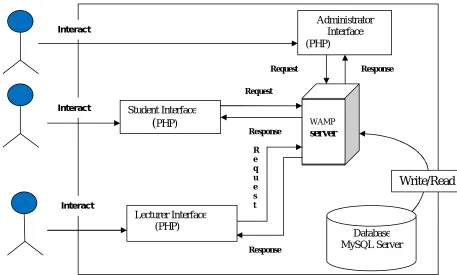
EaVaMa is a three-tier web-based system and Fig. 1 below presents the system’s architecture. The architecture has the following components:
Administrator interface (PHP) – It is a gateway for an Administrator who is registered on the system to interact with it and will decide that whether the sign up requests from students or Lecturers will be accepted or not.
Lecturer interface(PHP) – It is a gateway for a lecturer who is registered on the system to interact with it. Student interface(PHP) – It is a gateway with which an authorized student interacts with the system.
Web-server (WAMP)– It is an interface between Administrator interface, lecturer interface or student interface and the system’s database server (MySQL Server). It hosts the EaVaMa system.
IV.EXPERIMENTAL RESULTS
Fig. 1 – Architecture of EaVaMa System
DEFINITION OF THE SYSTEM
The EaVaMa system which we have built acts as an interactive media between the Lecturer and the students. The system acts as a forum where transfer of knowledge takes place. The EaVaMa system provides the following features:
Any user can create their own profile by registering & thereby logging into the system.
A user can upload their profile picture; change/update various features associated with their profile. Various courses are provided in the system.
Any course being provided can be activated, deactivated or deleted from the EaVaMa system. Any file of any of the specified courses/subjects can be uploaded or downloaded in the system.
Students can send their queries. Lecturer could thereby answer their questions and post them into the portal.
The system provides online-exam features. The exam is multiple choice questions type, each question associated with 4 options.
Online exam is associated with evaluation procedure.
A user can also view the entire set of questions available for a particular subject.
Scrap writing facility. Each user is provided with a scrapbook; one can write scrap to another user.
Online CHAT option is also present. Here student can interact with other student or Lecturers (whoever is online) and vice versa.
Student can make many friends in the system, by sending friend requests & thereby accepting or rejecting them. System is associated with a feedback facility.
There is also a searching facility present.
Student Interface
(
PHP)Lecturer Interface (PHP)
Administrator Interface (PHP)
Write/Read
WAMP
server Request
Response
Request Response
R e q u e s t
Response
Interact
Interact
Database MySQL Server
SCOPE OF THE SYSTEM
There are three users in the system:- Administrator
Student Lecturer
Following are the actions/privileges associated with each of the three users:
ADMINISTRATOR:
Administrator is the person who will decide that whether the sign up requests from students or Lecturers will be accepted or not.
Administrator can block or remove any user profile as required.
Administrator can block or remove any course being provided by the system. Administrator can remove any uploaded file.
STUDENT:
A student can create and update their own profile. They can send and accept friend request.
They can send and receive scraps to and from friends in their own friend list.
A student can post his questions, queries and answer any question posted by another student.
A student can also solve queries provided by the other students. A student can give online exam within the given time limit provide by the system.
A student can view all the question sets for a selected course provided by the Lecturer in the system.
They can download files that are uploaded by Lecturers or administrator.
A student can send feedback.
A student can use the Chat service to communicate with the Lecturers or/and the other Lecturers.
LECTURER:
They can create and update their own profile. Lecturer can post exam questions.
Lecturer posts the solution to the questions/queries provide by the student. Lecturer can upload files that may require by the students.
Lecturer can also delete files created by his own if he feels those are not appropriate.
Lecturer can use the chat service to communicate with the students or/and the other Lecturers.
IV.EXPERIMENTAL RESULTS
also assists lecturers in developing model solutions for test questions and thus automating the process of manually developing solutions to such questions. Once it has been developed, the system will then be evaluated for its effectiveness in improving students’ learning experience with regard to earned value management concepts in project management
.
The “EaVaMa System” provides a platform for online learning procedure. It can be used by the students of different schools, colleges, universities in the various part of the world.
EaVaMa is boundary barrier independent & also lacks time constraint. The system facility is available 24*7 a week. Even the facility is helpful for the professionals who cannot afford the time for in classroom teaching due to their busy schedule.
Implementing the services for the building of the system provides a cleaner approach. Each service is associated with one or more functions and the webpages utilizes these functions. The services allows the most important
aspect of coding i.e. Reuse.
For a developing country like India, this online learning process is a new aspect. India is now progressing towards E-Governance and education is one of those important fields that will come under E-E-Governance. Proper steps like this ensure a brighter future.
V. CONCLUSION
We have implemented “EaVaMa System” provides a platform for online learning procedure. It can be used by the students of different schools, colleges, universities in the various part of the world.For a developing country like India, this online learning process is a new aspect. India is now progressing towards E-Governance and education is one of those important fields that will come under E-Governance. Proper steps will ensure a brighter future.
REFERENCES
[1] R.T. Hans “Using A Web-Based Application To Teach Students Earned Value Management Concepts”, 2015 International Conference on Computer, Communication, and Control Technology (I4CT 2015), 2015.
[2] R.T. Hans, N.D. Chuene, C.K. Lepota and M.V. Masuku. “Using a web-based application to assist project management students learn financial analysis methods”, 2014 International Conference on Teaching and Learning in Computing and Engineering. pp. 29-32, 2014.
[3] I. Aldmour and A. Nylén. 2014 International Conference on Teaching and Learning in Computing and Engineering.pp. 37-40, 2014.
[4] S. Shinkins, "Using computers to teach project management", Journal of Management Development, vol. 28 Issue 4, pp. 4-14. 1995.
[5] G. Avram, “Empirical Study on Knowledge Based Systems”, Electronic Journal of Information SystemsEvaluation, vol. 8, issue 1, pp. 11-20,
2005.
[6] G. Ring, "Student reactions to courseware: gender differences", British Journal of Educational Technology, vol. 22 Issue 3, pp. 210-215, 1991. [7] L. Qiu, and C.K. Reisbeck, “Designing web Based Interactive learning environments for problem based learning”, Proceedings of the 5th
international Conference on Advanced Learning Technologies, 2005.
[8] P.A. Jaues, H. Seffrin, G. Rubi, F. Morais, C. Ghilardi, I.I.Bitterncourt and S. Isotani, “Rule-based expert systems to support step-by-step guidance in algebraic problem solving: The case of the tutor PAT2Math”, Journal of Expert Systems with Applications, vol. 40, pp. 5456-5465,2013
[9] A.H.K. Yuen, “Blended learning in Higher Education: an exploration of Teaching Approaches”, Proceedings of the 18th International Conference on Computers in Education. Putrajava, Malaysia: Asi-Pacofic Society for Computers in Education. 2010.
[10] G.J. Hwang, C.Y. Chen, P.S. Tsai and C.C. Tsai. “An Expert system for improving web-based problem-solving ability of students”, International Journal of Expert Systems with Applications, vol. 38, issue 7, pp. 8664-8672, 2011.
[11] J. Jia, “Building a Web-Based Collaborative Learning Environment”, ITHET 6th Annual International Conference 2005, Juan Dolio, Dominican Republic.
[12] D.M. Garyfallido & G.S. Ioannidis, “Energy concepts taught using ICT”, Proceedings of the 5th international Conference on Collaborative Learning, 2011.